Market Snapshot
Key Takeaways
Market Overview & Analysis
Report Summary
The UK connected car market is measured across factory-fitted hardware, cellular connectivity transmission, and software/SaaS services, valued at USD 2,312.10 million in 2025. Unlike several markets in this coverage set, this figure is taken directly from the underlying research's own rigorously sourced sizing chain, reconciled from SMMT Motorparc data, DfT and DVLA statutory series, and named carrier and OEM pricing disclosures, rather than independently constructed.
Structurally, this is a market whose commercial center of gravity sits firmly with commercial fleets rather than consumers. Fleet and business registrations, at 61.8% of the 2024 new-car market, generate 83.8% of all recurring connected software revenue, while private consumer paid subscription penetration sits at just 13.5% — a divide reinforced by nearly 27% of new factory-connected vehicles going commercially dormant within a year of registration.
The analysis is built for four reader types making different decisions: an automaker or Tier-1 supplier planning dual-eSIM 4G/5G retrofit strategy ahead of the 2G/3G network sunset, a commercial fleet telematics provider assessing the UK's proven, insurance-driven B2B demand base, a telecommunications operator or infrastructure investor evaluating Shared Rural Network coverage economics, and a policy analyst distinguishing this market's real £1.60 billion direct revenue from the frequently cited £62–£66 billion macroeconomic welfare estimate.
UK Connected Car Market Size and Forecast
Marqstats builds the UK figure directly from the underlying research's own year-by-year sizing table, itself reconciled from SMMT registration and Motorparc data, DfT/DVLA statutory series, and named component, carrier and subscription pricing. The market spans three revenue layers — factory-fitted hardware, cellular connectivity transmission, and software/SaaS services — each independently sized and summed to the reported total.
Market value grows from USD 2,312.10 million in 2025 to USD 4,451.20 million by 2030, a 14.00% CAGR, while the active connected vehicle parc grows from 18,806,000 to 32,850,000 units, a 9.77% CAGR. Value growing meaningfully faster than unit volume reflects rising cellular-generation intensity (the shift from 4G to 5G), deepening commercial fleet SaaS penetration, and a widening services layer, rather than growth in the underlying vehicle population alone.
The source's own two forward scenarios diverge specifically on network-infrastructure execution and regulatory consent friction. The Baseline Scenario assumes the Shared Rural Network closes multi-operator coverage gaps by late 2026 and new type-approvals fully convert to 4G/5G NG-eCall; the Structural Headwinds Scenario assumes Virgin Media O2's 2G/3G roaming withdrawal triggers operational eCall failures across the 12.24 million-vehicle legacy fleet, the ICO enforces strict opt-in PECR consent that constrains OEM data monetization, and Shared Rural Network construction delays persist across Wales, Scotland and northern England — reaching USD 3,620.00 million instead of the Baseline's USD 4,451.20 million by 2030.Why the real UK connected car market is 40 times smaller than the headline figure.
The Fleet Market Is Carrying the Whole Industry
Commercial fleet and business buyers registered 1,206,778 new vehicles in 2024, 61.8% of the total UK new-car market, and those buyers pay an average of £21.50 monthly per vehicle for telematics compliance, driver tracking and EV battery health analytics. That commercial demand alone generates 83.8% of all recurring connected software revenue in Great Britain — meaning the overwhelming majority of this market's actual monetized activity comes from roughly six in ten new vehicles, not the other four.
Private retail buyers, by contrast, have pushed back hard against recurring software subscriptions: paid consumer penetration sits at just 13.5% of the private connected parc, generating a comparatively modest $142.98 million against commercial fleet SaaS revenue of $408.00 million. Commercial fleet demand effectively insulates the entire connected-vehicle software industry from weak retail consumer appetite, which matters directly for how any vendor entering this market should prioritize its go-to-market investment.Why 517,000 UK connected cars go dark within a year.
A Fifth of New Connected Cars Go Dark Within a Year
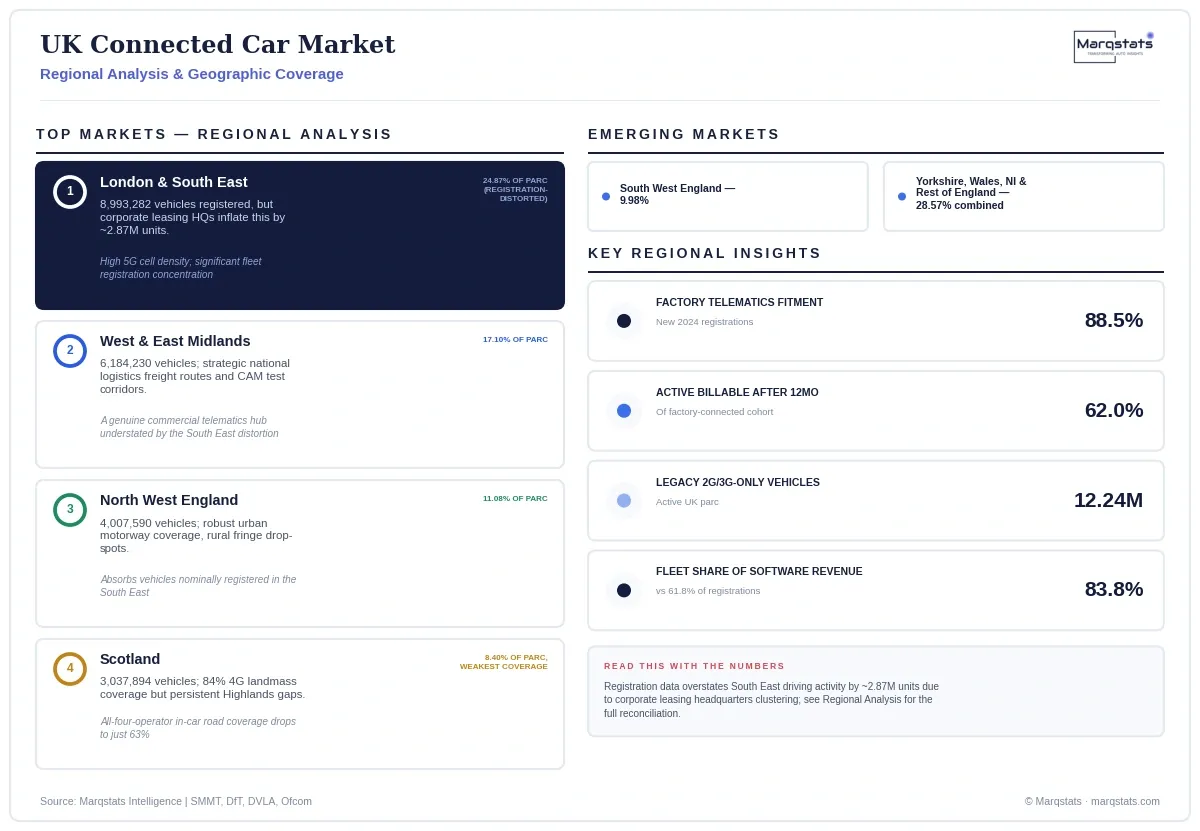
The gap between factory-installed hardware and ongoing commercial monetization is the single most consequential reconciliation in this market. SMMT registration data confirms 1,728,208 new vehicles, 88.5% of 2024 registrations, rolled off production lines with embedded telematics hardware. Mobile network connection data confirms only 1,210,722 of those vehicles, 62.0%, remained on an active, billable connected platform twelve months later — leaving 517,486 vehicles, 26.5% of the cohort, carrying unmonetized hardware.
The underlying cause splits cleanly by buyer type. Fleet drivers frequently neglect to activate secondary OEM digital profiles even when the primary compliance telematics system is active and billed separately to the fleet operator; private retail buyers, meanwhile, default to free Apple CarPlay and Android Auto projection rather than paying recurring OEM software fees for broadly comparable functionality. Both patterns point toward the same underlying conclusion this market's fleet-versus-consumer split already suggests: UK connected-vehicle software revenue is a B2B story wearing a B2C hardware footprint.The UK's connected car map is lying to you about where the cars actually are.
Market Dynamics
Key Drivers
Five conditions are moving this market, and commercial fleets matter more than consumer demand.
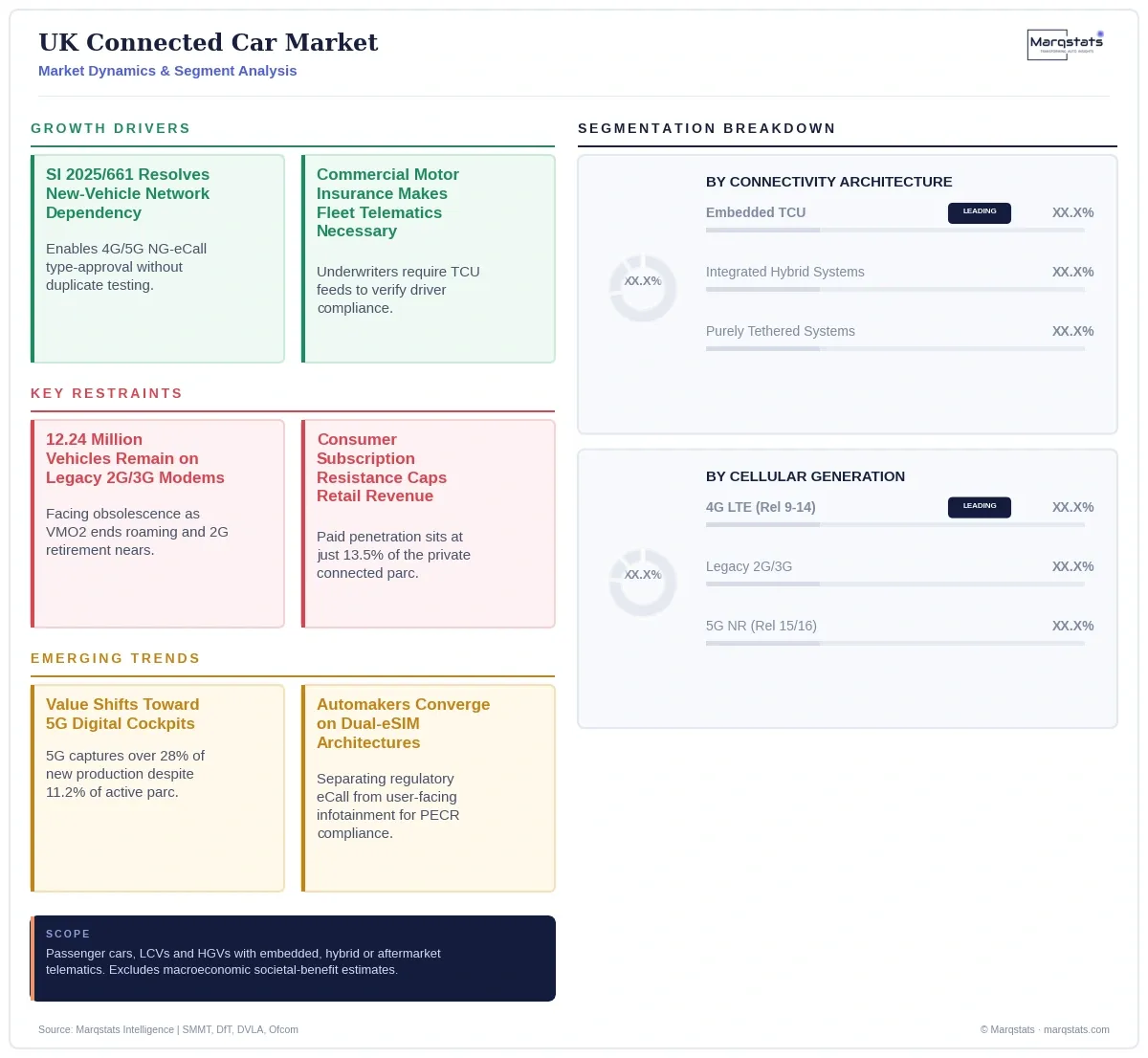
- Statutory Instrument 2025 No. 661 resolves new-vehicle network dependency by incorporating UNECE Regulation 144 into Great Britain type-approval, letting manufacturers ship 4G/5G Next Generation eCall systems without duplicate compliance testing across the entire vehicle type-approval process.
- Commercial motor insurance underwriters increasingly require telematics tracking or factory TCU feeds to verify driver rest breaks, speed compliance and harsh-braking events, converting fleet telematics from an optional management tool into a genuine, near-mandatory insurance necessity.
- The £1 billion Shared Rural Network initiative is extending in-car 4G coverage across an additional 16,000 kilometres of UK roads through late 2026, directly targeting the multi-operator coverage gaps that currently interrupt continuous telematics reporting nationwide.
- Mandatory corporate carbon reporting and the zero-emission transition sustain commercial fleet digitization demand independent of consumer sentiment, keeping fleet telematics ARPU stable at £21.50 per vehicle monthly across the sector.
- Standard essential patent licensing consolidation through the Avanci 5G pool — $29 to $32 per vehicle, adopted by Jaguar Land Rover, BMW, Volkswagen Group and Toyota — is reducing cellular patent litigation risk and standardizing automotive connectivity cost structures across the entire industry.
Key Restraints
Four constraints stand between near-universal hardware and a fully monetized, evenly distributed connected fleet.
- More than 12.24 million active UK vehicles remain equipped exclusively with 2G or 3G modems, and Virgin Media O2's October 2025 roaming withdrawal already strips 2G/3G connectivity from internationally roamed OEM SIMs, with full national 2G retirement following by 2032, a deadline recently confirmed by current carrier disclosures rather than the earlier 2033 figure some older reporting had cited.
- Consumer resistance to recurring software subscriptions caps realistic private-market revenue growth regardless of feature investment, with paid penetration at just 13.5% and high cancellation rates once initial OEM trial periods lapse.
- ICO enforcement of PECR's terminal-equipment classification requires affirmative, granular consent for non-safety telemetry, directly conflicting with software-defined vehicle designs built around continuous cloud telemetry streaming.
- Roughly 48% of connected vehicles from model years 2018 to 2021 changed ownership in 2024 without prior driver profiles or GPS history being purged, creating an unresolved data-protection liability for finance and leasing companies retaining data-controller status.
Key Trends
Four shifts show where the market is heading and who captures the value.
- Value is shifting toward 5G-enabled digital cockpits and edge computing on premium vehicle lines, even as 4G LTE remains the operational backbone for 76.8% of the active connected parc nationally.
- Automakers are converging on dual-eSIM architectures to satisfy ICO consent requirements without disrupting core telemetry: one embedded SIM handles regulatory eCall and diagnostics under global manufacturer roaming, the second handles user-facing infotainment via local UK carriers.
- OEMs are beginning to unbundle safety, diagnostic and infotainment packages, folding core maintenance updates into the vehicle purchase price while reserving subscriptions for genuinely optional high-bandwidth entertainment features, in direct response to high post-trial churn.
- Regulatory attention is shifting toward open, standardized extended-vehicle data interfaces, with the Competition and Markets Authority and independent aftermarket associations challenging OEM proprietary data silos — a shift that would move software margins toward independent telematics providers if mandated.
Strategic Implications
- New market entrants and digital mobility providers should avoid consumer-facing subscription features that compete directly with free smartphone projection, and should instead prioritize B2B fleet telematics — EV battery diagnostics, cold-chain monitoring, compliance tooling — where demonstrated demand and insurance-driven necessity already exist across the commercial vehicle sector nationwide.
- Incumbent OEMs should treat dual-eSIM 4G/5G migration as an urgent compliance and network-risk priority, and should unbundle core safety and diagnostic features from optional subscriptions to reduce the post-trial churn already suppressing consumer revenue.
- Telecommunications operators and infrastructure investors should move beyond low-margin wholesale data transport toward private network slicing, managed security gateways and standardized eSIM lifecycle platforms, capturing higher-margin positions in the connectivity layer.
- Analysts and policy stakeholders should consistently separate this market's real £1.60 billion direct commercial revenue from the frequently cited £62–£66 billion macroeconomic welfare estimate, which measures a fundamentally different thing and traces to a single unrevised 2017 baseline.
Market Segmentation
72.5% of market value, 13,634,350 units — factory-soldered eSIM modules with direct CAN/Ethernet bus integration, the dominant architecture as type-approval mandates phase out alternatives.
18.2% of market value, 3,422,692 units — native cellular safety telematics paired with smartphone app projection, common on mid-range models balancing cost and functionality.
9.3% of market value, 1,748,958 units — reliant entirely on passenger smartphone data connections, declining rapidly as dedicated onboard modems become mandatory.
76.8% of the active connected parc (14,443,000 units) — the operational backbone for core fleet telematics, OTA updates and Next Generation eCall.
12.0% of the active parc (2,256,720 units) — an operational liability as 3G networks complete decommissioning and 2G enters gradual national retirement.
11.2% of the active parc (2,106,280 units), over 28% of new production — expanding across premium lines for high-bandwidth digital cockpits and edge computing.
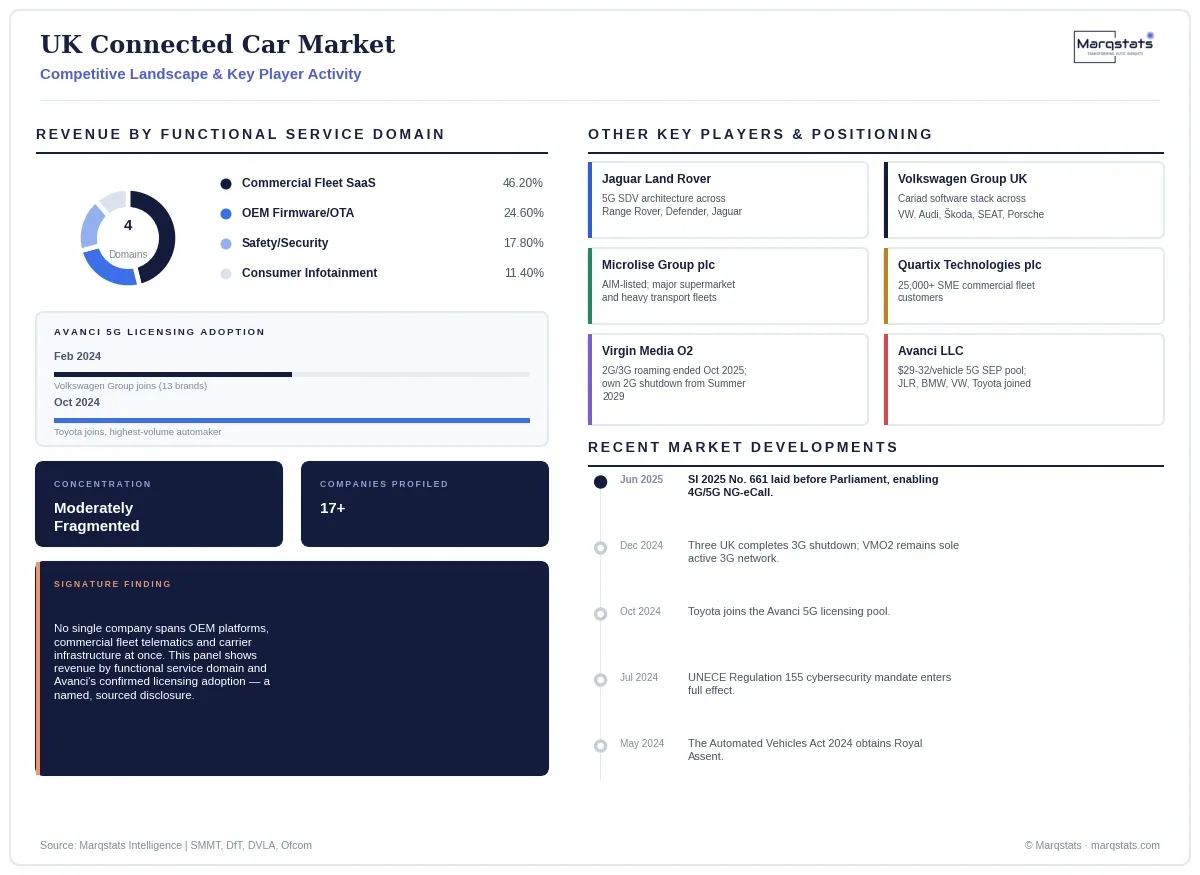
46.2% of services value, led by Microlise Group, Geotab UK and Quartix Technologies — driven by carbon reporting, logistics compliance and EV charging optimization.
24.6% of services value, delivered via AWS, Microsoft Azure, JLR and Cariad cloud infrastructure.
17.8% of services value, anchored by Tracker Network UK, Vodafone Automotive and Trakm8, driven by insurance requirements and road safety mandates.
11.4% of services value, the smallest and most consumer-resistance-constrained category.
By Geography
A note on regional interpretation
Official SMMT Motorparc registration figures weight heavily toward London and the South East, but cross-referencing DfT licensing data against corporate leasing records shows this substantially overstates real driving activity there — registration reflects corporate fleet finance headquarters, not where vehicles actually operate day to day.
London & South East
8,993,282 vehicles registered (24.87% of the UK parc), but this is inflated by corporate contract-hire and leasing company headquarters. Over 32% of fleet and long-term contract-hire vehicles are registered here despite being driven across the Midlands, the North West and Yorkshire — a roughly 2.87 million-unit overstatement. High 5G cell density supports genuine local demand alongside this registration distortion.
West & East Midlands
6,184,230 vehicles (17.10%), home to strategic national logistics freight routes and active CAM test corridors, a genuine hub for commercial fleet telematics activity that registration data alone understates due to the South East distortion.
North West England
4,007,590 vehicles (11.08%), with robust urban motorway coverage but rural fringe cellular drop-spots, absorbing a meaningful share of the vehicles nominally registered in the South East.
South West England
3,609,861 vehicles (9.98%), characterized by high rural A-road mileage and seasonal network capacity strain during tourist peaks.
Scotland
3,037,894 vehicles (8.40%), with 84% 4G landmass coverage but persistent Highlands connectivity gaps — all-four-operator in-car road coverage drops to just 63%, the weakest of any UK nation.
Yorkshire & the Humber, Wales, Northern Ireland and Rest of England
Together account for the remaining 28.57% of the parc. Wales (68% full-fibre backhaul) and Northern Ireland (93% full-fibre backhaul) show markedly different fixed-infrastructure foundations despite both facing rural topography coverage limits for in-vehicle cellular connectivity specifically.
How Competition Is Evolving
Competition spans OEMs, specialized commercial telematics providers, Tier-1 suppliers and mobile network operators. Jaguar Land Rover leads domestic premium OEM connectivity with 5G software-defined vehicle architecture across Range Rover, Defender and Jaguar; Volkswagen Group UK manages distribution for VW, Audi, Škoda, SEAT and Porsche on the Cariad software stack; Ford operates the Ford Pro commercial telematics platform across its leading Transit van fleet; BMW UK was an early Avanci 5G adopter; and Stellantis UK operates Free2move fleet telematics across Vauxhall, Peugeot and Citroën.
On commercial fleet telematics specifically, UK-listed specialists dominate: Microlise Group plc (AIM-listed, serving major supermarket and heavy transport fleets), Quartix Technologies plc (over 25,000 small and medium commercial fleet customers), and Trakm8 Holdings PLC (AI dashcams and insurance risk-scoring hardware) compete alongside Geotab UK's open-platform enterprise fleet telematics and EV battery health analytics.
Tier-1 suppliers Continental AG and Robert Bosch Limited manufacture the underlying TCU hardware, cockpit computers and gateway modules. Mobile network operators BT Group (EE), Vodafone and Virgin Media O2 compete for automotive IoT wholesale contracts while managing divergent 2G/3G sunset timelines. Avanci LLC's standard essential patent pool, adopted by Jaguar Land Rover, BMW, Volkswagen Group and Toyota at $29–$32 per vehicle, has become the industry's de facto cellular licensing standard — though Tesla has separately challenged these rates in the UK High Court of Justice.
Companies Covered
The report profiles 17+ companies with full strategy and financials analysis, including:
Recent Market Activity
Table of Contents
Coverage & Segmentation
This report measures passenger cars, light commercial vehicles and heavy goods vehicles operating in Great Britain and Northern Ireland that carry factory-embedded, hybrid or aftermarket telematics hardware, across a 2025 base year and a 2026 to 2030 forecast period, denominated in United States dollars at an exchange parity of £1.00 = $1.28. It excludes speculative macroeconomic societal gains, road infrastructure civil construction, and non-connected aftermarket repairs.
The analysis spans three segmentation dimensions — connectivity architecture, cellular generation and functional service domain — nine regional geographies, and 17 profiled entities across OEMs, commercial telematics providers, Tier-1 suppliers and regulatory bodies. Vehicle parc and registration figures trace to SMMT and DfT/DVLA; market value and segment splits are taken directly from the underlying research's own sourced sizing chain, re-anchored to a 2025 base year using the source's own year-by-year table.