Market Snapshot
Key Takeaways
Market Overview & Analysis
Report Summary
Italy's connected car market is measured across three commercial domains — vehicle connectivity hardware and solutions, integrated ADAS infrastructure, and smart mobility municipal platforms — valued at USD 4,298.40 million in 2025. Unlike most European connected-car markets, Italy's growth engine is not OEM software subscriptions but motor liability insurance economics: aftermarket black boxes remain the single largest connectivity architecture by volume, adopted overwhelmingly to offset regionally variable premiums rather than for discretionary digital features.
Structurally, this is a market where official statistics require careful handling. A 2023 methodological restatement revised the connected-parc series downward to correct for deactivated 2G-era devices and double-counted vehicles; a 30.36% gap exists between installed black boxes and actively insured telematics policies; and Trentino-Alto Adige's tax-driven fleet-registration arbitrage inflates that province's reported penetration above 110% of its resident fleet. A reader who takes any single headline figure from this market at face value risks materially mis-stating its actual size or distribution.
The analysis is built for four reader types making different decisions: an insurer or telematics service provider pricing usage-based motor policies against Italy's steep regional premium variation, an automaker deciding how much of its embedded-SIM growth to protect against European Data Act-driven third-party access, a fleet leasing company evaluating Trentino-Alto Adige registration economics, and an investor assessing how much downside risk Italy's slower-than-assumed 2G network transition actually removes from the market's own worst-case scenario.
Italy Connected Car Market Size and Forecast
Marqstats builds the Italy figure from the underlying research pack's three-domain 2023 baseline — Politecnico di Milano's Osservatorio Connected Car & Mobility census for vehicle connectivity solutions and ADAS infrastructure, and municipal smart-mobility platform data for the urban services layer — extended through the pack's own Base Scenario growth trajectory. Because the pack's last confirmed published year is 2023, with 2024 onward presented as the pack's own projections, this build's 2025 base year and its 2029-2030 extension are both flagged as projections rather than verified actuals.
Market value grows from an estimated USD 4,298.40 million in 2025 to USD 8,935.83 million by 2030, a 15.76% CAGR, while the active connected parc grows from an estimated 19,450,000 to 27,178,268 units, a 6.92% CAGR. The gap between value growth and parc growth reflects the same dynamic driving markets across this coverage set: software and service revenue per connected vehicle is compounding faster than the underlying hardware base, as recurring digital service revenue grew 29.17% in the pack's last confirmed year against 11.43% for core hardware and connectivity.
The market's downside case is specifically a network-infrastructure risk, not a demand-side one — and this coverage treats that risk as materially smaller than the pack's own framing suggests. The pack's Downside Scenario assumes 2G network sunsets between 2025 and 2027 orphan up to 2.5 million legacy black boxes; live verification found Italian carriers have not begun that transition and industry reporting places Italy's own 2G shutdown target closer to 2030, meaningfully de-risking the scenario's core trigger relative to the pack's own timeline.
Italy's Downside Scenario Assumed a 2G Shutdown That Isn't Coming Yet
The pack's own three-scenario forecast treats an uncoordinated 2G network sunset, stranding up to 2.5 million legacy insurance black boxes between 2025 and 2027, as the trigger for its Downside Scenario — a materially slower growth path reaching just EUR 5.10 billion by 2028 instead of the Base Scenario's EUR 6.24 billion. That trigger has not materialized on the assumed timeline. TIM, Vodafone, WindTre and Iliad continue operating 2G networks as of this analysis's preparation, and trade coverage of France's own 2026 2G transition specifically contrasts it with Italy, citing an Italian target closer to 2030.
The reason is structural, not a delay: 2G in Italy continues to carry emergency voice calling, elevator and alarm M2M devices, and legacy telematics that Italian carriers have been reluctant to strand, unlike France's more aggressive spectrum-refarming timeline. That does not eliminate the risk permanently — a shutdown will eventually happen — but it substantially reduces the probability that the Downside Scenario's specific 2025-to-2027 window is the one that actually plays out.Why Italy's 2G shutdown risk is smaller than the forecast assumed.
The 30% Gap Between Installed and Insured Telematics
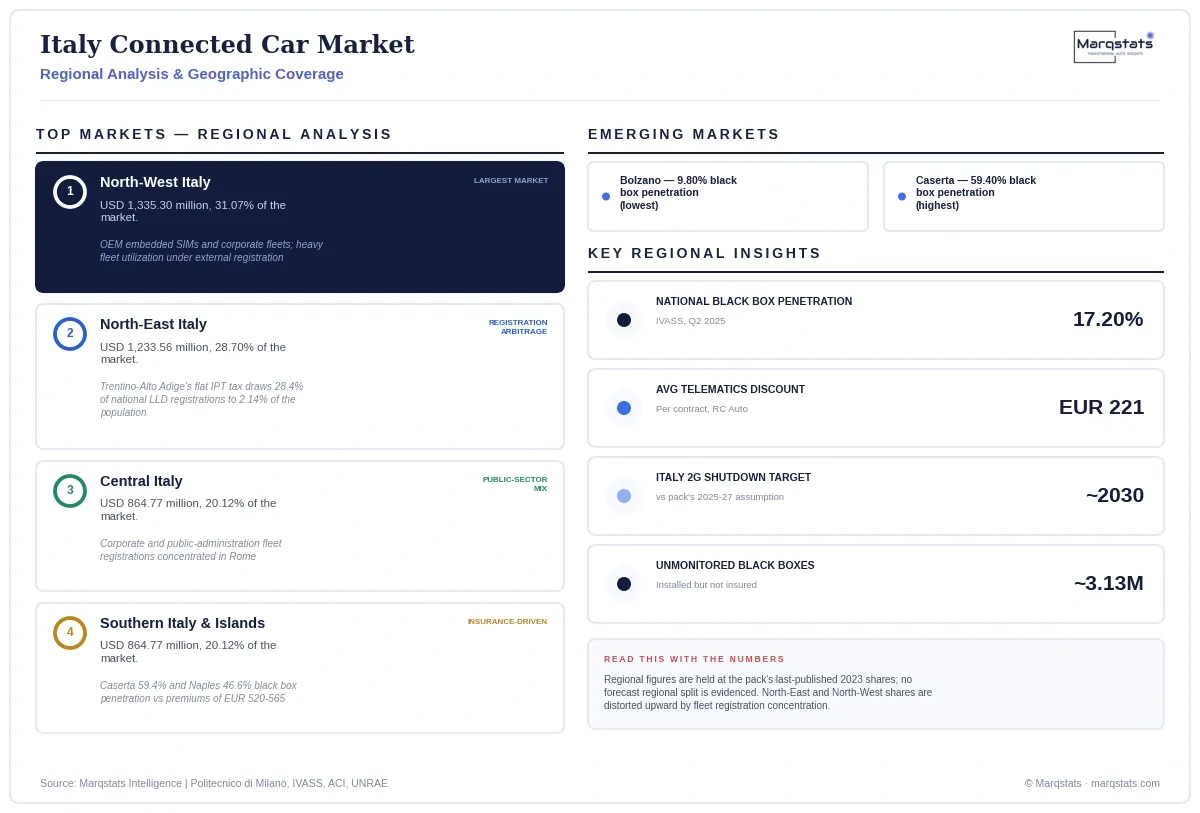
Cross-referencing the pack's own two primary data sources reveals a reconciliation problem worth surfacing directly. Academic census data counts 10.3 million installed insurance black boxes in 2023; regulatory IVASS data reports 17.80% active telematics policy penetration across a 40.3 million-vehicle fleet, which works out to roughly 7.17 million actively insured policies. Subtracting the two suggests roughly 3.13 million installed devices — nearly a third of the reported black box base — are not attached to an active insurance policy.
Those units are not phantom data points; they represent abandoned hardware in second-hand vehicles following policy termination, devices sitting in secondary-market trade inventory, and commercial light-vehicle installations captured in telematics censuses but excluded from private passenger insurance filings specifically. Any analysis using the installed-device count as a proxy for active, revenue-generating telematics penetration will overstate the commercially relevant market by close to a third.The 3 million Italian black boxes that aren't actually insured.
Market Dynamics
Key Drivers
Five conditions are moving this market, and insurance economics matter more than any single technology.
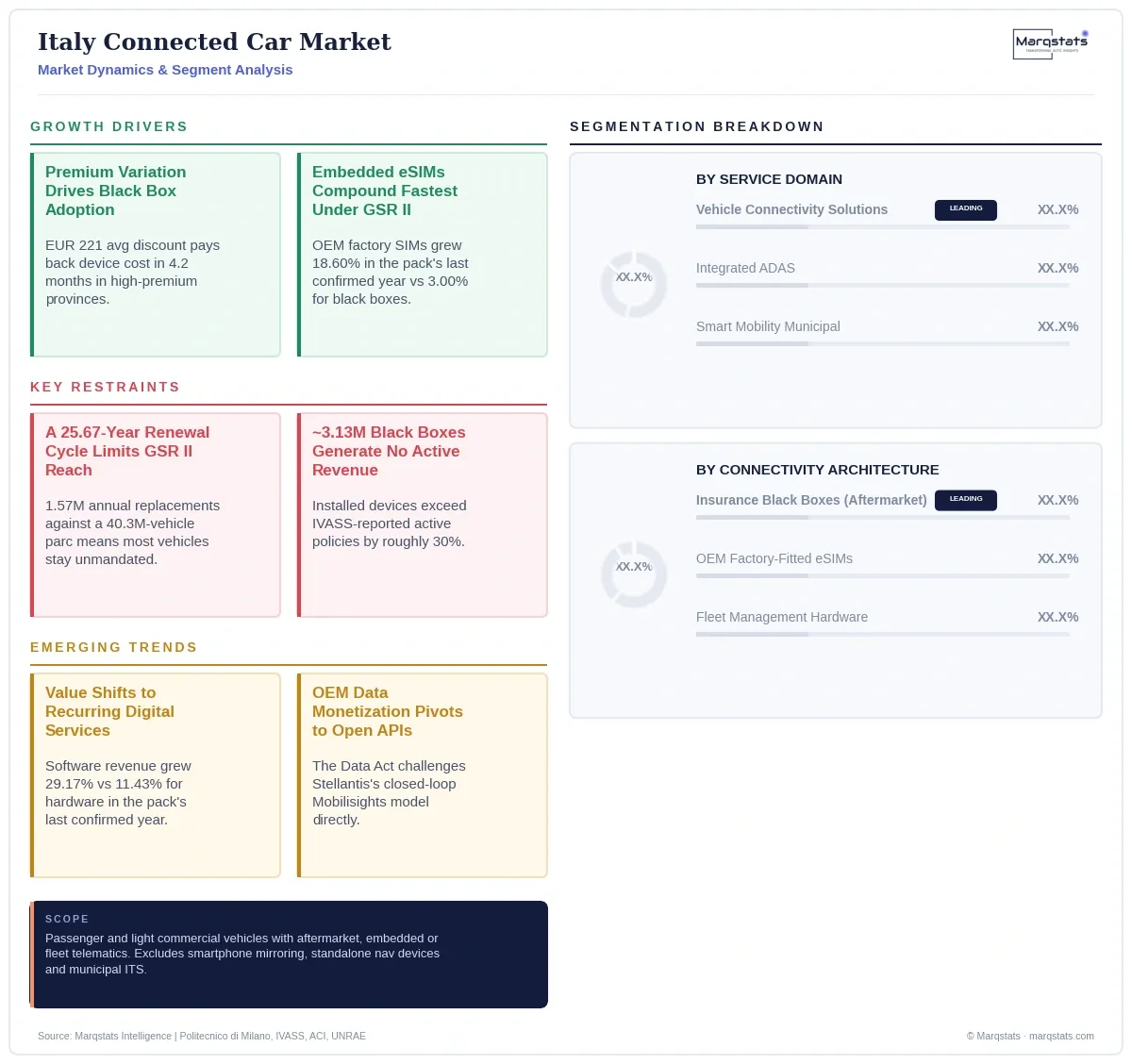
- Motor liability premium variation across Italian provinces continues to drive black box adoption as an economic necessity in high-premium regions, with the average EUR 221 telematics discount paying back the device cost within 4.2 months in provinces such as Caserta and Naples.
- Factory-fitted embedded SIMs are compounding at 14.98% a year, the fastest-growing connectivity architecture segment, as GSR II's mandatory ADAS and Event Data Recorder fitment on new registrations standardizes OEM connectivity across Stellantis, Volkswagen Group Italia and other major manufacturers.
- The European Data Act's FRAND access provisions, in full application since September 2025, are opening a genuine growth path for independent, hardware-agnostic telematics providers to activate dormant factory modems directly, without the cost of physical aftermarket installation.
- Commercial fleet telematics is the fastest-growing vehicle operational class at 25% annual growth, led by Targa Telematics's consolidated European platform following its 2023 acquisition of Viasat Group and by long-term leasing giants including Leasys, Ayvens Italia and Arval Service Lease Italia.
- Italy retains a genuine domestic Tier-1 manufacturing base rather than relying entirely on imported hardware: Vodafone Automotive's Varese plant alone produces roughly 3 million telematics and electronic safety systems annually for more than 40 global automakers, including Porsche, Aston Martin and Ferrari.
Key Restraints
Four constraints stand between the market and a fully monetized, evenly distributed connected fleet.
- Italy's 12.5-year average vehicle age and 25.67-year full fleet-renewal cycle mean GSR II's mandatory connectivity fitment reaches only new registrations, leaving the large majority of the operating parc dependent on aftermarket retrofitting for the foreseeable future.
- The roughly 3.13 million commercially unmonitored black boxes identified in this analysis's reconciliation represent installed capacity generating no current insurance or service revenue, a meaningful share of reported hardware volume that does not translate into active market value.
- Persistent legal disputes over OEM telemetry access under the European Data Act could delay rather than accelerate third-party market entry if Stellantis and other automakers contest FRAND terms aggressively — a risk the pack's own Downside Scenario treats as compounding alongside network transition risk, not as an independent, lower-probability variable.
- Regional insurance-driven adoption creates structural inequality in who actually benefits from connected-vehicle safety features: provinces such as Bolzano and Aosta, with the lowest black box penetration, are precisely the regions with the lowest financial incentive to adopt telematics at all, regardless of any safety case for doing so.
Key Trends
Four shifts show where the market is heading and who captures the value.
- Value creation is shifting from hardware installation toward recurring digital services, with software-driven revenue growing 2.54 times faster than physical connectivity solutions in the pack's last confirmed year — 29.17% against 11.43%.
- The architectural mix is shifting from aftermarket toward embedded: OEM factory-fitted SIMs compounding at 14.98% a year are steadily reducing aftermarket black boxes' share of the connected parc, from 63.29% to 60.95% in a single year.
- Consolidation is concentrating commercial fleet telematics around fewer, larger platforms, exemplified by Targa Telematics's 2023 acquisition of Viasat Group, which created a combined 900,000-vehicle European enterprise IoT platform generating EUR 125 million in 2025 revenue.
- OEM data-monetization strategy is pivoting away from closed-loop proprietary models toward open, standards-based API access, as the European Data Act forces Stellantis's Mobilisights and equivalent OEM data units to compete on service quality rather than exclusive data control.
Strategic Implications
- Insurers and telematics service providers should treat Italy's regional premium variation, not national average figures, as the actual driver of black box demand — provinces with premiums above roughly EUR 450 are where telematics adoption will continue rising fastest, while low-premium northern provinces will remain structurally under-penetrated regardless of feature investment.
- New market entrants should avoid the crowded consumer insurance telematics channel, where captive insurer-technology partnerships such as UnipolSai and UnipolTech control agency-network distribution, and instead target B2B logistics fleets and European Data Act-enabled, hardware-agnostic analytics that bypass physical installation costs entirely.
- Fleet leasing companies should factor Trentino-Alto Adige's IPT registration economics into acquisition planning explicitly, since the provincial tax structure genuinely lowers balance-sheet cost regardless of where the vehicles actually operate — while recognizing that doing so further distorts already-unreliable regional connected-vehicle statistics for the whole market.
- Investors and capital allocators should discount the market's own Downside Scenario probability relative to its stated framing, given that its core 2G-shutdown trigger is now confirmed to be running on a materially later timeline than the scenario assumed — without concluding the risk has disappeared entirely, since a shutdown remains a real, if more distant, eventuality.
Market Segmentation
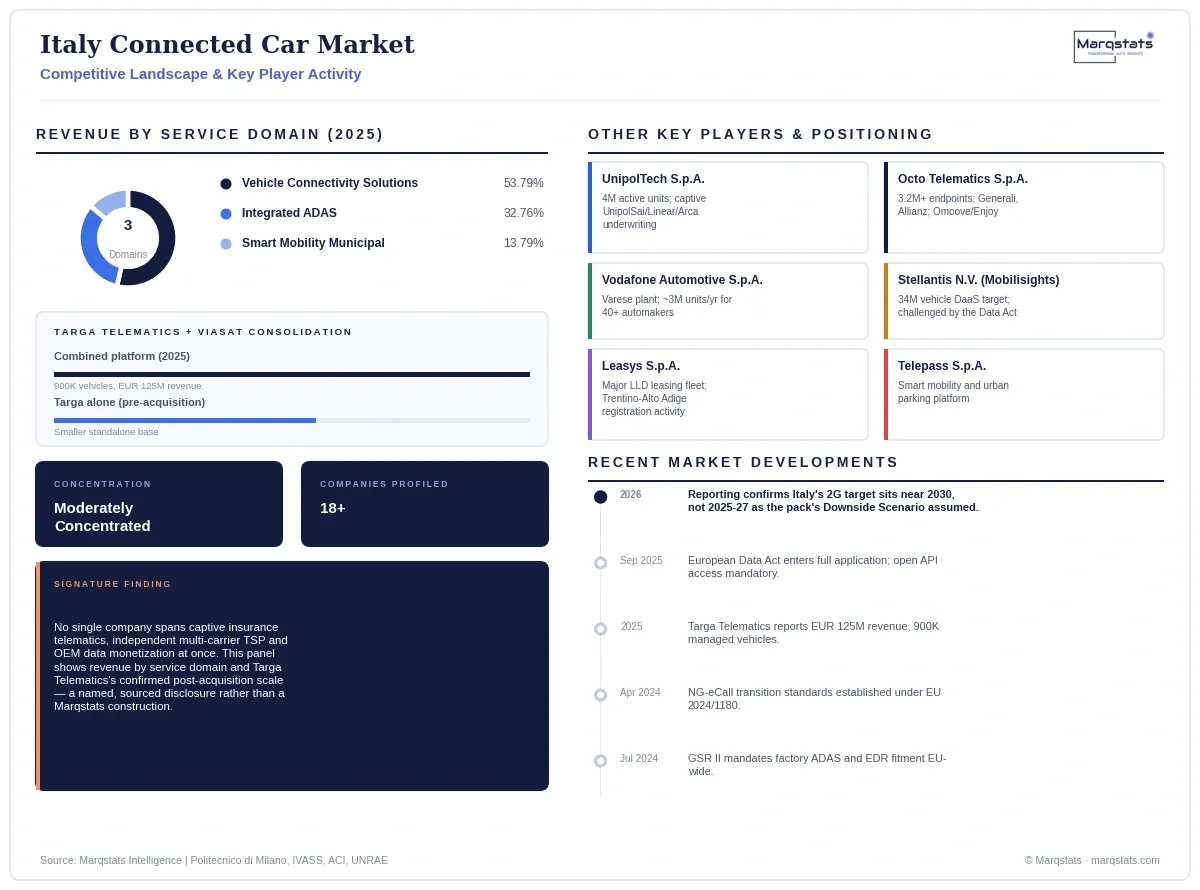
The largest service domain at USD 2,297.49 million in 2025, 53.79% of value, covering embedded and aftermarket telematics hardware, cellular connectivity and core software.
USD 1,408.16 million in 2025, 32.76% of value, expanding fastest among the three domains, directly stimulated by GSR II's mandatory fitment of Autonomous Emergency Braking, Emergency Lane Keeping and Intelligent Speed Assistance.
The smallest domain at USD 592.75 million in 2025, 13.79% of value, covering urban parking and shared-transport platforms such as Telepass and Eni's Enjoy car-sharing network.
The largest architecture segment by volume at 60.95% of the 2023 connected parc, growing only 3.00% annually — a mature, insurance-driven segment led by UnipolTech and Octo Telematics.
30.18% of the connected parc, the fastest-growing architecture at 18.60% annually, standardizing across Stellantis and Volkswagen Group Italia under GSR II fitment mandates.
The smallest architecture segment at 8.88% of the connected parc but the fastest-growing by unit count at 25% annually, led by Targa Telematics and Viasat Group's combined commercial platform.
USD 3,611.52 million in 2025, 84.02% of value, relying on a hybrid mix of aftermarket black boxes for insurance discounting and factory eSIMs for mandatory eCall.
USD 585.01 million in 2025, 13.61% of value, using hardwired CAN-bus telematics for tachograph management, route optimization and maintenance dispatching.
The smallest vehicle class at USD 101.87 million in 2025, 2.37% of value, using embedded wireless relay and keyless access systems for usage-based billing and remote immobilization.
By Geography
North-West Italy
USD 1,335.30 million, 31.07% of national connected-vehicle share on a 2023 parc basis, driven by OEM embedded SIMs and corporate fleets, with penetration figures distorted upward by heavy fleet registration activity concentrated outside the region.
North-East Italy
USD 1,233.56 million, 28.70% of national share, home to Trentino-Alto Adige's Imposta Provinciale di Trascrizione arbitrage — a flat, engine-power-independent registration tax that draws 28.40% of national long-term rental registrations into a province housing just 2.14% of the national population, inflating this region's reported penetration above 110% of its own resident fleet.Why does a province with 2% of Italy's population get 28% of its leased cars?
Central Italy
USD 864.77 million, 20.12% of national share, driven by a mix of corporate and public-administration fleet registrations concentrated in Rome, alongside genuine urban smart-mobility utilization in Rome and Florence.
Southern Italy & Islands
USD 864.77 million, 20.12% of national share, defined almost entirely by insurance-driven black box adoption. Caserta reaches 59.40% black box penetration and Naples 46.60%, against premiums of EUR 520 and EUR 565 respectively, compared to a EUR 417 national benchmark and lows of EUR 285 to EUR 303 in Bolzano and Aosta.
How Competition Is Evolving
Competition is concentrated among four domestic telematics specialists, each anchored to a different commercial model. UnipolTech S.p.A., the captive technology arm of Unipol Gruppo, manages roughly 4 million active units across UnipolSai, Linear and Arca Assicurazioni policyholders through its proprietary Unibox ecosystem — the single largest concentration of installed telematics in the market. Octo Telematics S.p.A. operates as the leading independent multi-carrier provider with over 3.2 million active endpoints, serving Generali Italia and Allianz alongside shared-mobility operator Omoove, which powers Eni's Enjoy car-sharing network.
On commercial fleet telematics, Targa Telematics S.p.A.'s May 2023 acquisition of Viasat Group S.p.A. created a consolidated 900,000-vehicle European enterprise IoT platform, reporting EUR 125 million in 2025 revenue and roughly EUR 30 million in EBITDA. Vodafone Automotive S.p.A. anchors Italy's Tier-1 hardware manufacturing base from its Varese plant, producing roughly 3 million telematics and safety systems annually for more than 40 global automakers, while also operating 750,000 of its own active stolen-vehicle-recovery subscriptions.
On OEM data monetization, Stellantis N.V.'s Mobilisights unit, launched at CES in January 2023 and targeting 34 million globally licensed connected vehicles under the Dare Forward 2030 plan, faces the most direct structural challenge from the European Data Act's September 2025 application — its closed-loop commercial data model is precisely the architecture the regulation was designed to open.
Companies Covered
The report profiles 18+ companies with full strategy and financials analysis, including:
Recent Market Activity
Table of Contents
Coverage & Segmentation
This report measures passenger cars (Category M1) and light commercial vehicles (Category N1) operating in Italy that carry aftermarket insurance telematics, OEM factory-embedded connectivity, or commercial fleet management hardware, across a 2025 base year and a 2026 to 2030 forecast period, denominated in United States dollars at a constant EUR 1.00 = USD 1.08 exchange rate. It excludes smartphone-mirroring-only vehicles, standalone non-communicating navigation devices, roadside ITS infrastructure and non-automotive transport telematics platforms. Both the 2025 base year and the 2029-2030 forecast extension are Marqstats projections built on the underlying research pack's own confirmed 2023 baseline and Base Scenario trajectory, disclosed as such throughout.
The analysis spans three segmentation dimensions — service domain, connectivity architecture and vehicle operational class — four regional geographies, and 18 profiled entities across regulators, insurers, telematics specialists and automakers. Registration and fleet-census figures trace to ACI, UNRAE and Politecnico di Milano; insurance-telematics penetration traces to IVASS; market value and the active connected parc are Marqstats extensions of the pack's own confirmed 2023 figures and Base Scenario trend.