Market Snapshot
Key Takeaways
Market Overview & Analysis
Report Summary
Thailand's connected car market is measured across factory-fitted OEM hardware, certified commercial compliance tracking devices, and recurring telecommunications and SaaS subscriptions, estimated at USD 474.19 million in 2025. The market's central dynamic is resilience through contraction: a household-debt-driven sales collapse cut total vehicle volumes by more than a quarter in 2024, yet connected penetration kept climbing because the vehicles least affected by the credit crunch — EVs and DLT-mandated heavy trucks — are also the vehicles most likely to ship connected.
Structurally, this is a market shaped by a genuinely bifurcated regulatory floor. Commercial compliance telematics is non-discretionary for buses, prime movers, hazardous-material haulers and ten-wheel-plus trucks, generating steady, mandate-backed recurring revenue; the same technology is entirely voluntary for the 7.1 million-vehicle one-tonne pickup segment, which behaves like an almost separate consumer market with its own low, price-sensitive adoption curve.
The analysis is built for four reader types making different decisions: an automaker deciding how much complimentary connectivity to bundle into the purchase price given Chinese competitors' aggressive multi-year free periods, a commercial telematics provider assessing whether to lobby for or wait on DLT mandate extension to pickups, a telecommunications operator planning eSIM/eUICC infrastructure investment across the Eastern Economic Corridor, and an investor weighing how much of this market's 2030 trajectory depends on Thai household credit conditions normalizing.
Thailand Connected Car Market Size and Forecast
Marqstats builds the Thailand figure from the underlying research's own sourced sizing chain, itself reconciled from Federation of Thai Industries sales data, Department of Land Transport fleet statistics, and named OEM, telecom and commercial-telematics pricing. The 2025 base year is interpolated between the source's own stated 2024 and 2027 figures, since the source provides no explicit 2025 row; the resulting 14.13% CAGR closely matches the source's own reported 14.34% figure calculated on a 2024 base.
Market value grows from USD 474.19 million in 2025 to USD 918.26 million by 2030, a 14.13% CAGR. This growth persists despite genuine near-term macroeconomic headwinds: household debt approaching 90% of GDP and auto-loan rejection rates of 60% to 70% throughout 2024 suppressed new-vehicle shipment volumes broadly, but the underlying connectivity intensity per vehicle sold kept rising regardless, driven by EV and heavy-commercial mix shift rather than aggregate volume recovery.
The source's own three forward scenarios diverge specifically on credit normalization and mandate extension. The Baseline Scenario assumes gradual macroeconomic normalization and continued manufacturing localization under BOI incentives; the Accelerated Expansion scenario assumes the DLT formally extends its GPS mandate to six-wheel trucks and light commercial pickups while 5G V2X reaches commercial deployment; the Constrained Stagnation scenario assumes sustained credit contraction continues suppressing new-vehicle volumes while private consumer subscription cancellation rates worsen further — a genuinely material downside risk given how thin consumer retention already runs.
Thailand's Connected Market Grew Because the Wrong Segment Collapsed
The headline numbers look contradictory until you look at which vehicles actually fell in 2024. Total sales dropped 26.2% to a fifteen-year low of 572,675 units, driven overwhelmingly by a 35% collapse in one-tonne pickup sales as small-business credit access tightened sharply. Pickups carry Thailand's lowest connected-penetration rate at just 22% of new sales — so a sales collapse concentrated in the least-connected segment mechanically raised the connected share of whatever vehicles were still selling, even as absolute connected shipment volumes also declined in raw terms.
Meanwhile, the segments that held up — BEVs, down just 2.8% against the pickup segment's 35% collapse, and DLT-mandated heavy trucks and buses, both effectively 100% connected by regulation — anchored the market's connectivity intensity. This is a market where regulatory mandate and electrification, not consumer software demand, are doing almost all of the work keeping connected penetration climbing through a genuine demand-side crisis.
The Pickup Segment Is a Separate Market Waiting for a Mandate
Thailand's one-tonne pickup segment, more than 7.1 million registered vehicles, sits entirely outside the DLT's core compliance mandate. The GPS and driver-card requirement, in force since January 2016, applies only to buses, prime movers, hazardous-material haulers and trucks with ten or more wheels; extension to six-wheel trucks and pickups was proposed, postponed during the COVID-19 pandemic, and has not been reinstated in the years since.
That regulatory gap is the single clearest lever this market has for a step change in connected penetration, and it is entirely outside any individual company's control. A formal DLT mandate extension to pickups — the trigger condition underlying the source's own Accelerated Expansion scenario — would convert millions of currently voluntary-adoption vehicles into mandatory compliance customers overnight, a far larger and faster structural shift than anything achievable through OEM marketing or consumer subscription pricing adjustments.
Why Chinese Automakers Are Winning the Connectivity Generosity War
Toyota bundles one free year of T-Connect before requiring annual renewal payments. Honda offers a variable one-to-three-year trial depending on trim level. BYD, MG and Great Wall Motor, by contrast, are each bundling two to five years of complimentary cellular connectivity directly into the purchase price — a materially longer runway before any Thai consumer has to make an active renewal decision at all, and precisely the moment this market's own data shows cancellation risk concentrates most heavily.
That gap is not incidental. Chinese entrants arrived in Thailand without decades of dealer-network and service-revenue relationships to protect, giving them more room to treat connectivity duration as a pure customer-acquisition lever rather than a recurring revenue line item, while incumbent Japanese brands still have to balance connectivity monetization against dealer economics built around shorter free periods. Whether Toyota and Honda respond by extending their own complimentary periods, or continue competing on other dimensions entirely, is one of the more consequential open questions for this market's competitive structure through 2030.
Market Dynamics
Key Drivers
Five conditions are moving this market, and regulation and electrification matter more than consumer demand.
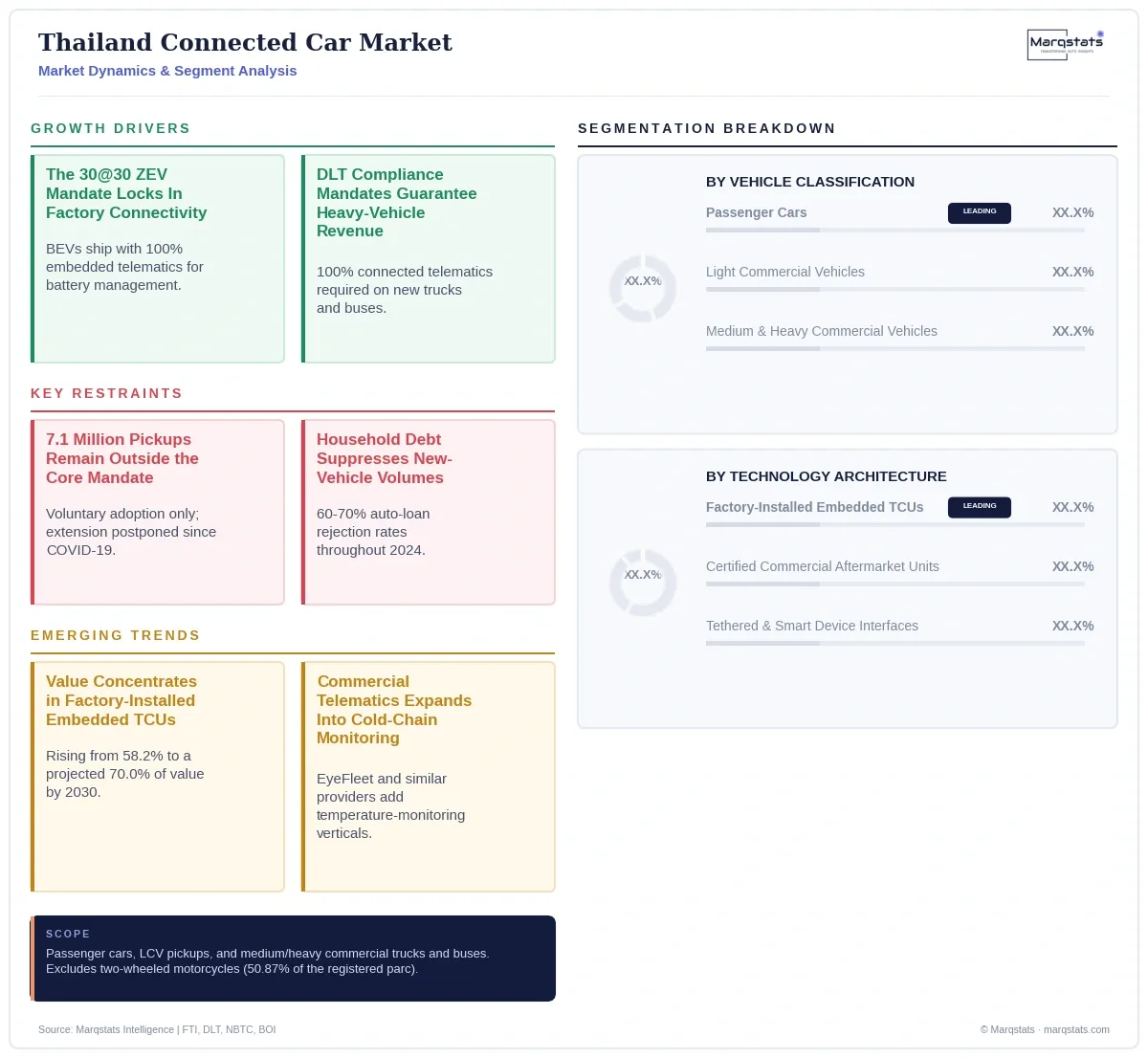
- The 30@30 zero-emission vehicle mandate and EV 3.0/3.5 incentive packages are structurally locking in rising factory connectivity penetration, since Thai-market BEVs ship with 100% embedded telematics for battery management and OTA updates regardless of consumer software demand.
- DLT compliance mandates guarantee 100% connected telematics on newly registered heavy trucks and buses, providing this market's most stable, regulation-backed recurring revenue base independent of consumer sentiment or broader vehicle-sales cycles.
- Board of Investment tax incentives under Categories 5.8 and 7.33 offer up to eight years of corporate income tax exemption, extending to thirteen years with technology-transfer or R&D commitments, for domestic manufacturing of TCUs, ADAS sensors and automotive software platforms.
- Chinese automakers including BYD, MG and Great Wall Motor are bundling two to five years of complimentary cellular connectivity into vehicle purchase prices, a materially more generous structure than incumbent Japanese brands, competing specifically on connected-feature generosity to win share from Toyota and Honda.
- Remote SIM Provisioning through GSMA-compliant eUICC architecture is eliminating physical SIM supply-chain costs and failure points for automakers importing vehicles through Laem Chabang Port, letting carrier profiles download over the air once vehicles clear customs.
Key Restraints
Four constraints stand between this market and a fully monetized, evenly distributed connected fleet.
- Household debt approaching 90% of GDP and auto-loan rejection rates of 60% to 70% throughout 2024 suppressed new-vehicle sales broadly, directly constraining the volume of factory-connected hardware entering the market regardless of underlying connectivity penetration rates.
- More than 7.1 million one-tonne pickup trucks remain outside the DLT's core compliance mandate, relying on voluntary adoption that has not meaningfully progressed since a proposed mandate extension was postponed during the COVID-19 pandemic.
- Private consumer subscription cancellation rates run high once complimentary one-to-three-year trial periods expire, forcing automakers to either absorb ongoing cellular connectivity costs or risk deactivating basic safety features on aging vehicles.
- PDPA Sections 28 and 29 require explicit consent or certified safeguards before transferring geolocation, in-cabin visual data or driving-habit logs to overseas cloud infrastructure, raising compliance costs specifically for foreign OEMs routing telemetry to Japan, China, Singapore or the EU.
Key Trends
Four shifts show where the market is heading and who captures the value.
- Value is concentrating in factory-installed embedded TCUs at the expense of tethered smartphone interfaces and entry-level aftermarket tracking, rising from 58.2% to a projected 70.0% of market value by 2030 as over-the-air software architectures become standard.
- Commercial fleet telematics providers are expanding into specialized verticals, exemplified by East Innovation's EyeFleet cold-chain temperature-monitoring integration for pharmaceutical and perishable freight alongside core DLT-compliant GPS tracking.
- V2X and cooperative intelligent transport systems remain constrained to managed testbeds — roughly 300 km of Greater Bangkok expressway — pending NBTC finalization of 5.850-5.925 GHz spectrum allocation, with public non-standalone network latency still exceeding safety-critical thresholds.
- Telecommunications operators are moving directly into commercial fleet management rather than remaining pure connectivity providers, exemplified by AIS Business's turnkey Smart Vehicle Management package combining MDVR cameras, GPS hardware and SIM connectivity for logistics SMEs.
Strategic Implications
- Automakers should treat complimentary connectivity duration as a genuine competitive battleground given Chinese entrants' two-to-five-year bundled periods, and should consider unbundling core safety features from paid renewal tiers to reduce the high post-trial cancellation rates already documented in this market.
- Commercial telematics providers should prioritize DLT-mandated segments (heavy trucks, buses) for near-term revenue certainty while treating the 7.1 million-vehicle pickup segment as a longer-horizon opportunity contingent on regulatory mandate extension, not organic voluntary adoption alone.
- Telecommunications operators and infrastructure investors should concentrate eSIM/eUICC and 5G investment specifically in the Eastern Economic Corridor, where automotive manufacturing concentration, port logistics density and formal Thailand 4.0 testbed designation combine to create the market's highest-value connected-vehicle activity outside Bangkok itself.
- Investors evaluating this market's 2030 trajectory should track DLT mandate-extension announcements and Thai household credit conditions as the two variables separating the source's own Accelerated Expansion and Constrained Stagnation scenarios, rather than treating consumer subscription behavior as the primary swing factor.
Market Segmentation
USD 211.01 million in 2025, 44.5% of value, supported by rapid introduction of connected hybrid and electric powertrains carrying higher software and hardware content per vehicle.
USD 101.95 million in 2025, 21.5% of value, with connected features largely restricted to high-tier personal lifestyle trims rather than base commercial models.
USD 161.22 million in 2025, 34.0% of value, sustained by mandatory DLT tracking requirements and recurring monthly connectivity subscriptions across more than 539,000 operational trucks and buses.
USD 275.98 million in 2025, 58.2% of value, expanding at the expense of tethered and aftermarket alternatives as OTA software architectures become standard.
USD 149.84 million in 2025, 31.6% of value, anchored by DLT-certified GPS terminals and driver card readers across the mandated commercial fleet.
USD 48.37 million in 2025, 10.2% of value, the smallest and most rapidly declining architecture as dedicated onboard modems become standard.
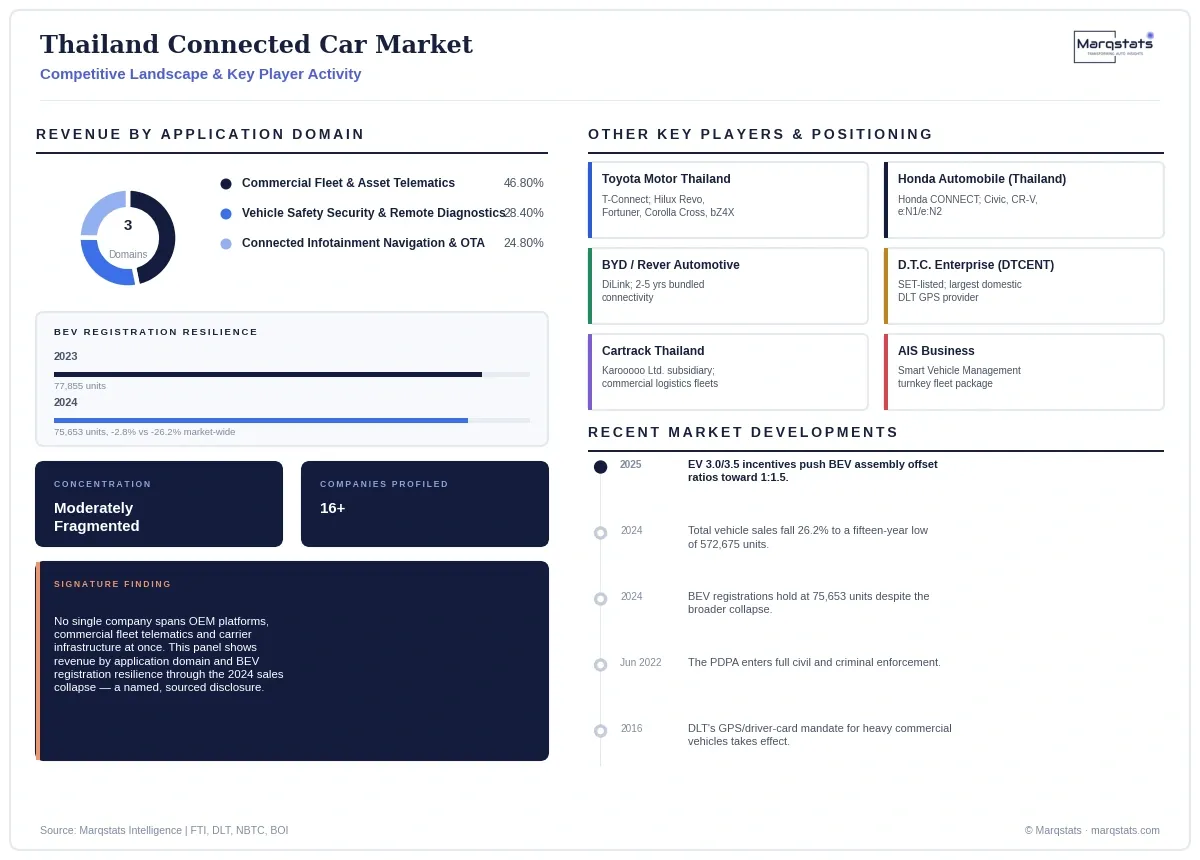
USD 221.92 million in 2025, 46.8% of value, the largest single revenue contributor, sustained by statutory compliance, route optimization and fuel-monitoring services.
USD 134.67 million in 2025, 28.4% of value, the fastest-growing application domain through 2030.
USD 117.60 million in 2025, 24.8% of value, growing quickly but most exposed to the consumer subscription-cancellation pattern documented elsewhere in this analysis.
By Geography
Greater Bangkok Metropolitan Area
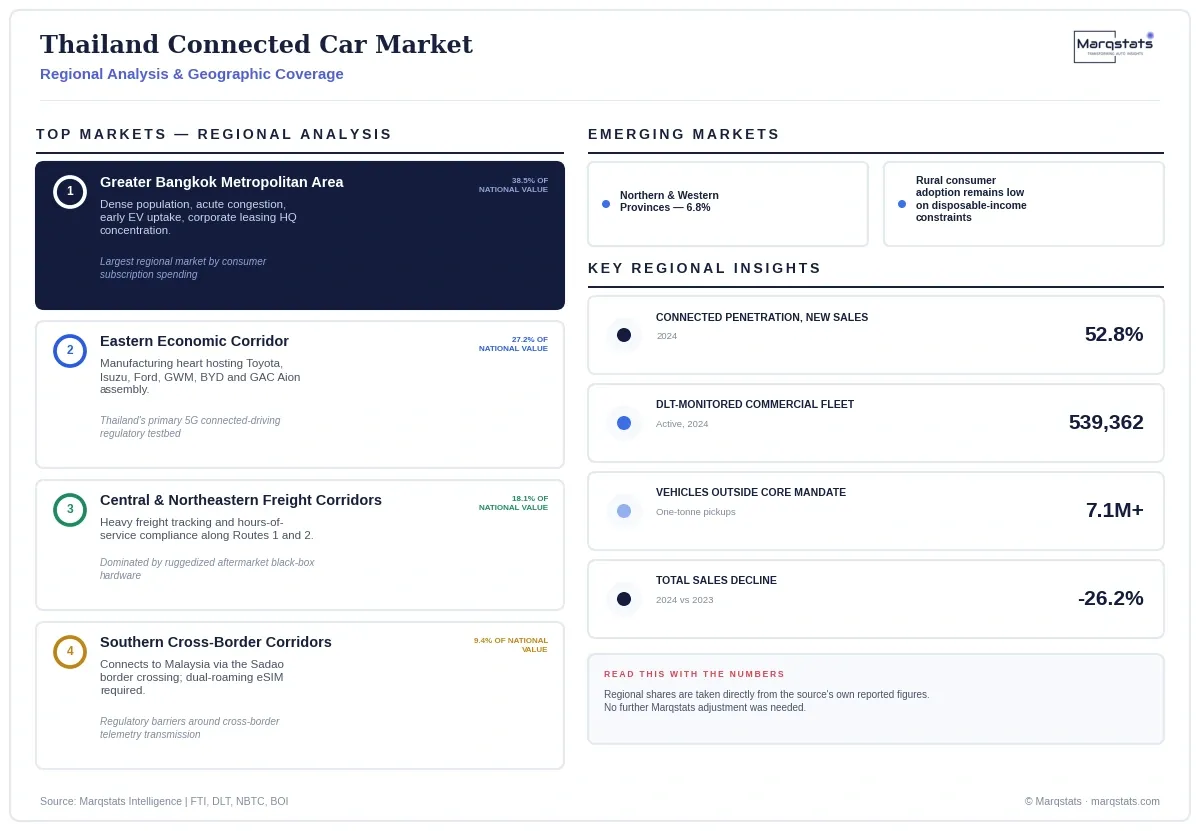
USD 182.56 million, 38.5% of national value, the largest regional market, driven by dense population, acute congestion, early EV uptake and corporate fleet registrations concentrated at national leasing headquarters.
Eastern Economic Corridor (Chonburi, Rayong, Chachoengsao)
USD 128.98 million, 27.2% of national value, the manufacturing heart of the domestic automotive industry, hosting Toyota, Isuzu, Ford, Great Wall Motor, BYD and GAC Aion assembly operations alongside Thailand's primary 5G connected-driving regulatory testbed.
Central & Northeastern Freight Corridors (Ayutthaya, Saraburi, Nakhon Ratchasima)
USD 85.83 million, 18.1% of national value, dominated by heavy freight tracking, hours-of-service compliance and automated fuel anti-theft sensors along National Highway Routes 1 and 2.
Southern Cross-Border Corridors (Songkhla, Surat Thani)
USD 44.57 million, 9.4% of national value, connecting to Malaysia via the Sadao border crossing, requiring dual-roaming eSIM profiles for continuous cross-border telemetry transmission.
Northern & Western Provinces
USD 32.24 million, 6.8% of national value, driven by interprovincial passenger bus compliance and tourism car rentals, with rural consumer adoption constrained by lower disposable incomes and base-trim pickup-dominated fleets.
How Competition Is Evolving
Competition runs on two largely separate tracks. On passenger OEM platforms, Toyota Motor Thailand leads with its T-Connect ecosystem across the Hilux Revo, Fortuner, Corolla Cross and bZ4X, bundling one free year before annual renewal fees apply; Honda Automobile (Thailand) competes with Honda CONNECT across the Civic, CR-V and electric e:N1/e:N2 lines with trim-dependent one-to-three-year free periods. Chinese entrants are competing specifically on connectivity generosity: BYD's DiLink, MG's Thai-language i-SMART, and Great Wall Motor's Coffee OS each bundle two to five years of complimentary cellular data, a materially longer free period than either Japanese incumbent offers.
On commercial fleet telematics, D.T.C. Enterprise (DTCENT), listed on the Stock Exchange of Thailand, is the largest domestic provider of DLT-approved GPS terminals, AI-camera MDVR systems and driver card readers, serving logistics haulers, passenger bus fleets and municipal vehicles. Cartrack Thailand, a Karooooo Ltd. subsidiary, manages a substantial commercial logistics and enterprise leasing subscriber base. Specialist providers East Innovation (EyeFleet, cold-chain monitoring) and Mastertech International (TAFF GPS, public transport) serve narrower verticals, while AIS Business's Smart Vehicle Management package lets a telecommunications operator compete directly in turnkey fleet management rather than remaining a pure connectivity supplier.
Companies Covered
The report profiles 16+ companies with full strategy and financials analysis, including:
Recent Market Activity
Table of Contents
Coverage & Segmentation
This report measures passenger cars, light commercial pickups, and medium/heavy commercial trucks and buses operating in Thailand that carry factory-embedded or certified aftermarket telematics hardware, across a 2025 base year and a 2026 to 2030 forecast period, denominated in United States dollars at a Bank of Thailand reference rate of THB 34.50/USD. It excludes two-wheeled motorcycles, which represent 50.87% of the total registered vehicle parc.
The analysis spans three segmentation dimensions — vehicle classification, technology architecture and service/application domain — five regional geographies, and 16 profiled entities across OEMs, commercial telematics providers, carriers and regulatory bodies. Vehicle sales and fleet figures trace to FTI and DLT; market value and segment splits are taken directly from the underlying research's own sourced sizing chain, with the 2025 base year interpolated between the source's own 2024 and 2027 figures.