Why 517,000 UK Connected Cars Go Dark Within a Year
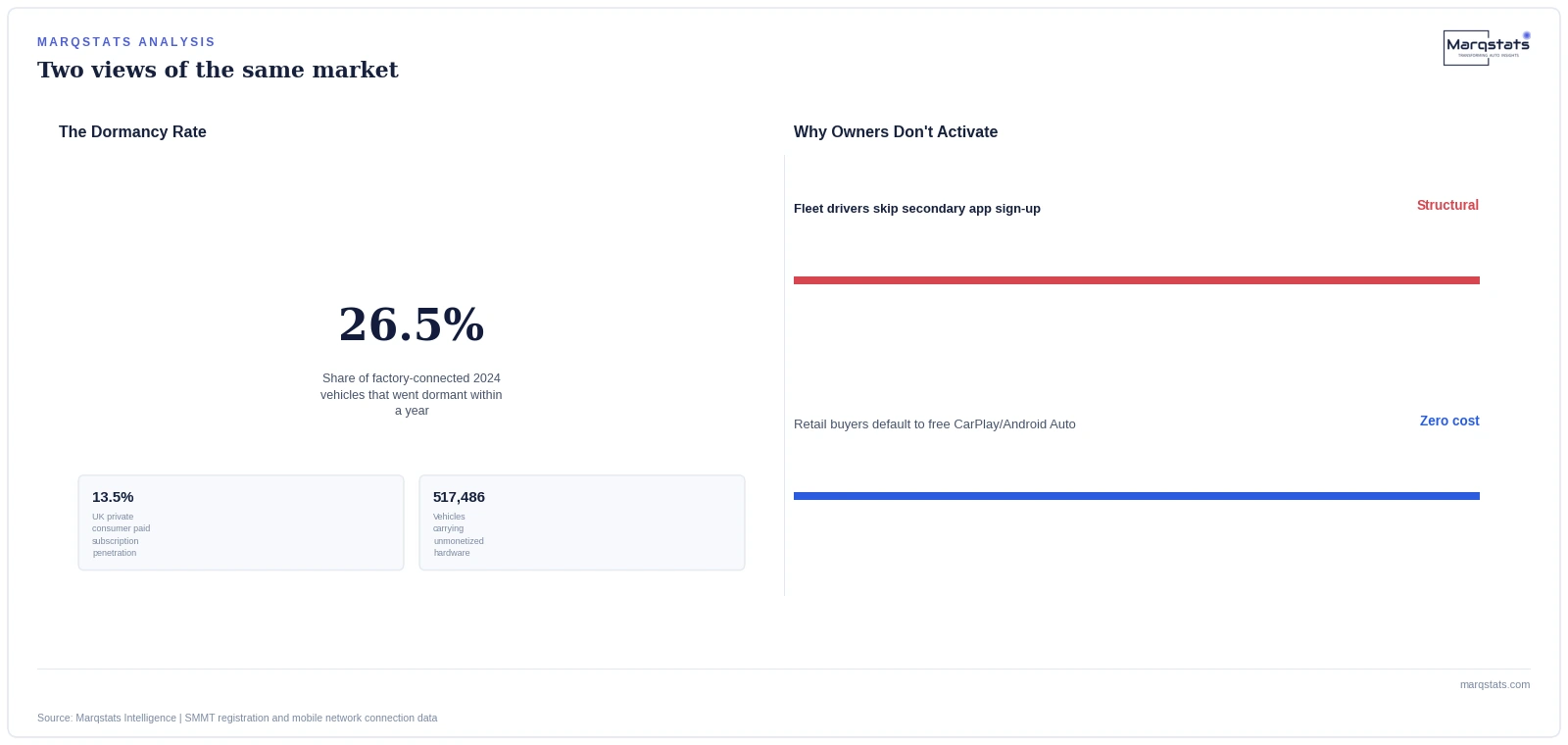
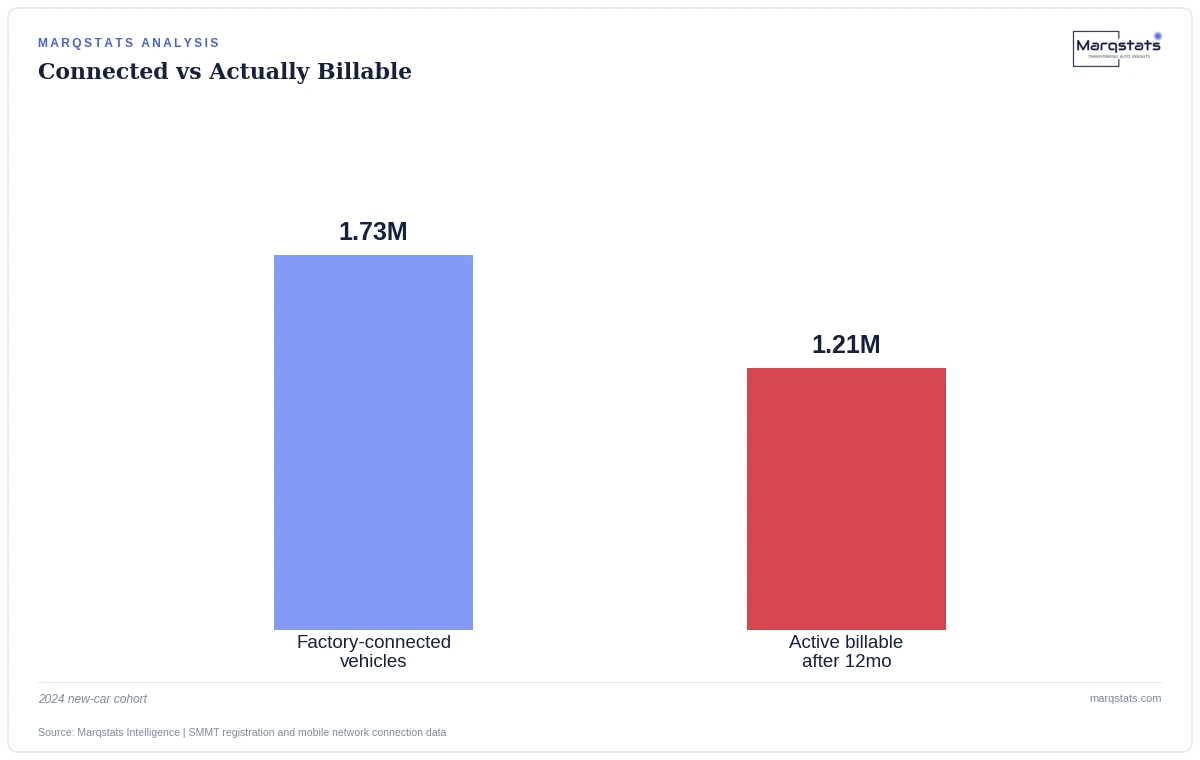
In 2024, 1,728,208 new UK vehicles rolled off the production line with factory-fitted telematics hardware — 88.5% of all new registrations. Twelve months later, only 1,210,722 of them, 62.0%, remained on an active, billable connected platform. The other 517,486 vehicles, 26.5% of the cohort, had gone commercially dark: hardware installed, connectivity capable, generating nothing.
Where the Gap Actually Comes From
The dormancy splits cleanly along two very different buyer behaviours across the UK new-car market. Fleet drivers, whose vehicles typically already carry an active compliance telematics system billed separately to their employer, routinely never activate the secondary OEM digital profile bundled with the car — not out of resistance, just because nobody in the process has a reason to complete an extra sign-up step for a feature they already effectively have. Private retail buyers, meanwhile, default to Apple CarPlay and Android Auto for navigation and media, at zero marginal cost, leaving little reason to activate and pay for a broadly overlapping OEM equivalent.
Neither of these is really a story about a deliberate consumer decision to reject connected features. It's closer to a story about default inertia — whichever option requires zero extra effort wins, whether that's a fleet driver leaving a redundant profile unopened or a retail buyer sticking with the navigation app already running on their phone.
Why This Isn't Really a Pricing Problem
It would be easy to assume a lower subscription price would close this gap. The evidence points the other way. UK consumer paid penetration sits at just 13.5% of the private connected parc, and cancellation rates spike specifically once initial OEM trial periods lapse — the same pattern this coverage set has documented in market after market. When a free, functionally adequate alternative already exists on the same dashboard, the marginal price of the paid OEM equivalent barely matters to the decision at all.
How This Compares to Markets Elsewhere in This Coverage Set
The UK's 26.5% dormancy rate sits in a similar range to the pattern documented in several other connected-car markets: Japan's factory DCM fitment vastly outpaces active paid usage, and Indonesia shows a comparably wide gap between factory-connected volume and genuine post-trial retention. What differs in the UK is the specific split between fleet-side neglect and retail-side substitution — in markets with less mature smartphone-projection ecosystems, the dormancy driver tends to skew more heavily toward pricing resistance than toward a genuinely free substitute already sitting on the same dashboard.
That contrast is itself a useful data point for anyone building a global connected-car go-to-market strategy: the maturity of smartphone-projection ecosystems in a given country is a genuinely predictive variable for how consumer dormancy will manifest, arguably more predictive than income level, vehicle price point, or any demographic factor typically used to segment these markets.
The Counter-Case: Does Dormancy Actually Hurt Anyone?
A fair objection: if the hardware cost is already recovered at the point of sale, does dormancy really cost automakers anything? Largely, no — which is precisely why UK OEMs have adapted by treating commercial fleets, not dormant private hardware, as the market's real revenue engine. But dormancy does matter for anyone forecasting UK consumer software revenue specifically: a model assuming rising subscription attach rates across the private fleet is building on an assumption this market's own data doesn't support.
What OEMs Are Doing About It
Rather than keep fighting this pattern, UK-facing automakers are beginning to restructure what they bundle into the purchase price versus what stays a genuine optional subscription — folding core maintenance and diagnostic updates into the vehicle price itself, and reserving recurring fees specifically for high-bandwidth entertainment features few owners would expect for free in the first place.
A Named Comparison: How Fleet Compliance Avoids This Problem Entirely
It's worth contrasting the dormancy pattern against the part of this market that doesn't have it at all. Commercial fleet compliance telematics — the systems tracking driver hours, harsh braking, and insurance-required safety metrics — essentially never goes dormant, because activation isn't optional: it's a condition the fleet operator's insurer or corporate policy requires before the vehicle can be put into service at all. There's no equivalent forcing function anywhere in the OEM consumer subscription flow, and that absence, more than any single pricing decision, is the real explanation for why one side of this market monetizes reliably and the other doesn't.
This forcing-function gap also explains why the dormancy problem is unlikely to resolve through OEM effort alone, however much they invest in app design or onboarding flow: consumer connected-vehicle activation has nothing forcing it, so it will keep defaulting to whichever path takes the least active effort, and a free smartphone app already sitting on the dashboard screen wins that comparison automatically.
That distinction points toward a practical lesson for any company trying to monetize connected-vehicle features in this market: a forcing function beats a feature pitch every time. Insurance requirements, regulatory mandates, and employer compliance policies reliably drive activation. A well-designed app and a compelling feature list, on their own, evidently do not — not when a free, adequate substitute is one tap away on the same screen.
What a Realistic Consumer Strategy Actually Looks Like
None of this means UK consumer connected-car revenue is a dead end, only that it needs a genuinely different design than a straightforward subscription pitch aimed at replicating what a free smartphone app already does. Bundling genuine safety value — automated crash notification, remote vehicle-location in the event of theft — into the purchase price rather than gating it behind a renewal decision removes the exact moment where most owners currently opt out. Anything gated behind a separate paid tier should be something meaningfully differentiated from what a smartphone can already do for free, not simply a slightly prettier version of the exact same map application everyone already has installed.
What This Means for a Sizing or Sourcing Model
Anyone forecasting UK connected-car consumer software revenue should treat post-warranty subscription attach rates as structurally capped, not a growth lever, and should instead model commercial fleet compliance demand as the segment carrying this market's genuine near-term expansion. The full market sizing this piece draws on is set out in the Marqstats analysis linked below.
Related reportUK Connected Car Market Size, Share & Forecast 2026 – 2030