Market Snapshot
Key Takeaways
Market Overview & Analysis
Report Summary
India's connected car market is measured across upfront hardware components, cellular network carrier connectivity fees, and recurring telematics software subscriptions, valued at USD 475.00 million in 2025. This figure is taken directly from the underlying research's own rigorously sourced sizing chain, reconciled from SIAM wholesale data, FADA/VAHAN retail registrations, and named OEM platform disclosures.
Structurally, this is a market where unit growth outpaces value growth, the reverse of the pattern seen in mature European and UK markets in this coverage set: the connected fleet expands at 22.38% annually against 19.30% value growth, as hardware cost deflation from localized 4G/5G module production offsets rising software revenue share. Layered on top of this is a genuine compliance-versus-utilization gap the Supreme Court's own May 2026 ruling has now directly targeted.
The analysis is built for four reader types making different decisions: an automaker deciding how aggressively to pursue post-trial subscription conversion given documented 15-20% renewal rates, a commercial telematics provider assessing how VAHAN-linked fitness-certificate enforcement converts dormant hardware into monetizable connections, a Tier-1 component supplier planning localized 5G RedCap chip production timelines, and an investor weighing how much of this market's 2030 trajectory depends on AIS-189/190 regulatory finalization versus organic consumer demand.
India Connected Car Market Size and Forecast
Marqstats builds the India figure directly from the underlying research's own year-by-year sizing table, itself reconciled from SIAM, FADA/VAHAN registration data, and named OEM disclosures including Hyundai Motor India's SEBI Draft Red Herring Prospectus. The market spans three revenue pools — upfront hardware components, cellular connectivity access fees, and recurring telematics software subscriptions — each independently tracked and summed to the reported total.
Market value grows from USD 475.00 million in 2025 to USD 1,148.00 million by 2030, a 19.30% CAGR, while the active connected vehicle parc grows from 9.80 million to 26.90 million units over the same period, a 22.38% CAGR. Value growth trailing unit growth, rather than exceeding it, reflects genuine hardware price compression as domestic component manufacturing scales, only partially offset by rising software and subscription revenue intensity per vehicle.
The source's own three forward scenarios diverge specifically on regulatory finalization timing and consumer subscription behavior. The Base Case assumes steady factory integration reaching 71.0% embedded fitment by 2031 and post-trial renewal rates holding at 20-25%; the Regulatory Acceleration scenario assumes MoRTH finalizes AIS-189/190 mandates by early 2027 and nationwide RTO enforcement closes compliance loopholes, reaching USD 1,580.00 million by 2031 at a 22.14% CAGR; the Compliance Attrition scenario assumes AIS-189/190 finalization delays beyond 2029 and post-trial renewal rates collapse below 12%, prompting mass-market OEMs to scale back embedded TCUs in favor of cheaper smartphone projection, reaching only USD 1,080.00 million at a 14.67% CAGR.
A Supreme Court Ruling Exposed What India's Connectivity Statistics Were Actually Measuring
For years, India's AIS-140 commercial telematics mandate generated an impressive-looking compliance statistic: near-universal hardware installation across medium and heavy commercial vehicles. The May 2026 Supreme Court ruling in S. Rajaseekaran v. Union of India revealed what that statistic was actually hiding — fewer than 1.0% of that hardware was transmitting live location and safety alerts to state emergency monitoring centers. Fleet operators had learned to purchase just enough certified hardware to clear RTO registration and permit renewal, then let the recurring cellular subscription lapse once the physical certificate was issued.
This matters far beyond a single court case: it means every India connected-vehicle statistic based on hardware installation counts, rather than verified active telemetry, has likely overstated genuine functional connectivity for years. The Court's directive requiring RTOs to verify active VAHAN telemetry before issuing fitness certificates is a direct structural fix aimed at this exact gap, and its enforcement effectiveness over the next several years is arguably the single most consequential variable for this market's real, functioning connected-vehicle base going forward.
Why India's Value and Volume Curves Run in the Opposite Direction From Mature Markets
Markets like Europe and the UK in this coverage set show market value compounding faster than connected-vehicle unit counts, as software and data monetization scale on top of a largely saturated vehicle base. India shows the reverse: the connected fleet is projected to grow at 22.38% annually against 19.30% value growth, because India's underlying automotive market itself is still expanding briskly, and because localized 4G/5G telematics module manufacturing is actively driving hardware costs down even as more vehicles adopt embedded connectivity.
That distinction matters for how this market's growth should be read: India's forecast reflects genuine new connected-vehicle formation, not primarily deepening monetization of an already-connected base. The strategic implication is that automakers and telematics providers competing in India need volume-oriented, cost-efficient hardware strategies at least as much as sophisticated software monetization strategies, a materially different competitive priority than in slower-growing, hardware-saturated European markets.
Market Dynamics
Key Drivers
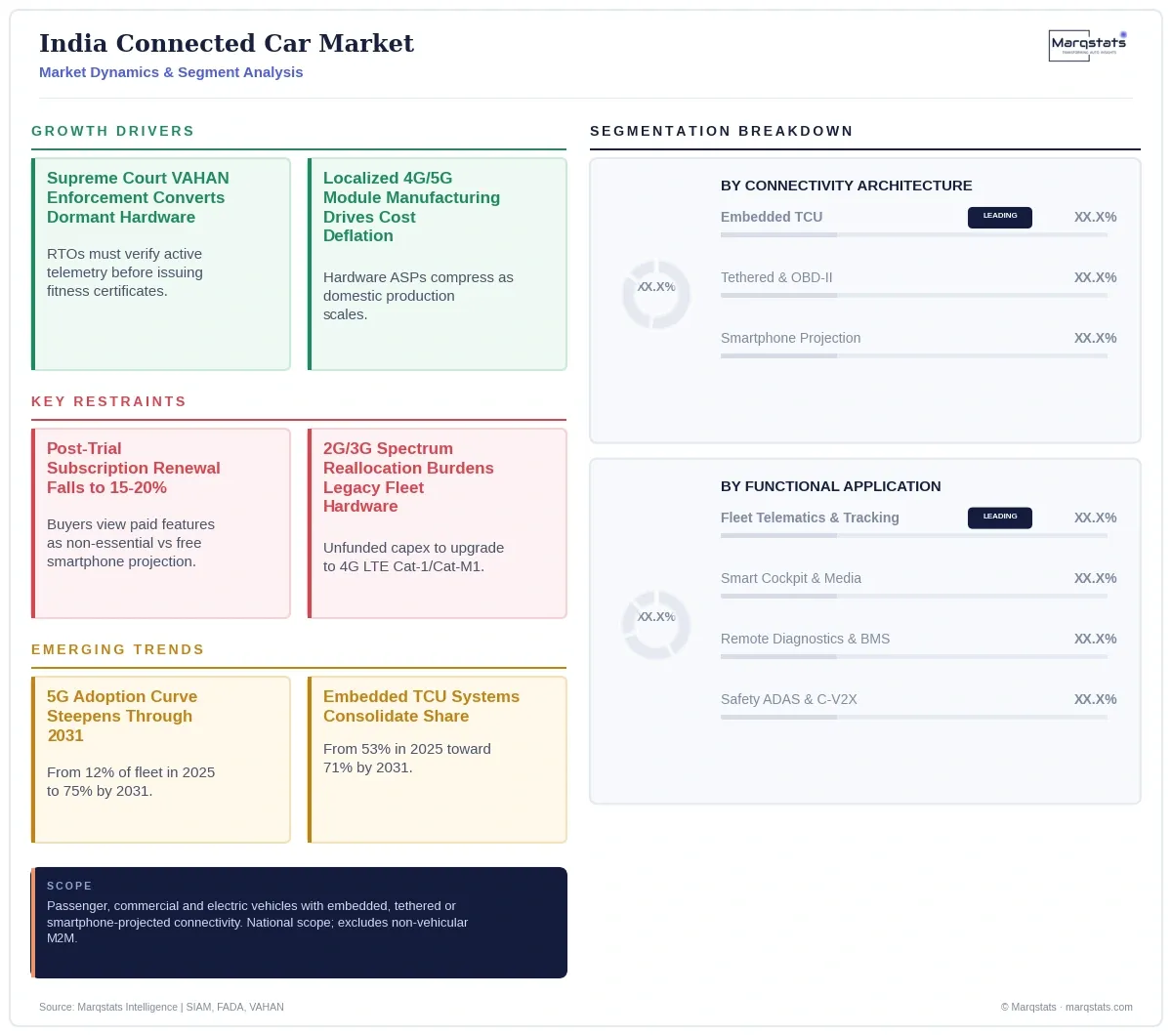
Five conditions are moving this market, and commercial insurance mandates matter more than consumer demand.
- India's underlying automotive manufacturing base continues expanding briskly, with record FY25 passenger vehicle wholesales of 4,301,848 units and total retail registrations exceeding 26 million, providing an ever-larger new-vehicle pool onto which embedded connectivity can expand independent of any single regulatory catalyst.
- Indian automotive manufacturing itself continues expanding at a pace few global markets can match, with record FY25 passenger vehicle wholesales of 4,301,848 units providing an ever-larger base of new vehicles onto which embedded connectivity can be layered, independent of any single regulatory catalyst.
- The Supreme Court's May 2026 directive requiring RTOs to verify active VAHAN telemetry before issuing vehicle fitness certificates directly targets the compliance-versus-utilization gap, converting previously dormant AIS-140 hardware into genuinely monetizable cellular connections.
- Localized manufacturing of automotive-grade 4G and 5G telematics modules is driving hardware cost deflation, expanding embedded TCU accessibility across lower-priced vehicle segments that previously relied on cheaper tethered or smartphone-projection alternatives.
- The Digital Personal Data Protection Act, 2023 and AIS-189/190 cybersecurity and software-update mandates are pushing automakers toward secure, localized cloud architectures, creating durable compliance-driven demand for Vehicle Security Operations Centers and cryptographic OTA infrastructure.
- Record domestic passenger vehicle wholesales (4,301,848 units in FY25) provide a large and growing base of new vehicles onto which embedded connectivity, already at 37.0% of 2024 registrations, can continue expanding.
- Insurance-linked usage-based insurance partnerships are emerging as a genuine alternative monetization channel for automakers facing weak direct subscription renewal, converting telematics data into premium discounts that give consumers a concrete financial reason to keep connectivity active.
Key Restraints
Four constraints stand between this market and a fully monetized, evenly connected fleet.
- The historical compliance-versus-utilization gap this market has long carried, where AIS-140 hardware installation counts materially overstated genuine functioning telemetry, means prior-year connected-vehicle statistics likely understate how much of this market's true value still depends on enforcement actually converting dormant hardware into active connections.
- Post-trial passenger-vehicle subscription renewal rates fall to just 15% to 20% once automakers' standard three-year complimentary period ends, as Indian consumers increasingly view paid connected features as non-essential relative to free smartphone projection alternatives.
- Telecom operators reallocating legacy 2G and 3G spectrum toward 4G and 5G networks impose an unfunded capital expenditure burden on commercial fleets still running legacy 2G tracking hardware, which must upgrade simply to maintain active VAHAN registration.
- Cellular coverage gaps along intercity freight corridors, remote industrial routes and rural highways compromise real-time panic alerting and geofencing reliability, even where AIS-140's 50,000-packet onboard storage buffer partially mitigates intermittent connectivity.
- Compliance and software engineering overhead from AIS-189 (CSMS) and AIS-190 (SUMS) requirements, including secure Vehicle Security Operations Centers and cryptographic OTA authentication, adds meaningful cost burden particularly for smaller and mid-tier automakers and suppliers.
Key Trends
Four shifts show where the market is heading and who captures the value.
- Automakers are increasingly treating three-year complimentary connectivity bundling itself as a competitive necessity across the mid-tier trim segment, even as the underlying post-trial renewal economics remain genuinely difficult, precisely because a shorter or entirely absent free connectivity period would put a given brand at an immediate disadvantage against every major competitor already offering the same three-year complimentary standard to every one of their own customers.
- 5G-enabled connections are on a steep adoption curve, projected to expand from just 12.0% of the connected fleet in 2025 to 75.0% by 2031, supported by 5G Standalone network deployment and localized 5G RedCap automotive chip production.
- Embedded TCU systems are consolidating share at the expense of tethered and smartphone-projection alternatives, growing from 53.0% of the connected base in 2025 toward 71.0% by 2031 as OEM standardization and tighter cybersecurity rules favor factory-integrated hardware.
- Automakers are restructuring monetization strategies toward unbundled service tiers, multi-year renewal discounts, and high-value paid features including cloud-backed dashcam feeds and usage-based insurance partnerships, moving away from undifferentiated subscription bundles.
- Telecommunications providers are expanding managed M2M platforms with automated eSIM profile provisioning and simplified ownership-transfer workflows aligned with TRAI standards, addressing the growing secondary market for connected used vehicles.
Strategic Implications
- Anyone benchmarking India against other emerging connected-car markets in this coverage set should weight the Supreme Court's own hardware-versus-telemetry finding heavily: a market where physical installation statistics have historically overstated genuine functioning connectivity is a materially different analytical starting point than a market where connected-vehicle counts can be taken at face value, and the true near-term growth story here is arguably as much about converting existing dormant hardware into active connections as it is about installing new hardware on newly sold vehicles going forward.
- Automakers should treat post-trial subscription conversion as an urgent monetization priority, shifting from undifferentiated bundles toward usage-based insurance partnerships and high-value paid features that give consumers concrete financial reasons to renew beyond the complimentary period.
- Commercial telematics providers should position directly around VAHAN-linked fitness-certificate enforcement, since the Supreme Court's own ruling creates near-term, regulation-backed demand for converting dormant AIS-140 hardware into genuinely active, monitored connections.
- Tier-1 component suppliers should prioritize localized 5G RedCap chip manufacturing and dual NavIC/GPS positioning integration to meet both AIS-140 price targets and the steep 5G adoption curve this market's own forecast describes.
- Investors and analysts should track AIS-189/190 finalization timelines and VAHAN enforcement effectiveness as the two variables separating this market's Regulatory Acceleration and Compliance Attrition scenarios, rather than treating consumer subscription behavior alone as the primary swing factor.
- A useful comparison point worth naming: India's unit-growth-outpacing-value pattern runs close to the opposite of what several mature markets in this coverage set show, where value compounds faster than the underlying connected fleet as software and data monetization scale atop an already largely saturated vehicle base rather than atop genuinely new-vehicle formation rather than existing fleet monetization intensity growth.
Market Segmentation
USD 251.75 million, 53.0% of value, hardwired into the vehicle electrical network with soldered eSIM, dual GNSS/NavIC positioning and independent battery backup, projected to reach 71.0% of the fleet by 2031.
USD 152.00 million, 32.0% of value, external hardware plugged into the OBD-II port, a declining segment due to tampering risk and limited secure CAN-bus access.
USD 71.25 million, 15.0% of value, Apple CarPlay and Android Auto, popular in lower-cost cars but unable to transmit telemetry or fulfill statutory tracking mandates.
USD 199.50 million, 42.0% of value, the largest application, driven by Rule 125H/Rule 90 compliance and 8-15% operational savings from route and driver management.
USD 133.00 million, 28.0% of value, cloud-connected dashboards and vernacular AI voice interfaces configured for regional Indian languages.
USD 85.50 million, 18.0% of value, powertrain error codes and EV battery state-of-charge and thermal monitoring.
USD 57.00 million, 12.0% of value, automated crash calling, Rule 125H panic alerts, and 5.9 GHz C-V2X communication under AIS-230.
USD 275.50 million, 58.0% of value, driven by consumer lifestyle features and smart SUV differentiation.
USD 161.50 million, 34.0% of value, mandate-driven compliance across M&HCV, hazmat and tractor segments.
USD 38.00 million, 8.0% of value, essential charging navigation and battery health reporting.
By Geography
A note on geographic scope
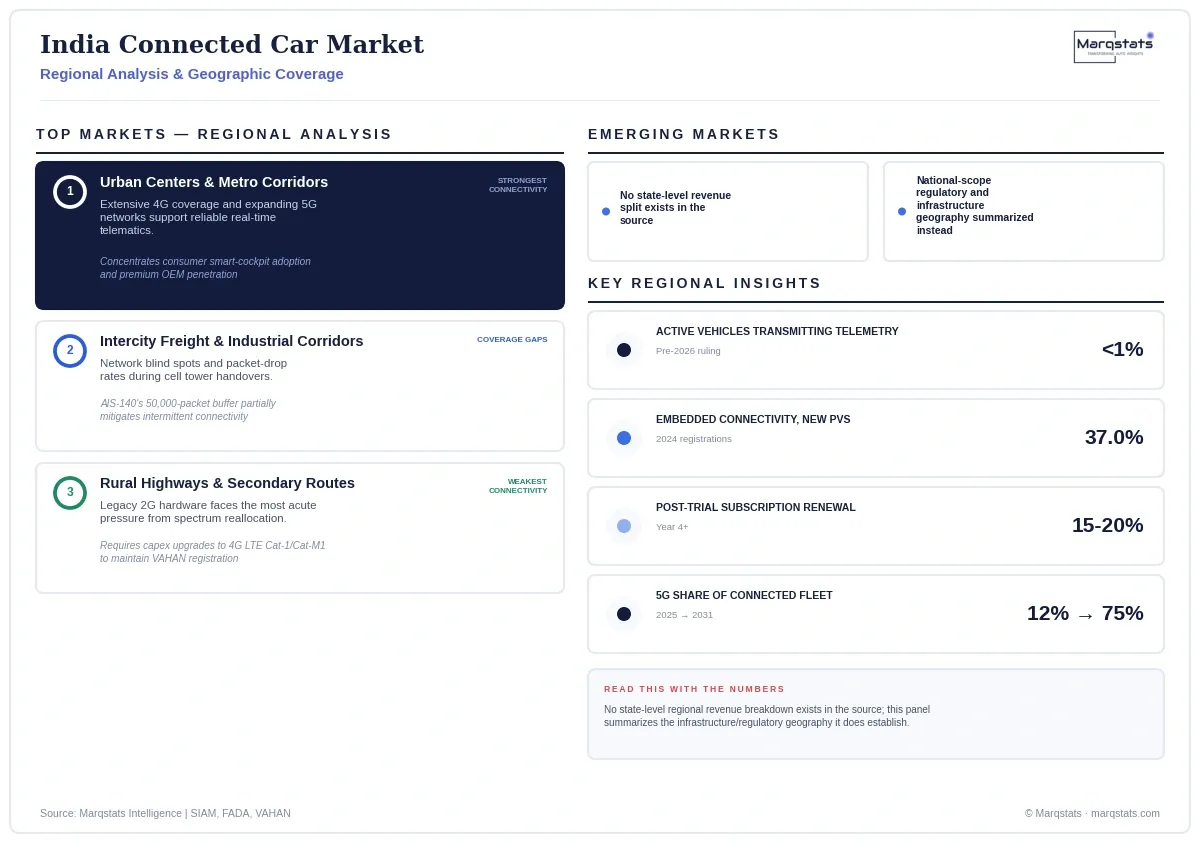
The underlying research documents this market at the national level, through SIAM, FADA/VAHAN and TRAI data, without a state-by-state or regional revenue breakdown. This section summarizes the infrastructure and regulatory geography the source does establish, rather than a constructed regional split.
Urban Centers and Metro Corridors
Extensive 4G coverage and expanding 5G networks support reliable real-time telematics, concentrating consumer smart-cockpit adoption and premium OEM connected-feature penetration.
Intercity Freight and Industrial Corridors
Frequent network blind spots and high packet-drop rates during cell tower handovers compromise real-time panic alerting and geofencing reliability, partially mitigated by AIS-140's mandatory 50,000-packet onboard storage buffer for batch transmission upon reconnection.
Rural Highways and Secondary Routes
The least reliable connectivity environment nationally, where legacy 2G tracking hardware faces the most acute pressure from telecom spectrum reallocation, requiring capital expenditure upgrades to 4G LTE Cat-1 or Cat-M1 devices simply to maintain active VAHAN registration.
How Competition Is Evolving
No single company in this market spans passenger OEM platforms, commercial fleet telematics and carrier infrastructure simultaneously, leaving genuine competitive white space for a provider capable of bridging Supreme Court-driven compliance demand with genuine consumer software monetization across every single vehicle class this market spans, from passenger to heavy commercial trucking.
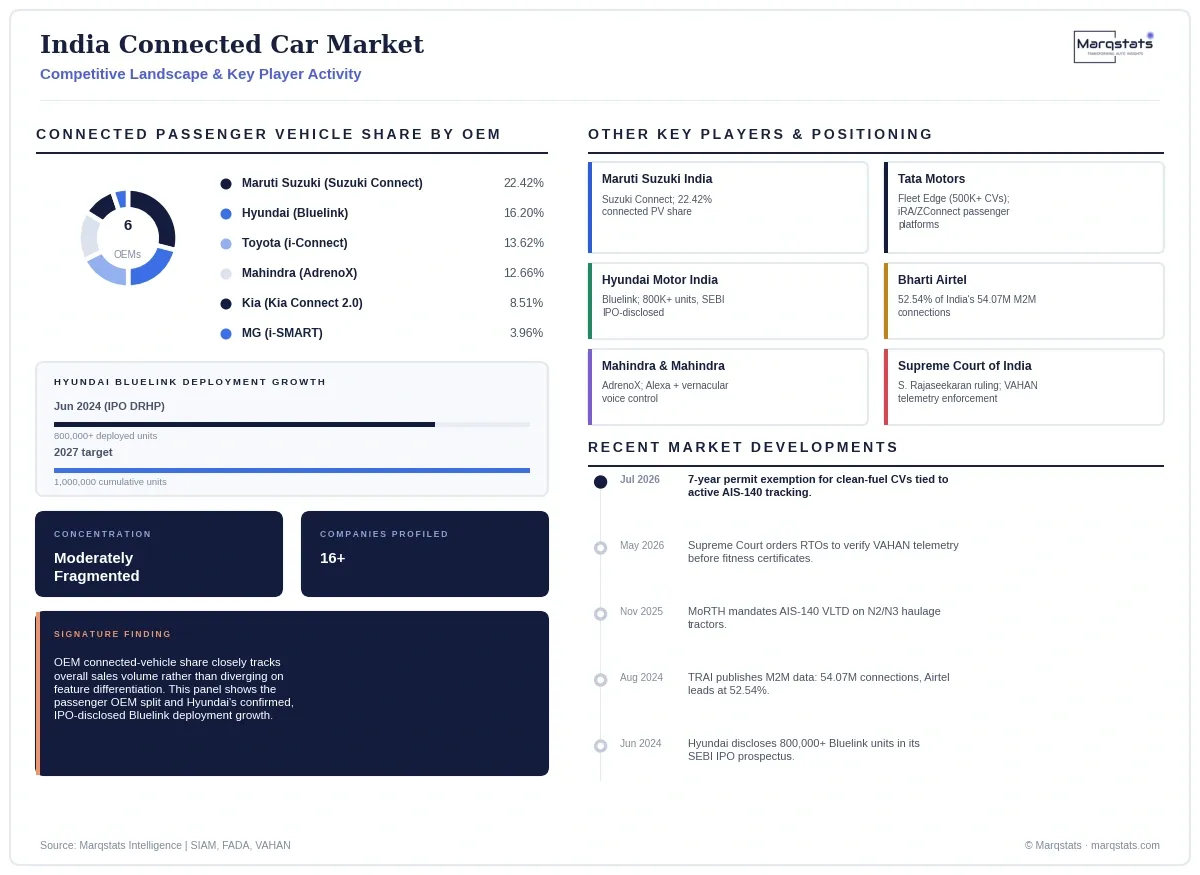
Competition on passenger connected platforms concentrates around six major OEMs, with market share closely tracking overall vehicle sales volume rather than diverging on connected-feature differentiation alone. Maruti Suzuki India leads with Suzuki Connect (22.42% share), followed by Hyundai Motor India's Bluelink (16.20%, disclosed in its SEBI IPO prospectus as exceeding 800,000 deployed units with a 1,000,000-unit target by 2027), Toyota Kirloskar Motor's i-Connect (13.62%, sharing modular software with alliance partner Maruti Suzuki), Mahindra & Mahindra's AdrenoX (12.66%, integrating Amazon Alexa and vernacular voice recognition), Kia India's Kia Connect 2.0 (8.51%, via an embedded partnership with Bharti Airtel), and JSW MG Motor India's i-SMART (3.96%, the market's pioneering mass-market connected platform launched in 2019).
On commercial telematics, Tata Motors operates Fleet Edge, an enterprise IoT platform connecting over 500,000 commercial vehicles with 100% factory fitment across medium and heavy commercial trucks, buses and commercial EVs. Tata Motors separately deploys iRA for ICE passenger vehicles and ZConnect for its EV lineup (Nexon EV, Tiago EV, Punch EV, Curvv EV), integrating with over 30,000 public EV charging points nationally. Telecommunications carriers Bharti Airtel (52.54% of 54.07 million M2M connections), Vodafone Idea, Reliance Jio and Tata Communications compete for automotive M2M contracts, while aftermarket and fleet software providers Uno Minda, Fleetx and Roadcast serve the tethered/OBD-II segment.
Companies Covered
The report profiles 16+ companies with full strategy and financials analysis, including:
Recent Market Activity
Table of Contents
Coverage & Segmentation
This report measures passenger vehicles, commercial vehicles and electric vehicles operating in India that carry factory-embedded, tethered or smartphone-projected connectivity, across a 2025 base year and a 2026 to 2030 forecast period, denominated in United States dollars. It excludes non-vehicular M2M connections.
The analysis spans three segmentation dimensions — connectivity architecture, functional application and vehicle classification — and 16 profiled entities across OEMs, telecommunications carriers and regulatory bodies. Wholesale and registration figures trace to SIAM and FADA/VAHAN; market value and segment splits are taken directly from the underlying research's own sourced sizing chain, using its 2030 row rather than its 2031 forecast horizon to match this coverage set's standard forecast window.