Market Snapshot
Key Takeaways
Market Overview & Analysis
Report Summary
Germany's connected car market is measured across telematics hardware, embedded cellular data pipelines, digital service subscriptions, and software-enabled driver assistance packages, valued at USD 6,240.00 million in 2025. This figure is taken directly from the underlying research's own rigorously sourced sizing chain, reconciled from KBA registration and fleet data, VDA production statistics, and named OEM and Bundesnetzagentur disclosures.
Structurally, this is a market whose own headline statistics require careful reconciliation before use: BMW's global OTA fleet figure substantially overstates German-specific reality once cross-referenced against KBA's own brand-level parc data, and commonly cited "alternative powertrain" registration shares conflate genuine battery-electric vehicles with plug-in hybrids and other categories carrying materially different connectivity architecture.
The analysis is built for four reader types making different decisions: an automaker weighing in-house software development against Volkswagen's costly CARIAD experience and its subsequent pivot to external partnership with Rivian, a Tier-1 supplier planning centralized zonal HPC production capacity, a telecommunications operator deciding how to monetize already-mature 5G infrastructure beyond raw data connectivity, and an investor weighing how much of this market's 2030 trajectory depends on the RV Tech joint venture's execution timeline versus organic consumer demand.
Germany Connected Car Market Size and Forecast
Marqstats builds the Germany figure directly from the underlying research's own year-by-year sizing table, itself reconciled from KBA registration and fleet data, VDA production statistics, and named corporate and regulatory disclosures. The market spans hardware, cellular connectivity, digital subscriptions and driver-assistance software, each independently tracked and summed to the reported total.
Market value grows from USD 6,240.00 million in 2025 to USD 11,850.00 million by 2030, a 13.69% CAGR, while the active connected vehicle parc grows from 29.40 million to 45.80 million units over the same period, a 9.27% CAGR, representing more than 90% of all registered German passenger cars by 2030 under the Base Case. Value growth outpacing unit growth reflects rising software, subscription and driver-assistance monetization intensity per vehicle, consistent with the pattern seen in other mature European markets in this coverage set.
The source's own two forward scenarios diverge specifically on software platform execution and 2G sunset handling. The Base Case assumes Volkswagen successfully industrializes its RV Tech zonal architecture across Audi and Porsche by 2027 and volume models by 2029, NG-eCall reaches 100% penetration on new registrations by January 2027, and 5G Standalone coverage completes along the full Autobahn network; the Downside Scenario assumes RV Tech organizational friction delays deployment beyond 2029, the 2028 2G shutdown creates legal disputes over retrofitting responsibility for roughly 16 million exposed vehicles, and persistent consumer resistance to software subscription fees combined with EU Data Act-enabled third-party competition erodes OEM software revenue, reaching only USD 8,200.00 million by 2030 at a 7.15% CAGR.
Germany's Connected Car Statistics Keep Measuring the Wrong Thing
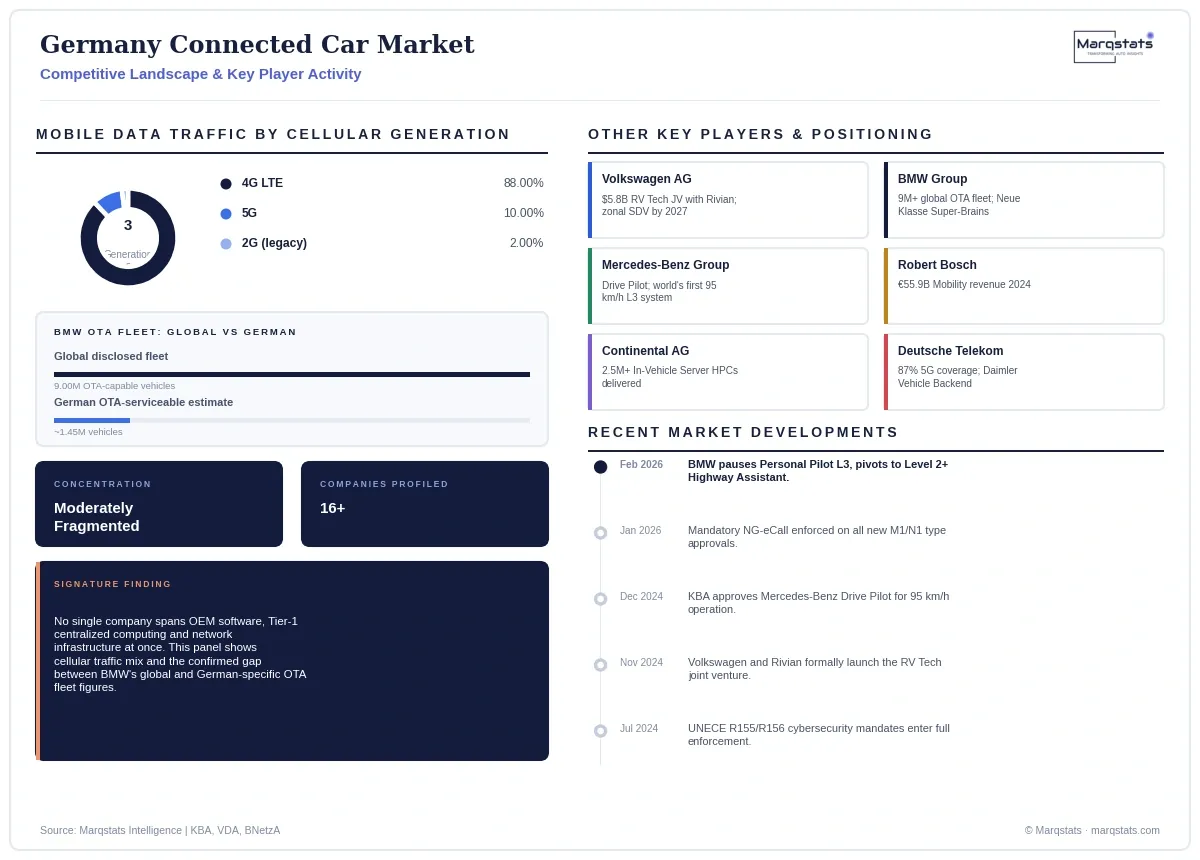
The gap between BMW's own corporate disclosures and its actual German operational reality is the clearest example. BMW reported a global active fleet exceeding 9 million OTA-capable vehicles with more than 10 million cumulative software upgrades delivered by October 2024. Mapped against KBA's own German BMW passenger car parc of 3.45 million units across all model years, the actual domestically OTA-serviceable BMW fleet is roughly 1.45 million vehicles — the remaining approximately 2.0 million German BMWs are older models built before modern high-performance domain computers became standard.
A parallel conflation runs through Germany's own "alternative powertrain" registration statistics. The 47.6% figure widely cited for 2024 spans battery-electric vehicles, plug-in hybrids, full hybrids and gas-powered models together, while true zero-emission BEV registrations accounted for just 13.5% — a meaningfully different number given that BEVs typically carry more advanced zonal electrical architectures capable of deeper over-the-air powertrain updates than the broader alternative-powertrain category as a whole.
BMW's Level 3 Retreat Is a Case Study in Automated-Driving Economics
Germany was the first country to establish a formal statutory framework for SAE Level 3 conditionally automated driving, and Mercedes-Benz secured the world's first internationally valid Level 3 type-approval in December 2021. BMW followed with its own Personal Pilot L3 system in December 2023 at €6,000. By February 2026, BMW paused the option entirely with its 7 Series facelift, redirecting engineering focus toward hands-off Level 2+ Highway Assistant operating up to 130 km/h instead.
The reasoning behind BMW's pivot is instructive for the entire automated-driving industry: Level 3's redundant sensor and actuator hardware pushed option pricing to roughly €6,000, regulators require continuous, documented fleet surveillance for every Level 3 vehicle in operation, and civil liability transfers entirely to the OEM the moment Level 3 mode engages. Level 2+ systems avoid all three burdens — the driver retains legal responsibility at all times — while still delivering broader daily utility at Autobahn cruising speeds, which is precisely why BMW's own commercial experience favors the less legally exposed technology despite its lower marketing prestige.
Market Dynamics
Key Drivers
Five conditions are moving this market, and commercial insurance mandates matter more than consumer demand.
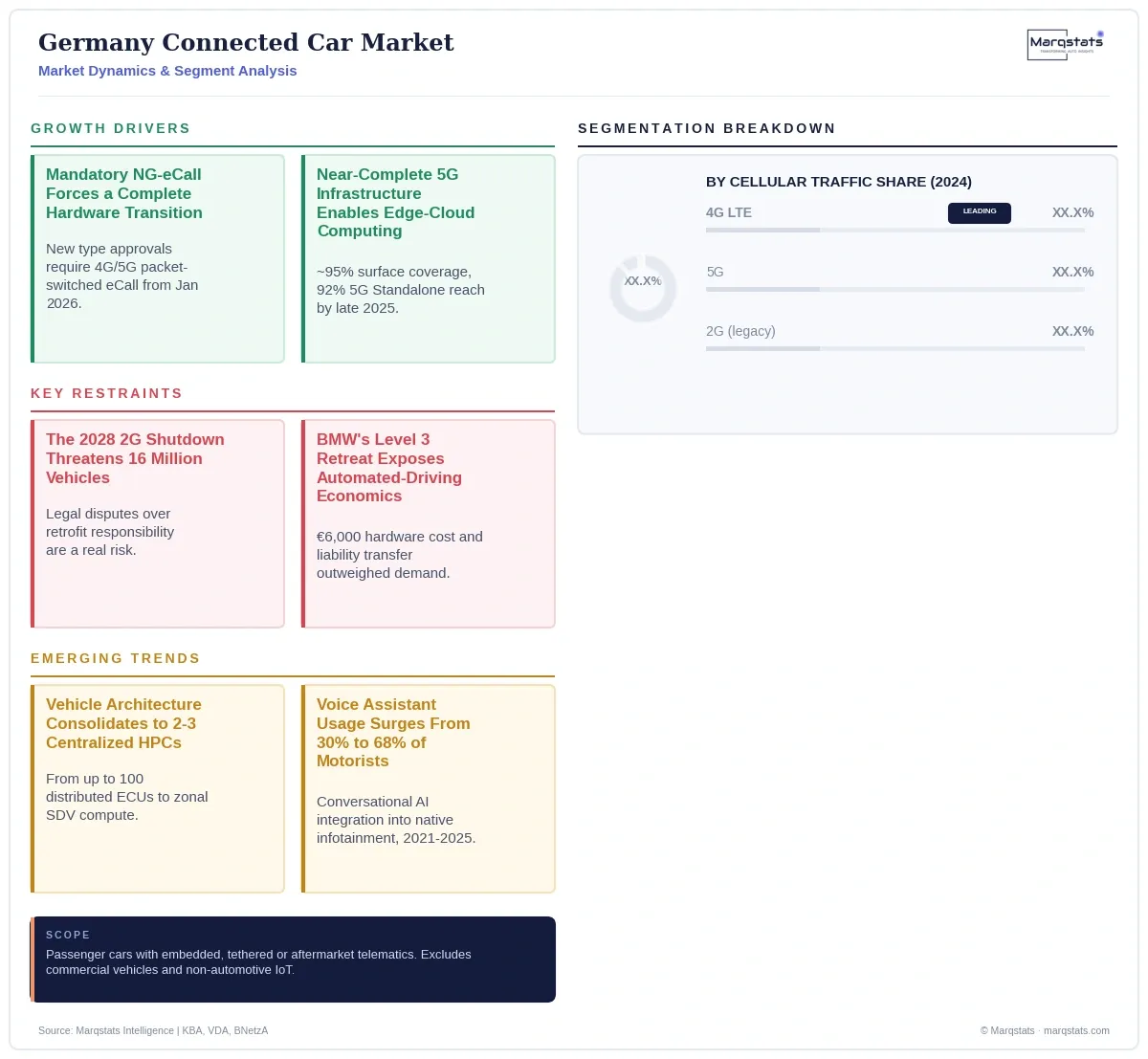
- Mandatory NG-eCall integration on all new type approvals from January 2026, under Delegated Regulation (EU) 2024/1180, is forcing a complete hardware transition from circuit-switched to packet-switched emergency-call architecture across every new German vehicle.
- UNECE Regulations 155 and 156, in full enforcement since July 2024, mandate certified cybersecurity management and software-update systems, favoring centralized zonal computing architectures over legacy distributed electronic control unit designs.
- Germany's near-complete 5G infrastructure, with approximately 95% surface coverage and 92% 5G Standalone reach by late 2025, provides the network foundation for ultra-low-latency V2X communications and edge-cloud computing that earlier infrastructure could not support.
- Volkswagen's $5.8 billion RV Tech joint venture with Rivian, targeting deployment across up to 30 million vehicles globally, demonstrates a credible path to resolving the software-development delays that plagued the automaker's in-house CARIAD subsidiary.
- Robert Bosch's reorganized Mobility business, generating €55.9 billion in 2024 revenue and targeting 5% organic annual growth through 2030, anchors a deep domestic Tier-1 supply base for steer-by-wire, brake-by-wire and centralized domain computing hardware.
Key Restraints
Four constraints stand between this market and a fully monetized, evenly connected fleet.
- Domestic assembly plants manufacture far more vehicles than the German market itself consumes, with more than 75% of the 4.10 million cars produced in 2024 destined for export, meaning domestic connectivity statistics describe only a fraction of German-engineered vehicle architecture reaching global roads and complicating any straightforward read of production data as a proxy for domestic connected-vehicle demand.
- Germany's scheduled 2028 2G GSM network shutdown threatens automatic emergency-call capability on roughly 16 million older vehicles, creating genuine potential for legal disputes over retrofitting responsibility between owners, insurers and manufacturers.
- BMW's own commercial experience with Level 3 automated driving demonstrates the structural economics working against premium automation features: disproportionate hardware costs, continuous regulatory fleet surveillance burdens, and direct OEM liability transfer collectively outweighed limited consumer willingness to pay.
- No permitted source publishes post-warranty subscription renewal rates for digital connected services in Germany, though survey evidence suggests private owners frequently allow premium connected features to lapse once initial free trial periods expire, unlike corporate fleets that maintain active subscriptions for maintenance and route tracking.
- Volkswagen's software strategy now depends on the RV Tech joint venture executing successfully on an ambitious timeline; organizational friction delaying deployment beyond 2029 would force continued reliance on fragmented legacy software systems across Volkswagen Group brands.
Key Trends
Four shifts show where the market is heading and who captures the value.
- Vehicle architecture is consolidating from up to 100 distributed electronic control units toward just 2 to 3 centralized High-Performance Computers connected via multi-gigabit Automotive Ethernet backbones, enabling full-stack synchronous over-the-air updates.
- In-vehicle voice assistant usage surged from 30% of German motorists in 2021 to 68% in 2025, driven by conversational AI integration into native infotainment systems, while smartphone projection compatibility has become a non-negotiable purchase criterion for 75% of buyers.
- Automakers are diverging on vehicle-to-everything protocol strategy, with Volkswagen standardizing on dedicated short-range ITS-G5 communications for localized hazard warnings without cellular fees, while BMW and Mercedes-Benz favor cellular C-V2X architecture routed through central cloud servers.
- Telecommunications operators are shifting focus from raw 5G coverage expansion toward commercializing dynamic network slicing with guaranteed quality-of-service tiers for safety-critical telematics and automated emergency braking applications.
Strategic Implications
- Anyone using this market's own headline statistics for planning should independently verify brand-level and powertrain-category figures against KBA's underlying registration data before citing them, given how consistently corporate disclosures and broad statutory categories have proven to overstate genuine German-specific operational reality in this market specifically.
- Automakers should prioritize hands-off Level 2+ driver assistance systems over costly Level 3 automated driving packages, following BMW's own commercial experience that broader daily utility at higher speeds, combined with retained driver liability, outweighs Level 3's prestige value against its disproportionate hardware and regulatory compliance costs.
- Tier-1 suppliers should accelerate development of modular, scalable High-Performance Computing platforms serving multiple vehicle segments simultaneously, repositioning away from isolated electronic control unit delivery toward cross-functional centralized software platforms.
- Suppliers and telematics providers should treat the 2028 2G network sunset as a near-term commercial opportunity, developing carrier-certified NG-eCall retrofit kits for the roughly 16 million vehicles that would otherwise lose emergency-call capability.
- Investors and analysts should track RV Tech joint venture deployment milestones as the clearest indicator separating this market's Base Case and Downside scenarios, given how directly Volkswagen's own software execution timeline determines the difference between USD 11,850 million and USD 8,200 million in 2030 market value.
Market Segmentation
The underlying research segments this market primarily by connectivity architecture generation (distributed, centralized domain, zonal SDV) and by cellular technology (4G LTE, 5G, 5G Standalone) rather than a single formal value-share table. This section summarizes those dimensions as the source establishes them.
The next-generation structural layer, consolidating vehicle compute into 2-3 centralized High-Performance Computers connected via multi-gigabit Automotive Ethernet, enabling full-stack synchronous over-the-air updates. Continental AG has delivered over 2.5 million In-Vehicle Server HPCs for Volkswagen's MEB platform alone; primary proponents include the VW-Rivian RV Tech platform and BMW's Neue Klasse "Super-Brain" architecture.
An intermediate structural layer using 4 to 6 domain controllers (Cockpit, Body, ADAS) connected via CAN-FD and hybrid Automotive Ethernet, offering domain-specific OTA updates but retaining flashing bottlenecks and moderate UNECE R156 recertification burden.
Up to 100 isolated microcontrollers connected via low-speed CAN, LIN and FlexRay buses, largely confined to pre-2020 production platforms, with limited or infotainment/TCU-only OTA capability and high UNECE R156 recertification complexity.
By Geography
A note on regional registration distortion
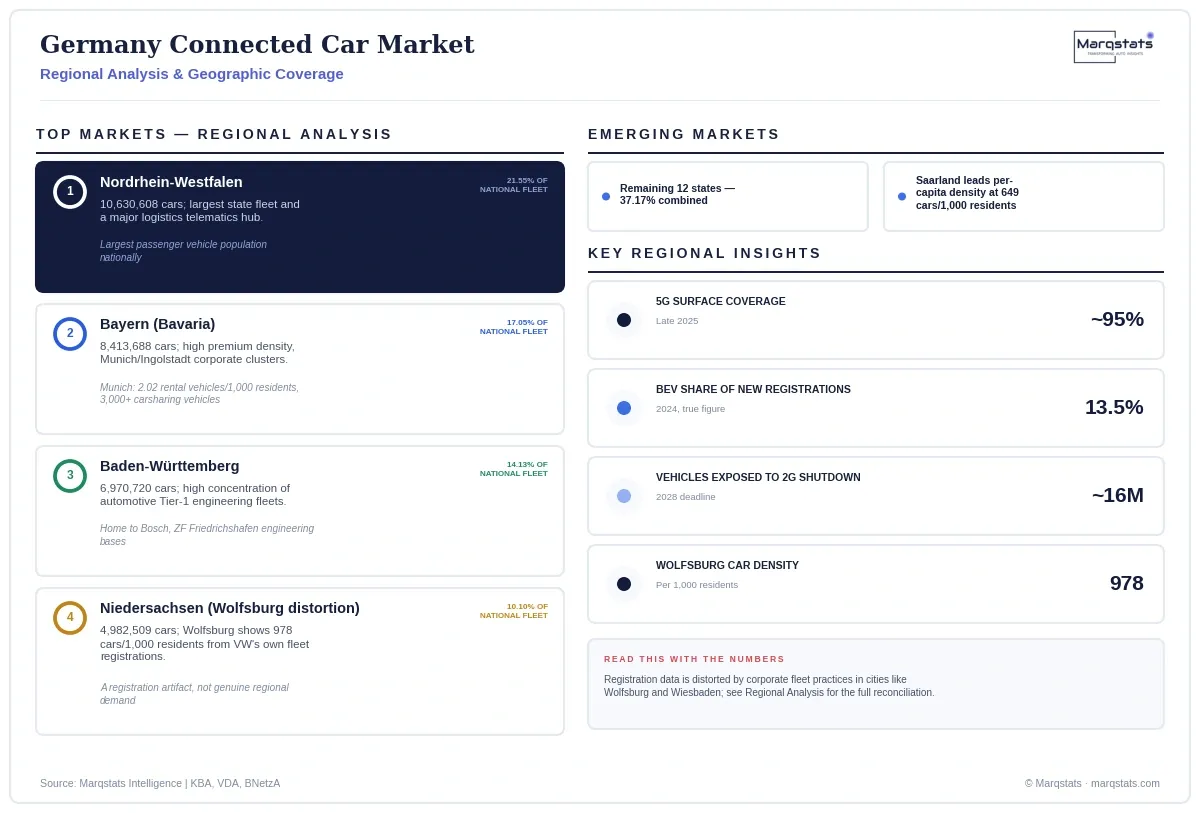
Official KBA registration statistics do not always reflect where vehicles physically operate. Commercial fleet operators, leasing firms and corporate mobility programs frequently register vehicles in specific municipalities due to lower local trade tax rates or centralized administration, concentrating digital registrations in administrative clusters distinct from genuine regional driving activity.
Nordrhein-Westfalen
21.55% of the national passenger car fleet (10,630,608 cars), the largest state fleet and a major logistics telematics hub.
Bayern (Bavaria)
17.05% of the national fleet (8,413,688 cars), with high premium-vehicle density and corporate clusters in Munich and Ingolstadt; Munich also shows 2.02 rental vehicles per 1,000 residents plus over 3,000 carsharing vehicles, serving as an entry point for new embedded telematics into the used-car market.
Baden-Württemberg
14.13% of the national fleet (6,970,720 cars), home to a high concentration of automotive Tier-1 engineering fleets.
Niedersachsen (Lower Saxony) and the Wolfsburg Distortion
10.1% of the national fleet (4,982,509 cars), heavily influenced by Wolfsburg's corporate registrations: 978 passenger cars per 1,000 residents, approaching one vehicle per citizen, driven by Volkswagen registering company fleets, executive pools and internal test vehicles locally rather than genuine regional demand.
Remaining States and the Urban-Rural Divide
The remaining twelve federal states together hold 37.17% of the national fleet. Wiesbaden shows 45.35% commercial registration share due to fleet-leasing administrative hubs; Berlin shows just 277 cars per 1,000 residents despite high population density, while rural Saarland leads per-capita density at 649 cars per 1,000 residents — rural areas also carry the highest exposure to the pending 2G network sunset given slower fleet turnover.
How Competition Is Evolving
No single company in this market spans passenger OEM software platforms, Tier-1 centralized computing hardware and telecommunications network infrastructure simultaneously, leaving genuine competitive white space for any provider capable of bridging all three layers as zonal SDV architecture becomes the industry standard through the back half of this decade.
Competition centers on three major OEM groups pursuing genuinely different software strategies. Volkswagen AG, after CARIAD SE development delays, committed up to $5.8 billion to its RV Tech joint venture with Rivian Automotive, targeting deployment of a shared zonal E/E architecture across up to 30 million vehicles globally, debuting on Audi and Porsche in 2027 before expanding to volume models including the electric Golf and entry-level ID.1 by 2029. BMW Group has built one of the industry's largest active connected fleets through ConnectedDrive, completing over 10 million over-the-air software upgrades across more than 9 million globally OTA-capable vehicles by October 2024, running its own AOSP-based BMW OS 9 across the Neue Klasse platform's four central "Super-Brain" computers.
Mercedes-Benz Group concentrates on its proprietary MB.OS chip-to-cloud architecture, developed with NVIDIA for compute and Google for geospatial mapping, and holds the industry's most advanced regulatory position in automated driving with its KBA-certified Drive Pilot SAE Level 3 system, now approved for 95 km/h operation. On the Tier-1 supply side, Robert Bosch's reorganized Mobility business generated €55.9 billion in 2024 revenue targeting steer-by-wire and brake-by-wire systems; Continental AG has delivered over 2.5 million In-Vehicle Server HPCs for Volkswagen's MEB platform; and ZF Friedrichshafen supplies vehicle motion control through its ProAI centralized supercomputing platform. Telecommunications infrastructure runs through Deutsche Telekom (leading enterprise IoT provider, 87% 5G coverage, hosts the Daimler Vehicle Backend), Vodafone Germany (40 million-plus global connected vehicle SIMs, 75% coverage), and Telefónica Germany (76% coverage, commercial fleet M2M connectivity).
Companies Covered
The report profiles 16+ companies with full strategy and financials analysis, including:
Recent Market Activity
Table of Contents
Coverage & Segmentation
This report measures passenger cars operating in Germany that carry factory-embedded, tethered or aftermarket telematics hardware, across a 2025 base year and a 2026 to 2030 forecast period, denominated in United States dollars. It excludes commercial vehicle categories and non-automotive IoT connections.
The analysis spans connectivity-architecture and cellular-generation segmentation, sixteen federal state-level geographies, and 16 profiled entities across OEMs, Tier-1 suppliers, telecommunications operators and regulatory bodies. Registration and fleet figures trace to KBA and VDA; market value is taken directly from the underlying research's own sourced sizing chain, with the CAGR recalculated on a 2025 base year.