Why the Real UK Connected Car Market Is 40 Times Smaller Than the Headline Figure
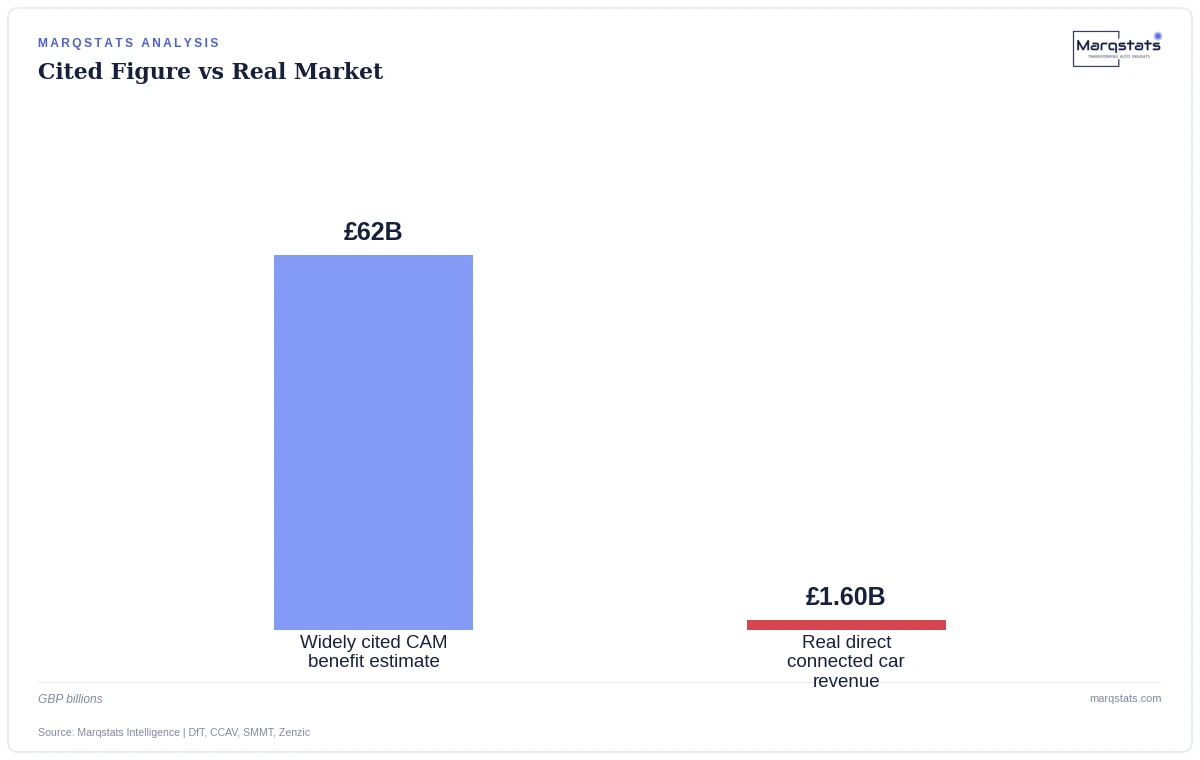
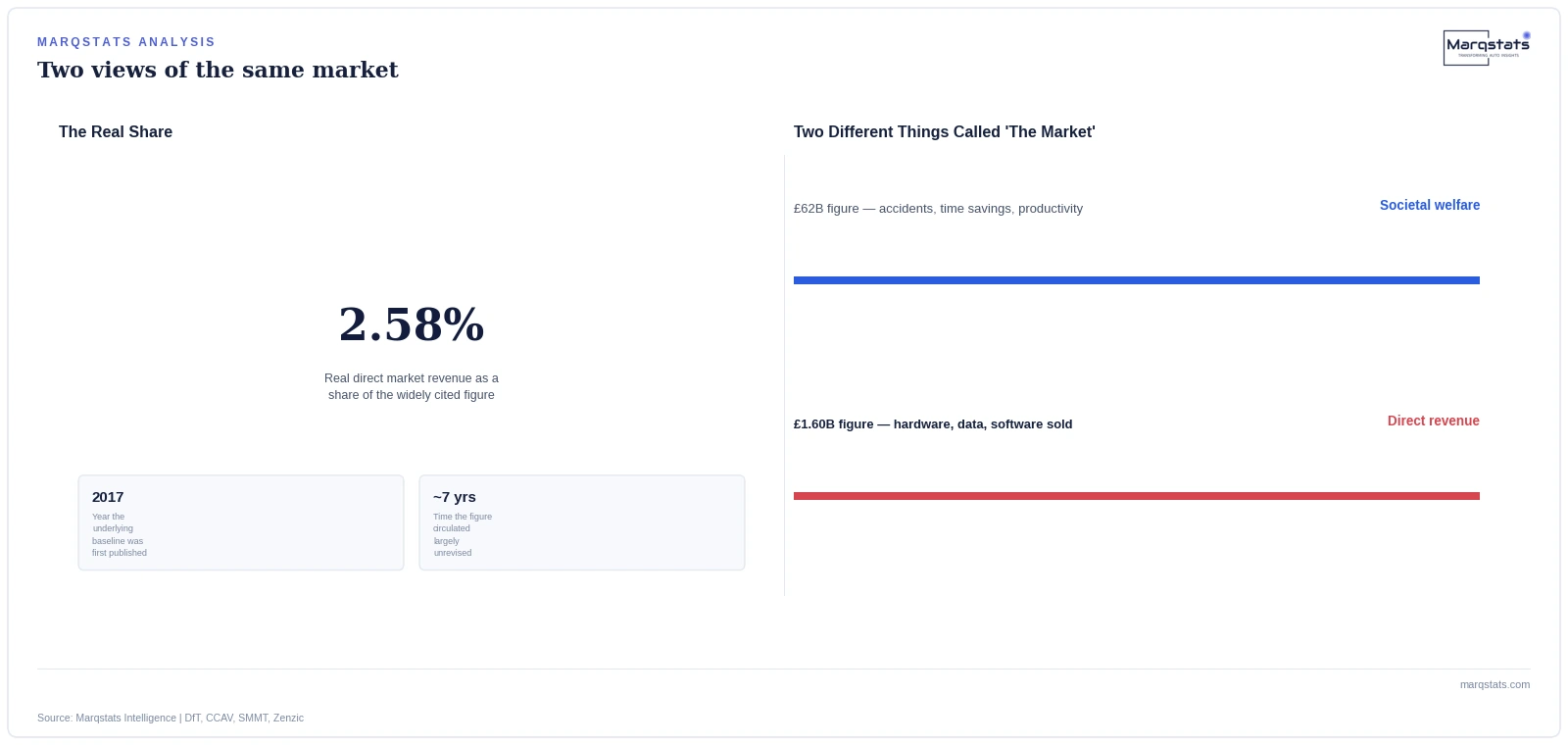
You may have seen the number: the UK's connected and autonomous mobility market is worth £62 billion, or even £66 billion by 2040. Those figures circulate widely in industry white papers, government policy documents, and conference keynotes. They are also measuring something almost entirely different from the actual UK connected car market — which totaled £1.60 billion in direct commercial revenue in 2024, just 2.58% of that widely cited figure.
Two Completely Different Things Called 'The Market'
The £62 billion figure is a macroeconomic welfare estimate: reductions in road accidents, travel-time savings, improved logistics productivity, automated taxi fares that don't yet exist at scale. These are genuine societal benefits, potentially, if autonomous and connected vehicle technology delivers on its promise — but they are not money changing hands for automotive hardware, connectivity, or software today. The £1.60 billion figure is direct commercial revenue: hardware sales, cellular data contracts, and software subscriptions companies actually invoice and collect right now.
Think of it as the difference between quoting the value of a new motorway to society — fewer accidents, faster commutes, more efficient freight — versus quoting how much the construction firm actually got paid to build it. Both are real numbers about the same project. They are not interchangeable, and confusing one for the other in an investment pitch or a policy brief leads to genuinely different, and genuinely wrong, conclusions about how the money actually flows.
Where the Big Number Actually Came From
Tracing the £62–£66 billion figure back through Department for Transport policy roadmaps, Parliamentary debates and industry publications leads to a single source: a 2017 econometric baseline published by the Transport Systems Catapult, later Connected Places Catapult. That baseline was updated once in 2020 and then adopted directly into the government's CAM 2025 strategy paper, circulating across public policy discussions for roughly seven years without material revision for changing automated driving timelines.
That November 2023 revision, when SMMT and Zenzic Partners jointly published the CAM Economic Opportunities Report, moved the goalposts again — taking the figure from £62 billion annually by 2030 to £66 billion by 2040, a shift that reads less like new independent modeling and more like the same underlying estimate being stretched across a longer time horizon.
Why the Confusion Persists
Big, round, socially significant numbers make for better headlines and stronger policy arguments than a precise but modest £1.60 billion commercial figure — which creates a genuine incentive, even unintentionally, to keep citing the larger number without pausing to check what it is actually measuring in the first place, rather than simply repeating it.
There's also a simple institutional-inertia explanation worth naming: once a government strategy paper cites a figure, that figure becomes the reference point every subsequent document in the same policy area tends to cite too, since revising it would mean explicitly contradicting an earlier official publication rather than just building on it. Seven years of unbroken citation isn't evidence the number is right — it's evidence nobody in the chain had a strong institutional incentive to go back and check.
What to Actually Cite Instead
If you're writing about the UK's real automotive connectivity industry — hardware sales, data contracts, software subscriptions — the £1.60 billion figure is the one to use. If you're writing about the broader societal case for autonomous and connected mobility investment, the £62 billion figure has its place, but it should come with the caveat that it's measuring potential future benefits, not money changing hands today, and should never be presented as a direct commercial revenue figure on its own without that context attached.