Market Snapshot
Key Takeaways
Market Overview & Analysis
Report Summary
The US connected car market is measured across four revenue streams — embedded TCU hardware value, wholesale carrier cellular connectivity fees, commercial fleet SaaS subscriptions and consumer connected software — valued at USD 9,621.00 million in 2025. This figure is taken directly from the underlying research's own fully transparent, bottom-up sizing chain, built from audited corporate disclosures, FHWA/BTS fleet statistics and SEC filings rather than a single aggregated industry estimate.
Structurally, this is a market where state-level privacy enforcement, not federal policy, has delivered the most immediate commercial consequences: Texas and California regulatory actions forced General Motors to terminate its OnStar Smart Driver data-broker program entirely, while commercial fleet telematics (exemplified by Ford Pro) has emerged as the most durable, highest-margin monetization model precisely because enterprise buyers value measurable ROI over convenience features retail consumers have shown reluctance to pay for.
The analysis is built for four reader types making different decisions: an automaker weighing consumer subscription strategy against Ford Pro's proven commercial-fleet model and GM's costly OnStar restructuring, a Tier-1 supplier planning Approved Supplier Registry compliance ahead of the BIS hardware deadline, a telecommunications carrier assessing wholesale automotive connectivity opportunity against AT&T's dominant position, and an investor or analyst tracking how state privacy regulation and BIS supply-chain enforcement together shape this market's Downside-versus-Upside scenario range.
United States Connected Car Market Size and Forecast
Marqstats builds the US figure directly from the underlying research's own fully disclosed bottom-up sizing chain: embedded TCU hardware value ($2.555 billion in 2024, from 15.484 million units at a blended $165 unit price), wholesale carrier cellular fees ($3.064 billion, from 138 million active endpoints at $1.85 monthly), commercial fleet SaaS ($1.277 billion, from 3.8 million subscriptions at $28 monthly), and consumer connected software ($1.701 billion, from 13.5 million subscriptions at a blended $10.50 monthly ARPU).
Market value grows from USD 9,621.00 million in 2025 to USD 17,777.03 million by 2030, a 13.06% CAGR, under the Base Scenario, extending the source's own 2024-2029 forecast trajectory one additional year using its own stated average annual growth rate. Commercial fleet SaaS software value is projected to grow fastest among the four revenue streams at a 24.18% CAGR through 2029, followed by consumer connected software at 22.04%, while embedded TCU hardware value grows just 2.17% as unit economics mature toward saturation.
The source's own three forward scenarios diverge specifically on BIS supply-chain enforcement and state privacy regulation intensity. The Base Scenario assumes orderly Tier-1 migration away from Chinese suppliers by model year 2027 without factory shutdowns and steady 20-25% annual commercial fleet subscription growth, reaching 182.0 million connected units and $15.750 billion by 2029; the Downside Scenario assumes aggressive BIS enforcement creates component bottlenecks where Tier-1 suppliers fail Approved Supplier Registry clearance before the deadline, combined with expanding state privacy regulation reducing consumer telematics activations by 40%, reaching only 168.0 million units and $12.180 billion; the Upside Scenario assumes the FCC finalizes comprehensive C-V2X technical rules and DOT mandates direct V2X equipment on new vehicles from 2028, reaching 196.0 million units and $18.620 billion.
State Regulators, Not Federal Policy, Delivered This Market's Real Commercial Shock
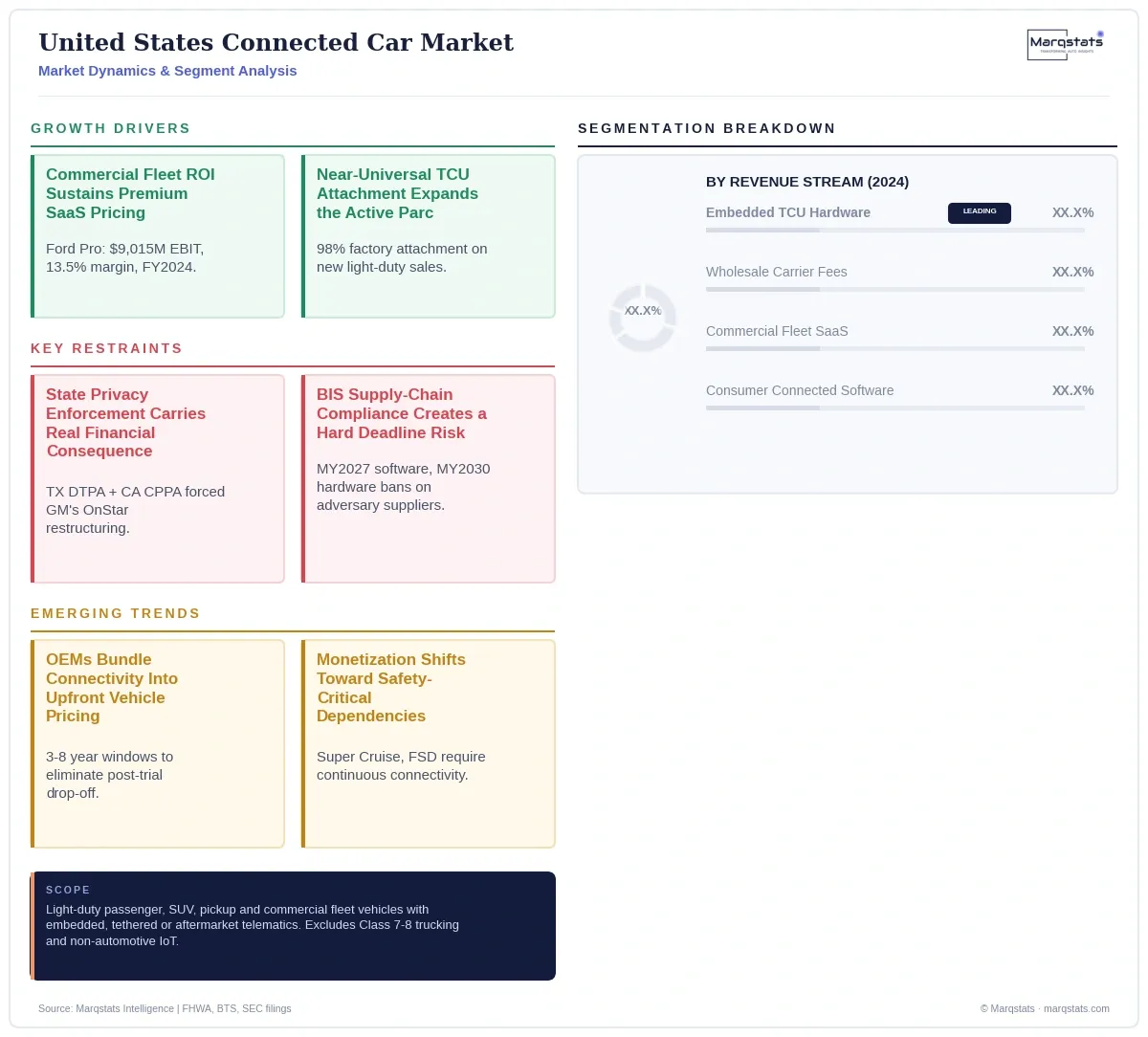
Much of the public conversation about US connected-car regulation centers on the Department of Commerce's national-security supply-chain rule — a genuinely consequential policy, but one whose hardware deadline doesn't bind until model year 2030. The regulatory action that actually forced an immediate, large-scale change in automaker behavior came from state privacy enforcement instead: Texas's DTPA lawsuit and California's CPPA consent order against General Motors and Honda respectively, which together drove GM to terminate its OnStar Smart Driver data-broker program entirely within weeks of the underlying media disclosures, well before either case reached final judgment.
The financial stakes were modest in isolation — a $632,500 CPPA penalty against Honda, a $12.75 million California settlement with GM — but the reputational and litigation exposure proved decisive. GM's decision to sever ties with LexisNexis Risk Solutions and Verisk Analytics before either regulatory action concluded suggests automakers are now treating state privacy enforcement as a leading indicator of broader legal and consumer-trust risk, not merely a cost of doing business to be absorbed.
Commercial Fleets Are Proving What Consumers Won't Pay For
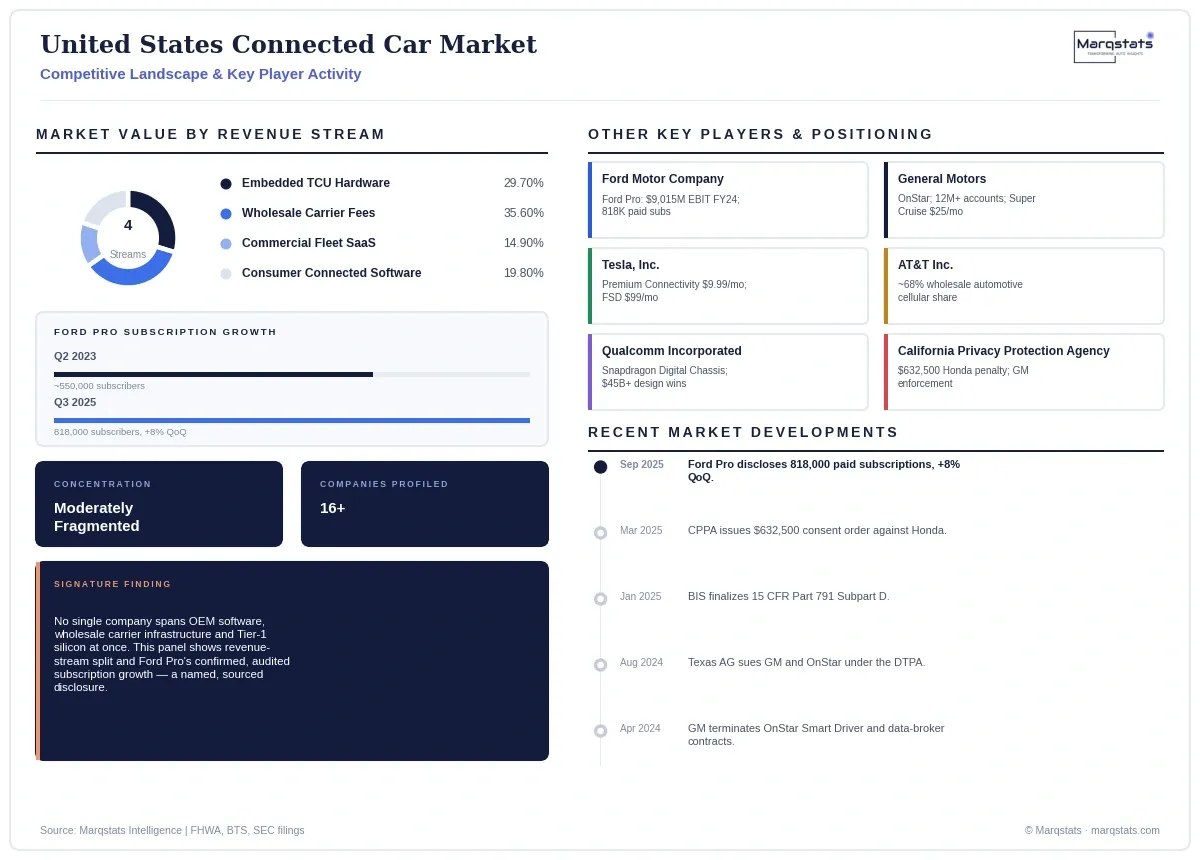
Ford Pro's financial performance and General Motors' OnStar restructuring together tell a consistent story about where genuine willingness-to-pay in this market actually sits. Ford Pro generated $9,015 million in EBIT at a 13.5% margin for fiscal 2024, growing paid subscriptions to 818,000 by Q3 2025 — durable, high-margin recurring revenue built on measurable uptime, fuel efficiency and predictive maintenance value that commercial fleet operators can directly quantify against their own bottom line.
Consumer telematics, by contrast, has required genuine restructuring to sustain: General Motors moved basic connectivity features into the upfront vehicle price for three-to-eight year windows specifically to eliminate the drop-off previously seen after short 90-day trials, while reserving active subscription monetization for high-utility features like Super Cruise that require continuous cellular connectivity to function technically, not merely as a convenience layer. The pattern across this market strongly favors monetization built on measurable utility — commercial fleet ROI, safety-critical connectivity dependencies — over discretionary consumer convenience features alone.
Market Dynamics
Key Drivers
Five conditions are moving this market, and commercial insurance mandates matter more than consumer demand.
- Commercial fleet telematics delivers measurable, quantifiable ROI through vehicle uptime, fuel efficiency and predictive maintenance, sustaining premium SaaS pricing and high renewal rates that retail consumer subscriptions have consistently struggled to match.
- Near-universal 98% factory TCU attachment on new light-duty vehicles ensures the active connected parc continues expanding as older, unconnected vehicles retire from the 255 million-unit national fleet, regardless of any single regulatory or commercial development.
- AT&T's dominant wholesale automotive connectivity position, anchoring contracts across GM, Ford, Stellantis, BMW, Nissan, Rivian and Toyota simultaneously, provides a stable, scaled cellular infrastructure foundation supporting continued embedded TCU expansion nationwide.
- Qualcomm's Snapdragon Digital Chassis platform, with an automotive design-win pipeline exceeding $45 billion, is consolidating telematics, digital cockpit and C-V2X processing into unified silicon packages that reduce integration complexity for automakers adopting software-defined vehicle architectures.
- Safety-critical dependencies embedded directly into advanced driver-assistance systems, exemplified by GM Super Cruise's real-time cellular requirement for HD map streaming, create structurally durable subscription revenue that survives consumer resistance to convenience-only paywalls.
Key Restraints
Four constraints stand between this market and a fully monetized, evenly connected fleet.
- State privacy regulators have demonstrated real enforcement capability and financial consequence, with Texas and California actions against General Motors and Honda forcing an entire commercial data-monetization model to be dismantled within months, creating genuine uncertainty for any automaker considering similar secondary data-broker arrangements.
- The Department of Commerce's BIS supply-chain rule creates a hard compliance deadline with severe downside risk: the Downside Scenario shows component bottlenecks from failed Approved Supplier Registry clearances alone reducing 2029 connected-vehicle parc growth by 14 million units relative to the Base Scenario.
- Nearly half of the 255 million-unit national light-duty fleet remains unconnected even after near-universal new-vehicle TCU attachment, since fleet-wide penetration depends on the slow retirement of older vehicles rather than new-sales momentum alone.
- Legacy network shutdowns, demonstrated by the 2022-2023 nationwide 3G sunset that stranded vehicles built between 2010 and 2019, represent a recurring structural risk as future spectrum reallocations threaten to strand additional vehicle generations lacking upgradable hardware.
Key Trends
Four shifts show where the market is heading and who captures the value.
- Automakers are increasingly bundling basic connectivity features into the upfront vehicle price for extended three-to-eight year windows, specifically to eliminate the steep subscriber drop-off previously observed following short complimentary trial periods.
- Several manufacturers, led by General Motors, have begun removing smartphone projection compatibility from new electric vehicle nameplates entirely, asserting direct control over the digital cabin experience to protect future native service subscription revenue.
- Monetization is shifting toward safety-critical, technically necessary connectivity dependencies — exemplified by GM Super Cruise and Tesla Full Self-Driving — where continuous cellular connection is required for the feature to function at all, rather than optional convenience layers consumers can decline without losing core functionality.
- Vehicle-to-everything communication infrastructure is transitioning definitively from DSRC toward 3GPP-based C-V2X following the FCC's 5.9 GHz band reallocation, with the Upside Scenario modeling a federal DOT mandate for direct V2X equipment on new light-duty vehicles beginning in 2028.
Strategic Implications
- Anyone benchmarking the US against other mature connected-car markets in this coverage set should weight the state-versus-federal regulatory dynamic heavily: unlike single-jurisdiction European markets, the US model means fifty separate state privacy regimes can each independently impose the kind of enforcement action that forced GM's OnStar restructuring, a genuinely different risk profile than a single EU-wide Data Act creates.
- Automakers should treat state privacy enforcement as a leading commercial risk indicator on par with, or ahead of, federal supply-chain compliance, and should proactively audit any secondary data-monetization arrangements against the specific consent-friction and disclosure standards the Texas and California actions established.
- OEMs should prioritize commercial fleet telematics investment following Ford Pro's proven model, while restructuring consumer subscription strategy toward safety-critical, technically necessary features rather than discretionary convenience paywalls that have consistently underperformed.
- Tier-1 suppliers should treat Approved Supplier Registry clearance under BIS 15 CFR Part 791 Subpart D as an urgent near-term priority given the Downside Scenario's demonstrated sensitivity to supply-chain compliance failures, well ahead of the formal model year 2027 and 2030 deadlines.
- Investors and analysts should track state privacy-enforcement actions and BIS Approved Supplier Registry clearance rates as the two clearest variables separating this market's Downside and Upside scenarios, rather than treating federal policy alone as the dominant regulatory driver.
Market Segmentation
72%+ of total connected automotive hardware and services value, factory-integrated with continuous battery connection supporting automatic crash notification, remote diagnostics and full-vehicle firmware OTA updates.
Apple CarPlay and Android Auto projection, offering familiar consumer interfaces but isolated from internal vehicle control networks; several OEMs, led by General Motors, have begun removing this compatibility from new EV nameplates.
OBD-II/SAE J1962 and J1939 commercial databus modules marketed by specialists including Geotab and Verizon Connect; retains a role in mixed enterprise fleets but contracting within light-duty passenger vehicles.
USD 2.555 billion, from 15.484 million units at a blended $165.00 Tier-1 unit price.
USD 3.064 billion, from 138 million active endpoints at $1.85 monthly ($22.20 annually).
USD 1.277 billion, from 3.8 million subscriptions at $28.00 monthly, the fastest-growing stream at a 24.18% CAGR through 2029.
USD 1.701 billion, from 13.5 million subscriptions at a blended $10.50 monthly ARPU.
By Geography
A note on registration distortion
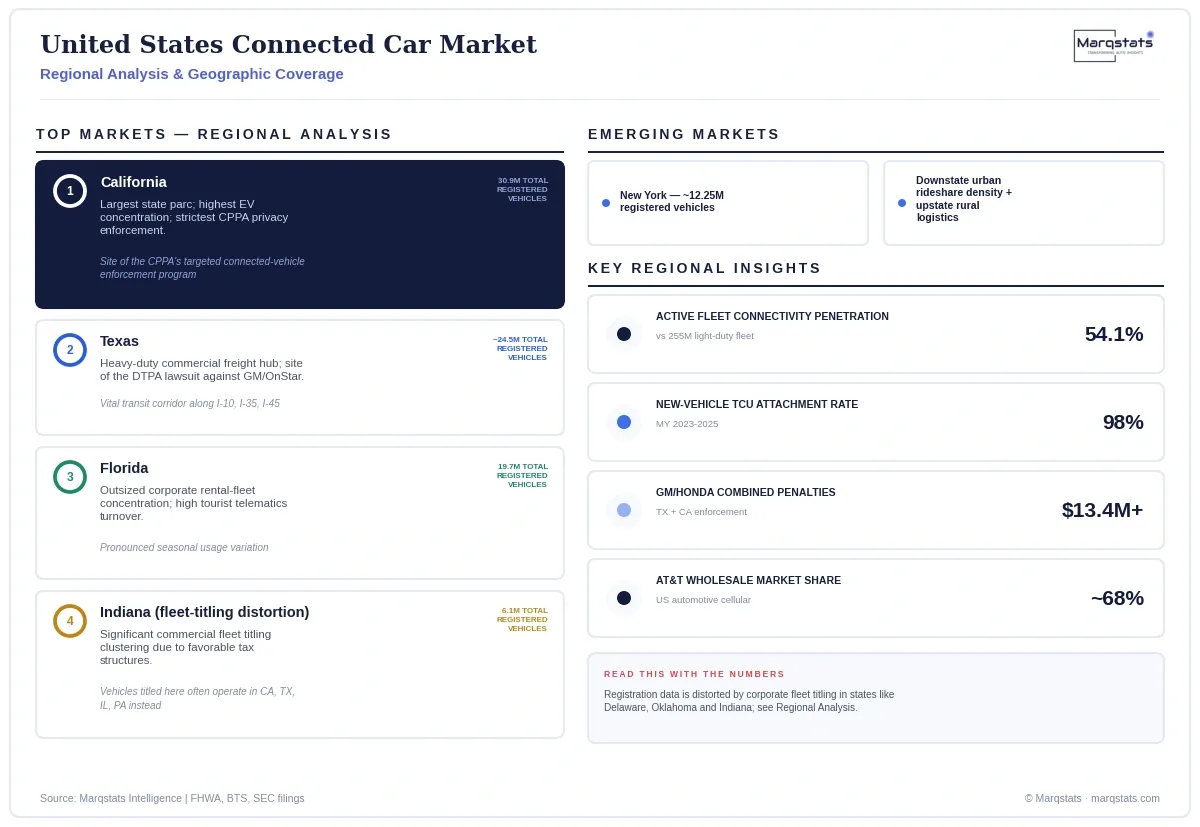
US connected-vehicle regional statistics carry a structural distortion comparable to those found elsewhere in this coverage set: national rental and commercial leasing fleets concentrate registrations in states offering favorable corporate tax and fee treatment, meaning raw state DMV figures overstate genuine regional activity in specific jurisdictions.
California
30,940,652 total registered motor vehicles in 2024, the largest state parc nationally, combining the highest concentration of battery-electric vehicles with the most rigorous connected-vehicle privacy enforcement via the CPPA.
Texas
~24,500,000 registered motor vehicles, heavily weighted toward light-duty pickup trucks and commercial fleets, a vital transit corridor for enterprise telematics and heavy-duty freight tracking, and the site of the DTPA enforcement action against GM/OnStar.
Florida
19,696,080 registered motor vehicles, characterized by outsized corporate rental-fleet concentration and high tourist telematics turnover creating pronounced seasonal usage variation.
New York
~12,250,000 registered motor vehicles, balancing dense downstate metropolitan transit and rideshare density with expansive upstate rural commercial logistics corridors.
Indiana and the Fleet-Titling Distortion
6,100,731 registered motor vehicles, showing significant commercial fleet titling clustering due to favorable statutory tax and fee structures — hundreds of thousands of vehicles titled in Delaware, Oklahoma or Indiana actually operate continuously across freight corridors in California, Texas, Illinois and Pennsylvania.
How Competition Is Evolving
No single company in this market spans OEM software platforms, wholesale carrier infrastructure and Tier-1 silicon simultaneously, leaving genuine competitive white space for a provider capable of bridging consumer, commercial and infrastructure layers as software-defined vehicle architecture becomes the industry standard through the remainder of this decade.
Competition centers on three distinct OEM monetization models. Ford Motor Company's Ford Pro division represents the most financially durable execution, combining commercial vehicle hardware with the Ford Pro Intelligence cloud platform to generate $9,015 million in fiscal 2024 EBIT at a 13.5% margin across 5.2 million connected commercial vehicles. General Motors' OnStar, the longest-operating US consumer telematics brand with over 12 million active accounts, has undergone fundamental restructuring following its Smart Driver data-broker controversy, now bundling basic connectivity into vehicle pricing while reserving subscription monetization for Super Cruise's safety-critical hands-free driving. Tesla operates the most vertically integrated model, eliminating traditional Tier-1 TCU architecture in favor of proprietary Linux-based compute, monetizing through Premium Connectivity ($9.99/month) and Full Self-Driving Supervised ($99/month) subscriptions.
On infrastructure, AT&T dominates wholesale automotive cellular connectivity at roughly 68% market share, anchoring contracts across GM, Ford, Stellantis, BMW, Nissan, Rivian and Toyota simultaneously, while Verizon Communications holds roughly 22% share through its Verizon Connect enterprise division and contracts with Audi and Hyundai. On silicon, Qualcomm's Snapdragon Digital Chassis platform has built an automotive design-win pipeline exceeding $45 billion across GM, BMW and Stellantis, while NVIDIA competes directly in high-performance centralized computing through its DRIVE Thor and Orin platforms. BlackBerry QNX remains the safety-critical RTOS benchmark, while Alphabet's Android Automotive OS has achieved rapid infotainment-layer adoption across multiple OEMs.
Companies Covered
The report profiles 16+ companies with full strategy and financials analysis, including:
Recent Market Activity
Table of Contents
Coverage & Segmentation
This report measures light-duty passenger vehicles, SUVs, pickup trucks and commercial fleet vehicles operating in the United States that carry factory-embedded, tethered or aftermarket telematics hardware, across a 2025 base year and a 2026 to 2030 forecast period, denominated in United States dollars. It excludes heavy-duty Class 7-8 trucking fleets not captured in light-duty registration statistics and non-automotive IoT connections.
The analysis spans connectivity-architecture and revenue-stream segmentation, five state-level geographies, and 16 profiled entities across OEMs, telecommunications carriers, silicon suppliers and regulatory bodies. Fleet and registration figures trace to FHWA and BTS; market value and revenue-stream splits are taken directly from the underlying research's own fully transparent, bottom-up sizing chain, extended one year to a 2030 forecast endpoint using the source's own stated average annual growth rate.