Market Snapshot
Key Takeaways
Market Overview & Analysis
Report Summary
France's connected car market is measured on the value of embedded telematics hardware, cellular M2M connectivity, commercial fleet software subscriptions and consumer digital services sold against the country's actively communicating vehicle fleet. The market is worth USD 1,289.31 million in 2025, and the single most consequential fact shaping its near-term trajectory is not a new technology but an old one being switched off: Orange's phased 2026 shutdown of its national 2G network, which is actively in progress as this analysis is being prepared.
Structurally, this is a two-speed market. Commercial fleets, anchored by long-term operational leasing giants Ayvens and Arval Service Lease, already run telematics penetration above 85%; private retail buyers, facing a EUR 36,700 average new-car price and free smartphone-mirroring alternatives, convert to paid connected subscriptions at well under half that rate. The market's growth is overwhelmingly a software and services story — hardware revenue is nearly flat across the forecast window while fleet SaaS and consumer B2C services compound fastest.
The analysis is built for four reader types making different decisions: an automaker or dealer network planning hardware retrofit capacity ahead of departmental 2G shutdown dates, a commercial fleet operator or leasing company pricing telematics against LOM greening-quota compliance costs, an independent telematics provider assessing how much the European Data Act's FRAND access rules actually open OEM-captive data, and an investor evaluating Stellantis's and Renault's competing software-defined-vehicle platform strategies.
France Connected Car Market Size and Forecast
Marqstats builds the France figure directly from the underlying research pack's four-layer revenue model: embedded hardware priced against newly registered vehicles carrying a factory-fitted telematics control unit, cellular connectivity priced per active M2M SIM, commercial fleet SaaS priced per managed vehicle, and consumer B2C services priced per paying post-trial subscriber. Each layer is tracked against its own named volume base — 2,106,932 new hardware-equipped registrations, 7.20 million active connectivity SIMs (2024), 2.10 million managed fleet vehicles, and 2.60 million paying consumer subscribers.
Market value grows from USD 1,289.31 million in 2025 to USD 1,963.69 million by 2030, a 8.78% CAGR, while the active connected parc grows from an estimated 7,924,625 to 12,800,000 units, a 10.06% CAGR. Commercial fleet SaaS and consumer B2C services are the two fastest-compounding layers, together explaining why value growth outpaces what new-vehicle registration volume alone would predict, since France's new-car market remains structurally suppressed below pre-2019 levels.
The forecast's downside case is not a demand-side risk but an infrastructure one. The research pack's own Network Sunset Friction scenario shows market value reaching only USD 1,572.00 million by 2030 (a 5.16% CAGR from the 2024 base) if 2G decommissioning outpaces hardware retrofit capacity and triggers consumer pushback — a scenario this coverage treats as materially more live than the pack itself assumed, given that the shutdown driving it is now confirmed to be actively underway rather than already completed.
Orange's 2G Shutdown Is Happening Now, Not Already Finished
A significant share of connected-car commentary on France's 2G sunset describes it in the past tense, citing an original December 2025 completion target. That target has not been met. Orange began decommissioning its national 2G network in phases starting 31 March 2026, with an initial pilot covering the Bayonne-Anglet-Biarritz urban zone and the Pyrénées-Atlantiques department, followed by the Landes on 12 May, seven further south-western departments on 9 June, and a staged national rollout running from September through 15 December 2026 — including a specifically dated 6 October shutdown across four Brittany departments.
That correction matters for anyone planning around the 2G transition. As of this analysis's preparation, the shutdown is roughly midway through its national rollout, not concluded — the 3.5 to 4.2 million vehicles carrying non-upgradeable 2G-dependent eCall modules are being exposed department by department, in real time, rather than having already lost service a year ago. The operational and safety risk the Commission Supérieure du Numérique et des Postes warned about in its April 2025 opinion is materialising now.Why France's 2G shutdown is happening in 2026, not 2025.
Statutory eCall Modules Are Not What This Market Actually Measures
A foundational error in connected-vehicle market sizing is conflating the near-universal presence of statutory eCall hardware with active commercial connectivity. Since March 2018, virtually every new M1 and N1 vehicle type approved in France has carried an embedded 112-based eCall module under Regulation (EU) 2015/758 — but that module is dormant by design, establishing no persistent IP session and transmitting only on crash detection or manual activation.
The commercially relevant population is far smaller and specifically defined: vehicles running an active M2M SIM that transmits continuous telemetry for fleet software, over-the-air updates or digital cockpit services. That population reached 7.20 million vehicles in 2024 against a 46.9 million-vehicle total national parc — a reader who treats the full parc, or even the 24.4 to 26.0 million-line broader M2M base that also includes smart meters and point-of-sale terminals, as this market's addressable population will overstate it by a wide margin.Does your French connected car count include a dormant eCall module?.
Market Dynamics
Key Drivers
Five conditions are moving this market, and a live infrastructure transition matters most.
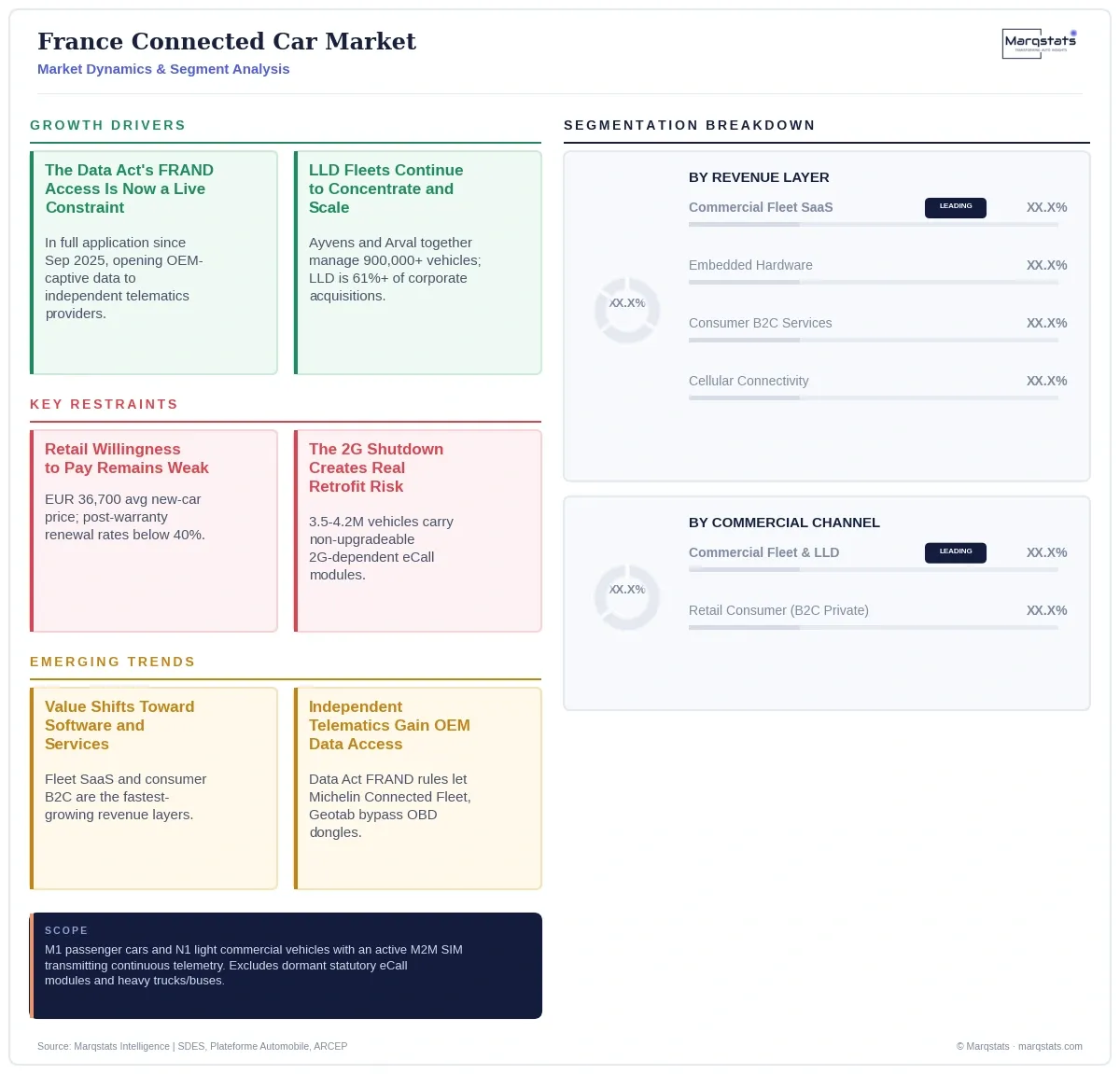
- The European Data Act's FRAND access requirement, in full application since 12 September 2025, is now a live constraint on OEM-captive data platforms, opening real commercial opportunity for independent fleet telematics providers such as Michelin Connected Fleet, Geotab France and Webfleet Solutions to ingest normalized vehicle data without proprietary aftermarket OBD hardware.
- Long-term operational leasing continues to concentrate and scale. Ayvens and Arval Service Lease together manage more than 900,000 vehicles in France, and SESAMLLD data shows LLD fleets account for over 61% of all corporate vehicle acquisitions, sustaining commercial telematics demand independent of retail consumer sentiment.
- Statutory greening quotas under the Loi d'Orientation des Mobilités require enterprise fleet operators to report emissions and track electrification milestones, sustaining structural demand for specialized compliance-grade telematics platforms regardless of broader connected-services monetization trends.
- Stellantis and Renault Group are both executing centralized software-defined-vehicle platform transitions — STLA Brain and Ampere's OpenR Link respectively — that consolidate distributed ECUs into domain and zonal architectures capable of supporting over-the-air monetization at scale.
- The Next-Generation eCall mandate under Commission Delegated Regulation (EU) 2024/1180, effective for all new vehicle types from January 2026, is forcing a wholesale transition to 4G/5G packet-switched telematics hardware, directly benefiting Tier-1 suppliers Valeo and ACTIA Group as automakers replace legacy circuit-switched modules across new model lines.
Key Restraints
Four constraints stand between the market and a fully monetized connected fleet.
- Retail consumer willingness to pay for connected services is structurally weak. With average new-car transaction prices reaching EUR 36,700 — up 70% over twelve years, outpacing wage inflation — and 74% of French consumers viewing a new-car purchase as an excessive financial burden, post-warranty subscription renewal rates for consumer connected services fall below 40%.
- Free smartphone-mirroring platforms remain a fully adequate substitute for the navigation and media features consumers actually use daily, giving Apple CarPlay and Android Auto continued structural pricing power over any OEM connected-services subscription that does not offer a capability a phone genuinely cannot replicate.
- The 2G shutdown creates real near-term obsolescence risk that hardware retrofit capacity may not match. An estimated 3.5 to 4.2 million operating vehicles carry embedded modems that cannot receive over-the-air firmware updates to support VoLTE, and unless dealer-level retrofit programmes scale faster than the phased national shutdown schedule, some share of this population will permanently lose connectivity rather than transition.
- Protracted legal disputes over FRAND licensing terms under the European Data Act could delay, rather than accelerate, third-party data access in practice — the research pack's own Network Sunset Friction scenario treats unresolved FRAND litigation as a compounding risk alongside the cellular transition, not an independent one.
Key Trends
Four shifts show where the market is heading and who captures the value.
- Value creation is shifting decisively toward recurring software and services. Commercial fleet SaaS and consumer B2C services are this market's two fastest-growing revenue layers, while embedded hardware revenue grows only modestly across the forecast window as new-vehicle registration volume remains structurally suppressed.
- Independent telematics providers are gaining structural access to OEM data for the first time. The European Data Act's FRAND provisions are enabling Michelin Connected Fleet, Geotab France and Webfleet Solutions to bypass proprietary Extended Vehicle server environments such as Mobilisights and Mobilize, reducing dependence on physical aftermarket OBD dongles.
- Cooperative intelligent transport systems infrastructure is scaling along France's toll motorway network. SANEF, APRR and VINCI Autoroutes have deployed roadside units across more than 3,000 kilometres of national toll motorways under the SCOOP@F and C-ROADS France programmes, supervised by DGITM and Cerema.
- Software-defined-vehicle architecture consolidation is accelerating through cross-industry partnerships. Renault's Flexis SAS joint venture with Volvo Group and CMA CGM, building modular connected electric delivery vans at Sandouville, exemplifies a broader shift toward shared SDV platforms that spread engineering cost across multiple industrial partners.
Strategic Implications
- Automakers and dealer networks should treat hardware retrofit capacity as an urgent, live operational priority rather than a completed transition. With Orange's 2G shutdown roughly midway through its phased national rollout as this analysis is being prepared, the window to retrofit at-risk 2018-2023 vehicles before their specific department loses 2G coverage is closing in real time, not already closed.
- Independent telematics and insurance providers should move now to build on European Data Act FRAND access rather than waiting for litigation to resolve every edge case — the access right has been in full application since September 2025, and providers that build integration capability early gain a structural head start over competitors waiting for perfect legal clarity.
- Fleet leasing companies and enterprise operators should price telematics explicitly against LOM greening-quota compliance costs and the 8% to 12% documented operating-expense savings from driver-behaviour and fuel-consumption telemetry, since this is the commercial logic actually driving the 85%-plus penetration rate in the LLD segment, not a generic connectivity pitch.
- Consumer-facing OEMs should concentrate post-warranty subscription monetization on features genuinely absent from smartphone mirroring — remote security monitoring, digital key sharing, over-the-air performance unlocks — rather than navigation or media features, given renewal rates below 40% on undifferentiated bundles.
Market Segmentation
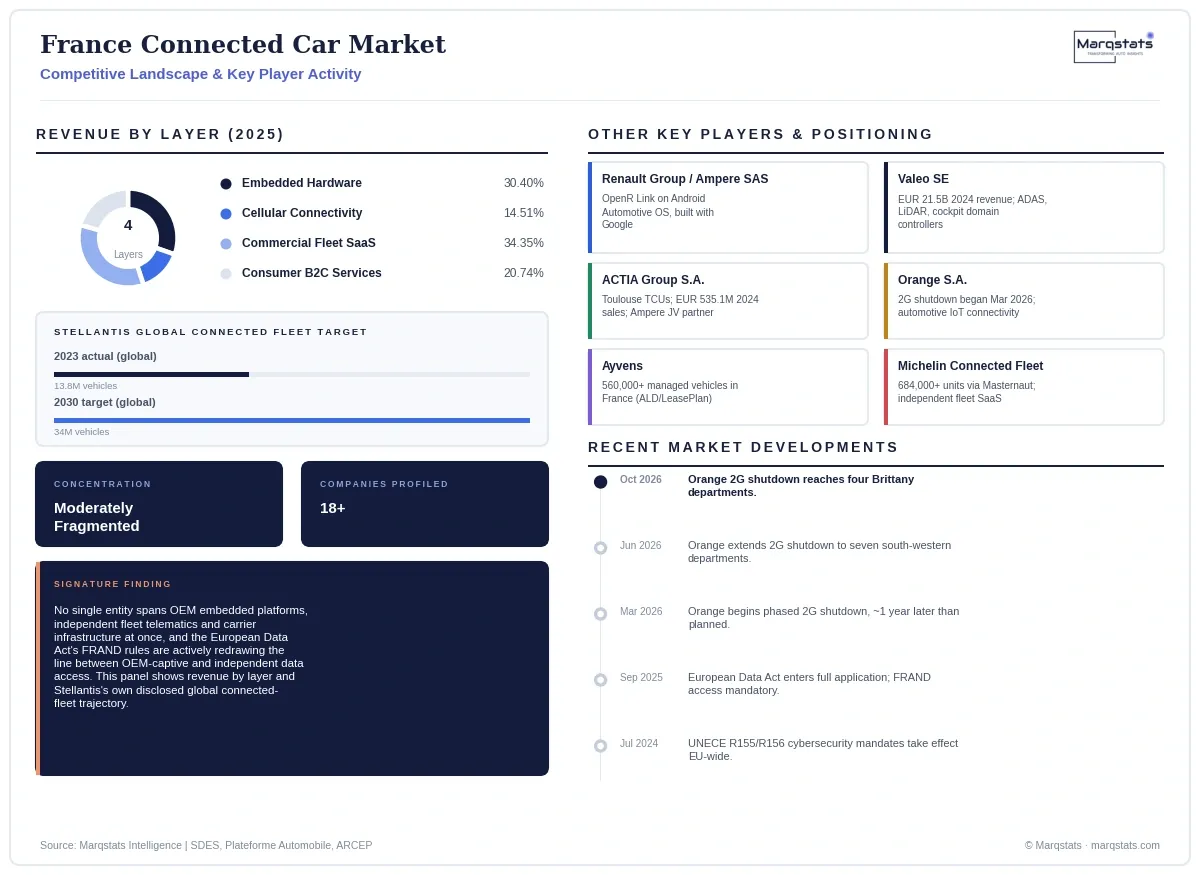
The largest revenue layer at USD 442.90 million in 2025, growing at 9.25% a year to USD 689.41 million by 2030. Priced per managed vehicle across long-term leasing and corporate fleets, this layer is anchored by Ayvens, Arval Service Lease and specialized platforms including Michelin Connected Fleet and Geotab France.
USD 391.90 million in 2025, the slowest-growing layer at 3.08% a year to USD 456.03 million by 2030, reflecting France's structurally suppressed new-vehicle registration volume relative to pre-2019 levels.
USD 267.45 million in 2025, the fastest-growing layer at 15.62% a year to USD 552.64 million by 2030, growing off a small base as post-trial subscription conversion gradually improves despite renewal rates below 40%.
The smallest layer at USD 187.05 million in 2025, growing to USD 265.61 million by 2030 at 7.26% a year, priced on wholesale M2M SIM tariffs averaging EUR 1.80 per month per active connection.
Active telematics penetration of 85% to 92% of operating fleet vehicles, priced at EUR 12.00 to EUR 22.00 per vehicle per month on 36-to-48-month leasing-aligned contracts. Core use cases include fuel and energy tracking, eco-driving scoring and remote tachograph compliance, driven by Loi d'Orientation des Mobilités greening quotas.
Active paid penetration of only 35% to 42% of the retail parc, priced at EUR 4.00 to EUR 9.00 per vehicle per month following a bundled promotional trial. Core use cases centre on remote cabin preconditioning, digital door unlock and navigation, driven by regional Low-Emission Zone (ZFE-m) access requirements rather than discretionary convenience spending.
By Geography
Île-de-France
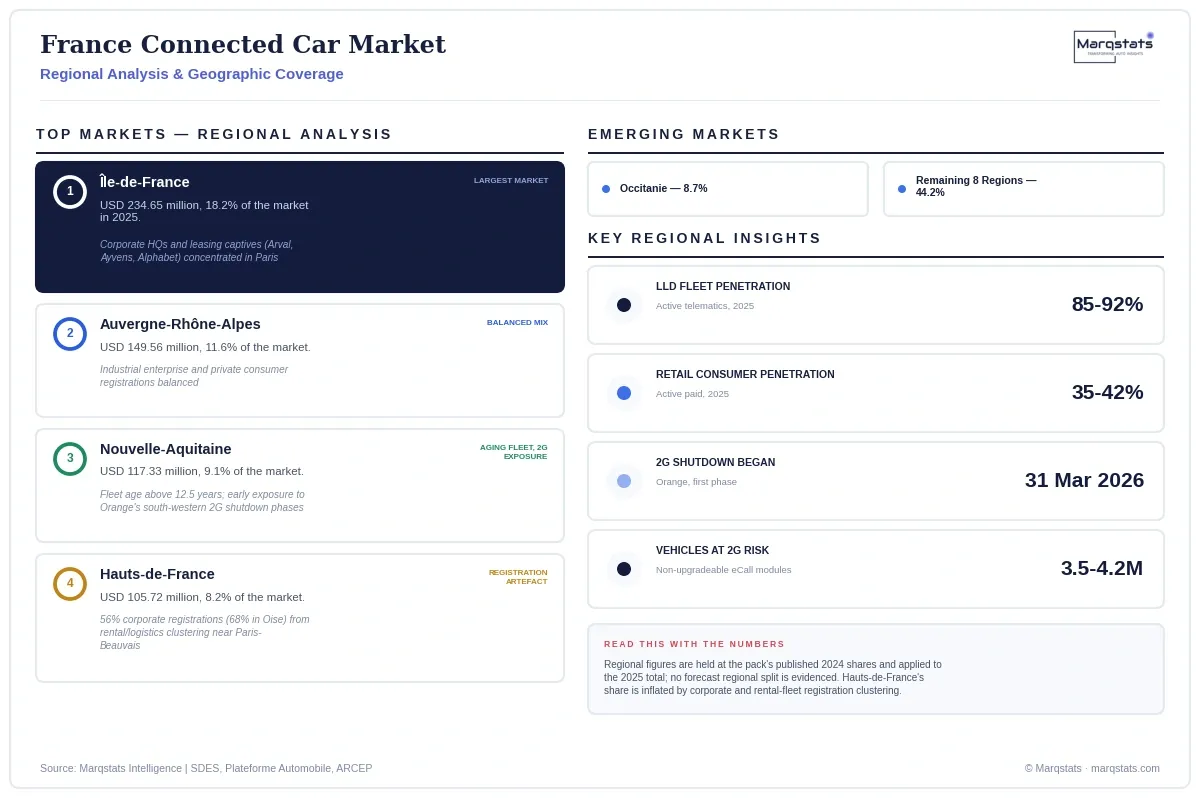
The dominant regional market at USD 234.65 million, 18.2% of national value in 2025, reflecting the concentration of corporate headquarters, financial institutions and long-term fleet management companies — including Arval, Ayvens and Alphabet — within the Paris metropolitan area.
Auvergne-Rhône-Alpes
USD 149.56 million, 11.6% of national value, reflecting a balanced mix of industrial enterprise fleets and private consumer registrations.
Nouvelle-Aquitaine
USD 117.33 million, 9.1% of national value, dominated by commuter and rural private retail registrations across a fleet averaging above 12.5 years old — among the regions most exposed to 2G-related connectivity loss as Orange's shutdown reaches south-western departments.
Occitanie
USD 112.17 million, 8.7% of national value, spanning commuter and agricultural commercial vehicle parcs across a fleet age profile similar to Nouvelle-Aquitaine's.
Hauts-de-France
USD 105.72 million, 8.2% of national value — a figure substantially inflated by administrative registration clustering rather than local retail demand. Corporate entities account for 56% of all new registrations in the region, rising to 68% within the Oise department, because short-term rental companies and logistics operators near Paris-Beauvais Airport register fleets there for processing and tax efficiency.
Remaining 8 Regions Combined
USD 569.88 million, 44.2% of national value across Grand-Est, Brittany and the remaining metropolitan regions, several of which carry both above-average fleet age and direct exposure to Orange's staged 2026 2G shutdown, including a specifically dated 6 October 2026 completion across four Brittany departments.
How Competition Is Evolving
Competition runs on three largely separate axes. On OEM embedded platforms, Renault Group's Ampere-built OpenR Link (developed with Google on Android Automotive OS) and Stellantis's STLA Brain, SmartCockpit and AutoDrive stack (built with Foxconn, Amazon Web Services and BMW Group) compete for the domestic consumer and fleet relationship, while Volkswagen Group France, BMW Group France, Mercedes-Benz France and Tesla France SARL compete as major importers with their own connected platforms.
On commercial fleet telematics, Michelin Connected Fleet (incorporating Masternaut, more than 684,000 units), Free2move SAS and Geotab France compete against Stellantis's own Mobilisights data-monetization unit for independent multi-brand fleet business — a contest the European Data Act's FRAND provisions have structurally shifted toward the independents since September 2025.Company car or personal car: which one gets the connected features first in France?
On network infrastructure, Orange S.A., SFR (Altice France) and Bouygues Telecom compete for automotive M2M wholesale contracts while simultaneously managing the operational and reputational risk of their respective 2G and 3G shutdown timelines — Orange furthest along with its phased 2026 rollout, SFR and Bouygues both targeting end-2026 for 2G. Free Mobile, lacking its own 2G radio access network, remains structurally dependent on Orange's wholesale roaming agreement.
Companies Covered
The report profiles 18+ companies with full strategy and financials analysis, including:
Recent Market Activity
Table of Contents
Coverage & Segmentation
This report measures passenger cars (Category M1) and light commercial vehicles (Category N1) operating in France that transmit continuous commercial telemetry over an active cellular machine-to-machine SIM, across a 2025 base year and a 2026 to 2030 forecast period, denominated in United States dollars at a constant EUR 1.00 = USD 1.0850 exchange rate, the European Central Bank's reference standard. It excludes dormant statutory eCall modules that establish no persistent data session, and excludes heavy trucks, buses and coaches beyond the M1/N1 vehicle classes.
The analysis spans two segmentation dimensions — revenue layer and commercial channel — six regional geographies, and 18 profiled entities across regulators, automakers, telecommunications operators and telematics providers. Registration and fleet-census figures are primary, sourced directly from SDES and the Plateforme Automobile / CCFA; market value and the four-layer revenue split are taken directly from the underlying research pack's own 2025 figures, while the active connected parc for 2025 is a Marqstats interpolation between the pack's confirmed 2024 and 2030 figures.