Market Snapshot
Key Takeaways
Market Overview & Analysis
Report Summary
Indonesia's connected car market is measured across factory-installed hardware, aftermarket commercial capex, cellular data backhaul, and recurring B2B/B2C SaaS fees, valued at USD 312.40 million in 2025. The market's central dynamic is a split personality: a consumer passenger segment where connectivity is bundled into the purchase price and largely abandoned once the free trial ends, and a commercial fleet segment where telematics is a documented, fast-payback operating expense enterprises actively choose to keep paying for.
Structurally, this is a market shaped by geography and regulation as much as by consumer or enterprise demand. Continuous cellular coverage across an archipelago of more than 17,000 islands is a genuine infrastructure achievement Telkomsel and its competitors have had to solve before any commercial telematics business could exist at all; and the Ministry of Transportation's PM 60/2019 and SUMBA e-Manifest mandates give commercial fleet telematics a regulatory floor consumer connectivity simply does not have.
The analysis is built for four reader types making different decisions: an automaker deciding how much to invest in post-trial consumer subscription conversion versus accepting hardware-embedded monetization as the ceiling, a fleet telematics provider prioritizing mining and extraction corridors over fragmented general freight, a telecommunications carrier planning eSIM and M2M infrastructure investment across the archipelago, and an investor assessing how much of this market's 2030 trajectory actually depends on a single regulatory integration — linking SUMBA compliance to mandatory vehicle inspections — materializing on schedule.
Indonesia Connected Car Market Size and Forecast
Marqstats builds the Indonesia figure directly from the underlying research pack's own confirmed 2025 baseline, itself reconciled from GAIKINDO wholesale delivery data, Korlantas Polri fleet statistics, and documented commercial fleet economics. The pack's own three-scenario forecast — Baseline, Expansionary and Constrained — each ties a specific USD 2030 endpoint to named, falsifiable trigger conditions rather than a single blended growth assumption.
Under the Baseline Scenario, market value grows from USD 312.40 million in 2025 to USD 492.60 million by 2030, a 9.53% CAGR, assuming domestic wholesale volumes stabilize between 850,000 and 1,000,000 units annually and NEV penetration reaches 35% of national sales by 2030. This is the trajectory used as this analysis's central case throughout.
The gap between the pack's three scenarios is unusually wide relative to other markets in this coverage set — USD 378.2 million (Constrained) to USD 615.4 million (Expansionary) by 2030, a spread of more than 60% around the Baseline figure. That width reflects genuine uncertainty concentrated in two variables specifically: whether SUMBA e-Manifest enforcement extends to mandatory vehicle inspections, and whether NEV penetration clears 50% rather than stalling near 35%, both binary-feeling policy and market outcomes rather than continuous variables a forecaster can smoothly interpolate between.
The 10% Club: Why So Few Connected Cars Stay Connected
Roughly 2.3 million new passenger vehicles carrying factory-fit telematics — Toyota T-Intouch, Hyundai Bluelink, Wuling WISE, Honda CONNECT — were delivered in Indonesia between 2021 and 2025. Fewer than 185,000 of those vehicles maintain an active, paid subscription beyond their complimentary trial period, which runs one year for Honda and three years for Toyota and Hyundai. That is a post-trial retention rate below 10%, and it means most of what automakers publicly describe as their "connected vehicle" base reflects a one-time app pairing at the dealership, not ongoing engagement.
The reasons are structural, not a single fixable pricing problem. Apple CarPlay and Android Auto deliver the navigation and media features most owners actually use, at zero marginal cost; Indonesian consumers show broad resistance to recurring software fees on hardware they already paid for once; and dealership networks, financially incentivized toward mechanical service revenue, have limited commercial reason to push digital subscription renewals. Toyota's IDR 750,000 annual fee — about USD 42 — is a genuinely small amount in absolute terms, which makes the sub-10% conversion rate a demand problem, not an affordability one.Why 90% of Indonesia's connected cars stop being connected.
Mining Fleets Pay for Telematics. General Freight Mostly Doesn't.
The gap between commercial telematics segments is even starker than the consumer-versus-commercial split. Extractive mining fleets — coal haulage in East Kalimantan and South Sumatra, nickel operations in Central Sulawesi and North Maluku — run telematics penetration above 95%. General road freight across Java and Sumatra, by contrast, sits below 35%, despite operating under the same PM 60/2019 GPS-tracking mandate on paper.
The difference is enforcement structure and operator economics, not technology availability. Mining contractors impose corporate health, safety and environmental standards that make telematics — AI driver-fatigue cameras, speed tracking, automated geofencing — a condition of doing business on-site, enforced directly by the contracting mining company. General freight, by contrast, is fragmented and dominated by subcontracted owner-operators working on thin margins, who have every incentive to resist digital monitoring that could surface informal operating practices, and no single enforcing counterparty with mining's direct leverage over the vehicles on its sites.Why do mining trucks in Kalimantan trust telematics more than truckers in Java?.
The Registry That Counts Cars That No Longer Exist
Korlantas Polri's national vehicle registry recorded 164,136,793 units in 2024. Cumulative GAIKINDO four-wheeled deliveries over the preceding 15 years, by contrast, total only about 12,800,000 units — a gap the pack itself attributes to Indonesia's administrative de-registration process, which requires an owner to actively file paperwork (penghapusan registrasi ranmor) before a scrapped or permanently non-operational vehicle is removed from the registry.
For anyone sizing the addressable aftermarket telematics opportunity, the practical consequence is direct: a market model built on the raw Korlantas Polri figure will overstate the actual operating four-wheeled fleet by roughly fourfold, since a large share of registered vehicles no longer exist on the road in any meaningful commercial sense. The GAIKINDO-derived cumulative delivery figure, imperfect as a fleet-age proxy, is the more defensible base for aftermarket opportunity sizing specifically.Indonesia says it has 164 million vehicles. It doesn't..
Market Dynamics
Key Drivers
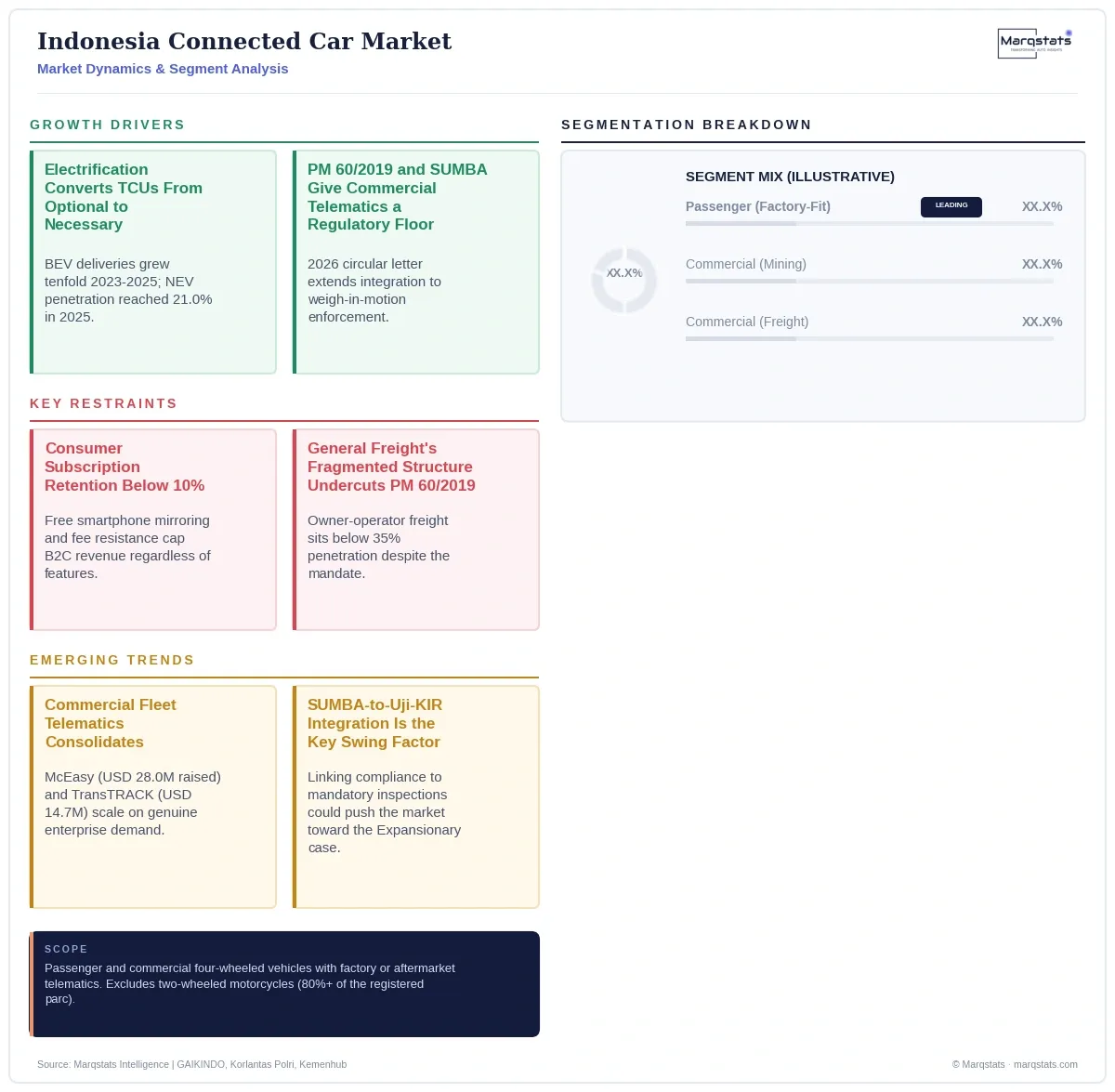
Five conditions are moving this market, and geography and regulation matter as much as demand.
- Vehicle electrification is converting telematics control units from optional equipment into functional necessities, with BEV wholesale deliveries growing tenfold between 2023 and 2025 and combined NEV penetration reaching 21.0% of national wholesale volume in 2025, and climbing further to 24.3% by the first half of 2026.
- The Ministry of Transportation's PM 60/2019 and SUMBA e-Manifest mandates give commercial freight telematics a genuine regulatory floor, with the Directorate General of Land Transportation's 2026 circular letter extending integration requirements to weigh-in-motion enforcement and automated roadside monitoring infrastructure across primary logistics corridors.
- Commercial fleet telematics offers a documented, fast payback: a 50-truck logistics operator recovers hardware and SaaS costs within 3 to 6 months through reduced fuel shrinkage, lower maintenance downtime and automated compliance documentation, a return profile few discretionary technology investments in this market can match.
- Well-capitalized independent fleet SaaS providers are scaling rapidly on genuine enterprise demand rather than subsidized growth: McEasy has raised USD 28.0 million across six funding rounds and TransTRACK USD 14.7 million, both backed by institutional venture investors including East Ventures, Granite Asia and Eurazeo.
- The shift from physical SIM cards to automotive-grade soldered eSIMs is solving a genuine reliability problem specific to Indonesia's tropical operating environment, where socket vibration, contact oxidation and thermal degradation have historically degraded physical SIM connections in engine compartments and truck chassis, particularly across humid coastal and mining regions.
Key Restraints
Four constraints stand between this market and a fully monetized, evenly distributed connected fleet.
- Consumer passenger subscription retention below 10% caps the addressable revenue OEMs can realistically expect from post-trial B2C monetization, regardless of feature investment, given free smartphone-mirroring alternatives and documented Indonesian consumer resistance to recurring software fees.
- General road freight's fragmented, owner-operator-heavy structure means the PM 60/2019 GPS mandate exists on paper without matching enforcement capacity, leaving penetration below 35% on secondary highways despite the formal regulatory requirement.
- The Korlantas Polri-versus-GAIKINDO vehicle parc disconnect — a fourfold gap between the police registry and cumulative actual deliveries — means market-sizing exercises using raw registry figures will substantially overstate the addressable four-wheeled aftermarket telematics opportunity.
- Cross-border telemetry compliance under the UU PDP adds real operational cost for OEMs routing vehicle data to cloud infrastructure in Japan, South Korea or China, requiring demonstrated equivalent data protection or explicit consumer consent for every cross-border transfer.
Key Trends
Four shifts show where the market is heading and who captures the value.
- Commercial fleet telematics is consolidating around fewer, better-capitalized platforms as McEasy and TransTRACK scale enterprise client bases into the thousands while offering increasingly specialized sensor suites — cold-chain probes, axle-load sensors, dual-facing fatigue cameras — tailored to specific logistics verticals.
- OEMs are beginning to integrate telematics with adjacent digital services rather than treating connectivity as a standalone product, exemplified by Toyota-Astra Motor's AstraPay integration for subscription renewal payments.
- Domestic EV manufacturing investment is concentrating in West Java's industrial corridors, anchored by BYD's IDR 11.2 trillion Subang Smartpolitan facility and Hyundai's Cikarang plant, positioning the region as both a production and export hub via the Patimban Deep-Sea Port.
- Regulatory integration is the single largest unresolved trend shaping this market's medium-term trajectory: whether SUMBA e-Manifest compliance becomes a precondition for mandatory periodic vehicle inspections would convert commercial telematics from a compliance-adjacent tool into a legal requirement for operating at all.
Strategic Implications
- Automakers should treat post-trial consumer subscription revenue as a structurally minor, not central, part of their Indonesian connected-vehicle business case, and focus commercial investment on hardware-embedded value and dealer-network digital-payment integration instead of subscription-conversion campaigns with a demonstrated sub-10% success rate.
- Fleet telematics providers should prioritize extractive mining and resource-corridor logistics over general road freight as the near-term growth engine, given the documented enforcement and payback advantages mining operators already provide, while treating general freight as a longer-horizon opportunity requiring regulatory tightening to unlock.
- Telecommunications carriers should continue investing in eSIM/eUICC infrastructure and archipelago-wide M2M coverage specifically, since Indonesia's geographic fragmentation makes connectivity reliability, not feature richness, the binding constraint on nationwide telematics deployment.
- Investors and capital allocators evaluating this market's 2030 trajectory should track the SUMBA-to-Uji KIR regulatory integration specifically as the single highest-leverage variable separating the Baseline and Expansionary scenarios, rather than treating NEV penetration or consumer subscription behavior as the primary swing factors.
Market Segmentation
The underlying research pack contains no formal value-based segment breakdown for Indonesia (no confirmed "% of 2025 market value" table by architecture, vehicle class or functional application), and this coverage does not construct one where no source data exists. What the pack does document is the qualitative and unit-level structure summarized below.
Toyota T-Intouch, Hyundai Bluelink, Wuling WISE and Honda CONNECT together represent the bulk of new factory-fit telematics volume, with roughly 2.3 million connected passenger vehicles delivered between 2021 and 2025. Monetization is concentrated almost entirely at the point of sale, embedded in vehicle MSRP, with post-trial paid retention below 10% — the pack estimates fewer than 185,000 active paid subscribers against that 2.3 million-vehicle base.
Anchored by Mitsubishi Fuso's Runner Telematics (over 84,000 active corporate users managing over 130,000 connected trucks) and independent SaaS providers McEasy and TransTRACK, this segment runs on recurring B2B subscription revenue with retention rates exceeding 90%, driven by documented 3-to-6-month payback from fuel-shrinkage reduction and compliance automation.
Tier-2 microchip, positioning-module and cellular-transceiver suppliers feed Tier-1 integrators including Denso Indonesia and PT Astra Otoparts, which package hardened telematics control units for both OEM factory installation and aftermarket commercial retrofit, priced at IDR 1.2 million to 3.5 million per unit for base commercial hardware.
By Geography
A note on regional structure
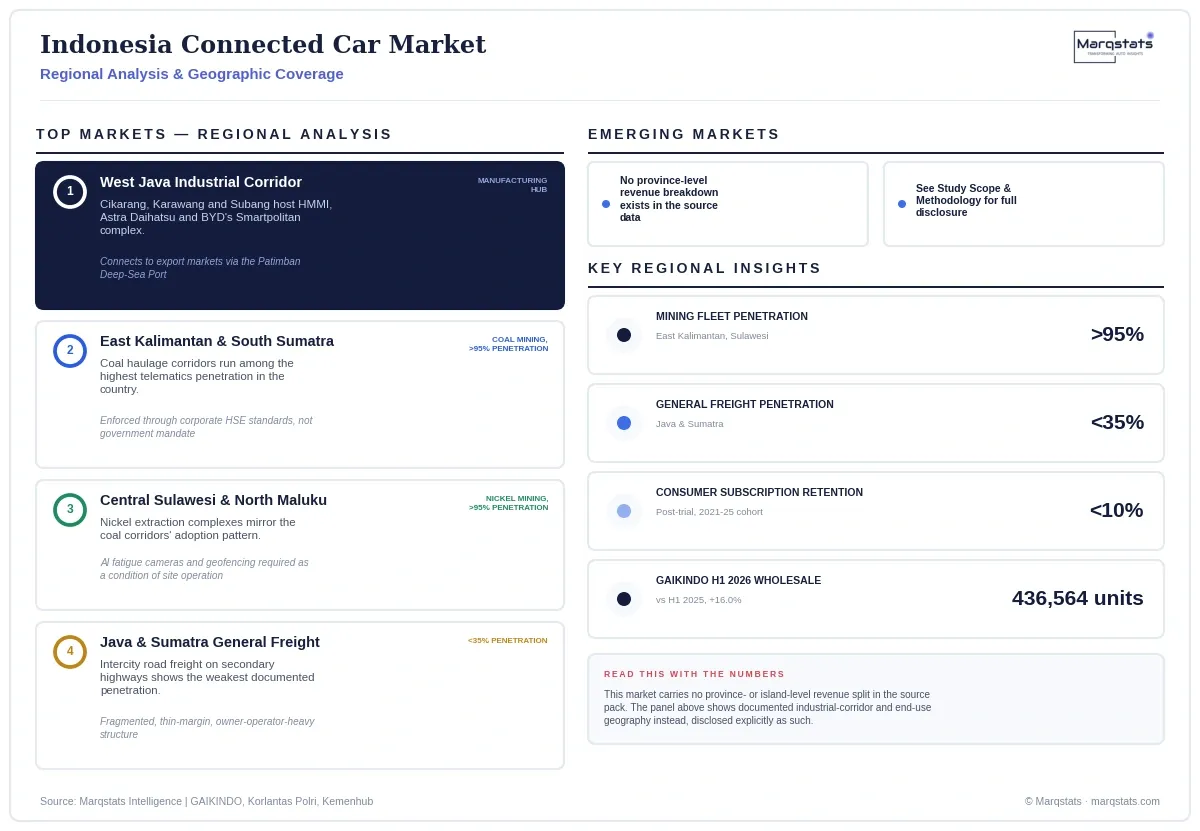
The underlying research pack contains no province-level or island-level revenue breakdown for Indonesia. Its documented geography is industrial-corridor and end-use-sector specific, summarized below.
West Java Industrial Corridor (Cikarang, Karawang, Subang)
Indonesia's connected and electrified vehicle manufacturing base is concentrated here. Cikarang and Karawang host Hyundai Motor Manufacturing Indonesia and Astra Daihatsu Motor alongside battery-cell joint ventures; the emerging Subang Smartpolitan corridor anchors BYD's IDR 11.2 trillion, 150,000-unit-capacity production complex. The corridor connects to export markets via the Patimban Deep-Sea Port, designed to support over 500,000 annual completely-built-up vehicle exports.
East Kalimantan & South Sumatra (Coal Mining Corridors)
Coal haulage operations in these provinces run among the highest telematics penetration rates in the country, exceeding 95% on heavy haulage trucks and specialized machinery, enforced through corporate health, safety and environmental standards rather than government mandate.
Central Sulawesi & North Maluku (Nickel Mining Corridors)
Nickel extraction complexes in these provinces mirror the coal corridors' telematics adoption pattern, with mining contractors requiring dual-facing AI driver-fatigue cameras, speed tracking and automated geofencing as a condition of site operation.
Java & Sumatra General Freight Corridors
General intercity road freight operating on secondary highways across these islands shows the weakest telematics penetration of any documented segment, below 35%, reflecting the fragmented, thin-margin, owner-operator-heavy structure of this part of the logistics sector.
How Competition Is Evolving
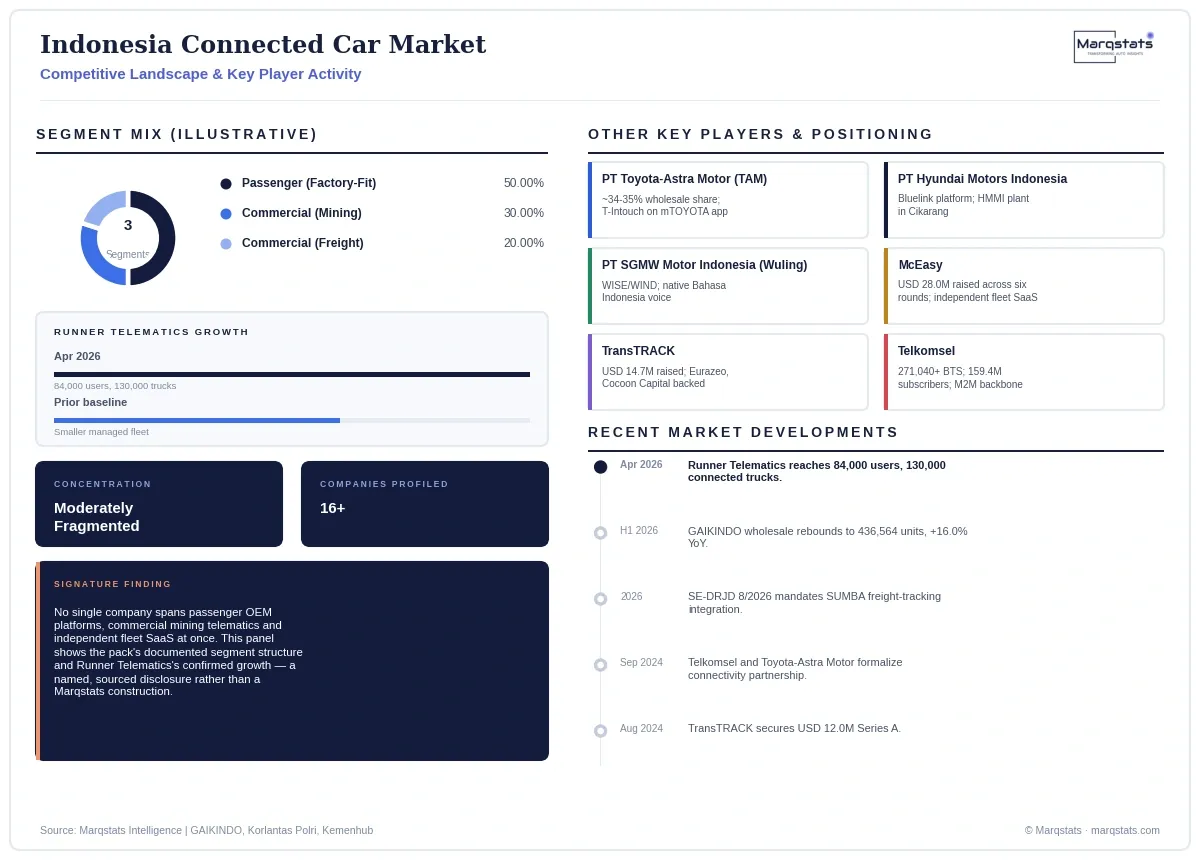
Competition runs on three largely separate tracks. On passenger vehicle OEM platforms, PT Toyota-Astra Motor leads with roughly 34% to 35% of national wholesale volume and its T-Intouch platform on the mTOYOTA app, competing against PT Hyundai Motors Indonesia's Bluelink, PT SGMW Motor Indonesia's WISE/WIND ecosystem (notable for native Bahasa Indonesia voice recognition), and PT Honda Prospect Motor's CONNECT platform, the newest entrant with the shortest complimentary trial period at one year.
On commercial light- and medium-duty truck telematics, PT Krama Yudha Tiga Berlian Motors commands the light-duty segment through Mitsubishi Fuso's roughly 52.9% Canter market share and its Runner Telematics platform, while PT Hino Motors Sales Indonesia competes with Hino Connect across its Dutro and Ranger 500 series, supported by a dealership network of dedicated Hino Telematics Officers.
On independent, multi-brand fleet SaaS, McEasy and TransTRACK compete for enterprise logistics, cold-chain and corporate fleet clients against multinational entrant Cartrack Indonesia (a Karooooo Ltd. operating entity) — all three offering fleet-agnostic platforms that can aggregate mixed-brand commercial fleets in a way single-OEM telematics systems cannot, a genuine structural advantage for corporate clients running genuinely mixed-brand vehicle fleets across sites.
Companies Covered
The report profiles 16+ companies with full strategy and financials analysis, including:
Recent Market Activity
Table of Contents
Coverage & Segmentation
This report measures passenger vehicles and commercial trucks and buses operating in Indonesia that carry factory-embedded or aftermarket telematics hardware, across a 2025 base year and a 2026 to 2030 forecast period, denominated in United States dollars at a constant IDR 17,687/USD exchange rate. It excludes two-wheeled motorcycles, which constitute more than 80% of the country's registered vehicle parc.
The analysis spans the pack's own documented segment and regional distinctions — disclosed as qualitative and unit-level rather than a formal revenue split — and 16 profiled entities across automakers, commercial vehicle telematics providers, independent fleet SaaS platforms and telecommunications carriers. Vehicle sales trace to GAIKINDO; fleet-registry figures trace to Korlantas Polri; market value and its three forward scenarios are taken directly from the underlying research pack's own confirmed 2025 figures.