Market Snapshot
Key Takeaways
Market Overview & Analysis
Report Summary
The Asia Pacific connected car market is being reshaped by who owns the network line, not only by who builds the modem. In South Korea, automakers registered as mobile virtual network operators and now sell 7,340,000 of the country's 9,582,898 vehicle IoT lines (76.59%), leaving the three carriers, SK Telecom Co., Ltd., KT Corporation and LG Uplus Corp., with 23.41%. That is not a story of carriers shrinking. Their own lines grew 43.8% since 2018. It is a story of a market that grew 435% while they kept the wholesale pipe and lost the customer. The same question, who owns the subscriber, now decides how the USD 13.61 billion regional market splits between hardware, airtime and software.
Marqstats measures new connected vehicles: passenger cars and light commercial vehicles leaving the factory or the showroom in a calendar year with a type-approved embedded cellular modem, an eSIM and a vehicle network interface. The value measure adds factory-gate telematics hardware, cellular connectivity airtime and software and service subscriptions at nominal United States dollar rates. The study excludes smartphone-mirroring systems, aftermarket dongles and the stock of older connected vehicles already on the road, which appears only as the 115 million active fleet used to price airtime. Smartphone mirroring is the largest definitional trap in this market: the pack behind this analysis records mirroring in 78.40% of new Asia Pacific cars in 2024 against 66.70% for embedded cellular telematics, so a headline that counts both overstates the connected base by 11.7 percentage points.
The analysis is written for four decisions. A Tier-1 supplier such as Denso Corporation or Robert Bosch GmbH choosing whether to keep funding standalone telematics boxes. A mobile network operator such as KDDI Corporation or China Mobile Communications Group Co., Ltd. deciding whether to compete for automaker connectivity contracts or sell wholesale. An automaker such as Hyundai Motor Company or Tata Motors Limited setting the price at which paid connectivity begins after the complimentary trial. And an investor pricing the shift from hardware revenue to recurring software revenue.
Asia Pacific Connected Car Market Size and Forecast
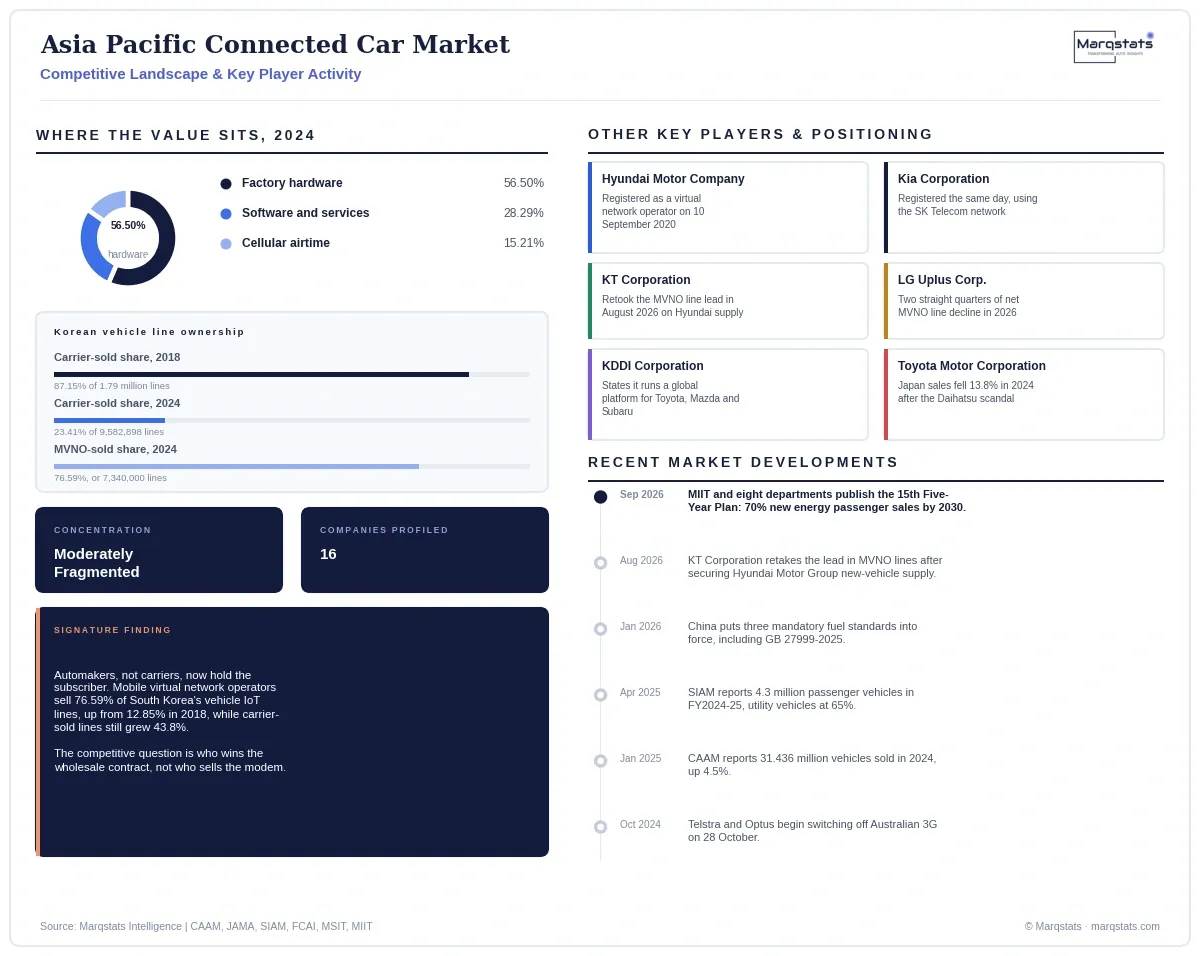
Marqstats builds the market as three layers so that each can be checked. Hardware is 26,990,432 new connected vehicles multiplied by a Marqstats estimate of USD 285 of factory-gate content per vehicle, giving USD 7.69 billion in 2024. Airtime is a Marqstats estimate of 115 million active connected vehicles multiplied by USD 18 of annual airtime revenue each, giving USD 2.07 billion. Software and services are a Marqstats estimate of USD 3.85 billion. The 81.80% China coefficient is a Marqstats construction applied to the CAAM domestic sales series, and it is the input the value panel is most sensitive to. The three layers sum to USD 13.61 billion, split 56.50% hardware, 15.21% airtime and 28.29% software. Marqstats estimates USD 16.17 billion for 2025 and an absolute rise of USD 17.79 billion to 2029.
Units are the primary series and value is derived from them. Volume grows at 9.41% a year and value at 18.20%, and the gap has one mechanism: mix. Hardware content per vehicle rises from USD 285 in 2024 to about USD 395 in 2029 as 5G Release 16 modules and central compute gateways replace 4G units, and the software layer more than doubles. Price per unit does not explain it, because the airtime layer is set by fleet size and a flat USD 18.
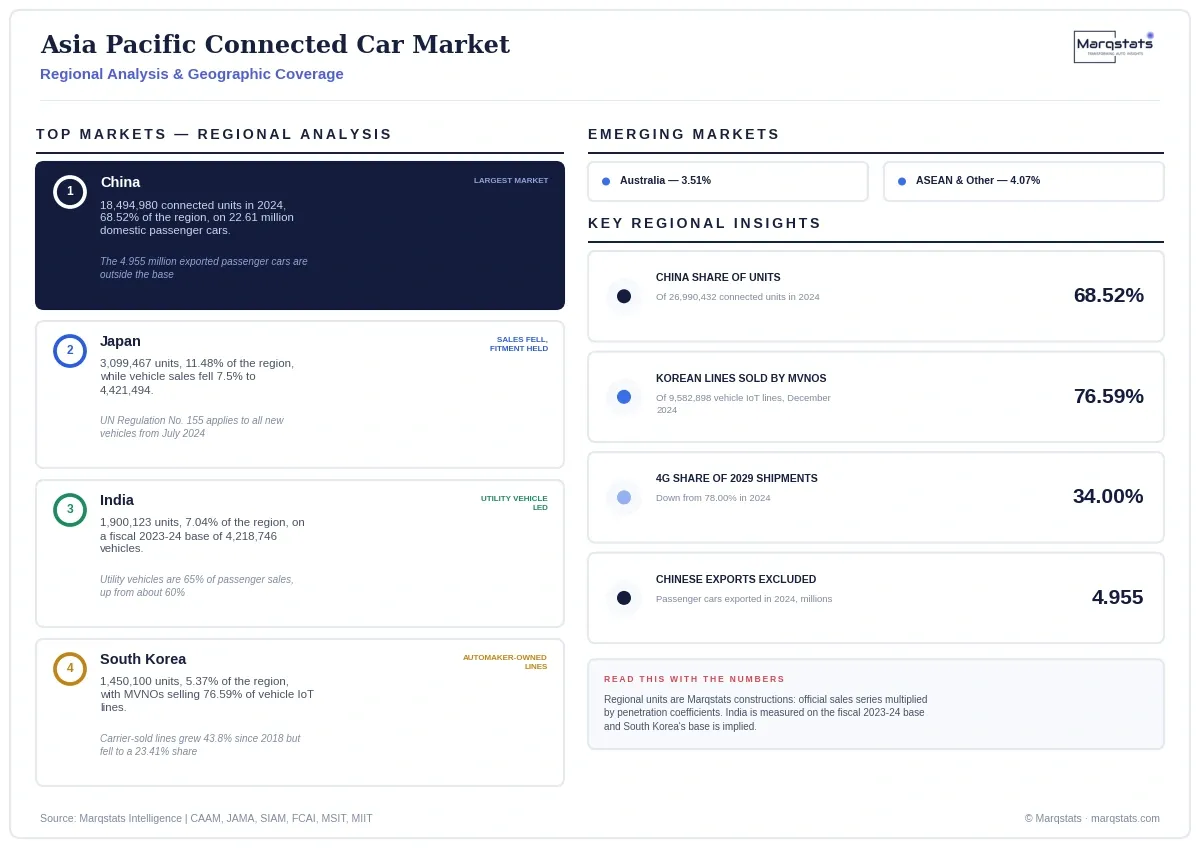
Carrier-sold lines grew 43.8% while their share fell from 87.15% to 23.41%
Marqstats reads the Korean line data as a transfer of the customer relationship, not of network traffic. The Ministry of Science and ICT (MSIT) reported 9,582,898 vehicle IoT lines in December 2024, up from 1.79 million in 2018, a compound rate of 32.26% a year. Of the December 2024 total, 7,340,000 lines were MVNO lines and 2,242,898 were carrier-sold. In 2018 the split was 1.56 million carrier-sold and 0.23 million MVNO (12.85%). Subtracting one from the other shows carrier-sold lines rose by 682,898, or 43.8%, while MVNO lines rose 31.9-fold.
The mechanism is dated and documented. On 10 September 2020 MSIT announced that Hyundai Motor Company and Kia Corporation had changed their registration to mobile virtual network operators, with Hyundai using the KT Corporation network and Kia using the SK Telecom Co., Ltd. network. That announcement put the lines of the two largest Korean automakers on carrier networks under automaker billing. KT's own lines then fell 67.5%, from 800,000 to 260,000, while SK Telecom rose 179.63% to 1,510,000 and LG Uplus Corp. rose 125.00% to 450,000.
The consequence is that a carrier competing for connected car business in Korea is competing for wholesale volume, not for drivers. A supplier or operator that plans around carrier-direct share is planning around 23.41% of the market. The lines of the three carriers sum to 2,220,000 against a 2,242,898 carrier-sold total, so 22,898 lines are unallocated in the published series. Marqstats does not attribute them to any carrier. The full line-by-line history is set out in the Marqstats analysis Who owns the connected car customer in South Korea?.
The China number rests on one base that most sources mix
China contributes 18,494,980 of 26,990,432 connected units, or 68.52%, and the choice of base moves the whole regional total. CAAM reported 27.563 million passenger car sales in 2024, of which 22.61 million were domestic and 4.955 million were exports. Marqstats applies its 81.80% fitment coefficient to the domestic figure only. Applying it to the full 27.563 million would have added 4.05 million units and USD 1.16 billion of hardware revenue, and would overstate the region by 15.0%.
The correction matters because exported vehicles are built to destination-market specifications and are frequently activated on foreign networks. A reader who sums Chinese production against an embedded-modem coefficient measured on domestic buyers is counting vehicles whose connectivity is delivered, billed and regulated elsewhere. Marqstats treats the Chinese export fleet as a supply chain story, not a Chinese connected car market story.
China's policy pull is real and current. On 11 September 2026 the Ministry of Industry and Information Technology (MIIT), with eight other departments, published the 15th Five-Year Plan for the Development of the Intelligent Connected New Energy Vehicle Industry (MIIT Joint Regulation Letter [2026] No. 305). It sets 2030 targets of 70% new energy share in passenger car sales and 40% in commercial vehicle sales. MIIT also reported that combined driver-assistance penetration in domestic passenger cars reached 64.9% in 2025 against a 2020 level of 16.2%. The definitional ladder from 31.436 million to 22.61 million is set out in the Marqstats analysis Which China car count should a connected car model use?.
Value grows at nearly twice the rate of volume, and the software layer explains it
Marqstats models the software and service layer at USD 3.85 billion in 2024 and USD 9.98 billion in 2029, a 2.59-fold rise. The base correction to China changes units and hardware, not this layer. The infotainment, navigation and over-the-air category grows 25.70% a year against 12.82% for safety and security services, and it becomes the largest service category by 2029 at 38.98% of value.
The counter-argument is strong and stays in the analysis. Paid conversion after the complimentary trial is the weakest link in the software case. Hyundai Motor Group reported 10 million global connected subscribers in June 2023 and targets 20 million by the end of 2026. That target needs 238,095 net additions a month for 42 months, a compound rate of 21.90% a year. Group disclosures count subscribers registered, not subscribers paying, so a rising subscriber count does not by itself confirm the paid revenue that the software layer assumes.
Market Dynamics
Key Drivers
Five conditions move this market, and regulation and platform decisions matter more than consumer demand.
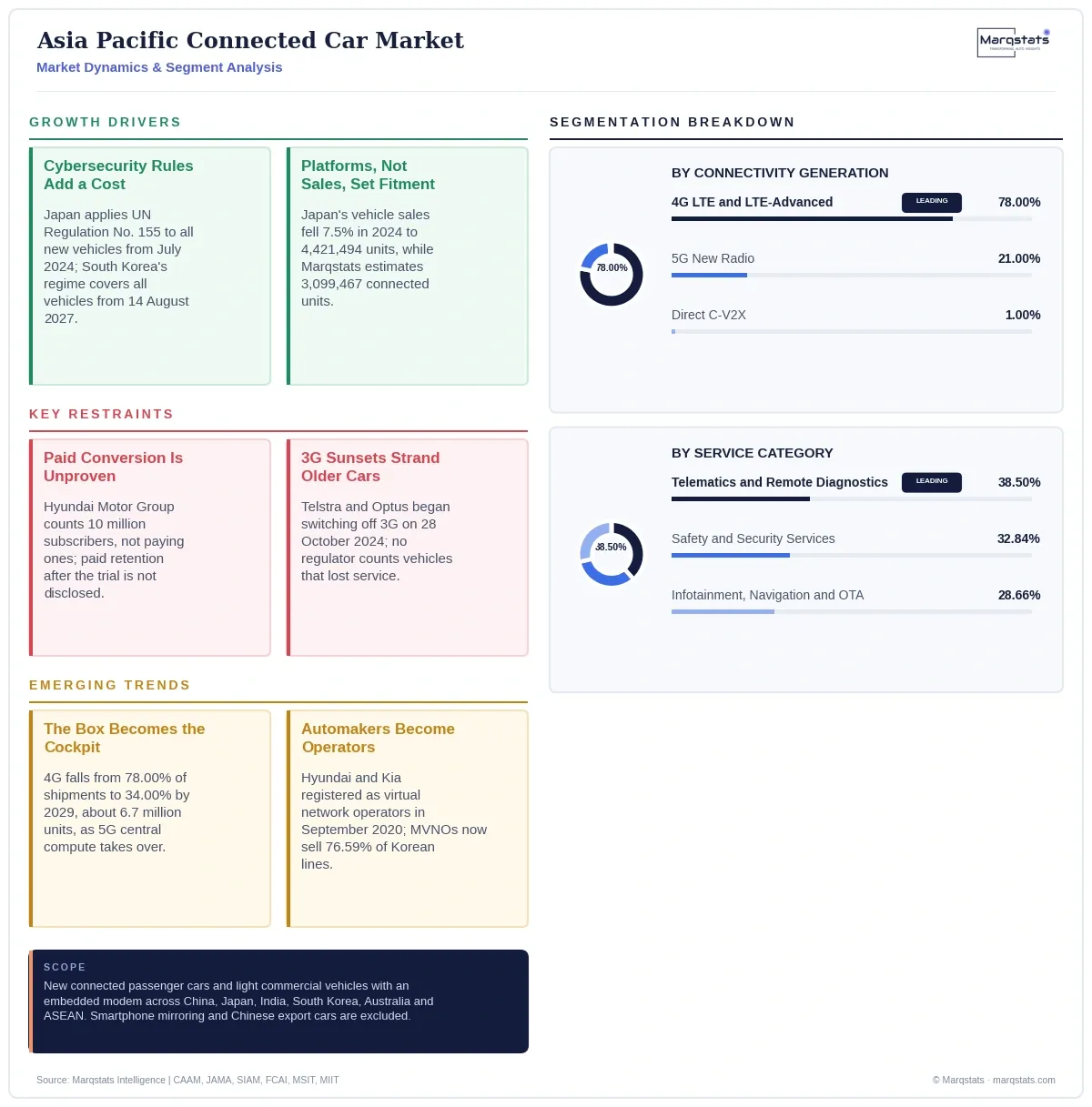
- Cybersecurity regulation adds a compliance cost to every connected vehicle, on different dates in each market. Japan applies United Nations Regulation No. 155 to new vehicle types from July 2022 and to all new vehicles from July 2024, with a later date of May 2026 for vehicles without over-the-air functionality. South Korea applies a national regime to new vehicle types from 14 August 2025 and to all vehicles from 14 August 2027. The rule requires a certified cybersecurity management system, not a modem, but a vehicle with a cellular modem cannot be sold without one, so connected features must earn back that cost.
- Installations are following platform decisions rather than the retail cycle. The Japan Automobile Manufacturers Association (JAMA) recorded a 7.5% fall in Japanese vehicle sales in 2024, to 4,421,494 units, after the Daihatsu certification scandal, while Marqstats estimates 3,099,467 connected units at a 70.10% fitment coefficient. A coefficient set at platform level is consistent with Toyota Motor Corporation, Honda Motor Co., Ltd. and Nissan Motor Co., Ltd. fitting the same Data Communication Module across compact vehicles, and it means connected volumes fall more slowly than sales when a market contracts.
- China's industrial policy raises the floor on intelligent connected content every five years. The 15th Five-Year Plan (MIIT Joint Regulation Letter [2026] No. 305) targets 70% new energy share of passenger car sales by 2030, and the 2025 driver-assistance penetration of 64.9% already exceeded the 50% target set in Roadmap 2.0 by 14.9 percentage points. Domestic automakers such as BYD Company Limited and Zhejiang Geely Holding Group Co., Ltd. build the connected cockpit as a core product feature.
- The utility vehicle shift carries embedded telematics into India. The Society of Indian Automobile Manufacturers (SIAM) reported 4.3 million passenger vehicles in fiscal year 2024-25, up 2%, with utility vehicles at 65% against about 60% the year before. Marqstats estimates 45.04% embedded fitment on the fiscal 2023-24 base, concentrated in nameplates from Mahindra & Mahindra Limited, Tata Motors Limited and Hyundai Motor India.
- Fuel-consumption regulation raises the value of powertrain data in China. Three mandatory standards took effect on 1 January 2026, including GB 27999-2025 on passenger car fuel consumption, which the Ministry of Industry and Information Technology plan pairs with a 3.3 litre per 100 kilometre fleet target for 2030. The standard does not require connectivity. It raises the return on remote diagnostics and over-the-air calibration, which are connected services.
Key Restraints
Four constraints stand between the market and the software-led value case its forecast assumes.
- Paid conversion after the complimentary trial is unproven. Automakers bundle multi-year trials with new vehicles, and no group discloses how many owners keep paying afterwards. Hyundai Motor Group's June 2023 milestone counts 10 million subscribers, not paying subscribers. Until a named group discloses paid retention, the USD 3.85 billion software layer is an estimate resting on assumptions about behaviour that nobody has published.
- Every ASEAN market except Singapore and Malaysia treats the embedded modem as an option. The ASEAN Automotive Federation reported 3,350,000 vehicle sales in 2024, and Marqstats estimates 24.40% fitment on a 4.5 million base that adds other Asia Pacific markets to ASEAN. Indonesia and Thailand entry cars prioritise smartphone mirroring over embedded cellular hardware, so the regional average hides a two-speed market.
- The 3G sunset strands older connected vehicles, and the size of the loss is not measured. TPG Telecom Limited closed its Vodafone 3G network in January 2024, and Telstra Corporation Limited and Optus began switching off 3G in Australia on 28 October 2024. Hyundai, Kia and Genesis required software updates to keep emergency calling working, while Toyota, Mazda, MG, Mercedes-Benz, BYD and Honda confirmed no impact on their telematics systems. No regulator publishes a count of vehicles that lost service, so Marqstats does not quantify the loss.
- Data-residency rules split the software stack by country. China requires vehicle telemetry, mapping and identity data to sit on local cloud nodes under laws overseen by the Cyberspace Administration of China, so a multinational automaker maintains a separate stack for China. That duplicates engineering cost and blocks a single regional software platform, which caps the scale economics the software layer relies on.
Key Trends
Four shifts show where the market is heading and who benefits.
- The standalone telematics box is being absorbed into the cockpit computer. Marqstats estimates 4G LTE units fall from 78.00% of 2024 shipments to 34.00% by 2029, losing about 6.7 million units, while central compute units that combine infotainment, telematics and driver-assistance perception replace four boxes with one. Suppliers such as Denso Corporation and Desay SV Automotive Co., Ltd. are repositioning towards zonal controllers.
- Automakers are becoming network operators. Beyond Hyundai Motor Company and Kia Corporation in South Korea, KDDI Corporation states that it runs a Global Communication Platform for Toyota, Mazda and Subaru fleets. The direction is consistent across both markets: the automaker keeps the customer and rents the network.
- Direct vehicle-to-everything communication moves first in China. Marqstats estimates direct C-V2X reaches 5.00% of 2029 shipments from 1.00% in 2024, a rate of 50.96% a year. The 15th Five-Year Plan pairs market-access pilots for intelligent connected vehicles with vehicle-road-cloud integration trials, which gives Chinese roadside deployment a policy schedule that Japan and ASEAN, with no statutory 5.9 GHz allocation in the pack evidence, do not yet have.
- Chinese cockpit platforms are now built as core product features. Geely Flyme Auto, BYD DiLink, SAIC Zebra OS and Huawei HarmonyOS Cockpit put the connected layer inside the vehicle operating system, which favours domestic automakers that control the whole stack over suppliers that sell a standalone box.
Strategic Implications
- Entrants should design for the cockpit computer, not the telematics box. With 4G units losing about 6.7 million volumes by 2029 and 5G New Radio growing 35.42% a year, capital placed in standalone 4G hardware is capital placed in the shrinking layer. A supplier entering South Korea also has to plan for the fact that 76.59% of vehicle lines are billed by automakers, so the buyer is the automaker's connectivity team and not the carrier.
- Incumbent automakers should treat the end of the trial period as the decisive commercial event, and price it before the subscriber count becomes a headline. Hyundai Motor Group needs 21.90% compound subscriber growth to reach its 20 million target by the end of 2026. Reporting paid subscribers alongside registered ones would turn a milestone into evidence, and would settle the question the software layer depends on.
- Suppliers and investors should test China exposure against the domestic base. A revenue plan that applies an embedded-modem rate to all 27.563 million passenger cars CAAM reported for 2024 overstates the base by about 4.05 million units. Capital is better placed with software providers supplying automotive cybersecurity for United Nations Regulation No. 155, remote eSIM provisioning and vehicle data services, where revenue does not depend on unit fitment alone.
- On trajectory, Marqstats expects the market to reach USD 31.40 billion in 2029 with high confidence in direction and moderate confidence in level. The direction rests on regulation already in force. The level rests on three constructions: the 81.80% China fitment rate, USD 285 of hardware content per vehicle and the 115 million active fleet. The first indicator to watch is the Hyundai Motor Group subscriber disclosure at the end of 2026.
Market Segmentation
4G is the incumbent and the shrinking segment. It carried 21,052,537 units in 2024, 78.00% of the total, and Marqstats estimates it falls to 14,387,406 units and 34.00% by 2029, a decline of 7.33% a year. It holds volume because Cat-1 bis modules cost far less than 5G units, and entry vehicles in India and ASEAN will keep using them. Suppliers of standalone 4G modules such as Quectel Wireless Solutions and Fibocom Wireless Inc. sell into the layer that loses about 6.7 million units in five years.
5G is the challenger and the growth engine. It carried 5,667,991 units in 2024, 21.00% of the total, and Marqstats estimates 25,812,698 units and 61.00% by 2029, growing 35.42% a year. Adoption follows the central cockpit computer: automakers that put infotainment, telematics and driver assistance on one chip specify a 5G modem for the high-bandwidth navigation and over-the-air update load. Qualcomm Incorporated and Huawei Technologies Co., Ltd. supply the platforms.
Direct C-V2X is the third geometry and the least mature. It carried 269,904 units in 2024, 1.00% of the total, and Marqstats estimates 2,115,795 units and 5.00% by 2029, growing 50.96% a year from a small base, so the rate says little about volume. The segment is China-led because roadside units and a 5.9 GHz allocation must exist before a vehicle can use them. Datang Telecom Technology Co., Ltd. and ZTE Corporation are the anchoring suppliers named in the research.
Telematics is the largest category in 2024 and the one most exposed to a slower rate. It earned USD 5.24 billion, 38.50% of value, and Marqstats estimates USD 10.99 billion and 35.00% in 2029, growing 15.97% a year. Demand comes from fleet tracking, remote diagnostics and over-the-air calibration, and the category is anchored by Denso Corporation and KDDI Corporation.
Safety and security is the compliance category and the slowest grower. It earned USD 4.47 billion in 2024, 32.84% of value, and Marqstats estimates USD 8.17 billion and 26.02% in 2029, growing 12.82% a year. Emergency calling, stolen vehicle tracking and cybersecurity monitoring are bought because regulation or insurers require them, and Robert Bosch GmbH and Continental AG supply the hardware.
Infotainment is the category that decides whether the market's value case holds. It earned USD 3.90 billion in 2024, 28.66% of value, and Marqstats estimates USD 12.24 billion and 38.98% in 2029, growing 25.70% a year, which makes it the largest category by the end of the period. The growth depends on paid subscriptions after the complimentary trial, and that conversion is the least evidenced input in the model. TMAP Mobility Co., Ltd. and ECARX Holdings Inc. anchor the category.
By Geography
China
China is where the region's volume, and its largest uncertainty, sit. Marqstats estimates 18,494,980 connected units in 2024, 68.52% of the region, from 22.61 million domestic passenger car sales reported by the China Association of Automobile Manufacturers (CAAM) at an 81.80% fitment coefficient. The Ministry of Industry and Information Technology (MIIT) published the 15th Five-Year Plan for the Development of the Intelligent Connected New Energy Vehicle Industry on 11 September 2026, with 2030 targets of 70% new energy share in passenger car sales. Data-residency law overseen by the Cyberspace Administration of China keeps vehicle telemetry on domestic cloud nodes, so the software stack is built separately for this market.
Japan
Japan is the region's example of connected installations decoupling from the sales cycle. Marqstats estimates 3,099,467 connected units in 2024, 11.48% of the region, at a 70.10% coefficient applied to the 4,421,494 vehicles reported by JAMA, which fell 7.5% that year. Japan applies United Nations Regulation No. 155 to all new vehicles from July 2024, with May 2026 for vehicles without over-the-air functionality, so cybersecurity approval sits on every platform Toyota Motor Corporation, Honda Motor Co., Ltd. and Nissan Motor Co., Ltd. sell.
India
India is a utility vehicle story with a fiscal-year mismatch that Marqstats states rather than hides. Marqstats estimates 1,900,123 connected units, 7.04% of the region, at a 45.04% coefficient on the 4,218,746 passenger vehicles the Society of Indian Automobile Manufacturers (SIAM) reported for fiscal year 2023-24; the calendar 2024 base is not published. SIAM reported 4.3 million passenger vehicles in fiscal year 2024-25 with utility vehicles at 65%, up from about 60%. The Ministry of Road Transport and Highways enforces Automotive Industry Standard 140 (AIS-140) for public fleets, which sets a floor of tracking demand independent of consumer choice.
South Korea
South Korea is the region where the network line is owned by the automaker. Marqstats estimates 1,450,100 connected units in 2024, 5.37% of the region, at an 85.30% coefficient on an implied base of about 1.7 million new passenger vehicles. The Ministry of Science and ICT (MSIT) reported 9,582,898 vehicle IoT lines in December 2024, with 76.59% sold by mobile virtual network operators. MSIT announced on 10 September 2020 that Hyundai Motor Company and Kia Corporation had registered as such operators, using the KT Corporation and SK Telecom Co., Ltd. networks respectively.
Australia
Australia is the region where a network switch-off tested the installed base. Marqstats estimates 947,762 connected units in 2024, 3.51% of the region, at a 76.60% coefficient on the 1,237,287 new vehicles reported by the Federal Chamber of Automotive Industries (FCAI). TPG Telecom Limited closed its Vodafone 3G network in January 2024 and Telstra Corporation Limited and Optus began switching off 3G on 28 October 2024. Hyundai, Kia and Genesis vehicles needed a software update to keep emergency calling, so the sunset hit some connected platforms and not others. A brand-by-brand account is set out in the Marqstats analysis Which connected cars lost service in Australia's 3G shutdown?.
ASEAN and Other Asia Pacific
ASEAN is the region where the average hides two markets. Marqstats estimates 1,098,000 connected units, 4.07% of the region, at a 24.40% coefficient on a 4.5 million base that adds other Asia Pacific markets to the 3,350,000 vehicles the ASEAN Automotive Federation reported for ASEAN in 2024. Singapore and Malaysia run well above the average on urban income, while Indonesia and Thailand entry cars prioritise smartphone mirroring over embedded cellular hardware. Chinese electric vehicle assembly in Thailand and Indonesia is the force that could move the average.
How Competition Is Evolving
Concentration is low at the vehicle level and different in each layer. Marqstats classifies the market as moderately fragmented because the value chain has four layers with different leaders: automakers that own the customer and the platform, carriers and mobile virtual network operators that carry the traffic, Tier-1 suppliers that build the hardware, and technology platforms that write the cockpit software. Group-level connected delivery shares are built in the delivered analysis from named company disclosures, because the counts automakers publish are not comparable, and this page therefore reports structure rather than a league table.
Firms compete on who owns the subscriber, not on the modem. Hyundai Motor Company and Kia Corporation run their own mobile virtual network operator registrations in South Korea. KDDI Corporation states that it operates a global communication platform for Toyota, Mazda and Subaru fleets. In China, domestic automakers such as BYD Company Limited and Zhejiang Geely Holding Group Co., Ltd. build the cockpit and connectivity stack themselves. Tier-1 suppliers such as Denso Corporation and Desay SV Automotive Co., Ltd. compete on how much of the vehicle's compute they absorb.
Position is set by network access, data law and platform control. The clearest signal of a moving order is on the Korean network side: in August 2026 KT Corporation retook the lead among carriers in mobile virtual network lines after securing supply for Hyundai Motor Group's new vehicle lines, while LG Uplus Corp. recorded net declines. That is a carrier competing for an automaker's wholesale contract, and the contract decides its line growth. In China, data-residency rules set by the Cyberspace Administration of China keep foreign platforms out of the data layer.
Companies Covered
The report profiles 16+ companies with full strategy and financials analysis, including:
Recent Market Activity
Table of Contents
Coverage & Segmentation
The analysis sizes new connected vehicles sold in 2024 and forecasts them to 2029, across six geographies: China, Japan, India, South Korea, Australia and a combined ASEAN and other Asia Pacific group. The historical period is 2020 to 2024 and the forecast period is 2025 to 2029, with 2025 shown as the estimated year. Value is stated in nominal United States dollars, converted at constant 2024 average rates of 7.23 yuan, 151.6 yen, 1,365 won and 83.5 rupees to the dollar. It is segmented by connectivity generation and by service category, and 16 companies are profiled. India is measured on the fiscal year 2023-24 base.
Units are the primary series and value is derived from them through three revenue layers. The market excludes smartphone-mirroring systems, uncertified aftermarket dongles, Bluetooth-only systems, portable navigation devices, heavy commercial vehicle telematics, and Chinese passenger cars built for export. The 4.955 million Chinese passenger car exports CAAM reported for 2024 are therefore outside the base, and a definition that counted them would raise the region by about 15%. The South Korean line counts are figures reported by the Ministry of Science and ICT and are not independently verified by Marqstats. Connected vehicle cybersecurity is covered by the Marqstats Global Connected Vehicle Cybersecurity Market report, and digital cockpit and infotainment hardware by the Marqstats In-Vehicle Infotainment Market report.