Market Snapshot
Key Takeaways
Market Overview & Analysis
Report Summary
Norway's connected car market is measured across four estimated revenue layers — embedded hardware and software, consumer subscription services, commercial B2B fleet telematics, and automotive-specific M2M carrier connectivity — built to a Marqstats bottom-up estimate of USD 135.91 million in 2025, since the underlying research contains no market-value figure of its own. What the research does establish beyond doubt is the structural driver behind this market: near-total vehicle electrification has converted connectivity from an optional feature into infrastructure Norwegian BEVs cannot function without.
Structurally, this is the most electrification-driven connected-vehicle market in this coverage set. With BEVs at 95.6% of 2025 new registrations and 31.78% of the total active fleet, Norway's connected-vehicle economics are set almost entirely by charging, battery-management and cold-weather operational requirements — not by the consumer-subscription resistance patterns driving markets such as Japan, France and Indonesia elsewhere in this coverage set.
The analysis is built for four reader types making different decisions: an automotive importer or OEM planning 4G/5G retrofit capacity ahead of Telenor's December 2027 2G shutdown, a commercial fleet telematics provider evaluating Norway's proven, high-margin ABAX-style SaaS economics as a template for other Nordic markets, a public-sector transport planner assessing NordicWay's C-ITS Interchange as a national road-pricing foundation, and an investor weighing how much of this market's own bottom-up construction rests on assumptions that could shift materially with better primary data.
Norway Connected Car Market Size and Forecast
Marqstats builds the Norway figure entirely bottom-up, since no market-value sizing chain exists in the underlying research. Four layers are estimated separately: embedded hardware and software value applied to new 2025 registrations; consumer subscription revenue informed by Tesla's disclosed 129 NOK/month Premium Connectivity pricing; commercial B2B fleet telematics apportioned from ABAX Group's own disclosed FY2024 financial results; and automotive-specific M2M carrier connectivity informed by Telenor's disclosed enterprise tariff tiers. Every multiplier used is a Marqstats assumption, disclosed explicitly rather than presented as sourced.
Under this construction, market value grows from an estimated USD 135.91 million in 2025 to USD 248.20 million by 2030, a 12.80% CAGR, while the total passenger car parc grows from 2,905,616 to an estimated 3,100,000 units, a 1.3% CAGR — the pack's own Baseline Scenario figure, stated directly. The far faster value CAGR against the much slower unit CAGR reflects Norway's connectivity growth coming almost entirely from deepening monetization and electrification intensity within a nearly saturated vehicle parc, not from fleet expansion.
The research's own two forward scenarios diverge specifically on whether Telenor's 2G shutdown proceeds on its postponed schedule or is further disrupted. The Baseline Scenario assumes automotive importers deliver certified 4G/5G retrofit modules ahead of the December 2027 deadline and NG-eCall enforcement proceeds from 2027 as planned; the Alternative Scenario assumes retrofit delivery fails, more than 350,000 vehicles permanently lose eCall capability, and commercial fleets accelerate toward independent aftermarket providers such as ABAX rather than OEM-embedded systems — a scenario this analysis's own bottom-up estimate does not separately quantify, since the underlying research provides no value figure to scale in either direction.
This Market's Numbers Had to Be Built, Not Found
Every other market in this coverage set arrived with at least a stated base-year value and a forecast endpoint — sometimes requiring correction, sometimes an outright projection, but always a number the underlying research itself proposed. Norway's research contains no such figure anywhere in its text: no USD, EUR or NOK total for the connected car market, no CAGR, no forward scenario values in currency terms. What it does contain is genuinely rich unit-level detail — fleet composition by powertrain, new-registration volumes, named-company financial disclosures, specific carrier pricing tiers — the raw material a market-sizing exercise needs, just not the exercise itself.
This report's USD 135.91 million 2025 estimate is Marqstats's own construction from that raw material, not a number the research proposed and this analysis merely adopted or corrected. Every reader using this figure should treat it accordingly: directionally reasonable, built from real underlying data points, but carrying materially wider uncertainty bands than a market-size figure taken directly from a source that publishes one.Why we had to build Norway's connected car market size from scratch.
Electrification Solved Norway's Adoption Problem Before It Started
Markets elsewhere in this coverage set spend years working through the question of whether consumers will accept and pay for connected-vehicle features. Norway never really had that question to answer, because its vehicle fleet transitioned to a powertrain that makes connectivity functionally mandatory faster than almost anywhere else in the world. A BEV that cannot receive remote charge-status updates, dynamic route planning around charging infrastructure, or cabin preconditioning commands is not offering a degraded experience — in Norway's sub-zero winters, it is meaningfully less usable.
That distinction matters for how Norway's forecast should be read against markets such as Japan or France elsewhere in this coverage set, where consumer subscription resistance caps realistic revenue growth regardless of feature investment. Norway's ceiling is set by electrification intensity and infrastructure buildout, not by whether Norwegian consumers can be persuaded to value connected features — they already depend on them.Why a car in Oslo and a car in Finnmark need completely different connectivity.
Market Dynamics
Key Drivers
Five conditions are moving this market, and electrification matters more than consumer demand.
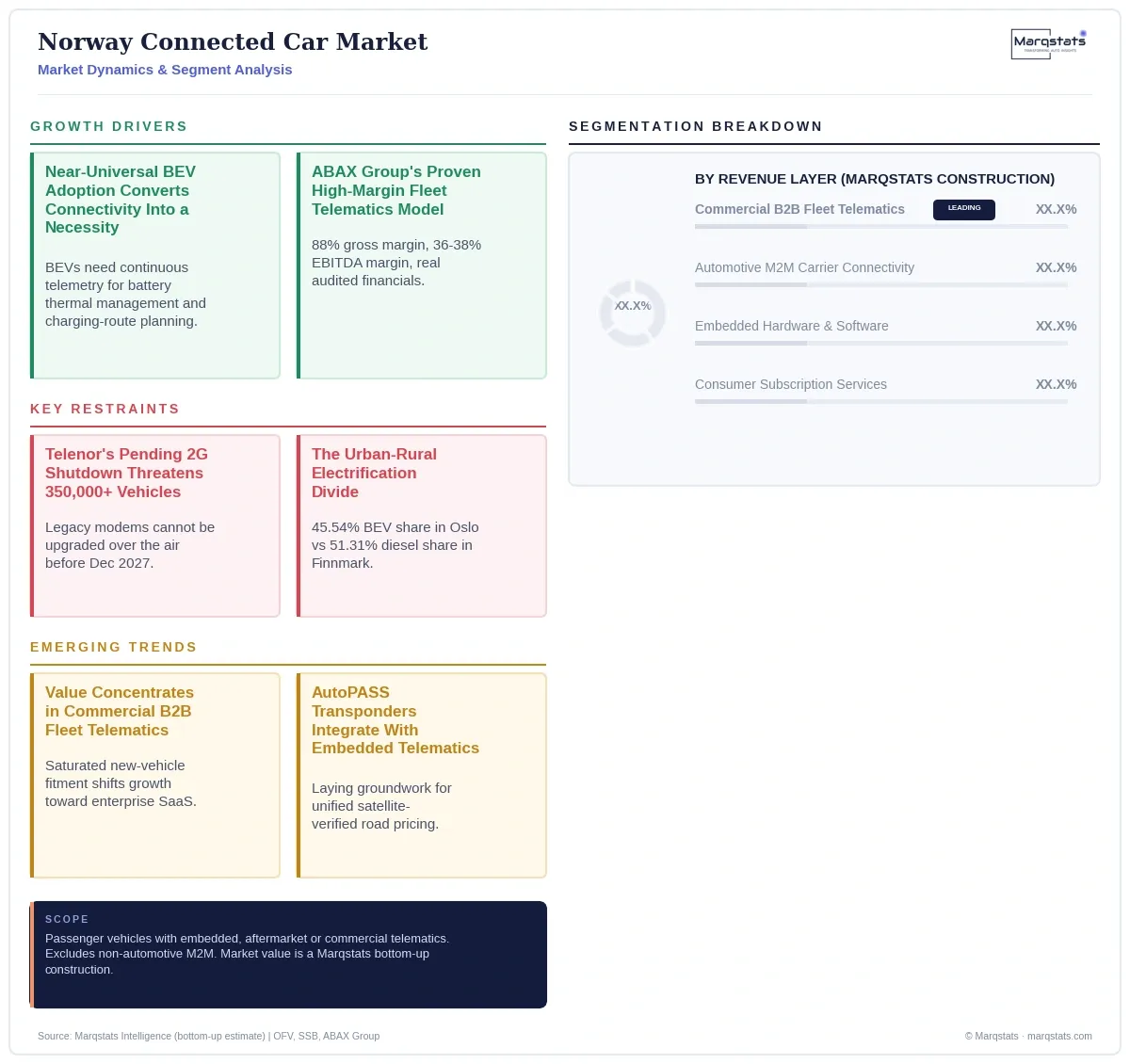
- Near-universal BEV adoption converts embedded connectivity from a discretionary feature into an operational necessity, with continuous telemetry required for battery thermal management, dynamic charging-route planning and cabin preconditioning in sub-zero conditions that no combustion vehicle depends on for basic day-to-day operability.
- ABAX Group's proven, high-margin commercial fleet telematics model — 88% gross margin, 36-38% EBITDA margin, 3% CAGR growth in average revenue per account — demonstrates a durable, profitable enterprise SaaS category other Nordic and European markets can benchmark against with genuine audited financial evidence rather than industry estimates.
- Statens vegvesen's NordicWay C-ITS Interchange, expanding from a pilot into permanent national infrastructure, gives Norway a genuinely cheaper cellular-based alternative to costly physical roadside sensor networks across its sparse, mountainous geography.
- AutoPASS's mature automated tolling infrastructure — 300-plus gantries, 90.9% automated transaction share — provides the institutional and technical foundation for future satellite- and cellular-based national road-user pricing.
- Mandatory commercial electronic trip-logging requirements under Skatteetaten tax rules give aftermarket fleet telematics providers non-discretionary demand independent of any broader connected-vehicle monetization trend, effectively guaranteeing a baseline commercial customer base.
Key Restraints
Four constraints stand between this market and a fully monetized, evenly distributed connected fleet.
Telenor's pending 31 December 2027 2G shutdown threatens automated eCall capability on more than 350,000 vehicles registered between 2018 and 2021 carrying legacy circuit-switched modems that cannot be upgraded over the air, and the retrofit or exemption process remains formally unresolved.350,000 Norwegian cars are about to lose their emergency call feature
- Norway's stark urban-rural electrification divide — 45.54% BEV share in Oslo against 51.31% diesel share in Finnmark — means connected-vehicle monetization potential is geographically concentrated, leaving northern Arctic counties dependent on aging, largely unconnected vehicles for years longer than the national fleet-average electrification curve would suggest.
- This report's own bottom-up market-value construction carries materially wider uncertainty than a sourced market figure would, given the underlying research provides no total addressable market estimate to validate against, and every multiplier used remains a disclosed Marqstats assumption rather than an independently verified industry figure.
- Norway's stringent EEA-aligned cybersecurity and software-update mandates (UN R155/R156, mandatory since July 2024) raise compliance costs for smaller aftermarket and Chinese OEM entrants relative to established manufacturers with existing EU-wide compliance infrastructure already amortized across larger production volumes.
Key Trends
Four shifts show where the market is heading and who captures the value.
- Value creation is concentrating in commercial B2B fleet telematics and automotive M2M connectivity rather than consumer hardware, reflecting a largely saturated new-vehicle embedded-fitment rate and a proven enterprise SaaS monetization model with genuine audited unit economics behind it.
- Physical AutoPASS toll transponders are progressively integrating with embedded factory telematics units, laying the operational groundwork for a unified, satellite-verified national road-pricing system that would eventually eliminate the need for separate dedicated hardware altogether.
- Chinese automakers are using Norway's tariff-free, technologically sophisticated market as a live proving ground for advanced connected-vehicle software features ahead of wider European rollout, treating early Norwegian consumer feedback as a genuine product-development input.
- Commercial fleet telematics providers are expanding beyond core tracking into adjacent financial services, exemplified by ABAX's OCTO Telematics partnership extending into usage-based insurance risk-scoring products.
Strategic Implications
- Automotive importers and OEMs should treat 4G/5G retrofit-module delivery as an urgent capital priority ahead of Telenor's December 2027 2G shutdown, given the scale of legacy-modem exposure already documented in the vehicle parc.
- Commercial fleet telematics providers should treat Norway's ABAX-proven unit economics — high gross margin, resilient ARR, steady ARPA growth — as a validated template for expansion into adjacent Nordic markets rather than an unproven category requiring fresh market validation.
- Public-sector transport planners in geographically similar markets should evaluate NordicWay's cellular C-ITS Interchange model as a lower-cost alternative to physical roadside sensor networks, particularly across sparse or mountainous terrain.
- Analysts and investors using these market-value figures should treat them explicitly as directional estimates built from real underlying data rather than a sourced market-size figure, and should weight the unit-level and company-specific data points — fleet composition, ABAX's financials, toll revenue — more heavily than the constructed USD totals themselves.
Market Segmentation
No formal value-based segment split exists in the underlying research. The four layers below are a Marqstats bottom-up construction — the same estimate underlying the total market value — not a measured revenue split. See Methodology for the full disclosure.
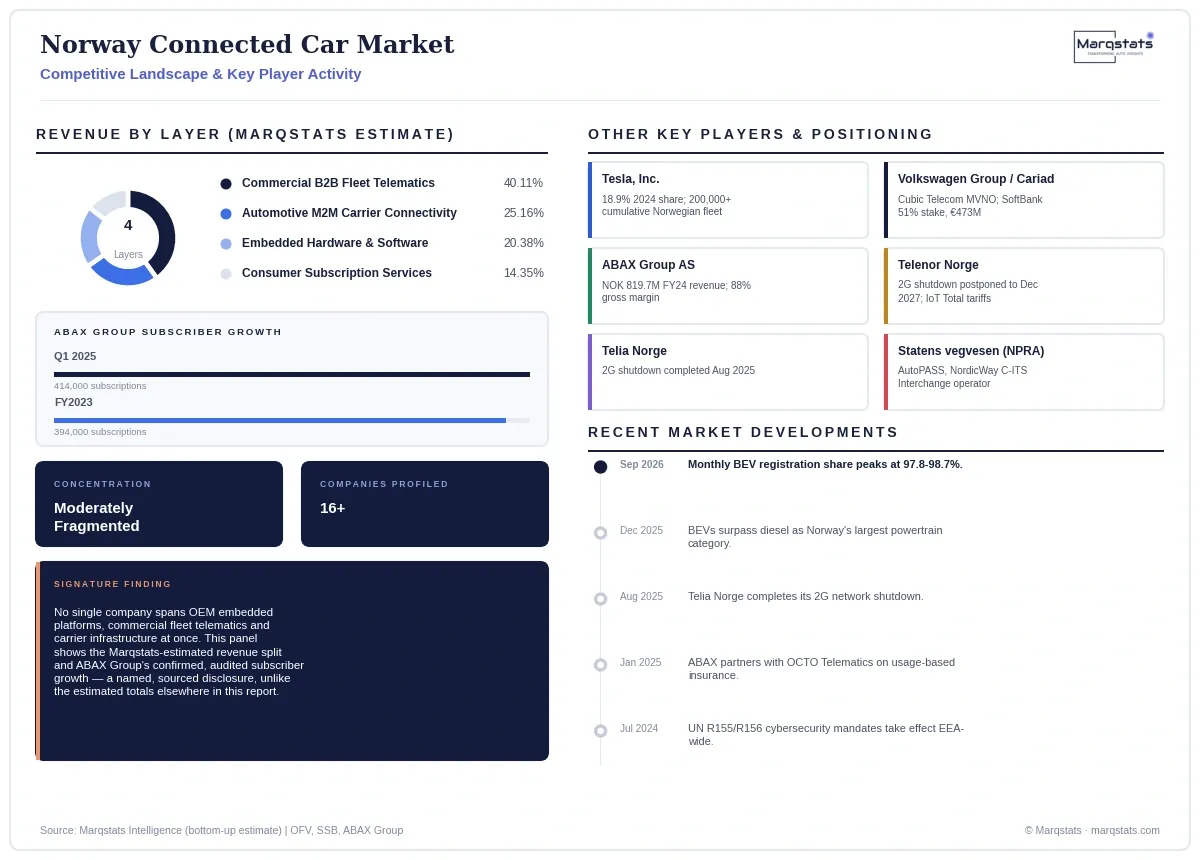
The largest estimated layer at USD 54.51 million in 2025, apportioned from ABAX Group's own disclosed FY2024 revenue (NOK 819.7 million) and other named commercial providers including Autoplan, Flyt AS and Fremtind Service. This is the segment with the most transparent underlying unit economics in the entire report, given ABAX's public financial disclosures.
USD 34.20 million in 2025, estimated from Telenor's disclosed enterprise IoT tariff tiers (20–29 NOK/month base, 5 NOK/month sensor tier) applied against an estimated automotive-specific share of the country's 4.79 million total M2M SIM base.
USD 27.70 million in 2025, estimated from 138,500 new 2025 passenger registrations at an assumed average embedded telematics hardware-and-software value per vehicle, informed by comparable European embedded-architecture segment values elsewhere in this coverage set.
The smallest estimated layer at USD 19.50 million in 2025, informed by Tesla's disclosed 129 NOK/month Premium Connectivity pricing and an estimated actively paying consumer base — Tesla itself bundles Standard Connectivity free for eight years post-delivery, structurally suppressing near-term B2C subscription revenue.
By Geography
A note on regional construction
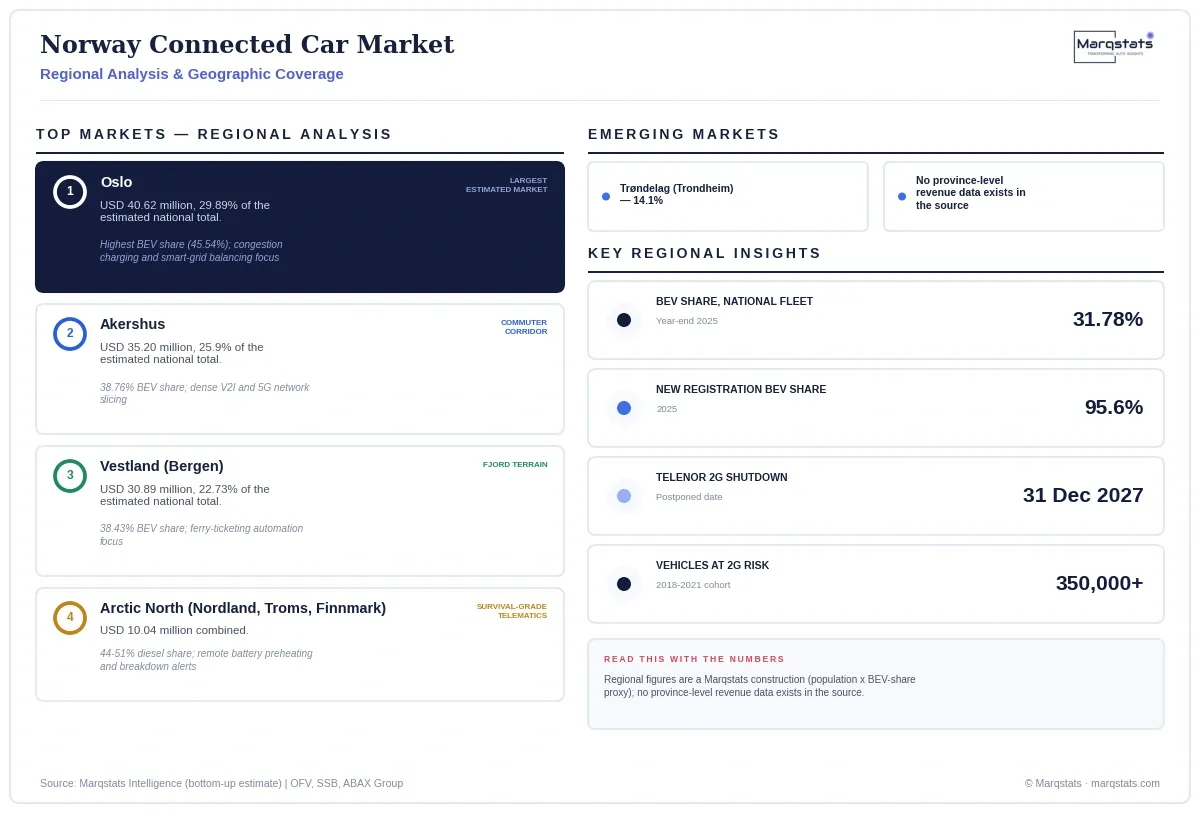
No province-level revenue breakdown exists in the underlying research either. The county (fylke) values below are a Marqstats construction, weighting each county's population against its own BEV adoption share as a reasonable proxy for connected-vehicle economic activity — not a measured regional revenue split.
Oslo
USD 40.62 million, 29.89% of the estimated national total, the highest-BEV-share county at 45.54% of its active fleet. Connected-vehicle activity centers on dynamic congestion charging, urban parking IoT and smart-grid balancing.
Akershus
USD 35.20 million, 25.9% of the estimated national total, 38.76% BEV share, defined by dense commuter-corridor V2I deployment and 5G network slicing.
Vestland (Bergen)
USD 30.89 million, 22.73% of the estimated national total, 38.43% BEV share, with telematics needs shaped by ferry-ticketing automation and fjord-terrain cellular handover resiliency.
Trøndelag (Trondheim)
USD 19.16 million, 14.1% of the estimated national total, 32.10% BEV share, host to active C-ITS GLOSA pilot corridor testing and cold-temperature routing algorithm development.
Nordland, Troms & Finnmark (Arctic North)
A combined USD 10.04 million, 7.39% of the estimated national total across three counties where diesel still holds 44% to 51% of the active fleet. Telematics needs here center on survival-grade functions — remote battery preheating, extreme-winter breakdown alerts, and satellite/cellular fallback along the E8 Borealis Arctic corridor — rather than discretionary monetization.
How Competition Is Evolving
Competition runs on three axes. On OEM embedded platforms, Tesla holds the largest single share with an 18.9% registration share in 2024 (expanding to 34,285 units in 2025) and a cumulative fleet surpassing 200,000 vehicles, running its own proprietary Tesla OS over a multi-IMSI global eSIM roaming Telenor and Telia. Volkswagen Group (VW, Audi, Škoda) routes global connectivity through Dublin-based MVNO Cubic Telecom, in which SoftBank acquired a 51% controlling stake for €473 million in 2023–2024; Volvo Cars and Polestar run Google's Android Automotive OS over Telenor Connexion's enterprise IoT platform.
Chinese manufacturers — BYD, XPeng, NIO, MG and Zeekr — surpassed 10% combined share of new Norwegian passenger sales in 2024, treating the tariff-free Norwegian market as a proving ground for advanced software features. On commercial fleet telematics, ABAX Group AS, headquartered in Larvik, is the clear category leader with 414,000 tracked subscriptions and an 88% gross margin, expanding through the acquisitions of RA Forsikring and Fleet360 and a January 2025 partnership with OCTO Telematics targeting usage-based insurance.
On network infrastructure, Telenor Norge and Telia Norge compete for automotive M2M wholesale contracts while managing divergent 2G sunset timelines — Telia already complete, Telenor postponed to December 2027 — and Ice (Lyse Tele AS) operates as the smaller third national carrier. Statens vegvesen, as the public infrastructure operator, sits outside direct commercial competition but shapes the market through NordicWay C-ITS deployment and AutoPASS tolling standards.
Companies Covered
The report profiles 16+ companies with full strategy and financials analysis, including:
Recent Market Activity
Table of Contents
Coverage & Segmentation
This report measures passenger vehicles operating in Norway that carry factory-embedded, aftermarket or commercial telematics hardware, across a 2025 base year and a 2026 to 2030 forecast period, denominated in United States dollars at an approximate USD 0.095/NOK exchange rate. It excludes non-automotive M2M connections such as smart-grid and industrial telemetry. Both the 2025 base year and the 2030 forecast are Marqstats constructions built bottom-up from unit, pricing and single-company financial data, since the underlying research contains no market-value sizing chain of its own — disclosed in full in the Methodology section below.
The analysis spans four estimated revenue layers, seven county-level (fylke) geographies built on a population-times-BEV-share proxy, and 16 profiled entities across automakers, commercial telematics providers, carriers and public infrastructure operators. Fleet and registration figures trace to OFV and SSB; the market value, segment split and regional split are all Marqstats constructions, explicitly disclosed rather than presented as sourced.