Market Snapshot
Key Takeaways
Market Overview & Analysis
Report Summary
Japan's connected car market is measured across factory-embedded, tethered and aftermarket telematics hardware, carrier connectivity contracts, and commercial and consumer software services, valued at USD 3,290.00 million in 2025. Unlike most connected-car markets, Japan's growth story is not about closing a hardware-adoption gap — factory DCM fitment already exceeds 86% on standard passenger cars — it is about whether OEMs, carriers and Tier-1 suppliers can find commercial value in a connected fleet that Japanese consumers have shown structural resistance to paying for directly.
Structurally, this is a market shaped more by industrial policy and public safety infrastructure than by consumer demand signals. The METI-MLIT Mobility DX Strategy sets an explicit national target for Japanese OEMs to capture 30% of the global software-defined-vehicle market; HELPNET and D-Call Net embed connected telematics directly into statutory emergency dispatch infrastructure; and the 2024 Logistics Problem labor reform has made commercial fleet telematics a compliance requirement rather than a discretionary purchase.
The analysis is built for four reader types making different decisions: an automaker or Tier-1 supplier evaluating whether to join Japan's collaborative hardware-standardization consortium model rather than compete on proprietary DCM architecture, a foreign technology vendor assessing whether B2B engineering supply is a more viable entry point than direct consumer subscription billing, a commercial fleet operator pricing telematics against 2024 Logistics Problem compliance costs, and an investor evaluating the ASRA chiplet consortium's realistic timeline against Japan's stated global SDV market-share ambitions.
Japan Connected Car Market Size and Forecast
Marqstats builds the Japan figure directly from the underlying research pack's own confirmed 2025 sizing — itself reconciled from JAMA and Zenkeijikyo sales and fleet-parc data against factory DCM fitment rates tracked separately for standard passenger cars and mini-vehicles. The market spans hardware, carrier connectivity, commercial fleet software and consumer telematics services as four distinct revenue contributors within a single reported total.
Market value grows from USD 3,290.00 million in 2025 to USD 6,850.00 million by 2030, a 15.79% CAGR, while the cumulative connected parc grows from 28,200,000 to 44,500,000 units, a 9.55% CAGR. As in most markets in this coverage set, value grows faster than the underlying unit base — here specifically because electronic content per vehicle, mandated commercial telematics, and cross-industry data exchange through the Ouranos Ecosystem are all expected to compound value without a proportional increase in the number of connected vehicles on the road.
The pack's own two forward scenarios diverge specifically on whether Japan can convert its consumer subscription resistance into a different revenue model rather than overcoming it directly. The Baseline Scenario holds the USD 6.85 billion, 15.79% CAGR trajectory on hardware content and B2B mandates alone; the Accelerated Disruption Scenario requires autonomous driving-as-a-service features to overcome subscription resistance entirely, pushing recurring software revenue above 15% of total market value and total value past USD 8.50 billion by 2030.
Japan Solved Hardware Adoption. It Hasn't Solved Monetization.
Factory DCM fitment reached 86.5% on standard registered passenger cars and 52.0% on mini-vehicles in 2025, a 74.8% weighted national rate across all new passenger registrations — figures that would represent a fully solved connectivity-adoption problem in almost any other national market in this coverage set. Roughly 2.87 million factory-connected passenger vehicles joined Japanese roads in 2025 alone.
What that hardware penetration has not produced is proportional consumer revenue. Total direct consumer spending on OEM telematics subscription fees reached just JPY 6.9 billion nationally in 2025 — a figure that, converted and scaled against the connected fleet, implies most Japanese owners of connected vehicles are paying nothing at all for ongoing digital services once their complimentary trial period, often running three to ten years, expires. Japanese OEM revenue models have adapted by depending on hardware margin absorption, dealer service-bay retention through remote fault scheduling, and B2B fleet contracts instead.Why won't Japanese drivers pay for connected car apps?.
Japan's 3G Sunset Is Now Complete, Not a Forward Risk
As of this analysis's preparation, Japan's cellular carriers have fully retired 3G nationally. KDDI shut down its CDMA 1x network on 31 March 2022, SoftBank followed on 15 April 2024, and NTT Docomo completed the final shutdown of its FOMA network precisely on its scheduled date, 31 March 2026 — confirmed by Japanese wire-service reporting on the day it happened. Approximately 350,000 individual 3G subscribers remained on NTT Docomo's network at the time of shutdown.
The practical consequence for the connected-vehicle fleet is now fully realized rather than pending: legacy, non-modular telematics units on vehicles such as early-generation Nissan CARWINGS, first-generation Honda Internavi and older Toyota G-BOOK models — concentrated among vehicles manufactured between 2004 and 2016, against a 13.40-year average passenger car lifespan — have permanently lost emergency eCall, remote tracking and probe-based navigation functionality. Unlike the France and Italy builds in this batch, where 2G shutdown risk remains a live, ongoing or delayed variable, Japan's cellular-sunset risk to its connected fleet is now a closed chapter.Japan just finished a 3G shutdown you probably didn't notice.
Market Dynamics
Key Drivers
Five conditions are moving this market, and industrial policy matters more than consumer demand.
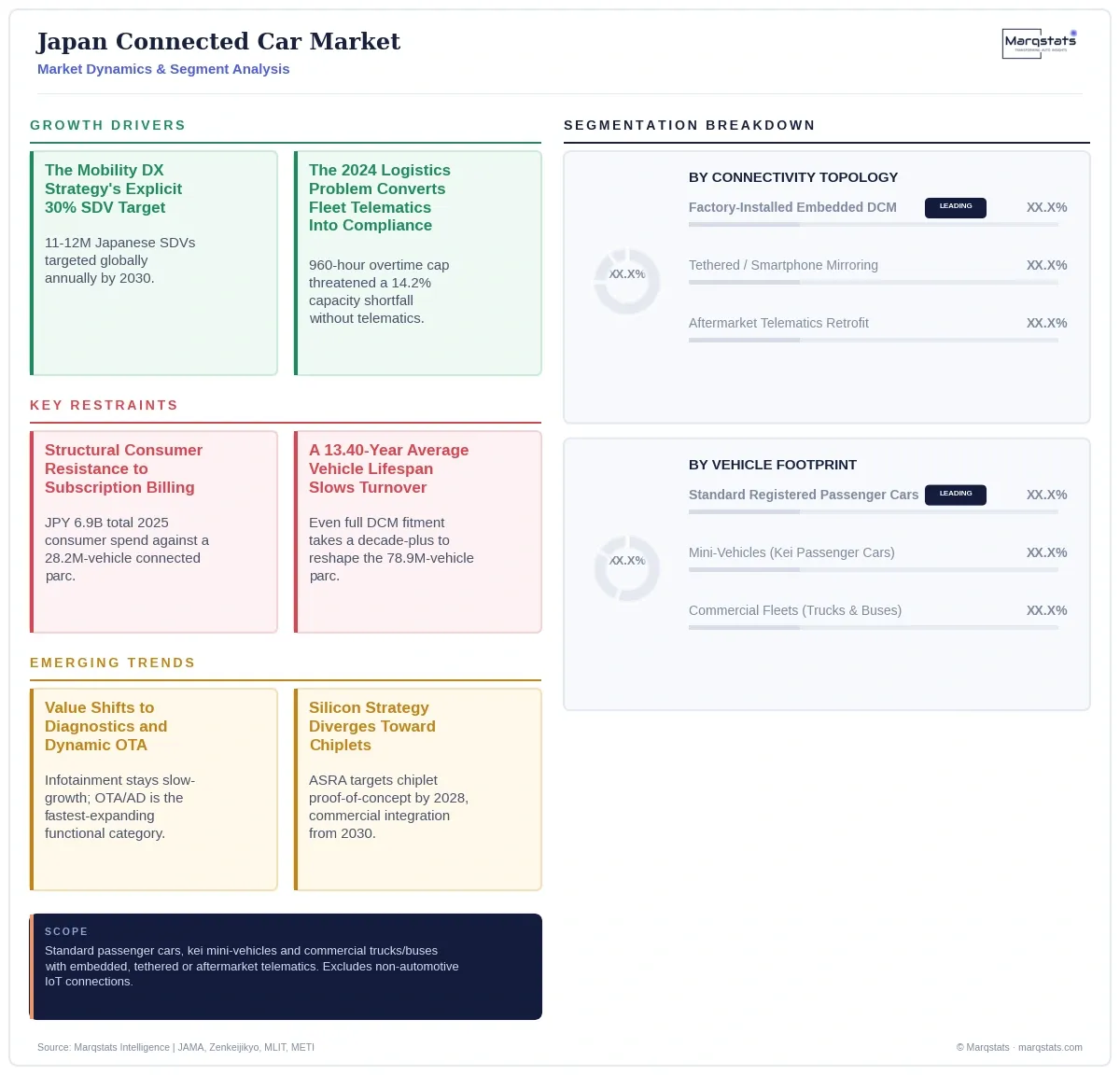
- The Mobility DX Strategy's explicit national target — 30% global SDV market share for Japanese OEMs, translating to 11 million to 12 million software-defined vehicles annually by 2030 — gives Japan's connected-vehicle industrial policy a scale and specificity most national markets in this coverage set lack.
- The 2024 Logistics Problem's statutory 960-hour driver overtime cap has converted commercial fleet telematics from a discretionary efficiency tool into a compliance necessity, with national logistics capacity projected to fall 14.2% below demand without technological intervention.
- The Five-OEM Common DCM alliance and the ASRA chiplet consortium let Japanese automakers share the cost of foundational hardware and silicon research while preserving brand-level software differentiation — a structural cost advantage against automakers pursuing fully proprietary connectivity stacks.
- Battery-electric mini-vehicle nameplates, led by the Nissan Sakura and Mitsubishi eK X EV, are pulling kei cars into the connected fleet for the first time at scale, since EV battery management requires continuous connectivity regardless of a vehicle's price positioning.
- HELPNET and D-Call Net's direct integration into statutory emergency dispatch infrastructure gives Japan's safety-telematics segment a durability and universality — near-100% activation on DCM-equipped vehicles — that discretionary infotainment features cannot match.
Key Restraints
Four constraints stand between near-universal hardware and a fully monetized connected fleet.
- Structural consumer resistance to subscription billing, evidenced by JPY 6.9 billion in total 2025 consumer telematics spending against a 28.2 million-vehicle connected parc, caps the addressable revenue OEMs can realistically expect from direct-to-consumer digital services regardless of feature investment. This figure is a pack-published estimate rather than an independently re-derived one, and is not further disaggregated by automaker or vehicle segment in the source material.
- Japan's 13.40-year average passenger car lifespan, the longest of any major market in this coverage set, means even a fully DCM-equipped new-vehicle fleet takes over a decade to meaningfully shift the connectivity profile of the total 78.9 million-vehicle national parc.
- Sony Honda Mobility's 2026 structural consolidation of its capital-intensive AFEELA software-first vehicle programme demonstrates the real commercial risk of pursuing premium, software-centric vehicle lines in a price-sensitive consumer market that has already shown resistance to paying for connected software specifically.
- Foreign technology vendors face substantial market-entry friction: compatibility with JASPAR Vehicle API specifications, HELPNET emergency-dispatch coordination, and MLIT's UN R155/R156 type-approval process are all required before any commercial engagement, regardless of a vendor's technical capability elsewhere. None of these requirements are waived for scale or prior international track record.
Key Trends
Four shifts show where the market is heading and who captures the value.
- Value creation is shifting toward diagnostics, maintenance telemetry and dynamic OTA/automated-driving functions, both identified as high-expansion functional categories, while infotainment and remote-control features — the segment most exposed to consumer subscription resistance — are explicitly tracked as slow-growth.
- Cross-industry sovereign data infrastructure is scaling beyond its original battery-traceability mandate: the Ouranos Ecosystem, verified interoperable with Europe's Catena-X network in March 2025, expanded through 2025 and 2026 to cover whole-vehicle life-cycle assessment and semiconductor supply-chain tracking.
- Automotive AI integration is moving from driver-assistance features toward end-to-end foundation models: Nissan's April 2025 partnership with Wayve Technologies targets commercial deployment of generative E2E AI models in ProPILOT from fiscal year 2027, replacing rule-based algorithms with learned neural networks.
- Silicon strategy is diverging from the monolithic system-on-chip approach dominant elsewhere: the ASRA consortium's chiplet disaggregation strategy targets automotive-grade compute scaling through packaging specialized dies onto a common substrate, rather than pursuing leading-edge monolithic fabrication directly.
Strategic Implications
- Foreign technology vendors should target B2B engineering supply — chiplets, virtualization hypervisors, data-space connectors — rather than attempting direct consumer subscription billing, given Japan's confirmed structural resistance to paying for connected software and the institutional barriers to market entry.
- Domestic OEMs should continue directing capital toward warranty administration, automated maintenance scheduling and B2B mobility services rather than consumer subscription products, since that is where this market's own data shows returns are actually being captured.
- Commercial fleet operators and logistics technology providers should treat 2024 Logistics Problem compliance, not discretionary efficiency gains, as the primary commercial argument for telematics adoption — it is the driver with the clearest regulatory backing and shortest payback horizon in this market.
- Investors evaluating Japan's SDV ambitions should track ASRA's chiplet proof-of-concept timeline specifically, since the Accelerated Disruption Scenario's higher USD 8.50 billion 2030 valuation depends on that consortium delivering ahead of its own 2028 target, not on any consumer-demand variable.
Market Segmentation
The dominant topology at USD 2,460.92 million in 2025, 74.8% of value, in high expansion driven by UN R155/R156 mandates, OEM data ownership requirements, and integrated digital cockpits.
USD 539.56 million in 2025, 16.4% of value, a maturing entry-level alternative on vehicles lacking factory-embedded navigation.
The smallest topology at USD 289.52 million in 2025, 8.8% of value, stable and niche, driven by commercial fleet management, digital tachographs and insurance OBD-II dongles.
USD 1,825.95 million in 2025, 55.5% of value, in moderate expansion with high penetration across premium, executive and family crossover nameplates.
USD 937.65 million in 2025, 28.5% of value, in rapid growth as battery-electric kei nameplates and high-trim tall-wagon models drive DCM adoption into a segment historically excluded on cost grounds.How a JPY 1.5 million kei car became a connected vehicle
USD 526.40 million in 2025, 16.0% of value, in strong expansion, supported by mandated digital tachographs, route optimization and remote alcohol-compliance logging.
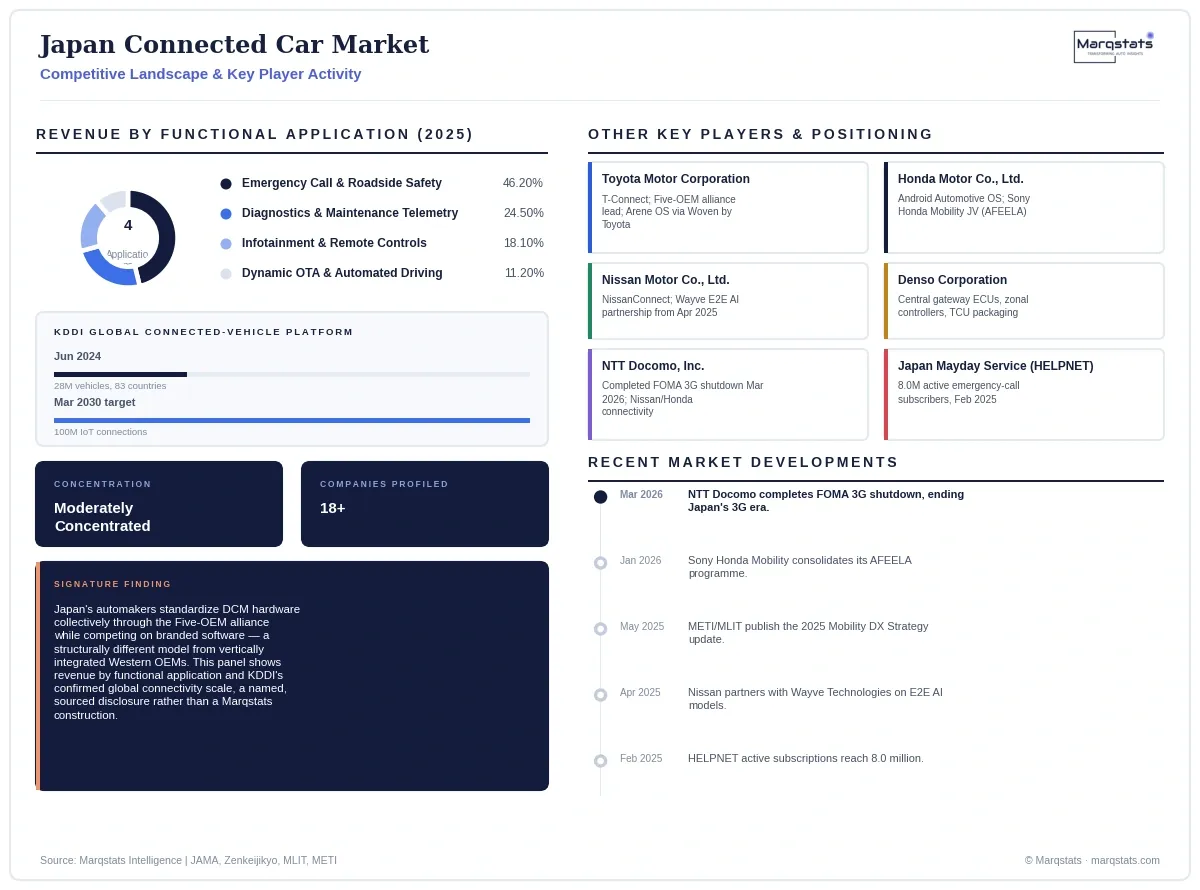
The largest functional category at USD 1,519.98 million in 2025, 46.2% of active platform utilization, subsidized by OEMs with near-100% activation on DCM-equipped vehicles via HELPNET and D-Call Net.
USD 806.05 million in 2025, 24.5% of utilization, in high expansion as a service-retention mechanism for franchised dealerships.
USD 595.49 million in 2025, 18.1% of utilization, in slow growth, limited directly by post-trial subscription drop-off.
The smallest but fastest-expanding category at USD 368.48 million in 2025, 11.2% of utilization, covering high-bandwidth sensor ingestion, HD map updates and End-to-End AI autonomous operations.
By Geography
A note on regional structure
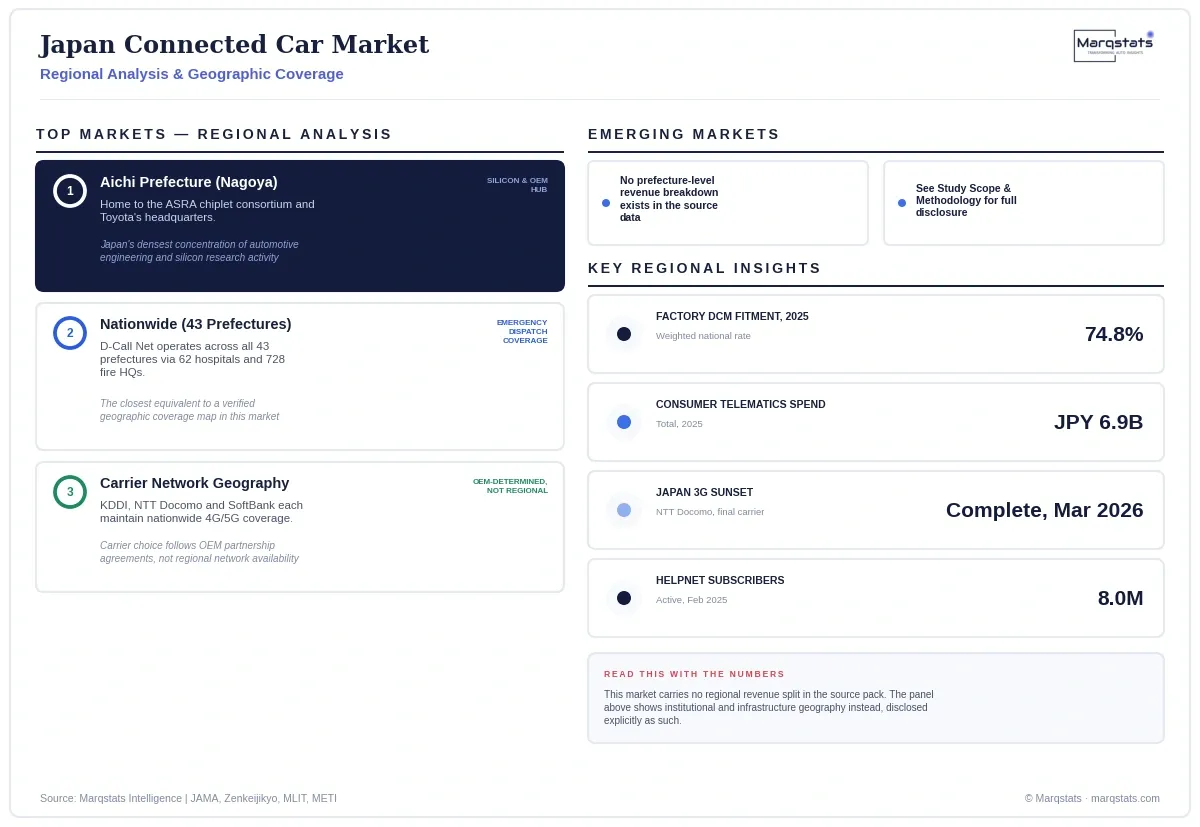
Unlike several other markets in this coverage set, the underlying research pack contains no prefecture-level revenue or connected-parc breakdown for Japan, and this coverage does not construct one where no source data exists. What the pack does document is institutional and infrastructure geography, summarized below.
Aichi Prefecture (Nagoya) — Silicon and OEM Engineering Hub
Home to the Advanced SoC Research for Automotive (ASRA) consortium, headquartered in Nagoya since December 2023, uniting 14 automakers, Tier-1 suppliers and semiconductor firms around chiplet research. Toyota, the consortium's chair, is headquartered in the same prefecture, anchoring Japan's densest concentration of automotive engineering and silicon research activity.
Nationwide Emergency Dispatch Coverage
D-Call Net's Advanced Automatic Collision Notification system operates across all 43 prefectures, coordinating with 62 doctor-helicopter base hospitals and 728 municipal fire headquarters — the closest equivalent this market offers to a verified geographic coverage map, built for emergency response rather than commercial market sizing.
Carrier Network Geography
KDDI, NTT Docomo and SoftBank each maintain nationwide 4G/5G coverage rather than regionally differentiated automotive connectivity offerings, meaning carrier choice in Japan is determined by OEM partnership agreements (KDDI with Toyota and most Common DCM alliance members; NTT Docomo and SoftBank with Nissan and Honda) rather than by regional network availability.
How Competition Is Evolving
Competition in Japan runs on a collaborative-hardware, competitive-software model unusual among the markets in this coverage set. Toyota Motor Corporation, Suzuki Motor Corporation, Subaru Corporation, Mazda Motor Corporation, Daihatsu Motor Co. and Hino Motors share standardized DCM hardware and baseband circuitry through the Five-OEM Common DCM alliance, while maintaining distinct branded software — T-Connect, Suzuki Connect, SUBARU STARLINK, MyMazda, Daihatsu Connect and HINO-CONNECT respectively. Toyota additionally operates Woven by Toyota, Inc. to develop the Arene operating system as a vehicle software abstraction layer.
Honda Motor Co. and Nissan Motor Co. pursue more independent strategies. Honda has adopted Android Automotive OS with Google built-in for its high-volume domestic line while separately operating Sony Honda Mobility Inc., a joint venture with Sony Group Corporation, for its software-first AFEELA prototype — a programme that underwent structural consolidation in 2026 amid rising bill-of-materials costs and slowing EV demand. Nissan continues integrating connected telemetry with its ProPILOT driver-assistance suite, partnering with Wayve Technologies Ltd. from April 2025 on generative end-to-end AI foundation models targeting fiscal year 2027 deployment.
On carrier connectivity, KDDI Corporation holds the dominant automotive position through its Global Communication Platform, established with Toyota in 2016: over 28 million connected vehicles across 83 countries by June 2024, 58.04 million total corporate IoT lines by March 2025, and a stated target of 100 million active IoT connections by 2030. NTT Docomo and SoftBank hold smaller automotive footprints anchored to Nissan, Honda and commercial fleet management respectively.
Companies Covered
The report profiles 18+ companies with full strategy and financials analysis, including:
Recent Market Activity
Table of Contents
Coverage & Segmentation
This report measures standard registered passenger cars, mini-vehicles (kei cars) and commercial trucks and buses operating in Japan that carry factory-embedded, tethered or aftermarket telematics hardware, across a 2025 base year and a 2026 to 2030 forecast period, denominated in United States dollars. It excludes non-automotive IoT connections and vehicles outside Japan's domestic registration system.
The analysis spans three segmentation dimensions — connectivity topology, vehicle footprint and functional application — and 18 profiled entities across automakers, carriers, Tier-1 suppliers and public-safety telematics operators. Vehicle sales and fleet-parc figures trace to JAMA and Zenkeijikyo; market value, the connected parc and segment splits are taken directly from the underlying research pack's own confirmed 2025 figures. This report's Regional Analysis section covers institutional and infrastructure geography rather than a revenue split, since the pack contains no prefecture-level breakdown to segment by.