Market Snapshot
Key Takeaways
Market Overview & Analysis
Report Summary
Brazil's connected car market is measured across enterprise aftermarket fleet telematics, factory hardware and subscriptions for light and heavy vehicles, and consumer aftermarket tracking, estimated at USD 2,071.47 million in 2025 through a Marqstats bottom-up construction, since the underlying research contains no market-value total of its own. What the research does establish beyond doubt is the structural driver: commercial cargo-theft risk management, not consumer software demand, dominates this market's connected fleet.
Structurally, this is a market defined by a genuine bifurcation between commercial necessity and consumer discretion. Heavy commercial trucks ship at over 90% factory connectivity because cargo insurance underwriters require it; light passenger vehicles ship at just 34% factory connectivity and are still marketed as a premium differentiator, with private buyers showing high churn once complimentary trial periods lapse.
The analysis is built for four reader types making different decisions: a commercial telematics provider deciding how much of its growth to anchor in mandatory freight-insurance demand versus discretionary consumer adoption, an automaker weighing how to compete against Chinese entrants' standard-equipment connectivity bundling, a telecommunications operator planning M2M infrastructure investment now that Law No. 15.320's tax relief has removed a structural cost barrier, and an investor assessing how much of this market's construction rests on assumptions that could shift with better primary data.
Brazil Connected Car Market Size and Forecast
Marqstats builds the Brazil figure entirely bottom-up, since no market-value sizing chain exists in the underlying research. Six components are estimated separately: enterprise fleet telematics SaaS applied to Sindipeças fleet data; factory light-vehicle hardware and subscriptions applied to ANFAVEA and Fenabrave registration figures; factory heavy-commercial hardware and subscriptions applied to the same sources; and consumer aftermarket tracking. Every multiplier used is a Marqstats assumption, disclosed explicitly rather than presented as sourced.
Under this construction, market value grows from an estimated USD 2,071.47 million in 2025 to USD 3,918.96 million by 2030, a 13.60% CAGR, broadly tracking the underlying research's own stated connected-parc growth from 7.25 million units in 2025 to a Base Modernization Case endpoint of 13.80 million units by 2030.
The research's own two forward scenarios diverge specifically on 2G/3G shutdown timing and macroeconomic conditions. The Base Modernization Case assumes orderly legacy-modem migration without a premature shutdown ahead of ANFAVEA's requested December 2029 timeline, continued Law No. 15.320 tax stability, and steady Programa MOVER credit disbursement, reaching 13.80 million connected units by 2030 with light-vehicle fitment at 65%; the Capital-Constrained Friction Case assumes accelerated 2G/3G decommissioning ahead of schedule, elevated interest rates compressing OEM R&D budgets, and declining consumer subscription renewals, reaching only 9.40 million units with light-vehicle fitment capped at 42% — a scenario this analysis's own bottom-up estimate does not separately quantify in dollar terms, since the underlying research provides no value figure to scale.
Brazil's Connected Car Market Runs on Cargo Insurance, Not Car Buyers
Every other market in this coverage set with a meaningful commercial fleet segment still has a recognizable consumer passenger story sitting alongside it. Brazil's connected car market is genuinely different: enterprise aftermarket fleet telematics alone accounts for 63.4% of the entire connected parc, more than factory-installed passenger and heavy-commercial systems combined, and the driver isn't consumer technology adoption at all — it's freight insurance underwriters along highway corridors like BR-116 and BR-101 requiring gerenciamento de risco tracking as a precondition of coverage against endemic cargo theft.
That single structural fact reframes how this market should be read. A telematics provider evaluating Brazil isn't really entering a connected-car market in the sense most other countries in this coverage set present one — it's entering a freight-security and insurance-compliance market that happens to run on the same underlying hardware and cellular infrastructure as consumer connected cars, with genuinely different sales cycles, buyer priorities and competitive dynamics.
This Market's Numbers Had to Be Built, Not Found
The underlying research is genuinely detailed — fleet composition by state, ARPU ranges for five named OEM telematics platforms, M2M connection counts by carrier — but it never rolls any of this up into a market total. No BRL or USD figure for the connected car market appears anywhere in the source text. This report's USD 2,071.47 million 2025 estimate is a Marqstats construction from that raw material, built from six separately estimated components rather than adopted from a source-proposed figure.
Every input into that construction is real: Sindipeças fleet counts, ANFAVEA and Fenabrave registration data, and named OEM pricing tables for OnStar, Bluelink, ConnectMe, Volvo Connect and Scania Connected Services. The multipliers connecting those real inputs into a total — blended ARPU assumptions, hardware cost estimates, paying-subscriber share assumptions — are Marqstats judgment calls, and every reader using this figure should weight the underlying unit-level data more heavily than the constructed USD total itself.
Why the Minas Gerais Distortion Matters Beyond Statistics
A registration quirk driven by a 3-percentage-point tax difference might sound like a minor footnote, but it has real consequences for anyone using Brazilian state-level vehicle data to plan network investment, sales territory coverage, or regional risk pricing. Minas Gerais appears, in raw registration statistics, to host a wildly disproportionate share of the nation's connected rental and corporate fleet vehicles — a signal that has nothing to do with where those vehicles actually generate telematics traffic, insurance claims, or consumer demand day to day.
The practical fix mirrors what this coverage set has already documented in the UK's own registration-distortion finding: treat state-level registration data as a ceiling on genuine regional activity, not a floor, and weight actual metropolitan population and freight-corridor density more heavily than raw plate-of-registration counts when making any capital allocation decision tied to where Brazilian connected vehicles physically operate.
Market Dynamics
Key Drivers
Five conditions are moving this market, and commercial insurance mandates matter more than consumer demand.
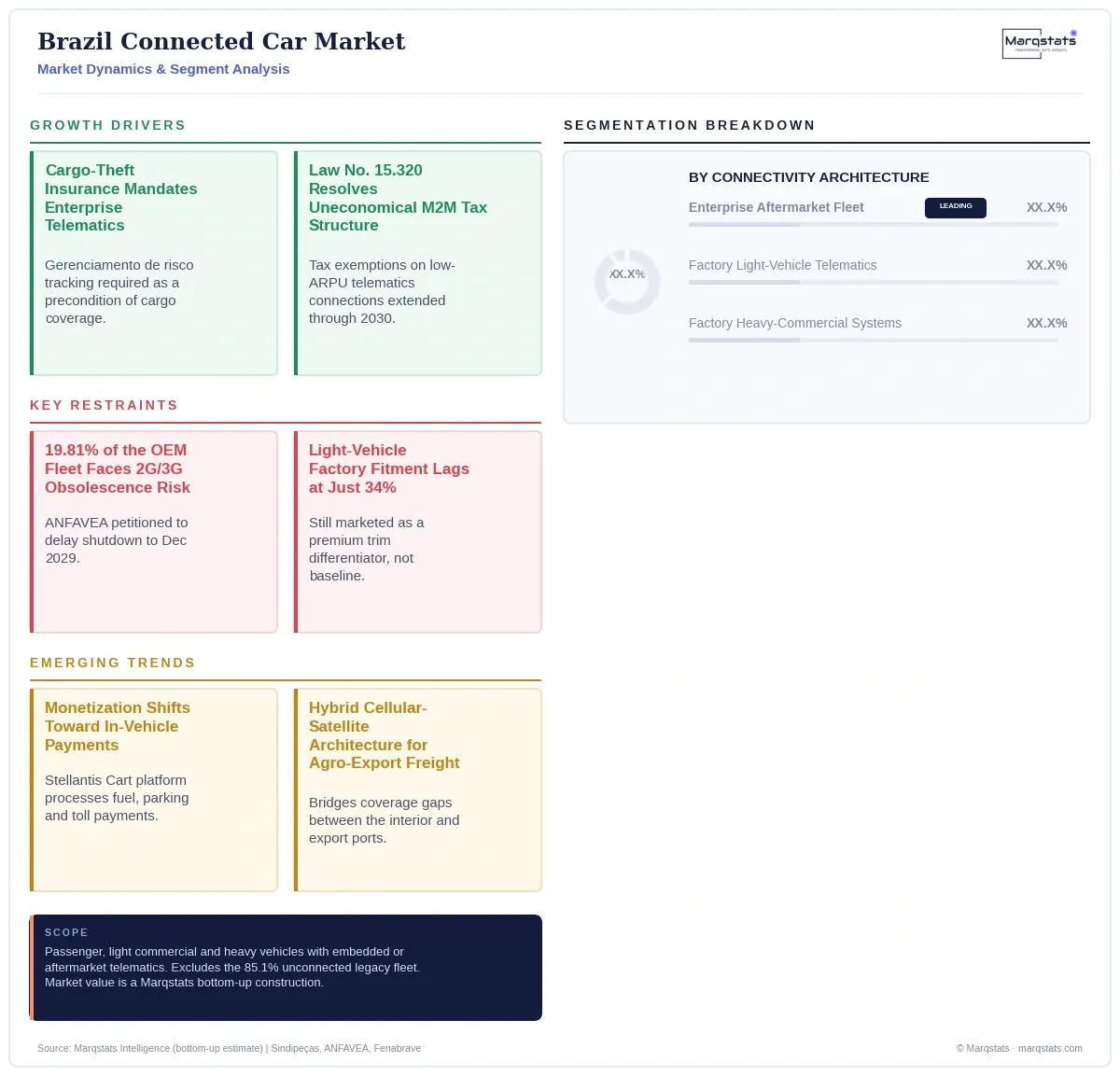
- Brazil's endemic highway cargo-theft problem along corridors including BR-116 and BR-101 gives freight insurance underwriters direct commercial leverage to require telematics tracking as a precondition of coverage, a structural demand driver with no equivalent forcing mechanism anywhere in the consumer passenger segment.
- Mandatory cargo-theft insurance underwriting requirements along high-risk freight corridors make enterprise fleet telematics a non-discretionary cost of doing business for commercial logistics operators, insulating this market's largest segment from consumer sentiment entirely.
- Federal Law No. 15.320, effective 1 January 2026, extends Fistel, CFRP and Condecine tax exemptions for M2M/IoT connections through 2030, removing a cost structure that previously made low-ARPU telematics connections economically unsustainable.
- Programa MOVER's tax-credit incentives for domestic software, OTA and V2X engineering are pulling global automakers toward establishing dedicated embedded-electronics development centers within Brazil rather than importing connectivity architecture unchanged.
- Chinese EV manufacturers BYD Auto and Great Wall Motor are standardizing connected cockpits as included equipment with no separate subscription charge, pressuring legacy automakers to extend their own complimentary trial windows to remain competitive.
- Stellantis's Cart in-vehicle payment platform, enabling fuel, parking and toll transactions directly through the infotainment display, demonstrates a genuine alternative monetization channel beyond recurring subscription fees that other automakers are likely to replicate.
Key Restraints
Four constraints stand between this market and a fully monetized, evenly connected fleet.
- Nearly a fifth (19.81%) of Brazil's OEM factory-connected fleet relies entirely on 2G/3G modems, creating a real obsolescence risk that ANFAVEA is actively lobbying to delay past December 2029 rather than a resolved problem.
- Light passenger vehicle factory fitment sits at just 34% of new registrations, with private buyers showing high subscription churn once complimentary trial periods end, capping realistic consumer revenue growth regardless of feature investment.
- This report's own bottom-up market-value construction carries materially wider uncertainty than a sourced market figure would, given the underlying research provides no total addressable market estimate to validate against.
- This market's construction reflects a structurally different starting point than most peer markets in this coverage set, where a source-stated base-year value exists to correct or re-anchor rather than build from nothing; Brazil's underlying research, however detailed at the unit level, provides no dollar total anywhere in its text.
- Brazil's circulating fleet carries an average age of 10 years and 11 months, meaning tens of thousands of vehicles from 2014-2020 have CAN-bus-hardwired TCUs that require costly dashboard and wiring-harness work to retrofit rather than a simple module swap.
Key Trends
Four shifts show where the market is heading and who captures the value.
- Insurance underwriters are increasingly specifying exact telematics hardware and data standards as a condition of cargo coverage, rather than accepting any generic GPS tracker, pushing the aftermarket fleet telematics segment toward standardized, insurer-approved hardware certification rather than open competition on price alone.
- Automakers are shifting monetization from recurring subscription fees toward integrated transactional commerce, exemplified by Stellantis's Cart platform for fuel, parking and toll payments processed directly through the vehicle infotainment system.
- Hybrid cellular-satellite telematics architecture is becoming standard for long-haul agricultural freight in the Center-West and MATOPIBA interior, where terrestrial coverage gaps between production zones and export ports at Santos and Paranaguá require continuous connectivity fallback.
- Multi-carrier virtual eSIM provisioning is expanding specifically to eliminate single-operator lock-in for national fleet operators who need guaranteed roaming continuity as vehicles cross state and regional network boundaries.
- VoLTE standardization for M2M and IoT operational profiles is advancing as the technical bridge letting mandatory emergency voice-call functionality migrate to packet-switched 4G channels ahead of eventual 2G/3G retirement.
Strategic Implications
- Commercial telematics providers should treat enterprise fleet risk-management demand, not consumer passenger adoption, as this market's primary growth engine, and should prioritize insurance-underwriter relationships and freight-corridor coverage over consumer feature marketing.
- Automakers competing against Chinese EV entrants' standard-equipment connectivity should evaluate extending complimentary trial periods or unbundling core safety features from paid tiers, following the pattern already emerging among Hyundai and Stellantis in response to competitive pressure.
- Telecommunications operators and infrastructure investors should treat Law No. 15.320's tax stability through 2030 as a genuine window to establish long-term enterprise M2M contracts with predictable economics, rather than a temporary relief measure.
- Analysts and investors using these market-value figures should weight the underlying fleet, registration and named-platform pricing data more heavily than the constructed USD totals themselves, and should track ANFAVEA's 2G/3G shutdown-timeline negotiations with Anatel as the single clearest near-term risk indicator for this market's downside scenario going forward, given how directly it could reshape the obsolescence timeline for legacy vehicles still on the road.
Market Segmentation
The percentage splits below are taken directly from the underlying research's own stated 2025 connected-parc composition. The dollar values are a Marqstats construction, applying those confirmed percentages to the bottom-up market-value estimate used throughout.
USD 1,313.31 million estimated, 63.4% of the connected parc (4.60 million units), driven by mandatory cargo-theft insurance underwriting requirements rather than voluntary adoption. Hardware form factor: hardwired blackbox/OBD-II with 4G LTE and 2G legacy fallback.
USD 586.23 million estimated, 28.3% of the connected parc (2.05 million units), integrated TCUs with embedded eSIM on 4G LTE Cat-1/Cat-4, covering stolen vehicle recovery, remote ignition, cabin pre-conditioning and automatic collision notification.
USD 171.93 million estimated, 8.3% of the connected parc (600,000 units), hardened gateway/CAN interface hardware over 4G LTE and dual-satellite hybrid links for real-time powertrain telemetry and predictive maintenance.
By Geography
Southeast (São Paulo, Minas Gerais, Rio de Janeiro, Espírito Santo)
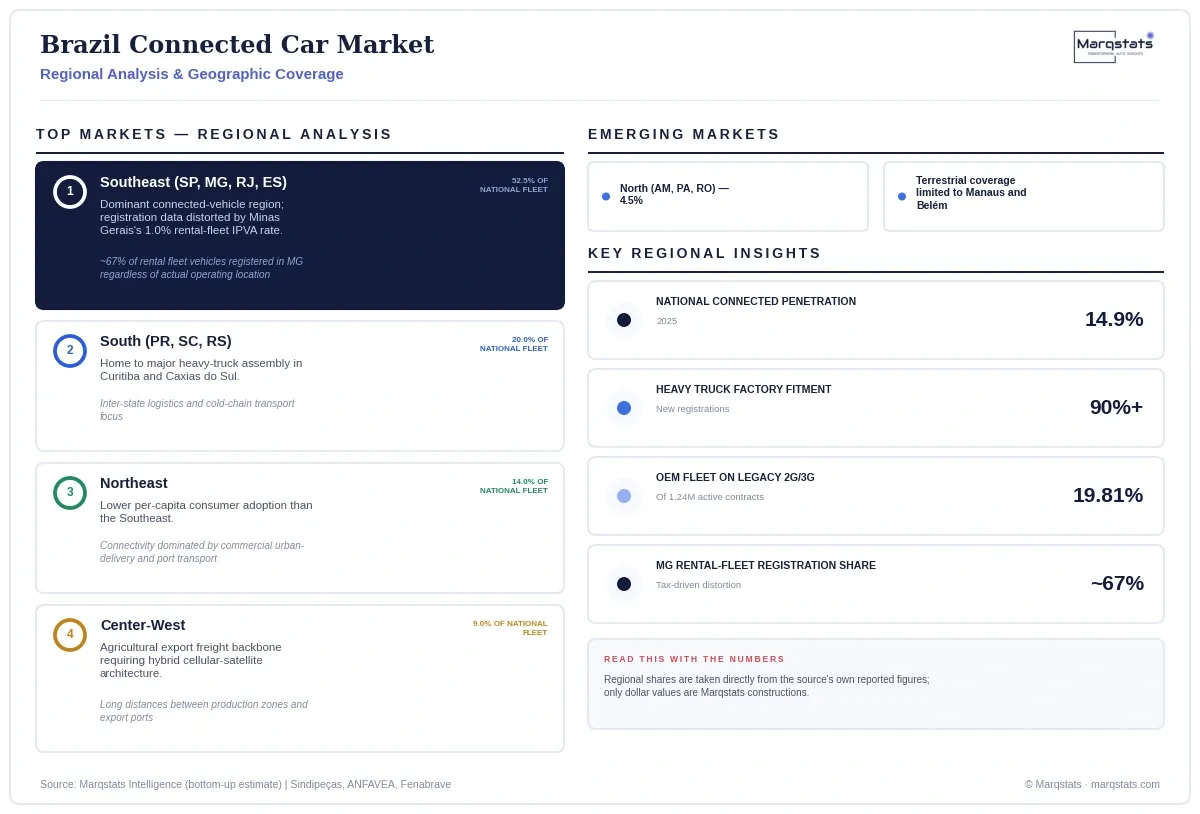
~52.5% of the national circulating fleet, the country's dominant connected-vehicle region, concentrated in metropolitan São Paulo, Campinas and Rio de Janeiro where network coverage and household incomes are highest. Registration data here is materially distorted by Minas Gerais's preferential rental-fleet tax rate; see the note below.
A note on the Minas Gerais registration distortion
Approximately 67% of all passenger vehicles acquired by commercial car rental and corporate fleet operators (Localiza, Unidas, Movida) are registered in Minas Gerais specifically because of its 1.0% preferential IPVA property-tax rate for rental fleets, against 4.0% standard rates in São Paulo and elsewhere — meaning hundreds of thousands of vehicles actually operating in São Paulo, Brasília, Salvador and Curitiba carry Minas Gerais plates.
South (Paraná, Santa Catarina, Rio Grande do Sul)
~20.0% of the national fleet, home to major heavy-truck assembly facilities in Curitiba and Caxias do Sul, with connectivity demand centered on inter-state logistics and cold-chain transport.
Northeast (Bahia, Ceará, Pernambuco and others)
~14.0% of the national fleet, showing lower per-capita consumer adoption than the Southeast, with connectivity dominated by commercial urban-delivery and port-container transport fleets rather than private passenger demand.
Center-West (Mato Grosso, Mato Grosso do Sul, Goiás, DF)
~9.0% of the national fleet, Brazil's agricultural export freight backbone, requiring hybrid cellular-satellite telematics architecture to bridge the long distances between production zones and the Port of Santos and Port of Paranaguá.
North (Amazonas, Pará, Rondônia and others)
~4.5% of the national fleet, the smallest and most connectivity-constrained region, with terrestrial coverage limited primarily to Manaus and Belém and mining-logistics traffic relying heavily on satellite-dominant architecture.
How Competition Is Evolving
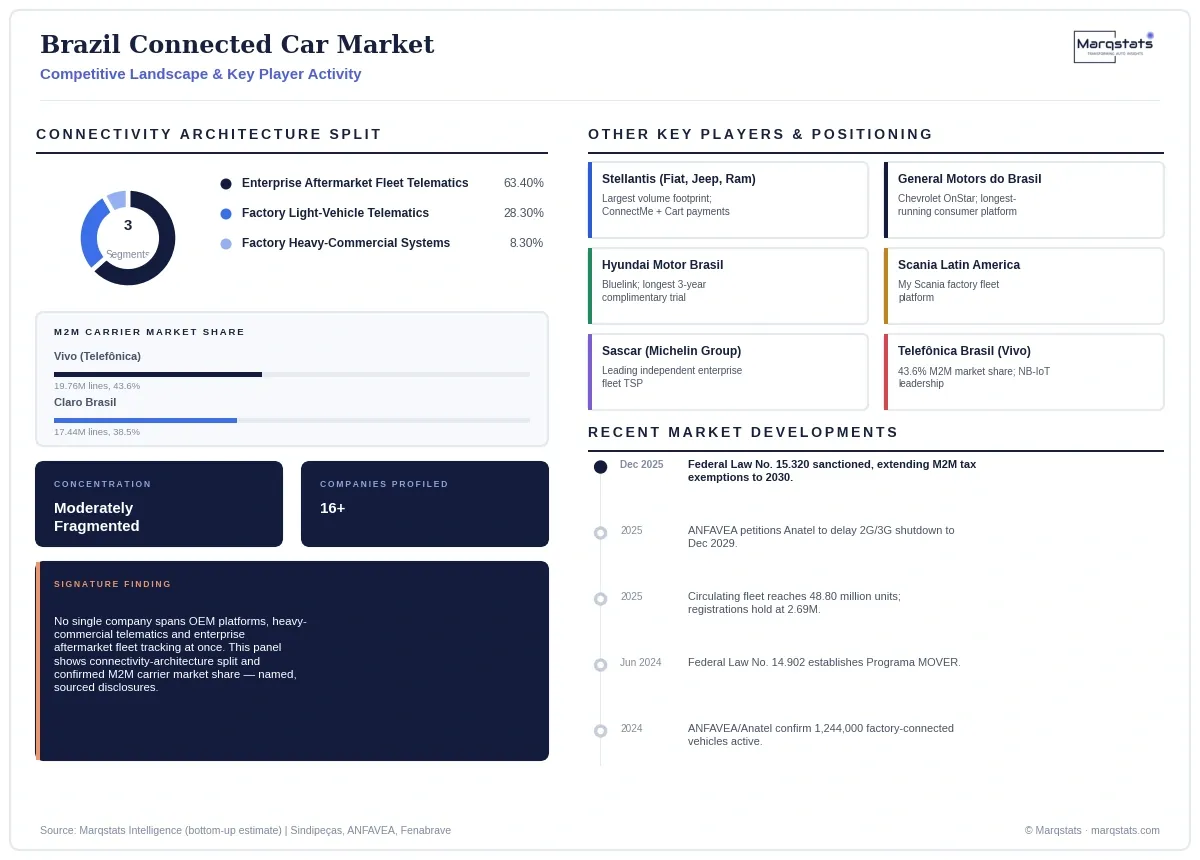
No single company in this market spans passenger OEM platforms, heavy-commercial factory telematics and enterprise aftermarket fleet tracking simultaneously, leaving genuine white space for a provider capable of bridging insurance-underwriter requirements with consumer-grade infotainment expectations across vehicle classes.
Competition splits between passenger OEM platforms and commercial fleet telematics specialists. On passenger platforms, Stellantis holds the largest volume footprint through its multi-brand Fiat, Jeep, Ram and Peugeot lineup, running ConnectMe and Adventure Intelligence over TIM Brasil's network with its distinctive Cart in-vehicle payment system. General Motors do Brasil operates the longest-running consumer telematics presence through Chevrolet OnStar in partnership with Claro Brasil, while Hyundai Motor Brasil's Bluelink offers the longest complimentary trial period among major platforms at three years.
Chinese entrants BYD Auto and Great Wall Motor are reshaping competitive dynamics by bundling connected infotainment as standard equipment with no separate subscription charge, pressuring legacy assemblers to extend their own trial windows. On heavy commercial telematics, Scania Latin America and Volvo Trucks install factory gateways at their São Bernardo do Campo and Curitiba assembly plants respectively, while independent telematics service providers Sascar (Michelin Group), Autotrac, Omnilink and Positron serve the much larger enterprise aftermarket fleet segment with multi-sensor security terminals combining cellular and satellite communication.
Companies Covered
The report profiles 16+ companies with full strategy and financials analysis, including:
Recent Market Activity
Table of Contents
Coverage & Segmentation
This report measures passenger vehicles, light commercial vans, and medium/heavy commercial trucks operating in Brazil that carry factory-embedded or aftermarket telematics hardware, across a 2025 base year and a 2026 to 2030 forecast period, denominated in United States dollars at the Banco Central do Brasil PTAX reference rate of BRL 5.5018/USD. It excludes the 85.1% of the circulating fleet with no active network connectivity. Both the 2025 base year and the 2030 forecast are Marqstats constructions built bottom-up from fleet, registration and named-platform pricing data, since the underlying research contains no market-value sizing chain of its own.
The analysis spans three connectivity-architecture segments, six regional geographies, and 16 profiled entities across OEMs, commercial telematics providers, carriers and the national telecom regulator. Fleet and registration figures trace to Sindipeças, ANFAVEA and Fenabrave; the market value figures are Marqstats constructions, explicitly disclosed rather than presented as sourced.