Market Snapshot
Key Takeaways
Market Overview & Analysis
Report Summary
Canada's connected car market is measured on the value of embedded and aftermarket telematics hardware, wholesale cellular connectivity, and recurring cloud software subscriptions sold against the country's new and operating vehicle fleet. The market is worth USD 3,160.00 million in 2025, and its growth is driven overwhelmingly by a single vehicle class: trucks and utility vehicles, which made up 88.04% of 2025 new-vehicle sales, not the passenger cars that connected-car coverage often defaults to picturing.
Structurally, this is a hardware-standardization market moving into a software-monetization phase. Factory-embedded connectivity penetration on new vehicles has already climbed from 91% in 2023 to an estimated 96% in 2025, so the open commercial question is no longer whether new Canadian vehicles ship connected — it is whether automakers, carriers and fleet-software providers can convert that installed base into durable recurring revenue across a fleet that spans dense southern Ontario corridors and remote northern territories with no cellular coverage at all.
The analysis is built for four reader types making different decisions: an automaker deciding how much telematics cost a truck's higher transaction price can absorb versus a shrinking passenger-car line, a telecommunications carrier planning 5G network-slicing investment along freight corridors such as Highway 401 and the Coquihalla, a commercial fleet operator weighing Canadian-built platforms such as Geotab against multinational alternatives, and a compliance officer structuring data pipelines around Quebec's Law 25 ahead of federal privacy reform.
Canada Connected Car Market Size and Forecast
Marqstats builds the Canada figure from Statistics Canada's new motor vehicle sales survey and registered fleet census, applying a recursive fitment-and-scrappage model: each year's active connected parc equals the prior year's parc, reduced by an annual 4.20% scrappage and deregistration rate, plus new vehicle deliveries multiplied by the year's embedded-connectivity fitment rate, plus net commercial aftermarket retrofits. Hardware is priced at a normalized USD 215.00 per factory-embedded telematics control unit and USD 185.00 per aftermarket device; recurring annual service revenue is estimated at USD 162.50 per active connected vehicle.
The active connected parc series is primary, following directly from Statistics Canada's published vehicle data; market value is derived from it. The parc grows from 15,470,000 units in 2025 to 24,040,000 by 2030, a 9.22% CAGR, while market value grows at 15.69% to USD 6,550.00 million — faster than the unit growth rate, because blended annual revenue per connected vehicle is itself projected to rise as software, data services and enterprise subscriptions mature alongside the hardware base.
That gap between value growth and parc growth is where this market's real strategic question sits. A parc growing at roughly 9% a year with revenue-per-vehicle growing fast enough to push blended market value above 15% suggests Canadian automakers and carriers still have meaningful room to raise average revenue per connected vehicle, rather than relying on parc growth alone to carry the forecast.
Canada's Connected Car Market Runs on Trucks Nobody Talks About
Coverage of connected vehicles defaults to picturing a passenger sedan with a touchscreen, but that is not the vehicle actually driving Canadian connectivity growth. Truck and utility vehicle sales reached 1,724,304 units in 2025, 88.04% of total new-vehicle volume, while passenger car sales fell to a fraction of that at just 234,278 units — a secular contraction that has run for years.
The commercial logic is straightforward: trucks and utility vehicles carry an average transaction price of CAD 57,276 against CAD 45,163 for passenger cars, a gap wide enough that manufacturers can absorb the bill-of-materials cost of a factory-embedded telematics control unit, multi-core domain controller and high-resolution cockpit display without meaningfully denting margin. A market model built around passenger-car connectivity trends is describing the wrong vehicle.
A 35.7% Drop in EV Sales Barely Touched This Market
Zero-emission vehicle sales fell 35.7% in 2025, to 169,972 units from 264,277 in 2024, after Ottawa suspended its federal EV incentive program in January 2025 and Quebec trimmed its own Roulez Vert rebates. January 2026 data shows the deceleration continuing, with ZEV sales down a further 39.3% year-on-year and ZEV share falling to 7.7% from 12.0% a year earlier.
A reader might expect a connected-car market this dependent on electrification to have taken a comparable hit. It did not, because electrified powertrains carry a 100% embedded-connectivity fitment rate regardless of how many are sold in a given year — every EV that does sell ships connected — while the combustion truck volume driving most of this market's growth was never tied to EV incentive cycles in the first place. ZEV volatility is a real signal for Canada's electrification trajectory; it is a weak signal for this market's connectivity trajectory specifically.Why Canada's connected car market didn't slow down when EV sales fell 35.7%.
Market Dynamics
Key Drivers
Five conditions are moving this market, and trucks matter more than any single new technology.
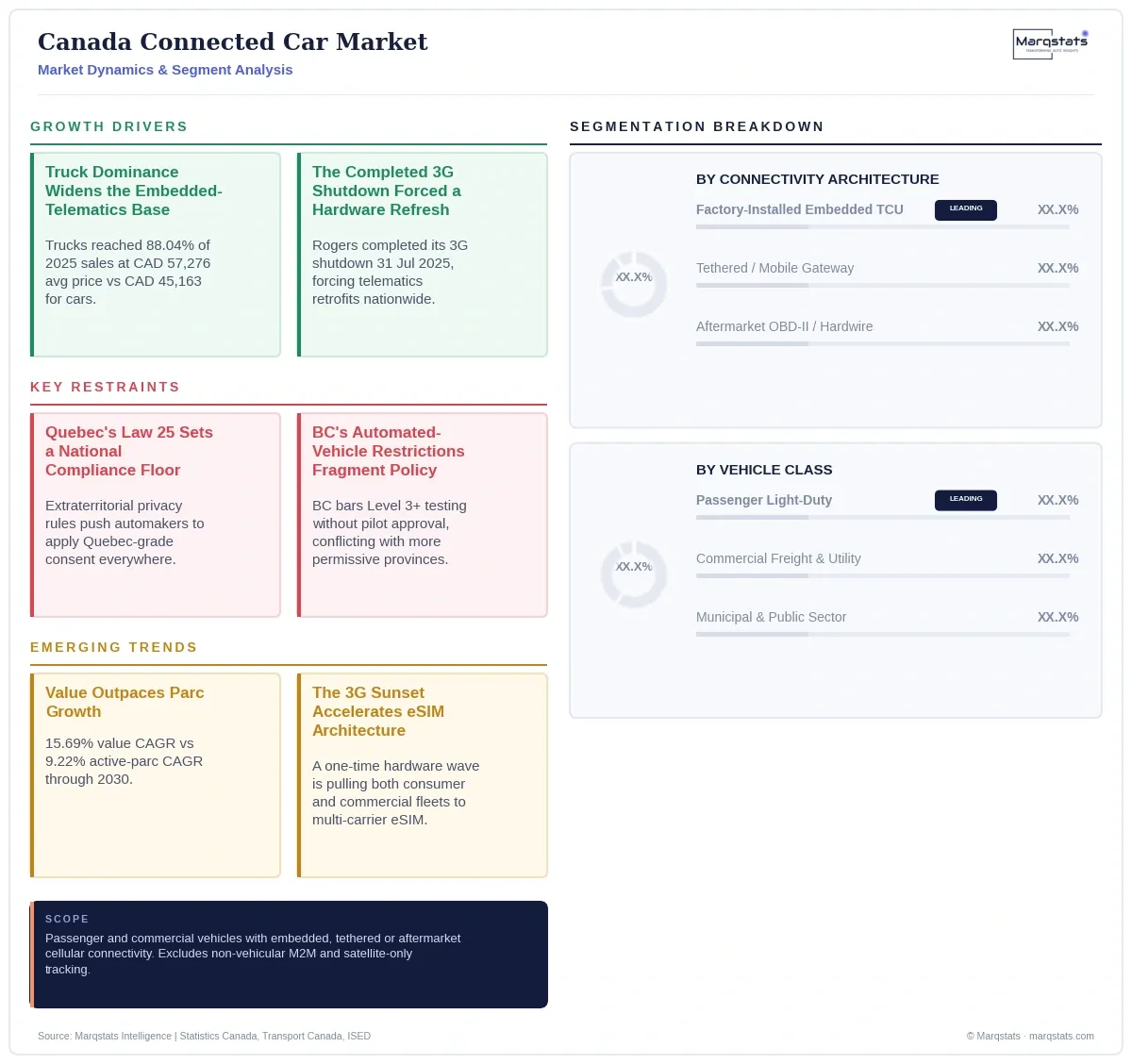
- Truck and utility vehicle dominance of new-vehicle sales continues to widen the base automakers can standardize embedded telematics onto, with higher per-unit transaction prices absorbing hardware costs that would meaningfully dent margin on a shrinking passenger-car line.
- The completion of Rogers Communications' 3G network shutdown on 31 July 2025 has forced a real, one-time wave of telematics hardware retrofits across vehicle manufacturers and commercial fleet operators, replacing legacy circuit-switched modems with dual-mode 4G LTE and 5G multi-carrier eSIM hardware.
- Telus Corporation's 5G standalone core network slicing, deployed with Cisco Systems from September 2024, gives commercial fleet operators and automakers access to low-latency, dedicated automotive IoT infrastructure that legacy shared-network architecture could not support.
- Environment and Climate Change Canada's Electric Vehicle Availability Standard, finalized in December 2023 under the Canadian Environmental Protection Act, mandates 100% zero-emission new-vehicle sales by 2035, locking in a long-term structural tailwind for connectivity fitment even through near-term ZEV sales volatility.
- Canada's domestic software and telematics enablers give the market a genuine engineering base beyond imported technology. Geotab Inc. surpassed 4.7 million active connected vehicles across 160 countries by 2025, and BlackBerry QNX's automotive software now runs inside more than 235 million vehicles globally, with a royalty backlog that reached approximately USD 950 million in fiscal 2026.
Key Restraints
Four constraints stand between the market and a fully standardized national architecture.
Quebec's Law 25 imposes real compliance friction that automakers cannot simply localize away. Any manufacturer or telematics provider transmitting a Quebec-registered vehicle's telemetry outside the province must complete formal privacy impact assessments and implement granular consent workflows, and the administrative monetary penalties for non-compliance are substantial enough that most automakers apply Quebec-grade consent architecture nationally rather than maintaining a separate, lighter-touch pipeline for the other nine provinces.Why does one province set the bar for Canada's connected car privacy rules?
- British Columbia's 2024 Motor Vehicle Act amendments prohibit SAE Level 3, 4 and 5 automated systems from operating on public highways without a specific provincial pilot approval, creating a direct regulatory conflict with jurisdictions such as Ontario that permit broader automated testing — a fragmentation this coverage treats as the primary trigger separating its Downside case from its Base Case.
- Vast stretches of northern and remote Canada remain outside commercial cellular coverage entirely. Freight operators along northern highway corridors depend on dedicated L-band satellite communication transceivers rather than standard cellular connected-car architecture, a cost and complexity burden concentrated specifically in the Northern Territories, which account for only 0.38% of national connected-car market value despite the country's full geographic breadth.
- Severe winter conditions place a genuine operational burden on connected hardware and electric vehicle range alike, requiring cold-weather-resilient telematics units and route-planning software tuned specifically to sub-zero battery degradation — a cost most global telematics platforms were not originally engineered around.
Key Trends
Four shifts show where the market is heading and who captures the value.
- Value creation is shifting toward blended revenue per connected vehicle rather than parc growth alone, with market value's 15.69% forecast CAGR running meaningfully ahead of the 9.22% CAGR for the active connected parc itself.
- The 3G network sunset has permanently retired an entire generation of legacy telematics hardware, accelerating the transition to multi-carrier eSIM architecture across both consumer and commercial fleet segments simultaneously rather than as a gradual, model-year-by-model-year replacement cycle.
- Level 2+ hands-free driver assistance systems — Ford BlueCruise and General Motors Super Cruise chief among them — are converting connected active safety from a background telemetry function into a continuously cellular-dependent feature, requiring real-time high-definition corridor mapping updates rather than periodic firmware checks.
- Commercial telematics platforms are pushing beyond basic Electronic Logging Device compliance toward predictive maintenance and electric-fleet transition analytics, with Geotab's MyGeotab platform processing more than 80 billion data points daily across its global customer base.
Strategic Implications
- Automotive OEMs should treat truck and utility vehicle telematics fitment as the market's real growth lever, not a secondary consideration behind passenger-car strategy, given trucks now carry 88.04% of new-vehicle volume at a transaction price that comfortably absorbs embedded hardware cost.
- Telecommunications carriers should prioritize 5G standalone network-slicing investment specifically along Canada's highest-density freight corridors — Highway 401, the Trans-Canada Highway and the Coquihalla — where Telus's Cisco-partnered deployment already demonstrates the commercial template for capturing high-margin enterprise fleet and automated-logistics revenue.
- Compliance and data-architecture teams should build to Quebec's Law 25 standard as the national baseline rather than a province-specific exception, since the administrative cost of maintaining two parallel consent and data-localization pipelines typically exceeds the cost of applying the stricter standard everywhere.
- Commercial fleet software providers should weight cold-weather operational resilience and cross-border customs integration as core product requirements, not regional add-ons, given that sub-zero reliability and complex regulatory compliance are structural features of the Canadian market rather than edge cases.
Market Segmentation
The largest architecture segment at USD 2,310.90 million in 2025, 73.13% of market value, projected to grow at 16.94% a year to USD 5,010.00 million by 2030. Standard fitment across General Motors, Ford, Stellantis and Toyota's Canadian-market lineups, these units combine an automotive-grade cellular transceiver, multi-frequency GNSS chipset and secure microcontroller wired directly to the vehicle's CAN and Ethernet backbones.
USD 565.96 million in 2025, 17.91% of value, the slowest-growing architecture segment at 12.63% a year to USD 980.00 million by 2030. Apple CarPlay and Android Auto-based smartphone mirroring is declining in relative share as OEMs prioritise untethered connectivity for maintenance and software monetisation.
USD 283.14 million in 2025, 8.96% of value, growing at 15.17% a year to USD 560.00 million by 2030. Anchored by domestic provider Geotab Inc., this segment standardises engine diagnostic data collection across mixed-make commercial and municipal fleets.
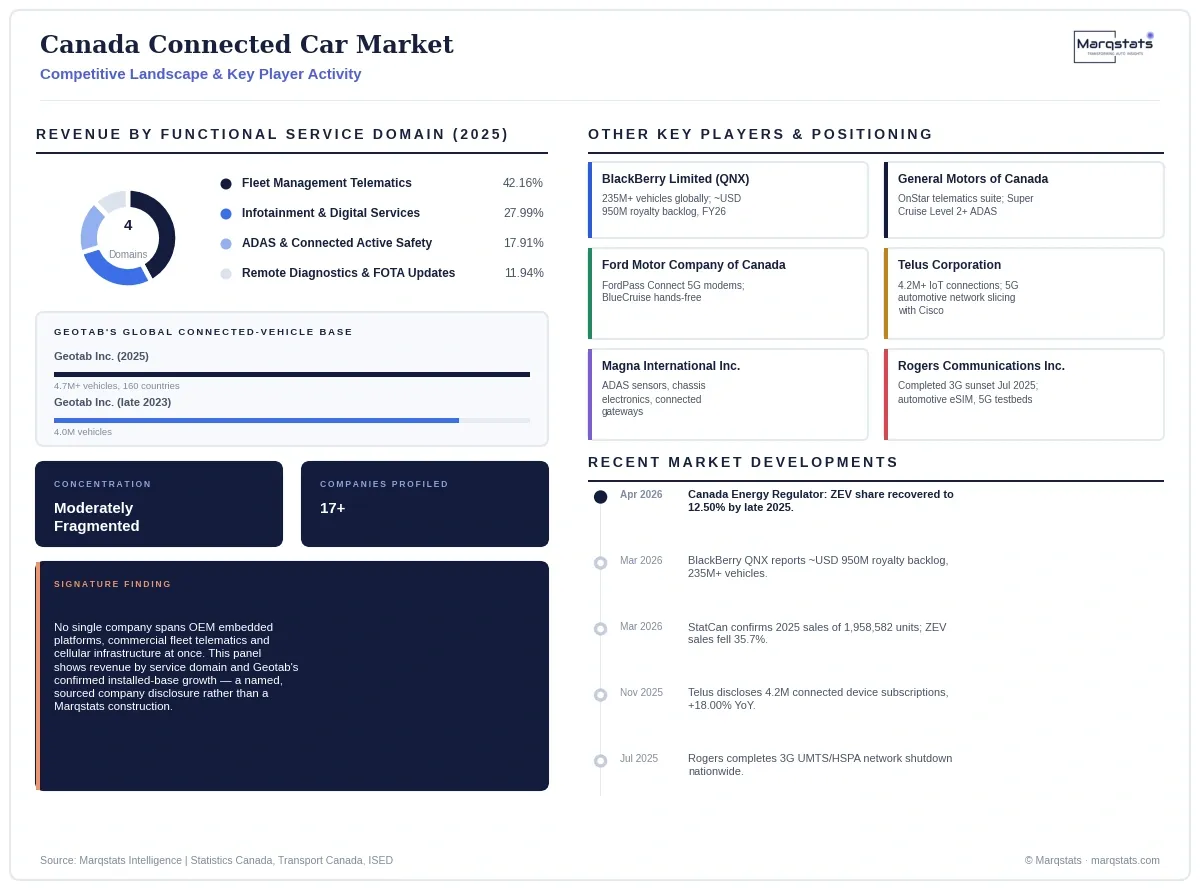
The largest service domain at USD 1,332.39 million in 2025, growing to USD 2,820.00 million by 2030. Federal and provincial Electronic Logging Device mandates have driven near-universal adoption among freight operators, led by Geotab Inc., Isaac Instruments Inc. and Complete Innovations (Fleet Complete).
USD 884.33 million in 2025, growing to USD 1,770.00 million by 2030, covering connected satellite and streaming audio, cloud navigation and in-vehicle Wi-Fi, monetised through multi-tier subscriptions with SiriusXM Canada, Bell Mobility and Rogers Wireless.
USD 565.97 million in 2025, growing to USD 1,200.00 million by 2030, anchored by General Motors' OnStar crash-notification platform and Level 2+ systems such as Ford BlueCruise and General Motors Super Cruise that require continuous cellular data for real-time mapping.
The smallest domain at USD 377.31 million in 2025, growing to USD 720.00 million by 2030, led by BlackBerry QNX and Tesla Motors' over-the-air firmware infrastructure, mitigating warranty overhead by remediating software issues without a dealership visit.
USD 1,863.13 million in 2025, driven by consumer scale and widespread factory fitment despite the passenger-car sales class's own ongoing volume contraction.
USD 1,049.44 million in 2025, carrying substantially higher annual average revenue per unit than passenger vehicles due to complex regulatory compliance and enterprise software licensing requirements.
The smallest vehicle class at USD 247.43 million in 2025, covering transit buses, emergency response units and specialised public-sector fleets using vehicle location systems, traffic-signal priority transmitters and encrypted cellular communications.
By Geography
Ontario
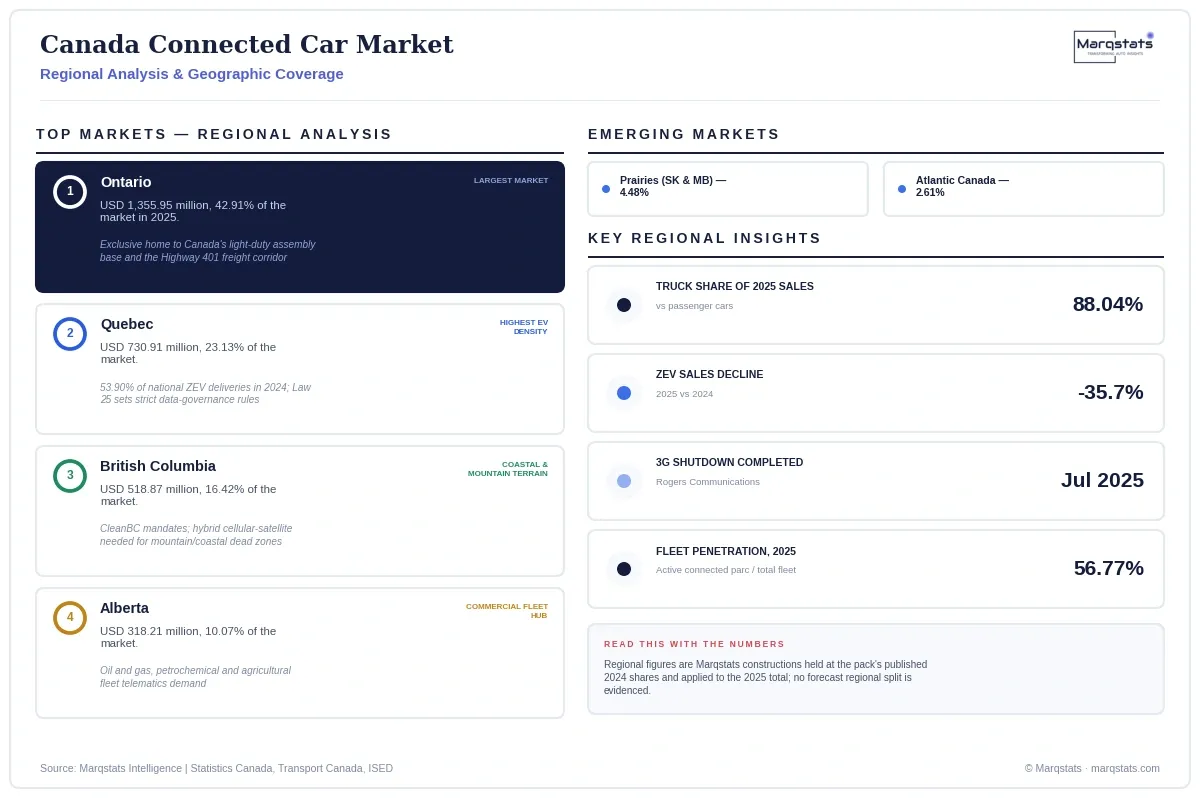
The dominant regional market at USD 1,355.95 million, 42.91% of national value in 2025. Ontario is the exclusive home of Canada's light-duty assembly infrastructure — Stellantis, Ford, General Motors, Toyota and Honda all operate plants in the province — and the Highway 401 corridor is the heaviest freight transit route in North America. Ontario also hosts Canada's primary connected-vehicle technology base, including BlackBerry QNX in Ottawa and Waterloo and Geotab Inc. in Oakville, and was the first province to establish a formal automated-vehicle testing ground under Ontario Regulation 306/15.
Quebec
The second-largest regional market at USD 730.91 million, 23.13% of national value. Quebec leads the country in electrification, accounting for 53.90% of national ZEV deliveries in 2024 with zero-emission platforms capturing over 30% of provincial new registrations, giving it higher active connected-vehicle density per capita than the national average since EVs require active cellular links for battery management in sub-zero climates. Quebec's Law 25 simultaneously imposes the country's strictest data-governance requirements on any automaker transmitting provincial vehicle telemetry outside its borders.
British Columbia
USD 518.87 million, 16.42% of national value, supported by CleanBC's zero-emission mandates and a 20.70% EV sales penetration in 2024. Complex mountainous terrain along the Trans-Canada Highway and coastal freight corridors terminating at the Port of Vancouver require hybrid cellular-satellite telematics to eliminate coverage dead zones, while 2024 Motor Vehicle Act amendments prohibit Level 3 and above automated systems from public highways without a specific pilot approval.
Alberta
USD 318.21 million, 10.07% of national value, driven by commercial enterprise applications rather than consumer subscriptions. Alberta's fleet skews heavily toward heavy-duty commercial trucks and full-size pickups serving oil and gas extraction, petrochemical manufacturing and agricultural distribution, demanding ruggedised, cold-weather-resilient telematics and satellite communication failovers for remote resource operations.
Prairies (Saskatchewan & Manitoba)
USD 141.57 million, 4.48% of national value, driven by transcontinental rail-freight intermodal trucking and agricultural machinery telemetry.
Atlantic Canada
USD 82.48 million, 2.61% of national value across Nova Scotia, New Brunswick, Prince Edward Island and Newfoundland and Labrador, reflecting maritime freight distribution and regional consumer convenience telematics adoption.
How Competition Is Evolving
Competition runs on three largely separate axes. On embedded hardware and OEM software platforms, General Motors of Canada's OnStar and Super Cruise, Ford Motor Company of Canada's FordPass Connect and BlueCruise, Stellantis Canada's Uconnect 5, and Toyota Canada's Safety Connect compete for the consumer relationship on vehicles assembled largely in Ontario. On commercial fleet telematics, Geotab Inc. operates as the largest global provider from its Oakville headquarters, competing against Isaac Instruments and Complete Innovations (Fleet Complete) domestically and international platforms without Geotab's Canadian winter-hardened engineering base.
On embedded software and real-time operating systems, BlackBerry Limited's QNX division holds a position few national markets can claim a domestic leader in: certified to ISO 26262 ASIL-D, QNX software runs inside more than 235 million vehicles worldwide, with a royalty backlog that reached approximately USD 950 million in fiscal 2026 as OEMs globally transition toward software-defined vehicle architectures.
On cellular infrastructure, Telus Corporation, Rogers Communications and BCE Inc. compete for automotive wholesale and enterprise IoT contracts, with Telus's Cisco-partnered 5G standalone network slicing positioning it specifically for low-latency automotive and fleet applications ahead of carriers still monetising automotive connectivity as commodity wholesale bandwidth.Rogers shut down 3G in July 2025 — does your connected car still work?
Companies Covered
The report profiles 17+ companies with full strategy and financials analysis, including:
Recent Market Activity
Table of Contents
Coverage & Segmentation
This report measures passenger and commercial vehicles operating in Canada with factory-embedded, tethered or aftermarket cellular connectivity, across a 2025 base year and a 2026 to 2030 forecast period, denominated in United States dollars at a constant 1.3650 CAD/USD exchange rate, the Bank of Canada's 2024 annual average. It excludes non-vehicular industrial and utility M2M connections and dedicated satellite-only tracking devices used in cellular dead zones outside standard connected-car architecture.
The analysis spans three segmentation dimensions — connectivity architecture, functional service domain and vehicle class — six regional geographies, and 17 profiled entities across regulators, automakers, telecommunications carriers and telematics software providers. New-vehicle sales and fleet-census figures are primary, sourced directly from Statistics Canada; market value, the active connected parc, and the 2025 segment and regional splits are Marqstats constructions held at the pack's most recently published 2024 composition and applied to the 2025 total.