Market Snapshot
Key Takeaways
Market Overview & Analysis
Report Summary
Europe's connected car market is measured across wholesale factory hardware, cellular connectivity pipelines, and connected software and digital applications, valued at USD 35,430.00 million in 2025. This figure is taken directly from the underlying research's own rigorously sourced sizing chain, reconciled from national vehicle registries across Germany, the UK, France, Italy and Spain, corporate OEM disclosures, and Vodafone IoT connection data.
Structurally, this is a market where value is decoupling from volume: connected-vehicle delivery growth runs at 5.84% annually while market value compounds at 14.70%, as revenue shifts toward recurring software, fleet data licensing and post-sale monetization. Yet European Commission research shows only 18% of consumers consider connected services essential, creating a genuine tension between OEM software ambitions and documented consumer indifference.
The analysis is built for four reader types making different decisions: an OEM deciding between in-house software development (CARIAD's costly path) and external partnership (Stellantis's more successful Mobilisights/Foxconn model), a Tier-1 supplier planning the transition from circuit-switched to packet-switched IMS eCall hardware ahead of the 2027 compliance deadline, an independent aftermarket provider assessing how the EU Data Act's September 2026 data-access mandate reshapes competitive access, and an investor weighing how much of this market's forecast growth depends on regulatory enforcement timelines rather than organic consumer demand.
Europe Connected Car Market Size and Forecast
Marqstats builds the Europe figure directly from the underlying research's own year-by-year sizing table, itself reconciled from national vehicle registration authorities, corporate OEM financial disclosures, and Vodafone's own IoT connection reporting. The market spans three monetization tiers — wholesale factory hardware, cellular connectivity pipelines, and connected software and digital applications — each independently tracked and summed to the reported total.
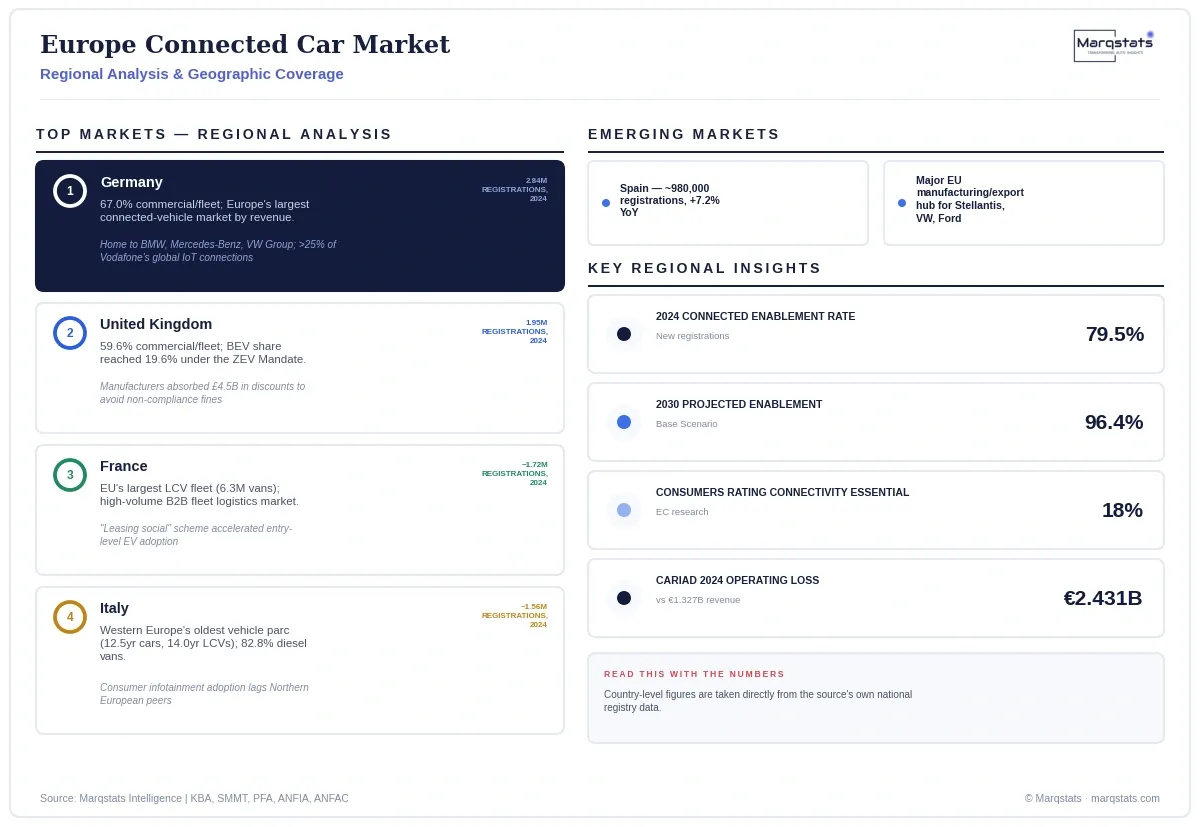
Market value grows from USD 35,430.00 million in 2025 to USD 70,330.00 million by 2030, a 14.70% CAGR, while annual connected-vehicle delivery volumes grow from a 2024 base of 10.42 million units (79.5% enablement rate) to a projected 14.65 million units (96.4% enablement rate) by 2030, just a 5.84% CAGR. The near-triple gap between value growth and volume growth is this market's central structural story: revenue is increasingly generated per-vehicle through software and data services, not through selling more vehicles.
The source's own three forward scenarios diverge specifically on regulatory enforcement speed and consumer subscription behavior. The Base Operating Scenario assumes steady enforcement of both Delegated Regulation (EU) 2024/1180 and the EU Data Act on their stated timelines, reaching €64.82 billion by 2030; the Accelerated Operating Scenario assumes rapid onboard API enforcement and completed TEN-T 5G corridor coverage, reaching €79.45 billion (USD 86,200.00 million) at an 18.49% CAGR; the Constrained Operating Scenario assumes TCU supply shortages delay the 2027 eCall deadline and Data Act legal disputes stall third-party access, with consumer subscription cancellation rates exceeding 80% post-trial, reaching only €51.20 billion (USD 55,550.00 million) at a 10.11% CAGR.
Europe's Connected Car Revenue Is Decoupling From Its Connected Car Volume
Most markets in this coverage set show unit growth and value growth moving in roughly the same direction, even if at different rates. Europe shows something structurally different: connected-vehicle delivery volumes are projected to grow just 5.84% annually through 2030, constrained by the upper bound of total automotive registrations across a largely saturated continent, while market value compounds at 14.70% annually — more than double the unit growth rate.
That gap is the whole story of where European OEM strategy is actually headed: toward recurring software subscriptions, B2B fleet telematics, usage-based insurance, and enterprise data-as-a-service licensing (exemplified by Stellantis's Mobilisights unit), rather than toward selling more connected vehicles. Any reader modeling this market's growth should recognize that the forecast is fundamentally a monetization-intensity story, not a volume story, which is precisely why the source's own scenario analysis diverges most sharply on regulatory and software-adoption variables rather than vehicle-sales assumptions.
The CARIAD-Stellantis Contrast Is a Live Natural Experiment
Volkswagen and Stellantis chose opposite strategies for the same underlying problem — how to build software-defined vehicle capability at scale — and the European market is now watching a genuine natural experiment play out between them. CARIAD, Volkswagen's wholly-owned software subsidiary, recorded a widening €2.431 billion operating loss in 2024 against just €1.327 billion in revenue, with architectural delays pushing back key model launches including the Porsche Macan and Audi Q6 e-tron.
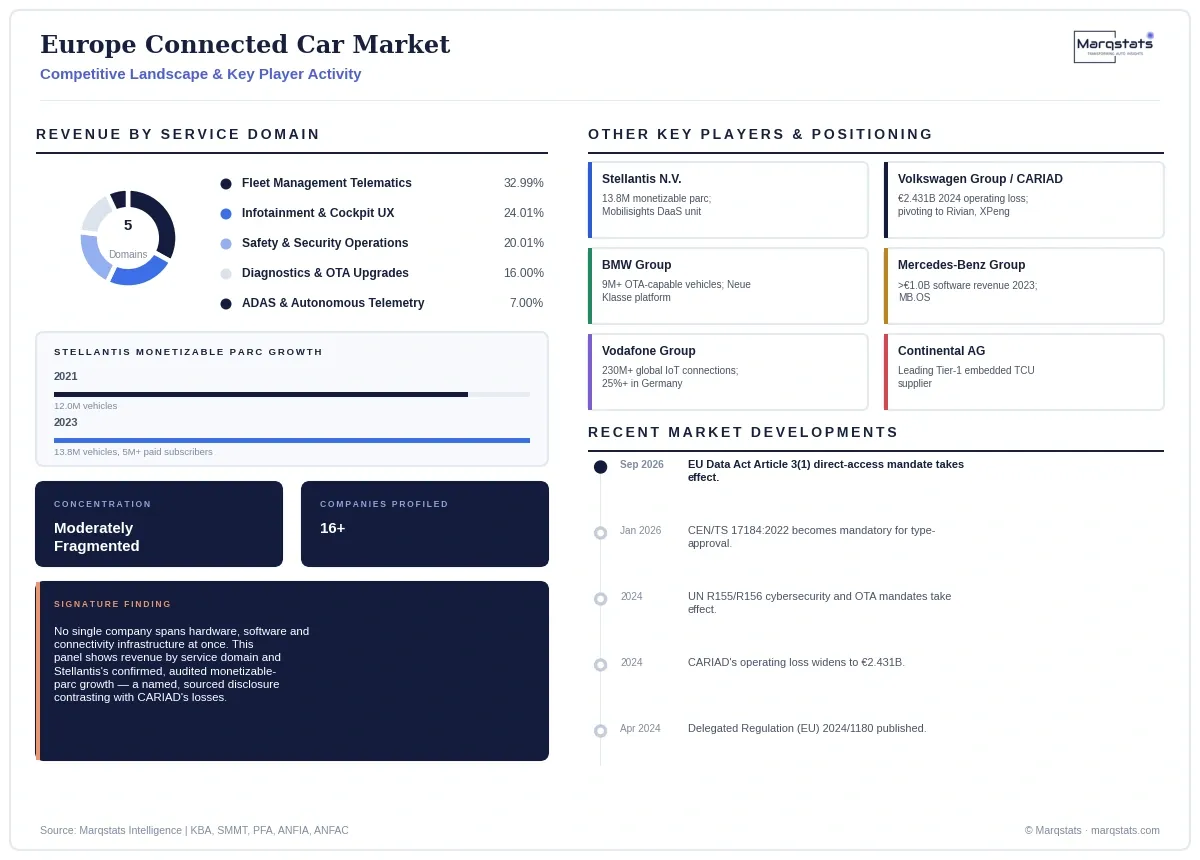
Stellantis took the opposite path: rather than building everything in-house, it partnered with Foxconn (via Mobile Drive) for its SmartCockpit platform and established Mobilisights as an independent data-licensing unit selling anonymized telemetry to fleet managers, utilities and insurers. The result is a monetizable connected parc that grew from 12.0 million vehicles in 2021 to 13.8 million by 2023, more than 5 million active paid subscribers, and software revenue that grew 2.5 times over the same period — a genuinely different trajectory from CARIAD's mounting losses, and Volkswagen itself has since pivoted toward external partnerships with Rivian and XPeng, tacitly validating the Stellantis approach.
Why Germany's Fleet Dominance Sets the Tone for the Whole Continent
With 67.0% of new registrations going to commercial and fleet buyers, Germany's automotive market runs on a fundamentally different buyer logic than a consumer-led market would suggest, and because Germany also hosts BMW, Mercedes-Benz and Volkswagen Group's own headquarters and core engineering bases, this fleet-first buying pattern shapes product design decisions that then ripple across every other European market these OEMs sell into.
That's a genuinely different dynamic from markets in this coverage set where private consumer sentiment sets the product roadmap directly. In Germany, a fleet manager's requirements for automated digital logbooks and company-car tax tracking carry disproportionate influence over what connected features actually ship as standard, since the OEMs building those features are headquartered in the exact market where fleet buyers, not individual consumers, are the dominant customer.
Market Dynamics
Key Drivers
Five conditions are moving this market, and commercial insurance mandates matter more than consumer demand.
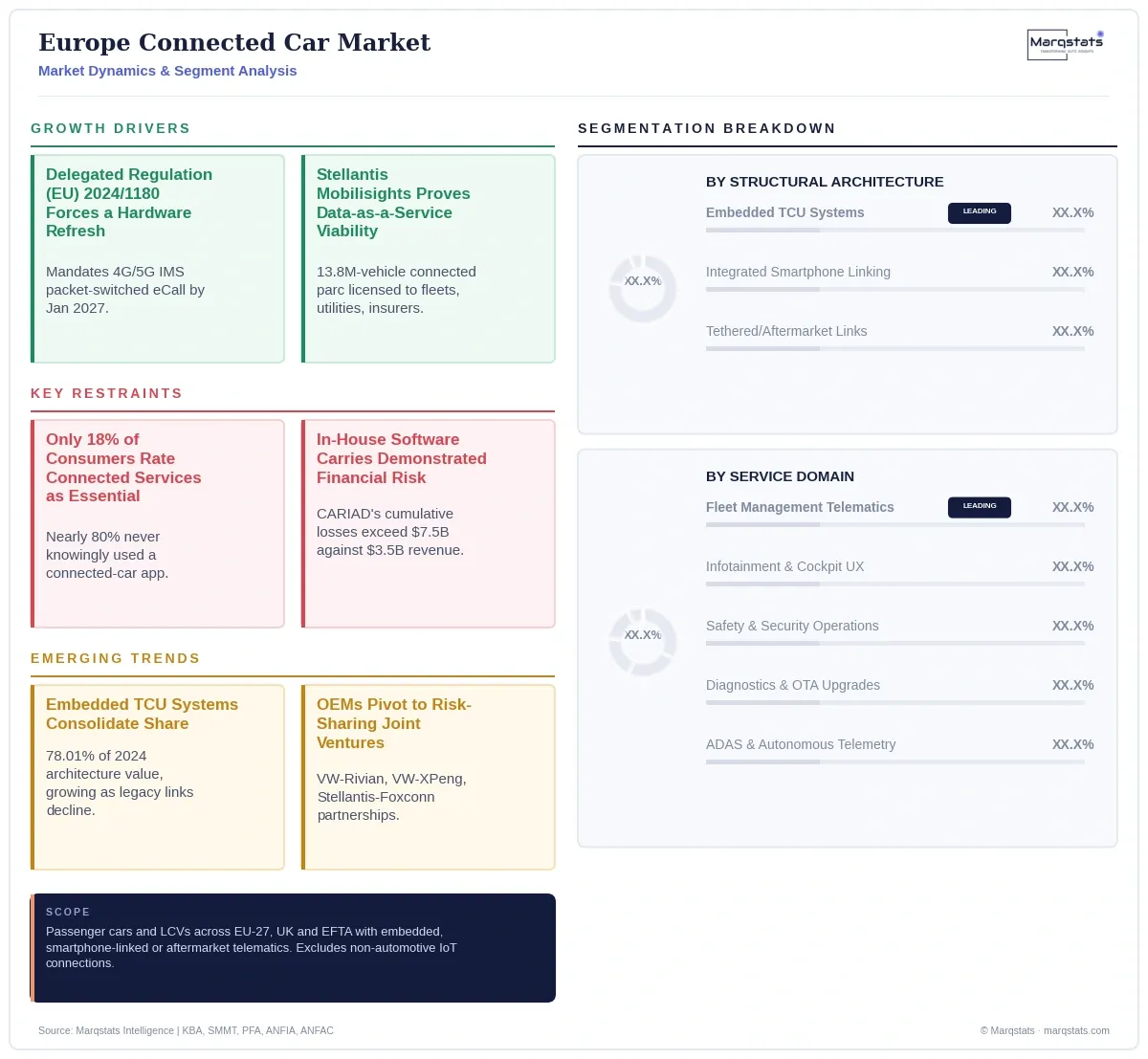
- Delegated Regulation (EU) 2024/1180 mandates the transition from 2G/3G circuit-switched to 4G/5G packet-switched IMS eCall, with Certificate of Conformity invalidation for non-compliant vehicles from 1 January 2027, forcing a hardware refresh cycle across the entire new-vehicle fleet.
- UN Regulations 155 and 156, mandatory for all new registrations since 7 July 2024, require certified Cyber Security Management Systems and Software Update Management Systems, establishing a baseline compliance cost that favors centralized zonal computing architectures over legacy multi-ECU designs.
- Stellantis's proven Mobilisights data-as-a-service model, licensing anonymized operational telemetry from its 13.8 million-vehicle connected parc to fleet managers, utilities and insurers, demonstrates a genuine alternative revenue channel beyond consumer subscriptions that other OEMs are likely to replicate.
- Germany's fleet-dominated new-car market (67.0% commercial registrations) sustains structural demand for fleet management software, automated digital logbooks and connected company-car tax tracking, independent of private consumer sentiment or wider economic cycles.
- Vodafone's dedicated automotive IoT business unit, managing over 230 million global connections with more than a quarter concentrated in Germany alone, demonstrates the sheer scale of managed connectivity infrastructure this market now depends on, and the degree to which automotive telematics has become a genuinely material line of business for major European telecom carriers rather than a peripheral IoT experiment worth treating as a rounding error in any national telecom operator's own revenue mix going forward.
- EU Agency for the Space Programme dual-frequency Galileo and EGNOS positioning mandates are driving Tier-1 suppliers toward AEC-Q100 qualified GNSS chipsets capable of centimeter-level accuracy, a genuine technical moat for established suppliers like u-blox, Qualcomm and STMicroelectronics.
Key Restraints
Four constraints stand between this market and a fully monetized, evenly connected fleet.
- Only 18% of European consumers rate connected services as essential, and nearly 80% report never knowingly using a connected-car application, directly undermining the consumer subscription revenue OEMs have built software strategies around.
- Tens of millions of vehicles type-approved between 2018 and 2023 with circuit-switched eCall modems face 2G/3G network retirement with no statutory OEM retrofit obligation, creating legal ambiguity over Periodic Technical Inspection roadworthiness failures and exposing OEMs to potential consumer litigation.
- In-house software development carries genuine, demonstrated financial risk, exemplified by CARIAD's cumulative 2022-2024 operating losses exceeding $7.5 billion against roughly $3.5 billion in cumulative revenue, a cautionary data point for any OEM considering a similar strategy.
- The OEM-preferred "Extended Vehicle" off-board data architecture remains contested by independent aftermarket coalitions FIGIEFA and ADPA, with implementation of the EU Data Act's direct-access mandate requiring OEMs to re-engineer vehicle gateways without compromising UN R155 cybersecurity boundaries.
Key Trends
Four shifts show where the market is heading and who captures the value.
- Embedded TCU systems are consolidating share at the expense of smartphone-linking and tethered architectures, holding 78.01% of 2024 segment value and continuing to expand as Delegated Regulation (EU) 2024/1180 mandates packet-switched hardware across all new registrations.
- OEMs are pivoting from isolated in-house software development toward risk-sharing joint ventures, exemplified by Volkswagen's partnerships with Rivian ($5.8 billion co-development commitment) and XPeng, and Stellantis's collaboration with Foxconn via Mobile Drive.
- Telecommunications operators are migrating from physical MFF2 soldered SIM chips to integrated SIMs (iSIM) embedded directly into baseband processor silicon, improving shock and thermal resistance while reducing bill-of-materials costs for Tier-1 TCU suppliers.
- Value is shifting toward battery-electric vehicle telematics specifically, with the BEV powertrain segment projected to grow from 25.99% of 2024 segment value toward a much larger share by 2030 as centralized compute and smart-charging data requirements expand.
Strategic Implications
- Automotive OEMs should treat CARIAD's losses as a cautionary benchmark against continued isolated in-house software development, and should prioritize risk-sharing partnerships and enterprise data-as-a-service models over consumer micro-subscriptions given documented low consumer demand.
- Tier-1 suppliers should accelerate the transition from legacy circuit-switched to 4G/5G packet-switched TCU production ahead of the January 2027 compliance deadline, while building certified Cyber Security Management System capability across their full sub-tier supply chains.
- Independent aftermarket providers and third-party software developers should prepare technical and commercial infrastructure now for the EU Data Act's 12 September 2026 direct-access mandate, which will open in-vehicle data access previously restricted under the Extended Vehicle model.
- Investors and analysts should track Delegated Regulation (EU) 2024/1180 and EU Data Act enforcement timelines as the clearest indicators separating this market's Base, Accelerated and Constrained scenarios, rather than treating consumer subscription adoption as the primary swing factor given how consistently low European consumer interest has measured.
Market Segmentation
USD 27,638.94 million, 78.01% of value, mandated by Delegated Regulation (EU) 2024/1180, led by suppliers including ACTIA and Continental.
USD 5,668.80 million, 16.0% of value, Apple CarPlay and Android Auto projection layers.
USD 2,122.26 million, 5.99% of value, retrofit fleet OBD-II modules and legacy commercial devices.
USD 11,688.36 million, 32.99% of value, the largest service segment, driven by high B2B operational ROI and EU tachograph rules.
USD 8,506.74 million, 24.01% of value, built on AOSP platforms and OEM-specific operating systems including BMW OS 9 and MB.OS.
USD 7,089.54 million, 20.01% of value, anchored by 112-based eCall and remote vehicle tracking.
USD 5,668.80 million, 16.0% of value, driven by UN R156 compliance and ECU re-flashing requirements.
USD 2,480.10 million, 7.0% of value, the smallest but among the fastest-growing domains, built on HD mapping and lane-level telemetry.
USD 20,549.40 million, 58.0% of value, a contracting volume share still anchoring baseline telematics demand.
USD 9,208.26 million, 25.99% of value, driven by centralized compute and smart-charging data requirements.
USD 5,672.34 million, 16.01% of value, driven by energy-efficiency routing and statutory OBFCM fuel-consumption logging.
By Geography
Germany
2,844,609 new registrations in 2024, 67.0% commercial/fleet. Europe's largest connected-vehicle market by revenue and hardware production, home to BMW, Mercedes-Benz and Volkswagen Group, and hosting over 25% of Vodafone's global IoT connection base.
United Kingdom
1,952,778 new registrations in 2024, 59.6% commercial/fleet. BEVs reached 19.6% share under the ZEV Mandate; manufacturers absorbed over £4.5 billion in retail discounts to avoid £15,000-per-vehicle non-compliance fines.
France
~1,720,000 new registrations in 2024, ~52.0% commercial/fleet. Home to the EU's largest light commercial vehicle fleet (6.3 million vans), making France a high-volume market for B2B fleet logistics software.
Italy
~1,560,000 new registrations in 2024, ~45.0% commercial/fleet. Western Europe's oldest major vehicle parc (12.5 years for cars, 14.0 years for LCVs) and most diesel-dominated van fleet (82.8% of new van registrations), constraining consumer infotainment adoption relative to Northern European peers.
Spain
~980,000 new registrations in 2024, ~48.0% commercial/fleet. A major EU manufacturing and export hub for Stellantis, Volkswagen Group and Ford, with connected demand shaped heavily by tourist rental fleet turnover against an otherwise aging operational parc.
How Competition Is Evolving
Competition centers on four major OEM groups pursuing genuinely different software strategies. Stellantis N.V. runs the most externally-partnered model, combining its STLA Brain/SmartCockpit/AutoDrive platforms (developed with Foxconn via Mobile Drive) with its independent Mobilisights data-licensing unit, targeting €20 billion in incremental annual software revenue by 2030. Volkswagen Group's CARIAD subsidiary represents the costliest in-house approach, with cumulative 2022-2024 losses exceeding $7.5 billion prompting a strategic pivot toward Rivian and XPeng partnerships.
BMW Group has built one of the sector's largest operating connected fleets, with over 9 million OTA-capable vehicles and more than 6 million actively transmitting real-time probe data, transitioning to its AOSP-derived BMW Operating System 9 ahead of the Neue Klasse platform's 2025 Debrecen production launch. Mercedes-Benz Group targets the luxury tier specifically, generating over €1.0 billion in software-enabled revenue in 2023 through its Digital Extras storefront and proprietary MB.OS chip-to-cloud architecture, developed with NVIDIA, Google and Microsoft.
On connectivity infrastructure, Vodafone Group's dedicated IoT business unit is the largest managed automotive IoT connectivity provider in Europe, managing over 230 million global connections with Germany alone hosting more than 25% of that base. Tier-1 hardware suppliers ACTIA Group, Continental AG, Robert Bosch, Valeo and Harman International compete on integrated gateway TCU production, while u-blox, Qualcomm and STMicroelectronics supply the underlying AEC-Q100 qualified GNSS and cellular modem chipsets.
Companies Covered
The report profiles 16+ companies with full strategy and financials analysis, including:
Recent Market Activity
Table of Contents
Coverage & Segmentation
This report measures passenger cars and light commercial vehicles across the EU-27, United Kingdom and EFTA member states carrying factory-embedded, smartphone-linked or aftermarket telematics hardware, across a 2025 base year and a 2026 to 2030 forecast period, denominated in United States dollars at the source's own stated 1.085 USD/EUR average benchmark exchange rate. It excludes non-automotive IoT connections.
The analysis spans three segmentation dimensions — structural architecture, service domain and propulsion powertrain — five major national markets, and 16 profiled entities across OEMs, Tier-1 suppliers, telecommunications operators and regulatory bodies. Registration figures trace to KBA, SMMT, PFA, ANFIA and ANFAC; market value and segment splits are taken directly from the underlying research's own sourced sizing chain, with the CAGR recalculated on a 2025 base year.