Market Snapshot
Key Takeaways
Market Overview & Analysis
Report Summary
South Korea's connected car market is measured on the value of connected vehicle services — carrier wholesale bandwidth, OEM consumer software subscriptions, and factory-installed hardware — sold against the country's registered vehicle fleet. The market is worth USD 13,626.20 million as of 2025, and it is already one of the most penetrated connected-vehicle markets in this coverage set: more than nine in ten new vehicles ship connected, and the whole operating fleet crossed 37.60% penetration in mid-2025.
Structurally, this is a monetization market rather than an adoption market. The connectivity question in South Korea was largely settled by 2023, when Hyundai Motor Group standardized factory telematics across its trim lineup; the open question now is whether automakers and carriers can convert a fleet that is already connected into one that pays for connectivity past the warranty period, against free smartphone-mirroring alternatives that do much of the same job.
The analysis is built for four reader types making different decisions: a telecommunications carrier bidding for the next Hyundai Motor Group wholesale contract cycle, an automaker pricing post-warranty subscription renewal against a smartphone-mirroring substitute, an infrastructure investor assessing the pace of LTE-V2X roadside deployment against its 2027 and 2030 statutory targets, and a foreign OEM deciding how to structure a Korean telematics partnership against Hyundai Motor Group's 80%-plus domestic share.
South Korea Connected Car Market Size and Forecast
Marqstats builds the South Korea figure primarily from the Ministry of Science and ICT's monthly Vehicle Control IoT registry, the single most granular connected-vehicle count published by any government in this coverage set, cross-referenced against MOTIE, KATECH and KIBO's connected vehicle services valuation series. Because the registry separates Mobile Virtual Network Operator (MVNO) lines from direct Mobile Network Operator (MNO) lines, the underlying data supports a level of network-category granularity most national markets do not publish at all.
Connected subscription-line volume is primary, following directly from MSIT's registry; market value is derived from it. Lines grow from 10,020,000 in 2025 to 12,800,000 by 2030 in the Baseline scenario, a modest 5.02% CAGR, while market value grows at 11.75% to USD 23,750.00 million — more than double the unit growth rate, because the market's value increasingly comes from software, data services and post-warranty subscription conversion rather than from connecting additional vehicles.
That gap between value growth and unit growth is the most important single number in the whole analysis. A market with 37.60% fleet penetration and above-92% new-vehicle connected-sales penetration has limited room left to grow by volume; South Korea's forecast assumes the market instead grows by raising what each already-connected vehicle is worth, through subscription retention, data monetization and premium service tiers.
A 2020 Reporting Rule Change Explains Much of This Market's Headline Growth Rate
South Korea's connected vehicle fleet grew at a 35.91% compound annual rate from 2018 to 2023, a figure frequently cited as evidence of unusually fast market adoption. Part of that rate is a statistical artefact. In October 2020, the Ministry of Science and ICT reclassified Hyundai and Kia's factory-installed telematics lines from direct carrier reporting into the Mobile Virtual Network Operator (MVNO) registry — both automakers had registered as specialized MVNOs under the Telecommunications Business Act, Hyundai in 2015 and Kia in 2020 — moving 2.14 million lines into a new statistical category in a single reporting change.
Between 2022 and 2023, MVNO subscriptions accounted for 92.21% of all net-new connected-vehicle line additions nationally. That concentration means the market's true organic growth rate is best read from the MVNO channel specifically, where Hyundai Motor Group's standard-trim telematics fitment is the primary driver, rather than from the blended headline figure, which combines a genuine adoption trend with a one-time reporting boundary shift.Why South Korea's 35.91% connected car growth rate isn't all organic demand.
The Carrier Switch Everyone Watched in 2024 Has Now Produced a Measurable Winner
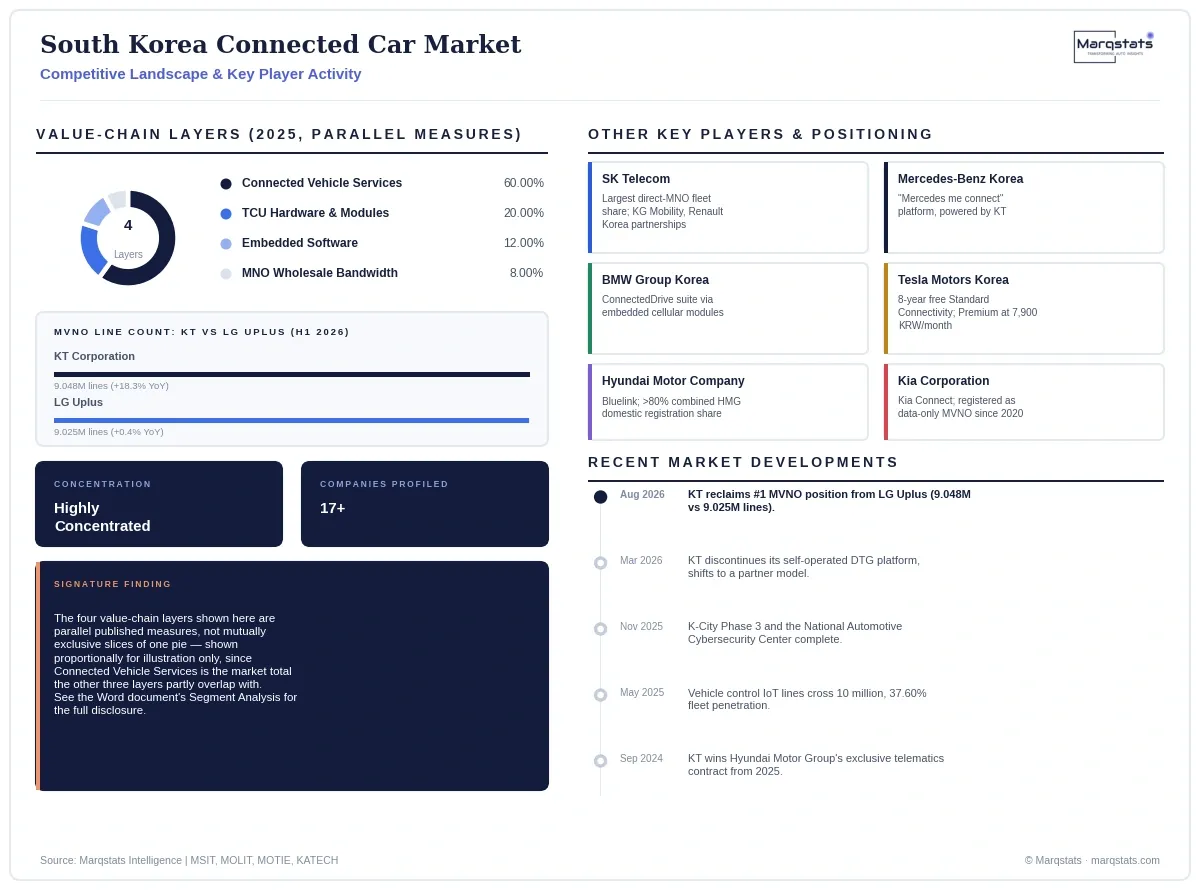
When KT Corporation displaced LG Uplus as Hyundai Motor Group's exclusive telematics wholesale provider in September 2024, effective for vehicles built from January 2025, the immediate question was whether the switch would actually move carrier rankings once new production volume worked through the system. It has. KT's MVNO line count reached 9.048 million in the first half of 2026, up 18.3% year-on-year, while LG Uplus grew just 0.4% to 9.025 million — the first time KT has led LG Uplus in MVNO lines since early 2024.
The reversal illustrates how concentrated this market's carrier economics are. A single wholesale contract, covering all newly manufactured Hyundai, Kia and Genesis vehicles, was large enough on its own to flip a national carrier ranking within eighteen months — a level of single-customer leverage over aggregate telecommunications statistics that would be unusual in almost any other national market this coverage set includes.What happens when one contract can flip a national carrier ranking?.
Market Dynamics
Key Drivers
Five conditions are moving this market, and monetization matters more than new connections now.
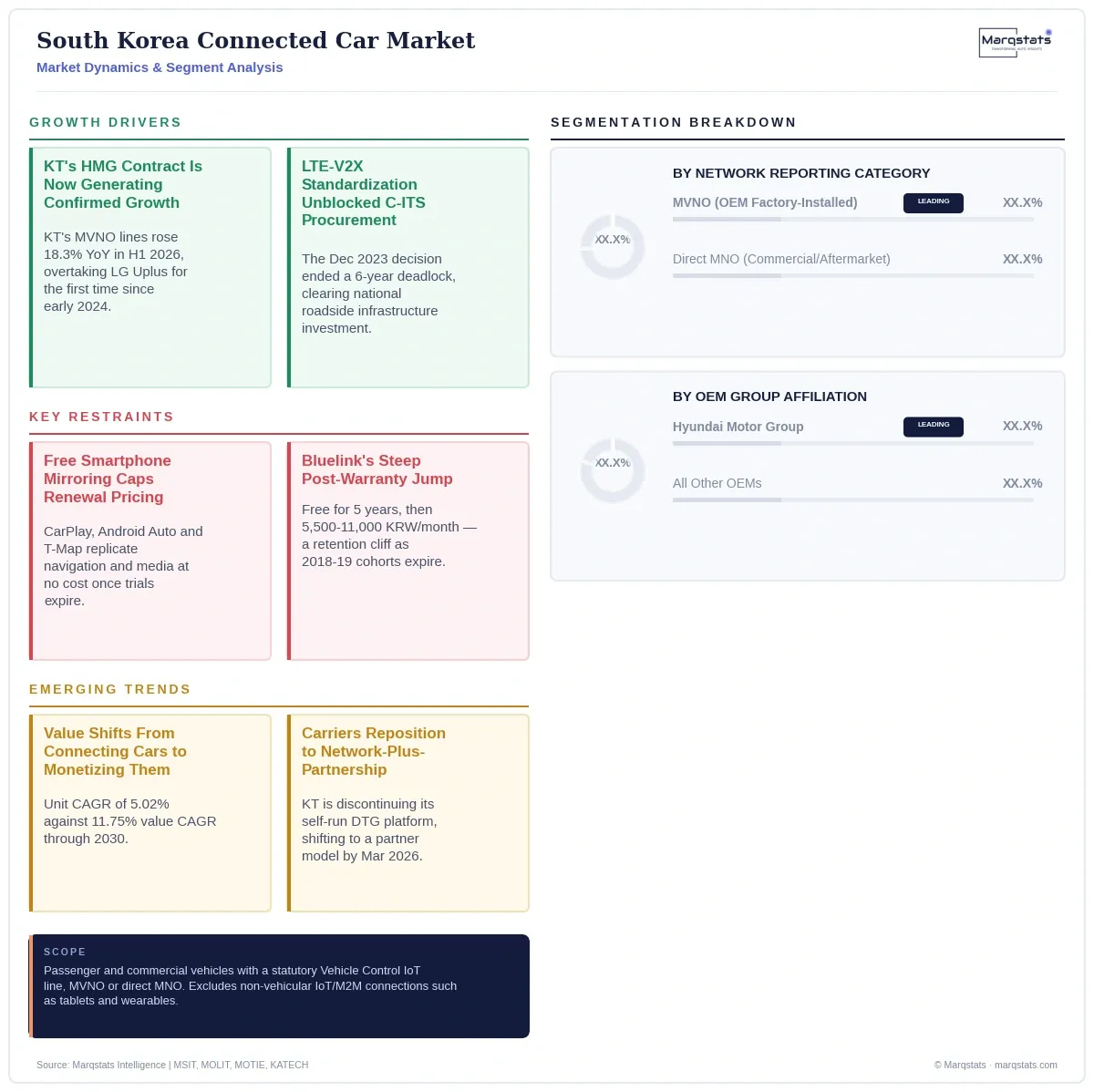
- KT Corporation's exclusive Hyundai Motor Group wholesale contract, effective for vehicles built from January 2025, is now generating confirmed, measurable subscriber growth: 18.3% year-on-year MVNO line growth in the first half of 2026, enough to retake the carrier's number-one MVNO position from LG Uplus.
- The December 2023 selection of LTE-V2X as South Korea's single mandatory C-ITS communication standard ended a six-year deadlock and unblocked national procurement for roadside infrastructure, with a three-stage rollout targeting 30,000 kilometres of expressway coverage by 2027 and all 110,000 kilometres of public roadway by 2030.
- New-vehicle connected-sales penetration above 92% as of mid-2025 means nearly every vehicle Hyundai Motor Group, and increasingly its competitors, sell now ships with factory telematics as standard equipment rather than an optional upgrade, continuously feeding the addressable base for future subscription monetization.
- The completion of the National Automotive Cybersecurity Center alongside K-City's Phase 3 expansion in late 2025 gives South Korea a dedicated domestic evaluation hub for UN ECE Regulations No. 155 and No. 156, positioning the country's cybersecurity compliance infrastructure ahead of markets still relying on foreign test facilities.
- Forty-three designated Autonomous Vehicle Pilot Demonstration Zones, spanning all 17 metropolitan cities and provinces by late 2024, generated 461,000 kilometres of cumulative autonomous mileage and 89,000 passenger rides in 2023 alone — increases of 206% and 876% year-on-year respectively — building a real-world validation base ahead of commercial Level 4 deployment.
Key Restraints
Four constraints stand between the market and durable post-warranty revenue.
- Free smartphone-mirroring systems cap what automakers can charge once a complimentary telematics period ends. Apple CarPlay, Android Auto and T-Map replicate dynamic navigation, audio streaming and voice queries at no subscription cost, limiting post-warranty OEM revenue primarily to safety and remote-access features a phone genuinely cannot provide.
Hyundai Bluelink's post-warranty pricing shows the retention challenge directly: a jump from a complimentary five-year bundle to 5,500 KRW a month on a one-year contract, or 11,000 KRW a month without one, arriving just as the 2018-to-2019 promotional cohort ages out of its free period en masse between 2023 and 2025.Hyundai Bluelink after the free 5 years: is 11,000 won a month worth it?
- The LTE-V2X standardization decision that resolved regulatory uncertainty simultaneously stranded legacy DSRC/WAVE roadside investment, and public budgets for national highway C-ITS expansion have faced recurring fiscal realignment in recent legislative reviews — a funding risk this coverage treats as the single largest swing factor on the 2030 outlook.
- Aggregating low-ARPU vehicle-control IoT lines with high-ARPU consumer mobile subscribers in national carrier statistics has become a recurring point of dispute. KT has publicly challenged LG Uplus's total-connections lead by noting its own substantially larger base of premium handset subscribers, arguing that blended rankings distort each carrier's actual competitive position.
Key Trends
Four shifts show where the market is heading and who captures the value.
- Value creation is shifting from connecting vehicles to monetizing them. With unit growth forecast at just 5.02% a year against 11.75% for market value through 2030, software, data services and subscription retention — not new connections — are where this market's incremental revenue increasingly concentrates.
- Automakers are converging on unified Software-Defined Vehicle architectures rather than distributed electronic control units. Hyundai Motor Group's proprietary Connected Car Operating System (ccOS), developed with Nvidia's high-performance computing hardware, processes real-time telemetry and runs deep-learning algorithms directly on the vehicle.
- Telecommunications carriers are repositioning from direct platform operators toward network-plus-partnership models. KT's move to discontinue its self-operated digital tachograph platform service by March 2026, while continuing to supply the underlying connectivity through a partner, is an early concrete example of carriers stepping back from owning every layer of the commercial telematics stack.
- Regional autonomous-mobility pilots are graduating from technology demonstrations into revenue-generating services. Commercial, revenue-generating autonomous vehicle permits grew 82% to 31 vehicles in 2023 across the pilot zone network, with Jeju's Route 901 "Tamra Autonomous Bus" and Pangyo Techno Valley's "PanTa-G" commuter shuttle among the most advanced operating services.
Strategic Implications
- Telecommunications carriers should treat the next Hyundai Motor Group wholesale cycle as the single most consequential contract in this market, given that KT's 2025 contract win alone was large enough to flip the national MVNO ranking within eighteen months. Carriers should also build differentiated B2B enterprise and data-service revenue now, since wholesale bandwidth margins alone will not sustain share gains once the next contract cycle turns over again.
- Automakers should price post-warranty subscriptions around features a smartphone genuinely cannot replicate — remote security monitoring, digital key sharing, and safety-critical functions — rather than navigation or media features consumers already get free through CarPlay, Android Auto or T-Map, where Hyundai Bluelink's steep post-warranty price jump has already shown where retention breaks down.
- Infrastructure investors and public-private partnership participants should treat LTE-V2X roadside deployment funding, not the technology decision itself, as the binding constraint on this market's upside case. The standard is settled; the fiscal commitment to build 30,000 kilometres of coverage by 2027 is the variable that determines whether the market reaches its Baseline or Conservative trajectory.
- Foreign OEMs entering or expanding in Korea should benchmark their telematics partnership structure against Mercedes-Benz Korea's KT-powered "Mercedes me connect" platform and BMW Group Korea's carrier-integrated ConnectedDrive suite, both of which compete for share inside a market Hyundai Motor Group otherwise dominates at over 80% of domestic registrations.
Market Segmentation
An estimated 7,414,800 lines in 2025, roughly 74% of the connected fleet, capturing Hyundai and Kia's factory-installed telematics, registered as specialized data-only MVNOs under the Telecommunications Business Act. This category absorbed 92.21% of all net-new connected-vehicle line additions between 2022 and 2023 and is where Korea's genuine organic connectivity growth is concentrated.
An estimated 2,605,200 lines in 2025, capturing enterprise logistics, bus and taxi fleet tracking, heavy commercial fleets and specialized aftermarket telematics provisioned directly by SK Telecom, KT Corporation and LG Uplus rather than through an automaker's own MVNO channel.
An estimated 8,016,000 connected vehicles in 2025, proxied from Hyundai Motor Group's more than 80% share of annual domestic vehicle registrations. Standardized factory telematics across HMG's mainstream trim levels, not optional upgrades, is the single largest driver of this market's fleet-wide penetration rate.
An estimated 2,004,000 connected vehicles in 2025 across KG Mobility, Renault Korea, Mercedes-Benz Korea, BMW Group Korea, Tesla Motors Korea and other importers, which registered 271,034 new passenger vehicles combined in 2023 and compete on telematics differentiation rather than volume.
USD 13,626.20 million in 2025, growing at 11.75% a year to USD 23,750.00 million by 2030. This is the headline market total this analysis is built on — the other three rows in this segment are published sub-components and adjacent measures, not mutually exclusive slices of it, and are not summed against it.
USD 1,704.00 million in 2025, the fastest-growing value-chain layer at 15.15% a year to USD 3,450.00 million by 2030, covering operating systems, firmware management and over-the-air update middleware.
USD 3,920.00 million in 2025, growing at 11.71% a year to USD 6,820.00 million by 2030, tracked separately by MOTIE's Supply Chain Division as a domestic manufacturing and localization output measure.
The smallest tracked layer at USD 184.20 million in 2025, growing at 9.87% a year to USD 294.90 million by 2030 — wholesale connectivity priced between 1,500 and 2,500 KRW per line monthly during OEM complimentary periods.
By Geography
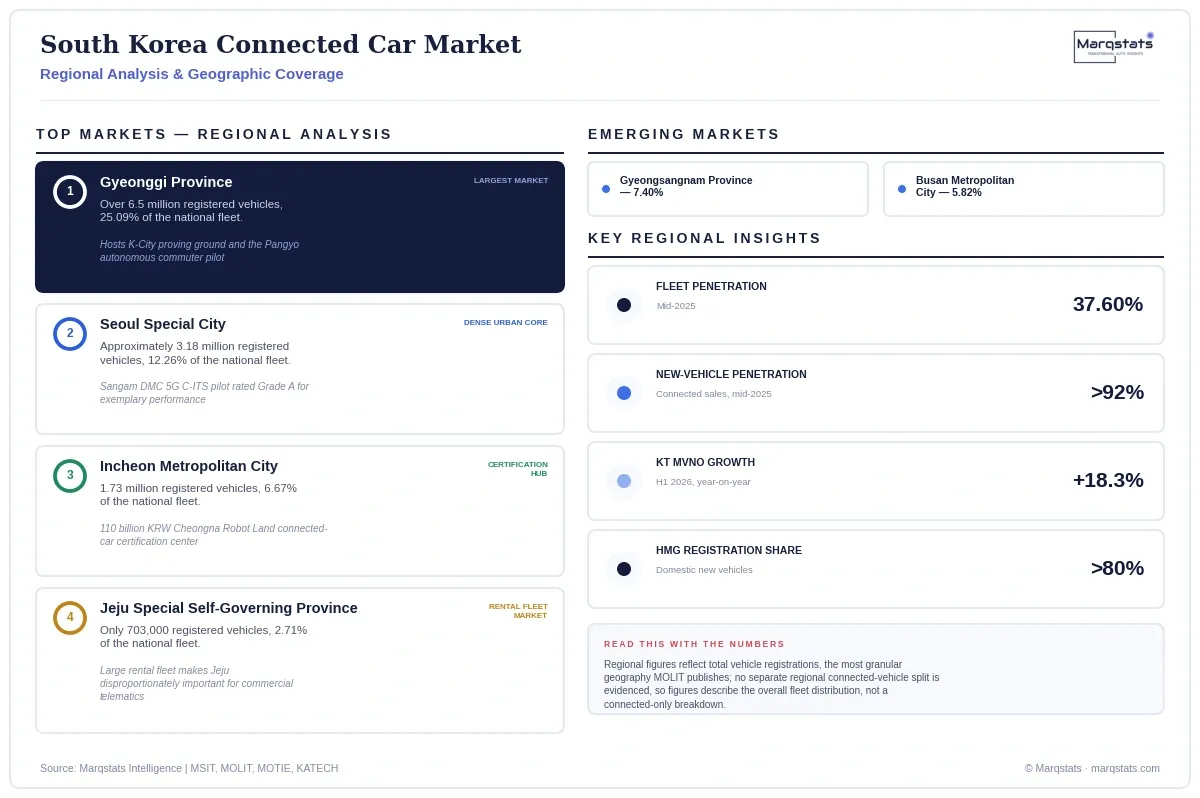
Gyeonggi Province
The largest vehicle parc in the country at over 6.5 million registered vehicles, 25.09% of the national total, anchored by commuter and industrial freight logistics fleets. Gyeonggi hosts both K-City, the national proving ground in Hwaseong, and the Pangyo Techno Valley autonomous commuter pilot, giving the province the country's densest concentration of connected-vehicle testing infrastructure alongside its registration volume.
Seoul Special City
Approximately 3.18 million registered vehicles, 12.26% of the national total, dominated by dense urban passenger cars and municipal public transit fleets. Seoul hosts the Sangam DMC pilot zone's 5G C-ITS deployment, rated Grade A for exemplary performance in MOLIT's most recent evaluation, alongside lower-graded tourist-loop services around Cheonggyecheon and the former Blue House grounds.
Incheon Metropolitan City
1.73 million registered vehicles, 6.67% of the national total, concentrated in corporate leasing fleets and airport logistics and drayage trucking. Incheon has invested 110 billion KRW in a dedicated Connected Car Materials, Parts and Equipment Certification Evaluation Center at Cheongna Robot Land, developed with MOTIE and KATECH to evaluate RF communications and connected antenna performance for domestic manufacturers.
Gyeongsangnam Province
1.92 million registered vehicles, 7.40% of the national total, spanning rural passenger vehicles and inter-city industrial transport. The Hadong rural demand-responsive transit pilot operates here, testing autonomous mobility service models outside the dense urban corridors most C-ITS investment otherwise targets.
Busan Metropolitan City
1.51 million registered vehicles, 5.82% of the national total, shaped by port container drayage trucking and urban coastal transit. The Osiria tourism complex autonomous shuttle corridor is Busan's flagship pilot deployment.
Jeju Special Self-Governing Province
Only 703,000 registered vehicles, 2.71% of the national total, but a disproportionately important connected and commercial telematics market because of Jeju's large rental-car fleet, where tracking hardware is standard equipment. Jeju's Route 901 "Tamra Autonomous Bus," running the 69.8-kilometre corridor between the airport and Jungmun, is one of the country's most visible commercial autonomous services.
How Competition Is Evolving
Hyundai Motor Group's more than 80% share of domestic vehicle registrations makes it the single largest structural force in this market, and its telematics wholesale contract is the one commercial relationship every carrier competes to win. SK Telecom holds the largest direct-MNO fleet share through partnerships with KG Mobility, Renault Korea and commercial fleet operators, but has never held the Hyundai Motor Group consumer wholesale contract. LG Uplus held that contract exclusively from 2022 through 2024, building rapid IoT subscriber growth on the back of it, before KT Corporation displaced it for all vehicles built from January 2025 onward — a switch that has already flipped the national MVNO ranking as of mid-2026.
Among foreign importers, telematics strategy is genuinely differentiated rather than converging on a single model. Mercedes-Benz Korea partners with KT Corporation to power its "Mercedes me connect" platform; BMW Group Korea operates its own ConnectedDrive suite through embedded cellular modules linked to domestic networks; and Tesla Motors Korea runs an integrated model, offering complimentary "Standard Connectivity" for eight years and pricing "Premium Connectivity" at 7,900 KRW a month — a distinct approach from every other OEM in the market.
Structurally, the competitive question in South Korea is no longer which carrier can win new connected volume — the market is already 37.60% penetrated and rising toward saturation on new sales — but which carrier and which OEM can convert an already-connected fleet into a durable subscription revenue base as complimentary periods expire at scale.
Companies Covered
The report profiles 17+ companies with full strategy and financials analysis, including:
Recent Market Activity
Table of Contents
Coverage & Segmentation
This report measures passenger and commercial vehicles in South Korea carrying a statutory Vehicle Control (차량관제) IoT line, spanning both Mobile Virtual Network Operator and direct Mobile Network Operator reporting categories, across a 2025 base year (anchored to MSIT's mid-2025 registry figures) and a 2026 to 2030 forecast period, denominated in United States dollars at a constant 1,305.40 KRW/USD exchange rate, the Bank of Korea's 2023 annual average. It excludes non-vehicular IoT and M2M connections such as tablets, wearables and remote facility monitoring, which share the same statutory reporting category but are not vehicles.
The analysis spans three segmentation dimensions — network reporting category, OEM group affiliation, and value-chain layer — six regional geographies, and 17 profiled entities across regulators, automakers and telecommunications carriers. Subscription-line counts and vehicle-registration totals are primary, sourced directly from MSIT and MOLIT; market value, the network-category split for 2025, and the OEM-affiliation proxy are Marqstats constructions or estimates built from those primary series.