Market Snapshot
Key Takeaways
Market Overview & Analysis
Report Summary
China's connected car market is measured across complete intelligent connected vehicle factory output, in-vehicle digital networking electronics, domain controllers, software stacks, and vehicle-road-cloud interface points, valued at USD 196,551.39 million in 2025. This figure is taken directly from the underlying research's own rigorously sourced and explicitly tagged sizing chain, reconciled from CAAM production and sales data, MIIT statutory technology-penetration monitoring, and China SAE/CICV industry output forecasts.
Structurally, this is a market defined by a severe, officially acknowledged policy shortfall: MIIT's own statutory C-V2X installation target has missed its 2025 mark by 46.50 percentage points, forcing an official downward revision of the 2026 target. Beneath that headline gap sits a second, equally consequential one — China's genuine active on-road connected-vehicle fleet penetration, at 13.36% of the 345 million-vehicle national parc, runs far behind the new-vehicle sales statistics most commonly cited.
The analysis is built for four reader types making different decisions: an automaker weighing how much C-V2X hardware to install ahead of MIIT's still-uncertain mandate timeline, a Tier-1 supplier assessing domestic consolidation dynamics against contracting foreign participation, a municipal government or infrastructure investor evaluating genuine roadside hardware requirements against inflated capital announcements, and an investor or analyst needing to distinguish this market's real ~USD 200-550 billion scale from the frequently cited but substantially unrelated RMB 14 trillion smart-mobility construct.
China Connected Car Market Size and Forecast
Marqstats builds the China figure directly from the underlying research's own explicitly tagged sizing chain, itself reconciled from CAAM production and sales statistics, MIIT statutory technology-penetration monitoring, and the joint China SAE/CICV Vehicle-Road-Cloud Integrated ICV Industrial Output Incremental Value Forecast. The market spans vehicle-side systems (88.43% of incremental ecosystem value), roadside intelligent infrastructure (3.06%), cloud control platforms (0.32%), and basic cellular networking, positioning and cybersecurity infrastructure (8.21%).
Market value grows from USD 196,551.39 million in 2025 to USD 546,672.42 million by 2030, a 22.70% CAGR, under the Baseline Transition scenario, extending the source's own 2024-2029 forecast trajectory one additional year using its own stated average annual growth rate. Total passenger vehicle sales are projected to expand from 27.563 million units in 2024 to 32.0 million by 2029, while connected-vehicle penetration featuring Level 2 combined assistance and Level 3 conditional automation expands from 62.00% to 93.00% over the same period.
The source's own two forward scenarios diverge specifically on regulatory enforcement of C-V2X installation and Level 3 liability resolution — the only two independently evidenced trigger conditions the underlying research identified, having explicitly tested and rejected municipal roadside spending as an independent driver rather than a downstream consequence of government financing capacity. The Baseline Transition scenario assumes MIIT maintains its phased Telematics Action Plan targets (50% 5G and 7.5% C-V2X by 2026; 95% 5G and 30% C-V2X by 2030) with Level 3 approvals remaining restricted to designated operational design domains, reaching 29.76 million connected units and RMB 3,182.20 billion by 2029; the Regulatory Acceleration scenario assumes MIIT issues a statutory C-V2X factory-installation mandate for all new vehicles above RMB 100,000 by 2027, backed by national insurance liability caps for certified Level 3 operations, reaching 31.36 million units and RMB 3,950.00 billion by 2029.
China's Official Roadmap Missed Its Own Target by 46.5 Percentage Points
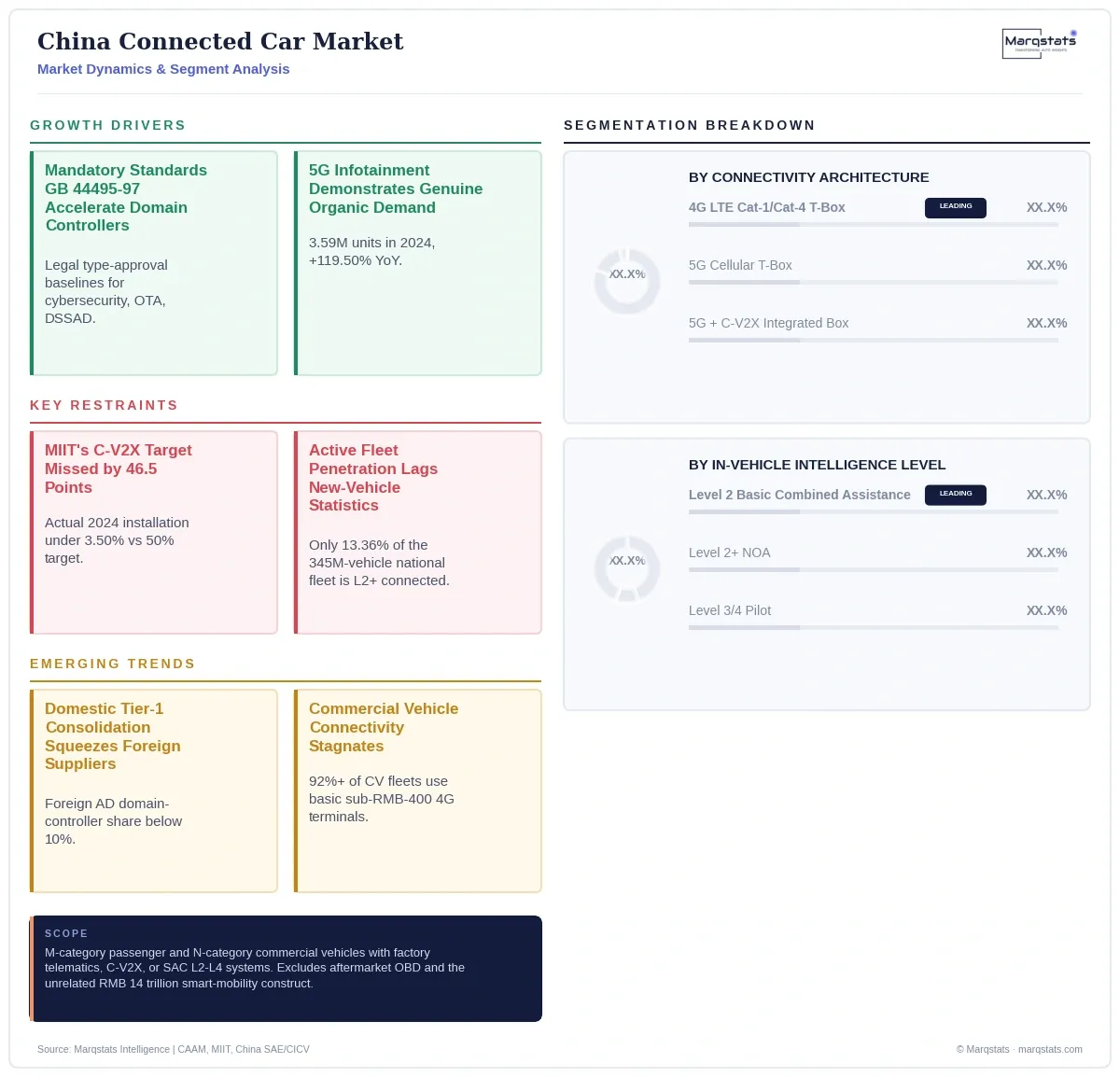
The scale of this shortfall is worth sitting with. MIIT's own Intelligent Connected Vehicle Technology Roadmap 2.0, a statutory policy document, set a specific, measurable target: 50.00% C-V2X direct-communication terminal penetration in new vehicles by 2025. Actual 2024 factory installation reached under 3.50%. That's not a modest miss requiring a minor course correction — it's a near-total failure to achieve the stated policy objective, severe enough that MIIT itself was forced to officially slash its 2026 target to just 7.50% in a revised Action Plan, publicly acknowledging the original roadmap's timeline was unrealistic.
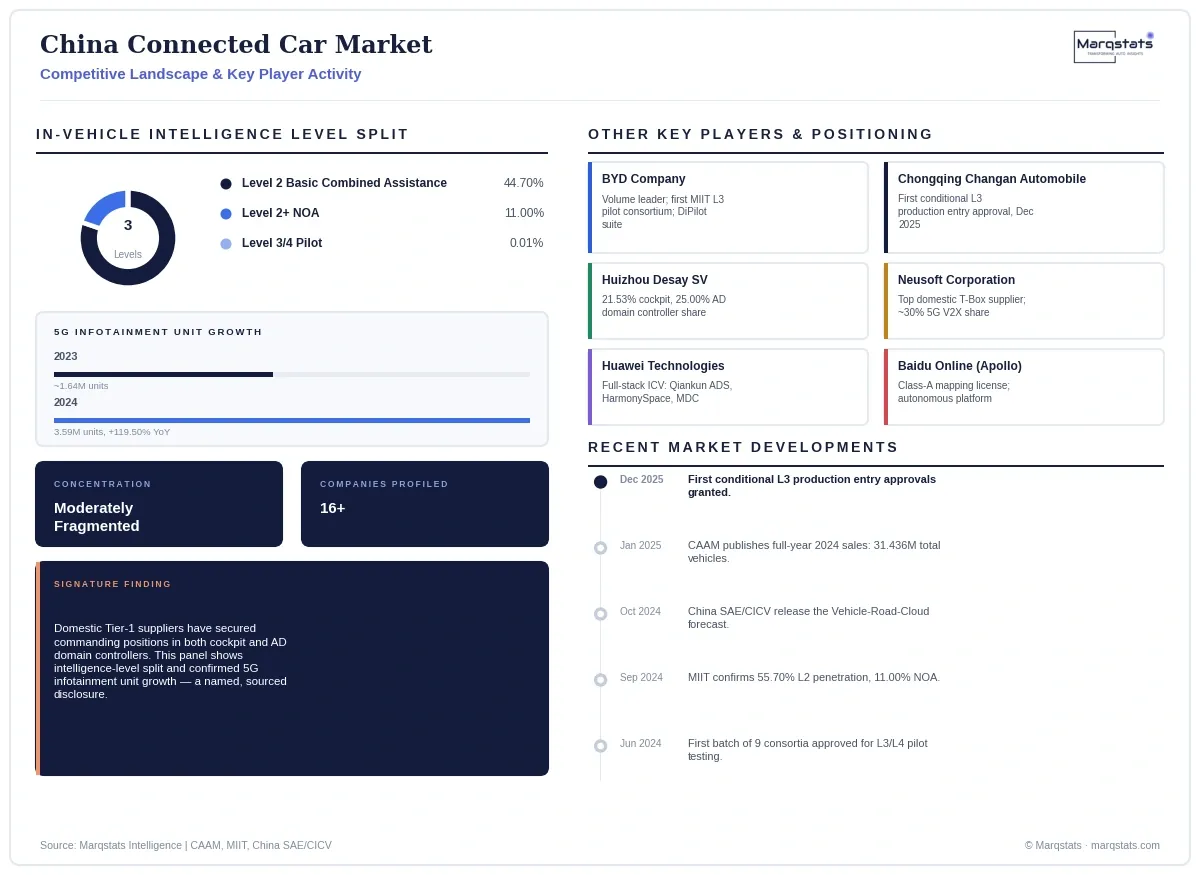
What makes this genuinely consequential, rather than just an embarrassing statistic, is what it reveals about the structural difference between 5G cellular infotainment and C-V2X safety hardware. 5G infotainment adoption is a real success story — 3.59 million units in 2024, up 119.50% year-on-year — because it delivers immediate, marketable consumer value (streaming, OTA updates, multi-screen cockpits) that justifies its cost to automakers and buyers alike. C-V2X safety hardware delivers value only once a critical mass of both vehicles and roadside infrastructure exists simultaneously, a coordination problem no individual automaker or municipality can solve alone, which is precisely why the policy target failed where the market-driven feature succeeded.
The 14 Trillion RMB Number You've Seen Isn't Measuring This Market
If you've encountered a headline claiming China's connected-vehicle or smart-mobility market will reach 14 trillion RMB by 2030, it's worth knowing exactly where that number comes from, because it isn't measuring what most readers assume it measures. Tracing the figure back to its source reveals an unweighted CICV scenario document that simply added together gross passenger vehicle retail turnover, municipal road civil paving expenditure, and smart energy charging grid investment — three genuinely different categories of economic activity bundled into a single headline number with no clear methodology connecting them.
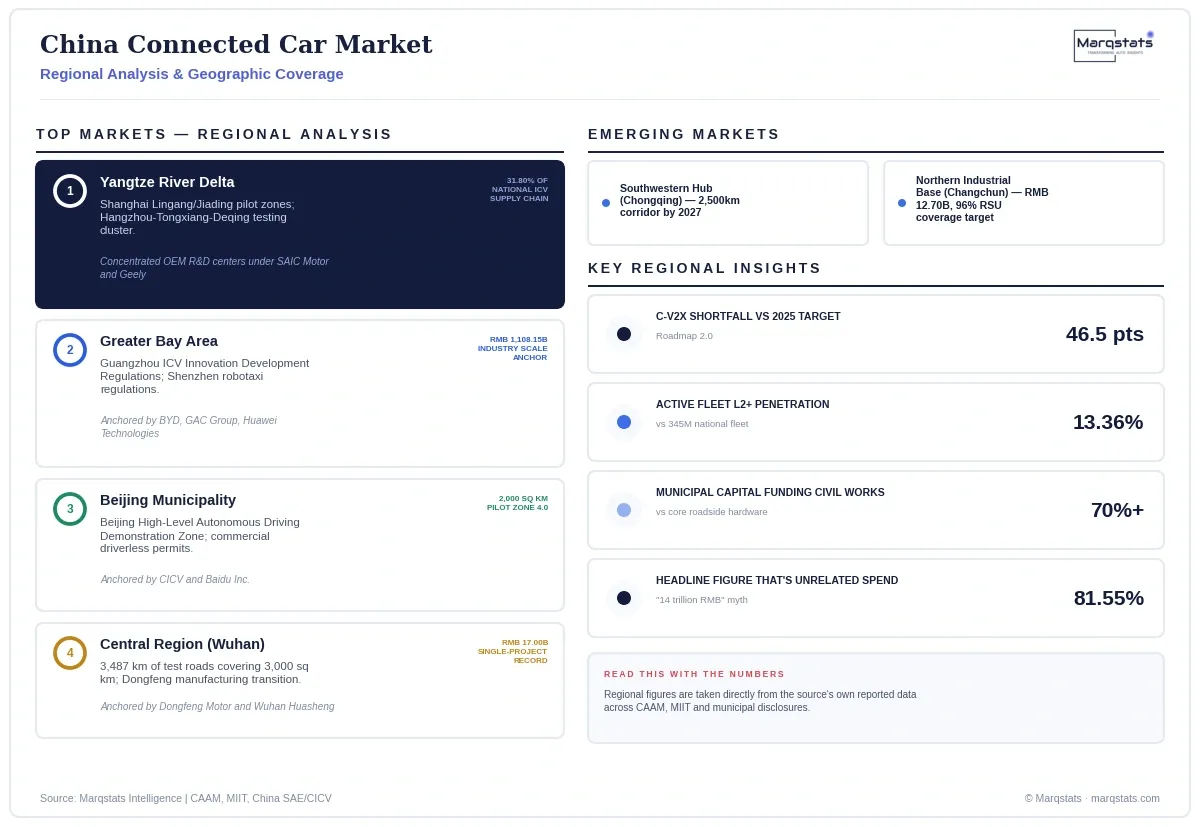
Subtracting the genuine core incremental ICV industry output the source's own more careful modeling calculates (RMB 2,582.50 billion for 2030) from that 14 trillion figure leaves roughly 11.4 trillion RMB, or 81.55% of the widely cited total, as unrelated civil infrastructure spending and base vehicle metal cost that has nothing specifically to do with connected-vehicle technology at all. Anyone citing the 14 trillion figure as a connected-car market size is, whether they realize it or not, citing a number that is more than four-fifths unrelated to the actual technology market this analysis measures.
Market Dynamics
Key Drivers
Five conditions are moving this market, and commercial insurance mandates matter more than consumer demand.
- Three mandatory national standards — GB 44495-2024, GB 44496-2024 and GB 44497-2024, covering cybersecurity, OTA software updates and DSSAD event-data logging — establish legal type-approval baselines accelerating the shift toward centralized domain-controller architectures capable of meeting the new compliance requirements.
- Rapid cost reduction of centralized domain controllers, combined with intensifying domestic Tier-1 competition from suppliers including Desay SV, Neusoft and Horizon Robotics, is driving connected-vehicle penetration from 62.00% toward a targeted 93.00% of passenger sales by 2029 under the Baseline Transition scenario.
- 5G cellular infotainment adoption is genuinely accelerating on its own commercial merits, reaching 3.59 million units in 2024 at 119.50% year-on-year growth, demonstrating strong organic consumer demand for multimedia streaming, OTA upgrades and multi-screen cockpit experiences independent of any regulatory mandate.
- MIIT's approval of the first batch of nine consortia for Level 3/4 on-road pilot testing in June 2024, followed by Chongqing Changan and BAIC BluePark's conditional production entry approval in December 2025, establishes a credible, if delayed, regulatory pathway toward mass-market autonomous driving commercialization.
- Domestic computing silicon suppliers Horizon Robotics and Black Sesame Technologies are achieving increasing compute density and software toolchain maturity, reducing Chinese automakers' historical dependence on foreign ADAS silicon providers for centralized domain-controller architectures.
Key Restraints
Four constraints stand between this market and a fully monetized, evenly connected fleet.
- MIIT's own C-V2X installation target has missed its 2025 statutory goal by 46.50 percentage points, forcing an official downward revision of the 2026 target and calling into question the realistic timeline for cooperative vehicle-to-infrastructure safety hardware deployment at scale.
- China's genuine active on-road connected-vehicle fleet penetration, at just 13.36% of the 345 million-vehicle national parc, reveals an 86.64% offline brownfield fleet gap that new-vehicle sales statistics alone do not capture, limiting the near-term addressable base for any V2X-dependent safety or traffic-coordination application.
- Integrated 5G+C-V2X T-Box hardware consumes 5.58% of total gross profit on entry-level vehicles priced under RMB 150,000 with typical 8% manufacturing margins, structurally confining advanced connectivity adoption to premium vehicle lines rather than the mass-market segment where volume growth is concentrated.
- Strict product liability under MIIT's formal Level 3 pilot framework transfers operational liability from driver to manufacturer upon system engagement, requiring actuarial reserves of up to RMB 10 million per catastrophic failure event — an underwriting barrier that structurally excludes smaller EV startups lacking multi-billion-RMB cash reserves from Level 3 commercialization.
Key Trends
Four shifts show where the market is heading and who captures the value.
- Domestic Tier-1 suppliers are rapidly consolidating leading positions across cockpit and autonomous-driving domain controllers, with foreign Tier-1 participation in merchant high-compute AD domain controllers contracting below 10% overall as Chinese suppliers scale faster on cost and localization.
- Commercial vehicle connectivity is stagnating even as passenger vehicle adoption accelerates, with over 92% of commercial fleet operators continuing to procure basic sub-RMB-400 4G telematics terminals amid a 3.90% overall commercial vehicle sales contraction driven by freight rate compression.
- Municipal Vehicle-Road-Cloud pilot programs are increasingly recognized as directing the majority of announced capital toward general civil infrastructure rather than automotive-specific roadside hardware, with genuine RSU and sensor equipment representing well under a third of announced budgets across the 20 official pilot cities.
- Foreign automotive OEMs face a structural mapping-data barrier under Ministry of Natural Resources Class-A surveying licensing rules, with only 19 domestic Chinese enterprises holding active credentials, forcing international automakers into domestic joint-venture cloud custody arrangements to access high-precision navigation data.
Strategic Implications
- Automakers should treat C-V2X hardware investment cautiously ahead of confirmed mandate enforcement, prioritizing 5G cellular infotainment — which has demonstrated genuine organic consumer demand — over safety-hardware installations dependent on roadside infrastructure that remains severely underbuilt relative to municipal capital announcements.
- Tier-1 suppliers, particularly foreign entrants, should recognize that domestic Chinese competitors have already secured commanding positions in both cockpit and autonomous-driving domain controllers, making differentiated technology or specialized niche positioning more viable than direct volume competition against Desay SV, Neusoft and similar domestic leaders.
- Municipal governments and infrastructure investors should independently verify genuine roadside hardware cost requirements against announced capital budgets before committing further public funds, given the documented pattern of announced investment substantially exceeding actual automotive-specific infrastructure need across pilot cities.
- Investors and analysts should consistently distinguish this market's genuine ~USD 200 to 550 billion scale from the frequently cited but substantially unrelated RMB 14 trillion smart-mobility figure, and should track MIIT's C-V2X mandate enforcement timeline and Level 3 liability resolution as the two evidenced variables separating the Baseline and Regulatory Acceleration scenarios.
Market Segmentation
80.9% of new installations in 2024, RMB 180-250 per unit, providing basic telemetry, remote lock/unlock and mandatory eCall compliance; anchored by Shenzhen Lianyou Technology and Fujian Huihan Technology.
15.6% installation rate (3.59 million units, +119.50% YoY) in 2024, RMB 600-750 per unit, delivering gigabit throughput for multimedia streaming, OTA upgrades and multi-screen cockpits; led by Neusoft Corporation and Huawei Technologies.
3.5% installation rate in 2024, RMB 850-1,100 per unit, combining 5G cellular link with 5.9 GHz PC5 direct sidelink for active collision avoidance; anchored by Neusoft Corporation and Beijing Jingwei Hirain Technologies.
44.7% of total 2024 passenger car sales (80.25% of the L2+ fleet), 12,320,660 units, running distributed ECUs with front monocular cameras and basic adaptive cruise control; led by BYD's DiPilot low/mid trims and Geely Automobile.
11.0% of total 2024 sales (19.75% of the L2+ fleet), 3,031,930 units, running centralized domain controllers (Nvidia Orin, Horizon Journey 5) with LiDAR/radar sensor suites; led by Li Auto, XPeng and Seres/Huawei HIMA.
Under 0.01% of total sales, confined to bounded pilot validation fleets with redundant computing, DSSAD data logging and dual-actuation wire-controlled steering/braking; led by Chongqing Changan Automobile and BAIC BluePark Magna.
27,563,000 units in 2024 (+5.80% YoY), 62.00% L2+ penetration, 91.20% of hardware and software revenue, driven by strong consumer demand for smart cockpits and highway/urban navigation assistance.
3,873,000 units in 2024 (-3.90% YoY), under 4.00% advanced domain-controller penetration, just 8.80% of hardware and software revenue, with severe fleet margin compression locking adoption into low-cost 4G GPS tracking terminals.
By Geography
Yangtze River Delta (Shanghai, Jiangsu, Zhejiang)
31.8% share of the national ICV components supply chain in 2024, anchored by Shanghai Lingang and Jiading pilot zones and the Hangzhou-Tongxiang-Deqing cross-regional testing cluster; concentrated OEM R&D centers under SAIC Motor and Geely Automobile Holdings.
Greater Bay Area (Guangzhou, Shenzhen)
The regional-national industry scale anchor at RMB 1,108.15 billion in 2024, under the enacted Guangzhou ICV Innovation Development Regulations and Shenzhen's commercial driverless robotaxi regulations; anchored by BYD Company, Guangzhou Automobile Group and Huawei Technologies.
Beijing Municipality
600 sq km Pilot Zone 3.0 complete with a 2,000 sq km Zone 4.0 launched in 2024, under the Beijing High-Level Autonomous Driving Demonstration Zone, which issued commercial driverless permits and a unified municipal cloud control platform; anchored by CICV and Baidu Inc.
Central Region (Wuhan, Xiangyang, Changsha)
RMB 17.0 billion single-project investment record in Wuhan, which opened 3,487 km of test roads covering 3,000 sq km with extensive municipal subsidies supporting Dongfeng's manufacturing transition; anchored by Dongfeng Motor and Wuhan Huasheng.
Southwestern Hub (Chongqing, Chengdu)
A 2,500 km connected road corridor targeted by 2027 in Chongqing, a mountainous highway testing hub with inter-provincial testing mutual recognition between Sichuan and Chongqing; anchored by Chongqing Changan Automobile and Seres Group.
Northern Industrial Base (Changchun, Shenyang)
RMB 12.7 billion three-year investment program in Changchun, targeting 96% RSU urban coverage and 1.5 million L2+ vehicle installations with severe cold-weather testing specialization; anchored by China FAW Group and Neusoft Corporation.
How Competition Is Evolving
Competition spans OEMs, domestic Tier-1 hardware suppliers, and full-stack technology providers. BYD Company leads by volume and was a member of the first MIIT L3 pilot consortium, deploying its DiPilot suite; Geely Automobile standardizes 5G T-Boxes across Zeekr and Lynk & Co; Chongqing Changan Automobile became the first OEM to receive conditional Level 3 production model entry approval in December 2025 alongside BAIC BluePark's Arcfox platform. NIO, XPeng and Li Auto lead premium advanced-autonomy adoption, with XPeng's end-to-end neural network XNGP and Li Auto serving as the primary customer for Desay SV's Orin domain controllers; Seres Group manufactures under Huawei's Harmony Intelligent Mobility Alliance (HIMA/AITO), while Xiaomi EV deploys its proprietary HyperOS connected cockpit.
On Tier-1 hardware, Huizhou Desay SV leads both intelligent cockpit (21.53%) and third-party autonomous driving (25.00%) domain controllers; Neusoft Corporation is China's top domestic T-Box supplier and leads 5G V2X modules at roughly 30% share; Beijing Jingwei Hirain, Joyson Electronics, Huihan Technology and Lianyou Technology round out the domestic telematics hardware base, while foreign Tier-1 participation, exemplified by Aptiv's 4.70% share, has contracted sharply. Huawei Technologies operates as a genuine full-stack provider spanning Qiankun ADS autonomous driving, HarmonySpace cockpit software, 5G T-Boxes and MDC domain controllers. On mapping and mobility platforms, Baidu Online's Apollo platform and AutoNavi (Alibaba Group) hold Class-A cartography licenses that structurally exclude most foreign competitors, while China Mobile and CICT Mobile anchor 5G base station and C-V2X direct-communication infrastructure.
Companies Covered
The report profiles 16+ companies with full strategy and financials analysis, including:
Recent Market Activity
Table of Contents
Coverage & Segmentation
This report measures M-category passenger cars and N-category commercial vehicles operating in China that carry factory-installed cellular telematics, C-V2X communication units, and centralized domain controllers at SAC Level 2 through Level 4 automation, across a 2025 base year and a 2026 to 2030 forecast period, denominated in United States dollars at the PBOC central parity rate of 7.1884 RMB/USD as of 31 December 2024. It excludes aftermarket OBD devices, non-cellular satellite navigation hardware, low-speed agricultural utility vehicles, two-wheelers, and the frequently cited but substantially unrelated broader smart-mobility construct exceeding RMB 14 trillion.
The analysis spans three segmentation dimensions — connectivity architecture, in-vehicle intelligence level and vehicle platform class — six regional geographies, and 16 profiled entities across OEMs, Tier-1 suppliers, technology platforms and regulatory bodies. Production and sales figures trace to CAAM and MIIT; market value and segment splits are taken directly from the underlying research's own explicitly tagged sizing chain, extended one year to a 2030 forecast endpoint using the source's own stated average annual growth rate.