Market Snapshot
Key Takeaways
Market Overview & Analysis
Report Summary
Malaysia's connected car market is measured on the value of factory-fitted telematics hardware, cellular connectivity airtime, software and cloud subscriptions, and commercial fleet telematics sold against new passenger cars and light commercial vehicles registered with the Road Transport Department (JPJ). The market is worth USD 151.51 million in 2025, the most recent complete calendar year for which the Malaysian Automotive Association (MAA) has published full-year registration data, and the figure in general circulation for 'connected' or 'smart' vehicles is frequently wider, because it folds in tethered smartphone-mirroring systems such as Apple CarPlay and Android Auto that carry no embedded modem of their own.
Structurally, this is a policy-and-platform market before it is a consumer-demand market. Malaysia's new-car volume is concentrated in two national carmakers that compete primarily on price, so the decision to fit a telematics control unit is made at the OEM's product-planning table, not at the dealership by a buyer choosing an options list. Non-national distributors monetise connectivity as a bundled trial that lapses into a paid subscription, and the size of that paid renewal base is the single largest unpublished number in the market.
The analysis is built for four reader types making different decisions: an international automaker weighing whether to localise assembly ahead of the end of Malaysia's completely built-up import concession, a telecommunications operator deciding whether to move beyond wholesale M2M connectivity into edge and cloud services, a commercial fleet operator pricing telematics against a post-subsidy fuel cost base, and an investor assessing whether Malaysia's domestically built cockpit platform can be exported into other national-carmaker markets.
Malaysia Connected Car Market Size and Forecast
Marqstats builds the Malaysia figure bottom-up from four layers. Factory-installed hardware is amortised against OEM accessory price lists — Toyota's Vehicle Telematics System and Honda CONNECT both retail as standalone options above RM 2,000 — multiplied by MAA's brand-level 2025 registration counts and a fitment coefficient set per OEM from trim-level specification sheets. Cellular connectivity is priced off M2M wholesale tariff structures; software and cloud subscriptions are estimated from the population of post-warranty paying users; and commercial fleet telematics is sized from monitored-vehicle counts disclosed by providers including Pixelated Sdn Bhd (KATSANA).
The hardware and shipment series is primary — it follows directly from MAA's published brand-level registrations — and the value series is derived from it. New connected vehicle shipments rise from 258,000 units in 2025 to 535,000 units in 2030, a 15.70% CAGR, while market value rises from USD 151.51 million to USD 365.28 million, a 19.24% CAGR. The 3.54 percentage-point gap between the two rates is a mix effect: 5G modules, over-the-air software platforms and recurring service revenue carry higher unit value than the 4G hardware they replace, so revenue per shipped vehicle rises through the forecast window even as the underlying unit growth rate moderates against a maturing national-brand product cycle.
The active connected vehicle parc — the stock of connected cars still on the road, as distinct from the flow of new shipments — grows from 860,000 units in 2025 to 2,420,000 in 2030, a 22.99% CAGR that outpaces both the value and shipment series because it compounds every prior year's connected sales rather than measuring one year in isolation. Marqstats holds this figure against the JPJ's own active-licence data rather than the cumulative registration archive, because the latter carries 4.07 million private cars that have not renewed road tax in over five years.
Malaysia's Registry Overstates Its Own Connected Fleet by a Factor of Four
Cumulative statutory registration counts are the wrong denominator for a connected-car penetration rate, and Malaysia's own transport ministry has now said so on the record. JPJ's cumulative database carries 19.69 million private cars, but 4.07 million of them — 20.67% — have not had road tax renewed for more than five years, a threshold the transport ministry's land division treats as a proxy for abandoned or scrapped vehicles.
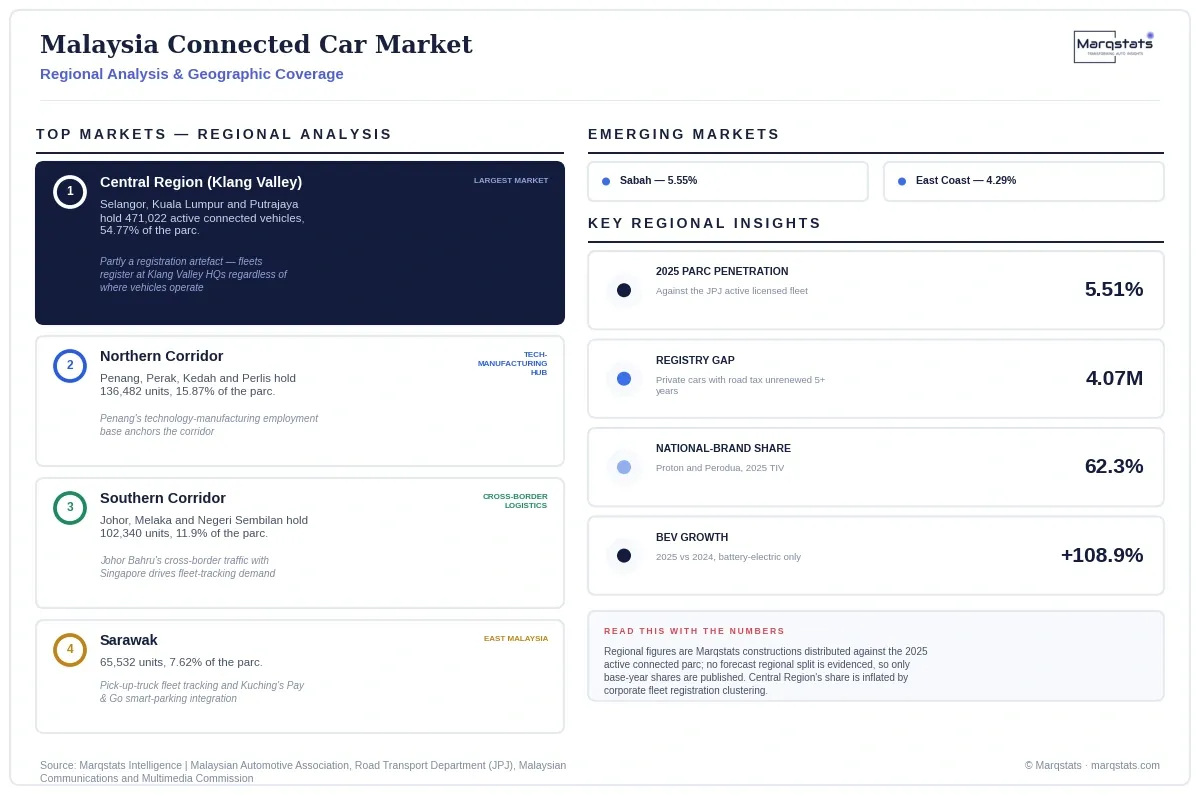
Measured against the resulting 15.61 million active licensed cars rather than the 19.69 million cumulative registry, Malaysia's estimated 860,000 active connected vehicles reach a 5.51% penetration rate in 2025. A model that instead divided against the cumulative registry would understate penetration by roughly a quarter and would imply a materially larger addressable base of unconnected cars than actually exists on Malaysian roads today.
The 'Electrified Vehicle' Figure in Circulation Is Two Different Products Added Together
A figure of 45,562 'electrified' passenger vehicles sold in Malaysia in 2024 has circulated widely since it was first published, and it is routinely read as a battery-electric sales count. It is not — it combines battery-electric vehicles with plug-in hybrids, two powertrains with different connectivity profiles, different duty treatment and different buyer economics.
On a battery-electric-only basis, JPJ registration data puts 2025 sales at 30,848 units, up 108.9% from 14,766 in 2024. The gap between that figure and the 45,562-unit 'electrified' total for 2024 is almost entirely plug-in hybrid volume, and the two powertrains diverged sharply through the CBU duty exemption's December 31, 2025 expiry: buyers pulled battery-electric purchases forward into 2025 specifically, because plug-in hybrids faced a smaller relative change in landed cost once the exemption lapsed and Malaysia moved to a 30% import duty, 10% excise duty and 10% sales tax on imported units from January 2026. The full line-by-line reconciliation between the two powertrain counts is set out in the Marqstats analysis Which Malaysia EV number should you trust: 45,562 or 30,848?.
Market Dynamics
Key Drivers
Five conditions are moving this market, and platform and policy decisions matter more than showroom demand.
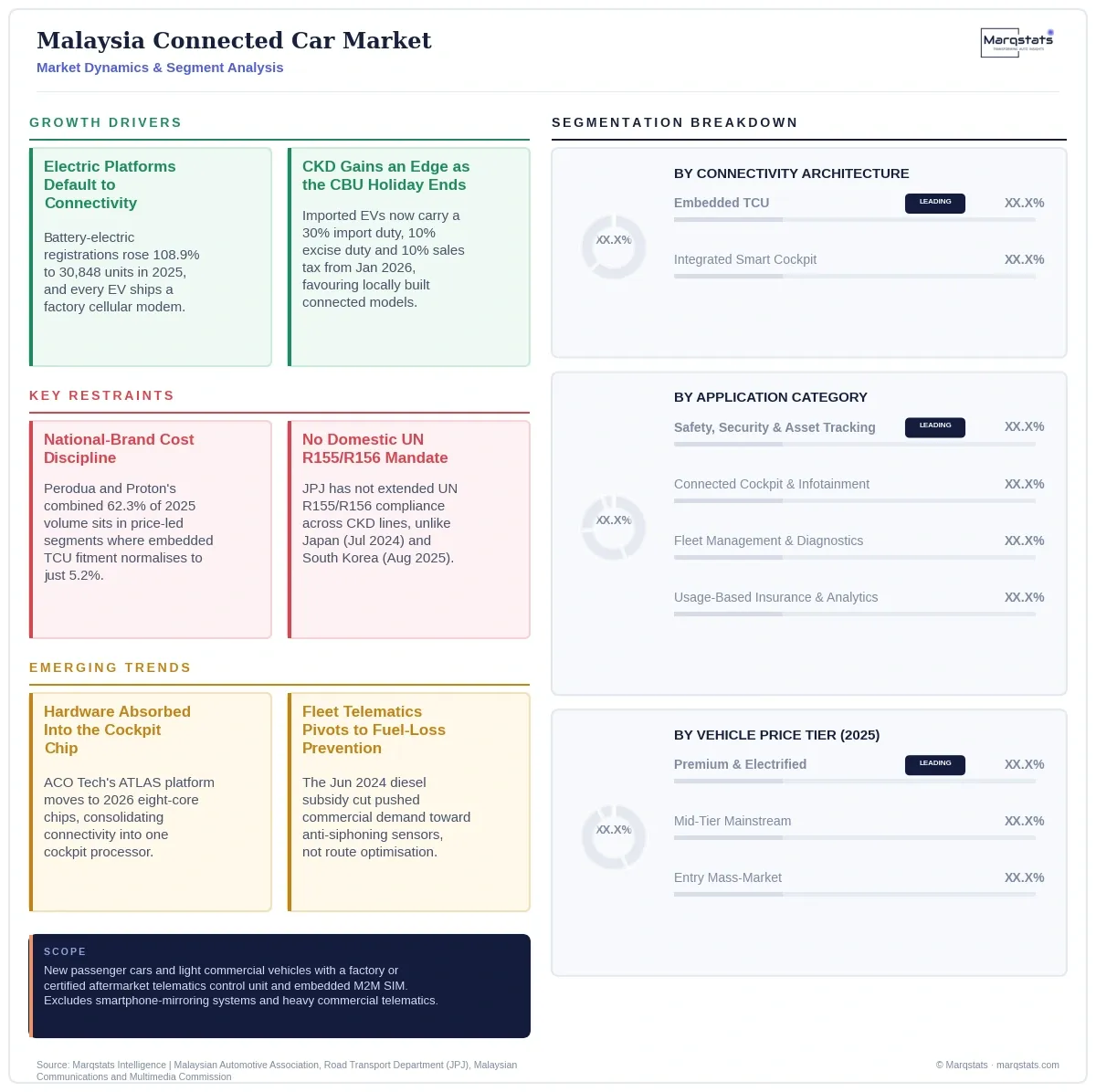
- Electric vehicle platforms carry embedded connectivity as a design default, and Malaysia's EV base is now growing off a real, verified number rather than a blended one. Battery-electric registrations rose 108.9% to 30,848 units in 2025, and every EV sold by Tesla, BYD, Chery and Proton's own e.MAS range ships with a factory-fitted cellular modem, so EV growth converts to connected-vehicle growth at a near one-to-one rate that no combustion segment matches.
- Malaysia's completely knocked-down localisation push is starting to bind alongside the end of the CBU duty holiday. With imported electric vehicles now carrying a combined 50% duty and tax load from January 2026, Proton's locally assembled e.MAS 7 and Perodua's planned mass-market EV — both built with standard factory-embedded telematics under the Perodua-TM One partnership — gain a structural price advantage that should pull volume toward domestically built, natively connected platforms.
- A domestically engineered cockpit operating system has removed the localisation barrier that usually slows connectivity adoption in a market this size. ACO Tech Sdn Bhd's ATLAS platform, built with Altel Communications and ECARX and now running on 400,000 vehicles, supports Malaysian English, Bahasa Melayu and Chinese-dialect voice recognition and an integrated e-wallet, ATLAS Pay — features a licensed international platform would need a separate localisation programme to match.
- The New Industrial Master Plan 2030 (NIMP 2030) has formalised a national cloud and connectivity roadmap around the automotive sector, and Perodua's own volume leadership makes its participation consequential. Perodua's November 2024 digital partnership with Telekom Malaysia's enterprise arm, TM One, targets private 5G manufacturing connectivity and cloud infrastructure for Perodua's upcoming electric-vehicle range — the brand that alone delivered 43.85% of 2025 industry volume.
- Post-warranty subscription conversion is a real, if narrow, revenue driver as the 2021-to-2023 delivery cohort ages out of its complimentary service period. UMW Toyota Motor and Honda Malaysia both bundle one-to-three-year trials with new-vehicle telematics packages, and every vehicle that ages past that window becomes a discrete paid-conversion decision for the owner, a mechanism that did not exist at scale before Malaysia's post-2021 embedded-telematics volume began ageing into its renewal window.
Key Restraints
Four constraints stand between the market and the software-led value case its forecast assumes.
- National-brand cost discipline caps hardware fitment in exactly the segment that carries most of Malaysia's volume. Perodua and Proton's combined 62.3% share of 2025 industry volume sits overwhelmingly in vehicles priced to compete on affordability, and Marqstats estimates factory-embedded fitment at 5.2% in the sub-RM 65,000 tier once normalised to the verified 2025 shipment total — a tier that alone accounts for more than half of all new passenger cars sold.
- No mandate, no floor. Malaysia has not mandated the cybersecurity type-approval standard that would force universal fitment. JPJ has not extended UN R155 or UN R156 compliance across domestic completely knocked-down production lines, in contrast to Japan's mandate from July 2024 and South Korea's national regime from August 2025, so entry-segment national-brand models carry no regulatory floor pushing them toward embedded connectivity.
Subscription economics are unproven once the free trial ends, and no non-national distributor discloses the renewal rate. UMW Toyota Motor and Honda Malaysia both bundle one-to-three-year complimentary periods before asking owners to pay RM 250 to RM 500 a year out of pocket, and Marqstats' own review of dealer terms found no published renewal-rate disclosure from either distributor — an unverified figure that stays out of the quantitative panel rather than shipping as stated fact. That gap stays open until a distributor discloses it.Toyota VTS or Honda CONNECT: which costs less after the free trial ends?
- Perodua's own volume leadership is currently a restraint on national fitment, not a driver of it. The brand that delivered 43.85% of 2025 industry volume still relies on Wuhan CARBIT's Perodua Smart Link smartphone-mirroring application rather than an embedded modem across most of its range. The market leader is, by the scope definition used here, mostly unconnected.
Key Trends
Four shifts show where the market is heading and who captures the value.
- Standalone telematics hardware is being absorbed into the cockpit system-on-chip rather than sold as a separate module. ACO Tech's ATLAS platform already runs navigation, connectivity, voice recognition and payments off a single processor, and the 2026 generation of Atlas hardware moves to eight-core chips built for AI-assisted features — a consolidation that shrinks the addressable market for a standalone connectivity module even as overall connected-vehicle volume grows.
- Automakers are becoming the primary connectivity relationship, not the carriers that supply the underlying network. CelcomDigi Berhad, Maxis Berhad and Telekom Malaysia sell wholesale M2M capacity into vehicles built by Proton, Perodua and the non-national distributors, but the consumer-facing subscription, app and payment relationship sits with ACO Tech, Toyota and Honda, not with the carrier whose network carries the traffic.
- Fleet telematics demand is pivoting from asset visibility to fuel-loss prevention. The June 2024 diesel subsidy rationalisation, which cut commercial vehicle sales 13.8% in 2024 and a further 11% in 2025, pushed operators toward anti-siphoning sensors and fuel-theft detection from providers such as Pixelated Sdn Bhd (KATSANA) and CSE Telematics Sdn Bhd, a narrower and more cost-defensive use case than the route-optimisation pitch that preceded it.
- Usage-based insurance remains smartphone-based rather than hardware-integrated, and that is unlikely to change before OEM telematics data-sharing agreements exist. Katsana's DriveMark platform, run with Allianz Malaysia Berhad and Etiqa Insurance Berhad, scores driving behaviour from a phone sensor rather than a vehicle's own telematics control unit — the same constraint that keeps UBI the smallest of the market's four application layers.
Strategic Implications
- International automakers entering Malaysia should treat embedded connectivity as a baseline expectation only above roughly RM 90,000, and as a secondary purchase factor below it. Chinese entrants including BYD, Chery and Omoda | Jaecoo have already made digital cockpits standard equipment in the mid-tier price band Perodua and Proton do not fully contest, and that positioning, not price alone, is what has moved non-national brands from 37% to a smaller share of 2025 industry volume.
- Non-national distributors should price hardware into the vehicle rather than sell it as a bundled option with a lapsing trial. UMW Toyota Motor and Honda Malaysia's current model — an upfront hardware charge followed by a paid renewal after one to three years — creates a subscription cliff with no published recovery rate; folding the hardware cost into the base price and monetising only the recurring service removes that cliff entirely.
- Telecommunications operators should move up the value chain from wholesale M2M connectivity toward edge computing, private 5G for automotive plants, and cloud hosting that satisfies MCMC MTSFB TC G056:2025's data-localisation requirements. CelcomDigi, Maxis and Telekom Malaysia currently monetise the connectivity layer at commodity wholesale rates while ACO Tech and the OEMs capture the higher-margin software and subscription relationship built on top of it.
- Commercial fleet and telematics providers should build specifically around the post-subsidy fuel-cost use case rather than a generic tracking pitch. Diesel subsidy rationalisation has already reduced commercial vehicle sales for two consecutive years, and operators are buying anti-siphoning and fuel-theft detection as a defensive cost measure — a narrower, more durable demand driver than route optimisation alone.
- Investors assessing Malaysia's connectivity platforms should weight ACO Tech's ATLAS system as the more exportable asset relative to carrier-level M2M infrastructure. A 400,000-vehicle domestically engineered cockpit platform with multilingual voice recognition and an integrated payment system is a harder capability for a competing national-carmaker market to replicate quickly than wholesale cellular connectivity, which is available from any carrier with M2M SIM provisioning.
Market Segmentation
Embedded TCUs led with 162,076 units in 2025, 62.82% of new connected shipments, and Marqstats projects 345,000 units by 2030, 64.49% of a larger base, a 16.31% segment CAGR. Dedicated, tamper-resistant modules hardwired into the vehicle bus dominate Toyota VTS, Honda CONNECT and every electric-vehicle platform sold in Malaysia, because emergency-call and stolen-vehicle functions require a connection independent of the driver's phone.
Smart cockpits, exemplified by ACO Tech's ATLAS OS, held 95,924 units in 2025, 37.18% of shipments, growing to 190,000 units by 2030 at a 14.65% CAGR — slower than embedded TCUs, because cybersecurity type-approval trends favour dedicated hardware isolation over a single combined compute module as vehicle platforms electrify.
The largest application layer at USD 66.82 million in 2025, 44.1% of market value, rising to USD 149.44 million by 2030. Stolen-vehicle tracking, geofencing and automated crash notification are the baseline feature set bundled with Toyota VTS and Honda CONNECT, which is why this layer leads despite carrying the market's lowest per-application growth rate of 17.47% — it is already the most penetrated use case.
Worth USD 44.97 million in 2025, 29.68% of value, and growing to USD 114.72 million by 2030 at 20.6% — the fastest-growing of the four application layers. ACO Tech's ATLAS platform, with its integrated e-wallet ATLAS Pay and municipal parking partnerships including Sarawak's Pay & Go, anchors this category's growth.
USD 31.42 million in 2025, 20.74% of value, rising to USD 76.40 million by 2030, a 19.45% CAGR. Post-subsidy fuel-cost pressure on commercial operators, not fleet expansion, is the layer's current demand driver, and Pixelated Sdn Bhd (KATSANA) and CSE Telematics Sdn Bhd are its leading named providers.
The smallest layer at USD 8.30 million in 2025, only 5.48% of value, but the fastest-growing at 24.39% through 2030 off USD 24.72 million. Adoption runs through smartphone telematics apps such as Katsana's DriveMark rather than embedded OEM hardware, in partnership with Allianz Malaysia Berhad and Etiqa Insurance Berhad.
The largest volume tier at 394,731 passenger cars in 2025, but factory connectivity fitment normalises to just 5.2% — 20,520 connected units — because the Perodua Axia, Bezza and Myvi and the Proton Saga are priced to compete on the ringgit, not the feature sheet. Marqstats does not model a forecast split for this dimension; the evidence base covers only the base-year fitment rate by tier. No forecast split is modelled.
250,502 passenger cars in 2025 at 49.91% factory fitment, 125,014 connected units — the tier where connectivity most often ships as standard equipment on upper trims, spanning the Proton X50, X70 and S70, the Perodua Ativa and Alza, and the Toyota Vios and Honda City.
113,865 passenger cars in 2025 at 98.77% fitment, 112,466 connected units — effective saturation, covering executive sedans, premium SUVs and every battery-electric model sold by BYD, Tesla, BMW and Mercedes-Benz, all of which ship cellular connectivity as a design default rather than an option.
By Geography
Central Region (Klang Valley)
The Central Region — Selangor, the Federal Territory of Kuala Lumpur and Putrajaya — holds 471,022 active connected vehicles in 2025, 54.77% of the national parc, the largest concentration by a wide margin. Marqstats does not publish a forecast regional split; the evidence base supports only the base-year distribution. Part of this concentration is a registration artefact rather than a demand signal: commercial leasing firms and national fleet operators routinely register vehicles at their Klang Valley administrative headquarters regardless of where the vehicles actually operate, so the region's true share of in-use connected vehicles is lower than its registered share.
Northern Corridor
Penang, Perak, Kedah and Perlis together hold 136,482 active connected vehicles, 15.87% of the parc. Penang anchors the corridor on the strength of its technology-manufacturing employment base, while Perak and Kedah contribute more balanced commercial-hub volume around Ipoh and Alor Setar.
Southern Corridor
Johor, Melaka and Negeri Sembilan hold 102,340 units, 11.9% of the parc, driven by cross-border commercial traffic through Johor Bahru into Singapore that sustains demand for telematics-enabled asset tracking and stolen-vehicle recovery on commercial fleets.
East Coast
Pahang, Terengganu and Kelantan hold 36,894 units, only 4.29% of the parc — the smallest of the six regions. Demand here concentrates on entry-level, non-connected personal transport and utility vehicles, and lower household incomes alongside sparser rural cellular coverage along interior corridors both work against premium connected options.
Sarawak
65,532 units, 7.62% of the parc. Consumer demand favours durable four-wheel-drive pick-up trucks suited to plantation and resource-extraction logistics, while Kuching has adopted smart cockpit features alongside municipal integrations such as the Pay & Go parking system built into ACO Tech's ATLAS platform.
Sabah
47,730 units, 5.55% of the parc, the smallest East Malaysian share. Rural telematics functionality is constrained by cellular coverage gaps across interior highways even where urban centres such as Kota Kinabalu show steady smart-cockpit adoption.
How Competition Is Evolving
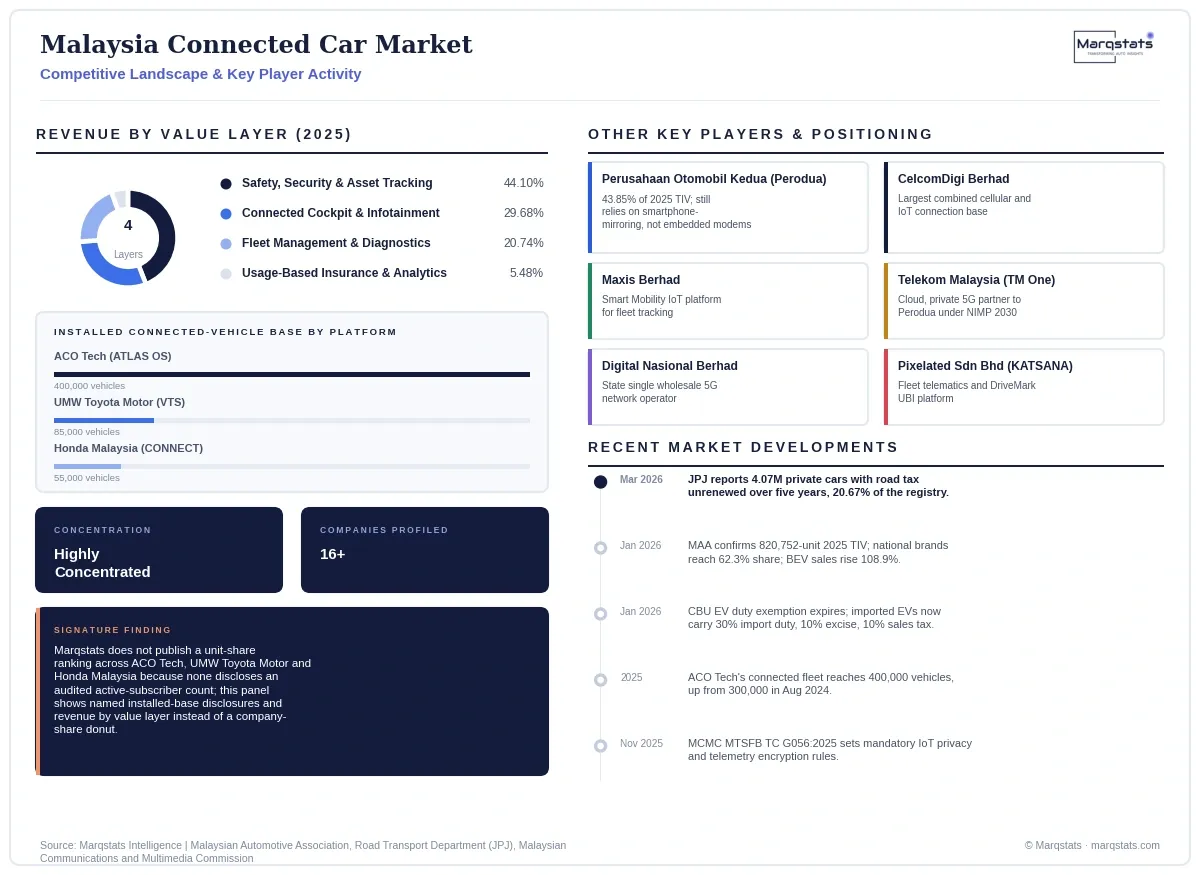
Platforms are concentrated. Vehicle sales are not. Malaysia's connected car market is concentrated at the platform level even though vehicle sales are not: ACO Tech Sdn Bhd's ATLAS system, UMW Toyota Motor's Vehicle Telematics System and Honda Malaysia's Honda CONNECT between them cover the overwhelming majority of factory-embedded connected vehicles on Malaysian roads, because Perodua — the volume leader at 43.85% of 2025 registrations — has not yet embedded cellular hardware across its core range. Marqstats does not publish a unit-share ranking across these three platforms, because none discloses an audited active-subscriber count; the competitive-landscape infographic accompanying the analysis shows the layer structure instead of a share donut.Why isn't Perodua a connected car company yet?
Competition runs on localisation and bundling rather than price. ACO Tech competes on native-language voice recognition and an integrated payment system that a licensed international platform would need a separate programme to match; UMW Toyota Motor and Honda Malaysia compete on trial-period bundling that defers the connectivity decision past the point of sale; and commercial telematics providers such as Pixelated Sdn Bhd (KATSANA) compete on integration depth with insurers and fleet-management software rather than on hardware cost alone.
Structurally, Malaysia's national-carmaker concentration means the connectivity market's centre of gravity sits with two companies' product-planning decisions. Proton's continued investment in ACO Tech and Perodua's TM One partnership will determine more of the market's next five years of fitment growth than any single non-national OEM's pricing decision, because between them Perodua and Proton control 62.3% of the vehicles the fitment decision is made on.
Companies Covered
The report profiles 16+ companies with full strategy and financials analysis, including:
Recent Market Activity
Table of Contents
Coverage & Segmentation
This report measures new passenger cars and light commercial vehicles registered in Malaysia that carry a factory-fitted or certified aftermarket telematics control unit and an embedded machine-to-machine SIM capable of independent bi-directional cellular data transmission, across 2025 as the base year, a 2021 to 2025 historical period and a 2026 to 2030 forecast period, denominated in United States dollars at a constant 4.45 Malaysian ringgit per dollar exchange rate. It excludes tethered smartphone-projection systems including Apple CarPlay, Android Auto and Perodua Smart Link, which use a driver's own handset for cellular backhaul rather than an onboard modem with independent network addressability, and it excludes heavy commercial and industrial vehicle telematics outside the light commercial vehicle class.
The analysis spans two segmentation dimensions — connectivity architecture and application service category — plus a base-year-only price-tier breakdown, six regional geographies, and 16 profiled entities across original equipment manufacturers, telecommunications operators, platform developers and commercial telematics providers. The shipment and vehicle-registration series are primary, sourced directly from the Malaysian Automotive Association and JPJ; the value, fitment-coefficient and active-parc series are Marqstats constructions derived from those primary series.
