Indonesia Says It Has 164 Million Vehicles. It Doesn't.
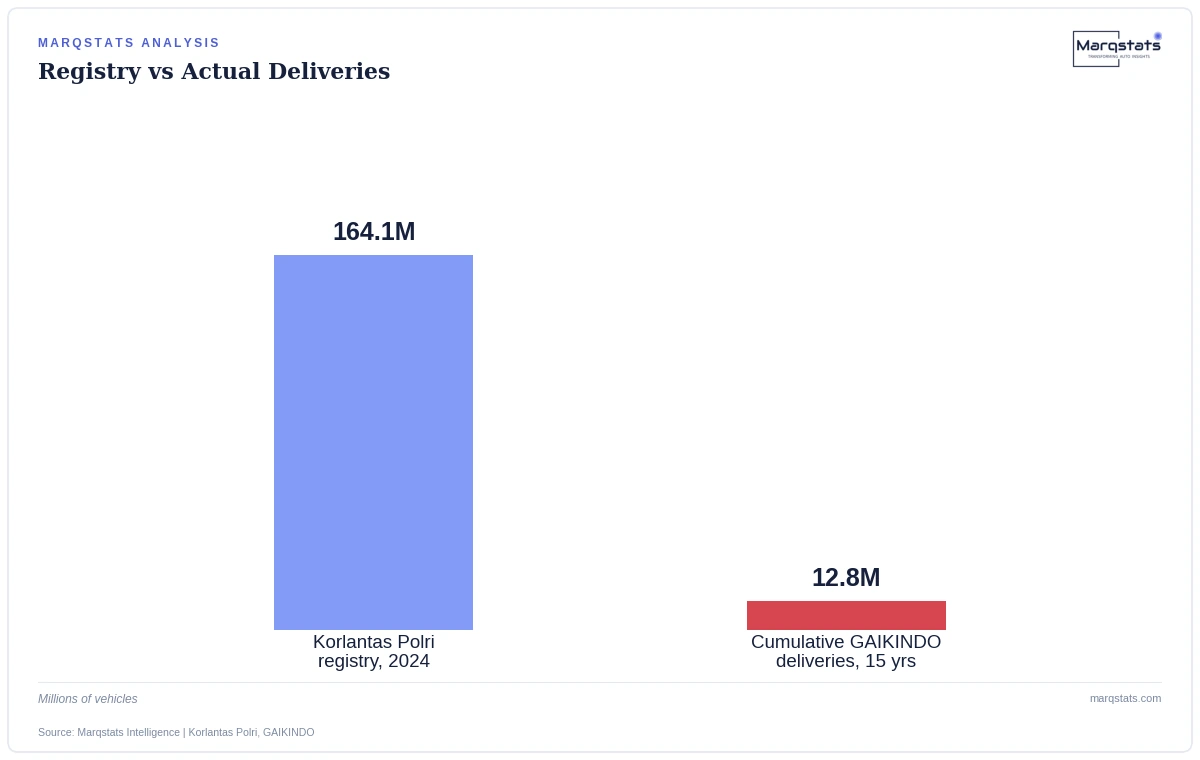
Korlantas Polri's national vehicle registry recorded 164.1 million registered vehicles in 2024. That is a real number from a real government database — and it substantially overstates how many vehicles are actually operating on Indonesian roads today. Cumulative four-wheeled GAIKINDO deliveries over the preceding 15 years total only about 12.8 million units. The registry counts millions of vehicles that no longer exist.
Where the Missing Vehicles Went
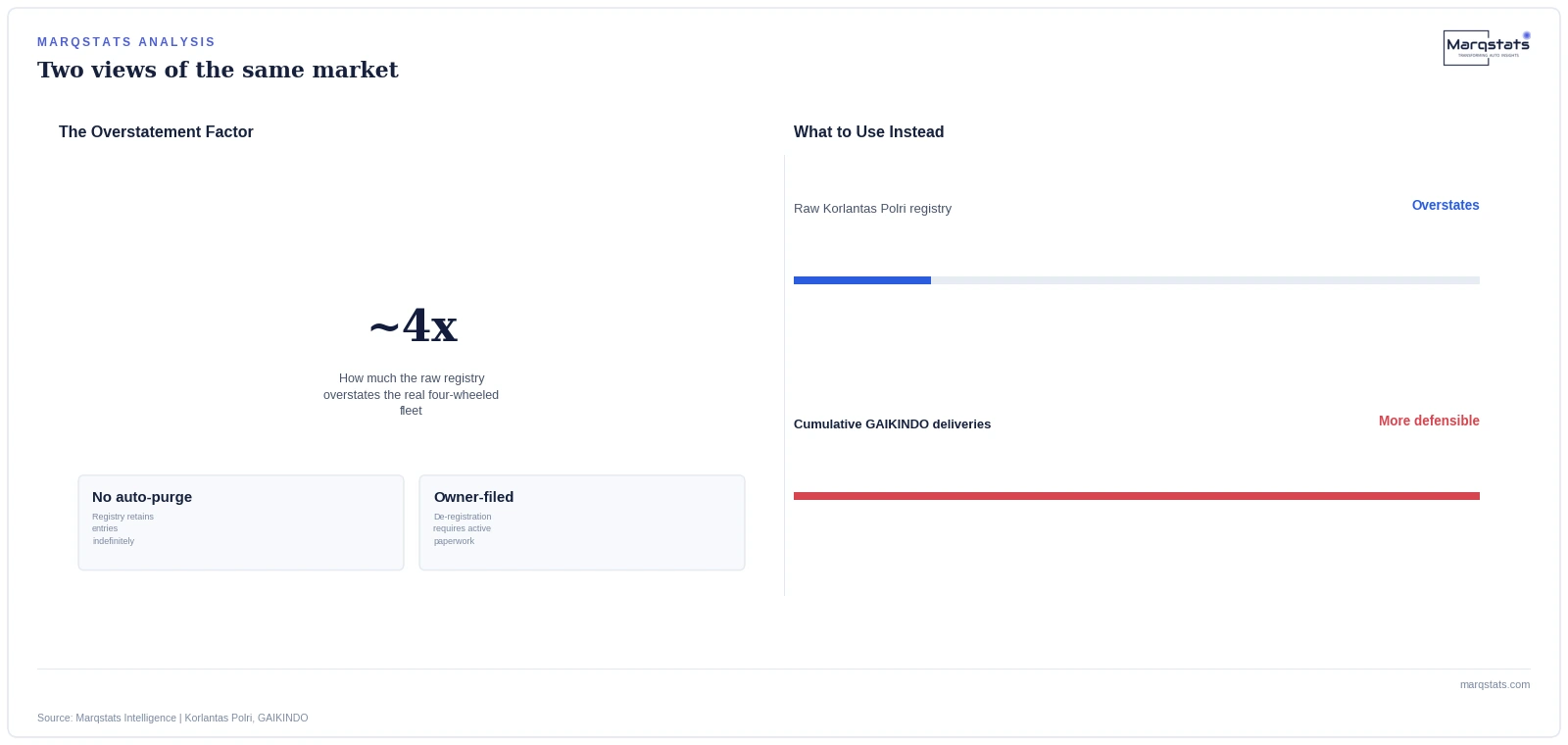
The explanation is bureaucratic, not mysterious. Indonesia's vehicle registration system requires an owner to actively file for formal de-registration (penghapusan registrasi ranmor) before a scrapped, exported, or permanently non-operational vehicle is removed from the police database. Most owners never do this — there's little incentive to file extra paperwork for a car that's already gone with no recourse at all. So the vehicle stays on the books indefinitely, counted in official statistics long after it physically stopped being a vehicle anyone could actually buy telematics hardware for.
There's a simple reason the incentive to file de-registration paperwork barely exists: it costs time and effort with no offsetting benefit to the owner. Nobody gets fined for leaving a scrapped car on the registry, and nobody gets a refund or discount for removing one. The gap between administrative record and physical reality simply grows every year, quietly, with no single event forcing a reconciliation.
Why This Matters for Anyone Sizing This Market
A market analyst, an insurer, or a telematics hardware vendor using the raw Korlantas Polri figure as a proxy for the addressable four-wheeled fleet will overstate the actual opportunity by roughly fourfold. The GAIKINDO-derived cumulative delivery figure isn't a perfect measure either — it doesn't account for vehicles scrapped or exported within that 15-year window — but it is by far the more defensible starting point for anyone estimating how many vehicles genuinely exist to sell aftermarket telematics into.
The gap also has a real practical consequence for anyone using registry data to plan physical logistics — warehouse siting, service-center footprint, retrofit-kit inventory. Planning against a fourfold-inflated base risks over-building capacity for a fleet that, in commercial reality, doesn't exist at that scale.
It's Not a Uniquely Indonesian Problem
Vehicle registries that retain entries indefinitely absent active de-registration show similar gaps elsewhere in this coverage set — Italy's insurance black-box market shows a comparable installed-versus-active reconciliation problem, for related but distinct reasons. The lesson generalizes: any market-sizing exercise built on a government vehicle registry needs to ask explicitly whether that registry actively purges non-operational vehicles, or simply accumulates them.
What to Ask Before Trusting Any Country's Vehicle Count
A simple diagnostic question separates a trustworthy registry figure from an inflated one: does removing a vehicle from the registry require an owner to take action, or does the registry itself periodically verify that registered vehicles still exist and are still operational? Registries built on the first model will drift upward indefinitely; registries built on the second stay closer to reality, at the cost of running a more expensive, actively maintained verification process the government has to fund and staff continuously.
For Indonesia specifically, GAIKINDO's wholesale delivery series is the closer proxy for reality precisely because it is built the second way: it counts actual shipments from manufacturer to dealer, a transaction that leaves a clear commercial paper trail neither party has any incentive to inflate or fabricate, unlike a police registry entry nobody is checking against the physical vehicle years later.
That's a useful heuristic worth carrying into any market-sizing exercise, not just Indonesia's: a figure tied to a real, ongoing commercial transaction is almost always more current and reliable than one tied to an administrative record no one has any real reason to keep updated over time at all.