Why Do Mining Trucks in Kalimantan Trust Telematics More Than Truckers in Java?
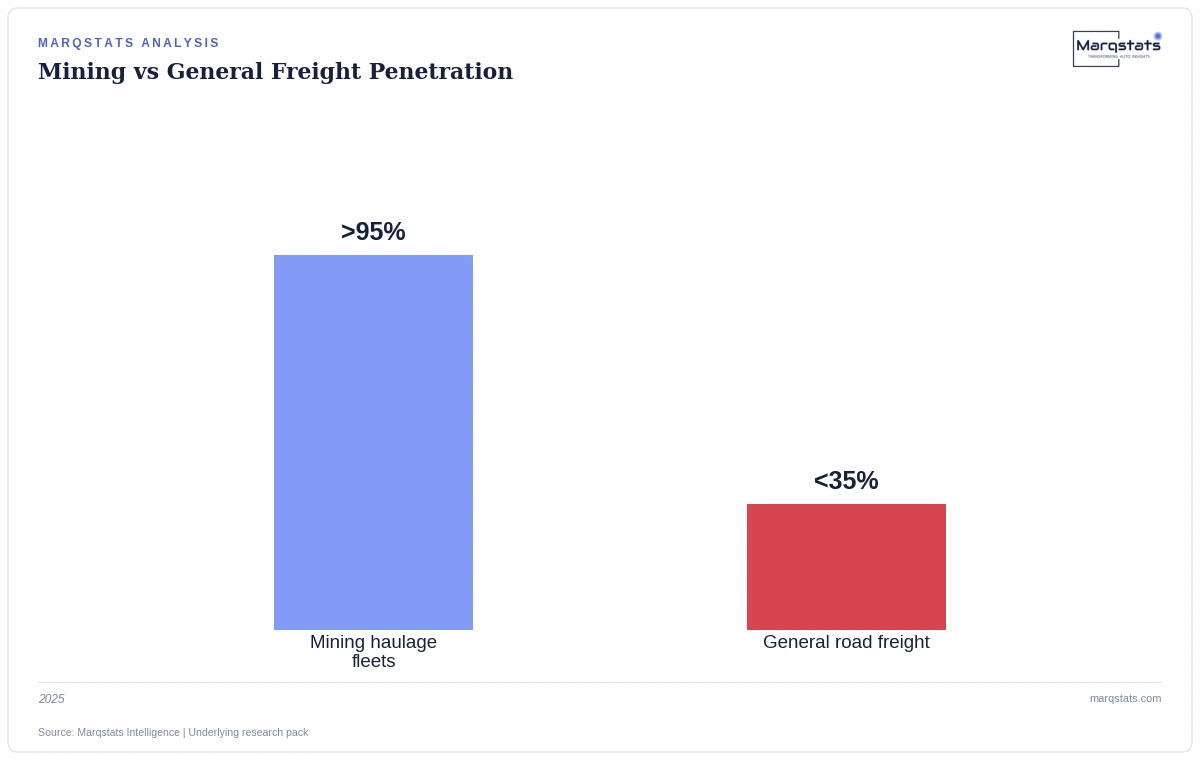
In brief: both segments operate under the same national regulation — the Ministry of Transportation's PM 60/2019 GPS-tracking mandate applies equally to mining haulage and general freight. Yet mining fleets run telematics penetration above 95%, while general freight sits below 35%. The gap isn't about the technology, the regulation, or even the money available to spend on it. It's about who actually has the power to enforce the requirement.
How Mining Sites Actually Enforce Telematics
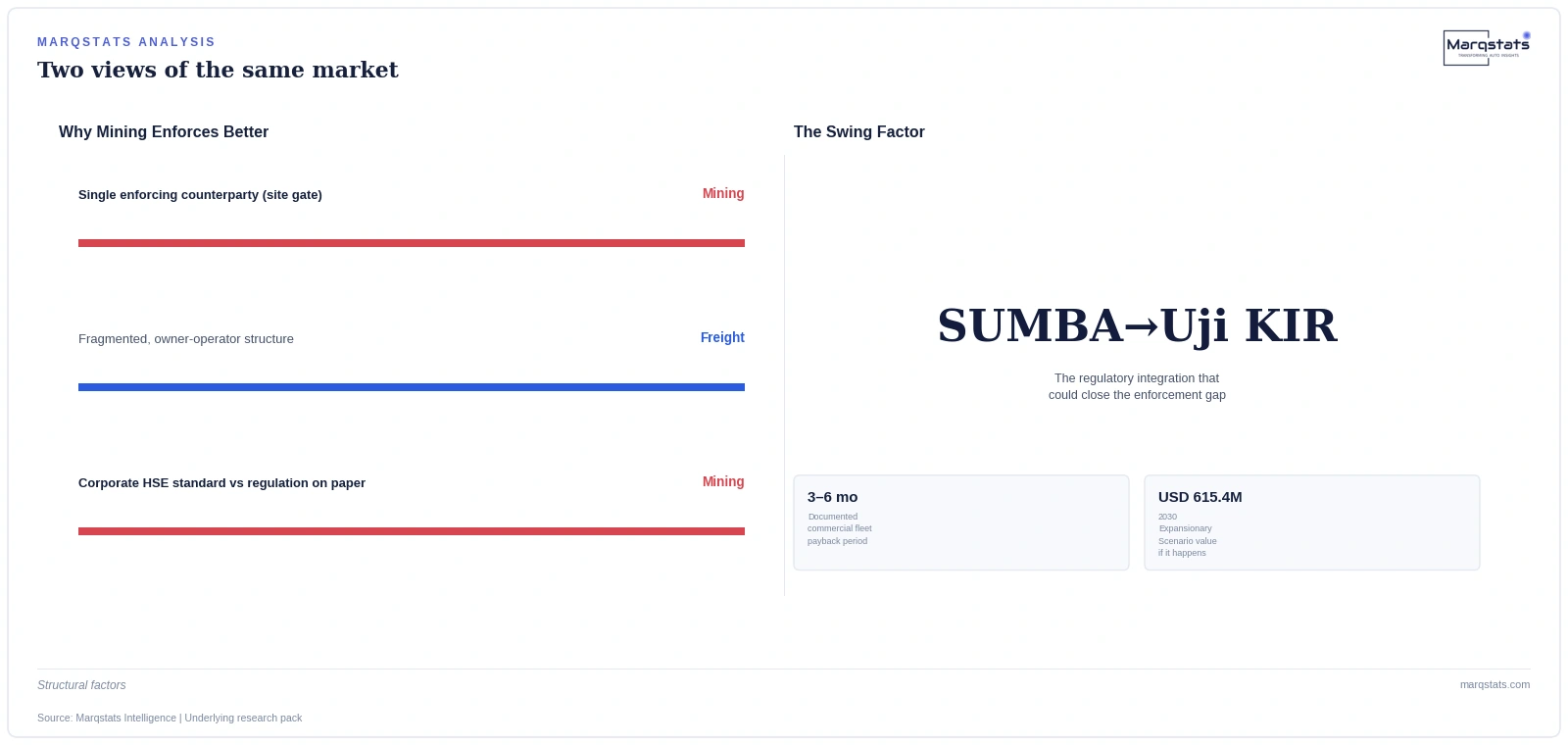
A coal or nickel mining contractor doesn't just recommend telematics to the haulage trucks working its site — it makes connectivity a condition of entry. Corporate health, safety and environmental standards, enforced directly at the site gate, require dual-facing AI driver-fatigue cameras, automated geofencing and continuous speed tracking before a truck is allowed to operate. There is a single enforcing counterparty — the mining company — with direct, immediate leverage: comply, or don't work the site.
That leverage extends beyond the initial installation, too. Mining contractors typically audit telematics data continuously as part of ongoing site-safety review, meaning a haulage operator caught disabling or tampering with a device faces immediate loss of site access, not a delayed penalty. The threat of exclusion is immediate and enforceable in a way most regulatory penalties, which typically require a formal violation process, administrative review and appeal window, simply are not enforced with anything like the same immediacy.
This is also why mining fleet operators tend to standardize on a single telematics vendor across an entire site or regional operation, rather than allowing each contracted haulage company to run its own preferred platform: a unified system makes cross-fleet safety auditing and compliance reporting to the mining company's own corporate headquarters dramatically simpler than reconciling data streams from a dozen different vendors' proprietary formats.
Why General Freight Can't Replicate That Structure
General road freight across Java and Sumatra has no equivalent chokepoint. The sector is fragmented among thousands of small operators and subcontracted owner-drivers working on thin margins, hauling cargo for whichever shipper offers the next job. No single counterparty has mining's direct leverage over any individual vehicle, and the PM 60/2019 mandate, while real on paper, lacks the kind of chokepoint enforcement mechanism that makes mining-site compliance nearly automatic.
The subcontracting structure compounds the problem specifically. A shipper hiring a logistics broker, who in turn hires an owner-operator for a single haul, creates a chain where no party in the middle has a strong incentive to verify or enforce telematics compliance on the actual vehicle doing the work — responsibility diffuses across the chain until, practically speaking, nobody owns it. Mining's directly contracted, site-controlled model has no equivalent diffusion problem: the truck is either on the approved list with active telematics, or it is not allowed through the gate.
Mining doesn't out-regulate general freight. It out-enforces it — because one mining company controls who enters its own gate.
— Marqstats Analyst Team
The Economics Reinforce the Enforcement Gap
Enforcement structure explains why telematics gets adopted; documented economics explain why it sticks once it is. A fleet operator running 50 trucks recovers telematics hardware and software costs within 3 to 6 months through reduced fuel shrinkage, lower unscheduled maintenance downtime and automated compliance documentation that replaces manual paperwork. Mining operators, running larger fleets against higher-value cargo, capture that payback faster and more visibly than a thin-margin general freight operator running a handful of trucks — reinforcing telematics adoption as an obvious, near-automatic business decision in mining and a marginal one in general freight.
Fuel shrinkage specifically deserves a closer look, since it is the single largest line item driving the payback calculation. Diesel theft and unauthorized route deviation are long-standing, well-documented problems in Indonesian trucking, and real-time GPS and fuel-sensor telemetry gives a fleet manager the first practical tool to catch both as they happen rather than discovering the loss weeks later in a reconciliation report — a capability worth far more to a company running hundreds of trucks than to an owner-operator running one or two.
Maintenance downtime tells a similar story from a different angle. A large mining contractor running a scheduled preventive-maintenance programme built on real-time engine and component telemetry can plan a haulage truck's downtime around its own production schedule; an owner-operator without that data typically only finds out about a developing mechanical problem when the truck actually breaks down on the road, at the worst possible moment for both the driver's income and the shipper's delivery timeline.
What Would Actually Close the Gap
The single most plausible path to lifting general freight penetration is not better technology or cheaper hardware — both already exist. It is the regulatory integration the market's own Expansionary Scenario names directly: linking SUMBA e-Manifest compliance to mandatory periodic vehicle inspections (Uji KIR). That would create, for the first time, a chokepoint general freight currently lacks — a vehicle without active telematics simply couldn't pass its legally required inspection, replicating for the entire freight sector the same enforcement logic mining sites already apply privately.
A Named Comparison: How Enforcement Chokepoints Work Elsewhere
This pattern isn't unique to Indonesian freight. Any regulatory requirement that depends on voluntary compliance from a fragmented population of small operators tends to under-perform relative to one enforced at a single, unavoidable chokepoint the regulated party has to pass through anyway. Vehicle safety inspections, customs checkpoints and port entry requirements all work for exactly this reason — they convert a distributed compliance problem into a single gate a vehicle cannot avoid. Linking SUMBA to Uji KIR would apply that same logic to telematics specifically, rather than relying on freight operators to self-report GPS-tracking compliance with no external verification point.
That same chokepoint logic explains why vehicle emissions testing and mandatory insurance requirements achieve near-universal compliance in most countries despite covering an equally fragmented population of individual vehicle owners: renewing a registration or passing an annual inspection is unavoidable, so compliance happens whether or not the owner would have volunteered for it otherwise.
What This Means for a Fleet Telematics Provider's Go-to-Market Plan
A telematics vendor deciding where to concentrate its Indonesian sales effort should read this gap as a clear, unambiguous prioritization signal, not an equal opportunity spread across sectors. Mining and resource-corridor logistics offer a genuinely shorter, more predictable sales cycle today, backed by an enforcement structure already firmly in place across the sector. General freight is a larger addressable market in raw vehicle count, but selling into it currently means overcoming the exact same fragmentation and enforcement gap this piece has described — a harder, considerably slower sale to close until the regulatory chokepoint actually changes.
That doesn't mean general freight should be ignored entirely — it means treating it as a longer-horizon land-grab rather than a near-term revenue target. A provider that establishes early relationships and reference customers in general freight now will be better positioned to scale quickly once SUMBA-to-Uji-KIR integration does eventually materialize on the ground, rather than starting the sales process from zero at that point once conditions finally shift.
The most efficient version of this strategy likely means using mining-sector revenue and case studies to fund the slower general-freight land-grab, rather than treating the two sectors as separate business lines competing for the same limited sales and engineering resources within a single company operating in what is, ultimately, a genuinely capital-constrained emerging market overall.
Outlook: One Trigger, Not Three
This market does not support a three-scenario outlook on the mining-versus-freight gap specifically. The single evidenced trigger is the SUMBA-to-Uji-KIR regulatory integration itself — without it, expect the gap to persist largely unchanged, since neither sector's underlying enforcement structure is likely to shift on its own, regardless of how much cheaper telematics hardware itself becomes over the forecast period.
A useful test for tracking this going forward: watch for any formal Ministry of Transportation announcement explicitly linking SUMBA compliance status to Uji KIR pass/fail outcomes, rather than incremental enforcement-capacity announcements alone. Anything short of that direct linkage is unlikely to meaningfully move general freight penetration away from its current fragmented, voluntary-compliance baseline going forward.