Why 90% of Indonesia's Connected Cars Stop Being Connected
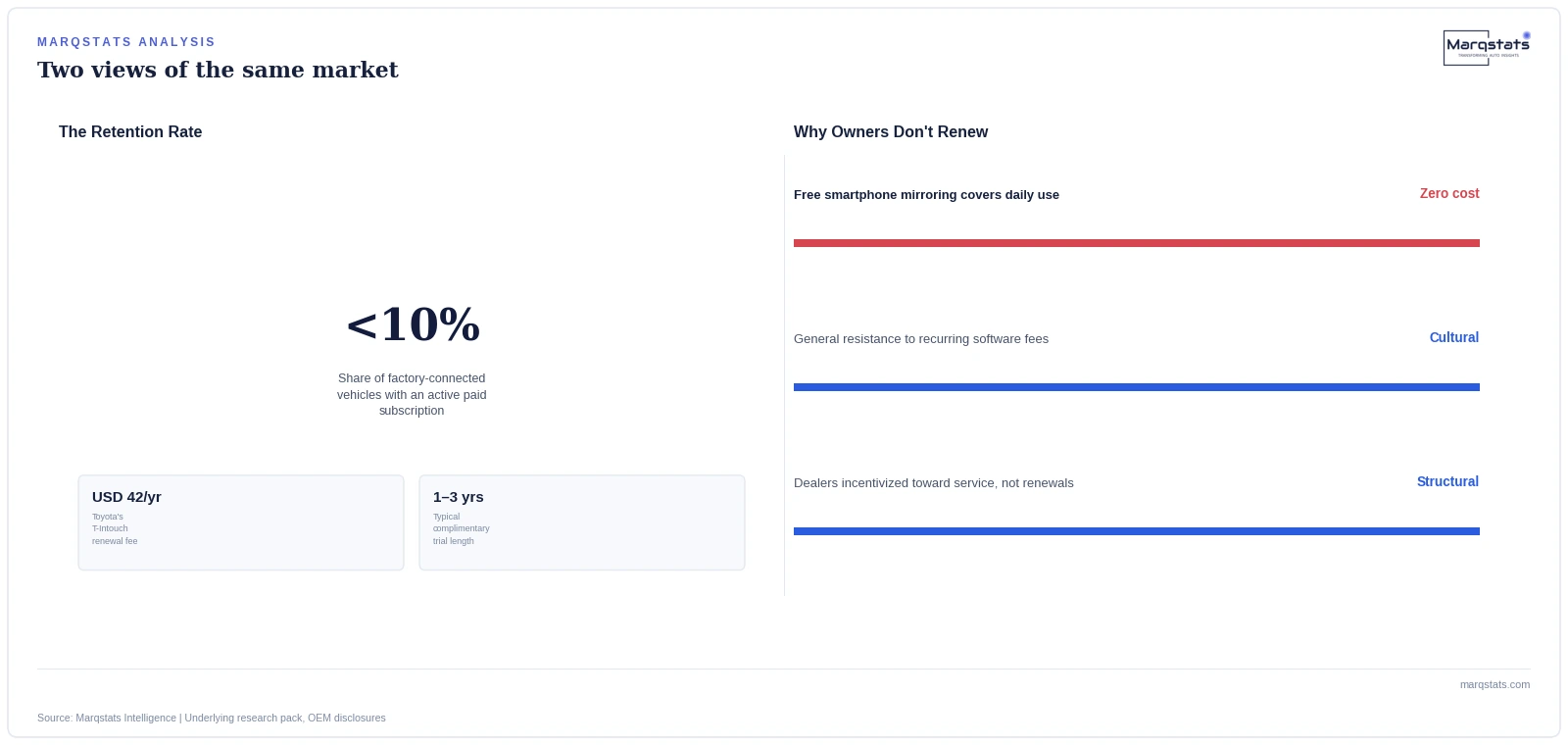
Roughly 2.3 million new Indonesian passenger vehicles shipped with factory-installed telematics between 2021 and 2025 — Toyota T-Intouch, Hyundai Bluelink, Wuling WISE, Honda CONNECT. Fewer than 185,000 of those vehicles still carry an active, paid subscription today. That is a post-trial retention rate below 10%, and it means most of what automakers publicly call their "connected vehicle" base reflects a one-time app pairing at the dealership, not ongoing engagement long after the sale is complete and the paperwork has all been signed.
What the Free Trial Actually Buys
Every major Indonesian automaker bundles telematics into the vehicle price with a complimentary activation period: one year for Honda, three years for Toyota and Hyundai. During that window, the owner gets remote engine start, vehicle-location tracking, driving-behavior scoring and basic diagnostics through the manufacturer's app. When the trial ends, continuing costs a real but modest fee — Toyota charges IDR 750,000 annually, about USD 42, a figure most Indonesian households would not consider a meaningful monthly expense on its own.
Why USD 42 a Year Doesn't Change the Decision
If this were purely a pricing problem, a fee this small should barely register against the cost of owning a car at all. It doesn't change the outcome, which is the clearest evidence this is a demand problem, not an affordability one at all. Apple CarPlay and Android Auto deliver the navigation and media functions most owners actually use every day, at zero marginal cost, on the same dashboard screen. And dealership networks, whose revenue comes overwhelmingly from scheduled maintenance and parts, have little direct financial incentive to push customers toward renewing a digital subscription that doesn't generate meaningful service-bay revenue for the dealership itself at all.
There is also a simple behavioural explanation worth naming: once a feature has been free for one to three years, most owners have already formed the habit of treating it as a standard part of the car, not a paid service. Converting that expectation back to "this now costs money" is a harder psychological sell than pricing a genuinely new paid feature from day one would be — the free trial period, intended to build familiarity and demand, may be inadvertently teaching owners that the feature is inherently free.
How OEMs Adjusted Their Strategy
Rather than keep fighting this resistance, Indonesian automakers have quietly redirected where they expect connected-vehicle revenue to actually come from going forward. Hardware margin, baked into the vehicle's sticker price at the point of sale, is captured regardless of what happens after delivery. Toyota-Astra Motor has gone further, integrating its T-Intouch renewal flow with AstraPay, the group's own digital payment platform — a real move that makes renewal marginally easier without requiring the underlying demand problem to be solved first at any point in the ownership lifecycle.
Dealer networks are also being pulled into the equation differently than before. Rather than relying on the OEM app alone to drive renewal, some franchised dealers now bundle a telematics renewal reminder into scheduled maintenance visits, using an existing in-person touchpoint that already has the customer's attention, instead of relying purely on a push notification the owner may never see or act on.
The Counter-Case: Does This Actually Matter for OEM Profitability?
A reasonable objection is that none of this threatens automaker profitability directly, since the hardware cost is already recovered at sale. That's true as far as it goes — but it does mean any strategic plan that assumes growing recurring software revenue from Indonesia's passenger fleet is building on a foundation the market's own data doesn't support. The revenue opportunity in Indonesian connected vehicles is real; it just isn't the one a consumer-subscription model assumes.
How This Compares to Indonesia's Commercial Fleet Segment
The contrast with commercial fleet telematics, covered in depth elsewhere in this analysis, is instructive. Mining and logistics fleet operators keep paying for telematics at retention rates above 90%, because the payback is direct, quantifiable and visible on a company's own balance sheet within 3 to 6 months. A private car owner has no equivalent line item to point to — the value of remote-start or driving-behavior tracking on a personal vehicle is diffuse and largely unmeasured, which makes it far easier to let a subscription lapse than it would be for a fleet manager watching fuel-shrinkage numbers improve month over month.
That asymmetry suggests the two segments will likely never converge toward similar retention rates, regardless of how OEMs adjust consumer pricing or feature bundles — the underlying difference is structural, not a temporary gap that better marketing or a lower price point could close.
What a Different Bundling Strategy Might Achieve
One structural change worth naming, even if no automaker has fully tested it in Indonesia yet, is extending the complimentary period rather than shortening it. Toyota and Hyundai's three-year trials already outperform Honda's one-year window in anecdotal retention terms, suggesting that delaying the moment a customer has to make an active renewal decision — rather than pricing the renewal more aggressively — may be the more promising lever automakers actually have available to them, especially given how quickly a one-year trial forces the renewal decision before most owners have built any real attachment to the connected features in the vehicle at all.
What Indonesia's Pattern Suggests About the Rest of Southeast Asia
Indonesia is unlikely to be an isolated case. Markets sharing Indonesia's combination of price-sensitive new-car buyers, strong smartphone-mirroring penetration and dealer networks structurally incentivized toward mechanical service revenue should be expected to show a similar gap between factory connectivity fitment and active paid usage, even where no comparable retention figure has yet been published. Automakers building a regional Southeast Asian connected-vehicle strategy around Indonesia's own subscription data would do well to treat it as a plausible baseline for neighbouring markets, not an outlier specific to Indonesian consumer behaviour alone.
What This Means for a Sizing or Sourcing Model
Anyone forecasting Indonesian connected-car software revenue should treat consumer subscriptions as a structurally minor contributor, not a growth engine. The full market sizing this piece draws on is set out in the Marqstats analysis linked below.
Related reportIndonesia Connected Car Market Size, Share & Forecast 2026 – 2030