Market Snapshot
Key Takeaways
Market Overview & Analysis
Report Summary
Saudi Arabia's connected car market is measured on the value of telematics hardware, cellular M2M connectivity airtime and recurring software subscriptions sold against the Kingdom's operating vehicle fleet. The market is worth USD 323.28 million in 2025, the most recent year for which a confirmed vehicle-sales anchor exists, and the figure differs sharply depending on whether it is read as a consumer statistic or a commercial-compliance statistic — the two segments behave as different markets entirely.
Structurally, this is a state-enforcement market before it is a consumer-electronics market. Commercial fleet operators connect their vehicles because Saudi law makes an active tracking feed a precondition for a valid operating card, not because of any feature a driver values; consumer buyers connect only when an OEM subscription clears a price bar that free smartphone mirroring does not have to clear at all.
The analysis is built for four reader types making different decisions: an international telematics hardware or software vendor deciding whether Saudi data-localization rules justify a domestic cloud partition, a commercial fleet operator pricing Wasl compliance against Road Transport Law penalties, an automotive OEM deciding how to price a consumer subscription against a free smartphone-mirroring substitute, and an investor assessing King Abdullah Economic City's manufacturing cluster against the SASO 2944 eCall mandate's now-2028 timeline.
Saudi Arabia Connected Car Market Size and Forecast
Marqstats builds the Saudi figure from three layers. Hardware is priced off the verified SAR 600 (USD 160) TGA-approved commercial tracking unit cost, multiplied by annual shipment volumes derived from GASTAT fleet data and OICA new-sales figures; connectivity airtime is priced off wholesale M2M SIM tariffs; and software and platform subscriptions are estimated from the active commercial and consumer subscriber base at their respective average revenue per user.
The active connected parc series is primary — it follows GASTAT's fleet baseline and the Transport General Authority's Wasl compliance mandate — and the value series is derived from it. Annual hardware shipments rise from 522,494 units in 2025 to 1,091,742 units in 2030, a 15.88% CAGR, while market value rises from USD 323.28 million to USD 735.44 million, a 17.87% CAGR. The gap between the two rates is the software-subscription layer, which grows fastest of the three because it compounds off the smallest base.
The active connected vehicle parc grows from 1,794,018 units in 2025 to 3,588,846 in 2030, a 14.88% CAGR. Because GASTAT's Road Transport Statistics report for 2025 is not due until roughly November 2026, the 2025 base-year figures here are built by extending the confirmed 2024 GASTAT baseline along the same growth trajectory implied by the underlying research pack's own 2026 forecast, rather than by independently re-modelling the fleet from first principles.
Government Mandate Has Built a Market Consumer Demand Never Would Have
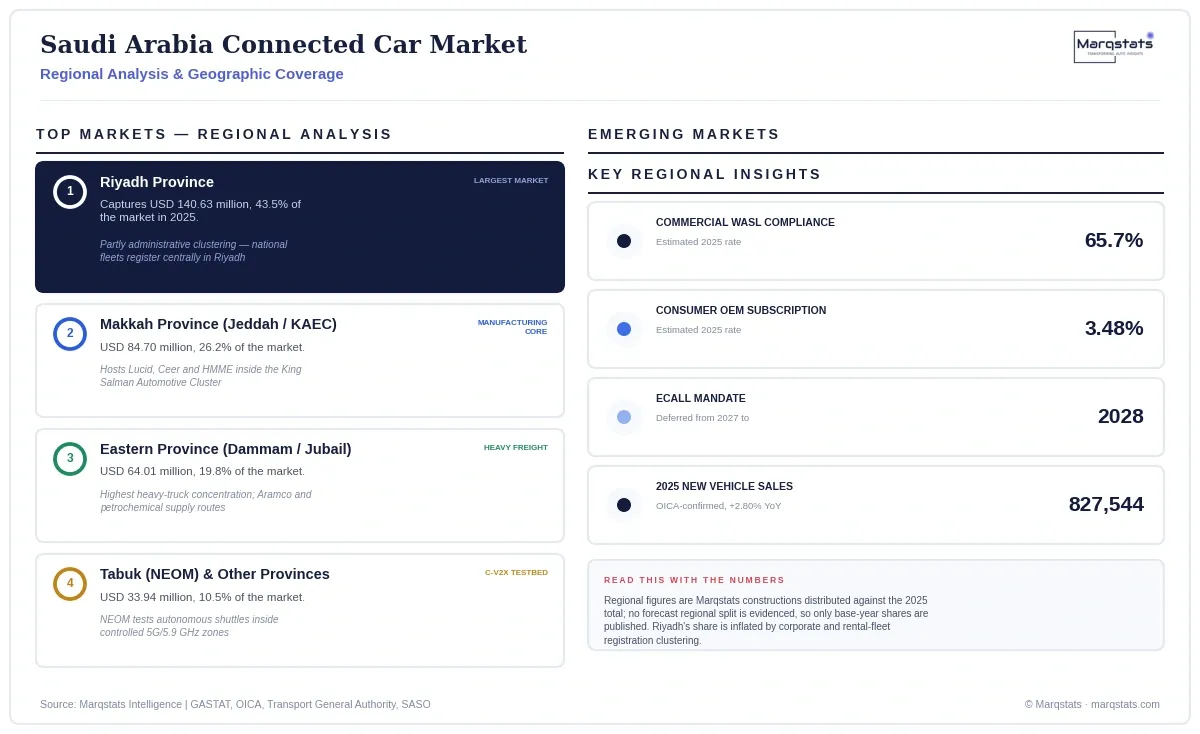
Saudi Arabia's commercial telematics compliance rate did not emerge from a business case. It emerged from the Transport General Authority's decision to make an active Wasl data feed a precondition for a valid commercial operating card, backed by fines reaching SAR 20,000 and vehicle impoundment of up to 60 days. An estimated 65.7% of the Kingdom's 2.0 million-vehicle commercial fleet complies in 2025 as a direct consequence.
Consumer connectivity, with no equivalent legal trigger, sits at an estimated 3.48% of the 13.8 million-vehicle private passenger parc. The 62-percentage-point gap between the two is not a story about awareness or infrastructure — Saudi Arabia has 4G and 5G coverage across its population centres — it is a story about which segment has a legal reason to stay connected and which does not.Why no one can publish Saudi Arabia's 2025 car fleet number yet.
The eCall Mandate That Was Supposed to Close the Gap Just Slipped a Year
SASO 2944:2023, the technical standard requiring embedded eCall connectivity on imported light-duty vehicles, was always the mechanism expected to pull consumer connectivity toward commercial-grade compliance. Saudi Standards, Metrology and Quality Organization (SASO) Board Decision 196 incorporated the standard into the mandatory Telecom Devices Technical Regulation in December 2023, with an original enforcement date of 1 January 2027.
That date has already moved once. SASO's Executive Committee, in Decision 01/59/2026 issued in July 2026, postponed mandatory enforcement to 1 January 2028 — a twelve-month deferral the Ministry of Commerce circulated to chambers of commerce to notify vehicle importers directly. Small-series manufacturers importing fewer than 75 units a year remain permanently exempt. Every year the mandate slips is a year the consumer segment's 3.48% penetration rate has no regulatory floor pushing it upward.
Market Dynamics
Key Drivers
Five conditions are moving this market, and state mandate matters more than consumer demand.
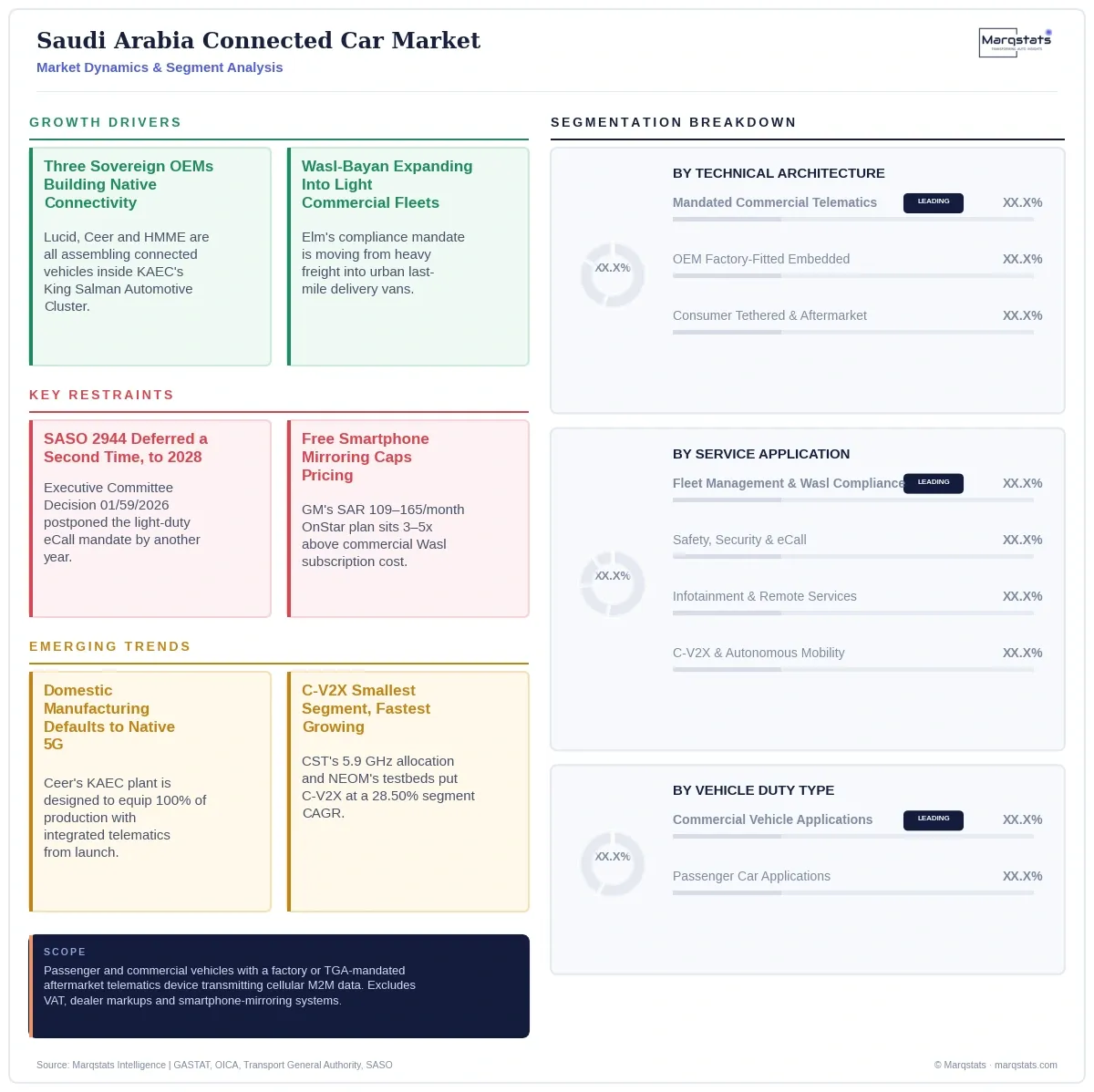
- Three sovereign-backed manufacturers are building native connectivity into Saudi-assembled vehicles from the factory floor rather than retrofitting it. Lucid Group's AMP-2 plant, Ceer National Automotive Company's PIF-Foxconn joint venture, and Hyundai Motor Manufacturing Middle East's USD 500 million facility all sit inside King Abdullah Economic City, with HMME's commercial rollout scheduled for the fourth quarter of 2026 at 50,000 units of annual capacity.
- The Transport General Authority continues to widen the Wasl mandate's scope beyond heavy freight. Elm Company's integration between the Wasl tracking gateway and the Bayan electronic waybill system, mandatory for land carriers since 1 March 2023, is expanding compliance requirements from long-haul trucking into urban last-mile delivery vans and light commercial vehicles.
- Real 2025 new-vehicle sales growth gives OEMs a larger base to fit connectivity onto. Passenger car sales rose 3.04% to 726,988 units and commercial vehicle sales grew an estimated 1.05% to 100,556 units in 2025, both ahead of 2024's commercial-segment contraction, expanding the annual pool of vehicles eligible for factory-fitted telematics.
- Dedicated 5.9 GHz spectrum removes a coordination barrier for vehicle-to-everything pilots. The Communications, Space and Technology Commission (CST) allocated the 5855–5905 MHz band to Cellular Vehicle-to-Everything communication in October 2024, providing interference-free spectrum for municipal V2I and V2V testing in NEOM and other sovereign development zones.
- iot squared's 2023 acquisition of Machinestalk created a single national telematics platform with the balance-sheet backing to underwrite further consolidation. The joint venture between the Public Investment Fund and stc Group now serves more than 2,000 public and private-sector fleet accounts, giving it scale independent commercial telematics providers cannot easily match.
Key Restraints
Four constraints stand between the market and full-fleet connectivity.
- The regulatory trigger consumer connectivity was waiting for has been deferred twice on the same standard. SASO 2944:2023's enforcement date has moved from an original 2027 baseline to 1 January 2028 under Executive Committee Decision 01/59/2026, extending by at least one more year the period in which embedded eCall connectivity remains optional on imported passenger vehicles.
Free smartphone mirroring caps what OEMs can charge for a subscription. Apple CarPlay and Android Auto deliver navigation, streaming and hands-free calling at zero marginal cost, and General Motors' own SAR 109 to SAR 165 monthly OnStar pricing sits three to five times above the commercial Wasl subscription rate — a premium the pack's own analysis notes most consumers decline once any complimentary trial period ends.GM OnStar vs free smartphone mirroring: is Saudi Arabia's priciest connected service worth it?
- CST's data-localization requirement raises the fixed cost of entry for foreign telematics vendors. Every server, database and cloud-processing instance handling Saudi-generated vehicle telemetry must physically reside inside the Kingdom under the July 2024 IoT Regulatory Framework, a requirement that has already pushed General Motors, BMW and Toyota toward localized cloud partitions or domestic telecom partnerships.
- GASTAT's own fleet-reporting cadence limits how current any Saudi connected-vehicle model can be. The authority's Road Transport Statistics report lags its reference year by roughly ten to eleven months — the 2024 report was released in November 2025 — so any 2025 or 2026 fleet total in circulation before roughly November 2026 is necessarily an estimate, not a published figure.
Key Trends
Four shifts show where the market is heading and who captures the value.
- Domestic manufacturing is shifting connectivity from an aftermarket add-on to a factory default. Ceer's KAEC facility is designed to equip 100% of its production with integrated 5G telematics architectures from first delivery, a native-connectivity approach none of the Kingdom's import-only distributors can replicate on vehicles built overseas.
- Fleet telematics providers are moving up the value chain from basic location tracking toward higher-margin services. Video telematics using edge computer vision for driver-behaviour monitoring, cold-chain monitoring compliant with Saudi Food and Drug Authority standards, and direct ERP integration are displacing commodity GPS tracking, which has fallen toward SAR 30 a month.
- C-V2X is the smallest application segment today and the fastest-growing. Marqstats' segment model puts Cellular Vehicle-to-Everything and autonomous-mobility platforms at a 28.50% segment CAGR, ahead of every other application category, driven by NEOM's testbed deployments and the CST's 5.9 GHz spectrum allocation.
- Enterprise telematics consolidation is concentrating the commercial segment around fewer, larger platforms. iot squared's 2023 acquisition of Machinestalk folded one of the Kingdom's largest domestic providers into a Public Investment Fund-and-stc joint venture, while independent platforms such as Wialon adapt by localizing their own server infrastructure inside Saudi borders.
Strategic Implications
- Foreign telematics hardware and software vendors should treat dual SASO and CST type-approval, plus in-Kingdom data hosting, as a cost of entry rather than an optional compliance step. A platform that cannot pre-integrate with Elm's Wasl API out of the box will struggle to sell into the commercial segment regardless of its technical merits, because fleet operators will not adopt a tool that leaves their operating cards at risk.
- Automotive OEMs selling consumer connectivity should price toward the smartphone-mirroring substitute, not toward the commercial-compliance market. General Motors' current SAR 109 to SAR 165 monthly OnStar pricing sits well above what a market with a free, adequate alternative has shown it will pay past a promotional trial, and every additional year the SASO 2944 mandate slips removes the regulatory floor that might otherwise force adoption.
- Incumbent commercial telematics providers should defend margin through service depth, not device count. Basic Wasl-compliant tracking has become a commodity near SAR 30 a month; video telematics, cold-chain compliance and ERP integration are where the fleet-management segment's 16.20% forecast CAGR is actually concentrated.
- Investors and sovereign capital allocators should weight King Abdullah Economic City's manufacturing cluster — Lucid, Ceer and HMME together — as the more durable connectivity asset relative to hardware distribution, because native factory-fitted architecture is insulated from the SASO 2944 timeline risk that still hangs over every imported vehicle sold in the Kingdom.
Market Segmentation
The largest architecture segment at USD 176.71 million in 2025, 54.66% of market value, growing to USD 367.96 million by 2030 at a 15.8% CAGR. These IP67-rated, CAN-bus-integrated devices with digital weight sensors and cold-chain probes transmit encrypted location and performance data directly to Elm's Wasl platform, and their fitment is a legal precondition for a valid commercial operating card, not a purchasing decision.
USD 91.94 million in 2025, 28.44% of value, and the fastest-growing architecture segment at a 22.4% CAGR to USD 252.59 million by 2030. Multi-carrier eSIM-equipped TCUs installed on the assembly line, led by General Motors' OnStar Arabia platform, sit at the premium end of passenger nameplates.
The smallest and slowest-growing segment at USD 54.63 million in 2025, 16.9% of value, reaching USD 92.89 million by 2030 at a 11.2% CAGR. Smartphone-projection systems and retail OBD-II anti-theft dongles dominate this category, competing directly against embedded OEM systems on price rather than capability.
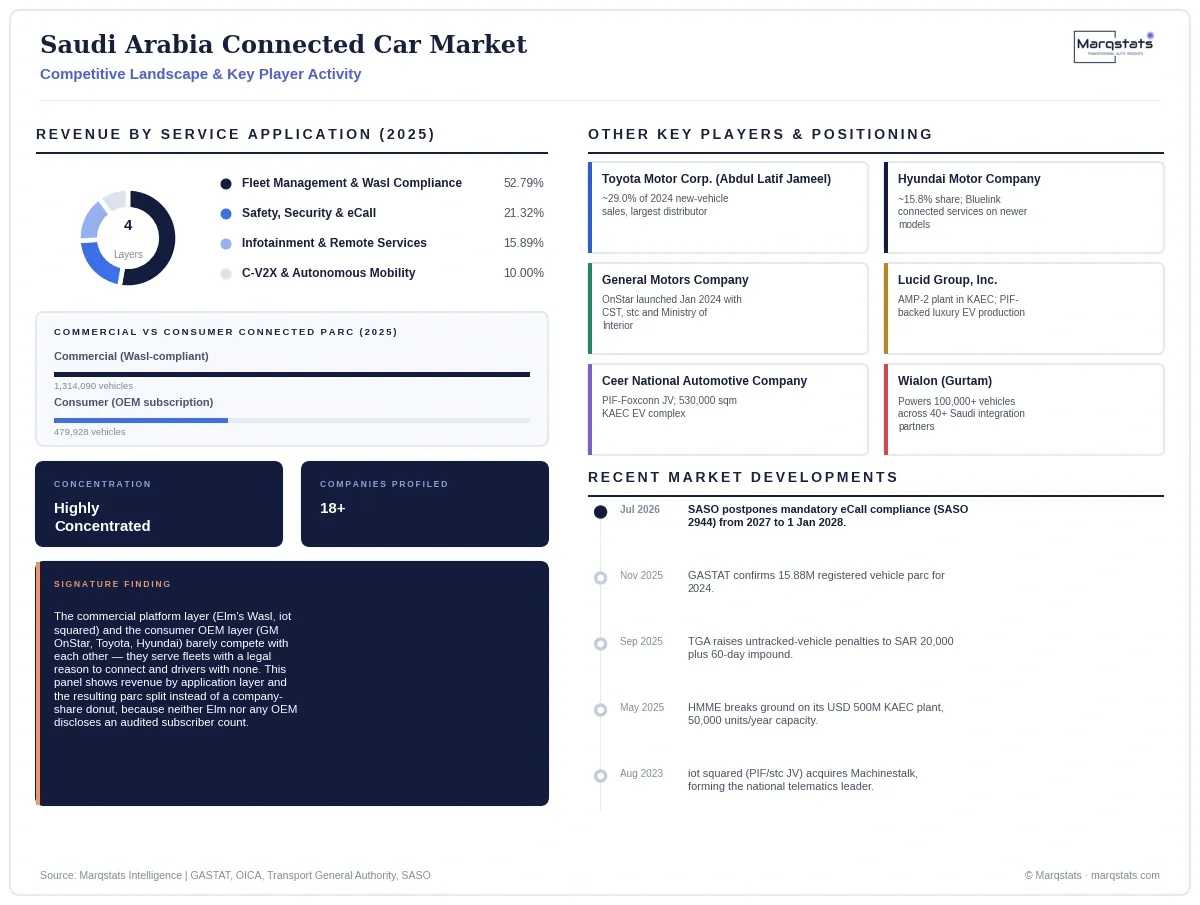
USD 170.66 million in 2025, 52.79% of value, rising to USD 361.55 million by 2030, a 16.2% CAGR. Compliance dashboards that automate Bayan waybill synchronisation and generate driver safety scorecards anchor this category, the largest of the four application segments.
USD 68.92 million in 2025, 21.32% of value, expanding at 24.5% a year to USD 206.15 million by 2030, driven by preparations for the now-2028 SASO 2944 mandate and subscription programmes such as OnStar Protect.
USD 51.37 million in 2025, 15.89% of value, growing to USD 102.43 million by 2030 at 14.8% a year, supported by remote climate pre-conditioning features valued in a market where summer surface temperatures exceed 70°C.
The smallest segment today at USD 32.33 million in 2025, just 10.0% of value, but the fastest-growing of any segment in the analysis at a 28.5% CAGR to USD 113.27 million by 2030, anchored on CST's 5.9 GHz spectrum allocation and NEOM's autonomous-mobility testbeds.
USD 185.40 million in 2025, 57.35% of value, growing to USD 376.16 million by 2030 at 15.2% a year — the larger of the two duty types today, carried by mandatory Wasl compliance across trucks, buses and tankers.
USD 137.88 million in 2025, 42.65% of value, but growing faster than commercial applications at 20.8% a year to USD 354.68 million by 2030, as the segment starts from a much smaller connected base with more room to expand.
By Geography
Riyadh Province
The capital province captures USD 140.63 million in 2025, 43.5% of national connected-car revenue, the largest of the four regions. Riyadh recorded 266,900 new vehicle registrations in 2024, but a meaningful share of that volume is an administrative artefact: national car rental corporations and logistics carriers register fleets centrally with the Ministry of Commerce and the Transport General Authority in Riyadh even when the vehicles themselves operate on freight corridors nationwide.
Makkah Province (Jeddah / KAEC)
USD 84.70 million in 2025, 26.2% of the market, the Kingdom's industrial automotive core. King Abdullah Economic City, north of Jeddah, hosts the King Salman Automotive Cluster — Lucid Group's AMP-2 plant, the Ceer National Automotive Company complex, and Hyundai Motor Manufacturing Middle East's assembly joint venture — while Jeddah Islamic Port's vehicle-import volumes add further logistics-telematics demand.
Eastern Province (Dammam / Jubail)
USD 64.01 million in 2025, 19.8% of the market, with the highest concentration of heavy commercial trucking per registered vehicle of any region. Telematics demand here is shaped by supply routes serving Saudi Aramco and petrochemical processing plants, plus cross-border freight through the King Fahd Causeway to Bahrain, which carried 49.9% of the Kingdom's total cross-border passenger traffic in 2024.
Tabuk (NEOM) & Other Provinces
USD 33.94 million in 2025, 10.5% of the market — the smallest of the four regions by current revenue, but the location of the Kingdom's most advanced connectivity testbed. NEOM operates autonomous shuttles and electric support vehicles inside controlled 5G and 5.9 GHz environments, validating Level 4 automated operations ahead of any nationwide rollout.
How Competition Is Evolving
Two entirely separate competitive contests run inside this one market. Two markets, two winners. On the commercial side, Elm Company's Wasl platform is the mandatory gateway every compliant fleet must transmit to, and iot squared — the Public Investment Fund and stc Group joint venture that acquired Machinestalk in August 2023 — is the dominant platform operator on top of it, serving more than 2,000 institutional accounts. On the consumer side, Toyota Motor Corporation leads new-vehicle sales at an estimated 29.0% share through its exclusive distributor Abdul Latif Jameel, but General Motors leads on connected-services depth through OnStar, launched in partnership with the CST, stc Group and the Ministry of Interior.
Competition on the commercial side runs on integration depth with Wasl and Bayan, not on hardware price, which has already fallen toward a commodity SAR 30 a month. On the consumer side, the competitive axis is subscription value against a free substitute: OEMs compete less against each other than against Apple CarPlay and Android Auto, which deliver the features most Saudi consumers actually use at no marginal cost.
Structurally, the Public Investment Fund now sits on both sides of the market at once — as co-owner of iot squared on the commercial platform side, and as the controlling or part shareholder of Ceer, Lucid and Hyundai Motor Manufacturing Middle East on the vehicle-manufacturing side. That dual position gives sovereign capital more influence over how fast native connectivity reaches Saudi roads than any single OEM's product decision.Why is the Public Investment Fund on both sides of Saudi Arabia's connected car market?
Companies Covered
The report profiles 18+ companies with full strategy and financials analysis, including:
Recent Market Activity
Table of Contents
Coverage & Segmentation
This report measures passenger cars and light, medium and heavy commercial vehicles operating in Saudi Arabia that carry a factory-fitted or Transport General Authority-mandated aftermarket telematics device with cellular machine-to-machine data transmission, across a 2025 base year, a 2021 to 2025 historical period and a 2026 to 2030 forecast period, denominated in United States dollars at a constant USD 1.00 = SAR 3.75 statutory exchange rate. It excludes retail dealer markups, the 15% value-added tax, and consumer smartphone-projection systems that route through a driver's own cellular data plan rather than a vehicle-integrated connection.
The analysis spans three segmentation dimensions — technical architecture, service application and vehicle duty type — four administrative-province geographies, and 18 profiled entities across regulators, platform operators, automotive manufacturers and telematics integrators. New-vehicle sales figures are primary, sourced directly from the International Organization of Motor Vehicle Manufacturers; the registered-fleet total, fitment coefficients and the active commercial-versus-consumer subscription split are Marqstats constructions built from the most recently published GASTAT baseline.