Why a Car in Oslo and a Car in Finnmark Need Completely Different Connectivity
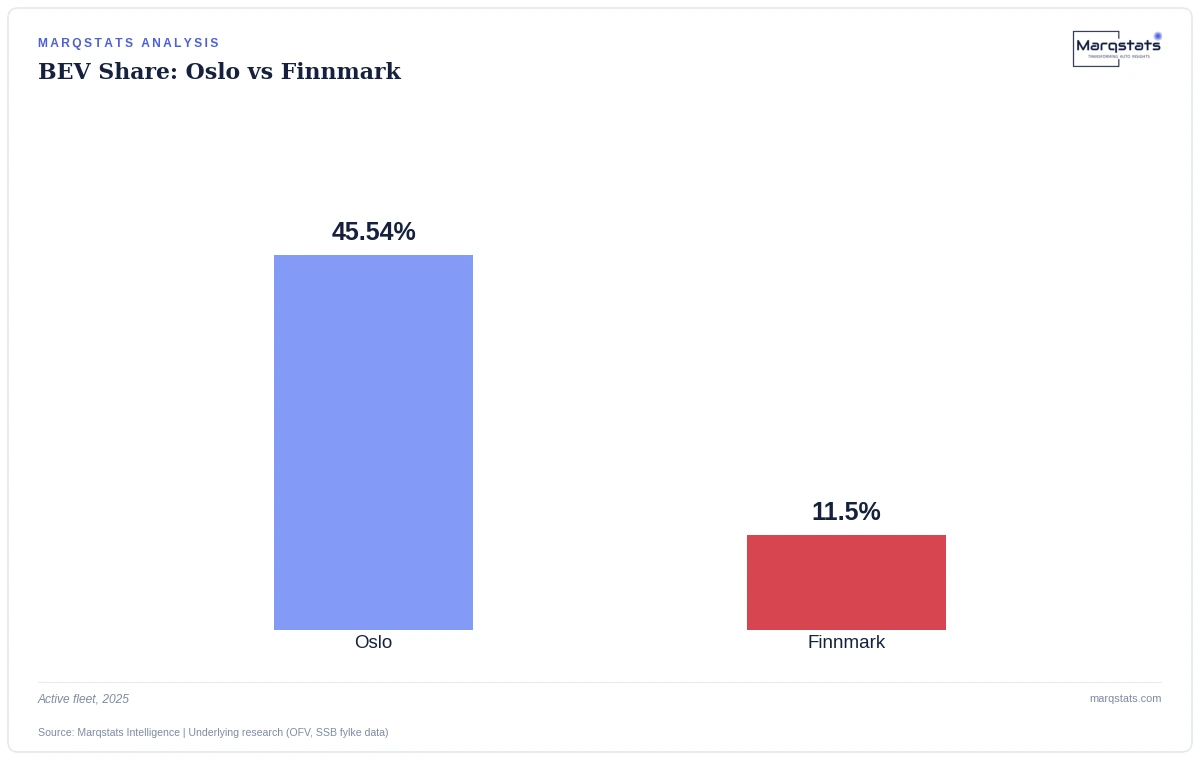
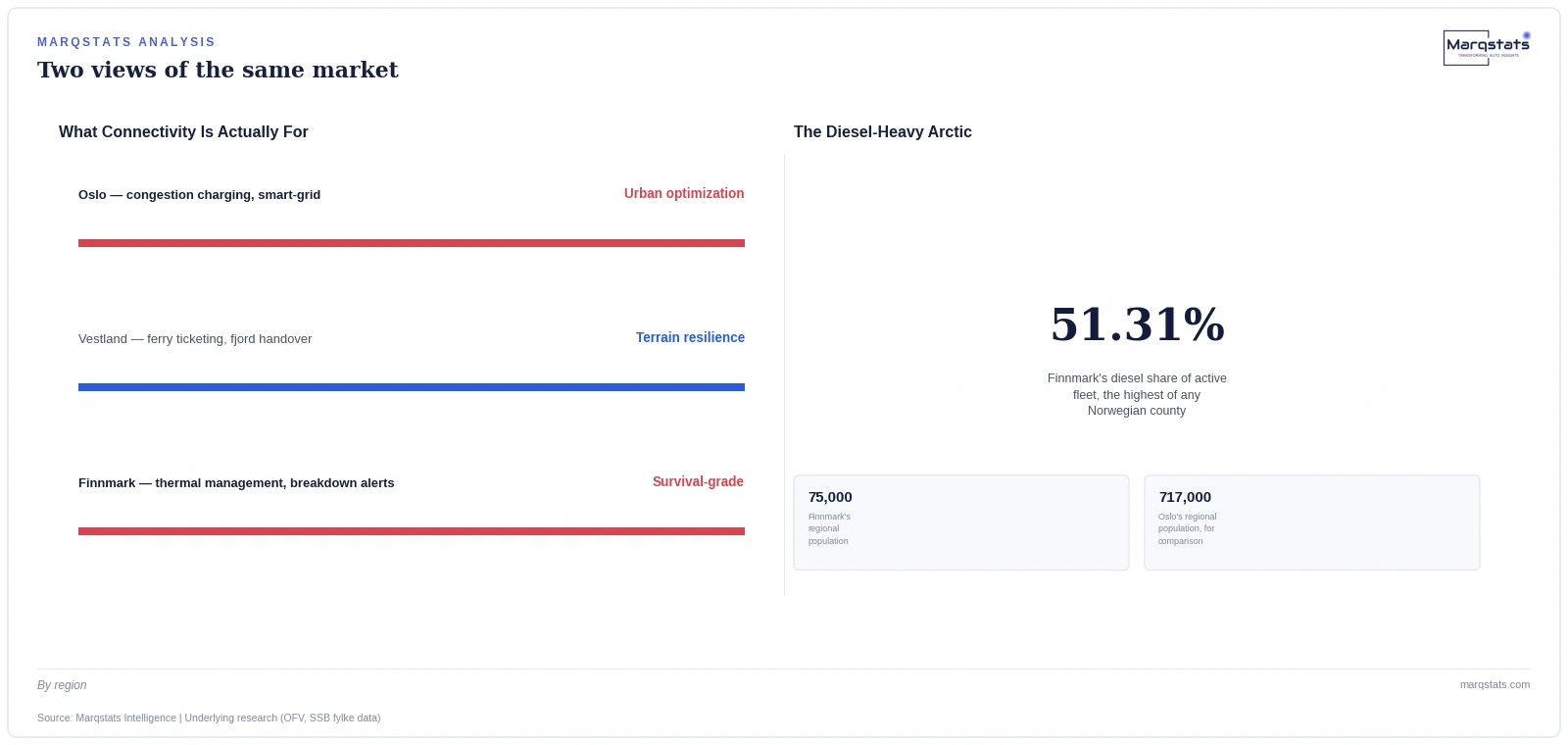
Two Norwegian counties, two entirely different connected-car realities. In Oslo, 45.54% of the active vehicle fleet is already battery-electric, and telematics exists to optimize congestion charging and smart-grid charging schedules. In Finnmark, at the country's Arctic edge, diesel still holds 51.31% of the fleet, and telematics exists to keep a stranded driver from freezing. Same country, same national regulations, two completely different jobs for the same technology.
What Connectivity Actually Does in Oslo
Oslo's connected-vehicle economy is an urban optimization problem. Automated toll cordons, dynamic low-emission-zone monitoring, intelligent curbside parking systems and smart-charging schedules synchronized with the local electrical grid all depend on dense, reliable 5G coverage and a vehicle fleet that is overwhelmingly electric already. This is the Norway most international coverage of the market actually describes — sophisticated, urban, software-forward.
It's the picture that makes for the better headline, too, which is part of why it's the version of Norway most people outside the country actually picture when they hear about the market's electrification story overall and really nothing more at all. It just isn't the whole story, not even close to it.
What Connectivity Actually Does in Finnmark
Finnmark's connected-vehicle economy is a survival problem. Long, isolated corridors between municipalities mean a breakdown can leave a driver genuinely stranded in extreme cold for hours before help arrives. Remote thermal management — keeping a battery from degrading and a cabin from freezing — isn't a convenience feature here, it's why the vehicle still runs at all when temperatures drop far below zero. And because Finnmark's fleet skews older and more diesel-heavy, much of its telematics runs on the network infrastructure that is furthest along toward retirement: Telenor's still-active but scheduled-for-shutdown 2G coverage.
That last detail matters more than it might first appear: Finnmark's vehicles are simultaneously the ones that most need reliable connectivity to survive winter conditions, and the ones most exposed to losing it entirely once Telenor's postponed shutdown eventually arrives. The region facing the hardest operational case for connectivity is also facing the least certain long-term network future.
The Middle Ground: Bergen, Trondheim and the Rest
Between these two extremes sit Norway's other major counties, each with its own specific operational focus rather than a simple midpoint blend. Vestland, home to Bergen, layers ferry-ticketing automation and fjord-terrain cellular handover resilience onto a fleet that is already 38.43% electric. Trøndelag, around Trondheim, hosts active pilot testing of Green Light Optimal Speed Advisory systems — a genuinely different connected-vehicle use case from either Oslo's congestion management or Finnmark's survival telematics.
Akershus, the commuter belt surrounding Oslo itself, sits closest to the capital's own profile — 38.76% BEV share and a connected-vehicle focus on dense V2I deployment along commuter corridors — but even here the emphasis differs slightly, weighted more toward home-to-work routing and 5G network slicing than Oslo's own congestion-charging-first priorities.
Why This Matters for Anyone Selling Into Norway
A telematics provider or OEM building a single national go-to-market message for Norway is already missing the country's actual structure. The pitch that resonates in Oslo — smart-grid integration, congestion-charging automation — has little relevance to a Finnmark buyer deciding whether their next vehicle can survive a winter breakdown on an isolated road.
The practical fix is simple even if it's rarely applied: segment Norwegian go-to-market messaging by regional BEV share rather than treating the country as a single homogeneous Nordic market. A provider that leads with charging-infrastructure integration everywhere is winning in Oslo and losing in Finnmark for the same reason — talking about the wrong problem to the wrong buyer.