350,000 Norwegian Cars Are About to Lose Their Emergency Call Feature
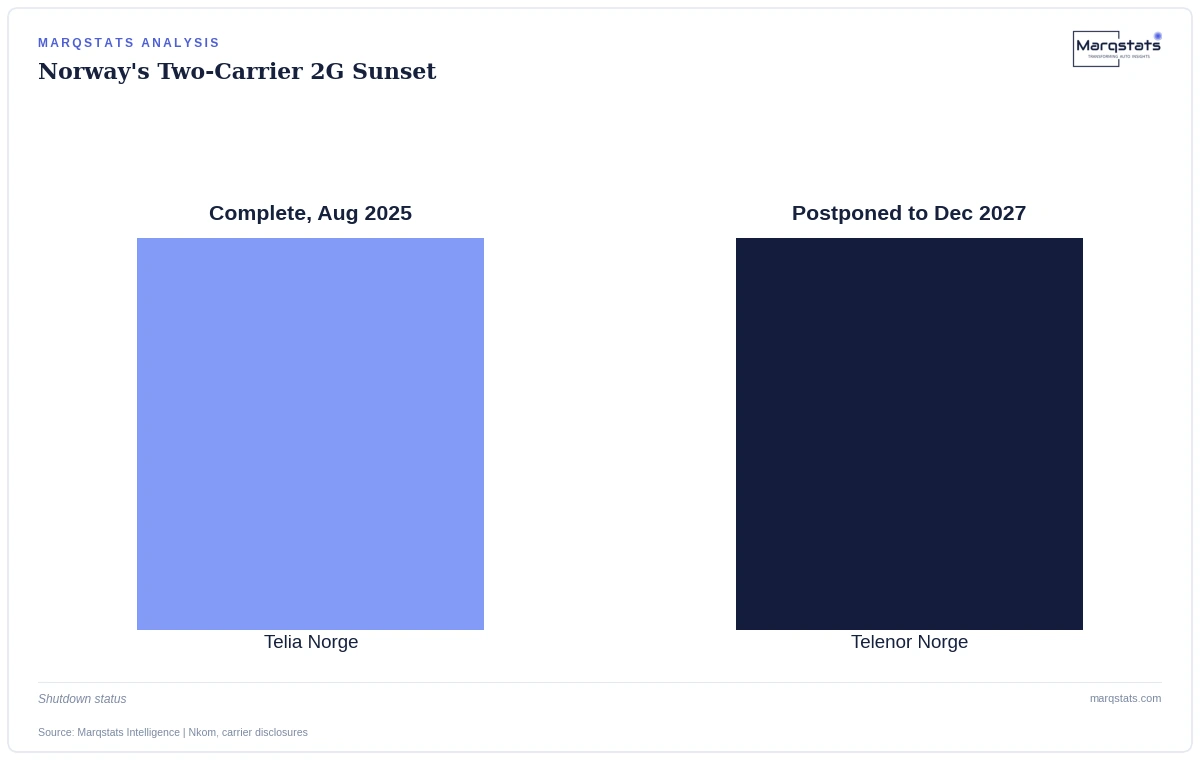
In brief: more than 350,000 Norwegian vehicles built between 2018 and 2021 carry an automated emergency-call system that depends on 2G or 3G circuit-switched connectivity, and cannot be upgraded remotely. Telia Norge has already shut its 2G network down. Telenor Norge, after parliamentary scrutiny, pushed its own shutdown back to 31 December 2027 — but that only delays the problem, it doesn't solve it.
Why This Specific Vehicle Generation Is Exposed
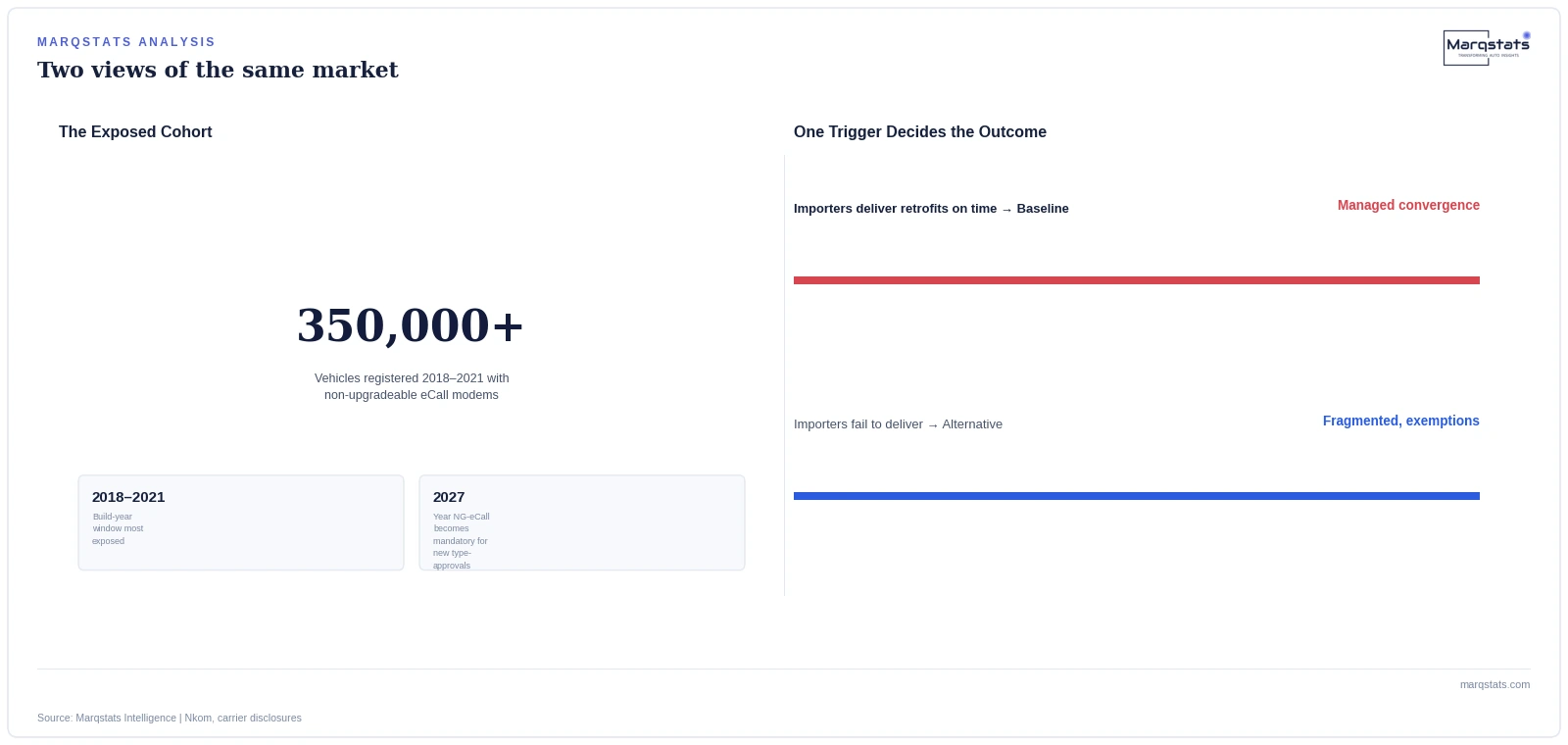
Regulation (EU) 2015/758, incorporated into the EEA framework, mandated automated 112-based eCall on all new type-approved vehicles from March 2018 onward. The original technical specification, based on 2011-era assessments, allowed manufacturers to build these systems on 2G and 3G circuit-switched networks — the dominant standard at the time. Vehicles from that specific window, roughly 2018 through 2021, are the ones now exposed: built to the original spec, too old to have the newer 4G/5G VoLTE-based NG-eCall hardware that becomes mandatory for new type-approvals from 2027 onward specifically.
It's worth being precise about why 2011-era technical assumptions ended up embedded in regulation that took effect in 2018. Drafting a Europe-wide safety mandate takes years, and the underlying eCall specification had to lock in a communication standard well before the regulation itself took legal effect. 2G and 3G were the obvious, universal choice at the time the specification was written — 4G was not yet the dominant automotive standard, and no one drafting the regulation could have precisely predicted exactly when European carriers would begin retiring those networks a decade later.
What Happens When the Network Actually Goes Dark
For an affected vehicle, the failure is total and silent. The eCall modem doesn't degrade gracefully at all — it simply stops transmitting entirely the day its carrier's 2G network shuts off. Automated crash notification, the system's entire purpose, stops working with no dashboard warning most drivers would notice. Remote smartphone-app connectivity, where applicable, stops too. A car that drove perfectly well on the road the day before can no longer call for help automatically if something goes wrong the day after.
That silence is arguably the most dangerous part of the transition. A mechanical fault typically announces itself — a warning light, an unusual sound, a dashboard alert. A dead eCall modem announces nothing at all. The vehicle continues to drive, start, and operate normally in every way a driver would notice, right up until the exact moment an automated emergency call would have mattered and simply doesn't happen.
Telenor's postponement bought Norway time. It didn't buy anyone a solution.
— Marqstats Analyst Team
The Regulatory Dispute Already Brewing
Norway's own research anticipates a genuine compliance conflict once the shutdown actually happens. Periodic Motor Vehicle Inspection (EU-kontroll) rules were not written with a scenario in mind where a vehicle's mandatory safety system becomes technically impossible to operate through no fault of the owner. The research's own Alternative Scenario anticipates the Ministry of Transport and Statens vegvesen having to grant recurring statutory exemptions waiving eCall requirements for the affected model years entirely — a workaround, not a fix, and one that leaves the underlying safety gap fully in place.
A statutory exemption solves the paperwork problem without solving the actual one. It lets a vehicle legally pass its periodic inspection despite lacking functioning eCall, but it does nothing to restore the emergency-call capability itself. Owners in that position are driving legally compliant vehicles that are, in the one specific way this entire system was designed to matter, less safe than they were the year before — a genuinely uncomfortable position for a regulator to formalize, even as the more practical alternative.
Who Actually Has to Act, and By When
Automotive importer groups — Harald A. Møller for Volkswagen Group, Bertel O. Steen among others — are the parties positioned to deliver certified 4G/5G retrofit modules before the December 2027 deadline. Whether they do so at scale, and at a price point owners are willing to pay, is the single variable separating Norway's Baseline Scenario (managed convergence, orderly retrofit) from its Alternative Scenario (fragmented aftermarket dependence, statutory exemptions, and commercial fleets abandoning OEM-embedded systems for independent providers like ABAX).
Importer groups are, in effect, being asked to solve an engineering and logistics problem at national scale with a hard deadline that public pressure has already moved once. There is no obvious reason to assume it cannot move again if retrofit delivery proves harder than currently expected — but each additional postponement extends the window during which this specific vehicle generation drives around with a safety system that everyone involved already knows will eventually fail entirely for good.
Why Commercial Fleets Have More to Lose Than Individual Owners
A private owner losing automated eCall loses a safety net they may never have needed to use. A commercial fleet operator loses something with a harder, more immediate cost: many corporate insurance and duty-of-care policies for company vehicles assume functioning emergency-call capability as a baseline safety standard, particularly for drivers regularly covering long, isolated routes. A fleet that loses this capability across a meaningful share of its vehicles may face genuine insurance or liability exposure well before the individual-consumer side of this specific market feels any comparable pressure.
This is precisely why commercial fleet operators are the population the research's Alternative Scenario expects to move first and fastest toward independent aftermarket providers like ABAX rather than waiting on OEM-embedded retrofit programmes. A fleet manager facing genuine insurance exposure has a much shorter decision timeline than an individual consumer weighing whether to pay for a retrofit on a personally owned vehicle they may replace in a few years anyway.
A Named Comparison: Why France's Shutdown Is Different
France, covered elsewhere in this batch, offers a genuinely useful contrast worth drawing out explicitly. Orange's own 2G shutdown there began roughly a year later than originally announced and is still rolling out region by region through the end of 2026 — a case of a carrier's timeline slipping later than planned. Telenor's situation runs the opposite direction: Norway's carrier proactively postponed its own shutdown, years in advance, specifically in response to parliamentary pressure about exactly this eCall exposure problem. That is a meaningfully more orderly process than France's, even though the underlying vehicle risk — legacy modems that genuinely cannot be upgraded remotely — is structurally identical in both national markets, despite the very different carrier behavior.
That distinction matters for how confident anyone should be in Norway's own Baseline Scenario actually playing out as described. A carrier that proactively manages a politically sensitive shutdown timeline, responding to legislative pressure years ahead of the deadline, is behaving in a way that suggests genuine institutional seriousness about avoiding the Alternative Scenario's worst outcomes — a meaningfully different signal than a carrier whose shutdown has simply slipped due to execution difficulty.
What Insurers Specifically Should Be Watching
An insurer underwriting Norwegian commercial fleet policies has a concrete, near-term reason to track retrofit-module delivery rates directly rather than waiting for the 2027 deadline itself. Building duty-of-care and liability terms around an assumption that automated eCall will remain universally functional through 2027 is a bet on the Baseline Scenario specifically — and policies written today, with multi-year terms, may still be in force when the Alternative Scenario's risks, if they materialize, actually land in practice.
Outlook: One Trigger, Not Three
This market does not support a three-scenario outlook on the eCall exposure question specifically. The single evidenced trigger is whether automotive importers deliver cost-effective, scalable retrofit modules before December 2027 — everything else in the research's own Alternative Scenario follows directly from that one variable failing to happen on time.
A useful test for tracking this going forward: watch for public retrofit-programme announcements from named importer groups specifically, rather than general OEM statements about connectivity roadmaps. A specific, priced, scheduled retrofit programme targeting the exact 2018-to-2021 vehicle cohort would be the clearest possible signal that the Baseline Scenario is actually on track; continued silence on that specific question, as the 2027 deadline approaches, would be the clearest signal the Alternative Scenario is becoming the more likely outcome instead.