Market Snapshot
Middle bar: base-year value × (1 + CAGR), rounded to two decimals. This is a calculated illustration, not a separately researched annual estimate.
The GCC tire market is valued at USD 3,750.62 million in 2025 and is projected to reach USD 5,064.60 million by 2030, registering a CAGR of 6.19% over 2026–2030. The market covers replacement tires for passenger cars, SUVs, light commercial vehicles, trucks and buses across Saudi Arabia, the United Arab Emirates, Kuwait, Qatar, Oman and Bahrain, valued at importer and distributor selling prices. Marqstats estimates 38.91 million tires were sold into a regional parc of 28.40 million vehicles in 2025, and almost all of them were imported, with China supplying 53% of Saudi tire imports by value.
Market size and forecast figures are generated using Marqstats' proprietary estimation framework, updated as of October 2026.
Coverage spans three vehicle types, six source countries and the six GCC member states. The analysis benchmarks 16 tire makers, including Bridgestone Corporation, Compagnie Générale des Établissements Michelin SCA, The Yokohama Rubber Co., Ltd. and Hankook Tire & Technology Co., Ltd., the distributors that represent them, and the PIF and Pirelli joint venture Mena Tyre Company, which plans 3.5 million tires a year at King Abdullah Economic City. Reference sizes include 265/65R17 and 285/60R18 on SUVs and pickups, 205/55R16 on sedans and 315/80R22.5 on trucks.
Key Takeaways
Market Overview & Analysis
Report Summary
The GCC tire market comprises new replacement tires for passenger cars, SUVs, pickups, vans, trucks and buses sold in Saudi Arabia, the United Arab Emirates, Kuwait, Qatar, Oman and Bahrain, valued at USD 3,750.62 million in 2025 at importer and distributor selling prices. Vehicles arrive in the region already fitted with tires, so the market is a replacement market served by imports. Off-the-road, agricultural and motorcycle tires, retreads, used tires and tires re-exported from UAE free zones to markets outside the GCC sit outside the market perimeter. Marqstats estimates 38.91 million tires were sold in 2025, rising to 46.54 million by 2030.
The vehicle parc sets the scale of demand. The General Authority for Statistics (GASTAT) counts 15.88 million vehicles in Saudi Arabia in 2024, up 6.9%, including 13.8 million passenger vehicles and 2.0 million commercial vehicles, and Marqstats estimates 16.38 million for 2025. The UAE counted about 4.56 million active registered vehicles in June 2025, Kuwait 2,814,775 in 2024 and Oman 1,753,872 at the end of 2024. Marqstats estimates the GCC parc at 28.40 million vehicles in 2025 and 33.58 million by 2030.
Trade data anchors the value. Saudi Arabia imported about USD 1.6 billion of new pneumatic tires in 2023, including USD 763 million of car tires and USD 698 million of bus and truck tires, with China supplying 53%, Japan 12.2%, South Korea 9.73% and Thailand 9.12%. The UAE imported USD 1.17 billion and exported USD 1.12 billion in 2023, led by shipments to Iraq, which confirms its role as a regional re-export hub. Marqstats values passenger car and SUV tires at an estimated USD 63.96 per tire in 2025, light commercial vehicle tires at USD 118.19 and truck and bus tires at USD 236.39 at distributor selling prices.
Local production begins with the PIF and Pirelli joint venture. Mena Tyre Company, owned 75% by the Public Investment Fund and 25% by Pirelli & C. S.p.A., awarded an estimated SR628 million (USD 167 million) construction contract to Saudi Amana in September 2025 for a plant of about 3.5 million tires a year at King Abdullah Economic City, with production expected from 2026. Saudi Basic Industries Corporation (SABIC) agreed in February 2026 to supply polybutadiene rubber and carbon black for the plant. Truck tire pricing and fleet benchmarks from the US market are covered in the Marqstats US Commercial Truck Tire Market analysis.
Market Dynamics
Key Drivers
Five factors expand GCC tire demand faster than the vehicle parc.
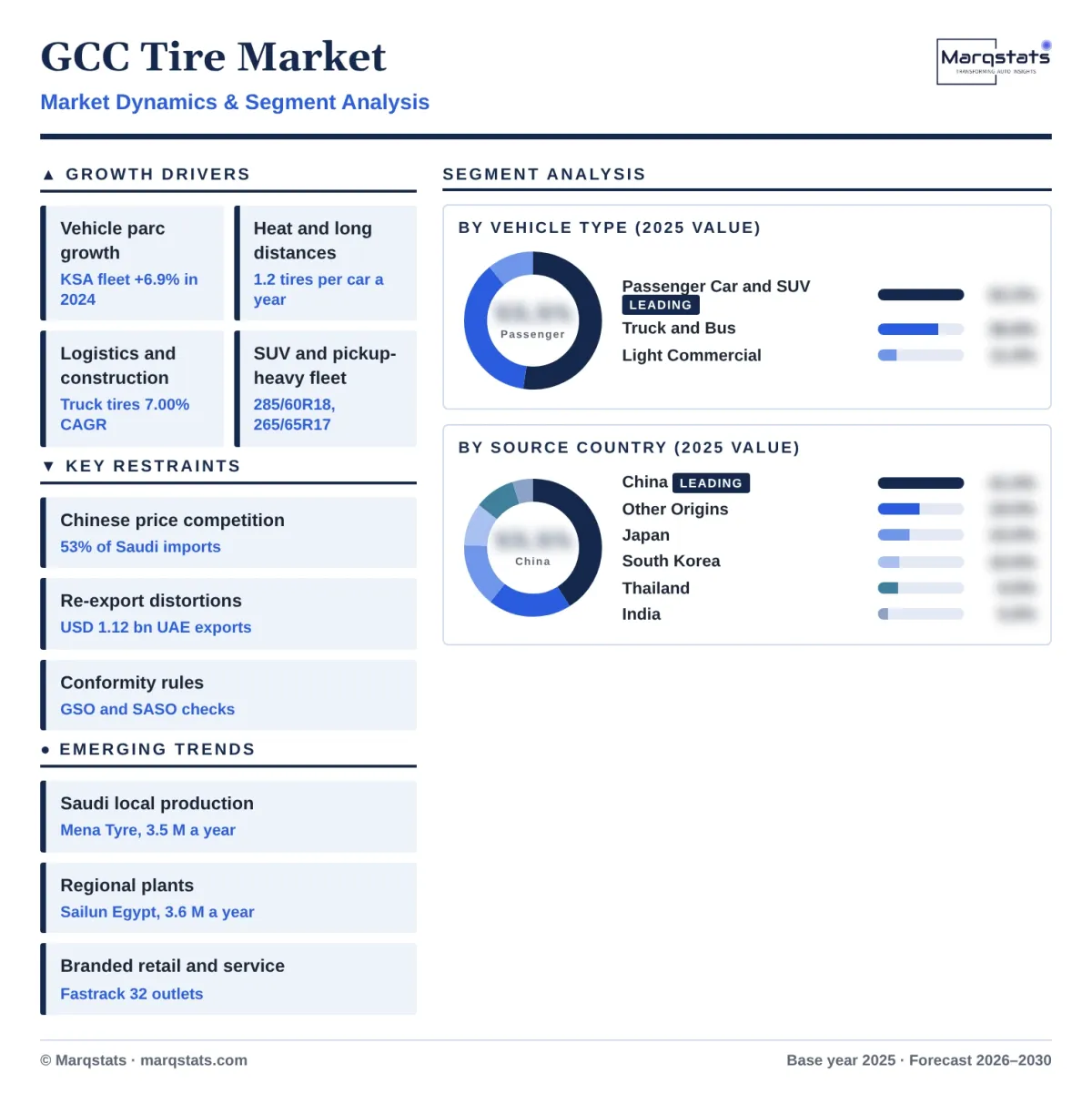
- Vehicle parc growth. Saudi Arabia's vehicle fleet grew 6.9% to 15.88 million in 2024, and UAE active registered vehicles rose 9.35%, or about 390,000, to some 4.56 million in the year to June 2025. Saudi new vehicle sales rose 2.80% to 827,544 in 2025. Marqstats projects the GCC parc to reach 33.58 million vehicles by 2030, adding replacement demand each year. Kuwait, Qatar, Oman and Bahrain add a combined 7.46 million vehicles in 2025, and each new car joins the replacement pool within two to three years.
- Heat and long distances. Summer air temperatures near 50°C, hot road surfaces, sand and long highway trips speed up tread wear and rubber aging across the region. Marqstats estimates replacement at 1.2 tires per passenger vehicle a year, above the rate in temperate markets. Drivers on routes such as Riyadh to Dammam or Dubai to Abu Dhabi cover high annual distances at sustained speed. Heat also raises tire pressure and sidewall stress, which leads many drivers to replace tires by age as well as by tread depth.
- Logistics and construction freight. Saudi Vision 2030 projects, port expansion and cross-border freight raise truck and bus activity across the region. Truck and bus tire units rise from 5.68 million in 2025 to 7.39 million by 2030, and the segment grows at a 7.00% CAGR. Fleets running 315/80R22.5 steer and drive tires and 385/65R22.5 trailer tires replace tires several times a year on high-mileage routes. Truck and bus tires carry the highest prices per tire in the market, so freight growth lifts value faster than units.
- SUV and pickup-heavy fleet. GCC buyers favor SUVs and pickups such as the Toyota Land Cruiser and Hilux, which run larger sizes such as 285/60R18 and 265/65R17. Larger sizes carry higher prices per tire than sedan sizes such as 205/55R16. The light commercial vehicle segment grows at a 6.87% CAGR to USD 576.45 million by 2030. Off-road and desert driving on weekends adds wear on all-terrain tires fitted to these vehicles.
- Population and tourism growth. Expatriate inflows, tourism programs and new cities raise car ownership and daily traffic around Riyadh and Dubai. The UAE registered 801,857 vehicles in 2024, including 484,223 in Dubai. The UAE grows fastest at a 7.81% CAGR. Growth in ride-hailing and rental fleets adds high-mileage cars that replace tires more often than private cars.
Key Restraints
Four constraints shape pricing and supply in the GCC tire market.
- Price competition from Chinese imports. China supplied 53% of Saudi tire imports by value in 2023, about USD 864 million, and 22% of UAE imports. Low-cost Chinese brands hold down average prices, and Marqstats values passenger car and SUV tires at only USD 63.96 per tire in 2025. Price-led buying limits premium brand share among taxi, ride-hailing and small fleet buyers. Premium brands answer with second brands and mid-tier lines to protect volume against low-cost imports.
- Re-export distortions. The UAE exported USD 1.12 billion of tires in 2023 against USD 1.17 billion of imports, with Iraq taking 15.8%, Pakistan 8.16% and Yemen 5.73% of exports. Traders stock tires for markets outside the GCC, which complicates inventory planning and price discipline in the domestic channel. Re-export trade also brings parallel imports of global brands outside authorized distribution, which pressures prices for official partners.
- Conformity and labelling rules. Each GCC state enforces Gulf Standardization Organization (GSO) conformity, labelling and production date checks, and Saudi Arabia applies Saudi Standards, Metrology and Quality Organization (SASO) rules. New suppliers must register products country by country, which raises entry cost and slows launches of new sizes. Conformity rules also protect buyers from aged or poorly stored tires, which favors suppliers with local warehouses and fast stock turns.
- Working capital and credit. Distributors hold large stocks across hundreds of sizes to serve dealers in each country, and dealers expect credit terms. Inventory and receivable days tie up capital, and suppliers without a strong local partner struggle to match the fill rates of established distributors. Large distributors with bank lines and multi-country warehouses hold an advantage over new entrants on credit and availability.
Key Trends
Four shifts are changing how tires are made, sourced and sold in the GCC.
- Local tire production in Saudi Arabia. Mena Tyre Company plans about 3.5 million tires a year at King Abdullah Economic City under Pirelli and a new local brand, with SABIC supplying rubber and carbon black from February 2026 and a supply MoU signed with Hyundai Motor Manufacturing Middle East. Blatco signed a partnership with Kumho Tire Co., Inc. and Misong Tech in February 2025 for a second Saudi tire project. Local output gives fleet buyers and automakers assembling in Saudi Arabia a domestic source with shorter lead times.
- Regional plants for nearby supply. Sailun Group Co., Ltd. broke ground in Egypt in September 2025 on a USD 291 million plant planned for 3.6 million tires a year, targeting Africa, the Middle East and Europe. Regional plants shorten lead times to GCC distributors against shipments from China and Southeast Asia. Chinese, Indian and Southeast Asian suppliers compete to serve GCC importers from several factory countries at once.
- Branded retail and fleet service. Distributors build branded service formats such as TyrePlus and Michelin truck service centers at Juffali, and Bridgestone's FirstStop and Truck Tyre Center models. Juma Al Majid renewed its Fastrack partnership in February 2025, reaching 32 outlets. Branded networks add fitting, alignment and fleet services to tire sales. Service formats also raise customer retention, since fleets and drivers return to the same outlet for each change.
- Indian supplier growth. Indian-made tires grow from 5.00% to 6.00% of value by 2030, the fastest at a 10.14% CAGR. Apollo Tyres Ltd., CEAT Limited and Balkrishna Industries Limited offer truck, light truck and off-the-road ranges to GCC importers as a mid-price alternative to Japanese and Korean brands. Indian makers also supply truck tires suited to high-load and long-haul duty on regional freight routes.
Market Segmentation
Passenger car and SUV tires account for an estimated USD 1,958.44 million, or 52.21% of 2025 value, and are projected to reach USD 2,554.70 million by 2030 at a 5.46% CAGR. The segment covers 29.82 million tires in 2025 at an estimated USD 63.96 per tire, with common sizes including 205/55R16 and 215/55R17 on sedans and 265/65R17 and 285/60R18 on SUVs. Share eases to 50.44% by 2030 as commercial fleets grow faster. Units rise from 29.82 million in 2025 to 34.86 million by 2030 as the passenger parc grows.
Light commercial vehicle tires account for an estimated USD 413.58 million, or 11.03% of 2025 value, and are projected to reach USD 576.45 million by 2030 at a 6.87% CAGR. The segment covers 3.41 million tires for pickups and vans in 2025 at USD 118.19 per tire, with sizes such as 265/70R16 and 195R15C used on delivery and contractor vehicles. Last-mile delivery and construction work lift demand. Units rise from 3.41 million in 2025 to 4.30 million by 2030.
Truck and bus tires account for an estimated USD 1,378.60 million, or 36.76% of 2025 value, and are projected to reach USD 1,933.45 million by 2030 at a 7.00% CAGR, the fastest vehicle type. An estimated 5.68 million tires were sold in 2025 at USD 236.39 per tire, led by 315/80R22.5, 12R22.5 and 385/65R22.5 sizes. Saudi Arabia imported USD 698 million of bus and truck tires in 2023. Units rise from 5.68 million in 2025 to 7.39 million by 2030 as freight fleets expand.
Chinese-made tires account for an estimated USD 1,537.76 million, or 41.00% of 2025 value, and are projected to reach USD 2,127.13 million by 2030 at a 6.70% CAGR. China supplied 53% of Saudi tire imports by value in 2023 and 22% of UAE imports, led by producers such as Zhongce Rubber Group Co., Ltd., Sailun Group Co., Ltd. and Shandong Linglong Tyre Co., Ltd. Share rises to 42.00% by 2030. Chinese suppliers also ship to the GCC from plants in Thailand, Vietnam and Malaysia, which appear under those origins in trade data.
Japanese-made tires account for an estimated USD 562.59 million, or 15.00% of 2025 value, and are projected to reach USD 658.40 million by 2030 at a 3.20% CAGR. Japan supplied 12.2% of Saudi and 21% of UAE tire imports in 2023, led by Bridgestone, Yokohama, Toyo and Sumitomo Rubber brands. Share falls to 13.00% by 2030 as buyers trade down. Japanese brands hold strong positions in SUV and pickup sizes on Toyota and Nissan fleets.
South Korean-made tires account for an estimated USD 375.06 million, or 10.00% of 2025 value, and are projected to reach USD 481.14 million by 2030 at a 5.11% CAGR. South Korea supplied 9.73% of Saudi and 10% of UAE tire imports in 2023, led by Hankook, Kumho and Nexen. Korean brands sponsor regional sports to build awareness, as Hankook does with Saudi club Al-Ittihad.
Thai-made tires account for an estimated USD 356.31 million, or 9.50% of 2025 value, and are projected to reach USD 455.81 million by 2030 at a 5.05% CAGR. Thailand supplied 9.12% of Saudi and 9.35% of UAE tire imports in 2023, from plants run by global and Chinese tire makers. Thai plants supply both global and Chinese brands at mid-tier prices.
Indian-made tires account for an estimated USD 187.53 million, or 5.00% of 2025 value, and are projected to reach USD 303.88 million by 2030 at a 10.14% CAGR, the fastest source country. India supplied 3.45% of Saudi and 6.73% of UAE tire imports in 2023. Indian truck and light truck tires gain share among fleets that want lower prices than Japanese and Korean brands.
Other origins, including Europe, Indonesia, Vietnam, Turkey and, from 2026, Saudi domestic production, account for an estimated USD 731.37 million, or 19.50% of 2025 value, and are projected to reach USD 1,038.24 million by 2030 at a 7.26% CAGR. Mena Tyre Company output from King Abdullah Economic City enters this group as the plant ramps up. European premium brands from Germany, Poland and Italy also sit in this group.
By Geography
Saudi Arabia
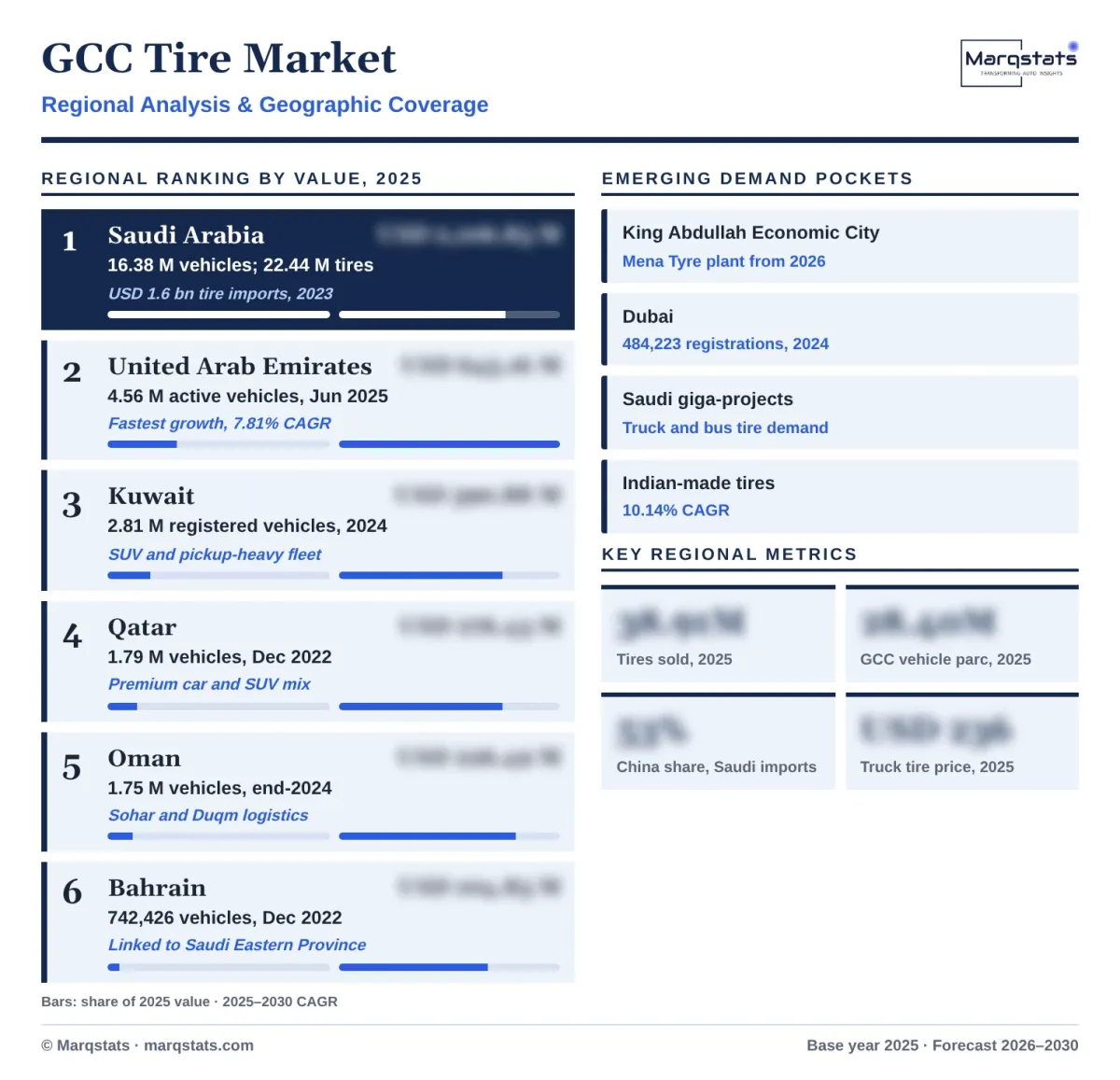
Saudi Arabia is the largest market, accounting for 56.17% of 2025 value, or USD 2,106.83 million, rising to USD 2,800.22 million by 2030 at a 5.86% CAGR. An estimated 22.44 million tires were sold in 2025 into a fleet of about 16.38 million vehicles, and the country imported about USD 1.6 billion of tires in 2023. E.A. Juffali & Brothers has represented Michelin since 1961 through a joint venture since 2002, and Bin Shihon states exclusive distribution for Hankook. Riyadh, Jeddah and the Eastern Province hold most of the fleet, and Vision 2030 giga-projects lift truck tire demand on construction routes.
United Arab Emirates
The United Arab Emirates accounts for 17.20% of 2025 value, or USD 645.16 million, and grows fastest at a 7.81% CAGR to USD 939.48 million by 2030. Active registered vehicles reached about 4.56 million in June 2025, up 9.35%, and the country registered 801,857 vehicles in 2024. Bridgestone Middle East and Africa runs a 23,040 square meter warehouse in Dubai, Al Masaood marked 50 years as Bridgestone's Abu Dhabi distributor in 2024, and Juma Al Majid distributes Yokohama. Dubai's role as a trading hub brings in stock for both domestic sale and re-export, and Marqstats counts only tires fitted to UAE-registered vehicles.
Kuwait
Kuwait accounts for 10.42% of 2025 value, or USD 390.88 million, and is projected to reach USD 517.02 million by 2030 at a 5.75% CAGR. The country counted 2,814,775 registered vehicles in 2024, among the highest vehicle densities in the region, and an estimated 3.97 million tires were sold in 2025. Large SUVs and pickups make up a high share of the fleet, which raises value per tire.
Qatar
Qatar accounts for 7.37% of 2025 value, or USD 276.43 million, and is projected to reach USD 365.63 million by 2030 at a 5.75% CAGR. The country counted 1,787,996 registered vehicles in December 2022, and an estimated 2.68 million tires were sold in 2025 into a fleet heavy in SUVs and premium cars. Infrastructure built for the 2022 FIFA World Cup expanded the bus and logistics fleet that now needs replacement tires.
Oman
Oman accounts for 6.04% of 2025 value, or USD 226.49 million, and is projected to reach USD 306.92 million by 2030 at a 6.27% CAGR. The National Centre for Statistics and Information counted 1,753,872 registered vehicles at the end of 2024, and port and logistics corridors at Sohar and Duqm add truck tire demand. Long intercity distances between Muscat, Sohar and Salalah raise annual mileage per vehicle.
Bahrain
Bahrain accounts for 2.80% of 2025 value, or USD 104.83 million, and is projected to reach USD 135.33 million by 2030 at a 5.24% CAGR. The country counted 742,426 registered vehicles in December 2022, and the King Fahd Causeway links its tire distributors to the Saudi Eastern Province. Bahrain is the smallest GCC market by fleet size and relies on Saudi and UAE distributors for much of its stock.
How Competition Is Evolving
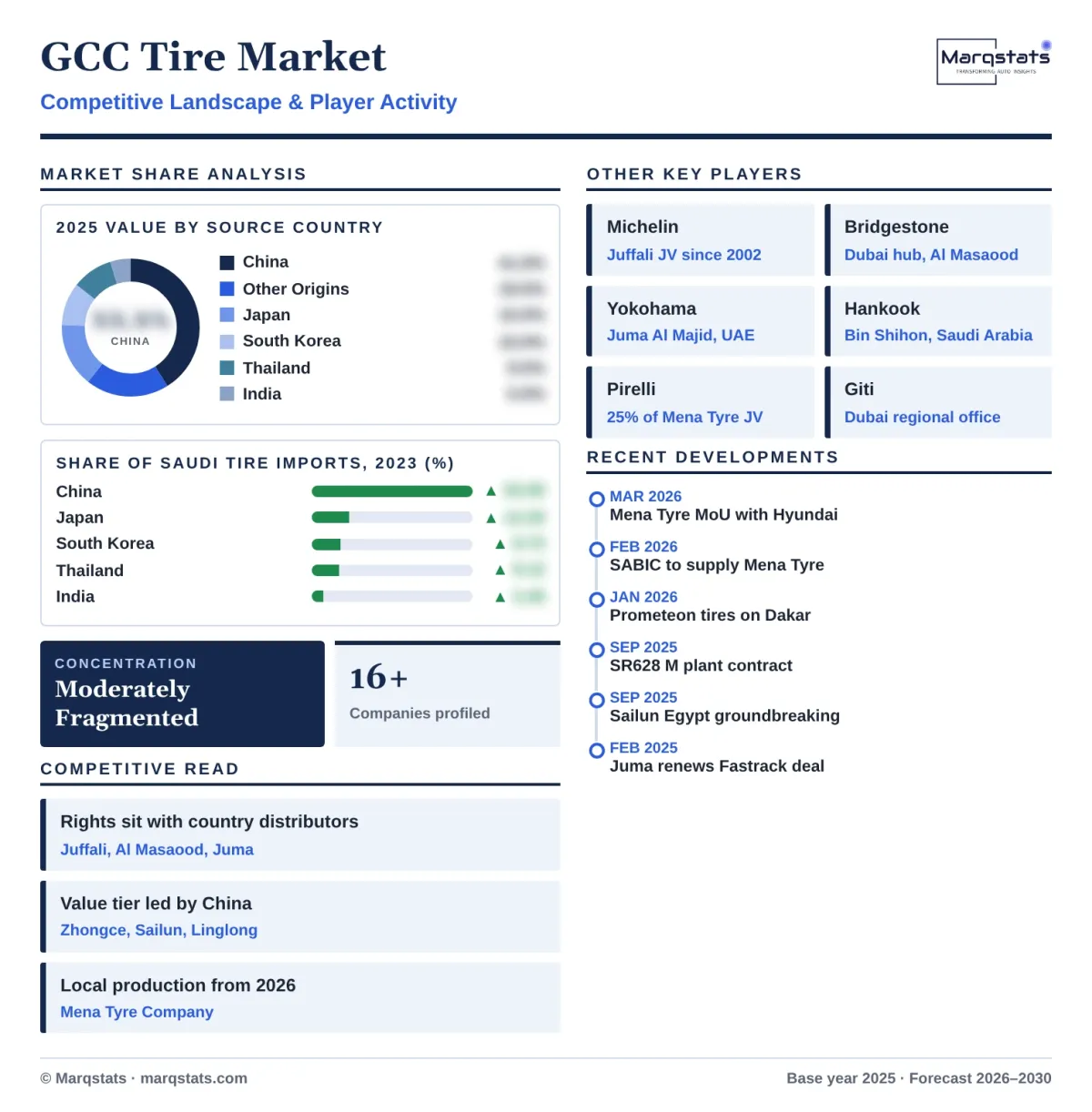
The GCC tire market is moderately fragmented, with global brands sold through long-standing family distributors and a wide range of Chinese, Thai and Indian brands sold through importers and independent dealers. Bridgestone Corporation, Compagnie Générale des Établissements Michelin SCA, The Yokohama Rubber Co., Ltd., Hankook Tire & Technology Co., Ltd., Toyo Tire Corporation and Sumitomo Rubber Industries, Ltd. hold the leading premium positions, while Zhongce Rubber Group Co., Ltd., Sailun Group Co., Ltd., Shandong Linglong Tyre Co., Ltd. and Giti Tire Pte. Ltd. lead the value tier.
Distribution rights define competition. Distributors hold country and category rights rather than GCC-wide rights, so a brand often works with a different partner in each state, as Bridgestone does with Al Masaood in Abu Dhabi and its own Dubai logistics hub. Juffali combines Michelin, BFGoodrich and Tigar brands with TyrePlus retail and truck service centers in Saudi Arabia, and Juma Al Majid reaches 32 Fastrack outlets in the UAE. Giti runs a Dubai regional office with a dealer and fleet model. Hankook works with Bin Shihon in Saudi Arabia, and Yokohama with Juma Al Majid in the UAE.
Local production changes the competitive frame from 2026. Mena Tyre Company, the PIF and Pirelli joint venture, plans about 3.5 million tires a year under Pirelli and a new local brand, and Blatco is developing a separate Saudi project with Kumho Tire Co., Inc. Chinese suppliers add plants outside China, such as Sailun's Egypt project, which shortens supply routes to the region. Dealer channels for replacement tires are covered in the Marqstats US Tire Dealer Market report.
Companies Covered
Companies covered in the report include:
Recent Market Activity
Table of Contents
Coverage & Segmentation
The GCC tire market comprises new replacement tires for passenger cars, SUVs, light commercial vehicles, trucks and buses sold in Saudi Arabia, the United Arab Emirates, Kuwait, Qatar, Oman and Bahrain, valued at importer and distributor selling prices in US dollars. The market excludes off-the-road, agricultural and motorcycle tires, retreads, used tires, fitting and service revenue, and tires re-exported outside the GCC. Coverage uses a 2025 base year, a 2021–2025 historical period and a 2026–2030 forecast period, with 2026 as the estimated year. The US replacement tire market is covered in the Marqstats US Replacement Tire Market report.
Segmentation covers three vehicle types, six source countries and six GCC member states, with 16 tire makers profiled. Units follow the vehicle parc by country and class and annual replacement rates, and value applies distributor selling prices per tire derived from customs import values, with sizes such as 205/55R16, 265/65R17, 285/60R18 and 315/80R22.5 tracked as reference sizes. Tires for electric cars, a growing share of new GCC registrations, are covered in the Marqstats Electric Vehicle Tire Market report.