Market Snapshot
Middle bar: base-year value × (1 + CAGR), rounded to two decimals. This is a calculated illustration, not a separately researched annual estimate.
The Saudi Arabia OTR tire market is valued at USD 236.87 million in 2025 and is projected to reach USD 320.11 million by 2030, registering a CAGR of 6.21% over 2026–2030. The market covers new pneumatic off-the-road (OTR) tires for wheeled mining, quarrying, construction and industrial handling equipment in the Kingdom, valued at importer and distributor selling prices. Marqstats estimates 222,510 OTR tires were sold in 2025, rising to 268,078 by 2030, as valid mining licenses grew 21.8% to 2,925 in 2025 and Saudi Arabian Mining Company (Maaden) moves Phosphate 3 Phase 1 toward commissioning at the end of 2026.
Market size and forecast figures are generated using Marqstats' proprietary estimation framework, updated as of October 2026.
Coverage spans five equipment types, four applications, two tire constructions and five regions of the Kingdom. The analysis benchmarks 16 OTR tire makers, including Compagnie Générale des Établissements Michelin SCA, Bridgestone Corporation, The Yokohama Rubber Co., Ltd. and Balkrishna Industries Limited, and tracks fitment sizes such as 27.00R49 and 33.00R51 on rigid haul trucks, 29.5R25 on articulated haulers, 23.5R25 and 26.5R25 on wheel loaders and 17.5R25 on graders. Solid tires, crawler tracks and OTR retreading sit outside the market.
Key Takeaways
Market Overview & Analysis
Report Summary
The Saudi Arabia OTR tire market comprises new pneumatic tires for rigid and articulated haul trucks, wheel loaders, wheeled dozers, backhoe loaders, motor graders, mobile cranes, telehandlers, forklifts and port handling equipment, valued at USD 236.87 million in 2025 at importer and distributor selling prices. Solid and cushion tires, crawler tracks, OTR repair and retreading, agricultural tires and on-road truck tires sit outside the market perimeter. Machines arrive in the Kingdom fitted with tires, so the market is a replacement market served by imports. Marqstats estimates 222,510 tires were sold in 2025.
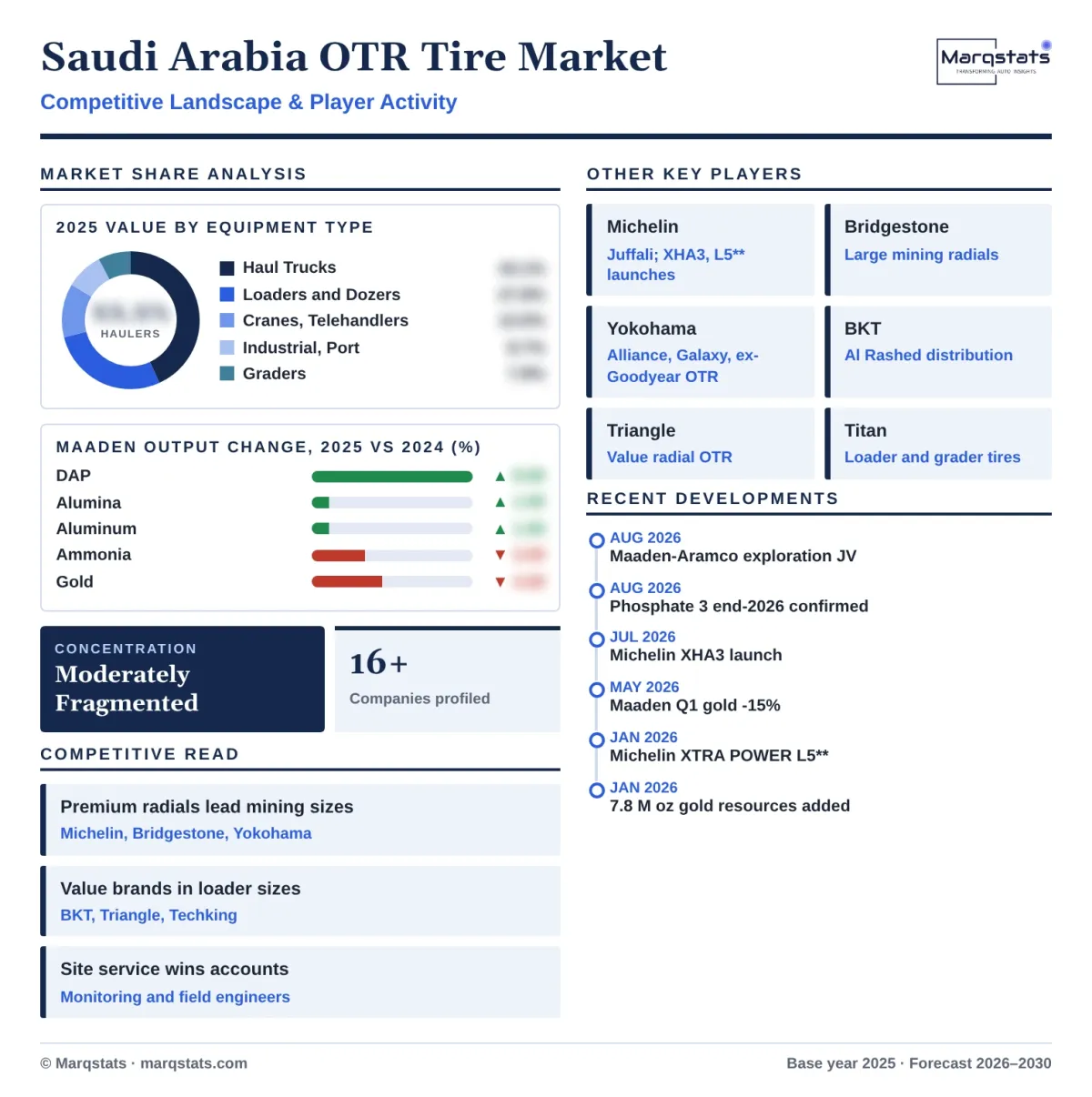
Mining activity anchors the highest-value demand. The Ministry of Industry and Mineral Resources reported 2,925 valid mining licenses in 2025, up from 2,401 in 2024, and mining-sector investment of SAR 189.4 billion. Maaden produced 6.723 million tonnes of diammonium phosphate in 2025, up 9%, 1.891 million tonnes of alumina, up 1%, 0.999 million tonnes of aluminum, up 1%, 3.008 million tonnes of ammonia, down 3%, and 478 thousand ounces of gold, down 4%. Maaden guided 2026 capital spending of about USD 4.15 billion, including USD 3.35 billion for growth, and USD 400 million for exploration.
Haul trucks carry the largest value pool. Marqstats estimates a wheeled haul truck fleet of about 1,800 rigid and articulated trucks in Saudi mines, quarries and earthworks, using 11,340 tires in 2025 at an average of USD 9,000 per tire, for USD 102.06 million of value. Wheel loaders, wheeled dozers and backhoe loaders add USD 65.78 million on 57,200 tires, while industrial and port handling equipment uses 121,600 tires, more than half of all units, at USD 170 per tire for USD 20.67 million. Graders add USD 18.52 million on 14,820 tires, and cranes and telehandlers add USD 29.84 million on 17,550 tires.
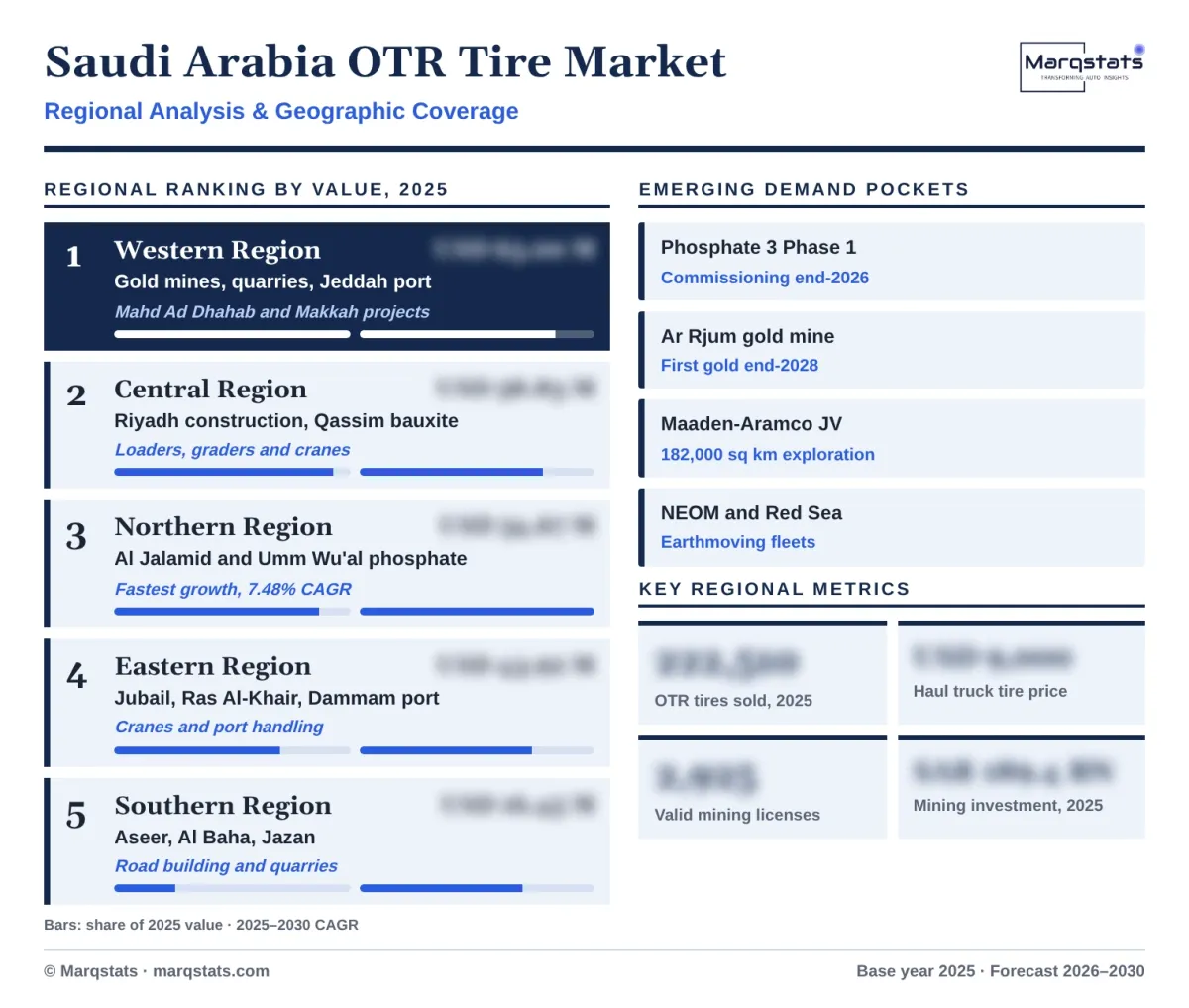
Project timing shapes the forecast. Maaden retained end-2026 commissioning for Phosphate 3 Phase 1 and end-2028 first gold for the Ar Rjum mine in August 2026, and agreed a conditional exploration joint venture with Saudi Arabian Oil Company (Aramco) covering about 182,000 square kilometers. Gold output fell 15% to 105 thousand ounces in Q1 2026 as two smaller mines were temporarily suspended, showing that fleet utilization moves with mine operations. Saudi road tire demand is covered in the Marqstats Saudi Arabia Tire Market report.
Market Dynamics
Key Drivers
Five factors lift OTR tire demand in Saudi Arabia faster than the wider tire market.
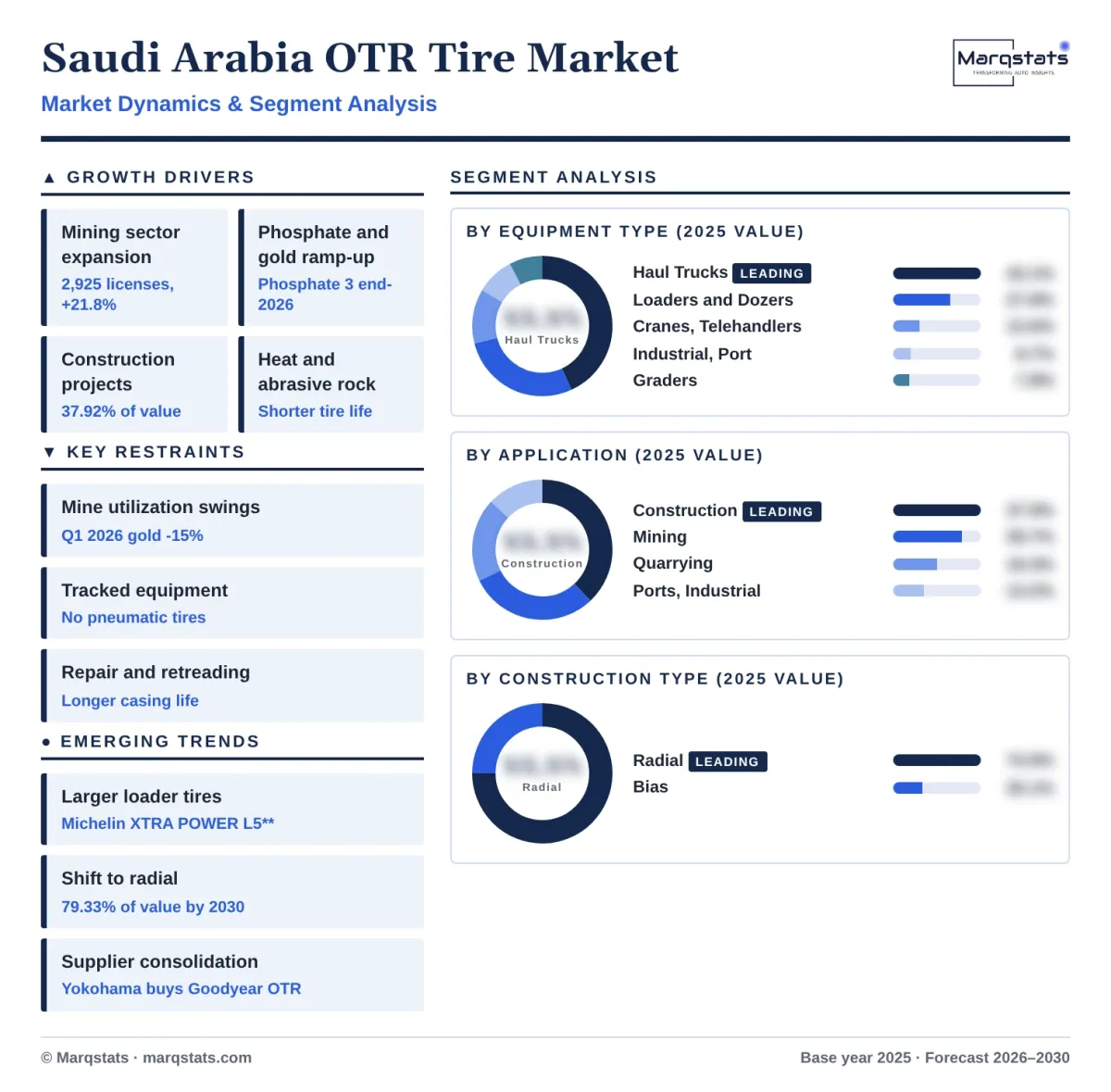
- Mining sector expansion. Valid mining licenses rose 21.8% to 2,925 in 2025, and mining-sector investment reached SAR 189.4 billion as the Kingdom builds mining into a third pillar of industry. Maaden added 7.8 million ounces of gold resources across four areas in January 2026. Each new operating mine adds haul trucks, loaders and graders that consume OTR tires every year. Exploration spending of USD 400 million guided by Maaden for 2026 builds the pipeline of future mines that will need haulage fleets.
- Phosphate and gold project ramp-up. Maaden expects Phosphate 3 Phase 1 to commission at the end of 2026 and Ar Rjum to pour first gold at the end of 2028. Phosphate mining moves large volumes of overburden and ore with rigid haul trucks on 27.00R49 and larger tires. Haul truck tire value grows at a 7.10% CAGR, the fastest equipment type, to USD 143.81 million by 2030. Phosphate 3 also adds processing capacity at Ras Al-Khair, which raises port and industrial handling activity in the Eastern Region.
- Construction and infrastructure projects. Vision 2030 projects, housing, roads, rail and industrial cities keep large fleets of wheel loaders, graders, backhoe loaders and cranes at work. Construction and infrastructure is the largest application at 37.92% of 2025 value, or USD 89.82 million. Construction operating revenues rose 9.6% in 2024. Mobile cranes on 385/95R25 and 445/95R25 tires and telehandlers on 405/70-24 tires work across these sites, adding demand in the cranes and telehandlers segment.
- Quarrying for aggregates and cement. Construction demand pulls aggregates, limestone and cement raw materials from quarries near Riyadh, Jeddah and the Eastern Province. Quarry wheel loaders on 23.5R25 and 26.5R25 tires and articulated haulers on 29.5R25 tires face sharp rock and heavy loads, which raise cut damage and tire use. Quarrying and aggregates accounts for USD 45.63 million in 2025. Quarry operators often run tires to the casing on short, rough haul cycles, which shortens replacement intervals.
- Heat and abrasive operating conditions. Summer air temperatures near 50°C, hot haul roads and abrasive rock raise tire operating temperatures and shorten service life. Haul truck tires reach their heat limit on long, loaded haul cycles, which forces operators to slow trucks or buy tires with higher heat ratings. Replacement demand per machine is higher than in temperate mining regions. Operators respond by fitting heat-resistant compounds and monitoring tire temperature and pressure on haul trucks.
Key Restraints
Four constraints hold OTR tire growth below the pace of announced project spending.
- Mine utilization swings. Maaden's gold output fell 4% to 478 thousand ounces in 2025 and 15% to 105 thousand ounces in Q1 2026, with two smaller mines temporarily suspended. Idle or lightly used fleets buy fewer tires, so tire demand follows operating hours rather than capital budgets. Contract miners also shift fleets between sites, which changes regional tire demand from year to year.
- Tracked equipment and fixed plant. Much mining and construction spending goes into crawler excavators, crawler dozers, crushers and processing plants that use no pneumatic tires. Exploration licenses and early project phases add little tire demand until haulage starts, which delays the effect of the 2,925 licenses on tire volume. Crawler equipment also competes with wheeled loaders in soft ground and steep terrain.
- High tire prices and supply risk. Large mining tires such as 33.00R51 and 40.00R57 carry high prices and long lead times from a small number of plants. Operators hold spare stock to avoid downtime, which ties up capital and slows replacement purchases when budgets tighten. Price competition from Chinese and Indian radial OTR tires helps operators manage cost in loader and grader sizes.
- Repair and retreading. Operators repair cuts and retread large casings to extend tire life, which lowers new tire purchases per machine. Regional service providers such as Al Dobowi offer OTR retreading in Saudi Arabia and the UAE, and repaired casings compete with new tires on cost per hour. Repair and retreading are strongest in large haul truck sizes, where a new tire costs several thousand dollars.
Key Trends
Four shifts are changing how OTR tires are specified, bought and managed in Saudi Arabia.
- Larger and stronger loader tires. Michelin launched the XTRA POWER L5** in 26.5R25 in January 2026 for high-capacity loaders in mines and quarries, and the XHA3 construction tire in July 2026, which Michelin estimates cuts total cost of ownership about 16% against its predecessor with up to 20% more load capacity in specified 23.5R25 uses. Larger loaders raise tire value per machine. Higher load capacity lets operators move more material per bucket without moving to a larger loader.
- Shift from bias to radial. Radial tires account for 74.87% of 2025 value and rise to 79.33% by 2030 as operators move loaders, graders and cranes to radials for heat resistance, traction and longer life. Bias tires remain common on backhoe loaders, older loaders and industrial handling equipment. Radial share rises fastest in loader and grader sizes, where bias tires still hold a meaningful share in 2025.
- Cost-per-hour buying. Large operators and contractors compare OTR tires on cost per operating hour or per tonne moved, including repairs, casing credits and downtime. Tire makers support this with tire monitoring, pressure checks and site service, which favors suppliers with local technical teams. Cost-per-hour contracts also give suppliers steady volume over the life of a mine or project.
- Consolidation among OTR suppliers. The Yokohama Rubber Co., Ltd. acquired Goodyear's OTR tire business and announced new OTR plants in India and Mexico in May 2026, adding to its Alliance, Galaxy and Primex brands. Chinese makers such as Triangle, Techking, Aeolus and Guizhou Tyre expand radial OTR ranges for the Middle East at value prices. Consolidation gives the largest suppliers a wider range of sizes and brands to offer mine and contractor accounts.
Market Segmentation
Haul trucks account for an estimated USD 102.06 million, or 43.08% of 2025 value, and are projected to reach USD 143.81 million by 2030 at a 7.10% CAGR, the fastest equipment type. An estimated 1,800 rigid and articulated haul trucks used 11,340 tires in 2025 at an average of USD 9,000 per tire, with sizes such as 24.00R35, 27.00R49 and 33.00R51 on rigid trucks and 29.5R25 and 875/65R29 on articulated haulers. Tire units on haul trucks rise to 14,473 by 2030 as mine fleets grow with new phosphate and gold capacity.
Loaders and dozers account for an estimated USD 65.78 million, or 27.77% of 2025 value, and are projected to reach USD 86.26 million by 2030 at a 5.57% CAGR. The segment covers about 26,000 wheel loaders, wheeled dozers, backhoe loaders and skid steers using 57,200 tires in 2025, with sizes such as 17.5R25, 20.5R25, 23.5R25 and 26.5R25 on loaders and 16.9-28 and 12.5/80-18 on backhoe loaders. Units rise from 57,200 in 2025 to 67,936 by 2030.
Graders account for an estimated USD 18.52 million, or 7.82% of 2025 value, and are projected to reach USD 23.71 million by 2030 at a 5.07% CAGR. About 3,800 motor graders used 14,820 tires in 2025 on 14.00R24 and 17.5R25 sizes for road building and haul road maintenance at mines and quarries. Units rise from 14,820 in 2025 to 17,180 by 2030.
Cranes and telehandlers account for an estimated USD 29.84 million, or 12.60% of 2025 value, and are projected to reach USD 38.56 million by 2030 at a 5.26% CAGR. About 6,500 mobile cranes and telehandlers used 17,550 tires in 2025 on sizes such as 385/95R25 and 445/95R25 for all-terrain cranes and 405/70-24 for telehandlers. Units rise from 17,550 in 2025 to 20,544 by 2030 as industrial and energy projects continue.
Industrial and port handling equipment accounts for an estimated USD 20.67 million, or 8.73% of 2025 value, and is projected to reach USD 27.77 million by 2030 at a 6.08% CAGR. About 38,000 pneumatic-tired forklifts, reach stackers and port machines used 121,600 tires in 2025, more than half of all units, at USD 170 per tire on sizes such as 28x9-15 and 7.00-12. Units rise from 121,600 in 2025 to 147,945 by 2030 as logistics zones and ports expand.
Mining accounts for an estimated USD 70.27 million, or 29.67% of 2025 value, and is projected to reach USD 97.52 million by 2030 at a 6.77% CAGR, the fastest application. Phosphate, bauxite and gold mines run rigid haul trucks, large loaders and graders, and Maaden's Phosphate 3 and Ar Rjum projects add fleets during 2026–2028. Mining's share rises from 29.67% to 30.46% by 2030.
Quarrying and aggregates accounts for an estimated USD 45.63 million, or 19.26% of 2025 value, and is projected to reach USD 62.77 million by 2030 at a 6.59% CAGR. Limestone, gravel and cement quarries run wheel loaders and articulated haulers on sharp rock that causes cuts and early tire removal. Quarry demand follows construction activity with a short lag, as cement and aggregate output responds to new projects.
Construction and infrastructure accounts for an estimated USD 89.82 million, or 37.92% of 2025 value, and is projected to reach USD 118.49 million by 2030 at a 5.70% CAGR. Earthworks, roads, rail, housing and industrial city projects run loaders, graders, backhoe loaders and cranes, and construction operating revenues rose 9.6% in 2024. Share eases from 37.92% to 37.02% by 2030 as mining grows faster.
Ports, logistics and industrial uses account for an estimated USD 31.15 million, or 13.15% of 2025 value, and are projected to reach USD 41.33 million by 2030 at a 5.82% CAGR. Forklifts, reach stackers and port machines at Jeddah, Dammam and Jubail run long shifts on hot paved surfaces. Logistics zones and industrial cities add forklift and reach stacker fleets each year.
Radial tires account for an estimated USD 177.35 million, or 74.87% of 2025 value, and are projected to reach USD 253.93 million by 2030 at a 7.44% CAGR. Radials dominate haul truck, crane and large loader fitments, where heat resistance, lower rolling resistance and longer life justify higher prices. Share rises to 79.33% by 2030.
Bias tires account for an estimated USD 59.52 million, or 25.13% of 2025 value, and are projected to reach USD 66.18 million by 2030 at a 2.14% CAGR. Bias tires remain common on backhoe loaders, skid steers, forklifts and older loaders, where low price and sidewall cut resistance matter more than heat performance. Share falls to 20.67% by 2030.
By Geography
Western Region
The Western Region is the largest market at 26.60% of 2025 value, or USD 63.00 million, rising to USD 85.24 million by 2030 at a 6.23% CAGR. Gold mines in the Makkah and Madinah regions, including Mahd Ad Dhahab, quarries serving Jeddah and Makkah projects, and handling equipment at Jeddah Islamic Port drive demand across haul trucks, loaders and forklifts. Red Sea tourism and Makkah development projects add construction fleets across the region.
Central Region
The Central Region accounts for 24.84% of 2025 value, or USD 58.83 million, and is projected to reach USD 77.98 million by 2030 at a 5.80% CAGR. Construction in Riyadh, aggregate and cement quarries around the capital and bauxite mining at Al Ba'itha in Al-Qassim support a large loader, grader and crane fleet. Riyadh's metro, housing and event venue projects add cranes and loaders to the regional fleet.
Northern Region
The Northern Region accounts for 23.08% of 2025 value, or USD 54.67 million, and grows fastest at a 7.48% CAGR to USD 78.42 million by 2030. Maaden's phosphate mines at Al Jalamid and Umm Wu'al in the Northern Borders run large rigid haul truck fleets, and Phosphate 3 Phase 1 adds capacity from the end of 2026. Haul trucks generate most of the region's value. NEOM construction in Tabuk adds earthmoving and crane demand alongside mining.
Eastern Region
The Eastern Region accounts for 18.54% of 2025 value, or USD 43.92 million, and is projected to reach USD 57.28 million by 2030 at a 5.46% CAGR. Industrial cities at Jubail and Ras Al-Khair, King Abdulaziz Port in Dammam and oil and gas construction keep large fleets of cranes, forklifts and port handling equipment at work. Maaden's processing plants at Ras Al-Khair also handle phosphate and aluminum products shipped from the mines.
Southern Region
The Southern Region accounts for 6.94% of 2025 value, or USD 16.45 million, and is projected to reach USD 21.19 million by 2030 at a 5.19% CAGR, the slowest region. Road building in the mountains of Aseer and Al Baha and quarrying around Jazan support demand for graders and loaders. The region has few large mines, so loaders and graders dominate demand.
How Competition Is Evolving
The Saudi Arabia OTR tire market is moderately fragmented overall, with supply concentrated in large mining sizes and spread across many brands in construction and industrial sizes. Compagnie Générale des Établissements Michelin SCA, Bridgestone Corporation and The Yokohama Rubber Co., Ltd., which acquired Goodyear's OTR business, lead in large radial mining tires, where few plants can make 49-inch and larger sizes. Balkrishna Industries Limited, Titan International, Inc., Triangle Tyre Co., Ltd., Techking Tires Limited and Guizhou Tyre Co., Ltd. compete in loader, grader and industrial sizes at lower prices.
Distribution and site service decide competition. Michelin sells earthmover, quarry, construction, port and industrial tires through Juffali, Al Rashed Tires carries BKT, Triangle and Maxam earthmoving and industrial ranges, and Bin-Shihon lists mining, construction and earthmoving categories through its distribution platform. Zahid Tractor & Heavy Machinery Co. Ltd., the Caterpillar dealer, supplies off-highway and mining trucks fitted with OE tires. Suppliers win mine accounts with tire monitoring, field engineers and stock held close to the mine. Contractors that run mixed fleets often buy through multi-brand distributors that hold both premium and value OTR ranges in stock.
Product launches and capacity moves reshape supply. Michelin added the XTRA POWER L5** in 26.5R25 in January 2026 and the XHA3 construction tire in July 2026, and Yokohama announced USD 130 million and USD 115 million OTR plants in India and Mexico in May 2026 after buying Goodyear's OTR business. Maaden, as the largest mining operator, sets procurement standards that contractors and suppliers follow. Saudi road tire distribution is covered in the Marqstats Saudi Arabia Tire Market report.
Companies Covered
Companies covered in the report include:
Recent Market Activity
Table of Contents
Coverage & Segmentation
The Saudi Arabia OTR tire market comprises new pneumatic tires for wheeled mining, quarrying, construction and industrial handling equipment sold in the Kingdom, valued at importer and distributor selling prices in US dollars. The market excludes solid and cushion tires, crawler tracks, OTR repair and retreading, agricultural tires, on-road truck tires and the value of equipment. Coverage uses a 2025 base year, a 2021–2025 historical period and a 2026–2030 forecast period, with 2026 as the estimated year. Saudi road tire demand is covered in the Marqstats Saudi Arabia Tire Market report.
Segmentation covers five equipment types, four applications, two tire constructions and five regions, with 16 OTR tire makers profiled. Units follow the wheeled equipment fleet by type, tire positions and annual replacement rates, and value applies distributor prices per tire by equipment type, with sizes such as 27.00R49, 33.00R51, 29.5R25, 26.5R25, 23.5R25 and 17.5R25 tracked as reference sizes. Gulf road tire demand is covered in the Marqstats GCC Tire Market report.