Market Snapshot
Middle bar: base-year value × (1 + CAGR), rounded to two decimals. This is a calculated illustration, not a separately researched annual estimate.
The North America OTR tire retreading market is valued at USD 441.06 million in 2025 and is projected to reach USD 555.71 million by 2030, registering a CAGR of 4.73% over 2026–2030. The market covers retreaded off-the-road tires for loaders, graders, articulated haulers, rigid haul trucks, scrapers and port equipment in the United States and Canada, valued at the price the end user pays for each retreaded casing. Marqstats estimates 108,562 OTR retreads in 2025, 89,040 in the United States and 19,522 in Canada, using about 35.17 million pounds of tread rubber.
Market size and forecast figures are generated using Marqstats' proprietary estimation framework, updated as of October 2026.
Coverage spans three rim diameter bands, three applications, two retread processes and five regions: the US South, Midwest, West and Northeast, and Canada. The analysis benchmarks 16 OTR retreaders, mining tire service providers, tread rubber and repair material suppliers and casing makers, including Purcell Tire & Rubber Company, H&H Industries, Inc., B.R. Retreading, Inc., Kal Tire Partnership and The Yokohama Rubber Co., Ltd., and tracks reference sizes from 17.5R25, 20.5R25, 23.5R25, 26.5R25 and 29.5R25 loader tires to 29.5R29, 35/65R33, 24.00R35 and 27.00R49 haulage tires. Mexico, section and spot repairs sold without a new tread, new OTR tires and industrial solid tires sit outside the market.
Key Takeaways
Market Overview & Analysis
Report Summary
The North America OTR tire retreading market comprises the replacement of worn tread on off-the-road tire casings in the United States and Canada, valued at USD 441.06 million in 2025 at the price the end user pays per retreaded tire. A retreader inspects the casing, buffs off the remaining tread, repairs cuts and injuries, applies new rubber and cures the tire in a mold or with a precured tread, then returns it to the same customer or sells it from stock. The market excludes new OTR tires, stand-alone section and spot repairs, industrial solid and press-on tires, and Mexico, which Marqstats treats as a separate module until plant-level evidence is available.
Retreading and repair are separate activities that are often sold together. A casing that is repaired and retreaded counts once as a retread, and the repair is a service event, while a second retread of the same casing in a later year counts as a new retread. Mines and quarries also buy stand-alone section repairs to return cut tires to service, and Marqstats excludes these from market value to avoid double counting with retreads.
Units come from published plant benchmarks rather than a national total, because no association reports OTR retread volume for the region. Nine companies in the 2025 Modern Tire Dealer Top 50 list reported OTR retreads, totaling 318 tires a day, led by Purcell Tire & Rubber Company at 90 a day, H&H Industries at 60 and B.R. Retreading at 55. Marqstats adds 12% for OTR specialists and dealer shops outside the list, applies 250 operating days, and estimates 89,040 US OTR retreads in 2025. No source publishes a regional OTR retread total, and the 108,562 figure for 2025 is a Marqstats construction from plant benchmarks of mixed years.
Canadian volume rests on archived rubber benchmarks of about 3.0 million pounds a year for Kal Tire and 2.5 million pounds for the North Bay, Ontario plant that Yokohama acquired with Goodyear's OTR business. At the Modern Tire Dealer average of 324 pounds of tread rubber per OTR retread, and with 15% added for other Canadian plants, Canada produced an estimated 19,522 OTR retreads in 2025. The combined 108,562 retreads use about 35.17 million pounds of rubber, close to the 33.05 million pounds reported by the main OTR specialists in the 2025 archive.
Rubber weight and tire count measure different things. A plant that serves large mining tires can rank high in pounds processed while producing fewer tires than a plant that serves smaller construction tires, so Marqstats tracks units, size mix and rubber together. Modern Tire Dealer uses an average of 324 pounds of tread rubber per OTR retread, against far less for a truck retread, and annual output depends on operating days, holidays and shutdowns as well as daily rates.
Price per retread follows the price of a new tire in each rim band. Online list prices in 2026 range from USD 1,199 to USD 3,599 for a 17.5R25 loader tire, USD 2,399 to USD 6,899 for 23.5R25, USD 2,999 to USD 9,199 for 26.5R25 and USD 5,399 to USD 12,499 for 29.5R25. Kal Tire puts the cost of a retread at about 60% of a new tire, which gives an average of USD 3,314.40 per 25-inch retread, USD 5,700.82 for the 29- to 35-inch band and USD 5,774.40 for the 49-inch and larger band in 2025, and a blended USD 4,062.75 per retread.
Mix assumptions differ by country. Marqstats assigns 72% of US retread units to the 25-inch band, 20% to the 29- to 35-inch band and 8% to 49-inch and larger tires, against 55%, 27% and 18% in Canada, where mining fleets dominate. Construction and aggregates take 62% of US value and mining 30%, while mining takes 75% of Canadian value. Larger bands gain share through 2030 as mining activity and haulage tire sizes grow.
History shows modest unit growth and faster value growth. Marqstats estimates North America OTR retreads rose from 104,313 in 2021 to a peak of 109,708 in 2023 and eased to 108,562 in 2025, as mining tire demand softened slightly in 2025 and H&H Industries reported a 5.9% fall in pounds. Market value rose from USD 376.40 million in 2021 to USD 441.06 million in 2025 as new tire prices climbed, and Marqstats projects units growing about 1.6% a year to 2030.
Value grows faster than units through price and mix. OTR retreads rise from 108,562 in 2025 to 117,729 by 2030, while the blended price per retread rises to USD 4,720.25 as new tire prices climb and larger-diameter haulage tires gain share. The United States accounts for USD 355.13 million of 2025 value and Canada for USD 85.93 million, and the market reaches an estimated USD 462.54 million in 2026. New construction and industrial tire demand in the United States is covered in the Marqstats US Construction and Industrial Tire Market report.
Market Dynamics
Key Drivers
Five factors support OTR tire retreading demand in North America.
- Cost per hour below a new tire. A retread costs about 60% of a new OTR tire, according to Kal Tire, and delivers a large share of the original tread life when the casing is sound. On a 29.5R25 loader tire listed at USD 5,399 to USD 12,499 new, the saving runs to several thousand dollars per tire, which matters to quarries and mines that run dozens of loaders and haulers. Retreading also shortens lead times when new sizes are on allocation, since the customer's own casing returns in days. A sound premium casing can often take one or two retreads before it is scrapped.
- Rising new OTR tire prices. Tariffs on imported tires raise landed costs, and ZC Rubber expects OTR tire prices to rise in 2026 as dealers pass these costs on. Each price rise on new tires widens the gap to a retread, and the blended price per retread rises from USD 4,062.75 in 2025 to USD 4,720.25 by 2030. Mines and quarries that budget per operating hour see the retread saving directly in cost reports. Retreads made from the customer's own casings also avoid import duties on new tires.
- Construction and infrastructure activity. Dodge construction starts rose 5.1% year to date through November 2025, and data center projects and public infrastructure funding offset weak residential building. Equipment bought in 2022 and 2023 moves further into its service life, which lifts replacement demand, and construction and aggregates hold 53.81% of 2025 retread value. Infrastructure work on highways, bridges and water systems keeps loaders and haulers busy in quarries. Michelin noted that equipment bought in 2022 and 2023 is moving further into its service life.
- Metal prices and critical minerals. Record metal prices and critical minerals investment support mining fleet use, and tire makers expect growth in Nevada gold, Arizona copper and Alaska. Mining retreads grow at a 5.30% CAGR to USD 221.33 million by 2030, and mining tire demand tracks equipment hours rather than new mine starts. Tire makers report that mining tire demand follows equipment use rather than new mine development. Underground mining was a growth driver for mining tires in 2025, according to Yokohama OTR.
- Carbon reporting by mine operators. Mining companies now report Scope 3 emissions, and repair and retreading avoid the emissions of making a new tire. About 70 mining customers in Kal Tire's Maple Program across six regions reported more than 32,700 tonnes of calculated CO2 savings in 2025, and the program's method gained ISO verification in September 2026. Carbon certificates also help mines meet supplier sustainability criteria set by their own customers. Customers can use the program data in their own Scope 3 reporting.
Key Restraints
Four constraints hold back OTR tire retreading growth.
- Low-cost imported new tires. Imported value OTR tires from Asia narrow the price gap to a retread, and Tire Business warned in April 2026 that cheap imported tires were hurting retreader margins. When a new value tire sells close to the price of a premium casing retread, small fleets buy new. Some contractors replace tires at shorter intervals and sell casings rather than retread them. New value tires also come with manufacturer warranties that a retread of an older casing lacks.
- Casing supply and rejection. A retread needs a sound casing, and cuts, impact breaks, heat damage and run-flat failures disqualify many OTR tires at inspection. Mines that run tires to destruction or leave damaged tires in service too long reduce the pool of retreadable casings, and value-brand casings often carry lower retread acceptance than premium casings. Casing pools for the largest haulage sizes are small, so a single damaged tire is a large loss. Casing collection programs at mines decide how many tires reach a retread plant at all.
- Skilled labor shortages. OTR retreading needs trained buffers, builders and inspectors who can handle tires weighing several tons, and 87% of retreaders surveyed by the Tire Retread Information Bureau in May 2026 cited labor as a challenge. Plants that cannot staff shifts lose turnaround time, and customers buy new tires instead. Large OTR tires also need cranes and handlers, which raises safety training needs. Retreaders compete with mines, tire dealers and truck retread plants for the same mechanics.
- Long transport distances and plant exits. Retreaders often ship OTR casings hundreds of miles, and Purcell previously sent some work to Potosi, Missouri before adding a plant in the East. RDH Tire & Retread went out of business before Purcell took over its operations in 2026, which shows how thin margins put small specialist plants at risk. Freight on a single large OTR tire can run to hundreds of dollars each way. Plant closures leave customers in some areas with no local OTR retreader.
Key Trends
Four shifts are changing how OTR tires are retreaded, sold and tracked.
- Hub-and-spoke plant networks. Purcell Tire integrated the former RDH Tire & Retread operations in Cleveland, North Carolina in June 2026, its third major OTR retread and repair plant after Potosi, Missouri and Portland, Oregon. The aim is shorter turnaround and lower freight for quarry, mining and aggregate customers in the southeastern and northeastern United States. Regional plants also stock retreads for exchange, which cuts downtime for customers. Purcell started as a single Missouri tire shop in 1936.
- Measured carbon savings. Kal Tire's Maple Program gives mining customers annual certificates of carbon and oil savings from repairs and retreads on tires from 25 to 63 inches, and SCS Global Services verified its method against ISO 14067:2018 in September 2026. Retreaders that quantify savings win sustainability-driven tenders. The method covers conventional repairs, KalPRO Ultra Repair, retreading and KalPRO Ultra Tread. The program launched in 2019 and draws on more than 25 years of repair and retread data.
- Digital tire and haul road management. Kal Tire and Decoda launched KalPRO HaulSight in January 2026 to detect haul road hazards on autonomous mine sites, and Kal Tire became the exclusive Canadian dealer for Transcale payload systems in August 2026. Better road and payload control lowers casing damage and raises the share of tires that reach the retread plant. Tire pressure and temperature monitoring also flag damage before it ruins a casing. Kal Tire already runs 10 to 15 payload site studies a year in Canada.
- Larger-diameter haulage tires. Tire makers expect demand for larger-diameter OTR tires to rise with mining activity, and the 49-inch and larger band grows fastest at a 6.56% CAGR, from 13.93% of 2025 value to 15.18% by 2030. Retreading these sizes needs large molds, heavy handling equipment and on-site service capability. Fewer plants can handle these sizes, which gives large specialists pricing power. Retreaders that invest in large-tire capability secure long-term mining contracts.
Market Segmentation
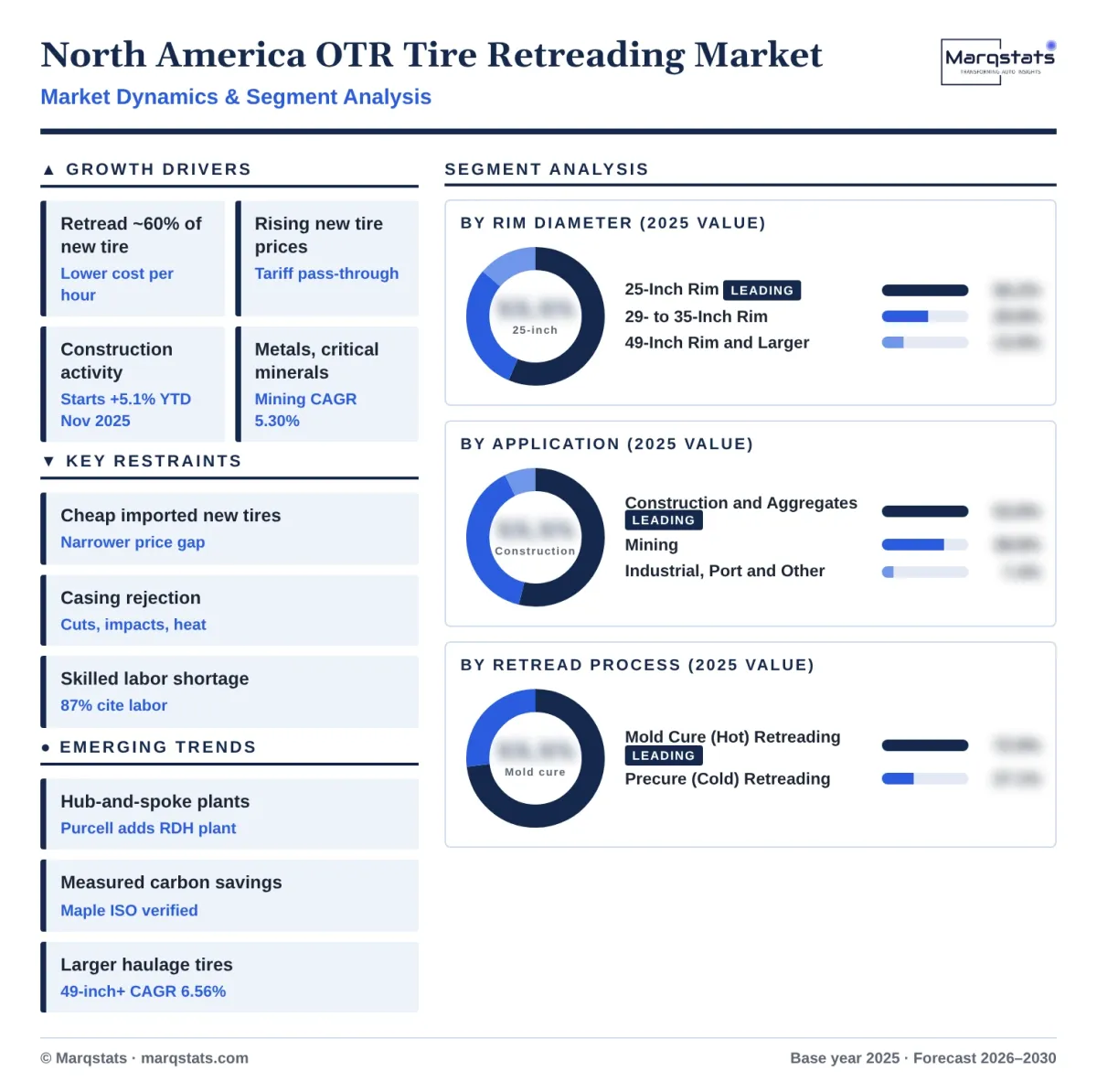
The 25-inch rim band accounts for an estimated USD 248.07 million, or 56.24% of 2025 value, the largest band, and is projected to reach USD 299.76 million by 2030 at a 3.86% CAGR. Wheel loader, grader and articulated hauler sizes such as 17.5R25, 20.5R25, 23.5R25, 26.5R25 and 29.5R25 make up about 72% of US retread units, at an average of USD 3,314.40 per retread in 2025. This band is the core of most independent US retread plants. Its share of value eases from 56.24% in 2025 to 53.95% by 2030 as larger bands grow faster.
The 29- to 35-inch band accounts for an estimated USD 131.57 million, or 29.83% of 2025 value, and is projected to reach USD 171.57 million by 2030 at a 5.45% CAGR. Large loader and rigid hauler sizes such as 29.5R29, 33.25R29, 35/65R33 and 24.00R35 list at USD 7,483 to USD 12,999 new, and a retread averages USD 5,700.82. These sizes need larger molds and heavier handling equipment than 25-inch tires. Its share of value rises from 29.83% in 2025 to 30.87% by 2030.
The 49-inch and larger band accounts for an estimated USD 61.42 million, or 13.93% of 2025 value, and is projected to reach USD 84.38 million by 2030 at a 6.56% CAGR, the fastest band. Haulage sizes such as 27.00R49 serve 90- to 100-ton haul trucks, and Canada's mining fleets give this band 18% of Canadian retread units against 8% in the United States. Haul truck tires in this band often get repairs on site before they go to the retread plant. The average retread in this band rises from USD 5,774.40 in 2025 to USD 6,628.81 by 2030.
Construction and aggregates account for an estimated USD 237.37 million, or 53.81% of 2025 value, the largest application, and are projected to reach USD 293.19 million by 2030 at a 4.31% CAGR. Quarries, sand and gravel pits, road builders and earthmoving contractors retread loader and hauler tires to control cost per ton moved. Contractors often retread a casing once and then sell or scrap it. Its share eases from 53.81% of value in 2025 to 52.76% by 2030.
Mining accounts for an estimated USD 170.98 million, or 38.77% of 2025 value, and is projected to reach USD 221.33 million by 2030 at a 5.30% CAGR, the fastest application. Surface coal, gold, copper, iron ore and oil sands operations and underground mines retread haul truck, loader and dozer tires, and mining makes up about 75% of Canadian retread value. Mines often run tire management contracts that include repair and retreading. Its share rises from 38.77% of value in 2025 to 39.83% by 2030.
Industrial, port and other uses account for an estimated USD 32.71 million, or 7.42% of 2025 value, and are projected to reach USD 41.19 million by 2030 at a 4.72% CAGR. Steel mills, slag handlers, log loaders, scrap yards and port container handlers retread pneumatic OTR tires that suffer heat and cut damage. Heat-resistant compounds are common in slag and steel mill applications. Its share holds near 7.4% of value through 2030.
Mold cure retreading accounts for an estimated USD 321.63 million, or 72.92% of 2025 value, and is projected to reach USD 395.33 million by 2030 at a 4.21% CAGR. Uncured rubber is applied to the buffed casing and cured in a sized mold, often bead to bead, which restores the original tread design and suits large mining and haulage tires. Bead-to-bead retreads also renew the sidewall rubber on worn casings. Its share eases from 72.92% of value in 2025 to 71.14% by 2030.
Precure retreading accounts for an estimated USD 119.43 million, or 27.08% of 2025 value, and is projected to reach USD 160.38 million by 2030 at a 6.07% CAGR, the faster process. A precured tread is bonded to the casing in a chamber, which needs fewer size-specific molds, and H&H Industries makes OTR precure treads and molds for its own and other retreaders' use. Precure treads let smaller plants offer OTR retreads without large mold investments. Its share rises from 27.08% of value in 2025 to 28.86% by 2030.
By Geography
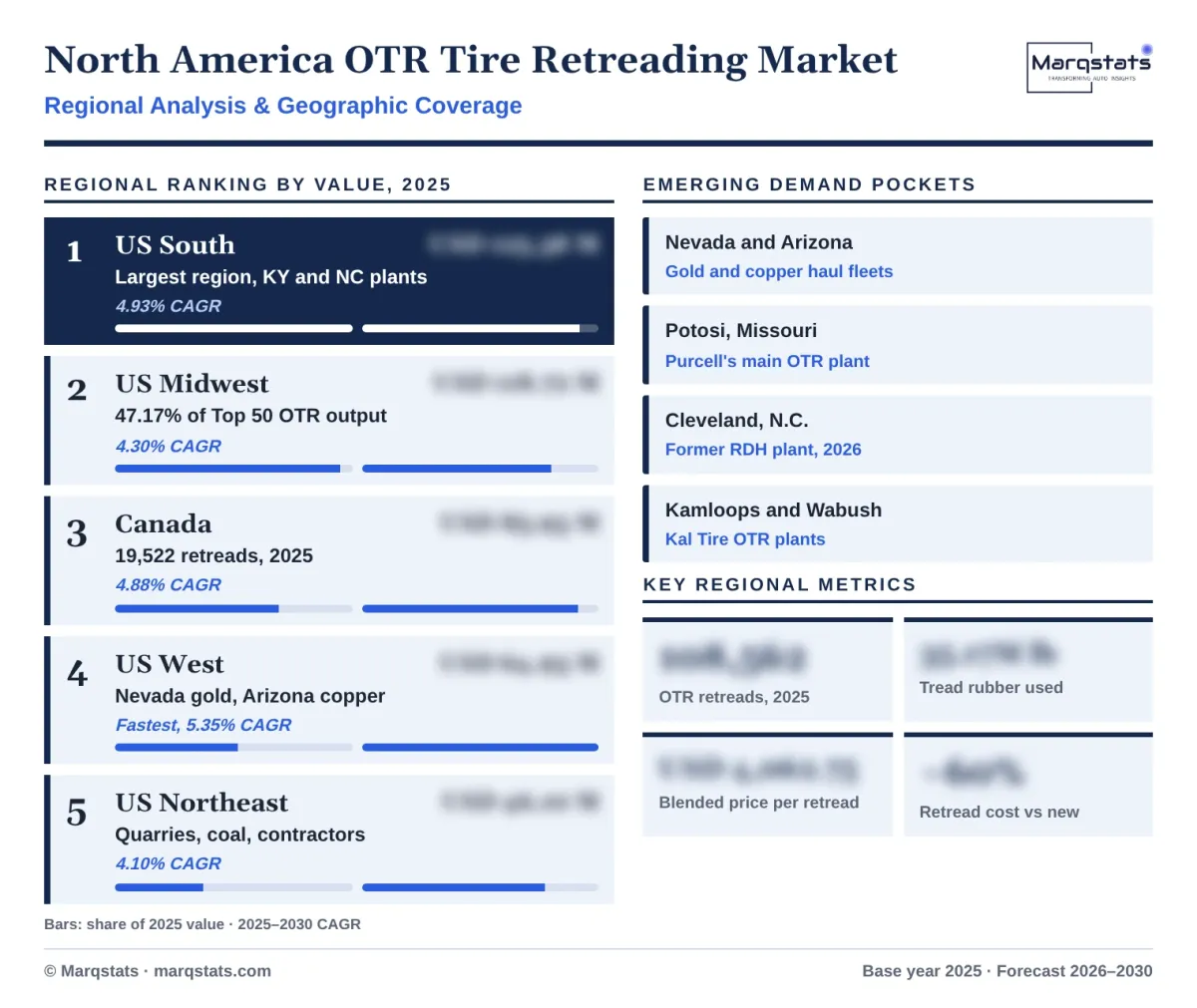
US South
The US South is the largest regional market at 28.43% of 2025 value, or USD 125.38 million, and is projected to reach USD 159.49 million by 2030 at a 4.93% CAGR. B.R. Retreading in Glasgow, Kentucky, White's Tire Service in Wilson, North Carolina and the former RDH plant in Cleveland, North Carolina retread OTR tires, and Texas and Florida lead construction employment. Aggregate demand from highway and data center construction keeps southern quarries running at high rates. The South holds 41.04% of US construction employment, the largest share of any region.
US Midwest
The US Midwest accounts for 26.92% of 2025 value, or USD 118.72 million, and is projected to reach USD 146.57 million by 2030 at a 4.30% CAGR. The region holds 47.17% of the OTR retread output reported in the 2025 Top 50 list, from Purcell in Potosi, Missouri, H&H Industries in Oak Hill, Ohio and Community Tire in St. Louis, and these plants ship retreads to other regions. Coal and aggregate operations in Ohio, Kentucky, Indiana and Illinois supply many casings to these plants. The region's share of retread value is lower than its share of output because Midwestern plants sell into other regions.
US West
The US West accounts for 14.72% of 2025 value, or USD 64.93 million, and grows fastest at a 5.35% CAGR to USD 84.27 million by 2030. Gold mines in Nevada and copper mines in Arizona run large haul fleets, and Purcell's Portland, Oregon plant and Superior Tire Service in Salem, Oregon serve the Northwest. Mine sites in remote areas favor retreaders that offer pickup and on-site service. Tire makers expect mining tire growth in Nevada, Arizona and Alaska in 2026.
US Northeast
The US Northeast accounts for 10.45% of 2025 value, or USD 46.10 million, and is projected to reach USD 56.35 million by 2030 at a 4.10% CAGR. Craft Tire, operating as Shrader Retreading in Uniontown, Pennsylvania, and Pete's Tire Barns in Orange, Massachusetts serve quarries, coal operations and contractors in Pennsylvania, New York and New England. Shorter construction seasons concentrate retread demand in spring and summer. The region holds 12.26% of OTR retread output reported in the 2025 Top 50 list.
Canada
Canada accounts for 19.48% of 2025 value, or USD 85.93 million, and is projected to reach USD 109.03 million by 2030 at a 4.88% CAGR. Kal Tire retreads OTR tires in Kamloops, British Columbia and Wabush, Newfoundland and Labrador, and the North Bay, Ontario plant serves mines in Ontario and Quebec, while oil sands, coal and iron ore fleets favor larger haulage tires. Long winters and remote sites make on-site repair and stock retreads valuable to Canadian mines. Canadian OTR retreads rise from 19,522 in 2025 to 21,342 by 2030.
How Competition Is Evolving
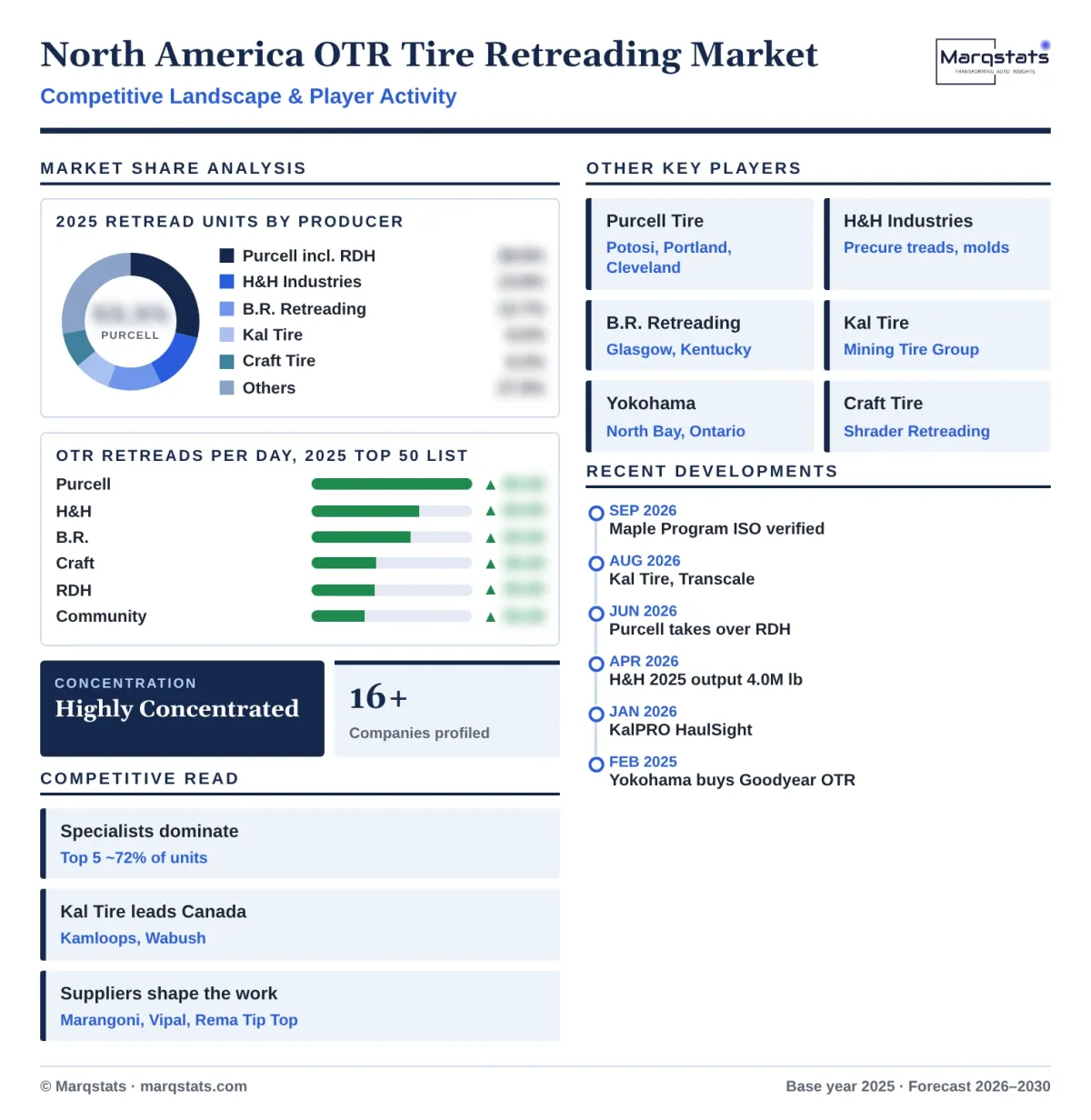
The North America OTR tire retreading market is highly concentrated, with a few specialist plants producing most of the volume. Marqstats estimates that Purcell Tire & Rubber Company, including the former RDH operations, produced about 28.79% of 2025 OTR retreads, followed by H&H Industries, Inc. at 13.82%, B.R. Retreading, Inc. at 12.67%, Kal Tire at 8.53% and Craft Tire, Inc. at 8.29%. The Yokohama Rubber Co., Ltd. through its North Bay plant and Community Tire Co. hold most of the rest. The top five producers account for about 72% of retread units, and most other plants retread only a few OTR tires a day alongside truck tires, which keeps the specialist group small and stable. Producer shares are a Marqstats estimate from reported daily output and are not confirmed by the companies.
Supply-side companies shape the work that retreaders can do. H&H Industries makes OTR precure treads and molds, Marangoni S.p.A. and Vipal Borrachas S.A. supply tread rubber and retread systems, and Rema Tip Top North America, Inc. provides the patches and repair materials used before a casing is retreaded. Casing makers such as Bridgestone Americas, Inc., Michelin North America, Inc., Titan International, Inc. and Yokohama decide how retreadable their tires are through casing design. Tread rubber, curing energy and repair materials make up a large part of a retreader's cost, so supplier pricing and support shape retread margins.
Retreaders compete on turnaround, casing acceptance and on-site service. Purcell's hub-and-spoke network places plants closer to customers, Kal Tire runs on-site repair bays and tire management programs at mines, and H&H Industries pairs retreading with used casing sales. Larger plants also offer warranty terms and tire-by-tire records that mines use for cost per hour reporting.
Ownership changes reshape the field. Yokohama completed its purchase of Goodyear's OTR tire business, including the North Bay OTR retread plant, in February 2025, and Purcell took over the RDH operations in June 2026 after RDH closed. Truck tire retreading, which shares plants, rubber suppliers and labor pools with OTR work, is covered in the Marqstats US Truck Tire Retreading Market report.
Companies Covered
Companies covered in the report include:
Recent Market Activity
Table of Contents
Coverage & Segmentation
The North America OTR tire retreading market comprises retreaded off-the-road tires for construction, aggregates, mining, industrial and port equipment in the United States and Canada, valued at end-user prices in US dollars. The market excludes new OTR tires, stand-alone repairs, industrial solid tires and Mexico. Coverage uses a 2025 base year, a 2021–2025 historical period and a 2026–2030 forecast period, with 2026 as the estimated year. Retread plant practice, rubber suppliers and labor trends draw on the Marqstats US Truck Tire Retreading Market report.
Segmentation covers three rim diameter bands, three applications, two retread processes and five regions, with 16 retreaders, service providers and suppliers profiled. US units apply 250 operating days to reported OTR retreads per day, Canadian units convert reported rubber pounds at 324 pounds per retread, value applies a 60% retread-to-new price ratio to list prices by rim band, and US regional values blend plant output with construction employment. Sizes from 17.5R25 to 27.00R49 are tracked as reference sizes. Canadian tire demand is covered in the Marqstats Canada Replacement Tire Market report.