Market Snapshot
Middle bar: base-year value × (1 + CAGR), rounded to two decimals. This is a calculated illustration, not a separately researched annual estimate.
The US trailer tire market is valued at USD 1,832.60 million in 2025 and is projected to reach USD 2,244.15 million by 2030, registering a CAGR of 4.14% over 2026–2030. The market covers new ST-designated tires fitted to nonpowered RV, utility, cargo, boat, horse, livestock and equipment trailers, sold to trailer makers as original equipment and to owners as replacements. Imports of special trailer tires jumped 22.60% to 33.24 million units in 2025, yet Marqstats estimates that trailer makers and owners consumed 29.20 million tires, up 4.29%, so a large share of the import surge went into importer and distributor stock.
Market size and forecast figures are generated using Marqstats' proprietary estimation framework, updated as of October 2026.
Coverage spans four trailer types, two sales channels, two construction types and four US regions: the South, Midwest, West and Northeast. The analysis benchmarks 16 tire makers, brand owners, distributors and trailer component suppliers, including The Goodyear Tire & Rubber Company, Titan International, Inc., Kenda Rubber Industrial Company, Ltd. and LCI Industries, and tracks reference sizes such as ST205/75R15, ST225/75R15 and ST235/80R16 for RV and cargo trailers, ST175/80R13 and 4.80-12 for boat and small utility trailers, and ST235/85R16 and ST215/75R17.5 for gooseneck and equipment trailers. Tires already mounted on imported complete trailers count within original equipment demand.
Key Takeaways
Market Overview & Analysis
Report Summary
The US trailer tire market comprises new tires carrying the ST designation that are fitted to nonpowered trailers, valued at USD 1,832.60 million in 2025 at the prices trailer makers and tire dealers pay. RV trailers, utility and cargo trailers, boat trailers, and horse, livestock and equipment trailers all fall in scope, in both radial and bias construction. Light truck tires fitted to heavier trailers, truck trailer tires such as 295/75R22.5, retreads, used tires, wheels and mounting services sit outside the market perimeter, as do tires on motorhomes and truck campers, which have no independent trailer tire positions.
Imports dominate supply. Special trailer tire imports rose from 27,115,392 units in 2024 to 33,242,649 units in 2025, an increase of 6,127,257 tires, while customs value rose only 12.05%, from USD 824.15 million to USD 923.47 million. Customs value per tire fell from USD 30.39 to USD 27.78. Special trailer tires accounted for 68.55% of the 48.49 million specialty tires imported in 2025 and for 117.6% of the net specialty import increase, as declines in solid, construction and agricultural tire imports offset part of the trailer gain.
Import volume and consumption diverged in 2025. Towable RV wholesale shipments, the main original equipment indicator, rose only 2.2% to 302,107 rolling trailers, as fifth wheels rose 21.6% to 65,632 units and travel trailers fell 2.1% to 232,530 units. Marqstats estimates that trailer makers fitted 5.80 million tires as original equipment in 2025 and owners bought 23.40 million replacement tires, for total consumption of 29.20 million. Importers and distributors built stock ahead of tariff changes, and about 5.12 million more tires entered the country than the market consumed, after domestic output and exports.
Reconciling supply with demand explains the 2025 gap. Of the 6,127,257 additional tires imported in 2025, Marqstats attributes about 1.20 million to higher consumption and the rest to stock building by importers, distributors and dealers, which bought ahead of expected tariff changes. Customs value per tire fell 8.60% over the same period as importers shifted sourcing and bought more small bias sizes, so the fall in landed cost does not signal a matching fall in dealer prices. The stock overhang unwinds through 2026, when Marqstats expects imports to run below consumption while units consumed hold at 29.19 million.
Value grows faster than volume through radial adoption and larger load ranges. The average value per tire across the market is an estimated USD 62.76 in 2025, rising to USD 70.31 by 2030, while units grow from 29.20 million to 31.92 million. Market value reaches an estimated USD 1,860.52 million in 2026 on flat units of 29.19 million, as a 15.5% fall in RV original equipment tires is offset by replacement demand from the existing trailer fleet. Passenger, light truck and truck tire replacement benchmarks are covered in the Marqstats US Replacement Tire Market report.
Market Dynamics
Key Drivers
Five factors support special trailer tire demand in the United States.
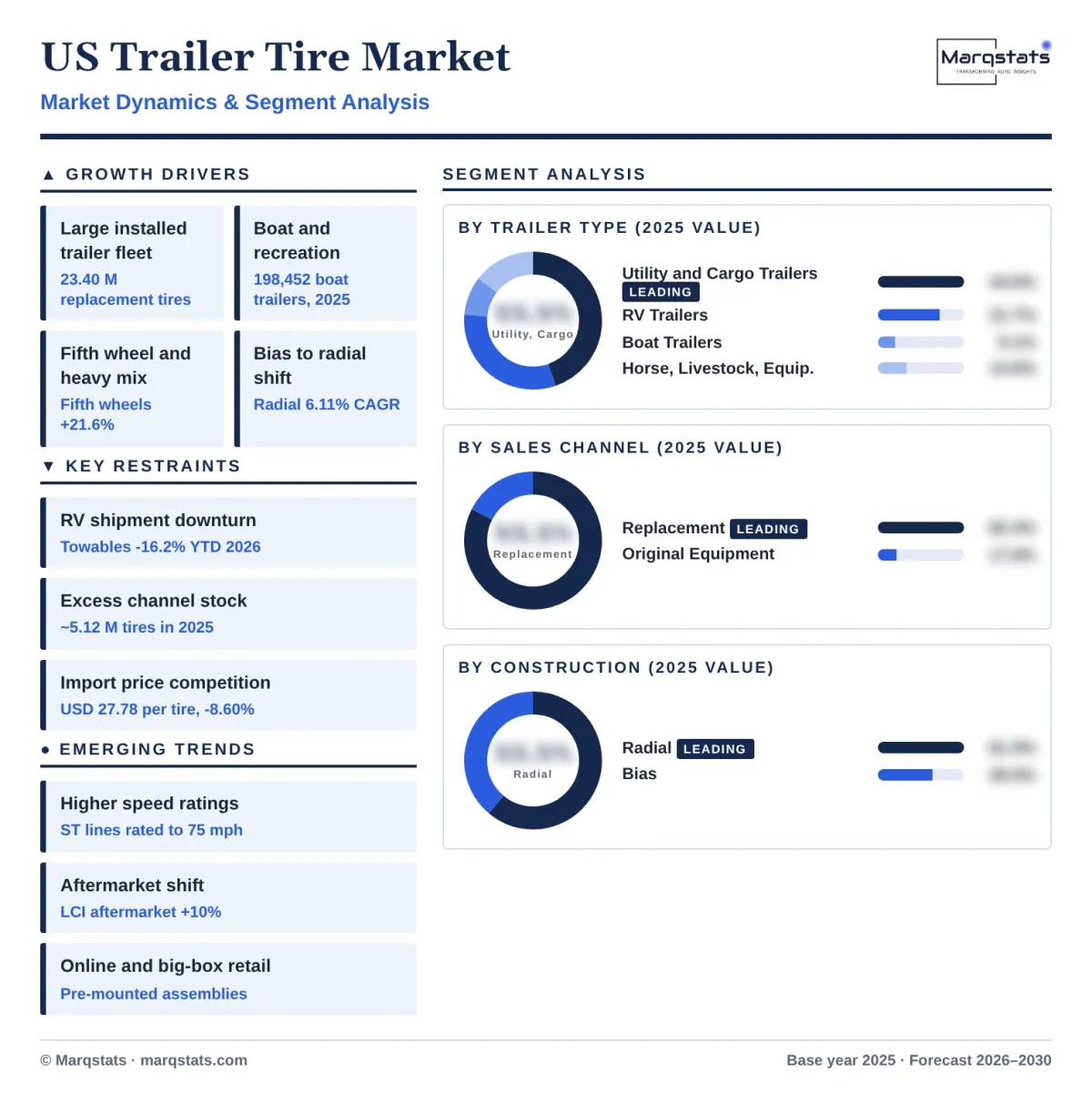
- A large installed trailer fleet. Replacement tires account for 23.40 million of the 29.20 million tires consumed in 2025, so demand rests on the trailers already in use rather than on new trailer builds. ST tires age out on time as well as on wear: trailers often sit parked for months, and ozone and sunlight crack sidewalls well before the tread wears out. Owners of RV and boat trailers therefore replace tires on a calendar cycle of about five to six years, which smooths demand across trailer build cycles. Replacement units rise to an estimated 25.85 million by 2030 as the fleet of trailers built in the strong 2021 and 2022 RV years reaches its first full replacement cycle. Tire makers commonly advise replacing ST tires after about five years of service whatever the tread depth.
- Boat and recreation activity. The National Marine Manufacturers Association (NMMA) reported 220,397 new powerboat retail sales in 2025, including 77,434 fishing boats and 71,461 watersports boats, and 198,452 boat trailer sales. Each boat trailer fitted about 3.02 tires as original equipment, including spares, in sizes such as ST175/80R13, ST205/75R14 and 4.80-12. Boat trailers spend time in salt and fresh water and in long storage, which shortens tire life and lifts replacement frequency. Watersports and fishing boats on single and tandem axle trailers make up most of the trailerable boat fleet.
- Fifth wheel and heavy trailer mix. Fifth wheel shipments rose 21.6% to 65,632 units in 2025, and fifth wheels run four to six tires in load range E and G sizes such as ST235/80R16 and ST235/85R16. Gooseneck, livestock and equipment trailers use the same heavy sizes and 17.5-inch sizes such as ST215/75R17.5. Heavier load ranges carry higher prices, and horse, livestock and equipment trailers grow fastest at a 4.60% CAGR. Toy haulers and luxury fifth wheels carry the heaviest loads and the highest tire value per trailer.
- Shift from bias to radial construction. Radial ST tires run cooler at highway speed, carry load more evenly and last longer than bias tires, and RV makers fit radial tires on most travel trailers and fifth wheels. Radial tires account for 61.00% of 2025 value and grow at a 6.11% CAGR to 67.00% by 2030, while bias tires grow at only 0.71% as they retreat to small utility and boat trailers in sizes such as 4.80-8, 4.80-12 and 5.30-12. Radial ST tires also improve fuel use for the tow vehicle, which matters on long RV trips.
- Small business and contractor trailers. Landscapers, contractors and small delivery businesses run enclosed cargo, dump and utility trailers daily, and these trailers wear tires out through mileage rather than age. Utility and cargo trailers consume 15.80 million tires in 2025, or 54.1% of units, and rise to 17.23 million by 2030. Equipment trailers that move compact loaders and mini excavators add demand for load range E and F sizes. Daily-use trailers wear through tires in two to three years, faster than recreation trailers.
Key Restraints
Four constraints hold back special trailer tire value growth.
- RV shipment downturn. RV Industry Association (RVIA) data show January to August 2026 towable shipments down 16.2% to 181,690 units, with travel trailers down 15.7% to 140,067 and fifth wheels down 20.1% to 36,083. LCI Industries cut its 2026 North American wholesale RV shipment range to 280,000–300,000 units in August 2026, and Marqstats projects RV original equipment tire units to fall 15.5% to an estimated 1.25 million in 2026. RV makers also shift mix toward single-axle travel trailers, which fit two road tires rather than four. RVIA's June 2026 forecast median of 314,000 units already implied an 8.2% fall from 342,220 units in 2025.
- Excess channel stock. Imports of 33.24 million tires in 2025 exceeded estimated consumption of 29.20 million by a wide margin, as importers bought ahead of tariff changes. Distributors and dealers work down this stock in 2026, which weakens import orders and pressures prices on common sizes such as ST205/75R15 and ST225/75R15. Dealers that hold full warehouses also delay orders for new size and load range additions.
- Price competition from imports. Customs value per tire fell 8.60% to USD 27.78 in 2025 as importers shifted sourcing and size mix. Value brands compete hard on price in online and farm store channels, and the gap between private label and branded ST tires limits price increases. Marqstats holds the 2026 price increase to an estimated 1.5%, below the passenger and light truck tire market. Online marketplaces make price comparison easy, which keeps margins thin for dealers on standard sizes.
- Tariff and trade uncertainty. The US Supreme Court ruled on 20 February 2026 that the International Emergency Economic Powers Act (IEEPA) does not authorize tariffs, and LCI Industries passed through USD 88.8 million of IEEPA tariff refunds in Q2 2026. In June 2026 the US International Trade Commission (USITC) began a five-year review of duties on passenger and light truck tires from South Korea, Taiwan, Thailand and Vietnam. Shifting duty rules complicate sourcing decisions for importers that buy a full season of stock at once. Tires used on trailers often sit in tariff categories shared with other tire types, which makes duty treatment harder to predict.
Key Trends
Four shifts are changing how special trailer tires are made, sold and used.
- Higher speed ratings. ST tires traditionally carry a 65 mph limit, and tire makers now launch ST lines rated up to 75 mph. Atturo Tire's ST200, for example, is rated for up to 75 mph and offered in high load index sizes for utility, RV and work trailers. Higher speed ratings reduce heat failures on long highway trips and support radial upgrades. Owners who tow at highway speed choose higher-rated tires to cut the risk of tread separation.
- Domestic and branded supply. Goodyear launched the Endurance in 2017 as the only radial special trailer tire built in the United States, adding the ST255/85R16 size in load ranges D and E. Titan International, Inc. acquired The Carlstar Group in February 2024 and sells Carlisle Radial Trail HD highway trailer tires under a Carlisle brand license that runs to 2033. Branded supply competes against private label imports on durability and warranty. Domestic production also shortens lead times for dealers that restock during the summer season. Titan reported Q2 2026 consumer segment sales of USD 146.6 million, up 27.2%, as Titan Specialty volumes recovered from a tariff-related slowdown in 2025, and it recorded USD 4.7 million of IEEPA tariff refunds in the consumer segment.
- Aftermarket shift at RV suppliers. LCI Industries reported Q2 2026 aftermarket sales of USD 293.9 million, up 10%, while RV original equipment sales fell 33% to USD 336.1 million. RV component suppliers and dealers push tire and wheel replacement, tire pressure monitoring and service packages to owners of existing trailers as new RV builds slow. Aftermarket growth at RV suppliers points to steady replacement demand as owners keep trailers longer.
- Online and big-box retail. Trailer owners buy ST tires and tire and wheel assemblies through farm and ranch stores, online tire retailers and national chains, and often mount them at home. Brands such as Trailer King, developed by TBC Corporation, and Westlake, made by Zhongce Rubber Group Co., Ltd., compete in these channels on price and size range. Pre-mounted tire and wheel assemblies let owners replace tires without a tire machine.
Market Segmentation
Utility and cargo trailers account for an estimated USD 817.19 million, or 44.59% of 2025 value, and are projected to reach USD 995.02 million by 2030 at a 4.02% CAGR. These trailers consume 15.80 million tires in 2025, including 3.42 million original equipment tires, at an average of USD 51.72 per tire. Open utility, enclosed cargo, dump and car hauler trailers run sizes from 4.80-12 and ST175/80R13 to ST205/75R15 and ST225/75R15. Original equipment units dip 4% to an estimated 3.28 million in 2026 as trailer makers cut production, and value per tire rises to USD 57.76 by 2030. Enclosed cargo trailers used by contractors and small delivery businesses run tandem axles and wear tires through daily mileage.
RV trailers account for an estimated USD 580.82 million, or 31.69% of 2025 value, and are projected to reach USD 714.92 million by 2030 at a 4.24% CAGR. Travel trailers, fifth wheels and folding camping trailers consume 6.90 million tires in 2025, including 1.48 million original equipment tires, or about 4.90 tires per towable RV shipped with spares. Units fall to an estimated 6.78 million in 2026 as original equipment tires drop to 1.25 million, then recover to 7.59 million by 2030. Common sizes include ST205/75R15, ST225/75R15 and ST235/80R16, at an average of USD 84.18 per tire. Owners of RV trailers favor branded radial tires with higher speed ratings for long highway trips.
Boat trailers account for an estimated USD 166.52 million, or 9.09% of 2025 value, and are projected to reach USD 198.60 million by 2030 at a 3.59% CAGR. These trailers consume 3.60 million tires in 2025, including 0.60 million original equipment tires on 198,452 new boat trailers, at an average of USD 46.26 per tire. Small sizes such as 4.80-12, ST175/80R13 and ST205/75R14 dominate, and galvanized wheel assemblies are common for salt water use. Boat owners often replace tires every few seasons because water and long storage damage the casing.
Horse, livestock and equipment trailers account for an estimated USD 268.07 million, or 14.63% of 2025 value, and are projected to reach USD 335.61 million by 2030 at a 4.60% CAGR, the fastest trailer type. These trailers consume 2.90 million tires in 2025 at the highest average value of USD 92.44 per tire, rising to USD 103.21 by 2030. Gooseneck and bumper pull trailers run load range E, F and G sizes such as ST235/85R16 and ST215/75R17.5, and farm and construction demand supports steady replacement. Farm and ranch owners replace tires in pairs or full sets to keep load ratings matched across axles.
Replacement accounts for an estimated USD 1,510.63 million, or 82.43% of 2025 value, and is projected to reach USD 1,869.61 million by 2030 at a 4.36% CAGR. Owners bought 23.40 million replacement tires in 2025, rising to 25.85 million by 2030. Replacement demand follows the trailer fleet, age-based tire changes and blowout damage rather than new trailer builds, so it holds up as RV production falls in 2026. Owners also replace spare tires on an age cycle, which adds units beyond the road positions.
Original equipment accounts for an estimated USD 321.97 million, or 17.57% of 2025 value, and is projected to reach USD 374.54 million by 2030 at a 3.07% CAGR. Trailer makers fitted 5.80 million tires in 2025, falling to an estimated 5.41 million in 2026 before rising to 6.07 million by 2030. Trailer makers buy tire and wheel assemblies in volume at prices below replacement, and RV makers in northern Indiana take the largest share of original equipment radial tires. Utility and cargo trailers take 3.42 million of the 5.80 million original equipment tires fitted in 2025.
Radial tires account for an estimated USD 1,117.89 million, or 61.00% of 2025 value, and are projected to reach USD 1,503.58 million by 2030 at a 6.11% CAGR, the fastest segment. Radial ST tires dominate RV trailers and the larger utility and cargo trailers in sizes such as ST205/75R15, ST225/75R15 and ST235/80R16, and all-steel radial designs serve heavy fifth wheels. Radial share rises from 61.00% to 67.00% of value by 2030 as owners upgrade on replacement.
Bias tires account for an estimated USD 714.71 million, or 39.00% of 2025 value, and are projected to reach USD 740.57 million by 2030 at a 0.71% CAGR. Bias tires keep a strong position on small utility trailers, boat trailers and low-speed farm trailers in sizes such as 4.80-8, 4.80-12, 5.30-12 and 20.5x8.0-10, where stiff sidewalls and low prices matter more than highway comfort. Bias tires keep a price advantage of several dollars per tire in small sizes, which holds their position on low-cost utility trailers.
By Geography
South
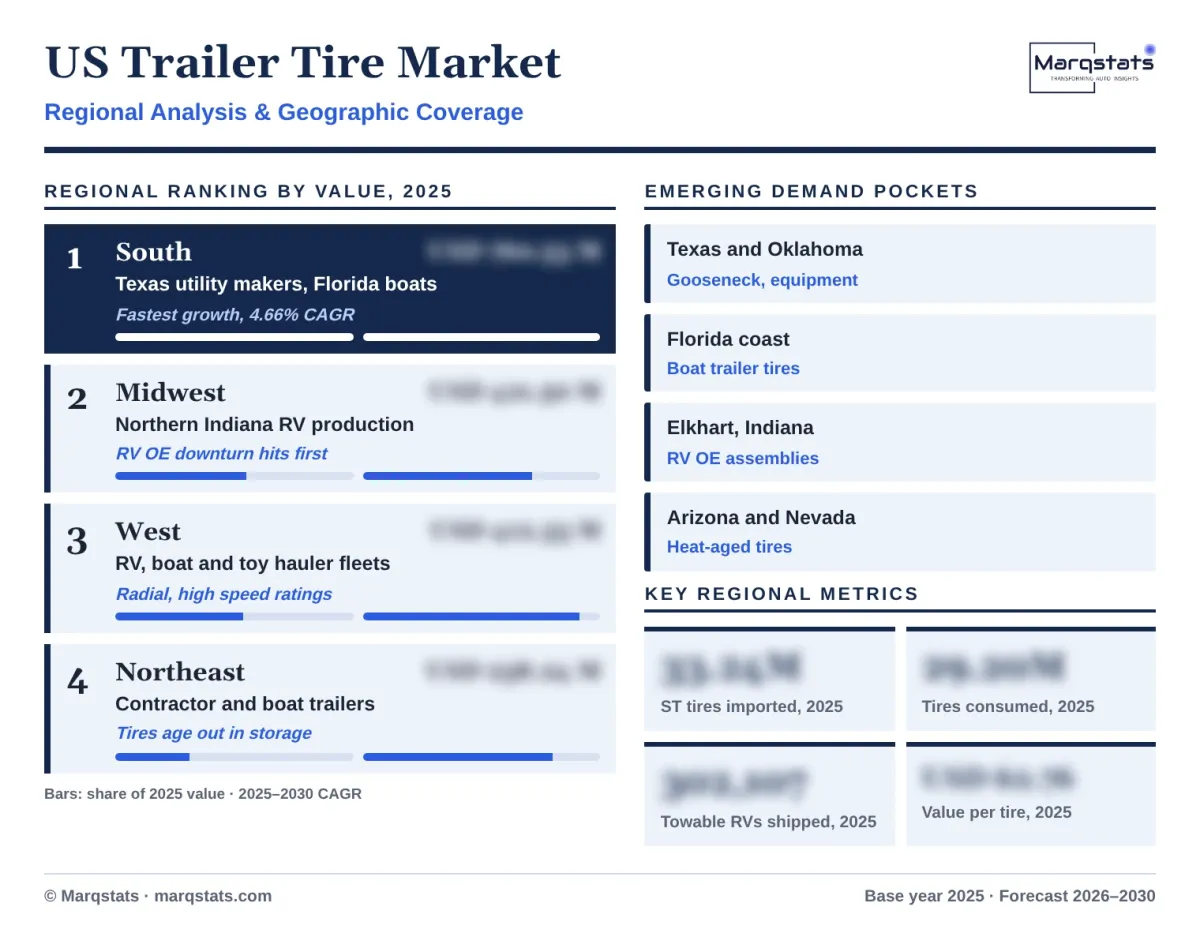
The South is the largest regional market at 41.50% of 2025 value, or USD 760.53 million, and grows fastest at a 4.66% CAGR to USD 954.85 million by 2030. Texas and Florida lead demand: Texas is home to large utility trailer makers such as Big Tex Trailers and PJ Trailers, and Florida has one of the largest boat fleets in the country. Ranch, oilfield and construction work across Texas, Oklahoma and Georgia supports gooseneck and equipment trailer tire demand. Year-round towing seasons across the Sun Belt keep trailers on the road for more months than in northern states.
Midwest
The Midwest accounts for 23.00% of 2025 value, or USD 421.50 million, and is projected to reach USD 495.87 million by 2030 at a 3.30% CAGR, the slowest region. Northern Indiana builds most US towable RVs, so the region takes the largest share of RV original equipment tires and feels the 2026 RV downturn first. Farm trailers across Iowa, Illinois and Ohio and boat trailers in Michigan and Minnesota support replacement demand. Elkhart County dealers and suppliers also run a large aftermarket for RV tire and wheel assemblies.
West
The West accounts for 22.50% of 2025 value, or USD 412.33 million, and is projected to reach USD 507.47 million by 2030 at a 4.24% CAGR. California, Arizona and Washington hold large RV, boat and off-road toy hauler fleets, and long desert and mountain highway runs push owners toward radial ST tires with higher speed ratings. Hot summer heat in Arizona and Nevada shortens tire life on parked trailers. Toy haulers that carry off-road vehicles to desert parks need load range E and G tires.
Northeast
The Northeast accounts for 13.00% of 2025 value, or USD 238.24 million, and is projected to reach USD 285.96 million by 2030 at a 3.72% CAGR. Pennsylvania, New York and New England combine contractor and landscaping trailers with boat trailers on the Atlantic coast and inland lakes. Short seasons mean many recreation trailers sit parked for most of the year, so tires age out before the tread wears. Winter road salt also corrodes wheels and valve stems on trailers stored outdoors.
How Competition Is Evolving
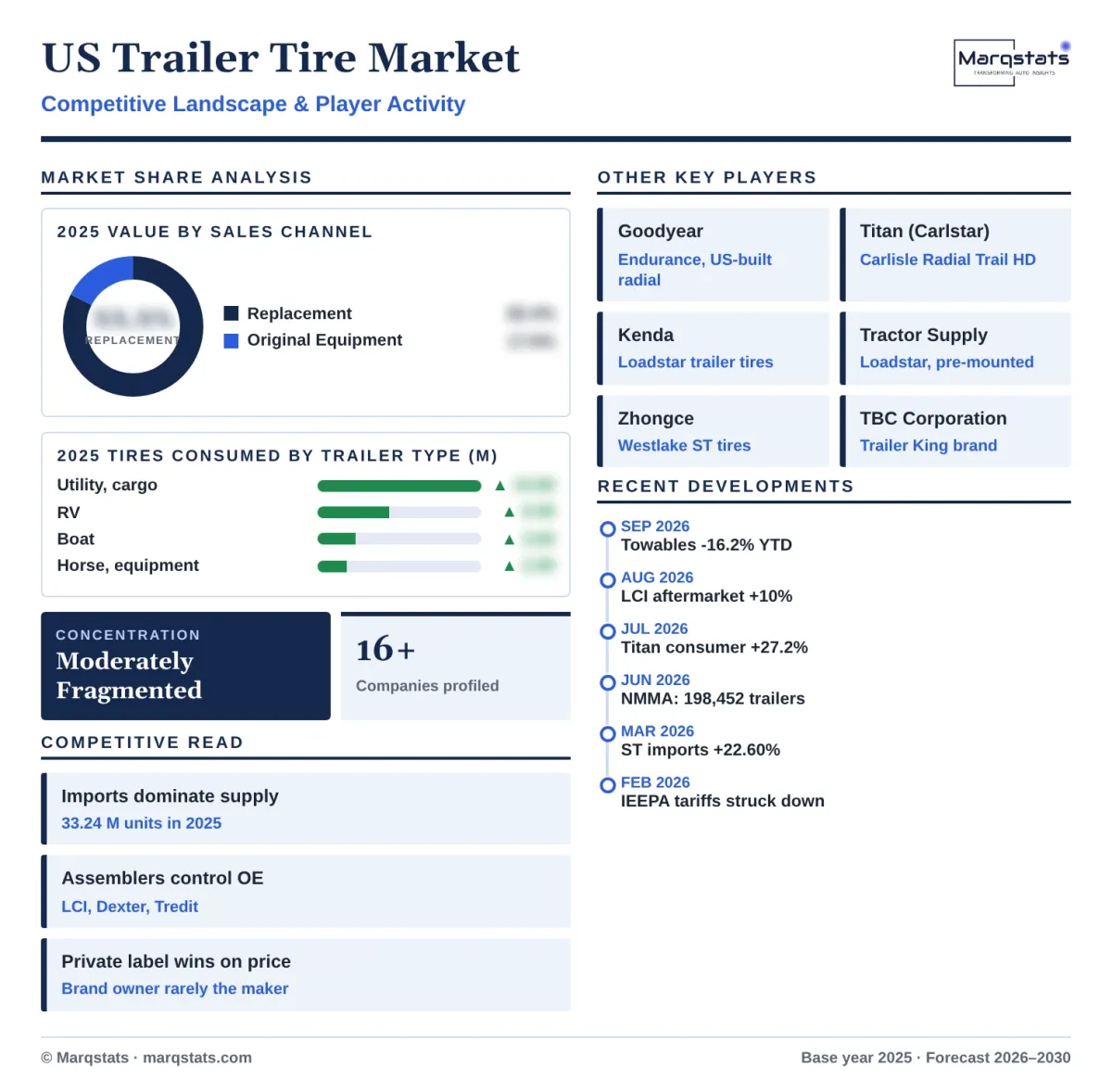
The US trailer tire market is moderately fragmented, with a mix of branded tire makers, Asian manufacturers, private label brand owners, national distributors and trailer component suppliers. The Goodyear Tire & Rubber Company sells the Endurance radial ST tire, Titan International, Inc. sells Carlisle trailer tires through its Carlstar business, and Kenda Rubber Industrial Company, Ltd. and Cheng Shin Rubber Ind. Co., Ltd. supply Loadstar and Maxxis trailer tires. Zhongce Rubber Group Co., Ltd., Sailun Group Co., Ltd., Triangle Tyre Co., Ltd. and Deestone Co., Ltd. supply imported radial and bias ST tires, often under private label brands.
Original equipment supply runs through tire and wheel assemblers. LCI Industries, Dexter Axle Company and Tredit Tire & Wheel Co., Inc. supply mounted tire and wheel assemblies to RV, utility and cargo trailer makers, so they control which tire brand reaches the original equipment fitment. In the replacement market, TBC Corporation markets the Trailer King brand, American Tire Distributors, Inc. supplies dealers, and retailers such as The Reinalt-Thomas Corporation, operating as Discount Tire, and Camping World Holdings, Inc. sell ST tires to trailer owners.
Quality and compliance shape supplier selection. ST tires must meet Federal Motor Vehicle Safety Standard (FMVSS) No. 119, and recalls fall on both the tire maker and the trailer maker: PJ Trailers recalled more than 30 of its 2024 trailer models after Goodride tires made in Zhejiang, China showed sidewall bubbling and tread delamination, with tires inspected and replaced at no cost to owners. Trailer makers therefore qualify a short list of tire sources and favor suppliers with consistent quality records, while tire and wheel assemblers such as LCI Industries and Dexter Axle Company manage replacements across dealer networks. Retail channels have widened as well: Tractor Supply Company sells Kenda Loadstar tires and pre-mounted assemblies in sizes from 4.80-8 to ST225/75R15 through its farm and ranch stores, which puts branded and private label tires side by side.
Brand owner, importer and factory roles often belong to different companies, so the brand on the sidewall rarely shows who made the tire. Competition centers on size range, load range, speed rating and warranty, and private label importers win on price in common sizes such as ST205/75R15 and ST225/75R15. Stock built in 2025 and a falling RV build rate intensify price competition in 2026, while branded makers compete on domestic production and durability. Light truck tire benchmarks for the same dealers are covered in the Marqstats US SUV and Light Truck Replacement Tire Market report.
Companies Covered
Companies covered in the report include:
Recent Market Activity
Table of Contents
Coverage & Segmentation
The US trailer tire market comprises new ST-designated tires fitted to nonpowered RV, utility, cargo, boat, horse, livestock and equipment trailers, sold as original equipment and replacement, valued at the prices trailer makers and tire dealers pay in US dollars. The market excludes light truck and truck tires fitted to trailers, retreads, used tires, wheels and mounting services, and tires on motorhomes and truck campers. Coverage uses a 2025 base year, a 2021–2025 historical period and a 2026–2030 forecast period, with 2026 as the estimated year. Commercial semi-trailer tires are covered in the Marqstats US Commercial Truck Tire Market report.
Segmentation covers four trailer types, two sales channels, two construction types and four US regions, with 16 tire makers, brand owners, distributors and trailer suppliers profiled. Original equipment units follow trailer shipments and tire positions, replacement units follow the trailer fleet and tire replacement cycles, and the import series is reconciled with consumption and channel stock. Sizes such as ST205/75R15, ST225/75R15, ST235/80R16, ST175/80R13, 4.80-12 and ST215/75R17.5 are tracked as reference sizes. Tire dealer channel economics are covered in the Marqstats US Tire Dealer Market report.