Market Snapshot
Middle bar: base-year value × (1 + CAGR), rounded to two decimals. This is a calculated illustration, not a separately researched annual estimate.
The US motorcycle tire market is valued at USD 470.45 million in 2025 and is projected to reach USD 593.35 million by 2030, registering a CAGR of 4.75% over 2026–2030. The market covers new on-road motorcycle and scooter tires sold as replacements to riders and fitted as original equipment to new motorcycles sold in the United States. Marqstats estimates that 4.16 million tires entered use in 2025, including 3.28 million replacement tires and 0.88 million original equipment tires, against 3.80 million motorcycle tires imported, up 11.77%. Riders logged 22.241 billion motorcycle miles in 2024, and mileage, not new motorcycle sales, sets most of the demand.
Market size and forecast figures are generated using Marqstats' proprietary estimation framework, updated as of October 2026.
Coverage spans five motorcycle types, two tire positions, two sales channels and four US regions: the South, West, Midwest and Northeast. The analysis benchmarks 16 tire makers, motorcycle makers and powersports distributors, including Compagnie Générale des Établissements Michelin SCA, Bridgestone Corporation, Sumitomo Rubber Industries, Ltd. and Pirelli & C. S.p.A., and tracks reference sizes such as 120/70ZR17 and 180/55ZR17 for sport bikes, 130/70B18 and 180/65B16 for touring bikes, 130/90B16 and MT90B16 for cruisers, 90/90-21 and 150/70R17 for adventure bikes, and 120/70-12 for scooters. Off-road competition tires, ATV and side-by-side tires and three-wheel motorcycle tires sit outside the market.
Key Takeaways
Market Overview & Analysis
Report Summary
The US motorcycle tire market comprises new tires for on-road motorcycles and scooters, valued at USD 470.45 million in 2025 at the prices dealers and motorcycle makers pay. Touring, cruiser, sport and sport touring, adventure and dual-sport, and standard and scooter motorcycles fall in scope, in front and rear positions, sold as replacement tires or fitted as original equipment on new motorcycles sold in the country. Dedicated motocross and enduro competition tires, ATV and side-by-side tires, three-wheel motorcycle tires, used tires and mounting services sit outside the market perimeter.
Mileage drives replacement demand. The Federal Highway Administration (FHWA) counted 9,261,249 registered motorcycles and 22.241 billion motorcycle miles in 2024, up 10.21% from 20.181 billion miles in 2023, or about 2,401 miles per registered motorcycle. Registrations fell from 9,516,910 in 2023 as states moved from estimated counts to reported data, so the lower count does not by itself prove a smaller active fleet. Marqstats applies separate front and rear tire lives by motorcycle type, from about 15,000 front and 11,000 rear miles on cruisers to 8,000 front and 5,000 rear miles on sport bikes, and adjusts for dormant motorcycles, punctures and age-based replacement, which yields 3.28 million replacement tires in 2025.
Tire construction and sizing differ sharply by motorcycle type. Sport, sport touring and most adventure motorcycles run radial tires with ZR or R ratings on 17-inch rear wheels, while cruisers and touring bikes run bias or bias-belted tires marked B, such as 130/90B16 and 180/65B16, on 16-inch to 18-inch wheels. Scooters use small bias tires on 12-inch and 13-inch rims. Load index and speed rating must match the motorcycle maker's specification, so riders replace tires with the same size and often the same model as the original fitment, which gives original equipment suppliers a lasting edge in the replacement channel.
Supply comes almost entirely from imports. Motorcycle tire imports rose from 3,398,430 units in 2024 to 3,798,570 units in 2025, an increase of 400,140 tires, while customs value rose 20.22% from USD 167.22 million to USD 201.03 million. Customs value per tire rose 7.56% from USD 49.20 to USD 52.92. Sumitomo Rubber USA stopped production at its Tonawanda, New York plant on 7 November 2024, ending US output of Dunlop motorcycle tires and shifting that volume to plants in Japan and Indonesia, so part of the 2025 import rise replaced domestic production rather than adding demand.
Reconciling supply and demand shows a modest stock build. Replacement demand of 3.28 million tires plus an estimated 0.30 million loose tires for motorcycles assembled in the United States sets loose tire need at about 3.58 million in 2025, against imports of 3.80 million. Distributors rebuilt Dunlop stock after the plant closure, and the import category also carries some off-road sizes, which accounts for the gap. Tires already fitted to imported motorcycles enter the market as original equipment outside the loose tire import series.
Value grows faster than volume through mix and price. The average value per tire is an estimated USD 113.09 in 2025, rising to USD 127.33 by 2030, as riders shift toward sport and adventure tires with radial construction and dual compounds. Market value reaches an estimated USD 490.00 million in 2026 on 4.25 million tires. Passenger and light truck replacement tire benchmarks for the same dealer channels are covered in the Marqstats US Replacement Tire Market report.
Market Dynamics
Key Drivers
Five factors support motorcycle tire demand in the United States.
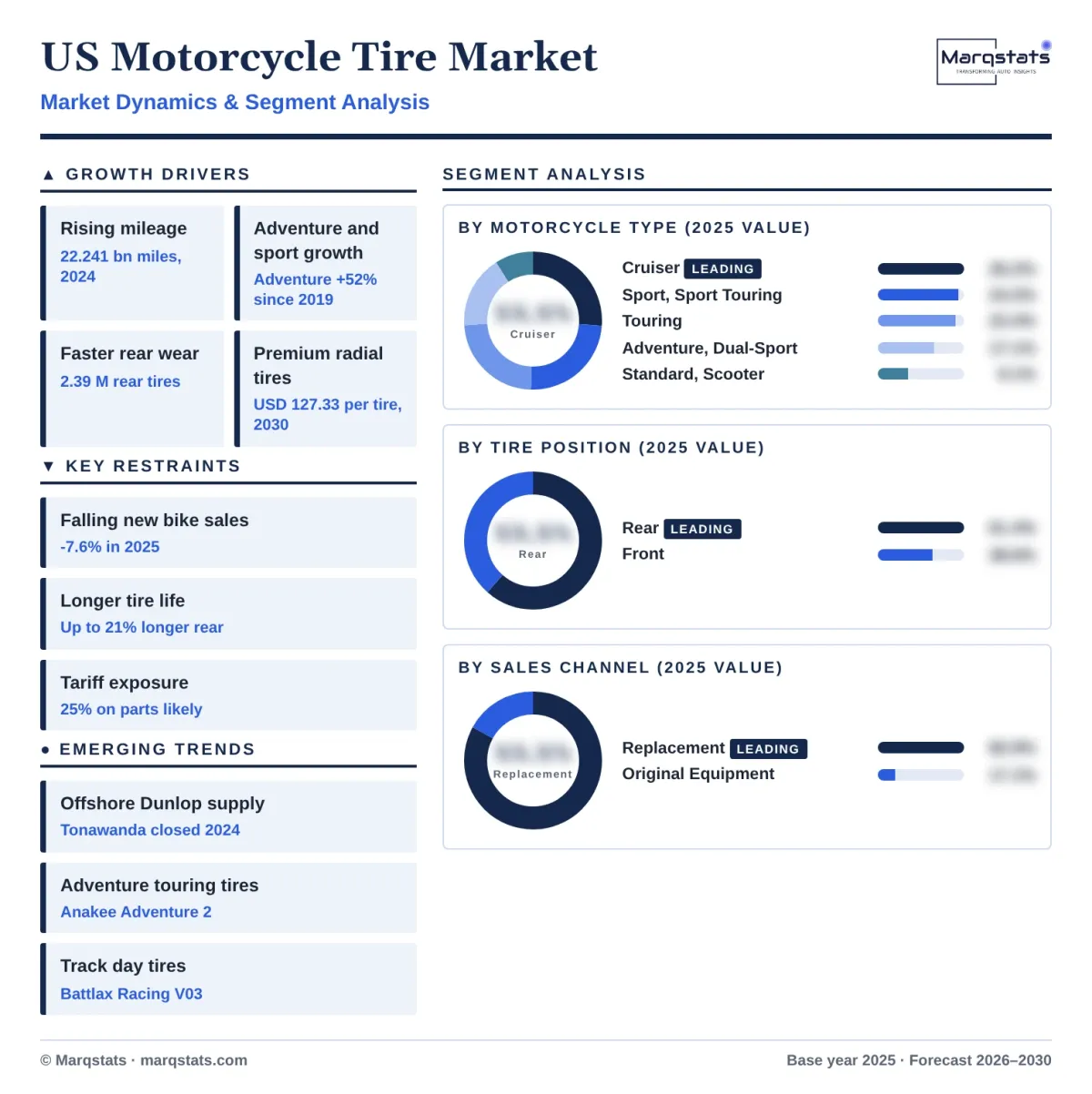
- Rising motorcycle mileage. Motorcycle miles reached 22.241 billion in 2024, up 10.21% from 2023 and 13.0% above the 19.688 billion recorded in 2019. Each additional billion miles adds roughly 146,000 replacement tires a year at average tire lives, so mileage growth feeds directly into tire demand. Marqstats projects replacement units to rise from 3.28 million in 2025 to 3.70 million by 2030. Mileage per registered motorcycle rose from 2,121 in 2023 to 2,401 in 2024. Marqstats assumes motorcycle mileage grows 1.5% in 2025 from the 2024 level, to about 22.57 billion miles.
- Growth of adventure and sport riding. The Motorcycle Industry Council (MIC) reported that adventure motorcycle sales rose 52% from 2019 to 2025, adventure bikes under 600cc rose 10% in 2025 and sport bike sales rose 13% in 2025. Sport bikes wear rear tires in about 5,000 miles, and adventure riders often run separate road and off-road tire sets in sizes such as 90/90-21 and 150/70R17, which lifts tires bought per motorcycle. Adventure and off-highway-capable motorcycles gained two share points of sales in 2025 and eight points since 2019. Small-displacement adventure models from Kawasaki, Honda and KTM bring new riders into the segment at lower purchase prices.
- Faster rear tire wear. Rear tires carry drive torque and most of the load, so they wear out well before front tires. Marqstats estimates 2.39 million rear tires against 1.77 million front tires in 2025. The FHWA-based wear illustration shows that raising rear tire life from 8,000 to 10,000 miles alone cuts annual tire need by about 556,000 units, which makes rear wear the most sensitive input in the market. Sport riders often replace rear tires twice for every front tire. Wider rear tires on modern cruisers and baggers also wear faster under heavy torque from large-displacement engines.
- Large and aging motorcycle fleet. The registered fleet of more than 9.2 million motorcycles includes a large base of older cruisers and touring bikes that need tires on a calendar cycle. Tire makers advise replacing motorcycle tires after about five years whatever the tread depth, and riders replace cracked or hardened tires before the riding season, which supports replacement demand from low-mileage bikes. Spring is the peak tire season, as riders inspect bikes after winter storage. Riders who store bikes outdoors see faster sidewall cracking from sun and ozone exposure.
- Premium radial and dual-compound tires. Riders upgrade to radial sport touring tires with dual compounds, such as Michelin's Road series and Bridgestone's Battlax line, which sell at higher prices than bias tires. Dunlop's American Elite 2 for touring cruisers retails at USD 218.95 to USD 453.95 per tire depending on size, and the average dealer value per tire rises from USD 113.09 in 2025 to USD 127.33 by 2030. Radial tires now fit most new sport, sport touring and adventure motorcycles as original equipment. Premium brands also offer mileage warranties on touring tires, which supports higher prices.
Key Restraints
Four constraints hold back motorcycle tire growth.
- Falling new motorcycle sales. MIC reported that new motorcycle and scooter retail sales fell 7.6% in 2025, with touring sales down 13% and cruisers down 6%. Marqstats estimates original equipment tires fell to 0.88 million in 2025 and recover only to 0.96 million by 2030. Weaker new sales also slow the arrival of new motorcycles into the replacement fleet. Buyers shifted toward smaller, lower-priced motorcycles in 2025, which carry cheaper tires.
- Longer tire life. Tire makers extend mileage with each product generation: Michelin claims up to 21% longer rear life and 7% longer front life for the Anakee Adventure 2 than its predecessor. Longer life lowers the number of tires bought per mile ridden and offsets part of mileage growth. Dual-compound treads extend center wear life without giving up cornering grip.
- Tariffs and import costs. With US motorcycle tire production gone after the Tonawanda closure, nearly all tires are imported and exposed to tariff changes. MIC noted in April 2026 that aftermarket and replacement motorcycle parts are still likely to face 25% Section 232 duties, even after a revision removed some finished motorcycles from the derivative product list. Customs value per tire already rose 7.56% in 2025. Distributors that import a full season of stock face the largest exposure to duty changes.
- Seasonal and dormant riding. Many motorcycles in northern states sit idle for four to six months a year, and a share of registered motorcycles barely moves. Marqstats applies an active-use adjustment to wear-based demand, which reduces modeled replacement demand by about 30% against the theoretical wear total. Dormant motorcycles still need tires on an age cycle when owners return them to the road.
Key Trends
Four shifts are changing how motorcycle tires are made, sold and used.
- Offshore production for US brands. Dunlop moved American Elite and other US-built lines to Japan and Indonesia after Sumitomo Rubber closed the Tonawanda plant, which employed about 1,550 workers and had operated since 1923. Dunlop launched the second-generation American Elite for Harley-Davidson touring and cruiser bikes from these plants, with a new tread and compound for higher mileage. Offshore sourcing also lengthens lead times for dealers that restock in the spring.
- Adventure touring tires. Michelin launched the Anakee Adventure 2 in January 2026 as the flagship of its adventure touring range, with silica compounds for wet grip, a dual-compound tread and an M+S marking. Continental's TKC70 Rocks rear and Michelin's Road Classic for standard motorcycles widen the range of road-biased and retro tires. Adventure riders replace tires more often when they alternate between road and trail sets.
- Track day and performance tires. Bridgestone is launching the Battlax Racing V03 in Europe and North America in 2026, including a Sprint Spec rear for short track sessions. Track day riders buy several sets of tires a season in sizes such as 120/70ZR17 and 200/55ZR17, which raises value per rider in the sport segment. Track day organizers and racing schools add steady demand for performance rear tires.
- Online tire retail and home mounting. Riders buy tires through online powersports retailers such as RevZilla and Cycle Gear, both owned by Comoto Holdings, Inc., and have them mounted at independent shops or at home. Distributors such as LeMans Corporation's Parts Unlimited and Western Power Sports, LLC supply independent dealers with next-day delivery across most of the country. Online retailers publish fitment guides by motorcycle model, which helps riders buy the right size.
Market Segmentation
Touring motorcycle tires account for an estimated USD 109.86 million, or 23.35% of 2025 value, and are projected to reach USD 128.17 million by 2030 at a 3.13% CAGR. These bikes use 0.89 million tires in 2025 at an average of USD 122.78 per tire, in sizes such as 130/70B18 front and 180/65B16 rear on Harley-Davidson touring models. Touring sales fell 13% in 2025, which slows original equipment demand, while long-distance riding keeps replacement steady. Touring riders cover long distances on loaded bikes, which wears rear tires faster than on unloaded cruisers.
Cruiser tires account for an estimated USD 123.15 million, or 26.18% of 2025 value, the largest motorcycle type, and are projected to reach USD 146.97 million by 2030 at a 3.60% CAGR. Cruisers use 1.05 million tires in 2025 at an average of USD 117.63 per tire, in sizes such as 130/90B16, MT90B16 and 150/80B16. Bias-belted construction dominates, and long tire life of about 11,000 rear miles keeps units per motorcycle low. Dunlop and Michelin supply most cruiser original equipment tires on US-built models.
Sport and sport touring tires account for an estimated USD 114.03 million, or 24.24% of 2025 value, and are projected to reach USD 151.02 million by 2030 at a 5.78% CAGR. These bikes use 0.89 million tires in 2025 at the highest average value of USD 128.26 per tire, in radial sizes such as 120/70ZR17, 180/55ZR17 and 190/50ZR17. Sport bike sales rose 13% in 2025, and short rear tire life of about 5,000 miles drives frequent replacement. Sport touring riders choose dual-compound tires that balance mileage with cornering grip.
Adventure and dual-sport tires account for an estimated USD 80.40 million, or 17.09% of 2025 value, and are projected to reach USD 112.83 million by 2030 at a 7.01% CAGR, the fastest motorcycle type. These bikes use 0.75 million tires in 2025 at an average of USD 106.71 per tire, in sizes such as 90/90-21, 120/70R19, 150/70R17 and 170/60R17. Adventure bike sales rose 52% from 2019 to 2025, and riders often own separate road and off-road sets. Adventure tires carry M+S markings and block treads that wear faster on pavement than road tires.
Standard and scooter tires account for an estimated USD 43.01 million, or 9.14% of 2025 value, and are projected to reach USD 54.36 million by 2030 at a 4.80% CAGR. These motorcycles use 0.58 million tires in 2025 at the lowest average value of USD 74.63 per tire, in sizes such as 110/70-17, 140/70-17, 120/70-12 and 130/70-12. Small-displacement bikes gained share in 2025 as buyers moved toward lower-priced models. Scooter tires on 12-inch and 13-inch rims are the lowest-priced products in the market.
Rear tires account for an estimated USD 288.78 million, or 61.38% of 2025 value, and are projected to reach USD 364.90 million by 2030 at a 4.79% CAGR. Riders bought or received 2.39 million rear tires in 2025, rising to 2.68 million by 2030, because rear tires carry drive torque and wear out in roughly 60% to 75% of the miles of a front tire. Wider rear sizes such as 180/55ZR17 and 180/65B16 also sell at higher prices. Rear tire value grows slightly faster than front value as sport and adventure riders gain share.
Front tires account for an estimated USD 181.67 million, or 38.62% of 2025 value, and are projected to reach USD 228.45 million by 2030 at a 4.69% CAGR. Front units were 1.77 million in 2025, rising to 1.98 million by 2030, at prices about 14% below rear tires of the same line. Many riders replace front and rear tires together for matched handling, which narrows the gap between front and rear replacement. Front tire wear also depends on braking style, and sport riders replace fronts more often than cruiser riders.
Replacement accounts for an estimated USD 389.93 million, or 82.88% of 2025 value, and is projected to reach USD 494.24 million by 2030 at a 4.86% CAGR. Riders bought 3.28 million replacement tires in 2025, rising to 3.70 million by 2030, through motorcycle dealers, independent shops, online retailers and tire specialists. Replacement follows mileage and tire age rather than new motorcycle sales. Spring and early summer account for the largest share of replacement purchases.
Original equipment accounts for an estimated USD 80.52 million, or 17.12% of 2025 value, and is projected to reach USD 99.11 million by 2030 at a 4.24% CAGR. New motorcycles carried 0.88 million original equipment tires in 2025, rising to 0.96 million by 2030, priced about 20% below replacement. Harley-Davidson, Inc. and Polaris Inc. buy original equipment tires for US-assembled motorcycles, while imported motorcycles arrive with tires already fitted. Original equipment fitments also shape replacement choices, as many riders replace tires with the same model.
By Geography
South
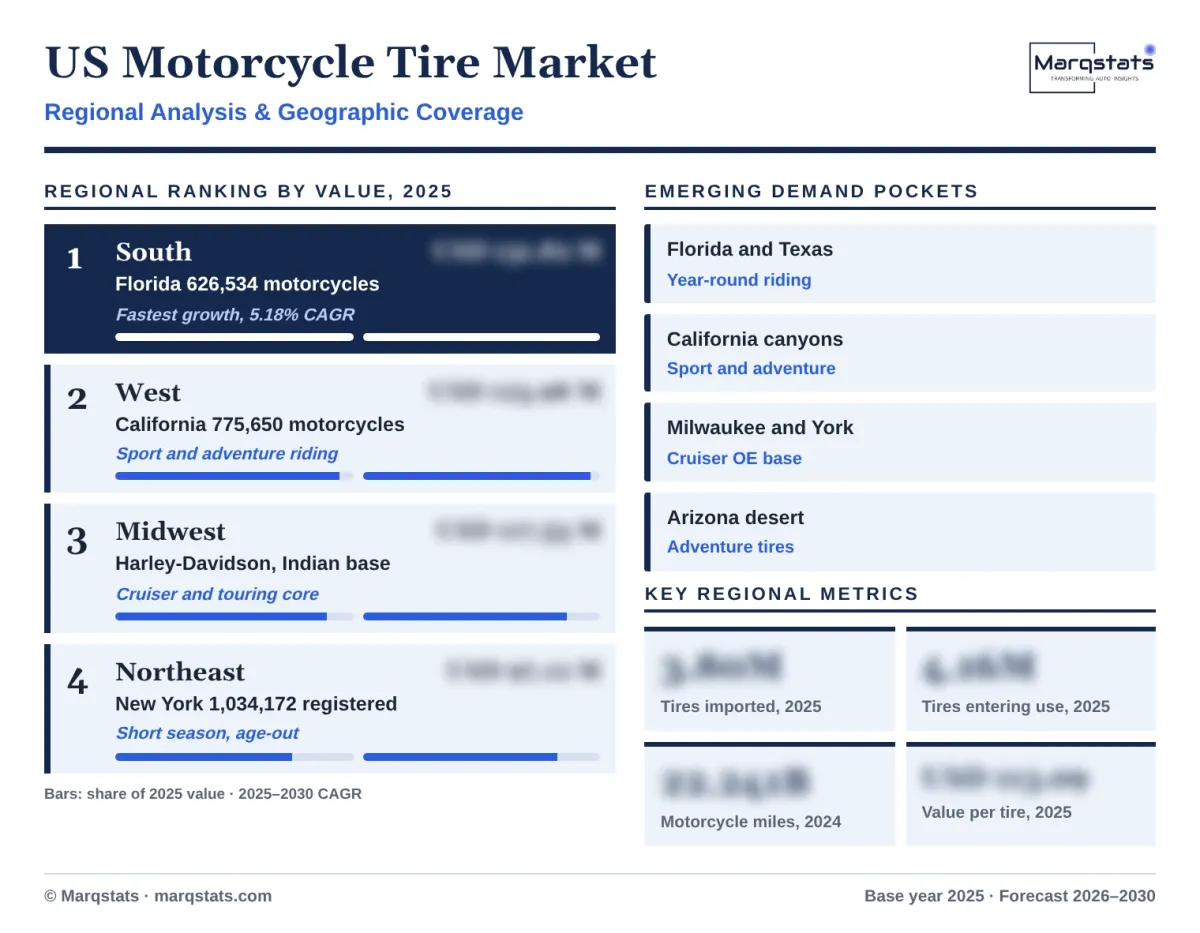
The South is the largest regional market at 28.03% of 2025 value, or USD 131.82 million, and grows fastest at a 5.18% CAGR to USD 169.69 million by 2030. Florida had 626,534 registered motorcycles in 2023 and Texas 333,397, and long riding seasons across the Sun Belt raise annual mileage per motorcycle. Daytona Bike Week and rallies across the region support touring and cruiser tire demand. Year-round riding in Florida and Texas pushes annual tire replacement above the national average.
West
The West accounts for 26.35% of 2025 value, or USD 123.98 million, and is projected to reach USD 158.03 million by 2030 at a 4.97% CAGR. California leads the country with 775,650 registered motorcycles, and Arizona adds 284,624. Montana's 423,458 registrations reflect many out-of-state owners who register vehicles there, so mileage in the West is lower than its registration count suggests. Canyon roads and desert trails favor sport and adventure tires. California's lane-splitting law and dense commuter riding add mileage on standard and scooter tires.
Midwest
The Midwest accounts for 24.98% of 2025 value, or USD 117.53 million, and is projected to reach USD 146.10 million by 2030 at a 4.45% CAGR. Ohio had 422,132 registered motorcycles and Wisconsin 323,755 in 2023. Harley-Davidson is headquartered in Milwaukee and Indian Motorcycle builds in Spirit Lake, Iowa, so the region anchors cruiser and touring demand and original equipment tire supply. Short riding seasons limit annual mileage. The Sturgis rally in South Dakota draws touring riders from across the region each August.
Northeast
The Northeast accounts for 20.64% of 2025 value, or USD 97.12 million, and is projected to reach USD 119.53 million by 2030 at a 4.24% CAGR. New York reported 1,034,172 registered motorcycles in 2023 and Pennsylvania 363,002, and Harley-Davidson builds motorcycles in York, Pennsylvania. Winter storage keeps many bikes off the road for months, so tires age out before tread wears on lightly used motorcycles. Dense urban areas in New York and New Jersey support scooter tire demand.
How Competition Is Evolving
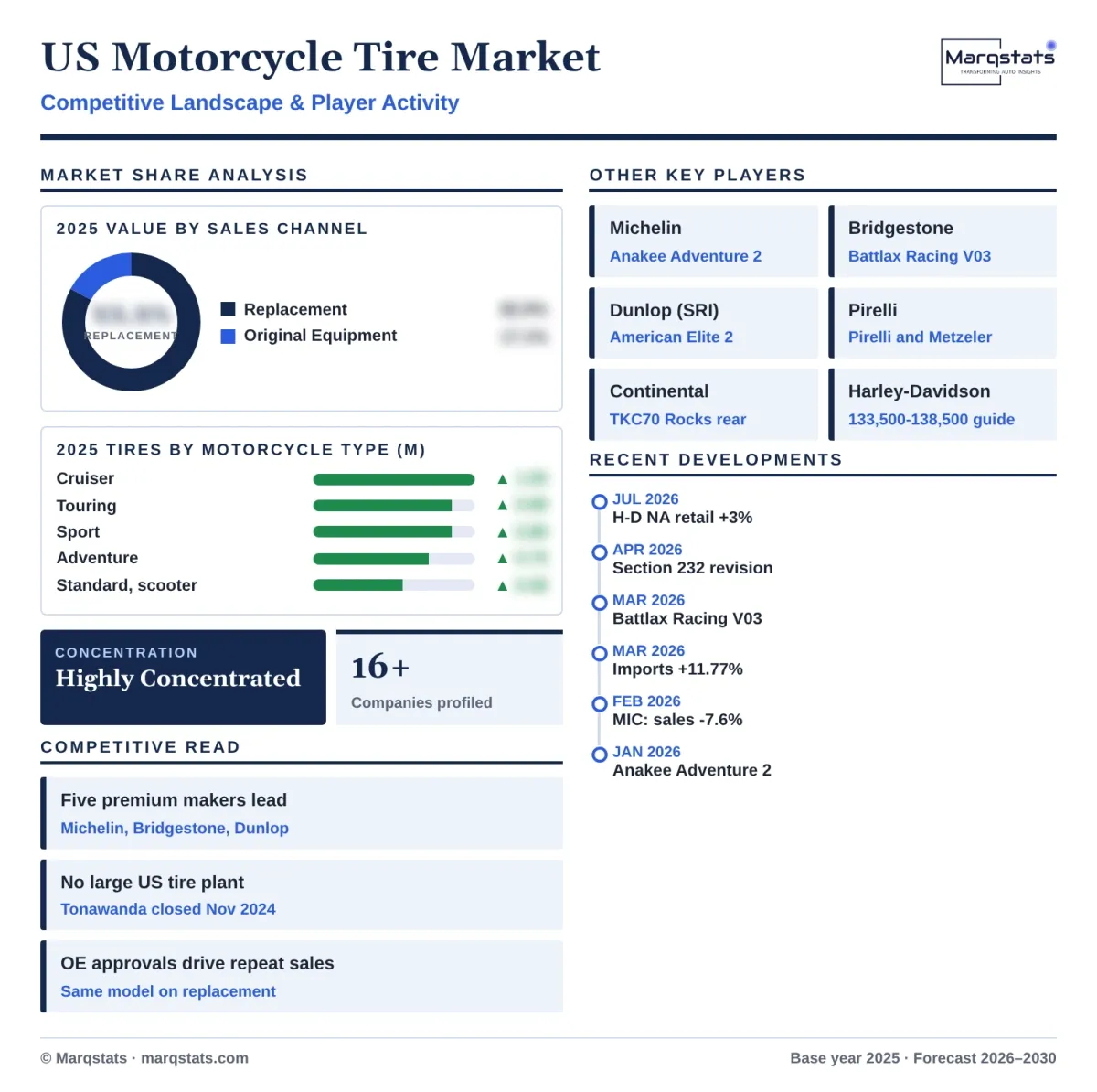
The US motorcycle tire market is highly concentrated, with five global premium makers holding most of the value. Compagnie Générale des Établissements Michelin SCA, Bridgestone Corporation, Sumitomo Rubber Industries, Ltd. through its Dunlop motorcycle brand, Pirelli & C. S.p.A. through the Pirelli and Metzeler brands, and Continental AG compete across sport, touring, adventure and cruiser lines. Dunlop holds strong original equipment positions on US cruisers and touring bikes, while Michelin, Bridgestone and Pirelli lead in radial sport and sport touring tires.
Value and specialty brands compete on price and niche fitments. Kenda Rubber Industrial Company, Ltd., Cheng Shin Rubber Ind. Co., Ltd. with its Maxxis brand, Inoue Rubber Co., Ltd. with IRC tires and Hwa Fong Rubber Industrial Co., Ltd. with Duro tires supply scooter, standard and dual-sport sizes. Reifenwerk Heidenau GmbH & Co. KG and The Yokohama Rubber Co., Ltd., which owns Mitas through Yokohama TWS, serve adventure and off-road riders with knobby and dual-purpose tires such as 90/90-21 fronts.
Distribution decides reach. LeMans Corporation's Parts Unlimited, Western Power Sports, LLC and Comoto Holdings, Inc., which owns RevZilla and Cycle Gear, move tires to dealers and riders, and Harley-Davidson, Inc. and Polaris Inc. sell branded and approved tires through their dealer networks. Harley-Davidson raised its 2026 retail guidance to 133,500 to 138,500 motorcycles in July 2026 after North American retail sales rose 3% in Q2, which supports original equipment and dealer tire sales.
Original equipment approvals carry weight in the replacement channel. Motorcycle makers approve specific tire models for each bike, and dealers recommend approved tires to protect handling and warranty, so a tire maker that wins an original equipment fitment on a high-volume cruiser or adventure model gains several years of replacement sales. Tire makers therefore invest in joint development with Harley-Davidson, Indian, BMW, Honda and Kawasaki for new models, and premium brands use racing programs such as MotoAmerica to build credibility with sport riders.
The Tonawanda closure reshaped supply. With no remaining large US motorcycle tire plant, all brands compete on imported supply and on product launches, and tariff costs fall on every competitor alike. Product cycles have quickened: Michelin, Dunlop, Continental and Bridgestone all launched new adventure, cruiser, standard or track tires for 2026. EV tire demand from electric motorcycles such as LiveWire models is covered in the Marqstats Electric Vehicle Tire Market report.
Companies Covered
Companies covered in the report include:
Recent Market Activity
Table of Contents
Coverage & Segmentation
The US motorcycle tire market comprises new tires for on-road motorcycles and scooters, sold as replacement tires and fitted as original equipment on new motorcycles sold in the United States, valued at dealer and motorcycle maker purchase prices in US dollars. The market excludes motocross and enduro competition tires, ATV and side-by-side tires, three-wheel motorcycle tires, used tires and mounting services. Coverage uses a 2025 base year, a 2021–2025 historical period and a 2026–2030 forecast period, with 2026 as the estimated year. Specialty trailer tire demand from the same import series is covered in the Marqstats US Trailer Tire Market report.
Segmentation covers five motorcycle types, two tire positions, two sales channels and four US regions, with 16 tire makers, motorcycle makers and distributors profiled. Replacement units follow motorcycle mileage and separate front and rear tire lives, original equipment units follow new motorcycle sales, and the import series is reconciled with demand and channel stock. Sizes such as 120/70ZR17, 180/55ZR17, 130/70B18, 180/65B16, 130/90B16, 90/90-21 and 120/70-12 are tracked as reference sizes. Tire dealer channel economics are covered in the Marqstats US Tire Dealer Market report.