Market Snapshot
Middle bar: base-year value × (1 + CAGR), rounded to two decimals. This is a calculated illustration, not a separately researched annual estimate.
The Saudi Arabia tire market is valued at USD 2,106.83 million in 2025 and is projected to reach USD 2,800.22 million by 2030, registering a CAGR of 5.86% over 2026–2030. The market covers replacement tires for passenger cars, SUVs, light commercial vehicles, trucks and buses, valued at importer and distributor selling prices. Marqstats estimates 22.44 million tires were sold in 2025 into a fleet of about 16.38 million vehicles, and Saudi Arabia imported USD 1,290.29 million of new car, bus and truck tires in 2024, 55.31% of it from China.
Market size and forecast figures are generated using Marqstats' proprietary estimation framework, updated as of October 2026.
Coverage spans three vehicle types, six source countries and five regions of the Kingdom. The analysis benchmarks 16 tire makers, including Bridgestone Corporation, Compagnie Générale des Établissements Michelin SCA, Hankook Tire & Technology Co., Ltd. and Pirelli & C. S.p.A., and the Saudi distributors that carry them, including Bin-Shihon, Juffali Michelin, Tamimi and Al Rashed. Reference sizes include 205/55R16 on sedans, 265/65R17 and 285/60R18 on SUVs and pickups, and 315/80R22.5 on trucks.
Key Takeaways
Market Overview & Analysis
Report Summary
The Saudi Arabia tire market comprises new replacement tires for passenger cars, SUVs, pickups, vans, trucks and buses sold in the Kingdom, valued at USD 2,106.83 million in 2025 at importer and distributor selling prices. Off-the-road, agricultural and motorcycle tires, retreads, used tires, installation and service revenue sit outside the market perimeter. Tires fitted to imported new vehicles arrive with the vehicle, so the market is a replacement market served by imports, with local production planned from 2026. Marqstats estimates 22.44 million tires were sold in 2025, rising to 26.45 million by 2030.
The vehicle fleet sets demand. The General Authority for Statistics (GASTAT) counts 15.88 million registered and roadworthy vehicles at the end of 2024, up 6.9%, including about 13.8 million passenger vehicles and 2.0 million commercial vehicles, and Marqstats estimates 16.38 million for 2025. New registrations reached 1,025.7 thousand in 2024, up from 878.1 thousand in 2023 and 681.5 thousand in 2022. Marqstats estimates replacement at 1.2 tires per passenger vehicle, 1.6 per light commercial vehicle and 4.0 per truck or bus each year, reflecting heat, long distances and high fleet utilization. Tire units therefore grow faster than imports suggest, as more vehicles reach replacement age each year and commercial fleets expand.
Customs data anchor the value. Saudi Arabia imported USD 728.034 million of passenger-type tires under HS 401110 and USD 562.251 million of bus and truck tires under HS 401120 in 2024, while gross exports were only USD 8.231 million and USD 2.942 million. Passenger-type tire imports peaked at USD 955.179 million in 2019, fell to USD 580.116 million in 2020 and recovered to USD 763.435 million in 2023. Marqstats values passenger car and SUV tires at an estimated USD 63.96 per tire in 2025, light commercial vehicle tires at USD 118.19 and truck and bus tires at USD 236.39 at distributor selling prices. China took a larger share of bus and truck tire imports than of passenger-type tire imports, at 68.18% against 45.37%, since fleets buy mainly on price per kilometer.
Local production and vehicle assembly are taking shape. Mena Tyre Company, owned 75% by the Public Investment Fund and 25% by Pirelli, awarded an estimated SR628 million construction contract in September 2025 for a plant of about 3.5 million tires a year at King Abdullah Economic City, and Saudi Basic Industries Corporation (SABIC) agreed in February 2026 to supply polybutadiene rubber and carbon black. Hyundai Motor Manufacturing Middle East targets 50,000 vehicles a year with a first vehicle in Q4 2026, and Lucid Group, Inc. reported in August 2026 that its AMP-2 manufacturing systems were being installed and commissioned. The wider Gulf market is covered in the Marqstats GCC Tire Market report.
Market Dynamics
Key Drivers
Five factors lift Saudi tire demand faster than the vehicle fleet.
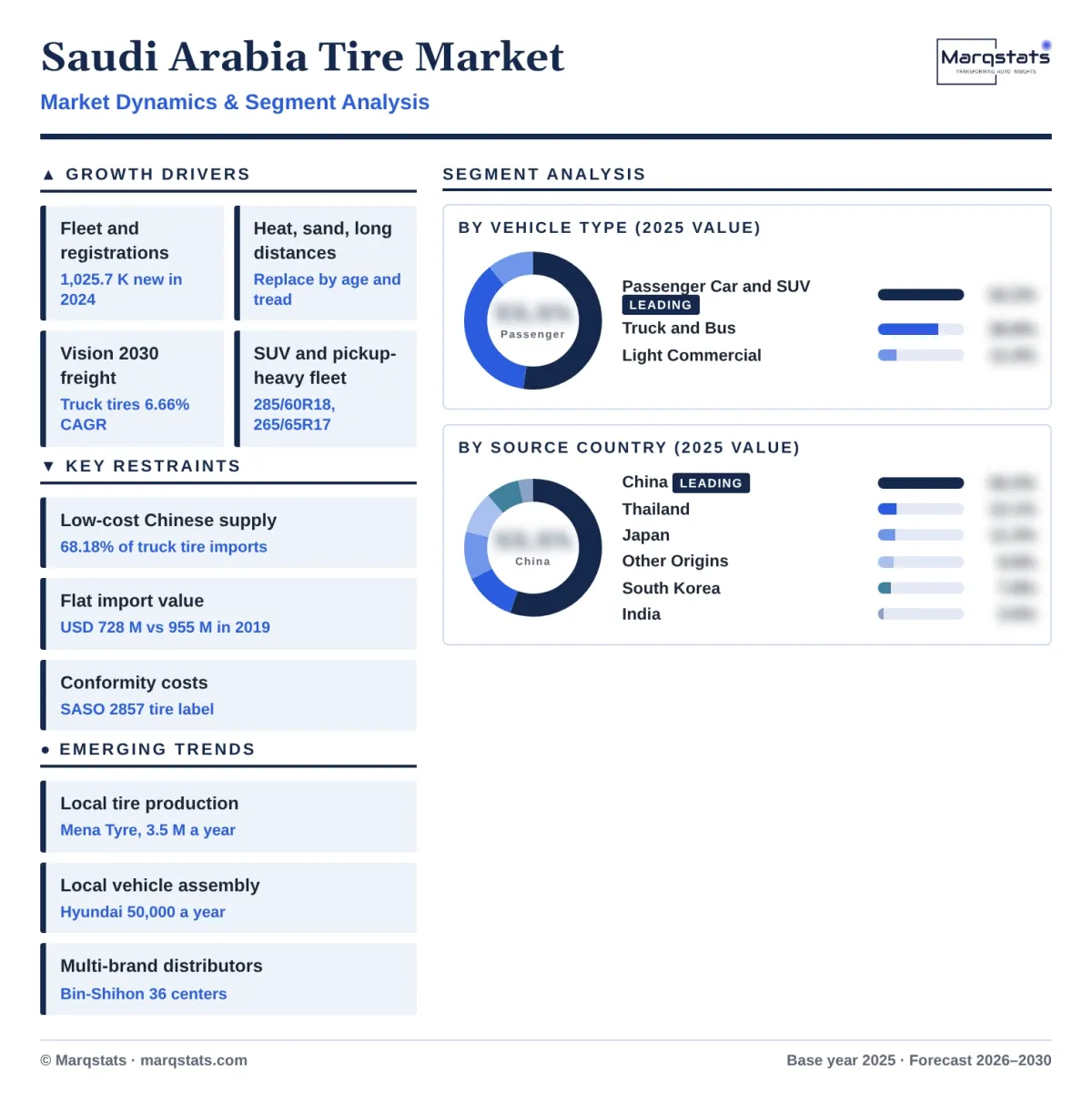
- Fleet growth and new registrations. The Saudi fleet grew 6.9% to 15.88 million vehicles in 2024, and new registrations rose 16.8% to 1,025.7 thousand. Each new vehicle joins the replacement pool within two to three years, and Marqstats projects tire units to rise from 22.44 million in 2025 to 26.45 million by 2030. Registrations rose from 568.3 thousand in 2020 to 1,025.7 thousand in 2024, so a large cohort of young vehicles reaches its first tire change during 2026–2028.
- Heat, sand and long distances. Summer air temperatures near 50°C, hot road surfaces and sand speed up tread wear and rubber aging. Long intercity trips, such as Riyadh to Dammam or Jeddah to Madinah, add high annual mileage. Many drivers replace tires by age as well as by tread depth, which raises replacement frequency above temperate markets. Heat also raises inflation pressure and sidewall stress, which increases the risk of failure on worn or aged tires.
- Vision 2030 projects and freight. Giga-projects, port expansion and logistics zones raise truck and bus activity across the Kingdom. Truck and bus tire units rise from 3.28 million in 2025 to 4.20 million by 2030, and the segment grows at a 6.66% CAGR to USD 1,069.01 million. Fleets running 315/80R22.5 and 385/65R22.5 tires on construction and haulage routes replace tires several times a year. Truck and bus tires carry the highest price per tire in the market, so freight growth lifts value faster than units.
- SUV and pickup-heavy fleet. Saudi buyers favor SUVs and pickups such as the Toyota Land Cruiser, Hilux and Nissan Patrol, which run larger sizes such as 285/60R18 and 265/65R17. Larger sizes carry higher prices than sedan sizes such as 205/55R16. Light commercial vehicle tires grow at a 6.53% CAGR to USD 318.72 million by 2030. Weekend desert and off-road driving adds wear on all-terrain tires fitted to these vehicles.
- Ride-hailing, rental and tourism. Tourism programs, religious travel to Makkah and Madinah and the growth of ride-hailing and rental fleets add high-mileage cars to the fleet. Fleet cars replace tires more often than private cars, which supports demand in the Western and Central regions. Rental and ride-hailing operators buy in bulk from distributors and negotiate fleet pricing and fitting packages.
Key Restraints
Four constraints shape pricing and growth in the Saudi tire market.
- Low-cost Chinese supply. China supplied USD 330.308 million, or 45.37%, of passenger-type tire imports and USD 383.337 million, or 68.18%, of bus and truck tire imports in 2024. Low-cost brands hold the passenger car and SUV price at an estimated USD 63.96 per tire, and price-led buying limits premium brand share among small fleets and taxi drivers. Premium brands answer with second brands and value lines to defend volume.
- Flat import value. Passenger-type tire imports fell 4.6% to USD 728.034 million in 2024 and remain below the 2019 level of USD 955.179 million. Buyers trade down to lower-priced brands, which holds value growth below unit growth in the passenger car and SUV segment. Value growth in the market therefore depends on vehicle mix and larger sizes as much as on price.
- Conformity and labelling costs. The Saudi Standards, Metrology and Quality Organization (SASO) regulates tire energy-efficiency labels under SASO 2857, and each product must pass conformity registration before sale. New suppliers face registration costs and lead times for each size, which slows launches and favors established importers. Conformity rules also protect buyers from substandard and aged tires, which favors suppliers with local warehouses and fast stock turns.
- Working capital and stock age. Distributors carry large stocks across hundreds of sizes and extend credit to thousands of dealers. Bin-Shihon reports one central and 32 sub-warehouses serving more than 8,000 dealers. Heat makes stock age a quality issue, so slow-moving sizes tie up capital and lose value. Distributors with bank lines and wide warehouse networks hold an advantage over new entrants on credit and availability.
Key Trends
Four shifts are changing how tires are made, sourced and sold in Saudi Arabia.
- Local tire production. Mena Tyre Company plans about 3.5 million passenger tires a year under Pirelli and a new local brand, with SABIC supplying polybutadiene rubber and carbon black and a supply MoU signed with Hyundai Motor Manufacturing Middle East in March 2026. Local output gives automakers and fleets a domestic source and enters the market from 2026. Domestic output also shortens lead times against shipments from China and Southeast Asia.
- Local vehicle assembly and OE fitment. Hyundai targets 50,000 vehicles a year at its Saudi plant from Q4 2026, and Lucid is commissioning AMP-2 manufacturing systems at King Abdullah Economic City. Local assembly opens an OE tire channel that does not exist today. OE approvals at local plants also guide replacement buying, since owners often keep the original tire brand.
- Multi-brand distributor portfolios. Bin-Shihon carries Hankook, Laufenn and Prinx through 36 sales centers, and its United Tires unit lists Jinyu, Roadx, West Lake and Kapsen. Al Rashed Tires carries Goodyear, Kelly, Sonar, Triangle, BKT, TVS and Maxam, and Tamimi Commercial distributes Firestone, Giti and Delinte with AutoFast maintenance services. Broad portfolios let distributors serve each price tier through the same dealer network.
- Promotions and branded service. Juffali and Michelin ran a Saudi National Day promotion from September to October 2025, with a SAR 95 voucher per eligible passenger or SUV tire at 16 branches. Branded service formats such as TyrePlus and Michelin Truck Service Centers combine tire sales with fitting, alignment and fleet services. Service formats raise customer retention, since drivers and fleets return to the same outlet for each change.
Market Segmentation
Passenger car and SUV tires account for an estimated USD 1,100.11 million, or 52.21% of 2025 value, and are projected to reach USD 1,412.49 million by 2030 at a 5.13% CAGR. The segment covers 17.20 million tires in 2025 at an estimated USD 63.96 per tire, with common sizes including 205/55R16 and 215/55R17 on sedans and 265/65R17 and 285/60R18 on SUVs. Units rise to 19.81 million by 2030. Share eases from 52.21% to 50.44% by 2030 as commercial fleets grow faster.
Light commercial vehicle tires account for an estimated USD 232.32 million, or 11.03% of 2025 value, and are projected to reach USD 318.72 million by 2030 at a 6.53% CAGR. The segment covers 1.97 million tires for pickups and vans in 2025 at USD 118.19 per tire, with sizes such as 265/70R16 and 195R15C. Delivery, contractor and government fleets drive demand. Units rise from 1.97 million in 2025 to 2.44 million by 2030.
Truck and bus tires account for an estimated USD 774.40 million, or 36.76% of 2025 value, and are projected to reach USD 1,069.01 million by 2030 at a 6.66% CAGR, the fastest vehicle type. An estimated 3.28 million tires were sold in 2025 at USD 236.39 per tire, led by 315/80R22.5, 12R22.5 and 385/65R22.5 sizes. Saudi Arabia imported USD 562.251 million of bus and truck tires in 2024. Units rise from 3.28 million in 2025 to 4.20 million by 2030 as construction and logistics fleets expand.
Chinese-made tires account for an estimated USD 1,165.28 million, or 55.31% of 2025 value, and are projected to reach USD 1,484.11 million by 2030 at a 4.96% CAGR. China supplied 45.37% of passenger-type and 68.18% of bus and truck tire imports in 2024, through brands such as West Lake, Triangle, Linglong and Sailun. Share eases to 53.00% by 2030 as local production starts. Chinese suppliers also ship from plants in Thailand and Vietnam, which appear under those origins in customs data.
Thai-made tires account for an estimated USD 254.72 million, or 12.09% of 2025 value, and are projected to reach USD 322.03 million by 2030 at a 4.80% CAGR. Thailand supplied USD 111.172 million, or 15.27%, of passenger-type tire imports in 2024 from plants run by Japanese, European and Chinese tire makers. Thailand supplied a further USD 44.856 million, or 7.98%, of bus and truck tire imports.
Japanese-made tires account for an estimated USD 237.44 million, or 11.27% of 2025 value, and are projected to reach USD 266.02 million by 2030 at a 2.30% CAGR, the slowest source country. Japan supplied 13.55% of passenger-type and 8.31% of bus and truck tire imports in 2024, led by Bridgestone, Yokohama, Toyo and Dunlop. Japanese brands hold strong positions in SUV and pickup sizes fitted to Toyota and Nissan vehicles.
South Korean-made tires account for an estimated USD 165.18 million, or 7.84% of 2025 value, and are projected to reach USD 196.02 million by 2030 at a 3.48% CAGR. South Korea supplied USD 94.917 million, or 13.04%, of passenger-type tire imports in 2024, led by Hankook through Bin-Shihon. South Korea supplied only 1.11% of bus and truck tire imports. Hankook sponsors Saudi football club Al-Ittihad under a three-season agreement from the 2024/25 season.
Indian-made tires account for an estimated USD 76.69 million, or 3.64% of 2025 value, and are projected to reach USD 126.01 million by 2030 at a 10.44% CAGR. India supplied USD 38.065 million, or 6.77%, of bus and truck tire imports in 2024, through brands such as BKT, Apollo and CEAT. India also supplied USD 8.869 million, or 1.22%, of passenger-type tire imports in 2024.
Other origins, including Europe, Vietnam, Indonesia, Turkey and Saudi domestic production from 2026, account for an estimated USD 207.52 million, or 9.85% of 2025 value, and are projected to reach USD 406.03 million by 2030 at a 14.37% CAGR, the fastest group. Mena Tyre Company output from King Abdullah Economic City lifts the group's share to 14.50% by 2030. European premium brands from Germany, Poland and Italy also sit in this group.
By Geography
Central Region
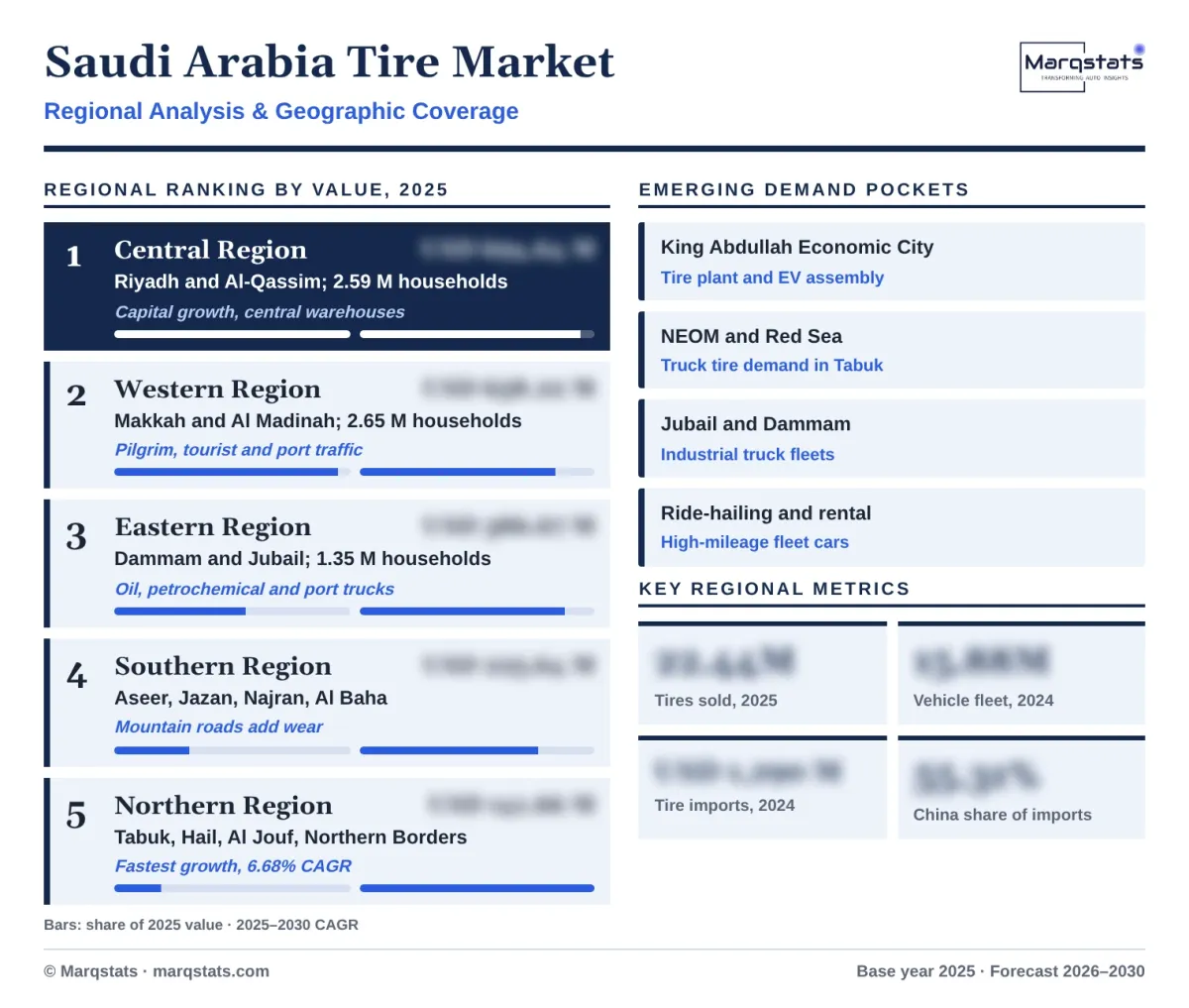
The Central Region, covering Riyadh and Al-Qassim, is the largest market at 32.98% of 2025 value, or USD 694.64 million, rising to USD 940.90 million by 2030 at a 6.26% CAGR. Riyadh and Al-Qassim hold 2.59 million of the Kingdom's 8.17 million households in the 2022 census, and Riyadh's growth as the capital and headquarters hub adds cars and service fleets. Long highway links to Dammam and Qassim raise annual mileage. Distributors such as Bin-Shihon and Tamimi run central warehouses that serve dealers across the Kingdom from the capital.
Western Region
The Western Region, covering Makkah and Al Madinah, accounts for 31.24% of 2025 value, or USD 658.22 million, and is projected to reach USD 860.92 million by 2030 at a 5.52% CAGR. The region holds 2.65 million households, the most of any region, and Jeddah Islamic Port is a main entry point for imported goods. Pilgrim and tourist transport adds bus and taxi tire demand. Juffali's TyrePlus outlets and truck service centers serve fleets along the Jeddah port corridor.
Eastern Region
The Eastern Region accounts for 18.35% of 2025 value, or USD 386.67 million, and is projected to reach USD 513.40 million by 2030 at a 5.83% CAGR. The region holds 1.35 million households, and oil, petrochemical and port activity around Dammam and Jubail lifts truck tire demand above the region's population share. The King Fahd Causeway also links the region's distributors to Bahrain.
Southern Region
The Southern Region, covering Aseer, Jazan, Najran and Al Baha, accounts for 10.71% of 2025 value, or USD 225.64 million, and is projected to reach USD 289.26 million by 2030 at a 5.09% CAGR, the slowest of the five regions. The region holds 1.00 million households, and mountain roads in Aseer and Al Baha add tread wear. Agricultural and border trade routes in Jazan and Najran add light commercial vehicle tire demand.
Northern Region
The Northern Region, covering Tabuk, Hail, Al Jouf and the Northern Borders, accounts for 6.72% of 2025 value, or USD 141.66 million, and grows fastest at a 6.68% CAGR to USD 195.74 million by 2030. The region holds 0.58 million households, and construction traffic for NEOM and Red Sea projects in Tabuk lifts truck tire demand. Long distances between towns raise annual mileage per vehicle across the region.
How Competition Is Evolving
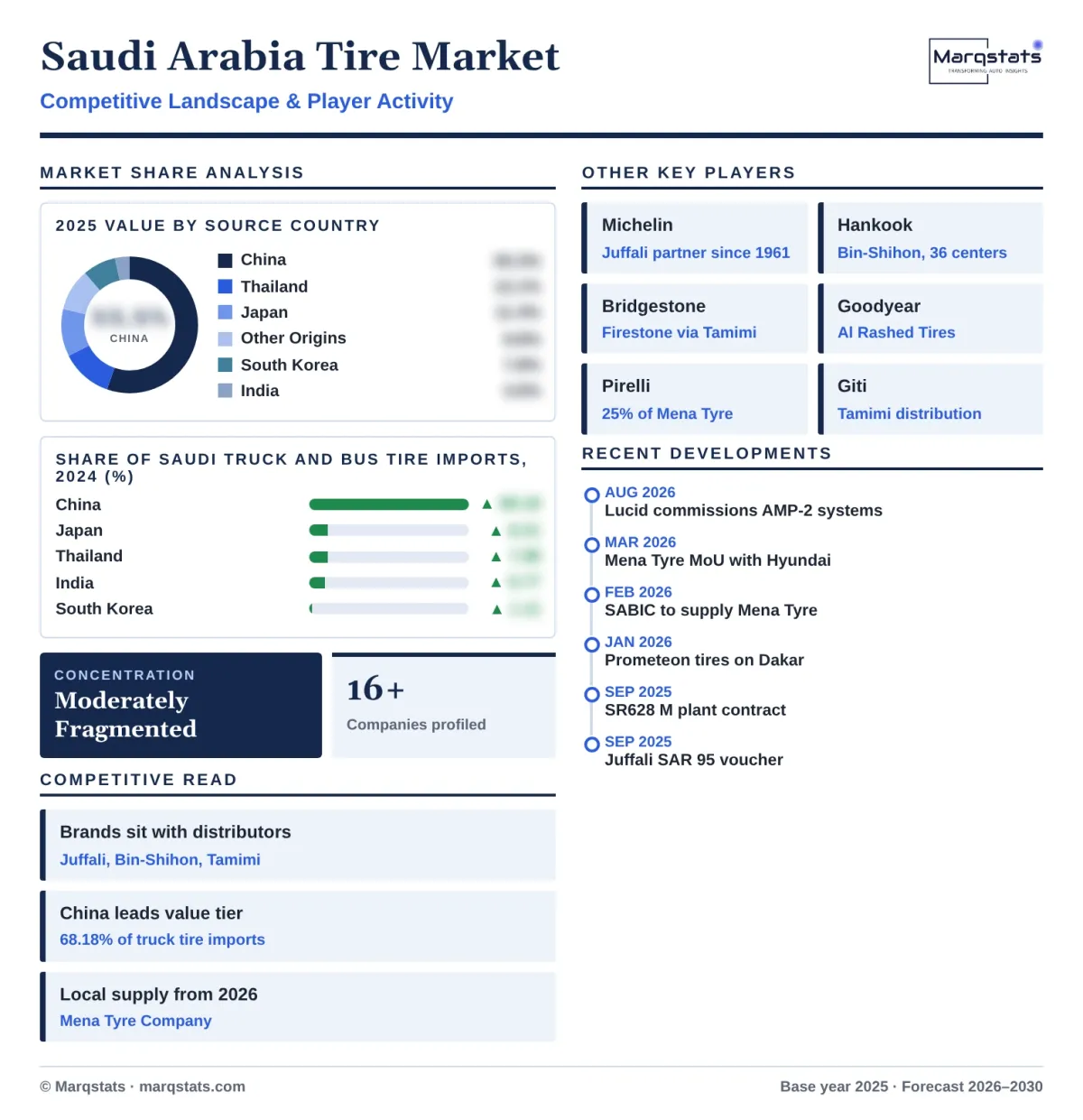
The Saudi Arabia tire market is moderately fragmented, with global brands sold through family-owned distributors and a broad range of Chinese brands sold through multi-brand importers and thousands of independent dealers. Compagnie Générale des Établissements Michelin SCA works through Juffali, its Saudi partner since 1961 and joint venture partner since 2002, and Hankook Tire & Technology Co., Ltd. works through Bin-Shihon, which states exclusive distribution. Bridgestone's Firestone brand, Giti Tire Pte. Ltd. and Delinte sell through Tamimi Commercial, and The Goodyear Tire & Rubber Company and Triangle sell through Al Rashed Tires. Pirelli & C. S.p.A. holds 25% of Mena Tyre Company, and Prinx Chengshan Holdings Limited reaches Saudi dealers through Bin-Shihon alongside Hankook and Laufenn.
Competition centers on distribution reach, stock availability and price ladders. Bin-Shihon reports 36 sales centers, three inspection centers, one central and 32 sub-warehouses and a reach of more than 8,000 dealers, while Tamimi lists offices and warehouses in nine Saudi cities. Distributors pair a premium brand with value brands to cover each price tier, and promotions such as Juffali's SAR 95 voucher campaign support premium sales. Chinese brands compete mainly on price per tire, while Japanese, Korean and European brands compete on durability in heat, fitting quality and warranty support.
Local production adds a new competitor from 2026. Mena Tyre Company plans about 3.5 million tires a year under Pirelli and a new local brand, and Blatco signed a partnership with Kumho Tire Co., Inc. and Misong Tech in February 2025 for a separate tire project. Local suppliers gain an advantage with automakers assembling in the Kingdom, such as Hyundai and Lucid. Imported brands respond with local warehousing and fleet service contracts to defend share against domestic supply. Dealer channel economics are benchmarked in the Marqstats US Tire Dealer Market report.
Companies Covered
Companies covered in the report include:
Recent Market Activity
Table of Contents
Coverage & Segmentation
The Saudi Arabia tire market comprises new replacement tires for passenger cars, SUVs, light commercial vehicles, trucks and buses sold in the Kingdom, valued at importer and distributor selling prices in US dollars. The market excludes off-the-road, agricultural and motorcycle tires, retreads, used tires, OE fitments at local assembly plants, and installation and service revenue. Coverage uses a 2025 base year, a 2021–2025 historical period and a 2026–2030 forecast period, with 2026 as the estimated year. Regional Gulf demand is covered in the Marqstats GCC Tire Market report.
Segmentation covers three vehicle types, six source countries and five regions, with 16 tire makers profiled. Units follow the vehicle fleet by class and annual replacement rates, value applies distributor selling prices per tire derived from customs import values, and regional values follow 2022 census household counts adjusted for commercial activity, with sizes such as 205/55R16, 265/65R17, 285/60R18 and 315/80R22.5 tracked as reference sizes. US truck tire benchmarks are covered in the Marqstats US Commercial Truck Tire Market report.