Market Snapshot
Middle bar: base-year value × (1 + CAGR), rounded to two decimals. This is a calculated illustration, not a separately researched annual estimate.
The US truck tire retreading market is valued at USD 3,650.07 million in 2025 and is projected to reach USD 4,121.72 million by 2030, registering a CAGR of 2.46% over 2026–2030. The market covers retreaded tires for medium and heavy trucks, trailers and buses, with roughly 15 million commercial tires retreaded in the United States each year from about 500 domestic plants. Retreads account for an estimated 37.78% of all truck and bus replacement tire applications in 2025, and 295/75R22.5 and 11R22.5 casings make up 52.6% of retread volume.
Market size and forecast figures are generated using Marqstats' proprietary estimation framework, updated as of October 2026.
Coverage spans three casing size groups and the five Traffic Volume Trends regions defined by the Federal Highway Administration (FHWA). The analysis benchmarks the retread system suppliers, including Bridgestone Bandag, Michelin Retread Technologies and Marangoni S.p.A., and the commercial dealers that operate retread plants, led by Southern Tire Mart, LLC with 25 plants and 8,310 retreads a day. Market value tracks the average retread price, estimated at USD 243.34 in 2025 and USD 275.97 by 2030.
Key Takeaways
Market Overview & Analysis
Report Summary
The US truck tire retreading market comprises retreaded tires for medium and heavy trucks, tractors, trailers and buses, valued at USD 3,650.07 million in 2025. The Tire Retread and Repair Information Bureau (TRIB) and the Tire Industry Association (TIA) report that roughly 15 million commercial tires are retreaded in the United States each year, and domestic retread plants fell from more than 3,000 in 1982 to about 500 in 2023. Passenger, light truck, off-the-road and aircraft retreads sit outside the market perimeter, as do new replacement tires, road service and casing trading revenue. The market value equals an estimated USD 243.34 per retread in 2025 applied to 15 million retreads, and the retread-to-new ratio of 0.607 is held through the forecast period.
Demand is driven by fleet cost per mile and the supply of retreadable casings. A retread costs an estimated USD 243.34 in 2025, about 40% less than the USD 405.56 average value of a new replacement truck tire, and retreading saves fleets nearly USD 3 billion a year according to TRIB. Adoption rises with fleet size, as 90% of fleets with 100 or more trucks use retreads, against 68% of fleets with 25 to 99 trucks, 55% with 5 to 24 trucks and 34% with one to four trucks. Retreads account for an estimated 37.78% of all truck and bus replacement applications in 2025, or 15 million of 39.7 million. The 2.46% value CAGR through 2030 comes from price growth, as retread volume eases from 15 million in 2025 to an estimated 14.94 million in 2030.
Freight weakness and imported low-cost new tires set the frame for 2026–2030. The US Tire Manufacturers Association (USTMA) forecasts replacement truck tire shipments of 22.9 million units in 2026, down 7.1%, and Marqstats projects retread volume to ease to an estimated 13.91 million in 2026 before recovering to 14.94 million by 2030. TRIB reported in May 2026 that 46% of surveyed businesses saw revenue decline in 2025, while 36% expect growth in 2026, and a 25% Section 232 tariff on imported medium and heavy truck parts, including tires, from 1 November 2025 narrows the price gap between low-cost imports and premium retreadable casings. Retread value falls to an estimated USD 3,458.41 million in 2026 and recovers to USD 3,775.53 million in 2028 and USD 4,121.72 million in 2030.
Supply is led by commercial dealers operating franchised retread systems. Southern Tire Mart, LLC used 57 million pounds of tread rubber in 2025 and produced 8,310 retreads a day across 25 plants, and McCarthy Tire Service Company, Inc. averaged 2,156 truck tire retreads a day across 13 facilities in 2025. Bridgestone Americas, Inc. supplies the Bandag system, Michelin North America, Inc. supplies Michelin Retread Technologies and Oliver, and Continental AG and Marangoni S.p.A. supply competing processes. Pomp's Tire Service, Inc. reports 5,000 retreads a day across 21 plants and Best One Tire & Service 3,650 a day across 20 plants. New truck tire demand is covered in the Marqstats US Commercial Truck Tire Market analysis.
Market Dynamics
Key Drivers
Five conditions sustain retread demand among US truck and bus fleets.
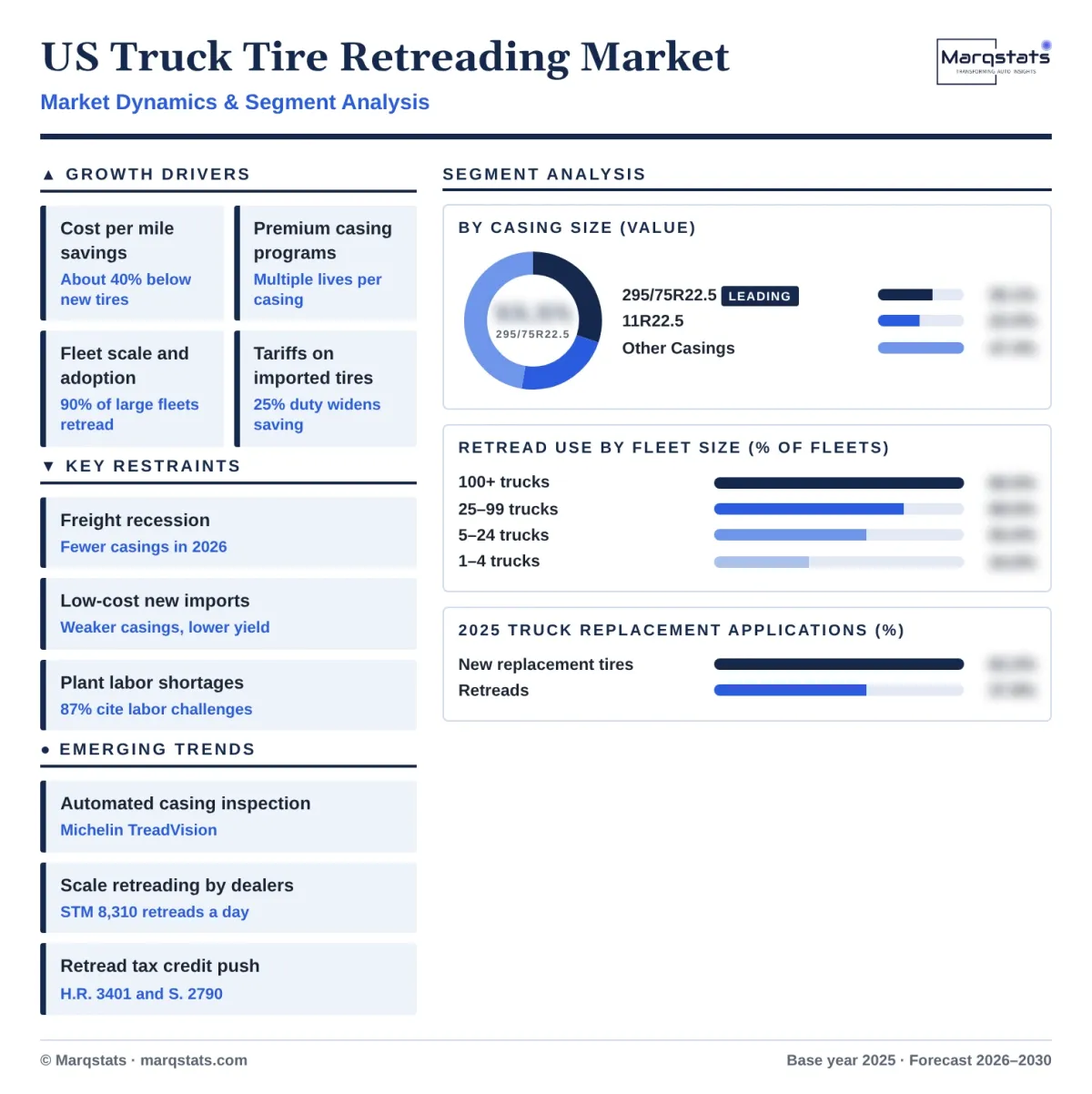
- Cost per mile savings. A retread costs an estimated USD 243.34 in 2025, about 40% less than a new replacement truck tire at USD 405.56, and retreading saves US fleets nearly USD 3 billion a year according to TRIB. Fleets running drive and trailer positions on retreads lower tire cost per mile without changing routes or equipment, which keeps retread demand resilient through freight downturns. The saving is largest on trailer positions, where tread wear is slower and casing damage is lower than on drive axles. Fleets that standardize casing programs across tractors and trailers capture the saving on every eligible position.
- Premium casing programs. Premium new truck tires are designed for multiple retread lives, and fleets that buy premium casings plan two or more retread cycles per casing. The Goodyear Tire & Rubber Company, Toyo Tire U.S.A. Corp. and Hankook Tire America Corp. all promoted retreadable casings to fleets in 2026, linking new tire sales on steer and drive positions to retread volume on later lives. Each successful retread life adds tread miles to a casing that has already been paid for, so the premium on the first new tire is recovered over later lives.
- Fleet scale and adoption. Retread use reaches 90% among fleets with 100 or more trucks and 68% among fleets with 25 to 99 trucks, according to TRIB statements in January 2026. Consolidation of trucking fleets and the spread of national fleet contracts through dealers such as Southern Tire Mart, LLC and Pomp's Tire Service, Inc. raise the share of trucks managed under casing programs. Smaller fleets lag in adoption, which leaves room for growth as dealers extend casing pickup and road service to owner-operators and regional carriers.
- Tariffs on imported new tires. The 25% Section 232 tariff on medium and heavy truck parts, including tires, from 1 November 2025 raises the landed cost of imported new truck tires. Higher new tire prices widen the saving from retreading, and Marqstats projects the average value of a retread to rise from USD 243.34 in 2025 to USD 248.68 in 2026 and USD 275.97 by 2030. The tariff also raises the cost of imported low-cost new tires that compete with retreads on trailer positions.
- Sustainability and policy support. A retread uses about 15 fewer gallons of oil and 90 to 100 fewer pounds of material than a new commercial truck tire. The Retreaded Tire Jobs, Supply Chain Security and Sustainability Act of 2025 (H.R. 3401) and the Resilient Tire Supply and Jobs Act (S. 2790) propose a tax credit equal to the lesser of 30% of the purchase price or USD 30 per retreaded tire. Retreading also keeps each casing out of the scrap stream for one or more additional lives.
Key Restraints
Four constraints hold retread volumes below the 2025 level through the forecast period.
- Freight recession and lower tire demand. The USTMA forecasts replacement truck tire shipments of 22.9 million units in 2026, down 7.1%, and Bridgestone Americas, Inc. estimates that North American truck and bus replacement demand fell 13% in the first half of 2026. Retread volume eases to an estimated 13.91 million in 2026 as fleets park trucks and run tires longer. Retread value falls to an estimated USD 3,458.41 million in 2026 before recovering to USD 3,613.49 million in 2027 as freight volumes stabilize. Retread volume tracks new replacement truck tire shipments at a ratio of 0.607 retreads per new tire throughout the forecast period.
- Low-cost new tire imports. Low-cost tier-three and tier-four new truck tires compete directly with retreads on price, and many of these casings support fewer retread lives than premium casings. American Tire Distributors, Inc. and TBC Corporation reported fleets tiering down to lower-priced new truck tires in 2026, which reduces the pool of retreadable casings. Casings from low-cost new tires fail inspection at higher rates, which lowers plant acceptance yields and raises scrap volumes. Tariffs on imported truck tires from November 2025 begin to narrow this price gap, although price-led buying persists among smaller fleets.
- Labor shortages in retread plants. TRIB reported in May 2026 that 87% of retreader respondents cite labor as a production challenge, and 46% of surveyed businesses saw revenue decline in 2025. Skilled buffing, inspection and curing labor limits plant throughput and raises unit costs at smaller retreaders. Smaller plants find it harder to fund automation, which widens the cost gap between national dealer networks and independent retreaders. Automation such as casing scanners offers a partial answer to the labor constraint at larger plants.
- Plant consolidation. Domestic retread plants fell from more than 3,000 in 1982 to about 500 in 2023, concentrating production in large dealer-owned plants. Fewer plants lengthen casing collection routes in rural regions and raise logistics costs for small fleets, which have the lowest retread adoption at 34% among fleets with one to four trucks. Rural fleets often pay more for casing collection and delivery, which slows retread adoption among owner-operators. National dealers counter this by running casing pickup routes linked to their road service networks.
Key Trends
Four shifts are changing how retreads are produced, inspected and sold in the United States.
- Automated casing inspection. Michelin Retread Technologies launched TreadVision in March 2026, with the TreadEye scanner taking 1,200 tread measurement points per tire. Automated inspection raises consistency in casing acceptance decisions and offsets the shortage of skilled inspectors reported by TRIB. Consistent inspection also reduces warranty claims and supports fleet confidence in multiple retread lives per casing. Michelin pairs the scanner with automation to raise output per technician at retread plants.
- Scale retreading by national dealers. Southern Tire Mart, LLC increased tread rubber use from 49 million to 57 million pounds and daily output from 8,000 to 8,310 retreads, operating 25 plants in 2025, and stated 28 plants in its May 2026 ranking announcement. Dealer-owned retread networks give national fleet accounts a single source for new tires, retreads and road service. Larger plants spread curing equipment costs over higher daily output. National networks also standardize retread quality across plants, which simplifies multi-state fleet contracts.
- Legislative push for retread incentives. The TIA and TRIB sought a larger legislative package in August 2026 for H.R. 3401, introduced in May 2025 with 10 House supporters, and S. 2790, introduced in September 2025 with three Senate supporters. A per-tire credit of up to USD 30 would narrow the price gap between low-cost imports and retreads. A per-tire credit would give fleets a direct incentive to retread rather than buy low-cost new tires. Retread industry groups argue that a credit supports domestic retread plant jobs and reduces reliance on imported low-cost tires.
- Data-led fleet tire programs. Retread operators link casing inspection data with fleet tire management platforms that track tread depth, pressure and casing history by position. Data-led programs raise casing recovery rates and support multi-life casing planning for large fleets. Fleet tire management data also helps dealers forecast casing availability and plan plant production. Casing history records also support resale value when fleets trade or retire equipment.
Market Segmentation
Retreads on 295/75R22.5 casings account for an estimated USD 1,098.67 million, or 30.1% of 2025 value, and are projected to reach USD 1,240.64 million by 2030 at a 2.46% CAGR. An estimated 4.51 million retreads were applied to the size in 2025, reflecting its position as the standard low-profile fitment on Class 8 linehaul tractors and trailers. Drive and trailer positions on long-haul fleets supply most of these casings, and premium 295/75R22.5 casings commonly support two or more retread lives. Retread volume on the size dips to an estimated 4.19 million in 2026 before returning to 4.50 million by 2030.
Retreads on 11R22.5 casings account for an estimated USD 821.27 million, or 22.5% of 2025 value, rising to USD 927.39 million by 2030 at a 2.46% CAGR. An estimated 3.38 million retreads were applied to the size in 2025, serving regional haul, vocational and bus fleets that prioritize load capacity. The conventional-profile casing has a long service history in fleet retread programs, which supports stable retread volume as older tractors remain in service. Retread volume on the size dips to an estimated 3.13 million in 2026 before returning to 3.36 million by 2030.
Retreads on other truck and bus casings account for an estimated USD 1,730.13 million, or 47.4% of 2025 value, and are projected to reach USD 1,953.69 million by 2030 at a 2.46% CAGR. The group covers an estimated 7.11 million retreads in 2025, including wide-base singles, 19.5-inch and 24.5-inch fitments for vocational trucks, and bus and coach sizes. Refuse, construction and transit fleets in this group run high-scrub duty cycles that wear treads quickly and favor retreading. Retread volume in the group dips to an estimated 6.59 million in 2026 before returning to 7.08 million by 2030.
By Geography
North Central
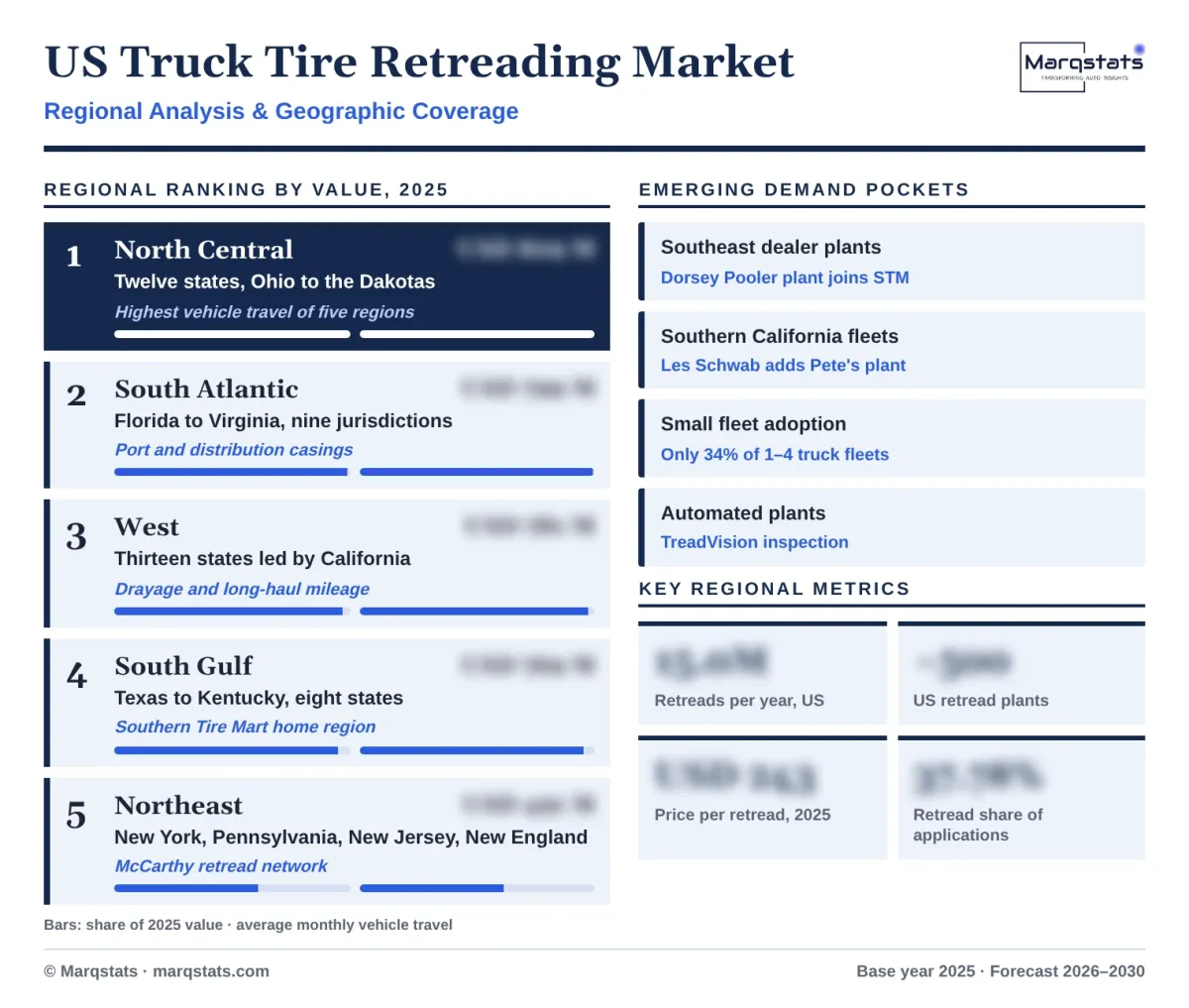
The North Central region is the largest regional market, accounting for 22.16% of 2025 value, or USD 808.85 million, across twelve states from Ohio and Michigan to Kansas and the Dakotas. Average monthly vehicle travel of 63.53 billion miles in the sampled 2025 months is the highest of the five FHWA regions, and an estimated 3.32 million retreads were applied in the region in 2025 along major Interstate freight corridors. Cold winters raise demand for retreads with deep drive treads and winter compounds across the region's freight routes.
South Atlantic
The South Atlantic region accounts for 21.90% of 2025 value, or USD 799.37 million, across Florida, Georgia, the Carolinas, Virginia, Maryland, Delaware, West Virginia and the District of Columbia. An estimated 3.29 million retreads were applied in the region in 2025, supported by port and distribution traffic and stable year-round travel, with December 2025 only 3.7% below October. The region's port traffic through Savannah and Charleston generates steady trailer casing supply for retread plants.
West
The West region accounts for 21.41% of 2025 value, or USD 781.48 million, across thirteen states led by California, Washington, Arizona and Colorado. An estimated 3.21 million retreads were applied in the region in 2025, and port drayage and long-haul routes across the Mountain states generate high annual mileage per tractor and a steady flow of casings. Long distances on desert routes accumulate high mileage per casing, which makes inspection quality important for retread acceptance in the region.
South Gulf
The South Gulf region accounts for 21.07% of 2025 value, or USD 769.07 million, across Texas, Oklahoma, Louisiana, Arkansas, Mississippi, Alabama, Tennessee and Kentucky. December 2025 travel of 57.615 billion miles rose 1.5% year on year, the fastest December gain of the five regions, and Southern Tire Mart, LLC, headquartered in Columbia, Mississippi, anchors retread capacity in the region. Texas freight volumes supply a large share of the region's casings.
Northeast
The Northeast region accounts for 13.46% of 2025 value, or USD 491.30 million, across New York, Pennsylvania, New Jersey and the six New England states. An estimated 2.02 million retreads were applied in the region in 2025, and McCarthy Tire Service Company, Inc., an Eastern US commercial operator, runs 13 retread facilities serving fleets in the region and beyond. Urban delivery and transit fleets supply casings from high-stop duty cycles across the region.
How Competition Is Evolving
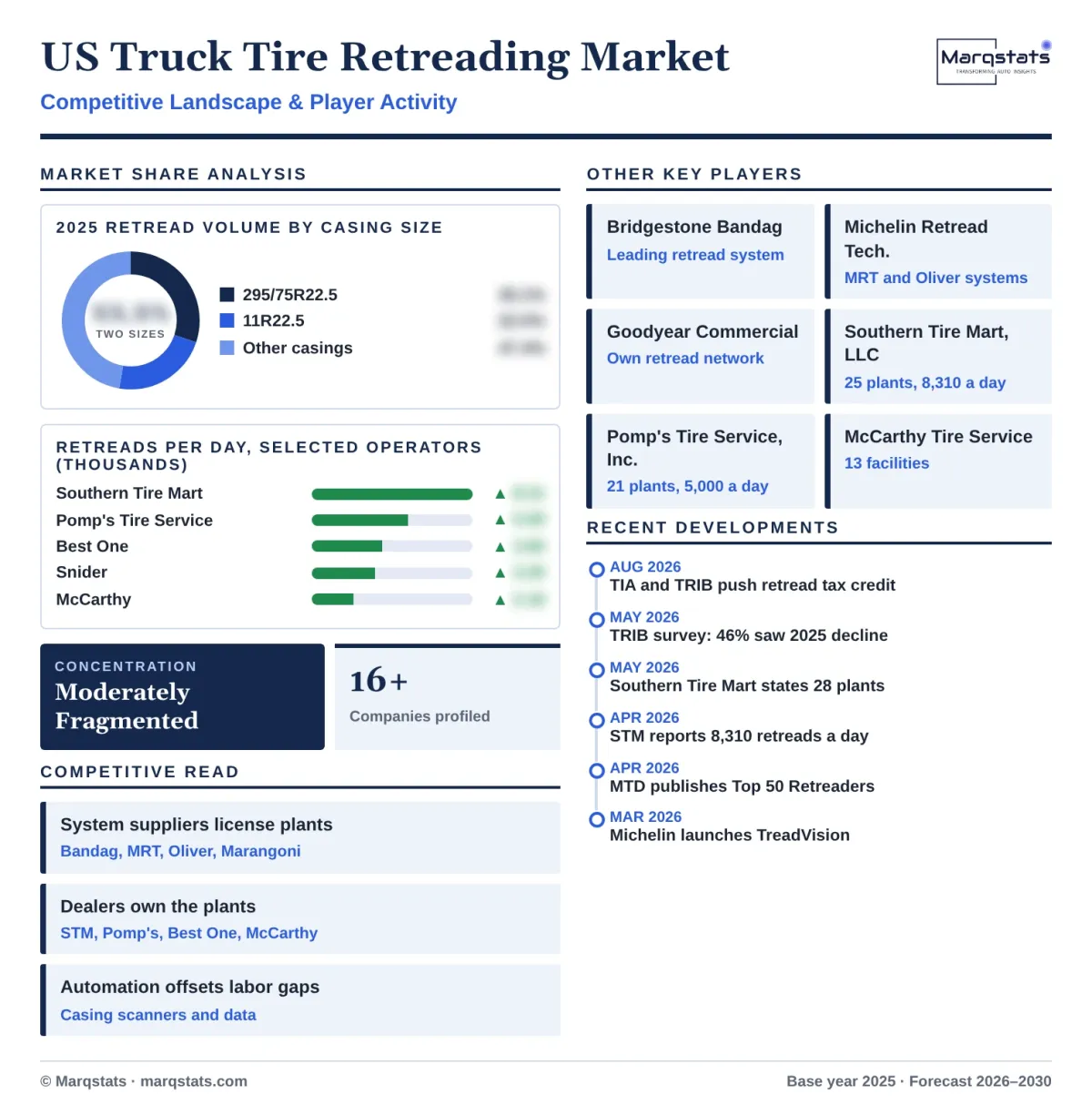
The US truck tire retreading market is moderately fragmented across about 500 plants, with production concentrating in large dealer-owned networks that license retread systems from tire manufacturers. Bridgestone Corporation supplies the Bandag system used by Southern Tire Mart, LLC, Best One Tire & Service and McCarthy Tire Service Company, Inc., while Compagnie Générale des Établissements Michelin SCA supplies Michelin Retread Technologies and Oliver, and The Goodyear Tire & Rubber Company runs its own commercial retread network. Continental AG, Marangoni S.p.A. and Borrachas Vipal S.A. supply competing processes and materials. System suppliers compete for franchised plants, and a plant's choice of system ties its tread rubber purchases to one supplier for years.
Competition centers on casing management, plant throughput and fleet service coverage. Southern Tire Mart produced 8,310 retreads a day across 25 plants in 2025, Pomp's Tire Service, Inc. reports 5,000 a day across 21 plants, Best One Tire & Service 3,650 a day across 20 plants, Snider Tire, Inc. 3,200 a day across 10 plants and McCarthy averaged 2,156 a day across 13 facilities in 2025. Larger operators spread inspection technology, such as Michelin TreadVision, and casing logistics over higher volume. Daily output figures cover all retread types at each operator, and plants with higher output reach lower unit costs on buffing, building and curing. Independent retreaders compete on local service and turnaround time for regional fleets.
Consolidation among commercial dealers is reshaping retread capacity. Southern Tire Mart completed its acquisition of Dorsey in June 2025, adding five Georgia and South Carolina stores and a retread plant in Pooler, Georgia, and Les Schwab Tire Centers acquired Pete's Road Service in February 2025, adding a retread plant in Southern California. Acquisitions of dealers with retread plants give national groups control of casing collection in new regions and shift volume toward larger, automated plants. Fleet tire upkeep software that tracks casing history is covered in the Marqstats Fleet Tire Management Software Market report.
Companies Covered
Companies covered in the report include:
Recent Market Activity
Table of Contents
Coverage & Segmentation
The US truck tire retreading market comprises retreaded tires for medium and heavy trucks, tractors, trailers and buses sold or returned to fleets in the United States, valued at the price paid for the retread in US dollars. The market excludes passenger, light truck, off-the-road and aircraft retreads, new replacement tires, road service and casing trading revenue. Coverage uses a 2025 base year, a 2021–2025 historical period and a 2026–2030 forecast period, with 2026 as the estimated year. New replacement truck tires are covered in the Marqstats US Commercial Truck Tire Market report.
Segmentation covers three casing size groups and five FHWA regions, with 16 retread system suppliers and operators profiled. Retread volume is the primary series, the market value is a Marqstats estimate, and value is derived from retread units and the average retread price relative to new truck tires, with the leading casing sizes 295/75R22.5 and 11R22.5 tracked separately. Regional values are allocated by vehicle travel across the five FHWA regions, and retreads by casing size follow the replacement size mix of new truck tires. Scrap casings that leave the retread loop are covered in the Marqstats End-of-Life Tire Market report.