Market Snapshot
Middle bar: base-year value × (1 + CAGR), rounded to two decimals. This is a calculated illustration, not a separately researched annual estimate.
The Canada replacement tire market is valued at USD 5,133.36 million in 2025 and is projected to reach USD 6,057.92 million by 2030, registering a CAGR of 3.37% over 2026–2030. The market covers new replacement passenger, light truck and truck and bus tires shipped in Canada, valued at dealer purchase prices. Replacement shipments reached 25.50 million tires in preliminary 2025, up 1.05 million or 4.29% from revised 2024, yet volume rose only about 0.60% a year from the 2019 level of 24.60 million, so the 2025 rebound is not a new structural growth rate.
Market size and forecast figures are generated using Marqstats' proprietary estimation framework, updated as of October 2026.
Coverage spans three tire types, four season types for passenger and light truck tires, and five regions: Ontario, Quebec, British Columbia, Alberta and the Rest of Canada. The analysis benchmarks 16 tire makers and retailers, including Compagnie Générale des Établissements Michelin SCA, Bridgestone Corporation, The Goodyear Tire & Rubber Company and Canadian Tire Corporation, Limited, and tracks reference sizes such as 225/65R17 and 205/55R16 for passenger tires, LT275/70R18 and LT265/70R17 for light trucks, and 295/75R22.5 and 11R22.5 for trucks and buses. Volume is measured from national shipment statistics, and imported tires are already counted within replacement shipments.
Key Takeaways
Market Overview & Analysis
Report Summary
The Canada replacement tire market comprises new replacement passenger, light truck and truck and bus tires shipped to the Canadian aftermarket, valued at USD 5,133.36 million in 2025 at dealer purchase prices. Original equipment fitments, retreads, used tires, off-the-road, agricultural and motorcycle tires, and installation and storage services sit outside the market perimeter. Imported tires are already included in replacement shipments, so the volume base counts each tire once. Winter, all-weather, all-season and summer products are tracked as season types within the passenger and light truck total. Passenger tires supply 20.00 million of the 25.50 million tires shipped in 2025, light truck tires 3.50 million and truck and bus tires 2.00 million.
Shipment history shows a resilient, slow-growing market. Replacement shipments were 24.58 million tires in 2017 and 25.54 million in 2018, fell to 20.50 million in 2020 and recovered to 24.70 million in 2021. Volume dipped to 22.36 million in 2023 before rising to 24.45 million in 2024 and 25.50 million in 2025. In 2025, passenger tires rose 3.63% to 20.00 million, light truck tires rose 6.06% to 3.50 million and truck and bus tires rose 8.11% to 2.00 million.
The vehicle fleet sets the demand base. Statistics Canada counted 27.6 million registered road motor vehicles in 2025, including 25.3 million light-duty vehicles, of which 11.1 million, or 44.0%, were multi-purpose vehicles. In 2024 the count was 26.8 million, up 4.2%, helped by stronger new vehicle sales and Ontario's automatic registration renewal program from July 2024. The 23.50 million passenger and light truck tires shipped in 2025 equal about 0.93 tires per registered light vehicle. Canada also counted 24,802 automotive repair establishments and 5,007 auto parts and accessories retailers, which together form the installation network for replacement tires alongside dedicated tire dealers.
Value grows faster than volume through price and mix. Marqstats values passenger tires at an estimated USD 172.56 per tire in 2025, light truck tires at USD 248.87 and truck and bus tires at USD 405.56, in line with US dealer purchase values, rising to USD 196.44, USD 282.29 and USD 460.02 by 2030. Units grow from 25.50 million to 26.36 million by 2030, after a slight dip to 25.39 million in 2026, while value rises to an estimated USD 5,229.85 million in 2026. The neighboring US aftermarket is covered in the Marqstats US Replacement Tire Market report.
Market Dynamics
Key Drivers
Five factors support replacement tire demand in Canada.
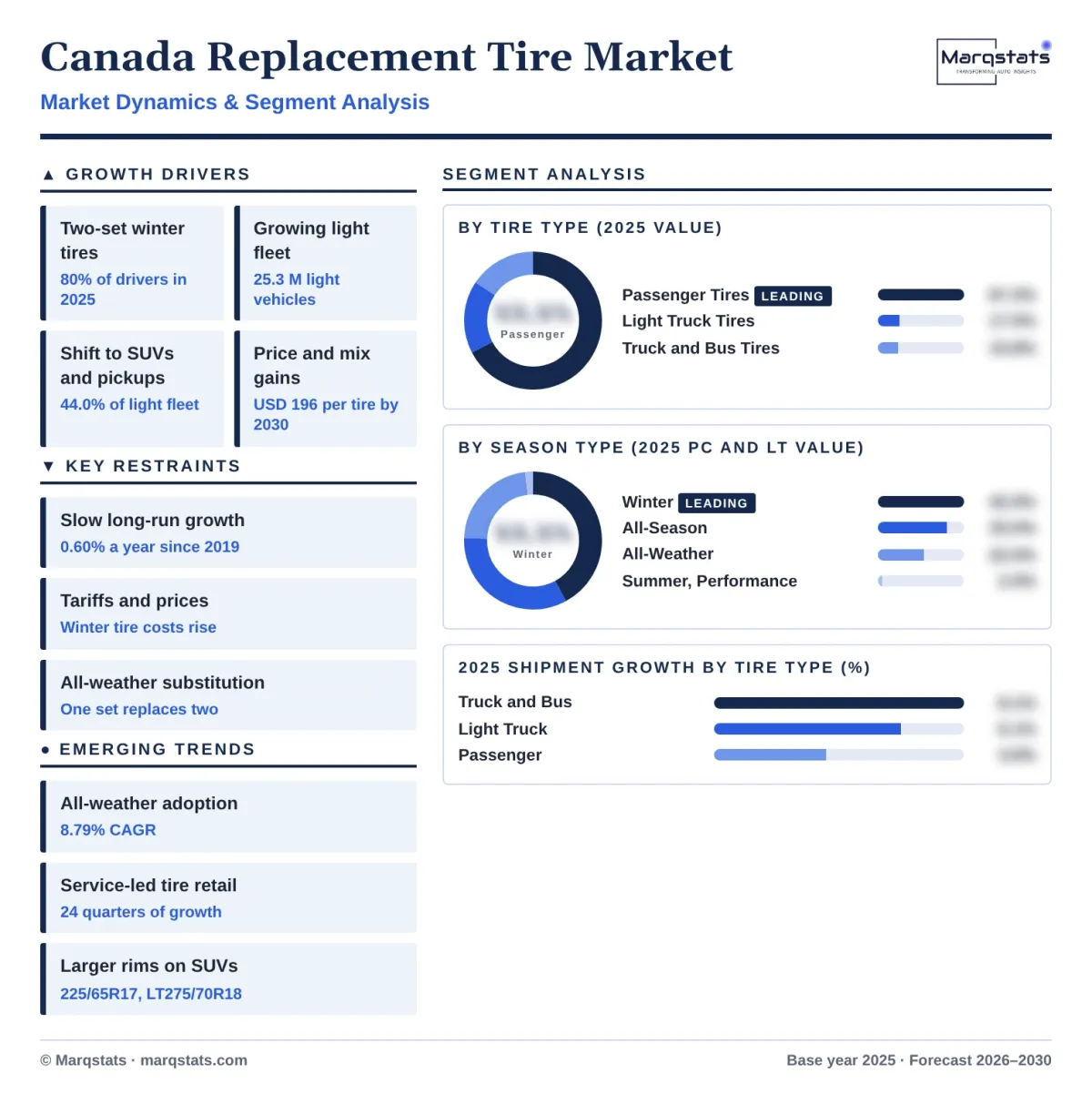
- Two-set winter tire ownership. The Tire and Rubber Association of Canada (TRAC) reported that 80% of Canadian drivers used winter tires in 2025, up from 78% in 2024, and Quebec requires winter tires on passenger vehicles in the winter season. Drivers who own a second set of tires on separate wheels buy two replacement cycles over a vehicle's life, which lifts tire demand per vehicle above markets that use one set all year. Seasonal changeovers also move tire purchases into two peaks, in spring and in October and November. Changeover appointments also give dealers two chances a year to inspect tread depth and sell replacements.
- A growing light vehicle fleet. Light-duty registrations rose from 24.6 million in 2024 to 25.3 million in 2025, and total registrations reached 27.6 million. New vehicle sales rose 9.5% in 2024. Each new vehicle joins the replacement pool within three to four years, supporting a steady base of 23.50 million passenger and light truck tires a year. Ontario's automatic renewal program lifted reported registrations from July 2024, so part of the recent fleet growth reflects administrative changes rather than new vehicles on the road. Registrations count vehicles on the record rather than vehicles driven, so active vehicles sit somewhat below the registered fleet.
- Shift to SUVs and pickups. Multi-purpose vehicles rose 9.3% to 10.3 million in 2024 and reached 11.1 million, or 44.0% of light-duty vehicles, in 2025, while passenger cars fell to 35.0% of the light fleet in 2024. Larger SUV and pickup sizes such as 225/65R17, LT265/70R17 and LT275/70R18 carry higher prices, and light truck tire value grows at a 4.91% CAGR. Passenger-rated tires also fit many crossovers, so not all SUV demand falls into the light truck tire category. Pickup owners in Alberta and Saskatchewan also favor all-terrain light truck tires for gravel and rural roads.
- Harsh weather and safety awareness. TRAC reported that three quarters of drivers say extreme weather makes winter tires more important than ever, despite rising living costs. Snow, ice and freeze-thaw road damage in winter raise tire wear and puncture rates, and British Columbia requires winter-rated tires on designated highways in the winter season. Insurance discounts for winter tires in some provinces add a further incentive for two-set ownership. Freeze-thaw cycles also create potholes that damage tires and wheels each spring.
- Price and mix gains. Larger rim sizes, higher load ratings and premium winter compounds raise the average value per tire. Marqstats projects passenger tire value per tire to rise from USD 172.56 in 2025 to USD 196.44 by 2030, which lifts market value at a 3.37% CAGR while units grow about 0.67% a year. Value per tire also rises as winter and all-weather tires carry premiums over standard all-season tires. Larger rims and premium compounds lift light truck value per tire from USD 248.87 in 2025 to USD 282.29 by 2030.
Key Restraints
Four constraints keep Canadian tire volume growth below 1% a year.
- Slow long-run volume growth. Replacement shipments grew from 24.60 million in 2019 to 25.50 million in 2025, an average of about 0.60% a year, and the 2025 rise followed a weak 2023 of 22.36 million. Marqstats projects a slight dip to 25.39 million in 2026 as dealers work through stock built in 2025. Dealers that built stock ahead of tariff changes in 2025 run down inventory in 2026, which softens shipments. The six-year average gives a more reliable guide to forecast volume than the latest annual rise.
- Tariffs and price pressure. CTV News reported in November 2025 that new winter tires were expected to cost more because of inflation and possible tariffs on tires and raw materials from Asia, Europe and the United States. Higher prices lead some drivers to delay replacement or run tires longer. Price-sensitive drivers trade down to value brands, which limits premium brand growth. Cross-border shopping for tires in the United States also shifts some purchases outside the Canadian market when exchange rates allow.
- Weak freight demand. Truck and bus tires account for 15.80% of 2025 value, and freight weakness across North America weighs on fleet tire purchases. Marqstats projects truck and bus units to fall 3% to an estimated 1.94 million in 2026 before recovering to 2.06 million by 2030. Fleets also extend tire life through retreading, which keeps some truck tire demand outside the new tire market. Freight volumes between Canada and the United States set the pace of truck tire replacement for linehaul fleets.
- All-weather substitution. All-weather tires with the three-peak mountain snowflake symbol let some drivers replace a two-set winter and all-season system with one set used all year. Each switch removes a second set from the replacement cycle, which slows unit growth even as all-weather value rises. The net effect is a mix shift toward all-weather tires rather than outright loss of tire value. Drivers who switch to all-weather tires also stop paying for seasonal changeovers and storage, which reduces service revenue for dealers.
Key Trends
Four shifts are changing how Canadians buy and use replacement tires.
- All-weather adoption. All-weather tires account for an estimated 22.50% of passenger and light truck value in 2025 and grow fastest at an 8.79% CAGR to 29.00% by 2030, against Bridgestone's estimate of 22% of 2025 Canadian tire sales. Drivers in Ontario, British Columbia and Atlantic Canada adopt all-weather tires to avoid seasonal changeovers and storage costs. All-weather tires also reduce storage needs for drivers in apartments and condominiums. All-weather share rises from 22.50% to 29.00% of passenger and light truck value by 2030.
- Service-led tire retail. Canadian Tire Corporation, Limited reported its 24th consecutive quarter of automotive sales growth in Q2 2026, with tire-change activity supporting the result. Retailers bundle seasonal changeovers, storage and wheel packages with tire sales, which keeps customers returning twice a year. Online booking and tire hotel services raise customer retention at national chains. Automotive growth at Canadian Tire continued through weather-affected quarters in other categories.
- Larger rims on SUVs. SUV and crossover growth moves demand to 17-inch and larger sizes such as 225/65R17 and LT-metric sizes on pickups. Larger sizes raise value per tire and require dealers to stock a wider size range. Dealers stock wider size ranges, which raises inventory investment per store. Crossovers on 17-inch and 18-inch wheels now account for a large share of passenger tire sales.
- Circular economy and tire recycling. TRAC and Nigeria's Used Tyres and Producer Responsibility Organization signed a knowledge-sharing partnership in August 2026 on end-of-life tire management. Provincial tire stewardship programs fund recycling through fees collected on each new tire sold. Stewardship fees are collected at the point of sale on every new tire in most provinces. Stewardship programs also fund rubber recycling into crumb rubber, mats and paving products.
Market Segmentation
Passenger tires account for an estimated USD 3,451.19 million, or 67.23% of 2025 value, and are projected to reach USD 4,003.80 million by 2030 at a 3.02% CAGR. Shipments rose 3.63% to 20.00 million tires in 2025, supplying 66.7% of the year's increase, and Marqstats projects 20.38 million by 2030. Common sizes include 205/55R16 on compact cars and 225/65R17 on crossovers. Passenger units dip slightly to an estimated 19.90 million in 2026 after the 2025 rebound, and value per tire rises to USD 196.44 by 2030 on larger sizes and winter mix.
Light truck tires account for an estimated USD 871.05 million, or 16.97% of 2025 value, and are projected to reach USD 1,106.93 million by 2030 at a 4.91% CAGR, the fastest tire type. Shipments rose 6.06% to 3.50 million tires in 2025, supplying 19.0% of the increase, and reach an estimated 3.92 million by 2030. Pickup sizes such as LT265/70R17 and LT275/70R18 lead demand. Light truck units rise to an estimated 3.55 million in 2026 as pickups and large SUVs take a growing share of the light fleet, and value per tire reaches USD 282.29 by 2030.
Truck and bus tires account for an estimated USD 811.12 million, or 15.80% of 2025 value, and are projected to reach USD 947.19 million by 2030 at a 3.15% CAGR. Shipments rose 8.11% to 2.00 million tires in 2025, supplying 14.3% of the increase, at an estimated USD 405.56 per tire. Linehaul fleets run 295/75R22.5 and 11R22.5 sizes on tractors and trailers. Truck and bus value per tire reaches an estimated USD 460.02 by 2030, and cross-border freight with the United States sets the pace of fleet tire purchases.
Winter tires account for an estimated USD 1,815.34 million, or 42.00% of 2025 passenger and light truck value, the largest season type, and are projected to reach USD 2,018.75 million by 2030 at a 2.15% CAGR. Bridgestone Americas estimated that dedicated winter tires made up about 42% of Canadian tire sales in 2025, usage reached 80% of drivers, and Quebec's seasonal requirement and British Columbia's highway rules anchor demand. Studded and studless winter tires both sit in this segment. Winter tires are bought ahead of the first snowfall, and dealers book changeovers from October to December, though winter share eases to 39.50% by 2030 as all-weather tires gain.
All-season tires account for an estimated USD 1,447.95 million, or 33.50% of 2025 passenger and light truck value, and are projected to reach USD 1,507.66 million by 2030 at a 0.81% CAGR. All-season tires serve as the summer set for two-set drivers and as the year-round tire in milder coastal areas, and share falls to 29.50% by 2030 as all-weather tires gain. Two-set drivers in Ontario and Quebec fit all-season tires from spring to autumn, so all-season replacement follows winter tire ownership.
All-weather tires account for an estimated USD 972.51 million, or 22.50% of 2025 passenger and light truck value, and are projected to reach USD 1,482.11 million by 2030 at an 8.79% CAGR, the fastest season type. Bridgestone Americas estimated that all-weather tires took about 22% of Canadian tire sales in 2025 after steady growth since 2017. These tires carry the three-peak mountain snowflake symbol for severe snow and replace a two-set system for many urban drivers. Tire makers expand all-weather size ranges each year to cover crossovers and pickups as well as cars.
Summer and performance tires account for an estimated USD 86.44 million, or 2.00% of 2025 passenger and light truck value, and are projected to reach USD 102.21 million by 2030 at a 3.41% CAGR. Demand comes from sports cars, premium sedans and performance SUVs that run dedicated summer sets on larger rims. Performance buyers in British Columbia and southern Ontario run summer tires for longer seasons than drivers in colder regions.
By Geography
Ontario
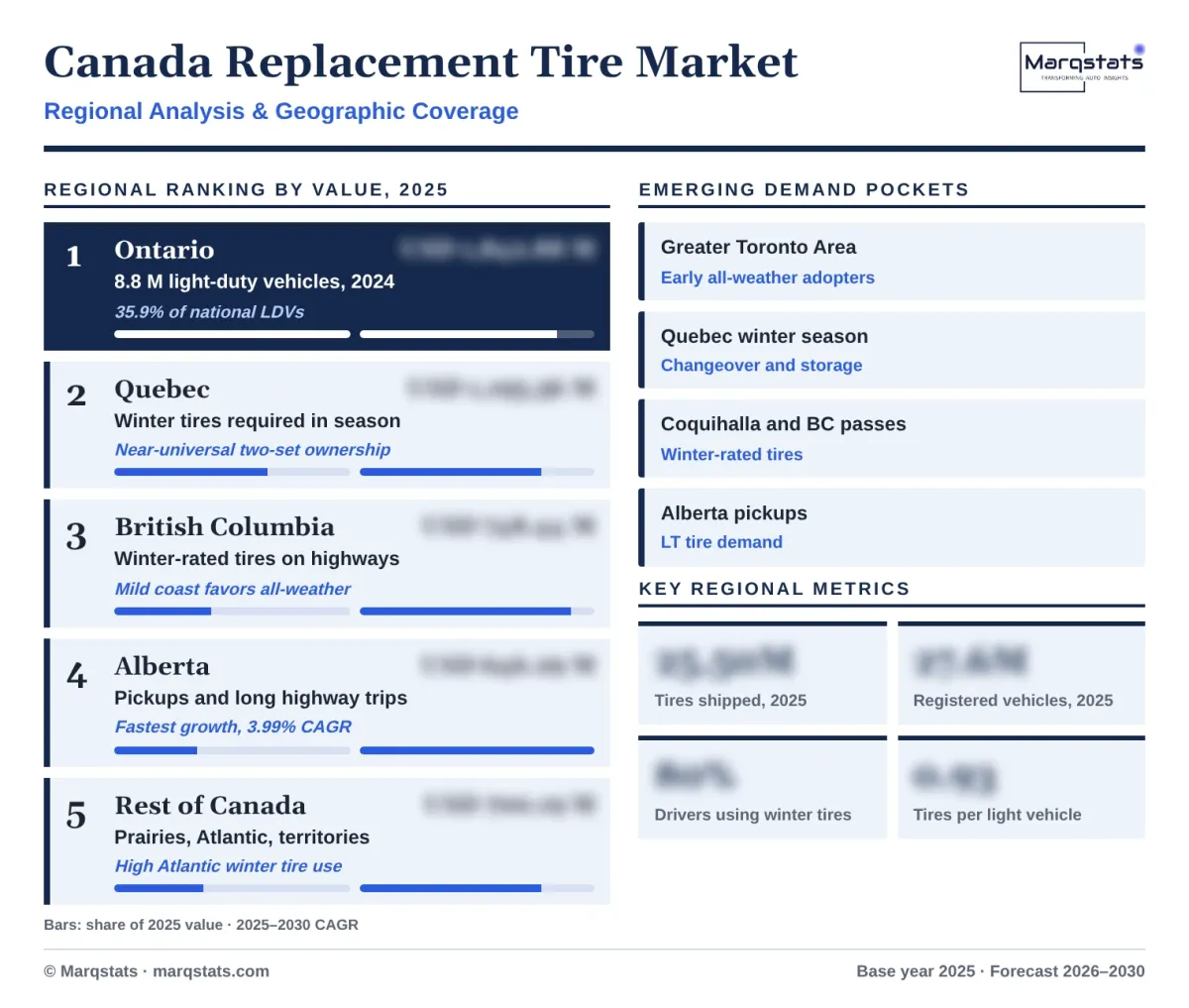
Ontario is the largest market at 35.90% of 2025 value, or USD 1,842.88 million, rising to USD 2,175.27 million by 2030 at a 3.37% CAGR. The province held 8.8 million light-duty registrations in 2024, 35.9% of the national total, and an estimated 9.15 million replacement tires were shipped there in 2025. Goodyear's Napanee plant supplies tires from within the province. Urban drivers in the Greater Toronto Area are early adopters of all-weather tires.
Quebec
Quebec accounts for 23.29% of 2025 value, or USD 1,195.56 million, and is projected to reach USD 1,390.16 million by 2030 at a 3.06% CAGR. Quebec requires winter tires on passenger vehicles in the winter season, which makes two-set ownership near universal, and Bridgestone produces tires in Joliette. An estimated 5.94 million replacement tires were shipped in 2025. The seasonal requirement also creates strong demand for winter tire storage and changeover services.
British Columbia
British Columbia accounts for 14.58% of 2025 value, or USD 748.44 million, and is projected to reach USD 892.31 million by 2030 at a 3.58% CAGR. The province requires winter-rated tires on designated highways in the winter season, while milder Lower Mainland weather favors all-season and all-weather tires. Kal Tire, headquartered in Vernon, operates a large dealer network across the province. Mountain passes such as the Coquihalla Highway require winter-rated tires on most vehicles in winter.
Alberta
Alberta accounts for 12.59% of 2025 value, or USD 646.29 million, and grows fastest at a 3.99% CAGR to USD 786.02 million by 2030. Population growth, long highway distances and a high share of pickups and SUVs lift light truck tire demand, and energy-sector fleets add truck tire demand. Calgary and Edmonton winters keep winter tire use high despite no provincial requirement.
Rest of Canada
The Rest of Canada, covering Manitoba, Saskatchewan, the Atlantic provinces and the territories, accounts for 13.64% of 2025 value, or USD 700.19 million, and is projected to reach USD 814.16 million by 2030 at a 3.06% CAGR. Long winters drive high winter tire use in the Atlantic provinces, and Michelin operates tire plants in Nova Scotia. Prairie provinces combine long distances with lower winter tire use than Quebec and the Atlantic provinces.
How Competition Is Evolving
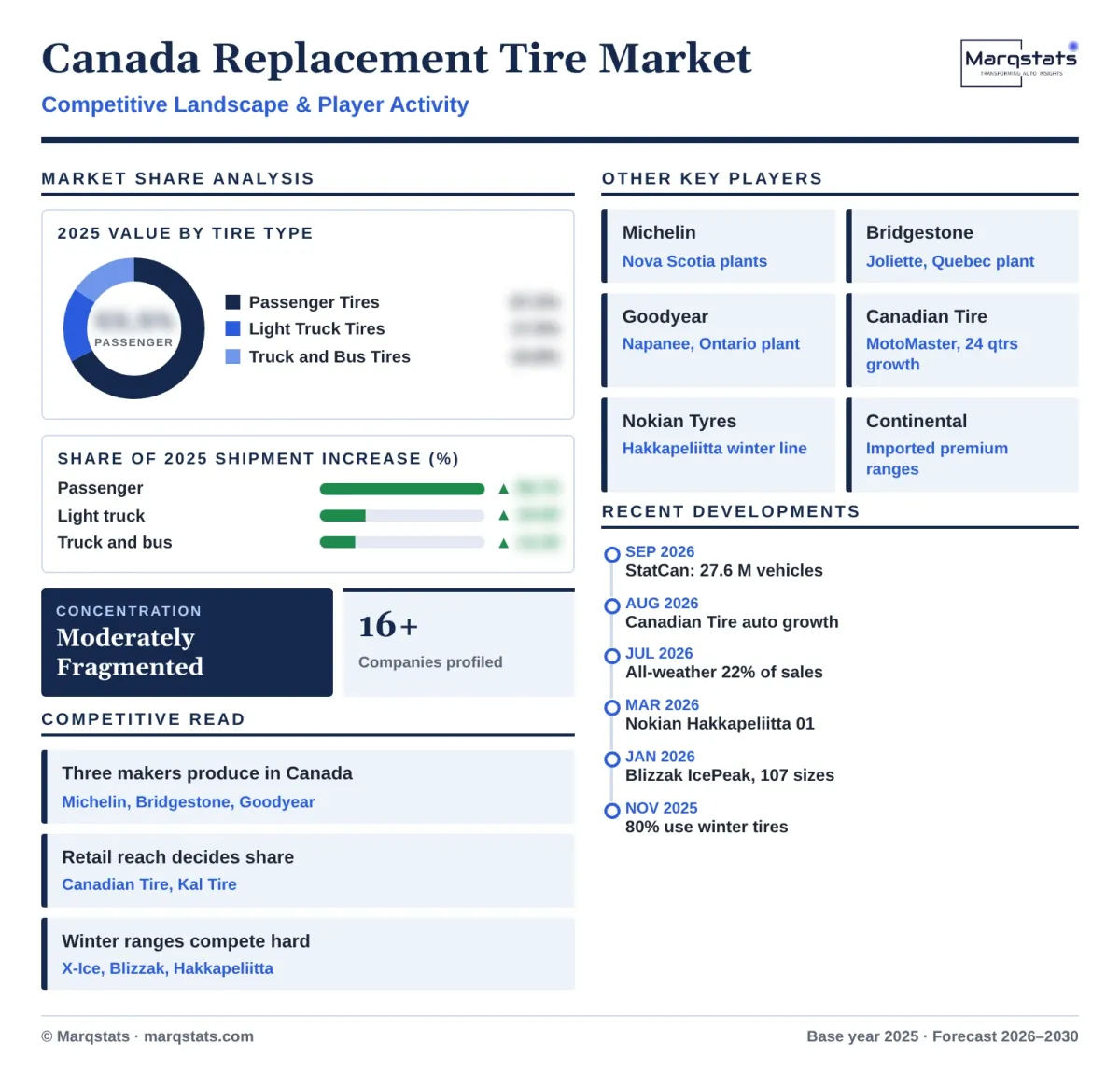
The Canada replacement tire market is moderately fragmented, with global tire makers competing through national retail chains, independent dealers, warehouse clubs and car dealerships. Compagnie Générale des Établissements Michelin SCA, Bridgestone Corporation and The Goodyear Tire & Rubber Company produce tires in Canada, at plants in Nova Scotia, Joliette in Quebec and Napanee in Ontario, while Continental AG, Pirelli & C. S.p.A., Hankook Tire & Technology Co., Ltd. and Nokian Tyres plc supply imported premium and winter ranges. The Yokohama Rubber Co., Ltd., Sumitomo Rubber Industries, Ltd., Kumho Tire Co., Inc. and Nexen Tire Corporation supply mid-tier brands through national distributors and independent dealers.
Retail reach and winter ranges define competition. Canadian Tire Corporation, Limited sells tires through its national store network, including its own MotoMaster brand, and reported a 24th consecutive quarter of automotive sales growth in Q2 2026. Independent dealer groups such as Kal Tire compete on service, seasonal changeovers and tire storage. Michelin's X-Ice, Bridgestone's Blizzak and Nokian's Hakkapeliitta lines compete for winter buyers, while value brands from Giti Tire Pte. Ltd., Zhongce Rubber Group Co., Ltd. and Sailun Group Co., Ltd. compete on price. Car dealerships compete for replacement tires on vehicles still under warranty, and warehouse clubs compete on price for common passenger sizes. New winter launches renew the premium segment: Bridgestone announced the Blizzak IcePeak in January 2026 with 107 planned sizes on 14-inch to 22-inch rims, and Nokian Tyres launched the studded Hakkapeliitta 01 in March 2026 for sale from autumn 2026.
Tariff uncertainty and product shifts are reshaping supply. Possible tariffs on tires and raw materials pushed up expected winter tire prices for the 2025 season, and suppliers balance Canadian, US and offshore production to manage cost. All-weather lines from Michelin, Nokian, Bridgestone and Toyo Tire Corporation expand as drivers move away from two-set systems. Dealer channel economics are benchmarked in the Marqstats US Tire Dealer Market report.
Companies Covered
Companies covered in the report include:
Recent Market Activity
Table of Contents
Coverage & Segmentation
The Canada replacement tire market comprises new replacement passenger, light truck and truck and bus tires shipped to the Canadian aftermarket, valued at dealer purchase prices in US dollars. The market excludes original equipment fitments, retreads, used tires, off-the-road, agricultural and motorcycle tires, and installation, changeover and storage services. Coverage uses a 2025 base year, a 2021–2025 historical period and a 2026–2030 forecast period, with 2026 as the estimated year. US replacement tire demand is covered in the Marqstats US Replacement Tire Market report.
Segmentation covers three tire types, four season types for passenger and light truck tires, and five regions, with 16 tire makers and retailers profiled. Units follow national replacement shipments by tire type, value applies dealer purchase values per tire, and regional values follow light-duty vehicle registrations, with sizes such as 225/65R17, 205/55R16, LT275/70R18, LT265/70R17, 295/75R22.5 and 11R22.5 tracked as reference sizes. Commercial truck tire benchmarks are covered in the Marqstats US Commercial Truck Tire Market report.