Market Snapshot
Middle bar: base-year value × (1 + CAGR), rounded to two decimals. This is a calculated illustration, not a separately researched annual estimate.
The electric vehicle tire market is valued at USD 11.76 billion in 2025 and is projected to reach USD 33.03 billion by 2030, registering a CAGR of 22.94% over 2026–2030. The market covers original equipment (OE) and replacement tires fitted to battery electric and plug-in hybrid electric cars worldwide, counted by application whether or not the product carries an EV label. Global electric car sales passed 20 million in 2025, a quarter of new car sales, and Marqstats estimates 130.83 million tires were supplied to the segment in 2025, of which 88.41 million were OE fitments.
Market size and forecast figures are generated using Marqstats' proprietary estimation framework, updated as of October 2026.
Coverage spans two sales channels, two propulsion types, three rim diameter bands and four regions: China, Europe, the United States and the Rest of World. The analysis benchmarks 16 tire makers, including Compagnie Générale des Établissements Michelin SCA, Continental AG, Hankook Tire & Technology Co., Ltd. and Pirelli & C. S.p.A., and tracks EV fitment sizes such as 235/45R18, 255/45R19 and 255/35R21. Replacement demand overtakes OE fitment in value during 2026 as the global electric car parc, estimated at 77.06 million vehicles at end-2025, ages into its first tire change.
Key Takeaways
Market Overview & Analysis
Report Summary
The electric vehicle tire market comprises OE and replacement tires fitted to battery electric vehicles (BEVs) and plug-in hybrid electric vehicles (PHEVs) in the passenger car class, valued at USD 11.76 billion in 2025. The market is defined by application: it counts every approved tire mounted on an electric car, including broad-purpose products sold across powertrains, and treats EV-labelled lines such as Hankook iON, Bridgestone Turanza EV and Goodyear ElectricDrive as a subset of that demand. Conventional hybrids, electric buses, trucks and two- and three-wheelers sit outside the market perimeter. Marqstats estimates 130.83 million tires were supplied to electric cars in 2025, rising to 297.21 million by 2030.
Vehicle growth sets the scale of demand. The International Energy Agency (IEA) reports that electric car sales rose 20% to more than 20 million in 2025, about 25% of new car sales, and that production reached about 22 million, with China building nearly 75%. Battery electric models took 65% of electric car sales. The IEA forecasts 23 million electric car sales in 2026, close to 30% of new cars, even after a global decline of 8% in Q1 2026, as Europe grew nearly 30% and Asia Pacific outside China grew 80%. Each new electric car carries four OE tires, which sets OE demand at an estimated 88.41 million units in 2025 and 131.90 million by 2030.
Replacement demand follows the parc with a lag of two to four years. Electric cars made up only about 5% of the global car stock in 2025, and Marqstats estimates that 42.42 million replacement tires were fitted in 2025 against 165.31 million by 2030 as cohorts sold during 2022–2025 reach their first change. Higher vehicle weight and instant torque wear tread faster, and Marqstats models an EV tread life of about 48,000 kilometers, or 30,000 miles. Replacement value reaches an estimated USD 8.14 billion in 2026 against USD 6.70 billion for OE fitment, the first year in which aftermarket spend exceeds OE spend.
Pricing reflects larger rims, higher load ratings and low-noise construction. Tire Business reported a Consumer Reports comparison of eight tires in June 2026 in which EV-specific products averaged USD 251 against USD 204 for standard products, a 23.0% gap in the sample. Marqstats values replacement EV tires at an estimated USD 198.44 per tire in the United States, USD 178.60 in Europe, USD 119.07 in the Rest of World and USD 89.30 in China in 2025, with OE contract prices at 62% of replacement value. Performance fitments on larger rims are covered in the Marqstats US High-Performance Tire Market analysis.
Market Dynamics
Key Drivers
Five forces expand tire demand from electric cars faster than the wider passenger tire market.
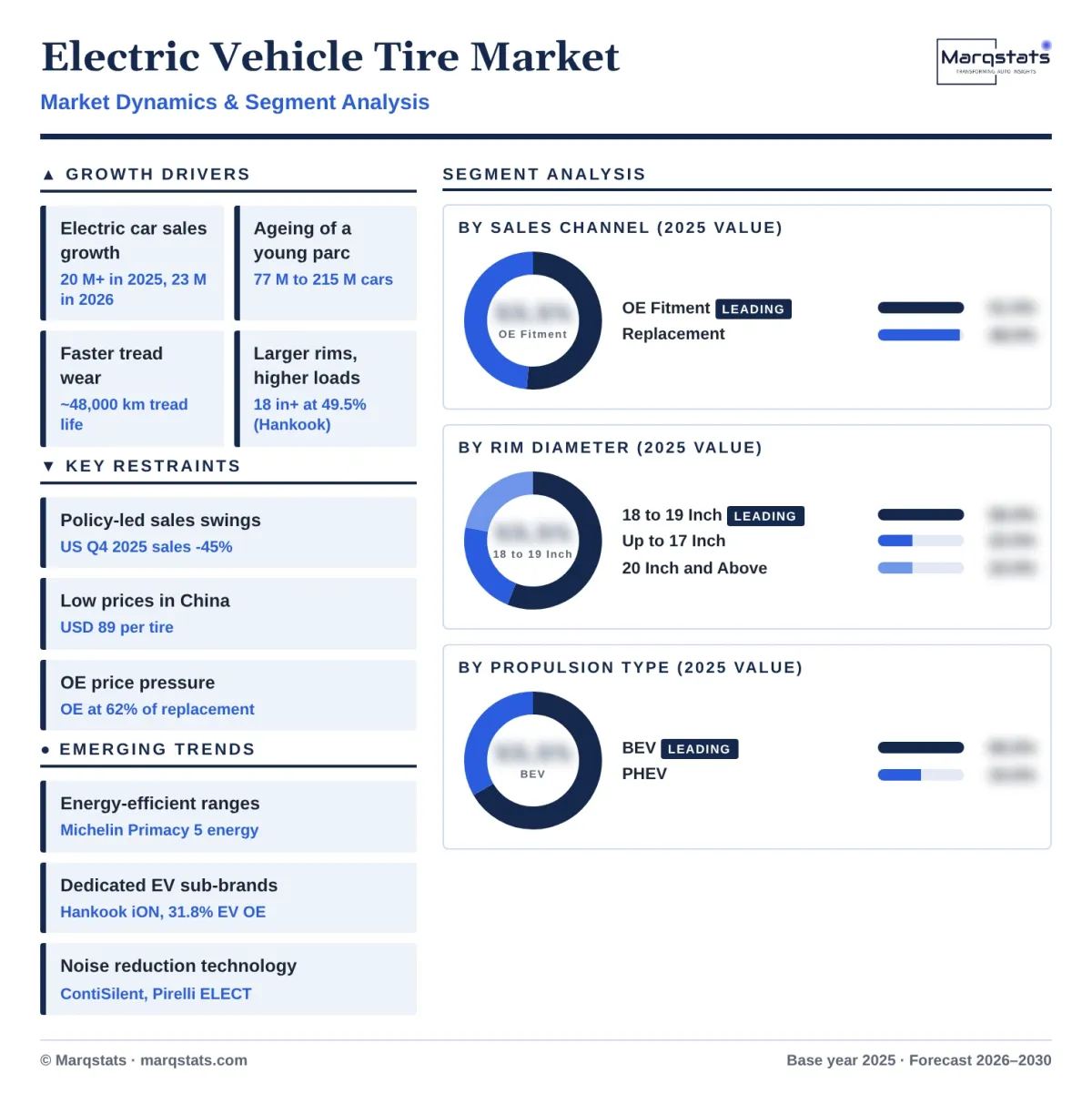
- Electric car sales growth. Electric car sales rose 20% to more than 20 million in 2025, and the IEA forecasts 23 million in 2026. Each new electric car adds four OE tires and a future stream of replacement sets, which lifts OE units from an estimated 88.41 million in 2025 to 131.90 million by 2030. Sales records in close to 100 countries in 2025 spread this demand beyond China and Europe. Battery electric models took 65% of 2025 sales, and the IEA expects electric cars to reach close to 30% of new car sales in 2026.
- Ageing of a young parc. The global electric car parc grows from an estimated 77.06 million at end-2025 to 214.67 million by end-2030 in the Marqstats model. More than half of today's parc was sold in 2023–2025, so most electric cars have not yet reached their first tire change. As these cohorts age, replacement units rise from 42.42 million in 2025 to 165.31 million by 2030, a 31.90% value CAGR for the channel. The parc age profile means replacement growth outpaces new vehicle sales growth through 2030.
- Faster tread wear. Battery packs add weight, and instant motor torque increases tread scrub during acceleration. Marqstats models EV tread life at about 48,000 kilometers, or 30,000 miles, which shortens the replacement cycle against conventional cars. Shorter cycles raise tires per vehicle per year, and fleets running ride-hailing and taxi duty in China and Europe replace tires more often than private owners. Heavier electric SUVs carry higher load indexes, and their drive-axle tires take the most tread scrub per kilometer.
- Larger rims and higher load ratings. Electric cars run larger wheels and higher load indexes to carry battery mass. Hankook reported that 18-inch and larger tires reached 49.5% of its Q2 2026 passenger car and light truck sales, with a 51% target for 2026, and Tesla fits 255/45R19 and 255/35R21 sizes on the Model Y. Larger sizes and HL load ratings carry higher prices per tire. Hankook's 18-inch and larger share was 49.5% across all powertrains, and the share on EV fitments runs higher.
- OE approval programs. Tire makers compete for OE approval on high-volume EV platforms, since the OE fitment drives early replacement purchases. Continental reported OE coverage of 18 of the 20 highest-volume EV manufacturers in 2024 and won the Nissan N7 fitment with EcoContact 7 in June 2026. Owners who keep the OE specification for noise and range carry these approvals into the aftermarket. Approval on a platform such as the Tesla Model Y or a BYD model gives a supplier a large base of matched replacement demand.
Key Restraints
Four constraints slow value growth in parts of the market.
- Policy-led sales swings. US electric car sales fell to about 1.5 million in 2025, with Q4 sales 45% lower year on year after federal purchase credits ended, and global sales fell 8% in Q1 2026. Sales swings shift OE volumes between quarters and delay the build-up of the parc in affected countries. Marqstats projects US electric car sales at 1.3 million in 2026. Lower sales in one year reduce the replacement pool three to four years later.
- Low prices in China. China accounts for about 55% of new electric car sales and nearly 75% of production, yet Marqstats values Chinese EV tires at an estimated USD 89.30 per tire in 2025, less than half the US level. Domestic suppliers such as Zhongce Rubber Group Co., Ltd., Shandong Linglong Tyre Co., Ltd. and Sailun Group Co., Ltd. compete hard on price for OE contracts. China's value share falls from 46.77% in 2025 to 43.69% by 2030. Price competition among domestic suppliers extends into exports to Southeast Asia and Latin America.
- OE price pressure. Automakers set OE tire prices through annual contracts, and Marqstats estimates OE prices at 62% of replacement value. OE fitment value grows at an 11.08% CAGR to 2030, against 31.90% for replacement, and the channel's share of value falls from 51.45% to 30.97%. Chinese automakers held about 60% of global EV sales in 2025, which concentrates purchasing power in a small group of buyers. Automakers also demand low rolling resistance and low noise at OE prices, which raises development cost per approval.
- Cross-powertrain substitution. Many electric cars run on broad-purpose tires, since tire makers design ranges for all powertrains. Michelin launched Primacy 5 energy and Pilot Sport 5 energy in March 2026 as cross-powertrain ranges, and Continental sells EcoContact 7 to both EV and combustion models. Owners therefore buy standard approved tires at standard prices, which limits the price gain from EV-specific products. The CR sample gap of 23.0% applies to eight products only and does not hold across all sizes and seasons.
Key Trends
Four shifts are changing how tire makers design and sell tires for electric cars.
- Energy-efficient ranges. Michelin launched Primacy 5 energy in 33 sizes from 16 to 19 inches and Pilot Sport 5 energy in 19 sizes from 19 to 21 inches in March 2026. The ranges target low rolling resistance for range extension on any powertrain, and the Primacy 5 base range grows from 88 sizes in 2025 to 127 planned by mid-2026. Low rolling resistance extends driving range per charge, which electric car owners rank highly when choosing replacement tires.
- Dedicated EV sub-brands. Hankook built its iON range as a dedicated EV line and set a target of 33% EV share in OE tire sales for 2026, after reaching 31.8% in Q2 2026. Bridgestone sells Turanza EV with ENLITEN technology, and Goodyear sells the ElectricDrive line. Dedicated lines promote noise reduction, load capacity and tread compounds tuned for torque. Dedicated lines also give dealers a clear product to recommend to EV owners at the first change.
- Noise reduction technology. Electric cars lack engine noise, so tire cavity noise becomes the main sound in the cabin. Continental fits ContiSilent foam and Pirelli supplies ELECT-marked tires with noise-reducing construction on premium EVs. Foam inserts add cost per tire and raise replacement prices on larger sizes such as 255/35R21 and 275/35R21. Noise-reducing foam appears on many premium OE fitments of 20 inches and above.
- Connected and sensor tires. Pirelli approved a US investment plan in September 2026 for 6 million premium car tires a year by 2033, covering its Cyber Tyre sensor technology. Sensor tires feed load, pressure and wear data to vehicle systems, which suits software-defined electric cars. Data from sensor tires also supports fleet replacement planning. Automakers developing software-defined platforms are the first buyers of sensor tire systems.
Market Segmentation
OE fitment accounts for an estimated USD 6.05 billion, or 51.45% of 2025 value, and is projected to reach USD 10.23 billion by 2030 at an 11.08% CAGR. The channel supplied an estimated 88.41 million tires in 2025, four per new electric car, on production of about 22 million vehicles. Value grows with production and rim size, and OE prices stay at an estimated 62% of replacement value under automaker contracts. China's OE volume reaches an estimated 66.00 million tires in 2025 on its role as the global EV production base.
Replacement accounts for an estimated USD 5.71 billion, or 48.55% of 2025 value, and is projected to reach USD 22.80 billion by 2030 at a 31.90% CAGR, the fastest of any segment. Units rise from 42.42 million in 2025 to 165.31 million by 2030 as the parc ages and tread wears faster than on conventional cars. Replacement value passes OE value in 2026 at an estimated USD 8.14 billion, and its share reaches 69.03% of the market by 2030.
Battery electric vehicles account for an estimated USD 7.82 billion, or 66.50% of 2025 value, and are projected to reach USD 21.70 billion by 2030 at a 22.65% CAGR. BEVs took 65% of electric car sales in 2025 and carry heavier battery packs, larger rims and higher load ratings than PHEVs. Fitments such as 255/45R19 and 255/40R20 on the Tesla Model Y raise value per tire.
Plug-in hybrid electric vehicles account for an estimated USD 3.94 billion, or 33.50% of 2025 value, and are projected to reach USD 11.33 billion by 2030 at a 23.52% CAGR. PHEV and range-extended models gained share in China during 2024–2025, and their combined engine and battery mass places them in the same load class as many BEVs. PHEV share of value rises from 33.50% to 34.30% by 2030.
Tires up to 17 inches account for an estimated USD 2.59 billion, or 22.02% of 2025 value, and are projected to reach USD 5.95 billion by 2030 at an 18.10% CAGR. The band covers compact electric cars and city models, many built in China and sold in Asia and Latin America, on sizes from 16 inches upward. Share falls to 18.01% by 2030 as automakers move compact models to larger wheels.
Tires of 18 to 19 inches account for an estimated USD 6.58 billion, or 55.96% of 2025 value, and are projected to reach USD 18.49 billion by 2030 at a 22.95% CAGR. The band includes 235/45R18 on the Tesla Model 3, 255/45R19 on the Tesla Model Y and the 19-inch EcoContact 7 fitment on the Nissan N7. Michelin's Primacy 5 energy range covers 16 to 19 inches and targets this core band.
Tires of 20 inches and above account for an estimated USD 2.59 billion, or 22.02% of 2025 value, and are projected to reach USD 8.59 billion by 2030 at a 27.10% CAGR, the fastest rim band. Premium and performance electric cars run 255/40R20, 255/35R21 and staggered 275/35R21 fitments, and Michelin's Pilot Sport 5 energy range covers 19 to 21 inches. Share rises to 26.01% by 2030.
By Geography
China
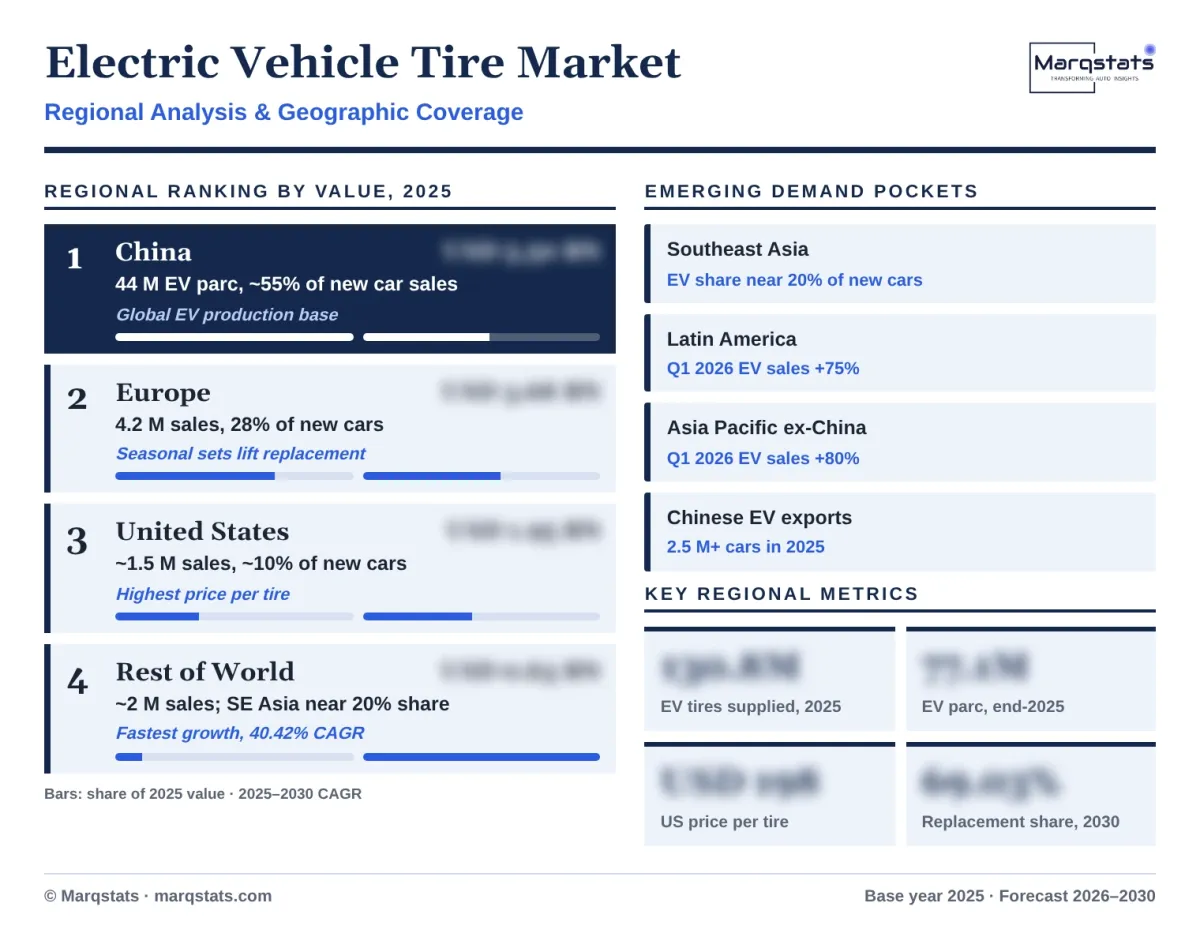
China is the largest market, accounting for 46.77% of 2025 value, or USD 5.50 billion, rising to USD 14.43 billion by 2030 at a 21.28% CAGR. The IEA reports more than 13 million electric car sales in China in 2025, almost 55% of new cars, and an EV parc of 44 million, around 13% of the national car stock. China built nearly 75% of the world's electric cars in 2025 and exported more than 2.5 million, so an estimated 66.00 million OE tires were fitted on Chinese assembly lines. Low prices per tire keep China's value share below its unit share.
Europe
Europe accounts for 31.29% of 2025 value, or USD 3.68 billion, and is projected to reach USD 10.61 billion by 2030 at a 23.59% CAGR. Electric car sales reached 4.2 million in 2025, 28% of new cars, and grew nearly 30% in Q1 2026 as emissions targets tightened. The European parc of an estimated 18.91 million electric cars supplies 12.19 million replacement tires in 2025, and summer, winter and all-season sets add to replacement demand in the Nordic and Alpine markets.
United States
The United States accounts for 16.58% of 2025 value, or USD 1.95 billion, rising to USD 4.55 billion by 2030 at an 18.47% CAGR, the slowest of the four regions. Electric car sales fell 7% to about 1.5 million in 2025, about 10% of new cars, after federal purchase credits ended in September. Higher annual mileage and the highest price per tire, an estimated USD 198.44, make replacement 58.83% of US units in 2025.
Rest of World
The Rest of World region accounts for 5.36% of 2025 value, or USD 0.63 billion, and grows fastest at a 40.42% CAGR to USD 3.44 billion by 2030. Electric car sales outside China, Europe and the United States reached about 2 million in 2025, and Southeast Asia's EV share of new car sales approached 20%. Sales grew 80% in Asia Pacific outside China and 75% in Latin America in Q1 2026, and 55% of electric cars sold in these markets were imported from China.
How Competition Is Evolving
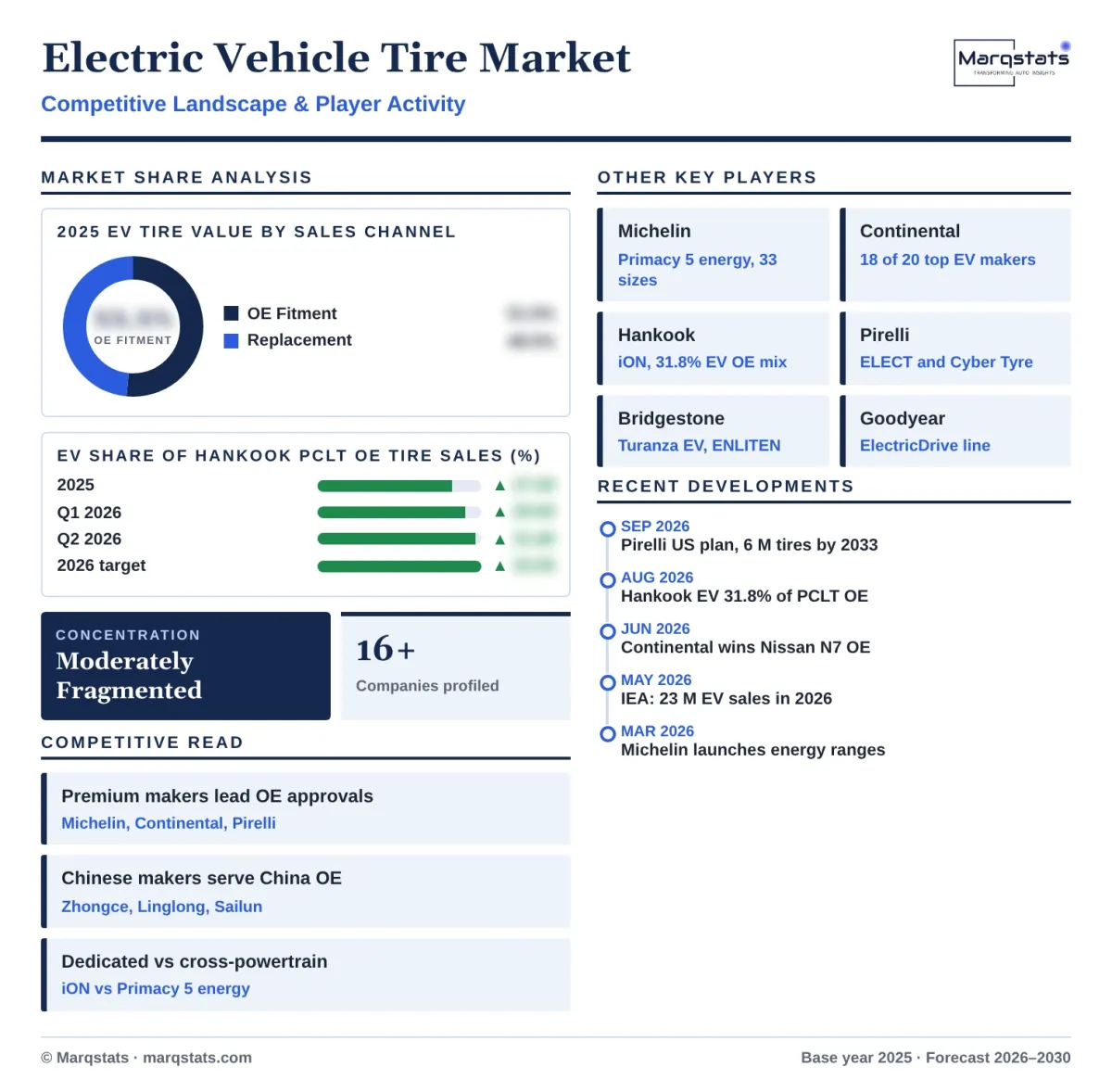
The electric vehicle tire market is moderately fragmented, with premium global tire makers leading OE approvals on high-volume EV platforms and Chinese producers supplying much of China's domestic OE and replacement demand. Compagnie Générale des Établissements Michelin SCA, Continental AG, Bridgestone Corporation, Pirelli & C. S.p.A. and Hankook Tire & Technology Co., Ltd. hold the leading premium positions, while Zhongce Rubber Group Co., Ltd., Shandong Linglong Tyre Co., Ltd. and Sailun Group Co., Ltd. compete on price with large Chinese automakers. Chinese automakers held about 60% of global EV sales in 2025, which gives domestic suppliers close access to the largest OE pool. Outside China, the premium makers supply most OE fitments on European, Korean, Japanese and US electric models, and their approvals carry through to replacement sales at dealers.
Strategies split between dedicated EV brands and cross-powertrain ranges. Hankook runs the iON sub-brand and reported EVs at 31.8% of its Q2 2026 passenger car and light truck OE tire sales, up from 27.0% in 2025 and 29.6% in Q1 2026. Michelin sells motorization-independent ranges such as Primacy 5 energy and Pilot Sport 5 energy, and Continental pairs EcoContact 7 with ContiSilent and high-load technology, reaching OE coverage of 18 of the 20 highest-volume EV manufacturers in 2024. Pirelli supplies ELECT-marked tires and Cyber Tyre sensor systems, with its High Value segment at 79% of 2025 sales. Bridgestone Corporation sells Turanza EV and ENLITEN technology, and The Goodyear Tire & Rubber Company sells the ElectricDrive line for replacement buyers.
OE approvals and capacity decisions shape share. Continental won the Nissan N7 OE fitment with EcoContact 7 in 19 inches in June 2026, and Pirelli approved about USD 1.2 billion of US investment in September 2026 for 6 million premium car tires a year by 2033. The Yokohama Rubber Co., Ltd., Toyo Tire Corporation, Nexen Tire Corporation and Sumitomo Rubber Industries, Ltd. compete for premium and value fitments with broad compatible portfolios. Replacement buying through US dealers is covered in the Marqstats US Replacement Tire Market report.
Companies Covered
Companies covered in the report include:
Recent Market Activity
Table of Contents
Coverage & Segmentation
The electric vehicle tire market comprises OE and replacement tires fitted to battery electric and plug-in hybrid electric passenger cars worldwide, valued at manufacturer and dealer purchase prices in US dollars. The market counts tires by application, including broad-purpose approved tires, and excludes conventional hybrids, electric buses and trucks, two- and three-wheelers, installation and service revenue. Coverage uses a 2025 base year, a 2021–2025 historical period and a 2026–2030 forecast period, with 2026 as the estimated year. The US passenger and light truck aftermarket is covered in the Marqstats US Replacement Tire Market report.
Segmentation covers two sales channels, two propulsion types, three rim diameter bands and four regions, with 16 tire makers profiled. OE units follow electric car production by region at four tires per vehicle, replacement units follow a cohort model of the electric car parc by age, annual mileage and tread life, and value applies regional prices per tire with EV fitment sizes such as 235/45R18, 255/45R19 and 255/35R21 tracked as reference sizes. US dealer channels for these tires are covered in the Marqstats US Tire Dealer Market report.