Market Snapshot
Middle bar: base-year value × (1 + CAGR), rounded to two decimals. This is a calculated illustration, not a separately researched annual estimate.
The US construction and industrial tire market is valued at USD 1,998.14 million in 2025 and is projected to reach USD 2,606.46 million by 2030, registering a CAGR of 5.46% over 2026–2030. The market covers new pneumatic tires for wheeled construction machines, such as skid steers, backhoes, telehandlers, wheel loaders, graders and articulated haulers, and for pneumatic forklifts, aerial work platforms and other industrial vehicles, sold as replacement and original equipment. Imports of construction and industrial tires fell 8.20% to 3.58 million units in 2025 while customs value per tire rose 7.33%, and Marqstats estimates that 4.21 million tires entered use, down 2.09%, as dealers worked through stock built ahead of tariff changes.
Market size and forecast figures are generated using Marqstats' proprietary estimation framework, updated as of October 2026.
Coverage spans five equipment types, two construction types, two sales channels and four US regions: the South, West, Midwest and Northeast. The analysis benchmarks 16 tire makers, distributors and equipment makers, including Compagnie Générale des Établissements Michelin SCA, Bridgestone Corporation, The Yokohama Rubber Co., Ltd., Titan International, Inc. and Balkrishna Industries Limited, and tracks reference sizes such as 10-16.5 and 12-16.5 for skid steers, 19.5L-24 and 405/70-24 for backhoes and telehandlers, 20.5R25 and 23.5R25 for wheel loaders, 14.00R24 for graders, 750/65R25 and 875/65R29 for articulated haulers, and 7.00-12 and 28x9-15 for pneumatic forklifts. Agricultural tires, solid and press-on tires, tracks and giant mining tires on 57-inch and larger rims sit outside the market.
Key Takeaways
Market Overview & Analysis
Report Summary
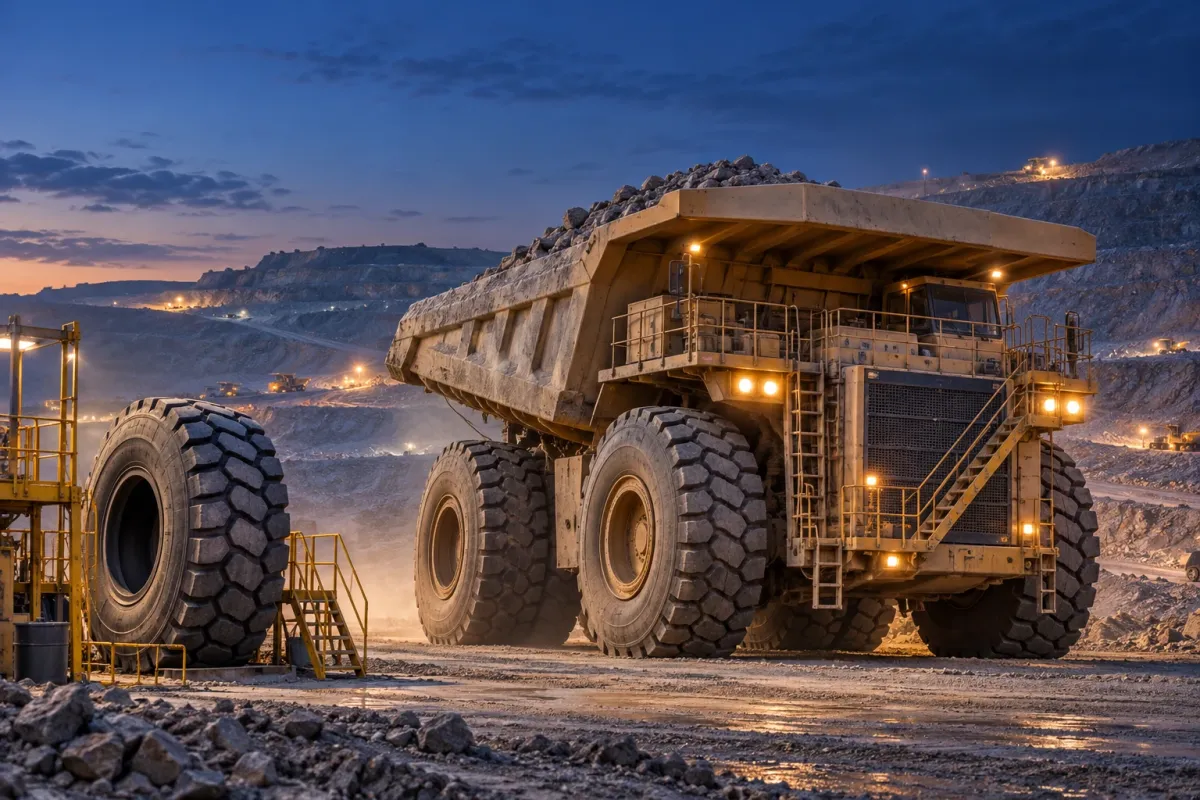
The US construction and industrial tire market comprises new pneumatic tires for wheeled construction and industrial machines, valued at USD 1,998.14 million in 2025 at the prices equipment makers and tire dealers pay. Compact construction equipment, wheel loaders and graders, articulated haulers and scrapers, pneumatic forklifts and industrial trucks, and aerial work platforms and other industrial vehicles fall in scope, in radial and bias construction. Foam-filled pneumatic tires count in the market. Agricultural tires, solid, resilient and press-on tires, rubber tracks, giant mining haul truck tires, retreads and tire services sit outside the market perimeter.
Imports supply most units. Construction and industrial tire imports fell from 3,903,412 units in 2024 to 3,583,322 units in 2025, while customs value fell only 1.47%, from USD 791.73 million to USD 780.11 million. Customs value per tire rose 7.33% from USD 202.83 to USD 217.71, which points to a shift toward larger sizes, different origins and higher negotiated prices rather than a simple fall in demand. A separate off-highway import category rose 32.18% to 454,420 units, and part of that flow serves the same machines.
Domestic plants fill the large-tire end of the market. Michelin produces earthmover tires in Lexington, South Carolina, Titan International produces construction tires in Des Moines, Iowa, and The Yokohama Rubber Co., Ltd. took over the Topeka, Kansas off-the-road plant when it bought Goodyear's off-the-road tire business for USD 905 million in February 2025. Marqstats estimates that domestic output of about 0.85 million tires, less about 0.40 million exported, plus about 0.18 million drawn from dealer stock, joins imports to supply the 4.21 million tires that entered use in 2025.
Equipment demand split in 2025 and 2026. Industrial Truck Association (ITA) data show US factory shipments of Class 4 and 5 internal combustion forklifts, the main users of pneumatic forklift tires, fell 22.37% from 82,260 units in 2024 to 63,855 in 2025, while Class 1 and 2 electric trucks fell from 97,050 to 88,461. Construction machinery turned up instead: Caterpillar reported North American retail sales up 18% in Q4 2025, 12% in Q1 2026 and 27% in Q2 2026 on a price-neutral basis. Marqstats estimates original equipment tires at 0.92 million in 2025, rising to 0.94 million in 2026, and replacement tires at 3.29 million.
Replacement demand rests on operating hours and service life. A wheel loader in an aggregate quarry can wear out a set of 23.5R25 tires in a few thousand hours, while the same tires on a loader moving mulch or snow last several seasons. Skid steers wear tires fastest because they steer by skidding, and rental fleets often replace 12-16.5 tires once or twice a year on busy machines. Marqstats sizes replacement by equipment type from the active fleet, typical annual hours and service life, and adds early removals for cuts, punctures and sidewall damage, which account for a large share of construction tire removals.
Value grows faster than units through size, radial mix and price. The average value per tire is an estimated USD 474.62 in 2025, rising to USD 546.43 by 2030, while units grow from 4.21 million to 4.77 million. Market value reaches an estimated USD 2,112.11 million in 2026. Mining and quarry off-the-road tire demand in the Gulf region is covered in the Marqstats Saudi Arabia OTR Tire Market report.
Market Dynamics
Key Drivers
Five factors support construction and industrial tire demand in the United States.
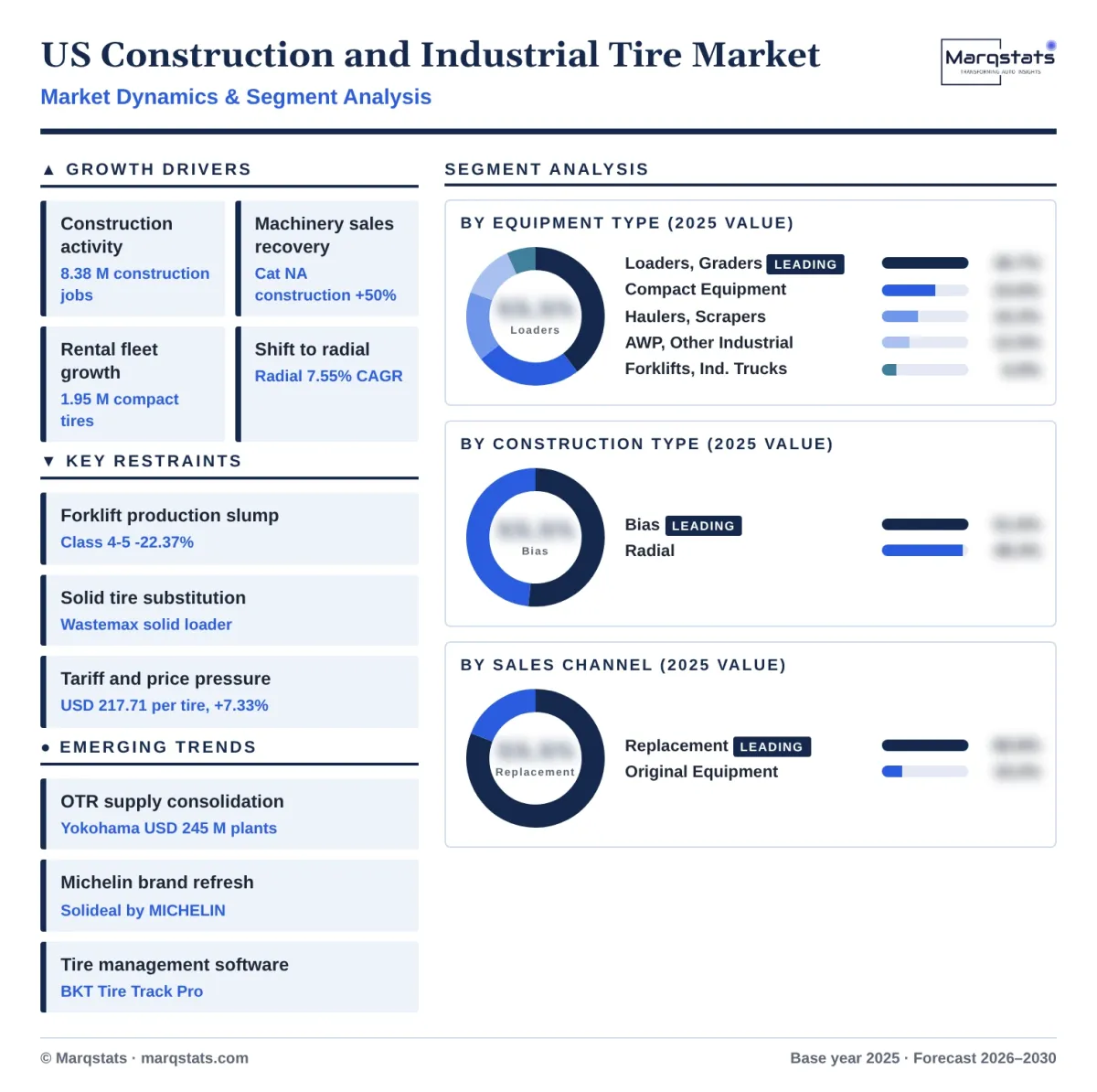
- Infrastructure and construction activity. Contractors employed about 8.38 million construction workers across the states in June 2026, according to state data compiled by the Associated General Contractors of America (AGC), with Texas at 927,300 and California at 881,200. Highway, data center, factory and utility projects keep loaders, graders, haulers and compact machines working long hours, and replacement tires follow operating hours rather than new machine sales. Construction employment is highest in the South, which holds 41.04% of the state total. Federal highway and bridge funding continues to support paving, grading and earthmoving work through 2026.
- Recovery in construction machinery sales. Caterpillar reported Q2 2026 North American Construction Industries sales of USD 5.065 billion, up 50%, helped by stronger sales to end users and dealer inventory changes. Each new wheel loader carries four tires in sizes such as 20.5R25 or 23.5R25 worth about USD 2,085 each, so a recovery in machine deliveries lifts original equipment tire value quickly. Original equipment value grows at a 5.82% CAGR, slightly faster than replacement. Caterpillar's price-neutral North American retail sales rose for five straight quarters from Q2 2025 to Q2 2026. Machine deliveries also raise the stock of newer equipment that enters the replacement cycle within two to three years.
- Rental fleet growth. Equipment rental companies own a large share of US skid steers, telehandlers and aerial work platforms and run them at high utilization across many job sites. Rental fleets replace tires on a fixed schedule to avoid downtime and damage claims, and they buy tires in volume in sizes such as 12-16.5, 405/70-24 and 355/65-15. Compact construction equipment consumes 1.95 million tires in 2025, rising to 2.26 million by 2030. Rental companies also standardize tire brands across their fleets to simplify stock and service. Utilization rates above typical owner fleets mean rental machines wear out tires faster per year of service.
- Shift to radial tires. Radial construction tires run cooler, resist punctures better and last longer on loaders, graders and telehandlers than bias tires. Radial share of value rises from 48.39% in 2025 to 53.37% by 2030, at a 7.55% CAGR, as fleets move wheel loader and telehandler tires to radial designs such as 20.5R25 and 400/70R20 and as compact loaders adopt radial options. Radial tires also cut fuel use on loaders that travel between stockpiles. Higher upfront prices for radial tires are offset by lower cost per hour over the tire's life.
- Warehouse, logistics and yard activity. Lumber yards, building supply stores, ports, rail yards and outdoor storage sites run pneumatic forklifts and reach stackers on rough surfaces where cushion tires do not work. These trucks use 1.20 million tires in 2025 in sizes such as 6.50-10, 7.00-12, 28x9-15 and 8.25-15, and replacement follows hours of use and surface damage. Outdoor yards with gravel or broken surfaces wear pneumatic forklift tires faster than indoor floors. Ports and intermodal yards also run reach stackers and container handlers on large pneumatic tires such as 18.00-25.
Key Restraints
Four constraints hold back construction and industrial tire growth.
- Forklift production slump. ITA shipments of Class 4 and 5 internal combustion forklifts fell 22.37% in 2025, and electric forklifts that often run cushion or solid tires keep gaining share. Marqstats projects forklift and industrial truck original equipment tires to fall 2% in 2026, and the segment grows at only a 4.41% CAGR, the slowest equipment type. Class 3 electric hand trucks rose from 75,049 to 79,081 units in 2025, and these trucks run polyurethane wheels rather than pneumatic tires.
- Substitution by solid and foam-filled tires. Scrap yards, demolition sites and waste transfer stations move skid steers and loaders to solid or puncture-proof tires to avoid flats. BKT showed its Wastemax solid loader tire at ConExpo-Con/Agg in March 2026. Each switch moves demand out of the pneumatic market into the solid tire market. Fleets that switch also spend less on tire service calls, which makes the change hard to reverse.
- Tariff and price pressure. Customs value per tire rose 7.33% in 2025 as tariff changes and sourcing shifts raised landed costs, and dealers passed part of the increase to fleets. Titan International recorded net tariff refund recoveries of USD 0.9 million in its earthmoving and construction segment in Q2 2026 after the Supreme Court struck down IEEPA tariffs, which shows how sharply duty rules have moved costs. Higher landed costs push some fleets toward lower-priced Asian brands.
- Uneven OEM ordering. Titan reported Q2 2026 earthmoving and construction sales up only 1.4% to USD 154.5 million, citing lower North American volumes and the timing of demand among some construction equipment makers, and said construction end markets had moderated. Machine makers build and draw down tire stock in cycles, so original equipment tire orders swing more than machine sales. Tire suppliers carry the risk of excess stock when equipment makers cut build rates at short notice.
Key Trends
Four shifts are changing how construction and industrial tires are made, sold and managed.
- Consolidation of off-the-road tire supply. Yokohama Rubber bought Goodyear's off-the-road business in February 2025 and announced in May 2026 two new plants, in Saltillo, Mexico for USD 115 million and in Odisha, India for USD 130 million, with combined capacity of about 19,800 tonnes a year from 2028. The plants take over production that Goodyear still makes for Yokohama under a supply agreement of up to five years. Yokohama also shifts some production to its Romanian off-the-road plant acquired in May 2025. New capacity in Mexico sits close to US construction markets and shortens supply lines for large radial tires.
- Brand consolidation at Michelin. Michelin announced its Beyond Road brand refresh on 2 September 2026, moving Solideal by Camso tires and wheels to the Solideal by MICHELIN name. The change folds the Camso industrial range into the Michelin brand family alongside Michelin earthmover and compact line tires. Distributors expect a transition period while packaging and catalog listings change over. Dealers use the change to review stock of industrial pneumatic and solid tires under one supplier relationship.
- Tire management software. Tire makers sell data and service with tires: BKT demonstrated its Tire Track Pro fleet tire management software at ConExpo in March 2026. Fleets track tread depth, pressure, hours and cost per hour by machine, which supports radial upgrades and planned replacement. Telematics on new machines gives fleets hour meters that feed directly into tire tracking. Cost per hour tracking also helps fleets compare premium and value brands on the same machines.
- Telehandler and compact loader growth. Telehandlers and compact track and wheel loaders take a growing share of job site work, and wheeled models use tires such as 405/70-24, 400/70R20 and 14-17.5. Compact construction equipment tire value grows at a 5.64% CAGR to USD 647.98 million by 2030. Rental companies add telehandlers faster than most other machine types to serve commercial and residential builders. Wheeled telehandlers in 17-inch to 24-inch rim sizes are the fastest-growing tire group within compact equipment.
Market Segmentation
Wheel loaders and graders account for an estimated USD 792.49 million, or 39.66% of 2025 value, the largest equipment type, and are projected to reach USD 1,037.24 million by 2030 at a 5.53% CAGR. These machines use only 0.38 million tires in 2025, valued at about USD 2,085.50 per tire, in sizes such as 17.5R25, 20.5R25, 23.5R25 and 26.5R25 for loaders and 14.00R24 and 17.5R25 for graders. Radial construction dominates, and quarry and aggregate loaders replace tires most often. Loader tires on aggregate faces often need replacement after cut damage rather than tread wear.
Compact construction equipment accounts for an estimated USD 492.51 million, or 24.65% of 2025 value, and is projected to reach USD 647.98 million by 2030 at a 5.64% CAGR. Skid steers, backhoe loaders, telehandlers and compact wheel loaders use 1.95 million tires in 2025, the largest unit segment, including 0.47 million original equipment tires, at an average of USD 252.57 per tire. Common sizes include 10-16.5 and 12-16.5 for skid steers, 19.5L-24 and 12.5/80-18 for backhoes and 405/70-24 for telehandlers. Skid steers wear tires fast because they turn by skidding, which scrubs tread on hard surfaces.
Articulated haulers and scrapers account for an estimated USD 324.91 million, or 16.26% of 2025 value, and are projected to reach USD 432.32 million by 2030 at a 5.88% CAGR, the fastest equipment type. These machines use about 0.06 million tires in 2025 at the highest value of about USD 5,415 per tire, in sizes such as 750/65R25, 875/65R29 and 29.5R25. Large earthmoving and site preparation projects drive demand. Haul road maintenance and load control have a large effect on tire life in this segment.
Aerial work platforms and other industrial vehicles account for an estimated USD 250.24 million, or 12.52% of 2025 value, and are projected to reach USD 317.67 million by 2030 at a 4.89% CAGR. Rough-terrain scissor lifts, boom lifts, reach stackers, port equipment and ground support equipment use 0.62 million tires in 2025 at an average of USD 403.62 per tire, in sizes such as 355/65-15 and 18.00-25. Many boom lifts run foam-filled tires to prevent flats. Foam-filled tires carry a higher price than air-filled tires of the same size.
Forklifts and industrial trucks account for an estimated USD 137.99 million, or 6.91% of 2025 value, and are projected to reach USD 171.25 million by 2030 at a 4.41% CAGR. Pneumatic forklifts use 1.20 million tires in 2025 at the lowest average value of USD 114.99 per tire, in sizes such as 6.50-10, 7.00-12, 28x9-15 and 8.25-15. Cushion and solid pneumatic-shaped tires on the same trucks sit in the solid tire market. Lumber yards and building supply stores remain the core users of pneumatic forklift tires.
Bias tires account for an estimated USD 1,031.31 million, or 51.61% of 2025 value, and are projected to reach USD 1,215.50 million by 2030 at a 3.34% CAGR. Bias construction dominates skid steer, backhoe, forklift and many aerial work platform tires, where stiff sidewalls resist cuts and low prices matter, in sizes such as 12-16.5, 19.5L-24 and 7.00-12. Bias tires also remain common on backhoe front axles and older machines in rental fleets.
Radial tires account for an estimated USD 966.83 million, or 48.39% of 2025 value, and are projected to reach USD 1,390.96 million by 2030 at a 7.55% CAGR, the fastest segment. Radial tires dominate articulated haulers, graders and most wheel loaders, in sizes such as 20.5R25, 23.5R25, 750/65R25 and 875/65R29, and gain share on telehandlers and compact loaders. Radial share of value rises from 48.39% to 53.37% by 2030.
Replacement accounts for an estimated USD 1,614.18 million, or 80.78% of 2025 value, and is projected to reach USD 2,096.87 million by 2030 at a 5.37% CAGR. Fleets and rental companies bought 3.29 million replacement tires in 2025, rising to 3.71 million by 2030, through commercial tire dealers, equipment dealers and mobile service providers. Replacement follows operating hours, haul distance, surface conditions and cut damage. Many fleets replace tires in sets per axle to keep machines level and stable.
Original equipment accounts for an estimated USD 383.96 million, or 19.22% of 2025 value, and is projected to reach USD 509.59 million by 2030 at a 5.82% CAGR. Equipment makers fitted 0.92 million tires in 2025, rising to 0.94 million in 2026 and 1.05 million by 2030. Original equipment prices run about 15% below replacement, and recovering construction machine sales lift original equipment demand from 2026. Equipment makers approve two or three tire brands per model, which shapes later replacement choices.
By Geography
South
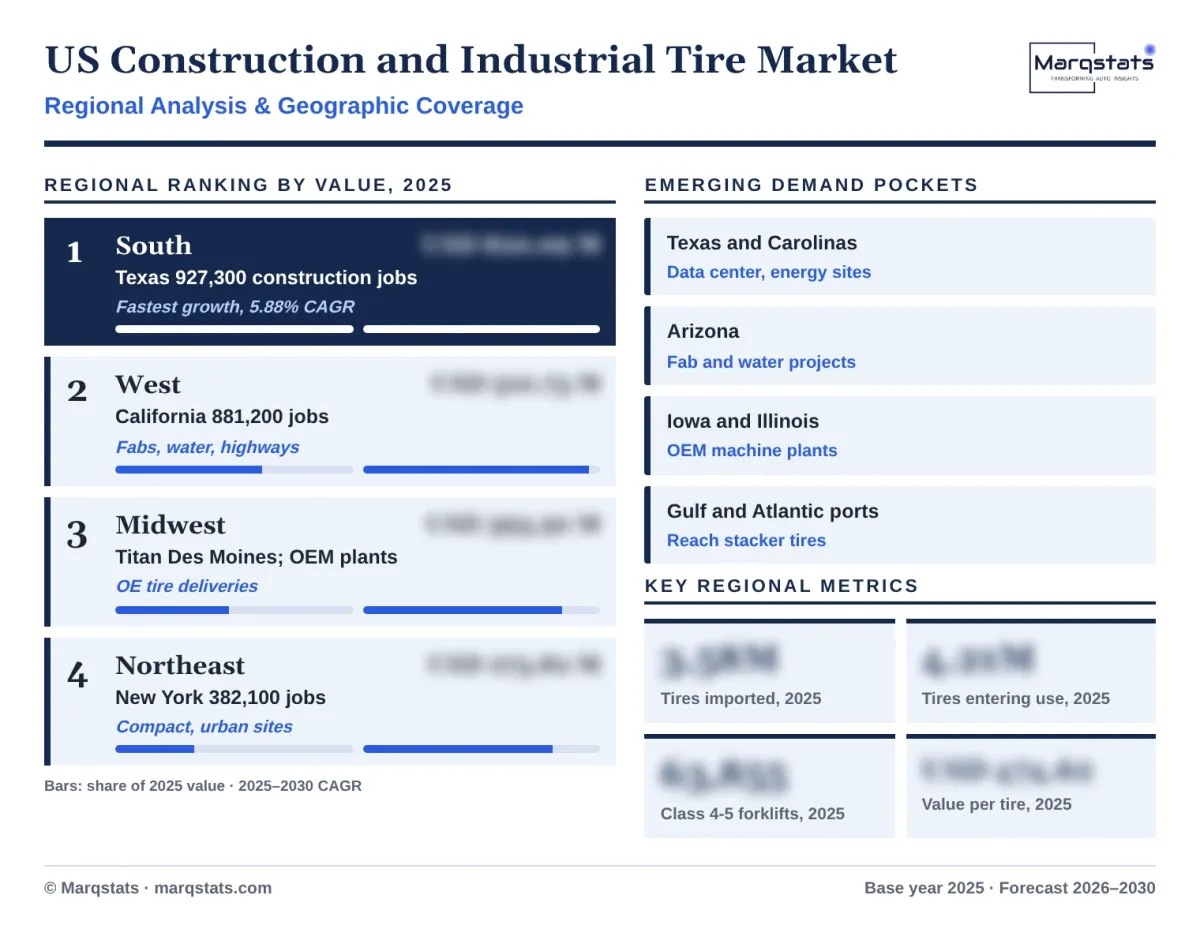
The South is the largest regional market at 41.05% of 2025 value, or USD 820.09 million, and grows fastest at a 5.88% CAGR to USD 1,091.34 million by 2030. Texas employed 927,300 construction workers in June 2026 and Florida 654,800, and data center, energy, highway and housing projects across Texas, Georgia and the Carolinas keep loaders and compact machines busy. Ports on the Gulf and Atlantic coasts add demand for reach stacker and port equipment tires. Long working seasons across the Sun Belt raise annual machine hours and tire wear.
West
The West accounts for 25.56% of 2025 value, or USD 510.73 million, and is projected to reach USD 669.59 million by 2030 at a 5.57% CAGR. California employed 881,200 construction workers in June 2026 and Arizona 227,600, and semiconductor fab, water and highway projects support articulated hauler and loader tire demand. Aggregate quarries across the region run loaders that replace tires frequently on abrasive surfaces. Mountain and desert projects expose tires to sharp rock and heat, which shortens service life.
Midwest
The Midwest accounts for 19.69% of 2025 value, or USD 393.50 million, and is projected to reach USD 500.64 million by 2030 at a 4.93% CAGR. Ohio employed 270,700 construction workers in June 2026 and Illinois 250,500. Titan International builds construction tires in Des Moines, Iowa, and Caterpillar, Deere and Bobcat build construction machines across Illinois, Iowa, North Dakota and Minnesota, which concentrates original equipment tire deliveries in the region. Freeze-thaw seasons and road salt add wear and corrosion on wheels and tires.
Northeast
The Northeast accounts for 13.70% of 2025 value, or USD 273.82 million, and is projected to reach USD 344.89 million by 2030 at a 4.72% CAGR. New York employed 382,100 construction workers in June 2026 and Pennsylvania 261,700. Dense urban job sites favor skid steers, compact loaders and aerial work platforms, and winter shutdowns shorten the working season for many fleets. Utility and transit projects in the New York and Philadelphia areas support compact equipment demand.
How Competition Is Evolving
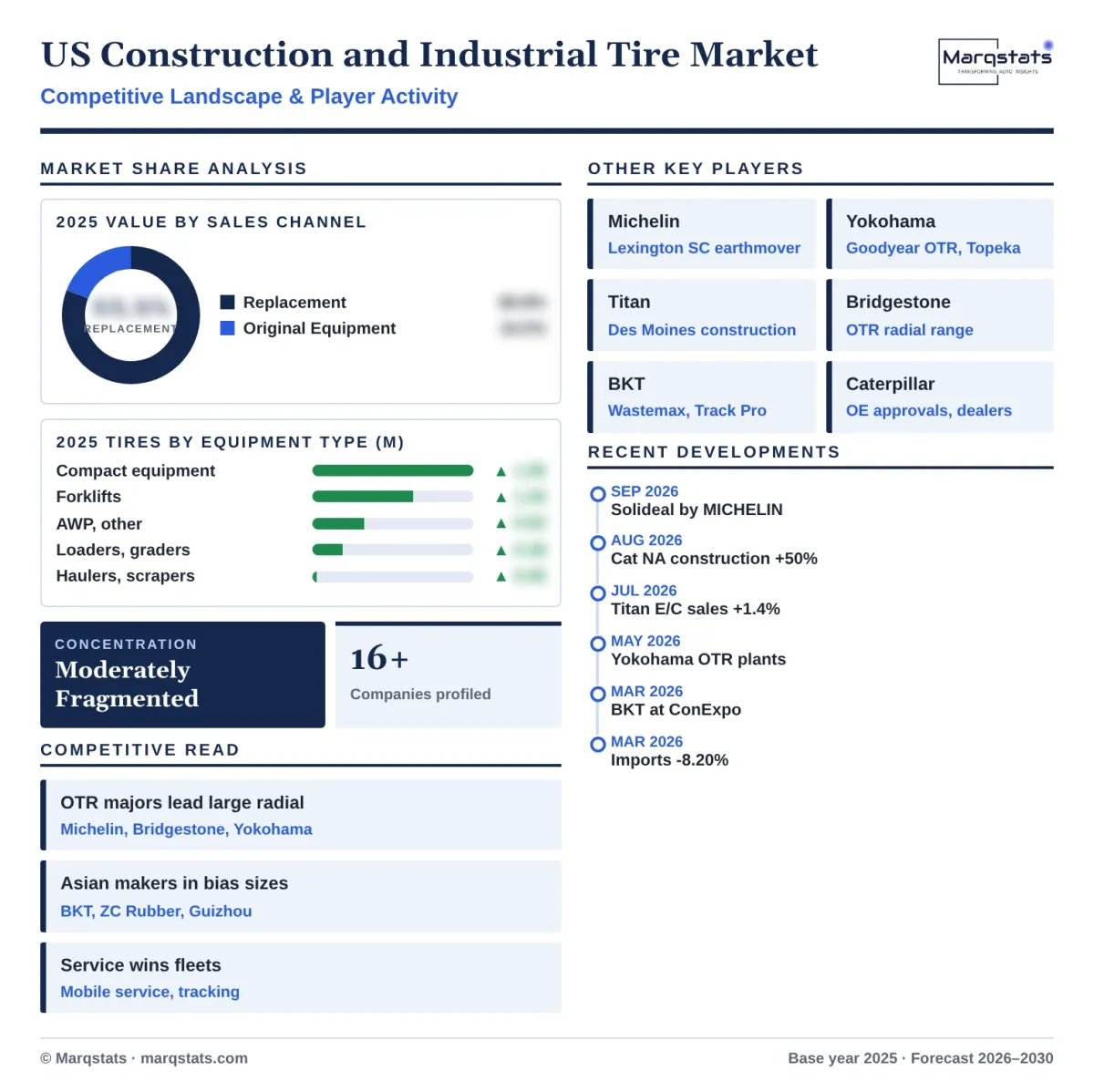
The US construction and industrial tire market is moderately fragmented, with global off-the-road makers leading in large radial tires and a wide field of Asian makers competing in bias compact and industrial sizes. Compagnie Générale des Établissements Michelin SCA, Bridgestone Corporation and The Yokohama Rubber Co., Ltd., which now owns the Goodyear off-the-road business along with the Trelleborg, Galaxy and Alliance brands, lead in loader, grader and articulated hauler tires. Titan International, Inc. competes in both large and compact sizes through its Titan and Carlisle brands.
Value and specialist makers compete hard in compact and industrial sizes. Balkrishna Industries Limited (BKT), Continental AG, Kenda Rubber Industrial Company, Ltd., Zhongce Rubber Group Co., Ltd., Guizhou Tyre Co., Ltd., Triangle Tyre Co., Ltd., Aeolus Tyre Co., Ltd., Sailun Group Co., Ltd. and Double Coin Holdings Ltd. supply skid steer, backhoe, forklift and loader tires, often at large discounts to premium brands. Magna Tyres Group B.V. supplies specialist large radial and industrial tires to distributors.
Service capability decides fleet business. Commercial dealers such as Southern Tire Mart, LLC run mobile service trucks, on-site tire changes and tire tracking programs for contractors, quarries and rental companies, while equipment makers such as Caterpillar Inc. approve tires for original fitment and sell replacement tires through their dealers. Tire makers back dealers with management software such as BKT's Tire Track Pro.
Ownership changes are reshaping supply. Yokohama's purchase of the Goodyear off-the-road business added the Topeka plant and a lineup of mining and construction tires, and its May 2026 plans for Mexico and India move part of that production to new plants by 2028. Michelin's September 2026 brand refresh folds the Camso Solideal range into the Michelin name. Solid and resilient industrial tires are outside this market, and US commercial truck tire benchmarks for the same dealers are covered in the Marqstats US Commercial Truck Tire Market report.
Companies Covered
Companies covered in the report include:
Recent Market Activity
Table of Contents
Coverage & Segmentation
The US construction and industrial tire market comprises new pneumatic tires for wheeled construction machines, pneumatic forklifts, aerial work platforms and other industrial vehicles, sold as replacement and original equipment, valued at equipment maker and dealer purchase prices in US dollars. The market excludes agricultural tires, solid, resilient and press-on tires, rubber tracks, giant mining haul truck tires on 57-inch and larger rims, retreads and services. Coverage uses a 2025 base year, a 2021–2025 historical period and a 2026–2030 forecast period, with 2026 as the estimated year. Agricultural tire demand is covered in the Marqstats North America Agricultural Tire Market report.
Segmentation covers five equipment types, two construction types, two sales channels and four US regions, with 16 tire makers, distributors and equipment makers profiled. Original equipment units follow machine shipments and tire positions, replacement units follow the active fleet and tire service life, and the import series is reconciled with domestic output, exports and dealer stock. Regional values follow construction employment by state. Sizes such as 12-16.5, 19.5L-24, 405/70-24, 20.5R25, 23.5R25, 14.00R24, 875/65R29 and 7.00-12 are tracked as reference sizes. Tire dealer channel economics are covered in the Marqstats US Tire Dealer Market report.