Market Snapshot
Middle bar: base-year value × (1 + CAGR), rounded to two decimals. This is a calculated illustration, not a separately researched annual estimate.
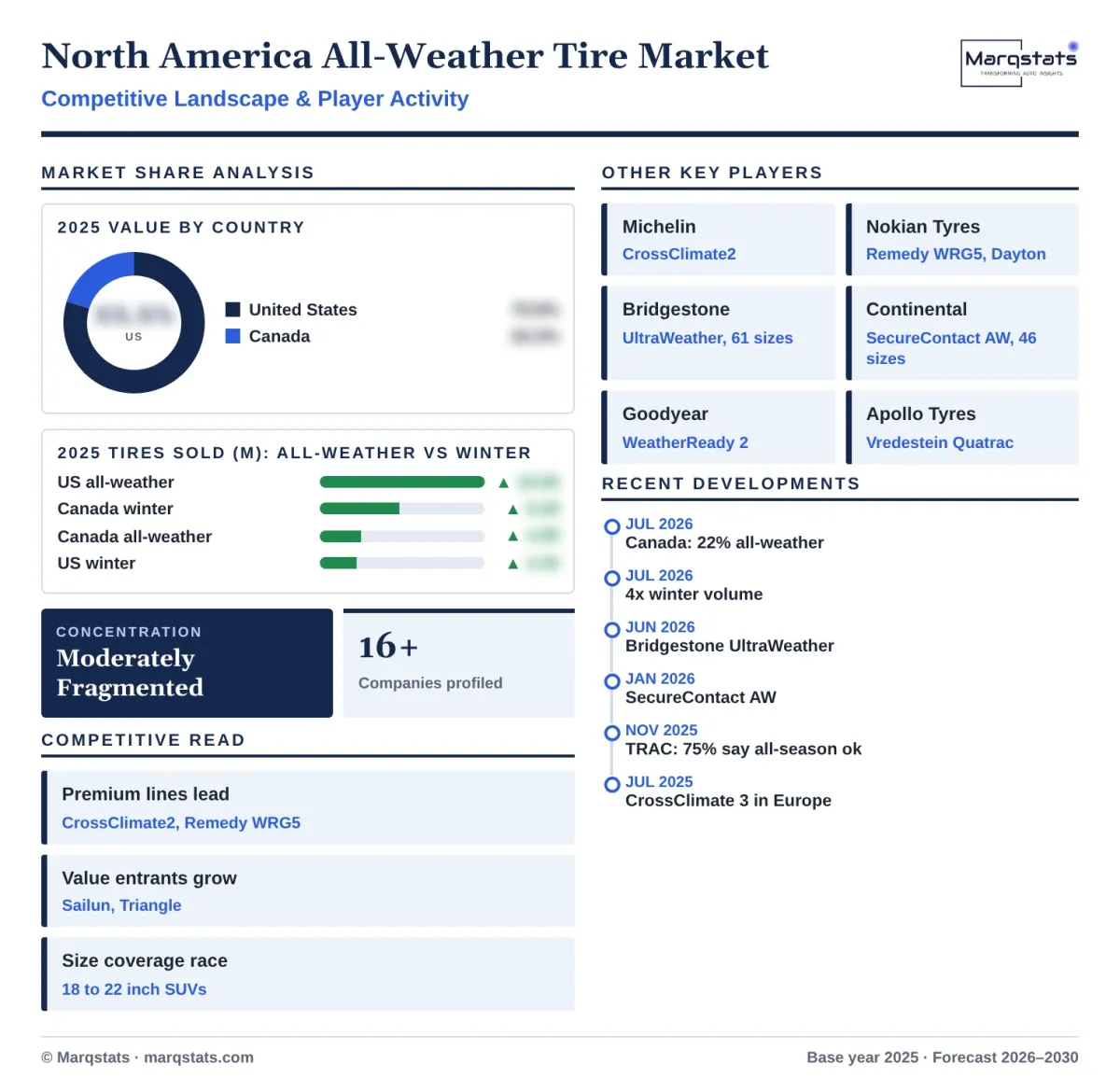
The North America all-weather tire market is valued at USD 4,813.03 million in 2025 and is projected to reach USD 7,250.87 million by 2030, registering a CAGR of 8.54% over 2026–2030, the fastest-growing season type in the region's replacement market. The market covers year-round passenger and light truck replacement tires marketed as all-weather and carrying the three-peak mountain snowflake symbol, sold in the United States and Canada. Marqstats estimates that 24.89 million all-weather tires were sold in 2025, including 19.90 million in the United States, about 7.7% of US passenger and light truck replacement units, and 4.99 million in Canada, where Bridgestone Americas estimates all-weather tires took about 22% of 2025 tire sales.
Market size and forecast figures are generated using Marqstats' proprietary estimation framework, updated as of October 2026.
Coverage spans two vehicle types, four rim diameter bands, three price tiers and five regions: the US West, US South, Canada, US Midwest and US Northeast. The analysis benchmarks 16 tire makers and retailers, including Compagnie Générale des Établissements Michelin SCA, Bridgestone Corporation, Nokian Tyres plc, Continental AG and Apollo Tyres Ltd, and tracks reference sizes such as 215/55R17 and 225/65R17 for compact crossovers, 235/60R18 and 235/55R19 for midsize SUVs, 255/50R20 for large SUVs and EVs, and LT265/70R17 for pickups. Dedicated winter tires, all-season tires without the three-peak symbol and all-terrain tires sit outside the market. Mexico is excluded because all-weather demand there is negligible.
Key Takeaways
Market Overview & Analysis
Report Summary
The North America all-weather tire market comprises new year-round passenger and light truck replacement tires that tire makers market as all-weather and certify for severe snow with the three-peak mountain snowflake symbol, valued at USD 4,813.03 million in 2025 at dealer purchase prices. Dedicated winter tires, standard all-season tires, all-terrain light truck tires, original equipment fitments and installation services sit outside the market perimeter. Because some winter and all-terrain tires also carry the snowflake symbol, the definition follows the maker's year-round positioning and product family rather than the symbol alone.
The United States is the volume engine. U.S. Tire Manufacturers Association (USTMA) data cited by Kumho Tire U.S.A. show all-weather tires reached about 6% of US tires sold in 2023 and about 7% by the end of 2024, after sales rose 19% in 2023 and 18% in the first half of 2024. Over the same periods, winter tire sales fell 21% and 39%, leaving all-weather volume close to three times winter volume at the end of 2023. Marqstats estimates 19.90 million US all-weather tires in 2025, about 7.7% of the 259.6 million passenger and light truck replacement tires shipped, worth USD 3,840.52 million.
Canada is the most mature market. Bridgestone Americas estimated that all-weather tires made up about 22% of Canadian tire sales in 2025, against 42% for dedicated winter tires and 35% for all-season tires, after steady growth since 2017. Marqstats estimates 4.99 million Canadian all-weather tires in 2025, worth USD 972.51 million, rising to USD 1,482.11 million by 2030 at an 8.79% CAGR. Distributor Dynamic Tire reported that its all-weather demand grew more than threefold in about three years.
All-weather adoption follows three routes. Drivers in the snow belt replace a two-set winter and all-season system with one set, drivers in milder regions upgrade from all-season tires for occasional snow, and new car buyers pick all-weather tires at first replacement. Apollo Tyres Ltd said in July 2026 that all-weather tires now sell about four times the volume of dedicated winter tires, up from about two times a few years ago, and that growth is shifting to a steadier pace. Marqstats projects US unit growth to ease from about 12% in 2025 to 4.5% by 2030.
The three-peak mountain snowflake symbol anchors the category. Tires earn the symbol by beating a standard reference tire in a medium-packed snow traction test, which separates all-weather tires from conventional all-season tires marked only M+S. Quebec and British Columbia accept tires with the symbol where winter tires are required, and many Canadian insurers accept them for winter tire discounts. Because the symbol is a minimum snow standard, all-weather tires still trade some ice grip against dedicated winter tires, while gaining year-round wear life and dry handling that winter compounds lack.
Value grows faster than units through larger sizes and price. The average value per all-weather tire is an estimated USD 193.37 in 2025, rising to USD 220.53 by 2030, and units grow from 24.89 million to 32.88 million. Market value reaches an estimated USD 5,270.99 million in 2026. Dedicated winter tire demand in the same two countries is covered in the Marqstats North America Winter Tire Market report.
Market Dynamics
Key Drivers
Five factors support all-weather tire demand in North America.
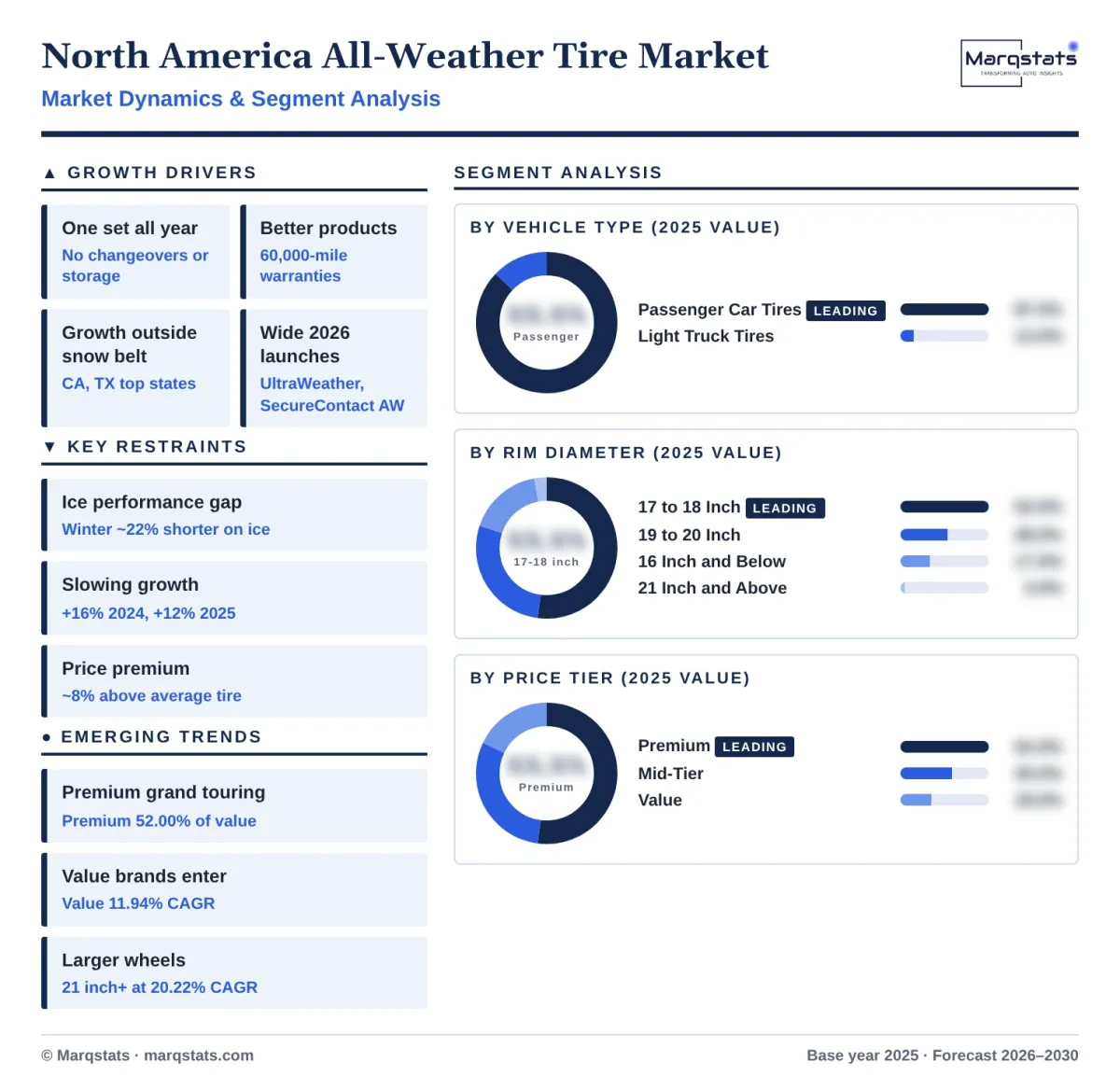
- One set for all seasons. All-weather tires remove the cost of a second set of tires and wheels, twice-yearly changeovers and seasonal storage. Drivers in apartments and condominiums with no storage space, and drivers in regions with occasional snow, gain severe snow certification without a winter set. TRAC found that 75% of Canadian drivers who skip winter tires believe all-season tires are good enough, which makes this group a natural all-weather upgrade. Switching to one set also frees garage and closet space and removes storage fees at dealers. Changeover appointments and storage fees can add a meaningful cost each year for two-set owners in Canadian cities.
- Better product performance. Bridgestone Americas said that five years ago engineers had to compromise on dry braking, wear life and comfort to gain snow grip, and newer compounds have narrowed those gaps. Many all-weather tires now carry mileage warranties of 60,000 to 70,000 miles: Continental's SecureContact AW and Bridgestone's UltraWeather carry 60,000-mile warranties and Nokian's Remedy WRG5 60,000 miles. Consumer awareness has caught up with what the products can do, according to Apollo Tyres. Warranties near those of premium all-season tires remove a key reason buyers once avoided all-weather tires. Independent test results published by consumer groups also raise buyer confidence.
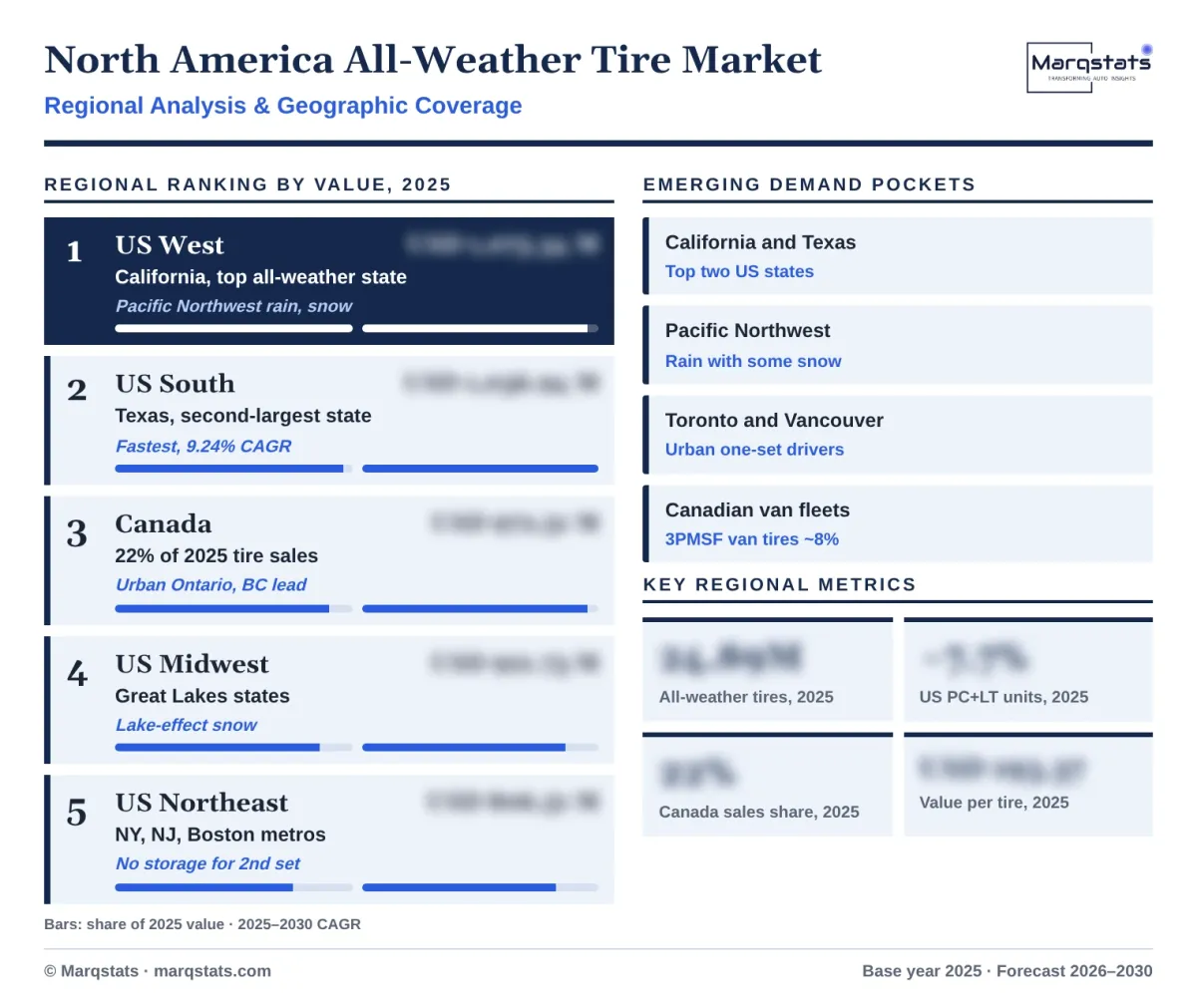
- Growth outside the snow belt. Apollo Tyres reported that all-weather growth in non-winter areas such as California, Washington, Texas and parts of the Southeast is stronger than many expected, and Kumho Tire U.S.A. cited USTMA data showing that California and Texas are the top two all-weather states. Ten states account for 54% of US all-weather volume. The US South grows fastest at a 9.24% CAGR. Heavy rain and occasional ice storms in the South make severe snow grip a safety feature rather than a necessity. Kumho Tire U.S.A. noted strong demand in the upper Midwest alongside the Sun Belt states.
- Crossover, SUV and EV fleets. Crossovers, SUVs and EVs dominate new vehicle sales, and their owners favor one-set tires that handle rain, cold and snow. The 17-inch to 18-inch range makes up just over half of all-weather demand, with 18 inches the largest fitment, and the 20-inch band has more than doubled its share in recent years, according to Apollo Tyres. Light truck all-weather tire value grows at a 9.65% CAGR. Instant torque and heavier curb weights on EVs favor tires that grip well in cold rain and slush. Crossover owners make up the largest single group of first-time all-weather buyers.
- Wide product launches. Continental launched the SecureContact AW in January 2026 in 46 sizes on 15-inch to 20-inch rims, and Bridgestone launched the UltraWeather in June 2026 with 61 planned sizes on 16-inch to 22-inch rims, replacing the WeatherPeak. Each launch widens fitment coverage and dealer stocking, which lifts all-weather sales at retail. Dealers that stock a full size range convert more all-season shoppers at the counter. Michelin, Goodyear, Toyo and Hankook also extended their all-weather size ranges in recent seasons.
Key Restraints
Four constraints hold back all-weather tire growth.
- Performance gap against winter tires on ice. Dedicated winter tires still stop shorter on ice: a winter tire stopped about 22% shorter than a leading all-weather tire from 12 mph on ice in testing cited by Apollo Tyres. Quebec's winter tire rule and strong winter tire habits in Atlantic Canada keep dedicated winter sets dominant where ice is common, and Bridgestone estimates winter tires still took 42% of Canadian tire sales in 2025. Drivers in northern Canada and the snowiest US regions continue to buy dedicated winter sets. Northern Ontario, the Prairies and Alaska remain strongholds of studded and studless winter sets.
- Slowing growth from a larger base. After several years of rapid gains, the category is shifting to steadier expansion, according to Apollo Tyres. US all-weather units grew an estimated 16% in 2024 and 12% in 2025, and Marqstats projects growth of 7% in 2026 easing to 4.5% by 2030. A larger installed base also means a higher share of sales comes from repeat buyers rather than new adopters. Dealers also report that some first-time buyers return to winter sets after a harsh season.
- Price premium over all-season tires. All-weather tires sell at a premium to standard all-season tires of the same size, and Marqstats values them about 8% above the average passenger and light truck tire. Price-sensitive buyers in mild regions often stay with lower-priced all-season tires, and Nokian Tyres estimated that the North American passenger and light truck replacement market fell about 5% in the first half of 2026. Retailers with heavy all-season stock also promote those lines over all-weather tires during sales events. The premium narrows on value brands, which supports adoption among cost-conscious drivers.
- Definition and labeling confusion. Some all-season tires, all-terrain tires and winter tires also carry the three-peak mountain snowflake symbol, and tire makers use different names for year-round severe snow products. Shoppers who cannot tell the categories apart may default to familiar all-season tires, which slows conversion. Clear labeling and retailer education remain key to converting shoppers at the point of sale. Tire makers address this with marketing that explains the snowflake symbol and the year-round use case.
Key Trends
Four shifts are changing how all-weather tires are made, sold and used.
- Premium grand touring all-weather tires. Bridgestone positions the UltraWeather as a premium grand touring tire for sedans, minivans, crossovers, SUVs and trucks, and Michelin keeps the CrossClimate2 in North America for the next several years while launching the CrossClimate 3 in Europe in July 2025, citing North American mileage expectations. Premium tires hold 52.00% of 2025 all-weather value. Premium value share eases to 48.00% by 2030 as lower-priced lines gain. Premium lines also hold the strongest positions in large crossover and EV sizes.
- Value brands enter the category. Sailun's Atrezzo 4S and Triangle's TA01 SeasonX bring three-peak capability to lower price points, and value tires grow fastest by tier at an 11.94% CAGR, from 18.00% to 21.00% of value by 2030. Wider choice draws price-sensitive buyers from all-season tires. Online tire retailers make value all-weather lines easy to compare against premium brands. Online retailers and distributors widen access to value all-weather brands in Canada and the United States.
- Larger wheels. Tires for 19-inch to 20-inch rims grow at a 12.17% CAGR and tires for 21-inch and larger rims at 20.22%, while 16-inch and smaller sizes fall from 17.00% to 12.00% of value. The 17-inch to 20-inch band captures about four-fifths of all-weather demand. Larger sizes also lift the average value per all-weather tire from USD 193.37 in 2025 to USD 220.53 by 2030. The 21-inch and larger band grows from USD 144.39 million to USD 362.54 million by 2030.
- All-weather commercial van tires. Three-peak commercial van tires now make up about 8% of the Canadian all-weather category after being nearly nonexistent five years ago, according to Bridgestone. Delivery and trades fleets adopt all-weather tires to avoid seasonal changeovers on vans. Van fleets in Canadian cities lead this shift, and US fleets in the snow belt follow. Fleet managers also cut downtime by avoiding seasonal changeover appointments for large van fleets.
Market Segmentation
Passenger car all-weather tires account for an estimated USD 4,187.00 million, or 86.99% of 2025 value, and are projected to reach USD 6,258.51 million by 2030 at an 8.37% CAGR. Sedans, crossovers and most SUVs run passenger-rated all-weather tires in sizes such as 215/55R17, 225/65R17, 235/60R18 and 235/55R19, led by Michelin's CrossClimate2, Nokian's Remedy WRG5 and Bridgestone's UltraWeather. Crossovers take a growing share of passenger all-weather tire value. Passenger all-weather units account for most of the 24.89 million all-weather tires sold in 2025.
Light truck all-weather tires account for an estimated USD 626.03 million, or 13.01% of 2025 value, and are projected to reach USD 992.36 million by 2030 at a 9.65% CAGR, the faster vehicle type. Pickups, large SUVs and commercial vans use load-rated all-weather tires in sizes such as LT265/70R17 and LT245/75R16, and three-peak van tires gain share in fleet use. Pickup owners in mild snow regions choose all-weather light truck tires over all-terrain tires for road comfort. Light truck all-weather value rises from USD 626.03 million to USD 992.36 million by 2030.
All-weather tires for 17-inch to 18-inch rims account for an estimated USD 2,502.77 million, or 52.00% of 2025 value, the largest band, and are projected to reach USD 3,625.44 million by 2030 at a 7.69% CAGR. Compact and midsize crossovers on sizes such as 225/65R17 and 235/60R18 make 18 inches the single largest fitment. This band carries the widest product choice across premium, mid-tier and value brands. Share eases slightly from 52.00% to 50.00% by 2030 as larger sizes gain.
All-weather tires for 19-inch to 20-inch rims account for an estimated USD 1,347.65 million, or 28.00% of 2025 value, and are projected to reach USD 2,392.79 million by 2030 at a 12.17% CAGR. Midsize and large SUVs and EVs use sizes such as 235/55R19 and 255/50R20, and the 20-inch band has more than doubled its share in recent years. Premium brands launch large sizes first, which keeps this band focused on higher-priced tires. Share rises from 28.00% to 33.00% of value by 2030.
All-weather tires for 16-inch and smaller rims account for an estimated USD 818.22 million, or 17.00% of 2025 value, and are projected to reach USD 870.10 million by 2030 at a 1.24% CAGR. Compact cars and older sedans use sizes such as 205/55R16 and 215/60R16, and this band shrinks as small cars leave the fleet. Value brands compete hardest in these smaller sizes. Share falls from 17.00% to 12.00% of value by 2030.
All-weather tires for 21-inch and larger rims account for an estimated USD 144.39 million, or 3.00% of 2025 value, and are projected to reach USD 362.54 million by 2030 at a 20.22% CAGR, the fastest segment. Premium SUVs, large pickups and EVs on 21-inch and 22-inch wheels drive demand, and Bridgestone's UltraWeather range runs to 22 inches. Limited size coverage in this band supports high prices per tire. Share rises from 3.00% to 5.00% of value by 2030.
Premium all-weather tires account for an estimated USD 2,502.77 million, or 52.00% of 2025 value, and are projected to reach USD 3,480.42 million by 2030 at a 6.82% CAGR. Michelin, Bridgestone, Nokian, Continental, Goodyear and Pirelli lead this tier with mileage warranties of 60,000 miles or more. Premium lines also dominate original equipment fitments that shape replacement choices. Premium buyers value long warranties and strong wet and snow test results.
Mid-tier all-weather tires account for an estimated USD 1,443.91 million, or 30.00% of 2025 value, and are projected to reach USD 2,247.77 million by 2030 at a 9.26% CAGR. Toyo, Yokohama, Hankook, Kumho, Falken and Apollo's Vredestein brand compete here on value for money. Mid-tier brands win buyers who want three-peak capability at a lower price than premium lines. Mid-tier share rises from 30.00% to 31.00% of value by 2030.
Value all-weather tires account for an estimated USD 866.35 million, or 18.00% of 2025 value, and are projected to reach USD 1,522.68 million by 2030 at an 11.94% CAGR, the fastest tier. Sailun, Triangle and other Asian makers bring three-peak tires to lower price points through distributors and online retailers. Value lines often carry shorter mileage warranties than premium tires. Value brands also gain shelf space at warehouse clubs and online retailers.
By Geography
US West
The US West is the largest regional market at 22.34% of 2025 value, or USD 1,075.34 million, and is projected to reach USD 1,640.25 million by 2030 at an 8.81% CAGR. California is the top all-weather state, and Washington, Oregon, Colorado and Utah combine mountain snow with mild valleys where a single set of tires suits most drivers. Ski traffic into the Sierra Nevada and the Rockies adds demand from drivers who face chain controls a few days a year. Pacific Northwest cities such as Seattle and Portland see mostly rain with occasional snow, a near-ideal use case for all-weather tires.
US South
The US South accounts for 21.54% of 2025 value, or USD 1,036.94 million, and grows fastest at a 9.24% CAGR to USD 1,613.44 million by 2030. Texas is the second-largest all-weather state, and drivers across Texas, Tennessee, Virginia and the Carolinas buy all-weather tires for occasional ice storms and heavy rain. Winter storms in recent years showed how quickly ice can close roads across Texas and the mid-South. Southern dealers stock all-weather tires year-round rather than seasonally, which supports steady sell-through.
Canada
Canada accounts for 20.21% of 2025 value, or USD 972.51 million, and is projected to reach USD 1,482.11 million by 2030 at an 8.79% CAGR. Bridgestone estimates all-weather tires took about 22% of Canadian tire sales in 2025, and urban drivers in Ontario and British Columbia lead adoption. Canadian all-weather units grow from 4.99 million in 2025 to 6.65 million by 2030. British Columbia's Lower Mainland and southern Ontario cities are the strongest Canadian adoption areas.
US Midwest
The US Midwest accounts for 19.15% of 2025 value, or USD 921.73 million, and is projected to reach USD 1,350.81 million by 2030 at a 7.94% CAGR. The Great Lakes states remain strong all-weather markets, where drivers balance lake-effect snow against the cost of a winter set. Chicago, Detroit and Minneapolis drivers increasingly treat all-weather tires as a middle ground. Rural drivers in Minnesota and the Dakotas still favor dedicated winter tires for long, icy seasons.
US Northeast
The US Northeast accounts for 16.76% of 2025 value, or USD 806.51 million, and is projected to reach USD 1,164.26 million by 2030 at a 7.62% CAGR. Urban drivers in New York, New Jersey and Boston without storage for a second set choose all-weather tires, while rural New England keeps strong winter tire use. Winter tire share stays higher in Vermont, New Hampshire and Maine than in coastal cities. Pennsylvania and New Jersey drivers face frequent freeze-thaw cycles that suit all-weather compounds.
How Competition Is Evolving
The North America all-weather tire market is moderately fragmented, with a few premium lines holding most of the value and a growing field of mid-tier and value entrants. Compagnie Générale des Établissements Michelin SCA with CrossClimate2, Nokian Tyres plc with the Remedy WRG5 made in Dayton, Tennessee, Bridgestone Corporation with UltraWeather, Continental AG with SecureContact AW, and The Goodyear Tire & Rubber Company with Assurance WeatherReady 2 lead the premium tier.
Mid-tier and value makers widen the field. Pirelli & C. S.p.A., Toyo Tire Corporation, The Yokohama Rubber Co., Ltd., Hankook Tire & Technology Co., Ltd., Kumho Tire Co., Inc., Sumitomo Rubber Industries, Ltd. through Falken and Apollo Tyres Ltd through Vredestein compete with all-weather lines, and Sailun Group Co., Ltd. and Triangle Tyre Co., Ltd. bring three-peak tires to value price points.
Size coverage, mileage warranties and retail reach decide share. Makers race to fill 18-inch to 22-inch crossover and SUV sizes, and Bridgestone's 61 planned UltraWeather sizes and Continental's 46 SecureContact AW sizes show how quickly coverage expands. Canadian Tire Corporation, Limited sells all-weather tires through its national store network, and The Reinalt-Thomas Corporation, operating as Discount Tire, stocks all-weather lines across its US stores.
The shift from winter to all-weather tires changes dealer economics. Drivers who switch to one set stop paying for seasonal changeovers and storage, which reduces service revenue, while dealers gain a higher-priced tire on every replacement. Tire makers with strong positions in both winter and all-weather tires, such as Michelin, Bridgestone and Nokian, protect share whichever way buyers move. The full Canadian replacement market by season type is covered in the Marqstats Canada Replacement Tire Market report.
Companies Covered
Companies covered in the report include:
Recent Market Activity
Table of Contents
Coverage & Segmentation
The North America all-weather tire market comprises new year-round passenger and light truck replacement tires marketed as all-weather with the three-peak mountain snowflake symbol, sold in the United States and Canada and valued at dealer purchase prices in US dollars. The market excludes dedicated winter tires, standard all-season tires, all-terrain tires, original equipment fitments, Mexico and installation services. Coverage uses a 2025 base year, a 2021–2025 historical period and a 2026–2030 forecast period, with 2026 as the estimated year. Canadian all-weather value matches the all-weather segment in the Marqstats Canada Replacement Tire Market report.
Segmentation covers two vehicle types, four rim diameter bands, three price tiers and five regions, with 16 tire makers and retailers profiled. US units follow passenger and light truck replacement shipments and the all-weather share reported in USTMA data, Canadian units follow the all-weather share of replacement sales, and value applies dealer purchase values per tire. Sizes such as 215/55R17, 225/65R17, 235/60R18, 235/55R19, 255/50R20 and LT265/70R17 are tracked as reference sizes. The full US replacement market is covered in the Marqstats US Replacement Tire Market report.