Market Snapshot
Middle bar: base-year value × (1 + CAGR), rounded to two decimals. This is a calculated illustration, not a separately researched annual estimate.
The Vietnam motorcycle market is valued at USD 3.89 billion in 2025 and is forecast to reach USD 4.64 billion by 2030 at a 3.59% CAGR, on volume rising from 3,116,510 to an estimated 3,850,000 units at 4.32%. The panel counts all brands, combining the 2,615,057 units reported by association members with 501,453 non-member electric deliveries. Value compounds 0.73 points slower than volume, because the electric average selling price sits below the petrol one. Electric reaches an estimated 55.84% of sales by 2030.
Market size and forecast figures are generated using Marqstats' proprietary estimation framework, updated as of September 2026. The panel measures new two-wheeler retail value in Vietnam across every brand sold, built as units by propulsion against a disclosed average selling price in dong. Confidence is graded high on the association member series and on company-reported electric deliveries, both published on a fixed calendar, and medium on the non-member brands outside those two disclosures, which is the modelled input the panel is most sensitive to.
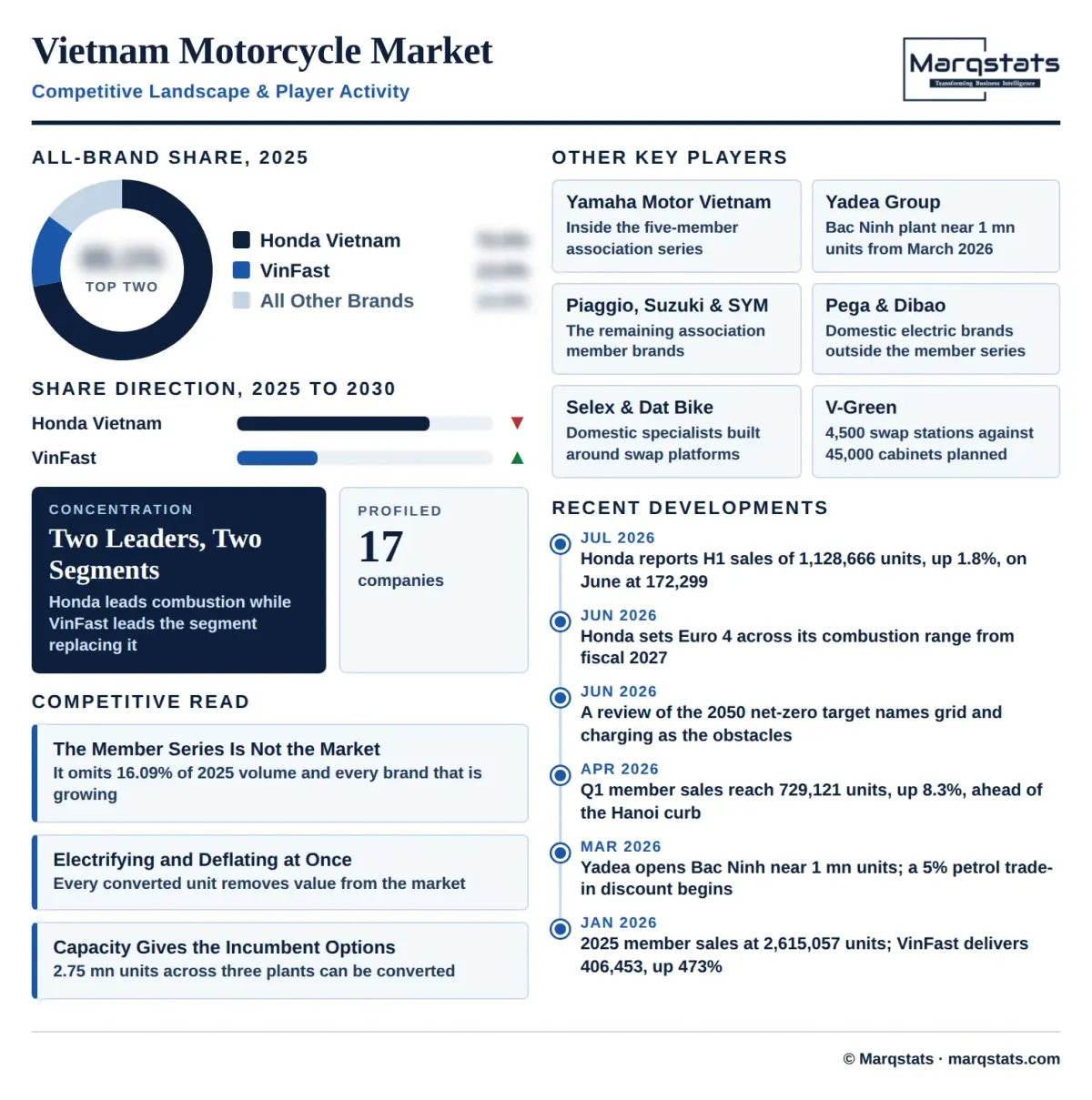
One company sells seven vehicles in ten. Honda Vietnam Co., Ltd. moved 2,245,562 motorcycles in calendar 2025, up 4.6%, for an estimated 85.9% of association member volume and an estimated 72.05% of the all-brand total. Its fiscal year to 31 March 2026 closed at 2,262,140 units, a marginal 0.05% increase, against production of nearly 2.5 million units and installed capacity of 2.75 million units per year across three plants.
The petrol series is flat and the electric one is not. Association members sold 2,615,057 units in 2025, down 1.5%, while VinFast delivered 406,453 electric two-wheelers in the same year, up 473%. Through the first four months of 2026 the all-brand market reached approximately 1.28 million units, up 23.3%, with the electric segment up 112.6% year on year, a rate no petrol segment in the market has approached in a decade.
Policy is now doing the work that price alone did not. Hanoi restricts petrol motorcycles inside its inner ring road on a time basis from July 2026, Euro 4 applies to all newly manufactured combustion motorcycles from fiscal 2027, and the national transport net-zero target is 2050. Vingroup added a 5% trade-in discount on electric motorcycles from 10 March 2026, converting an existing petrol vehicle into a deposit on its replacement.
Key Takeaways
Market Overview & Analysis
Report Summary
Vietnam has the largest two-wheeler installed base in Southeast Asia, at roughly 75 million vehicles in circulation against a population near 100 million, and a new-vehicle market that has been structurally flat for several years. Growth in this market has not come from more riders for some time. It now comes from replacing a petrol fleet with an electric one, and 2025 was the year that replacement became visible in the volume series rather than in announcements.
The measure is the retail value of new two-wheelers sold in Vietnam, covering cub, scooter, clutch and sport motorcycles with combustion engines and battery electric mopeds and scooters, across every brand selling into the market. Used two-wheeler retail, the aftermarket, battery swapping subscription revenue and electric bicycles below the registration threshold are excluded. Units are counted on a combined basis, being association member wholesale plus non-member electric deliveries, and values are expressed at a constant VND 26,200 per USD.
The analysis is written for incumbent combustion manufacturers deciding how quickly to convert capacity, electric entrants sizing the share still available above a dominant domestic brand, component suppliers whose content per vehicle changes entirely between the two propulsions, and fleet operators in delivery and ride-hailing whose duty cycles reach electric parity ahead of private buyers.
Vietnam Motorcycle Market Size and Forecast
The market is estimated at USD 3.89 billion in 2025 and USD 4.64 billion by 2030, an increase of USD 0.75 billion. Volume moves from 3,116,510 to an estimated 3,850,000 units at 4.32%, an increase of 733,490 units, while blended average selling price falls from USD 1,248 to an estimated USD 1,206. Value therefore compounds at 3.59%, or 0.73 points below the unit rate.
That gap is the single most important number on this page and it runs opposite to the direction it runs in passenger cars. Electrification lifts the average car price because an electric car costs more than its combustion equivalent. It lowers the average two-wheeler price in Vietnam, because a VinFast Evo lands near VND 22 million against a Honda Air Blade near VND 42 million. A market can electrify and deflate at the same time, and this one does.
The panel is built as units by propulsion against a disclosed price. In 2025 an estimated 2,615,057 combustion units carried VND 34.58 million each, or USD 1,320, and 501,453 electric units carried VND 22.93 million, or USD 875. By 2030 an estimated 1,700,000 combustion units carry VND 38.78 million, or USD 1,480, as Euro 4 adds injection and catalyst content, and 2,150,000 electric units carry VND 25.94 million, or USD 990, as pack capacity rises faster than cell cost falls.
Volume growth of 4.32% on a market this mature deserves explanation, because replacement demand alone would hold it near flat. The accelerant is that restriction pulls replacement forward. A rider whose petrol vehicle is barred from central Hanoi from July 2026 replaces it in 2026 rather than in 2029, and the pull-forward shows up as incremental units inside the forecast window rather than as a change in the underlying fleet turnover rate.
The Denominator Is the First Decision on This Page
The association member series covers five manufacturers, being Honda, Piaggio, Suzuki, SYM and Yamaha, and reported 2,615,057 units in 2025. VinFast is not a member. Yadea is not a member. Pega, Dibao, Anbico, Dat Bike, Selex, DK Bike and Detech are not members. Between them those brands sold an estimated 501,453 units in 2025, or 16.09% of the all-brand total, and they are the entire growth of the market.
Publishing the member series as the market size is therefore an error of 16.09% in 2025 that widens to an estimated 55.84% by 2030, at which point the omitted brands would be larger than the included ones. This panel counts the combined total of 3,116,510 units and states the construction in the unit string, so a figure taken from here can be reconciled against the member release rather than read as contradicting it.
The non-member estimate is anchored on two disclosures and one cross-check. VinFast reported 406,453 deliveries in 2025, up 473%, which is 81.06% of the estimated electric total. The remaining 95,000 units sit across Pega, Dibao, Yadea, Anbico, NIU, Gogoro and the smaller domestic brands, whose 2020 share structure placed Pega near 16% and Dibao at 12% of a much smaller segment. The cross-check is the 2026 year-to-date series: an all-brand total of approximately 1.28 million units to end-April with the electric segment up 112.6%, which implies a 2025 electric base near 500,000 and corroborates the build independently.
Why the Petrol Series Falls Rather Than Plateaus
Association member volume fell 1.5% in 2025 and then rose 8.3% in the first quarter of 2026 to 729,121 units, which on its own reads as stabilisation. Reading the base year alongside the current-year run rate gives a different answer, because the two policy measures that bite have effective dates inside 2026 and 2027 rather than before them. The first quarter of 2026 is the last clean quarter in the series.
Hanoi's time-based restriction inside the inner ring road takes effect from July 2026 and applies to the densest motorcycle catchment in the north. Euro 4 applies to all newly manufactured combustion motorcycles from fiscal 2027, which raises bill of materials on the entry models where the price elasticity is highest. A forecast that held petrol flat would have to assume neither measure changes a purchase decision, and the 112.6% electric growth already recorded in early 2026 makes that assumption untenable.
The forecast therefore carries petrol at negative 8.25% to an estimated 1,700,000 units by 2030, a decline of 915,057 units from the 2025 base. That is not a collapse in riding. The fleet of roughly 75 million vehicles continues to turn over at a similar rate; the replacement simply arrives with a motor instead of an engine, which is why total volume rises while the petrol line falls.
Market Dynamics
Key Drivers
Five forces carry the forecast, and four of the five act on propulsion mix rather than on total demand.
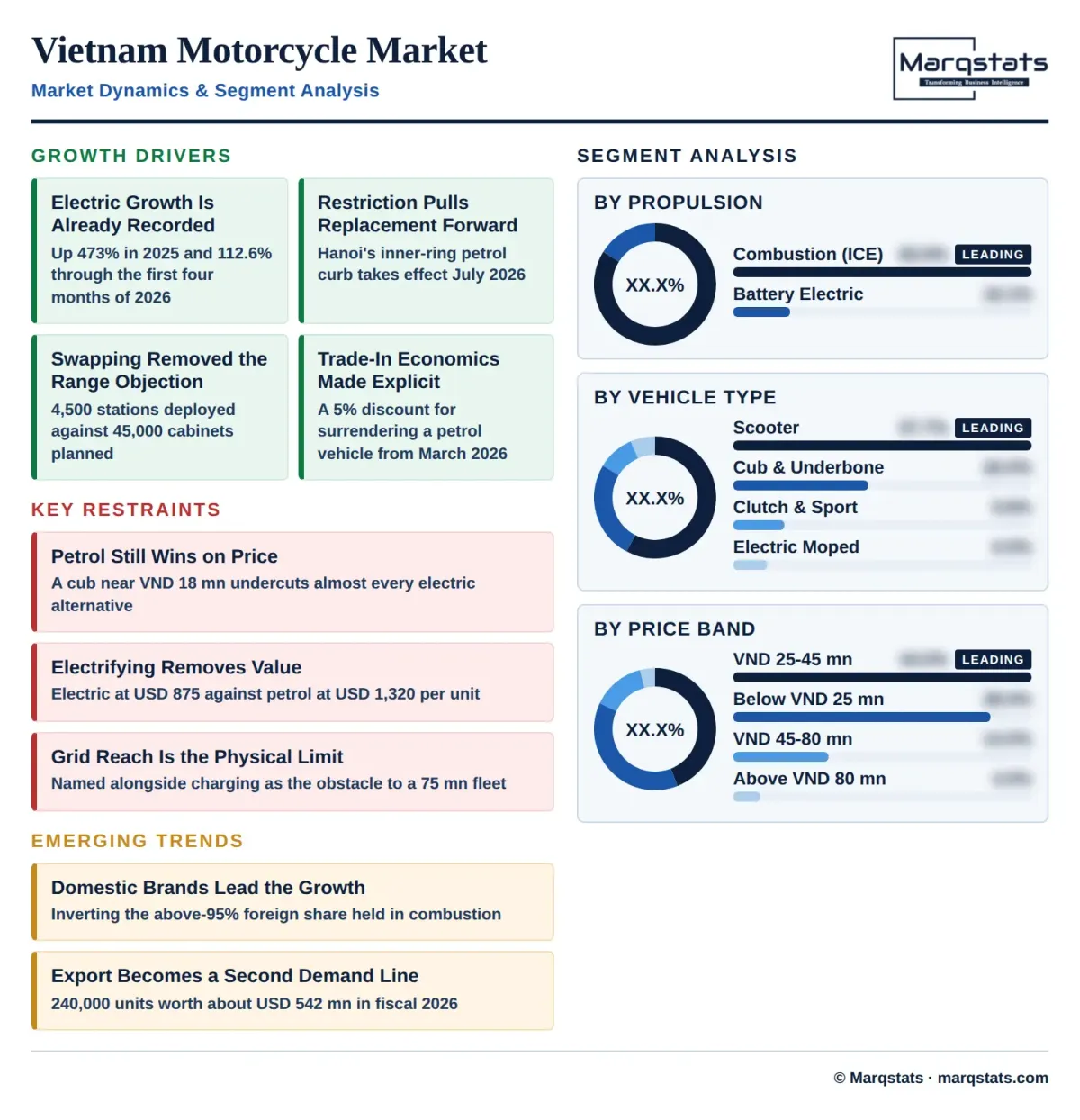
- Electric deliveries grew 473% in 2025 to 406,453 units at the leading brand and a further 112.6% year on year through the first four months of 2026, establishing an adoption rate no policy schedule has had to create.
- Hanoi's time-based petrol motorcycle restriction inside the inner ring road from July 2026 converts replacement timing into a compliance decision for riders in the country's densest urban catchment.
- Charging and swapping density removed the range objection ahead of the purchase: 4,500 battery-swapping stations were already deployed by early 2026 against a plan for 45,000 additional swap cabinets nationwide.
- Manufacturing capacity for electric two-wheelers now exceeds 1 million units per year at a single plant, with Yadea's Bac Ninh facility, an investment above USD 100 million, entering service from March 2026.
- Trade-in economics were made explicit rather than implied, with a 5% additional discount on electric motorcycles for customers surrendering a petrol vehicle from 10 March 2026 across four markets including Vietnam.
Key Restraints
Three constraints hold the transition below the pace its early growth rates would imply, and each is strongest outside the two largest cities.
- Petrol remains prevalent in suburban and rural areas on affordability grounds, where a Honda Wave Alpha near VND 18 million undercuts almost every electric alternative and where charging density is a fraction of the urban figure.
- One brand holds an estimated 72.05% of all-brand volume on 2,245,562 units and 2.75 million units of installed capacity, so the pace of the transition is materially a function of one company's product timing rather than of aggregate demand.
- The electric average selling price of USD 875 against a petrol USD 1,320 means every converted unit removes value from the market, so manufacturer incentive to accelerate conversion is weaker than unit-share arithmetic alone suggests.
- Grid and electricity supply constraints were identified alongside charging infrastructure as the principal obstacles to shifting a fleet of this size, in a June 2026 review of the 2050 transport net-zero target.
Key Trends
Four movements reshape the competitive structure inside the forecast window rather than at its end.
- Domestic brands now lead the fastest-growing segment, with VinFast at an estimated 81.06% of 501,453 electric units in 2025, inverting the foreign-brand dominance that holds above 95% in the combustion segment.
- Export volume is becoming a second demand line rather than an overflow valve, with nearly 240,000 motorcycles and spare parts worth about USD 542 million shipped in fiscal 2026 from 2.75 million units of capacity.
- Battery swapping is being built as consumer infrastructure rather than as fleet infrastructure, with 45,000 swap cabinets planned nationwide against 4,500 stations already deployed by the first quarter of 2026.
- Compliance is arriving as a product deadline rather than a target, with Euro 4 mandated for all newly manufactured combustion motorcycles from fiscal 2027 by the manufacturer holding the majority of the market.
Market Segmentation
Combustion accounts for an estimated 2,615,057 units and 83.91% of volume in 2025, falling to an estimated 1,700,000 units and 44.16% by 2030 at negative 8.25%. At USD 1,320 per unit it holds an estimated USD 3,451.88 million of 2025 value, or 88.72% of the market, against 83.91% of units, because the petrol price sits above the blended one. Euro 4 from fiscal 2027 lifts the price to an estimated USD 1,480 while removing volume.
Electric accounts for an estimated 501,453 units and 16.09% of volume in 2025, reaching an estimated 2,150,000 units and 55.84% by 2030 at 33.80%, the fastest segment on the page. Value moves from an estimated USD 438.77 million to USD 2,128.50 million at 37.14%, faster than the unit rate because the price rises from USD 875 to an estimated USD 990. The segment crosses the combustion line during 2029 on this trajectory.
Automatic scooters are the largest body style at an estimated 57.70% of 2025 volume, or roughly 1,798,226 units, and the style where electric substitution is most direct because the electric portfolio is almost entirely scooter-shaped. Growth runs at an estimated 5.85%, above the market's 4.32%, as conversion moves volume into rather than out of the body style.
Cub and underbone motorcycles, led by a model line priced near VND 18 million, hold an estimated 26.00% of 2025 volume, or roughly 810,293 units, concentrated in suburban and rural catchments. The segment declines at an estimated negative 4.10% as Euro 4 raises the cost of the cheapest models in the market, where price elasticity is highest.
Manual clutch and sport models hold an estimated 9.80% of 2025 volume, or roughly 305,418 units, and are the segment least exposed to electric substitution because no volume electric equivalent is offered. The segment grows at an estimated 1.20%, effectively tracking replacement demand alone.
Low-speed electric mopeds, including the student and entry models that carried the early years of the segment, hold an estimated 6.50% of 2025 volume, or roughly 202,573 units. Growth runs at an estimated 21.40%, below the electric segment's 33.80%, as demand migrates upward into full-specification electric scooters with swappable packs.
Vehicles below VND 25 million hold an estimated 38.00% of 2025 volume, or roughly 1,184,274 units, and are the band where combustion and electric meet directly, since a VND 22 million electric scooter and a VND 18 million petrol cub compete for the same buyer. The band grows at an estimated 6.90% as electric entrants price into it deliberately.
The VND 25 million to VND 45 million band holds an estimated 44.00% of 2025 volume, or roughly 1,371,264 units, covering the highest-volume scooters in the market near VND 31 million to VND 42 million. Growth runs at an estimated 3.10% as Euro 4 pushes combustion models upward into the band from below.
The VND 45 million to VND 80 million band holds an estimated 14.00% of 2025 volume, or roughly 436,311 units, covering premium scooters and the upper electric models with larger packs. Growth runs at an estimated 4.60%, close to the market rate, as electric premium volume replaces combustion premium volume roughly one for one.
Models above VND 80 million hold an estimated 4.00% of 2025 volume, or roughly 124,660 units, and are the only band with no material electric participation. Growth runs at an estimated 2.20%, tracking discretionary income rather than any propulsion effect.
Private commuting accounts for an estimated 78.00% of 2025 volume, or roughly 2,430,878 units, and is the slowest-converting use case because the purchase is made once every several years on total cost rather than on operating cost. Growth runs at an estimated 3.60%, below the market's 4.32%.
Delivery and last-mile logistics account for an estimated 11.00% of 2025 volume, or roughly 342,816 units, and reach electric parity ahead of private buyers because daily distance converts the energy cost difference into a payback within months. Growth runs at an estimated 12.40%, with electric penetration in this use case running well above the market average.
Ride-hailing accounts for an estimated 7.00% of 2025 volume, or roughly 218,156 units, and is the use case where swapping infrastructure matters most, because a swap removes the charging downtime that would otherwise take a vehicle off the platform. Growth runs at an estimated 10.80% as platform operators specify electric fleets directly.
Rural and agricultural use accounts for an estimated 4.00% of 2025 volume, or roughly 124,660 units, carrying loads and operating at distances from charging points that keep combustion competitive longest. Growth runs at an estimated 0.90%, the slowest use case on the page.
By Geography
Hanoi and the Red River Delta
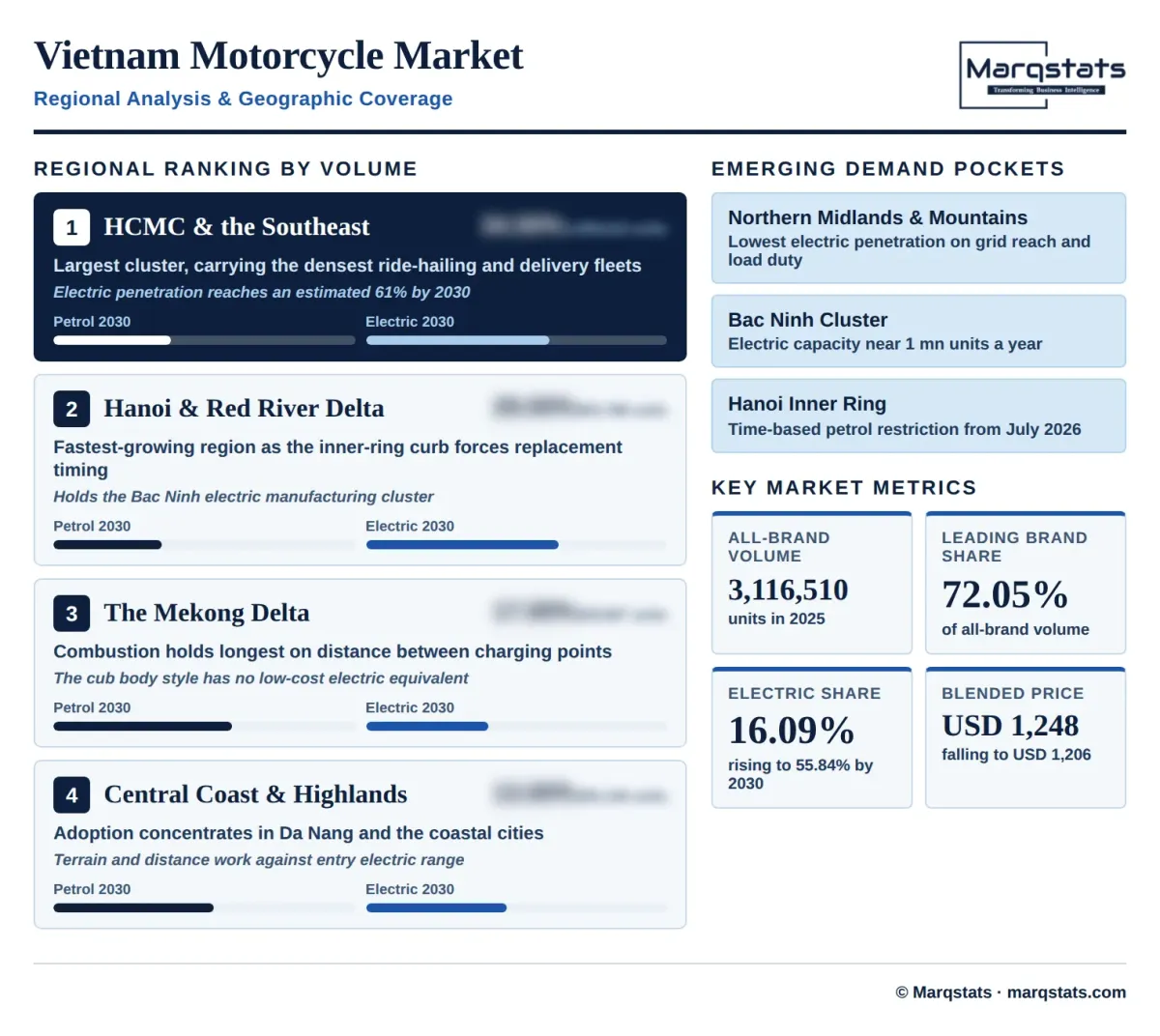
The northern cluster accounts for an estimated 29.00% of 2025 volume, or roughly 903,788 units, and is the fastest-growing region at an estimated 7.20% because the inner-ring petrol restriction from July 2026 converts replacement timing into a compliance decision. Electric penetration here is forecast to reach an estimated 64.00% by 2030, above the national 55.84%. The region also holds the Bac Ninh electric manufacturing cluster.
Ho Chi Minh City and the Southeast
The southern cluster is the largest at an estimated 34.00% of 2025 volume, or roughly 1,059,613 units, growing at an estimated 5.10%. It carries the densest ride-hailing and delivery fleets in the country, which is why its electric penetration reaches an estimated 61.00% by 2030 despite having no restriction equivalent to Hanoi's in force at the base year.
The Mekong Delta
The Mekong Delta accounts for an estimated 17.00% of 2025 volume, or roughly 529,807 units, growing at an estimated 2.40%. Combustion holds longest here, with electric penetration reaching an estimated 41.00% by 2030, because distances between charging points are greater and the cub and underbone body style that dominates the region has no low-cost electric equivalent.
The Central Coast and Central Highlands
The central cluster accounts for an estimated 13.00% of 2025 volume, or roughly 405,146 units, growing at an estimated 3.30%. Electric penetration reaches an estimated 47.00% by 2030, with adoption concentrated in Da Nang and the coastal cities rather than across the highlands, where terrain and distance both work against the entry electric range.
The Northern Midlands and Mountains
The northern uplands account for an estimated 7.00% of 2025 volume, or roughly 218,156 units, the smallest cluster, growing at an estimated 1.80%. Electric penetration reaches an estimated 33.00% by 2030, the lowest of the five, constrained by terrain, grid reach and the load-carrying duty that keeps combustion competitive.
How Competition Is Evolving
The market is highly concentrated and concentrated twice over, because the combustion segment and the electric segment each have a single dominant brand and they are not the same company. Honda Vietnam Co., Ltd. held an estimated 85.9% of association member volume in 2025 on 2,245,562 units, an increase of nearly 5 percentage points on 2024, and 84.7% across its fiscal year to March 2026 on 2,262,140 units. Across the all-brand total that is an estimated 72.05%. Foreign brands hold above 95% of the combustion segment between them.
The electric segment inverts that structure entirely. VinFast Trading and Production Joint Stock Company delivered 406,453 units in 2025, up 473%, for an estimated 81.06% of the electric segment, with the Evo series alone accounting for over 250,000 units, or nearly half of deliveries. Domestic and regional brands hold the remainder: Pega, Dibao, Anbico, DK Bike and Detech are Vietnamese, and Yadea, NIU and Gogoro are the principal foreign entrants. A market where the domestic champion leads the growth segment and the foreign incumbent leads the declining one is structurally unusual and it sets the terms of every competitive decision on this page.
Competition is now being fought on infrastructure and trade-in rather than on product specification. VinFast recorded over 135,000 orders and delivered over 93,000 electric two-wheelers in March 2026 alone, supported by approximately 600 distributors nationwide, 4,500 battery-swapping stations already deployed and a plan for 45,000 additional swap cabinets. Yadea committed above USD 100 million to a Bac Ninh plant with capacity near 1 million units per year from March 2026, which is the first electric capacity in the country capable of contesting the leader on volume rather than on price. Honda has set Euro 4 compliance across its combustion range from fiscal 2027 and holds 2.75 million units of installed capacity across three plants, giving it the option of converting existing lines rather than building new ones.
Companies Covered
Companies covered in the report include:
Recent Market Activity
Table of Contents
Coverage & Segmentation
The analysis measures the retail value of new two-wheelers sold in Vietnam from 2021 to 2030, with 2025 as the base year and 2026 to 2030 as the forecast period, covering propulsion, vehicle type, price band and end use, with five regional clusters. Units are counted on a combined all-brand basis of 3,116,510 vehicles in 2025, being 2,615,057 association member wholesale units plus an estimated 501,453 non-member electric deliveries, because the member series omits every brand growing fastest in the market. Used two-wheeler retail, the aftermarket, battery swapping subscription revenue and electric bicycles below the registration threshold are excluded. Values are expressed in USD at a disclosed constant VND 26,200 per USD.
Coverage spans two propulsions, four vehicle types, four price bands and four end uses across five regional clusters. Volume is carried as the primary series at 3,116,510 units in 2025 and value as the derived series at USD 3.89 billion, built as units by propulsion against a disclosed average selling price of VND 34.58 million for combustion and VND 22.93 million for electric. Seventeen entities are profiled across combustion manufacturers, electric manufacturers and swapping network operators.