Market Snapshot
Middle bar: base-year value × (1 + CAGR), rounded to two decimals. This is a calculated illustration, not a separately researched annual estimate.
The UAE RoboVan market size is estimated at USD 6.45 million in 2025 and is projected to reach USD 285.50 million by 2030, growing at a CAGR of 113.41% over 2026 – 2030. The active fleet of Level 4 cabless delivery vans grows from 45 to 3,650, a 140.89% annual rate.
Marqstats defines the UAE RoboVan market as spending on purpose-built, cabless SAE Level 4 electric delivery vans with gross weights of 1,000 to 3,500 kg and payloads of 400 to 1,500 kg operating on UAE public roads and in logistics zones. It includes vehicle purchases, RoboVan-as-a-Service contracts, remote supervision software and specialist maintenance. Sidewalk delivery robots, robotaxis, port tractors and drones are excluded. In dirham terms, the market grows from AED 23.69 million to AED 1,048.50 million at 3.6725 dirhams per dollar.
Abu Dhabi accounts for an estimated 58.14% of 2025 value and Dubai for 37.98%. Middle-mile warehouse-to-hub transport generates 66.67% of 2025 value and compact vans with payloads up to 600 kg 75.19%. The study segments the market by mission, payload class and emirate.
Key Takeaways
Market Overview & Analysis
Report Summary
Marqstats sizes the UAE RoboVan market as spending on purpose-built, cabless Level 4 electric delivery vans operating on public roads and in logistics free zones in the UAE. This includes vehicle purchases, RoboVan-as-a-Service subscriptions, remote supervision and fleet software licences, and specialist maintenance. Sidewalk and campus robots under 80 kg, robotaxis, port tractors, highway trucks and drones are excluded. In 2025 the market was worth an estimated USD 6.45 million from 45 active vehicles.
The market sits between two excluded segments. Sidewalk and community delivery robots weighing 30 to 80 kg carry small orders on pedestrian paths and inside closed communities, while autonomous port tractors at Jebel Ali and Khalifa Port move containers inside terminals. RoboVans occupy the space in between, carrying commercial loads on public urban roads, which is where most parcel and grocery volume moves and where the largest cost savings lie.
RoboVans have no cab, steering wheel, pedals or seat. They carry 400 to 1,500 kg in 2.5 to 10 cubic metres of space at up to 50 to 70 km/h and are supervised by remote vehicle operators. Leading models include the Neolix Xolra 3 and Xolra 6, the Zelos Z5 and Z10 and the WeRide Robovan W5. Variants include multi-locker vans that act as mobile pickup points and refrigerated vans for groceries, medicines and laboratory samples.
The UAE moved from pilots to commercial operation in 2025. Abu Dhabi issued commercial driverless permits and dedicated autonomous vehicle number plates monitored through the Integrated Transport Centre's digital platform, Neolix received the first robovan licence, and K2 and 7X formed operating partnerships with Neolix and Zelostech. Between 2021 and 2024 the active fleet stayed below 15 vehicles in closed trials and test zones.
Climate shapes vehicle design. Summer temperatures above 45°C to 50°C, road surfaces up to 70°C, humidity and dust require liquid-cooled batteries, sealed and self-cleaning sensors, and low-power computers. Neolix and Zelostech use swappable batteries so vehicles can run around the clock while charging takes place in climate-controlled depots. Mapless driving software helps vehicles cope with frequent road changes.
The same heat also drives demand. Midday outdoor work restrictions in summer limit motorcycle couriers, e-commerce parcel volumes keep rising, and courier costs, including visas, insurance and housing, keep increasing. Marqstats expects the fleet to reach 420 vehicles in 2026, 1,150 in 2027, 2,280 in 2028, 3,100 in 2029 and 3,650 in 2030, below company targets because production, route approvals, remote operator staffing and depot charging take time.
UAE RoboVan Market Size and Forecast
The UAE RoboVan market grows from USD 6.45 million in 2025 to USD 285.50 million in 2030, a CAGR of 113.41%. The fleet grows from 45 to 3,650 vehicles, a 140.89% annual rate. In dirhams, the market grows from AED 23.69 million to AED 1,048.50 million.
The market grew from USD 0.35 million in 2021, with two test vehicles, to USD 0.80 million in 2022, USD 1.25 million in 2023 and USD 2.30 million in 2024. Marqstats estimates USD 48.20 million in 2026 as postal and e-commerce routes go live and 375 vehicles are added, USD 112.50 million in 2027, USD 195.00 million in 2028 and USD 246.00 million in 2029.
Growth is fastest in 2026 and 2027 as the first commercial fleets are delivered, then slows as the market matures. Annual fleet additions peak at about 1,130 vehicles in 2028 before falling to about 550 in 2030, when growth comes increasingly from higher utilisation and service revenue rather than new vehicles.
Value per vehicle falls steadily. Marqstats estimates average spending per active vehicle falls from about USD 143,300 in 2025 to about USD 78,200 in 2030 because early deployments include high vehicle, setup and certification costs, while later years are dominated by recurring service fees and vehicles priced at about USD 45,000 to 65,000.
Unit economics favour robovans on busy routes. Marqstats estimates a compact robovan costs about USD 900 to 1,100 a month in vehicle amortisation over five years, about AED 450 to 600 in electricity against AED 1,800 to 2,200 in diesel for a conventional van, and AED 350 to 500 in maintenance against AED 600 to 800. Combined with remote supervision at about AED 400 to 600 a month, operating costs are well below those of a driver-operated van, and the gap widens with every additional delivery wave a robovan completes.
Service contracts gain share as fleets grow. Early deployments rely on vehicle purchases by state-backed operators and pilot budgets, while later growth comes from RoboVan-as-a-Service contracts in which logistics companies pay monthly fees for vehicles, software, remote supervision and maintenance. This shift spreads spending over the life of each vehicle and is one reason value grows more slowly than the fleet.
The forecast is below company ambitions. Neolix has said it plans 5,000 autonomous vehicles in the UAE by the end of 2026, and Zelostech expects large global volumes. Marqstats estimates 3,650 active robovans by 2030 after allowing for production schedules, municipal route approvals, remote operator ratios and depot power connections.
Market Dynamics
Key Drivers
Five forces are scaling driverless delivery vans across Abu Dhabi and Dubai.
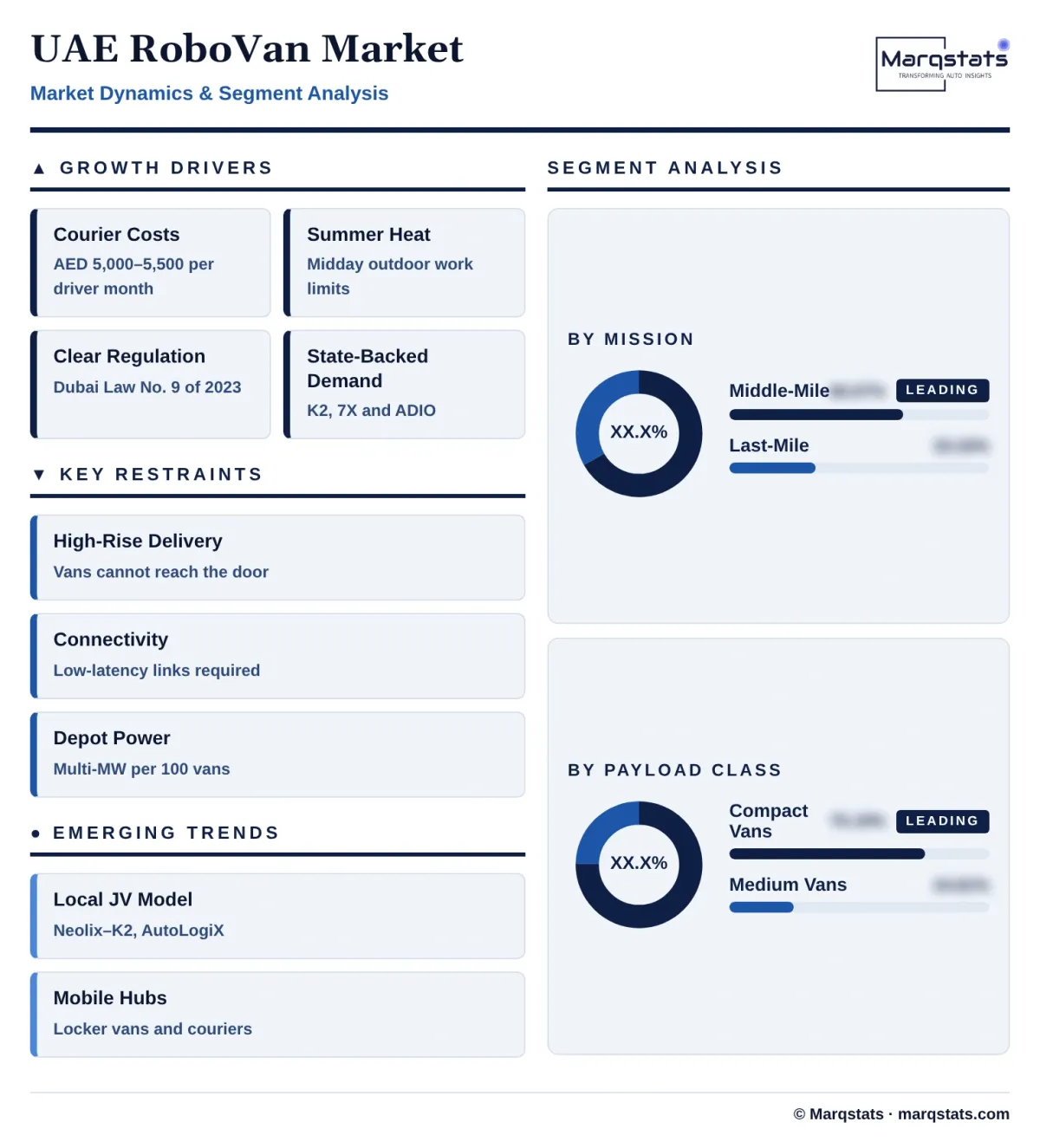
- Courier costs keep rising. A conventional one-tonne diesel delivery van costs about AED 8,500 to 10,000 a month to run in Dubai or Abu Dhabi, with the driver costing AED 5,000 to 5,500 once visa, insurance, housing and fees are included. A remote operator supervising 10 to 20 robovans costs about AED 400 to 600 per vehicle per month.
- Summer heat limits human delivery. Midday outdoor work restrictions and temperatures above 45°C reduce courier productivity and raise safety risks, while robovans can operate 18 to 22 hours a day.
- Regulation supports commercial service. Dubai Law No. 9 of 2023, Abu Dhabi's commercial driverless permits and autonomous number plates, and federal testing frameworks under the UAE Cabinet's RegLab give operators a clear path from testing to commercial service.
- Government targets set a clear direction. The Dubai Autonomous Transportation Strategy aims for 25% of trips in the emirate to be driverless by 2030, and Abu Dhabi has made autonomous mobility a priority sector for investment through the Smart and Autonomous Vehicles Industry cluster. These targets encourage logistics companies to plan fleet changes and give technology suppliers confidence to invest in local operations.
- State-backed companies anchor demand. K2 and its subsidiary AutoGo, 7X and its EMX courier arm, and the Abu Dhabi Investment Office bring capital, licences and guaranteed volumes, reducing risk for technology suppliers.
- E-commerce and quick commerce keep growing. Noon, Talabat, Aramex and other platforms handle rising parcel and grocery volumes, which make high-frequency warehouse-to-hub runs economical for robovans.
Key Restraints
Four constraints shape how fast UAE robovan fleets can grow.
- High-rise living complicates the last metres. Many residents live in towers in areas such as Dubai Marina, Downtown Dubai and Al Reem Island. A robovan cannot deliver to an apartment door, so operators need couriers or small robots for the final step, which limits savings on door-to-door delivery.
- Remote operator ratios are still being proven. Regulators allow one remote operator to supervise several vehicles, and Marqstats assumes ratios of 1:15 to 1:20 by 2030. If incidents in mixed traffic lead regulators to cap ratios at lower levels, supervision costs would rise and fleet growth would slow, particularly for last-mile routes in busy districts.
- Connectivity must be reliable. Regulators require continuous low-latency links to remote control centres, and each van needs strong uplink bandwidth for camera feeds. Coverage gaps in underground car parks and industrial areas can force vehicles to stop.
- Depot power and charging take time. A depot serving 100 robovans needs multi-megawatt power connections, and battery-swapping requires 1.5 to 2 batteries per vehicle and agreements with DEWA, TAQA and ADDC.
- Customer acceptance is still developing. Residents used to doorstep delivery by couriers may not want to walk to a van or locker point in summer heat, so operators must design handover points, notification systems and service levels that keep customers satisfied while capturing cost savings.
- Approvals differ between emirates. Dubai and Abu Dhabi have separate licensing systems, and cross-emirate driverless freight on highways needs further approval, which limits network routes linking Abu Dhabi, Dubai and the Northern Emirates.
Key Trends
Four shifts are reshaping how UAE parcels move between hubs and homes.
- Chinese platforms partner with UAE state companies. Neolix works with K2 in Abu Dhabi and Zelostech with 7X through AutoLogiX, combining proven vehicles with local licences, operations and customers.
- Mapless driving software is spreading. Neolix and Zelostech use vision-based models that interpret roads in real time rather than relying on detailed maps, helping vehicles cope with frequent roadworks and new developments.
- Robovans are becoming mobile hubs. Multi-locker vans act as pickup points, and vans carrying bulk orders to neighbourhoods are combined with couriers or small robots for final delivery.
- Battery swapping is becoming standard. Neolix and Zelostech vans use swappable battery packs that can be exchanged in under five minutes, letting vehicles keep running through the day while depleted packs charge in climate-controlled depots. The 7X agreement with UAEV to build logistics charging depots supports this model.
- Cold-chain and healthcare logistics are emerging. Refrigerated vans such as the Zelos Z5 Cold-Chain carry groceries, medicines and laboratory samples, and healthcare networks such as PureLab are part of Abu Dhabi's autonomous logistics partnerships.
Strategic Implications
- For vehicle and technology suppliers, climate engineering and local partners are essential. Liquid-cooled batteries, low-power computers and self-cleaning sealed sensors are required for summer operation, and partnerships with state-backed operators such as K2 and 7X open access to permits and customers.
- For logistics and e-commerce companies, start with middle-mile routes. Warehouse-to-hub and hub-to-branch runs deliver the largest savings and the most predictable operations before expanding to residential delivery.
- For postal and courier operators, hybrid networks are the practical model. Robovans can carry bulk parcels from sorting centres to neighbourhood hubs and lockers overnight, while couriers on light electric vehicles handle the final delivery to tower residents during the day. This combination captures most of the cost saving without lowering service quality.
- For property developers and city planners, design for delivery. Staging bays, battery-swapping sites, curbside delivery zones and locker points in new communities reduce the cost of the last metres in high-rise areas.
- For telecom and utility providers, autonomous fleets are new customers. Network slicing and redundant connections from e& and du, and depot power from DEWA, TAQA and ADDC, are critical services for robovan operators.
- For investors, utilisation and contracts matter most. Robovans earn their returns by running many waves a day on routes with steady volumes, so operators with long-term contracts from postal, e-commerce and grocery customers, and with access to depots and charging, are best placed to reach profitability.
- For regulators, cross-emirate harmonisation is the next step. A single national credential for driverless freight vehicles would unlock routes linking Abu Dhabi, Dubai and the Northern Emirates and support the Dubai target of 25% driverless trips by 2030.
Market Segmentation
Middle-mile runs between fulfilment warehouses, sorting centres and distribution hubs generate 66.67% of 2025 value, USD 4.30 million, rising to USD 150.50 million by 2030, a 103.62% CAGR, while their share falls to 52.71%. Fixed depot-to-depot routes are easier to license and operate, and vans can run 10 to 15 waves a day carrying 400 to 500 parcels.
Urban last-mile delivery and neighbourhood consolidation generate 33.33% of 2025 value, USD 2.15 million, and grow faster, reaching USD 135.00 million and 47.29% of the market by 2030, a 128.86% CAGR. Multi-locker vans, curbside drops and vans acting as mobile hubs for couriers drive growth.
Compact vans with payloads up to 600 kg and less than 4 cubic metres of space, such as the Neolix Xolra 3 and Zelos Z5, generate 75.19% of 2025 value, USD 4.85 million, rising to USD 177.00 million by 2030, a 105.33% CAGR, while their share falls to 61.99%. They are the standard vehicles for express parcel shuttles and locker distribution.
Medium vans with payloads of 600 to 1,500 kg and up to 10 cubic metres of space, such as the Neolix Xolra 6, Zelos Z10 and WeRide Robovan W5, generate 24.81% of 2025 value, USD 1.60 million, and grow fastest, reaching USD 108.50 million and 38.01% of the market by 2030, a 132.41% CAGR, driven by store replenishment, cold-chain and postal trunk routes.
By Geography
Abu Dhabi
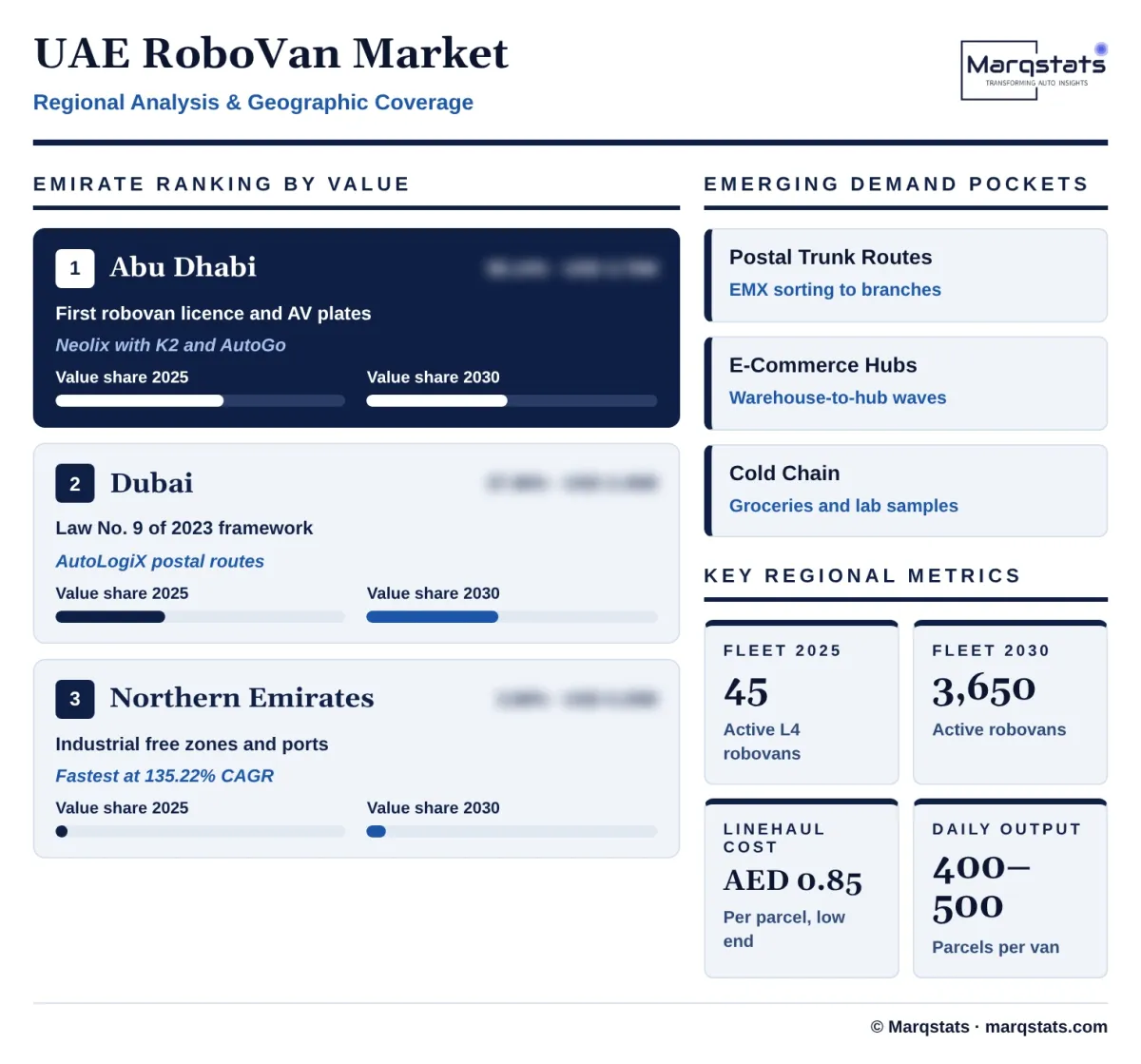
Abu Dhabi is the largest market, with an estimated 58.14% of 2025 value, USD 3.75 million, and 28 vehicles, rising to USD 138.50 million and 1,770 vehicles by 2030, a 105.82% CAGR, while its share falls to 48.51%. The Smart and Autonomous Systems Council, the Integrated Transport Centre and the Abu Dhabi Investment Office have issued commercial driverless permits and autonomous number plates, and K2 and AutoGo operate Neolix vehicles with partners including EMX and Noon.
Dubai
Dubai accounts for an estimated 37.98% of 2025 value, USD 2.45 million, and 15 vehicles, rising to USD 129.00 million and 1,650 vehicles by 2030, a 120.95% CAGR. Dubai Law No. 9 of 2023 provides a clear licensing and liability framework, AutoLogiX automates routes between EMX sorting centres and branches, WeRide's Robovan W5 is offered to free zone operators in Dubai Silicon Oasis and Dubai Investment Park, and the RTA targets 25% driverless trips by 2030.
Northern Emirates
The Northern Emirates, including Sharjah, Ras Al Khaimah, Ajman and Fujairah, account for an estimated 3.88% of 2025 value, USD 0.25 million, and two pilot vehicles, but grow fastest, reaching USD 18.00 million, 6.30% of the market and 230 vehicles by 2030, a 135.22% CAGR. Activity focuses on industrial free zones and ports, with cross-emirate links to Dubai distribution networks expected by 2029.
How Competition Is Evolving
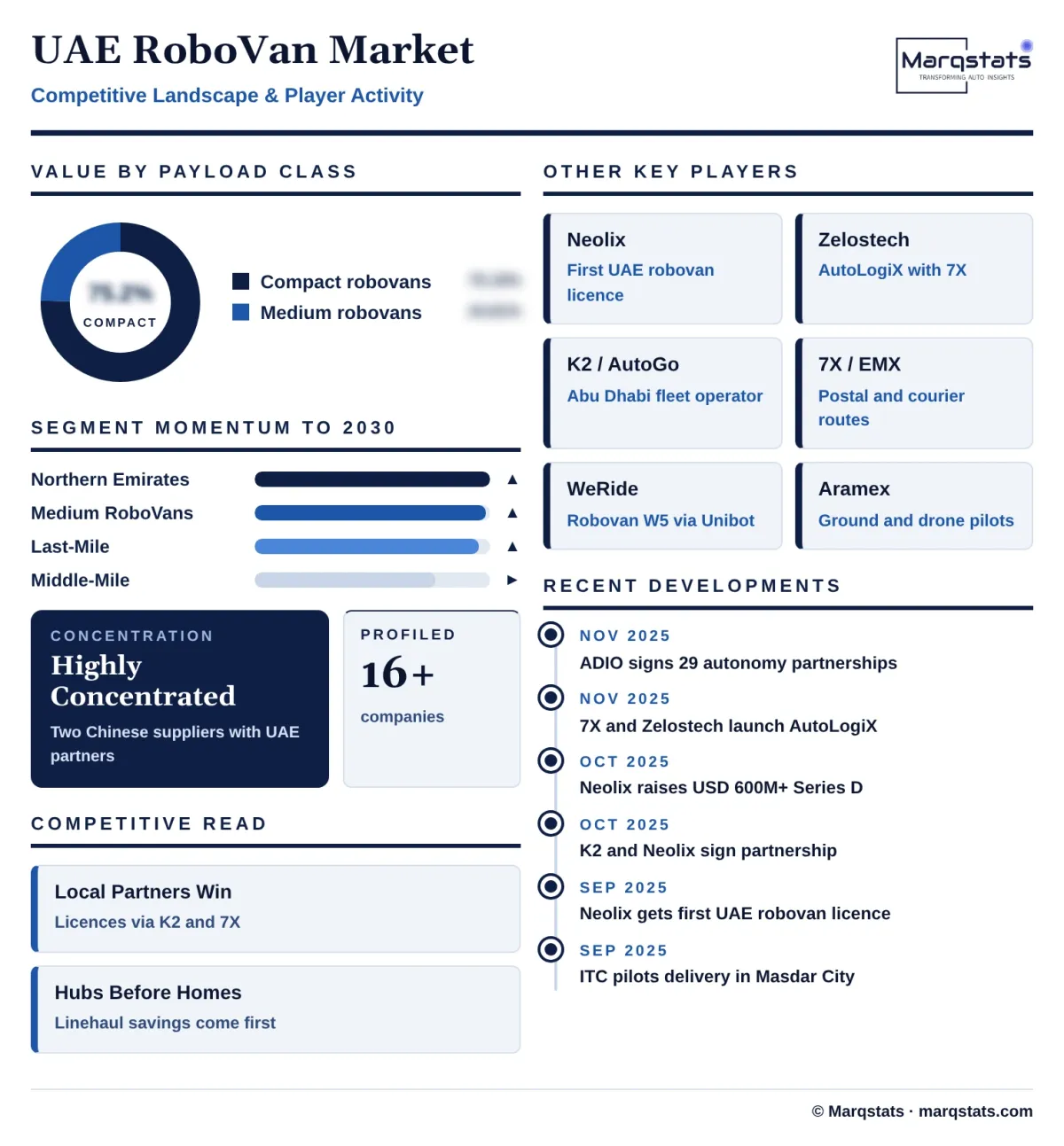
The UAE RoboVan market is highly concentrated. Neolix, operating with K2 and AutoGo in Abu Dhabi, and Zelostech, operating through the AutoLogiX joint venture with 7X, account for most active vehicles. WeRide offers its Robovan W5 through local distributors such as Unibot, and Aramex pilots autonomous ground vehicles alongside drones.
State-backed partners are central. K2, 7X, the Abu Dhabi Investment Office and the Integrated Transport Centre provide licences, operating companies, customers and funding, while Chinese suppliers provide vehicles and software. Most new entrants will need a similar local partner.
Vehicle supply is dominated by Chinese manufacturers. Neolix, Zelostech and WeRide build their vans in China at high volumes, which keeps prices low but makes UAE fleets dependent on imports and on the suppliers for software updates, spare parts and remote support. Local assembly or service centres could become a requirement for larger public contracts.
Suppliers are well funded. Neolix raised more than USD 600 million in its Series D round in 2025 and passed 10,000 vehicles delivered globally, and Zelostech expects tens of thousands of units deployed globally. This scale allows them to offer competitive prices and fund overseas fleets.
Robotaxi operators are a potential source of competition. WeRide, Baidu Apollo Go and Uber run driverless robotaxis in Abu Dhabi and Dubai and already operate remote control centres, depots and maintenance teams. Extending these capabilities to delivery vans, as WeRide has done with the Robovan W5, could bring new fleet operators into the market as passenger services scale.
Customers and infrastructure providers shape competition. Noon, Talabat, Aramex, EMX and PureLab decide which services scale, while e&, du, DEWA, TAQA and UAEV provide the connectivity and charging fleets depend on. Operators that combine vehicles, remote supervision, charging and customer contracts will lead.
Companies Covered
Companies covered in the report include:
Recent Market Activity
Table of Contents
Coverage & Segmentation
The study covers the UAE RoboVan market, with 2025 as the base year, 2021 – 2025 as the historical period and 2026 – 2030 as the forecast period. Values are in US dollars, with dirham values converted at 3.6725 dirhams per dollar. The market is defined as spending on cabless SAE Level 4 electric delivery vans with gross weights of 1,000 to 3,500 kg, including vehicle purchases, RoboVan-as-a-Service contracts, remote supervision software and specialist maintenance. It is segmented by mission, payload class and emirate.
Sidewalk and campus robots, robotaxis, port tractors, highway trucks and drones are excluded. Fleet counts, values, segment and emirate splits are Marqstats estimates built on regulator announcements, company disclosures, partnership agreements and vehicle and service pricing benchmarks.