Market Snapshot
Middle bar: base-year value × (1 + CAGR), rounded to two decimals. This is a calculated illustration, not a separately researched annual estimate.
The Saudi Arabia robotaxi market size is estimated at USD 1.80 million in 2025 and is projected to reach USD 157.50 million by 2030, growing at a CAGR of 144.57% over 2026 – 2030. The active fleet grows from about 15 vehicles to 4,200, and fully driverless vehicles supervised remotely account for 85.02% of 2030 revenue, up from none in 2025.
Marqstats defines the Saudi robotaxi market as passenger fares, platform booking fees and fleet-servicing revenue earned by SAE Level 4 passenger vehicles that operate without a human driver in control. In 2025 the market consisted of sandbox and pilot operations in Riyadh, led by WeRide robotaxis booked through the Uber app, with a safety operator on board every vehicle, plus early autonomous mobility work in NEOM and Madinah. In SAR terms, the market grows from SAR 6.75 million to SAR 590.63 million at the fixed rate of 3.75 riyals per dollar.
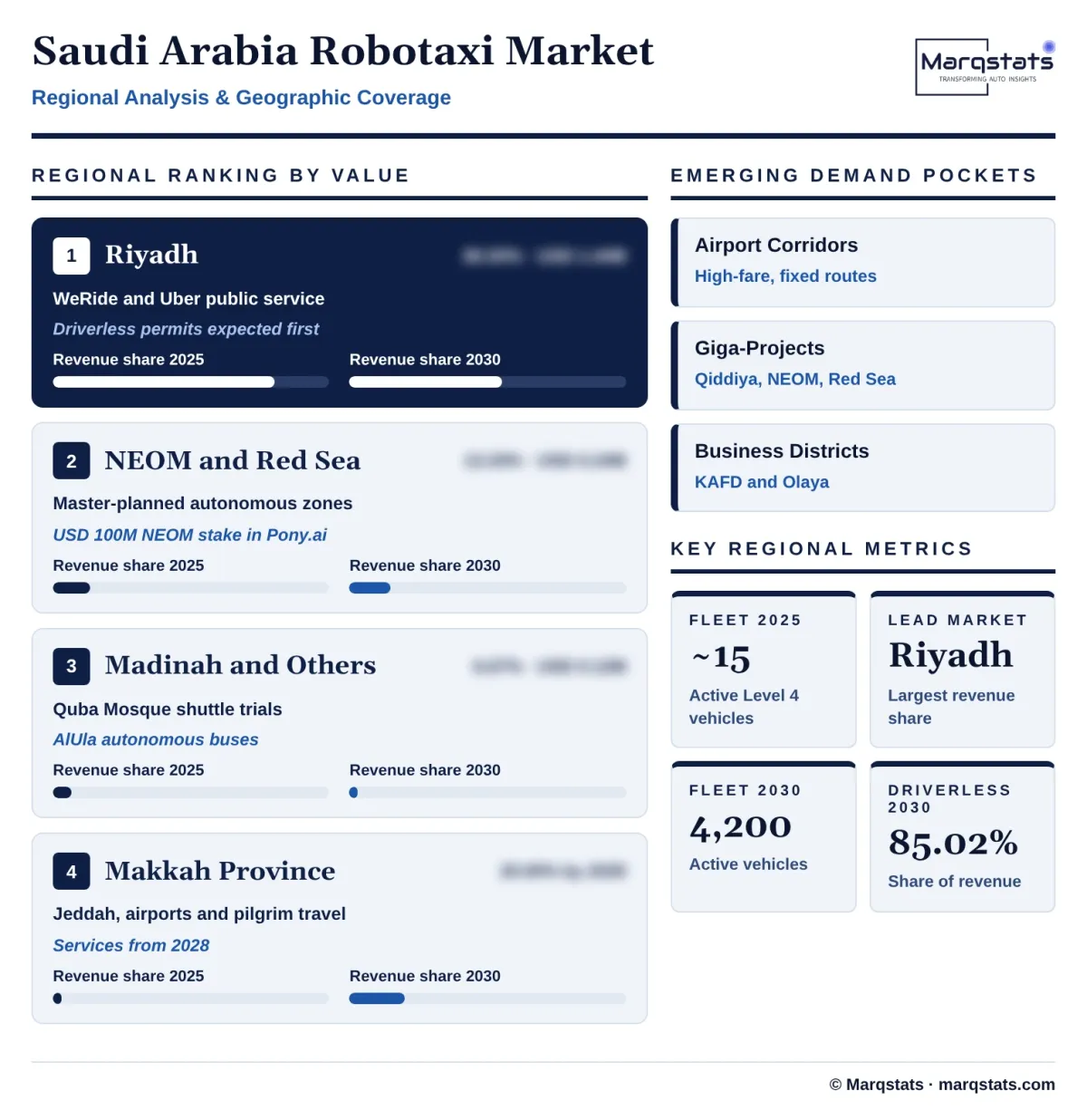
Riyadh accounts for an estimated 80.00% of 2025 revenue, NEOM and the Red Sea projects for 13.33% and Madinah and other regions for 6.67%. The study segments the market by automation level, service model and region. It excludes vehicle sales, driver-assistance systems in private cars, autonomous trucks and delivery vehicles, driverless metro and aerial mobility.
Key Takeaways
Market Overview & Analysis
Report Summary
Marqstats sizes the Saudi Arabia robotaxi market as revenue from on-demand passenger transport in SAE Level 4 vehicles that do not need a human driver to control them. This includes passenger fares, platform booking fees and fleet-servicing and operating payments for pilots and commercial services, whether the vehicle carries a safety operator or is supervised remotely. Vehicle and sensor sales, driver-assistance features in private cars, autonomous trucks and delivery vehicles, driverless metro systems and air taxis are excluded. In 2025 the market generated an estimated USD 1.80 million from about 15 active vehicles.
The market is at an early stage. Saudi Arabia moved from closed research trials at King Abdullah University of Science and Technology and preliminary concessions before 2024 to a formal regulatory sandbox run by the Transport General Authority (TGA) in 2025. In July 2025 the Minister of Transport and Logistic Services launched the initial operational phase of autonomous passenger vehicles in Riyadh, WeRide received the country's first autonomous driving permit, and in October 2025 WeRide and Uber began offering rides to the public between ROSHN Front and Princess Nourah bint Abdulrahman University.
Revenue per vehicle is high in the early years because pilot operations include fleet-servicing and operating payments from project sponsors, not just fares. As the fleet grows and services move to standard ride-hailing pricing, revenue per vehicle falls from about USD 120,000 in 2025 to about USD 37,500 in 2030, close to the earnings of a busy ride-hailing vehicle, while total revenue rises sharply.
The legal framework developed quickly between 2025 and 2026. SASO's Technical Regulation for Autonomous Vehicles, approved in July 2025 and published in October 2025, became mandatory in April 2026. The Traffic Law amendments of June 2026 set out who is liable when a fully autonomous vehicle crashes. Data protection rules administered by the Saudi Data and Artificial Intelligence Authority (SDAIA) require sensitive sensor, mapping and passenger data to be stored in the Kingdom, and the Communications, Space and Technology Commission regulates the connectivity needed for remote supervision.
National policy supports the market. Saudi Vision 2030 and the National Transport and Logistics Strategy aim for autonomous vehicles to make up 15% of public transport vehicles and 25% of goods transport by 2030. The Public Investment Fund supports electric vehicle production through Ceer Motors and Lucid Group's factory in King Abdullah Economic City, and EVIQ, a joint venture between PIF and the Saudi Electricity Company, is building a national fast-charging network. NEOM's investment fund invested USD 100 million in Pony.ai in 2023 to develop autonomous mobility for the project.
Marqstats expects the fleet to pass 650 vehicles in 2028 and reach 4,200 by 2030, with Riyadh remaining the largest market and Makkah Province, including Jeddah, becoming the second largest. The key milestone is the TGA's authorisation of fully driverless commercial service, which Marqstats expects in designated districts of Riyadh from late 2026 to 2027.
Saudi Arabia Robotaxi Market Size and Forecast
The Saudi Arabia robotaxi market grows from USD 1.80 million in 2025 to USD 157.50 million in 2030, a CAGR of 144.57%. In riyal terms, the market grows from SAR 6.75 million to SAR 590.63 million. The fleet grows from about 15 vehicles to 4,200, a 208.63% annual rate. Revenue grows more slowly than the fleet because early pilot revenue includes sponsor payments, while later revenue comes mainly from fares at ride-hailing prices.
The market started small. Marqstats estimates revenue of USD 0.15 million in 2022, USD 0.35 million in 2023 and USD 0.60 million in 2024, mostly from closed trials and development concessions, before reaching USD 1.80 million in 2025 as public pilots began in Riyadh. Revenue reaches about USD 6.50 million in 2026 with an average of about 45 vehicles in service, USD 18.50 million in 2027 with 180 vehicles, USD 45.00 million in 2028 with 650 vehicles and USD 92.00 million in 2029 with 1,800 vehicles.
Growth accelerates once vehicles can run without a safety operator. Driverless operation lets each vehicle run longer hours at lower cost, and lets operators expand service areas without hiring and training safety staff. Marqstats expects the first fully driverless commercial services in designated parts of Riyadh between late 2026 and 2027, followed by Jeddah and the giga-projects from 2028.
Fare levels follow ride-hailing prices. Robotaxi rides in Riyadh are offered through the Uber app at prices close to standard rides, and operators use pricing to encourage riders to try the service. Marqstats assumes robotaxi fares stay close to human-driven ride-hailing fares through 2030, with operating savings used to expand service areas and improve vehicle availability rather than to cut prices sharply.
The forecast is conservative compared with company ambitions. WeRide has said it could operate 7,000 to 10,000 robotaxis in Saudi Arabia by the end of the decade. Marqstats estimates 4,200 vehicles by 2030 across all operators, reflecting the time needed for driverless permits, depot and charging infrastructure, vehicle certification and expansion beyond Riyadh.
Market Dynamics
Key Drivers
Five forces are moving Saudi robotaxis from sandbox trials to paid service.
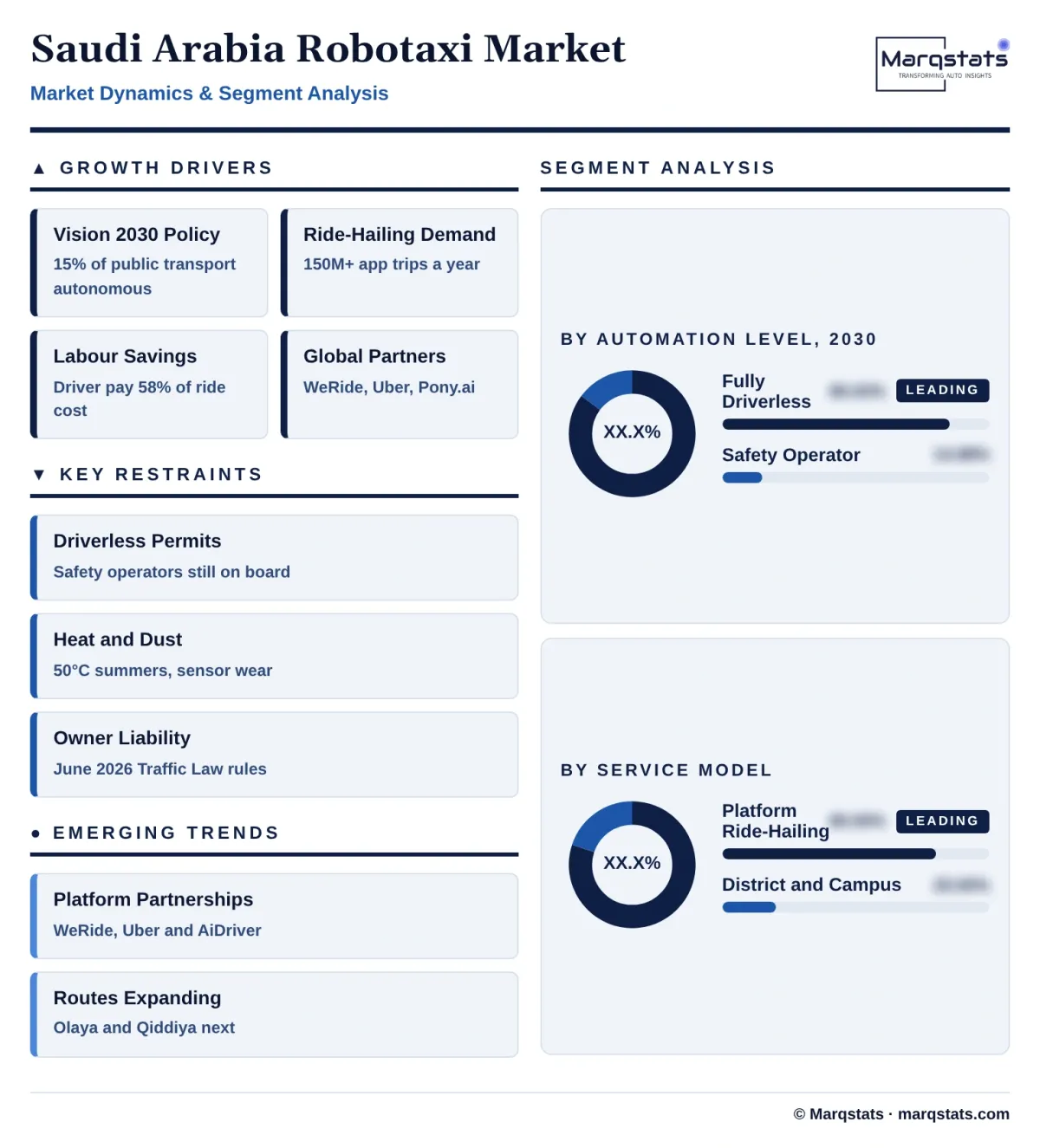
- Government policy and funding push the market forward. Saudi Vision 2030 aims for 15% of public transport vehicles to be autonomous by 2030, and the TGA, SASO, the Ministry of Interior and SDAIA have built a sandbox, technical regulation and liability rules in less than two years. Few markets have moved from first permit to codified liability rules this quickly.
- Large ride-hailing demand offers a ready customer base. Ride-hailing apps handled 39.04 million trips in the third quarter of 2025 and more than 43 million in the fourth quarter, and 38.30 million in the second quarter of 2026. Riyadh alone accounts for about 44% of trips. Robotaxis dispatched through Uber and other apps can reach these riders immediately.
- Labour costs make driverless operation attractive. Saudi ride-hailing drivers earned more than SAR 2 billion in 2024, and driver pay is the largest single cost of a ride-hailing vehicle, at about 58% of total cost. Moving to remote supervision at ratios of 10 to 20 vehicles per supervisor can reduce labour costs by 80% to 90%.
- International technology partners are ready to scale. WeRide brings Level 4 systems already operating in China, Abu Dhabi and Singapore, Uber provides booking and payment, and Pony.ai, backed by the NEOM Investment Fund, has adapted its systems to Gulf conditions. This lets Saudi Arabia skip years of domestic development.
- Giga-projects and new districts create ideal operating areas. NEOM, the Red Sea projects, Qiddiya, the King Abdullah Financial District and ROSHN developments are planned with wide roads, controlled access and digital infrastructure, making them well suited to early driverless service and to integrating robotaxis with other transport.
Key Restraints
Four constraints keep the Saudi fleet small and costly in the near term.
- Driverless permits are still pending. All public robotaxi services in 2025 and most of 2026 operate with a safety operator on board, which keeps costs close to those of a conventional ride-hailing car plus the cost of sensors and computers. Until the TGA authorises fully driverless commercial service, fleets will stay small and dependent on pilot funding.
- Heat and dust add cost and risk. Summer temperatures above 50°C and dust storms reduce lidar and camera performance, can cause unnecessary emergency stops and strain on-board computers. Sensor cleaning systems, liquid cooling and imaging radar add cost, and WeRide recalled its street-cleaning robots in Saudi Arabia for upgrades to cope with dust and sand.
- Liability rules put the burden on owners. The June 2026 Traffic Law amendments make the owner of a fully autonomous vehicle liable as if it were the driver, without separating the owner from the software developer. Fleet owners must negotiate contracts with technology providers and buy insurance to cover system failures, which adds cost and slows financing for local fleet owners.
- Charging and depot infrastructure is limited. Fleet depots with fast charging are still few, and high-power charging can overload local power networks. Operators are installing battery-buffered chargers, with stationary storage units of 215 to 430 kWh that draw modest power from the grid and supply up to 200 kW to vehicles, but depot construction must keep pace with fleet growth.
Key Trends
Four shifts are shaping who builds, runs and sells Saudi robotaxi rides.
- Platform partnerships are the standard model. WeRide supplies vehicles and software, Uber provides the booking app, payment and riders, and AiDriver manages vehicles, maintenance and safety staff. This division of roles lets each partner focus on its strengths and is likely to be repeated with other technology companies and platforms such as Careem.
- Chinese technology companies lead in the Gulf. WeRide, Pony.ai and Baidu's Apollo Go are expanding in Saudi Arabia, the UAE and Qatar, while US developers concentrate on their home market. Saudi Arabia benefits from competition between Chinese suppliers and from systems already proven at scale in China.
- Routes are expanding from campuses to city streets. The first public route linked ROSHN Front with Princess Nourah University, a second route between Hayat Mall and Riyadh Gallery opened in March 2026 and exposed vehicles to busy multi-lane boulevards, and WeRide plans to extend service to Olaya and to Qiddiya. By mid-2026 Riyadh pilots had completed more than 1,700 trips and 30,000 kilometres.
- Autonomy is spreading across transport modes. Saudi Arabia is testing autonomous shuttles at the Quba Mosque in Madinah, autonomous buses in AlUla and driverless delivery vehicles in Riyadh's Al-Falah district. These projects share infrastructure, regulation and remote supervision skills with robotaxis.
Strategic Implications
- For technology developers, local adaptation and certification are essential. Systems must handle heat and dust, comply with SASO certification through SABER, and store data in the Kingdom under SDAIA rules. Early investment in local data centres, testing and partnerships shortens the route to driverless permits.
- For ride-hailing platforms, robotaxis complement human drivers. Platforms can use human-driven cars for peak demand and areas outside approved zones while deploying robotaxis on predictable, high-volume corridors such as airport and business district routes.
- For local fleet owners and investors, contracts and insurance matter as much as vehicles. Because owners carry legal liability, they need clear agreements with technology providers on responsibility for system failures, and insurance that covers both motor liability and software risks.
- For infrastructure providers, depots and charging are a growth opportunity. Battery-buffered fast charging, secure depots, sensor cleaning and calibration facilities and remote supervision centres will be needed in Riyadh, Jeddah and the giga-projects as fleets grow into the thousands.
- For government agencies, the timing of driverless permits is the main lever. Clear criteria and timelines for moving from safety operators to remote supervision, published performance data and coordination with city transport plans will determine how quickly private investment follows.
Market Segmentation
Level 4 vehicles operating with a safety operator on board generate all 2025 revenue, USD 1.80 million, from about 15 vehicles. Revenue grows to USD 23.60 million by 2030, a 67.31% CAGR, with about 630 vehicles, but the segment's share falls to 14.98% as operators move to remote supervision. Safety operators remain in use in complex areas, during expansion to new cities and for new vehicle types until they are approved for driverless operation.
Fully driverless vehicles supervised from remote operations centres generate no revenue in 2025, as driverless commercial service had not yet been authorised. Marqstats expects the first driverless services in designated Riyadh districts between late 2026 and 2027. By 2030 the segment reaches USD 133.90 million, 85.02% of the market, with about 3,570 vehicles. Remote supervision at ratios of 10 to 20 vehicles per supervisor makes this the profitable model for operators.
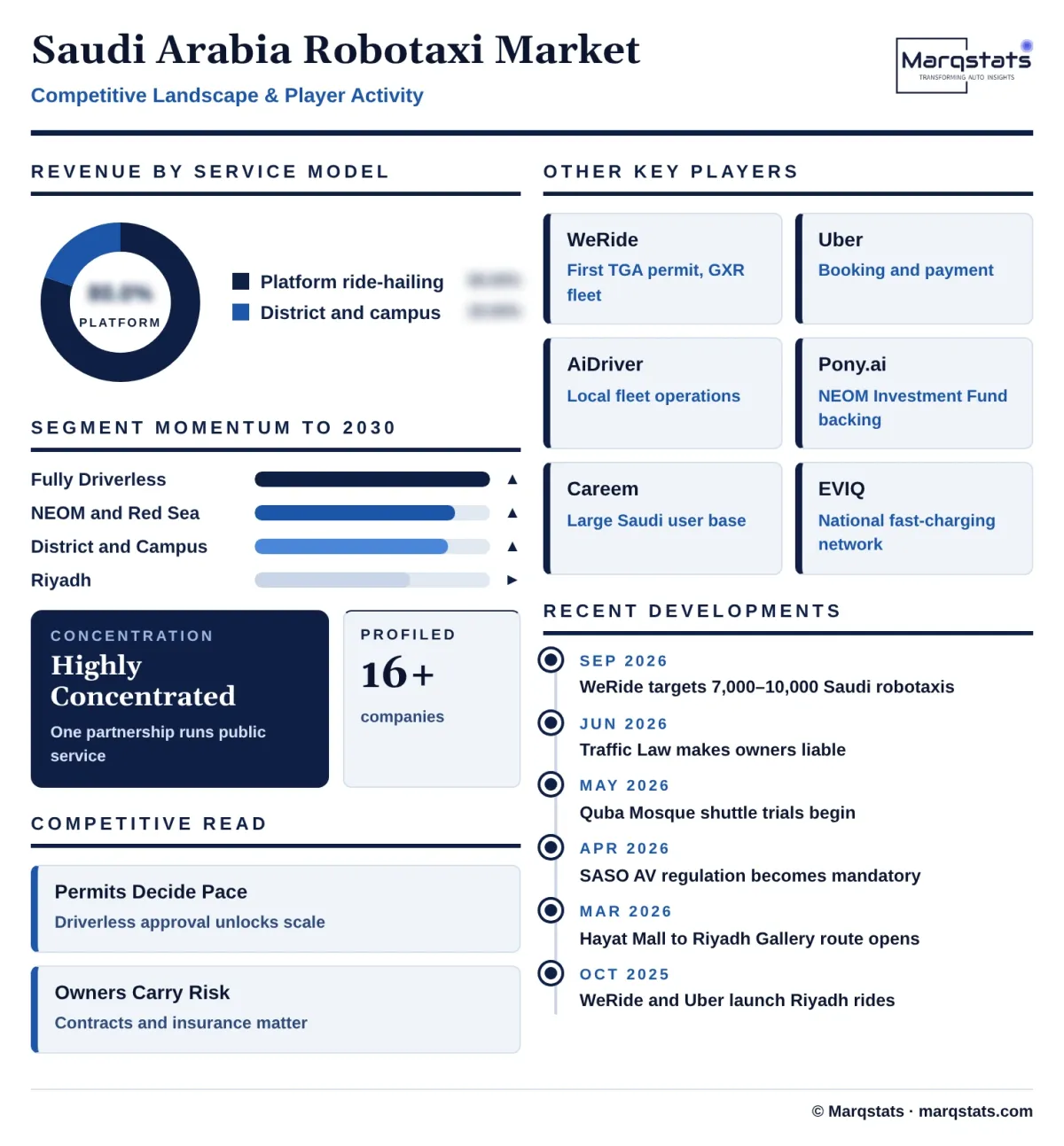
Robotaxis booked through ride-hailing apps such as Uber account for an estimated 80.00% of 2025 revenue, USD 1.44 million, led by WeRide's service in Riyadh. Revenue reaches USD 122.85 million and 78.00% of the market by 2030, a 143.33% CAGR, as services extend across Riyadh and into Jeddah, Makkah and the Eastern Province. Platform ride-hailing gives operators immediate access to millions of app users.
Robotaxis and autonomous shuttles serving defined districts, campuses and giga-projects, such as NEOM, the Red Sea projects, the King Abdullah Financial District and the Quba Mosque in Madinah, account for 20.00% of 2025 revenue, USD 0.36 million. Revenue reaches USD 34.65 million and 22.00% of the market by 2030, a 149.28% CAGR, as master-planned developments use autonomous vehicles as their main internal transport.
By Geography
Riyadh
Riyadh is the largest market, with an estimated 80.00% of 2025 revenue, USD 1.44 million, from about 12 vehicles, rising to USD 86.60 million and about 2,310 vehicles by 2030, a 126.90% CAGR. Its share falls to 54.98% as other regions start commercial service. Riyadh accounts for about 44% of Saudi ride-hailing trips, hosts the WeRide and Uber service, the Hayat Mall to Riyadh Gallery route and trials at the King Abdullah Financial District, and is where driverless permits are expected first.
Makkah Province
Makkah Province, including Jeddah, had no commercial robotaxi revenue in 2025 but reaches an estimated USD 31.50 million and 20.00% of the market by 2030, with about 840 vehicles. The province accounts for about 21% of ride-hailing trips, and airport links, urban transport in Jeddah and mobility for pilgrims and visitors provide strong demand. Services are expected to start from 2028 once driverless operation is established in Riyadh.
NEOM and Red Sea Projects
NEOM and the Red Sea projects account for an estimated 13.33% of 2025 revenue, USD 0.24 million, rising to USD 23.65 million and 15.02% of the market by 2030, a 150.45% CAGR, with about 630 vehicles. These master-planned developments restrict private combustion-engine cars and plan autonomous transport as a core service. The NEOM Investment Fund's USD 100 million investment in Pony.ai supports autonomous shuttles, robotaxis and logistics in the project.
Eastern Province
The Eastern Province had no commercial robotaxi revenue in 2025 but reaches an estimated USD 11.00 million and 6.98% of the market by 2030, with about 294 vehicles. It accounts for about 14% of ride-hailing trips, and smart city developments in Khobar and Dammam and transport for large industrial campuses offer suitable operating areas.
Madinah and Other Regions
Madinah and other regions account for an estimated 6.67% of 2025 revenue, USD 0.12 million, rising to USD 4.75 million and 3.02% of the market by 2030, a 108.69% CAGR. In May 2026 the TGA began trials of autonomous electric shuttles in the courtyards of the Quba Mosque in Madinah, and WeRide operates autonomous buses in AlUla. Other regions such as Asir, Qassim, Tabuk and Hail are expected to follow after 2030.
How Competition Is Evolving
The Saudi robotaxi market is concentrated around a single partnership. WeRide, Uber and AiDriver operate the only public robotaxi service in Riyadh, with WeRide supplying its Robotaxi GXR vehicles and WeRide One software, Uber providing the booking app and AiDriver managing vehicles and safety staff. WeRide received the first autonomous driving permit in July 2025 and plans to grow its Riyadh fleet to about 100 vehicles by the end of 2026.
Other technology companies are preparing to enter. Pony.ai, backed by the NEOM Investment Fund, has adapted its seventh-generation system to Gulf conditions and operates in Dubai and Qatar, and Baidu's Apollo Go is expanding in Dubai and Abu Dhabi. Careem, which has a large user base in Saudi Arabia, could offer a second platform for robotaxi services.
Sovereign capital shapes the wider ecosystem. The Public Investment Fund supports electric vehicle production through Ceer Motors and Lucid Group, and charging through EVIQ, which operates about 70% of the Kingdom's fast-charging network and plans 5,000 fast chargers at 1,000 locations by 2030. Local companies such as Bidaya Holding and SmartChips are working with Zadar Labs to produce 4D imaging radar suited to dusty conditions.
Competition will be decided by permits and local partnerships. Companies that first secure driverless permits, certify vehicles through SASO, build depots and remote supervision centres, and partner with platforms and giga-project developers will capture the largest share as the fleet grows to thousands of vehicles.
Companies Covered
Companies covered in the report include:
Recent Market Activity
Table of Contents
Coverage & Segmentation
The study covers the Saudi Arabia robotaxi market, with 2025 as the base year, 2021 – 2025 as the historical period and 2026 – 2030 as the forecast period. Values are in US dollars, with Saudi riyal values converted at the fixed rate of 3.75 riyals per dollar. The market is defined as passenger fares, platform booking fees and fleet-servicing revenue from SAE Level 4 passenger vehicles operated as fleets, including pilots with safety operators and fully driverless services. It is segmented by automation level, service model and region.
Vehicle and sensor sales, driver-assistance systems in private cars, autonomous trucks and delivery vehicles, driverless metro systems and air taxis are excluded. Fleet counts, revenue estimates, the service model split and regional shares are Marqstats estimates built on TGA releases, regulatory publications, operator announcements and ride-hailing trip statistics.