Market Snapshot
Middle bar: base-year value × (1 + CAGR), rounded to two decimals. This is a calculated illustration, not a separately researched annual estimate.
The India bike taxi market size is estimated at USD 823.14 million in 2025 and is projected to reach USD 2,624.64 million by 2030, growing at a CAGR of 26.10% over 2026 – 2030. Completed rides grow from about 1,314 million to 3,358 million a year, a 20.64% annual rate, while the average fare rises from about INR 54.50 to INR 68.00 per ride.
Marqstats defines the market as the gross merchandise value of app-based passenger rides on two-wheelers in India, measured as completed trips multiplied by the fare paid. In rupee terms, the market grows from INR 7,161.30 crore in 2025 to INR 22,834.40 crore in 2030. Values are converted at INR 87.00 per US dollar. Self-drive scooter and motorcycle rentals, vehicle sharing, parcel and food delivery on two-wheelers, and auto-rickshaw and cab rides are excluded.
Petrol motorcycles carry an estimated 88.00% of 2025 value and Tier 1 cities generate 62.00%. Standalone point-to-point rides account for 59.00% of value and South India for 34.00%. The study segments the market by vehicle type, city tier, trip type and region.
Key Takeaways
Market Overview & Analysis
Report Summary
Marqstats sizes the India bike taxi market as the gross merchandise value of passenger rides booked through apps on motorcycles and scooters. In 2025 riders completed an estimated 1,314 million trips, about 3.60 million a day, at an average fare of INR 54.50, giving a market value of INR 7,161.30 crore, or USD 823.14 million at INR 87.00 per US dollar.
Bike taxis have become part of urban public transport in India. They cost about half as much as an auto-rickshaw for the same trip, move 30% to 40% faster than cabs in peak traffic, and can reach narrow lanes that buses and cars cannot. Most trips are short, between 2 and 6 km, and many connect passengers to metro, suburban rail and bus stations.
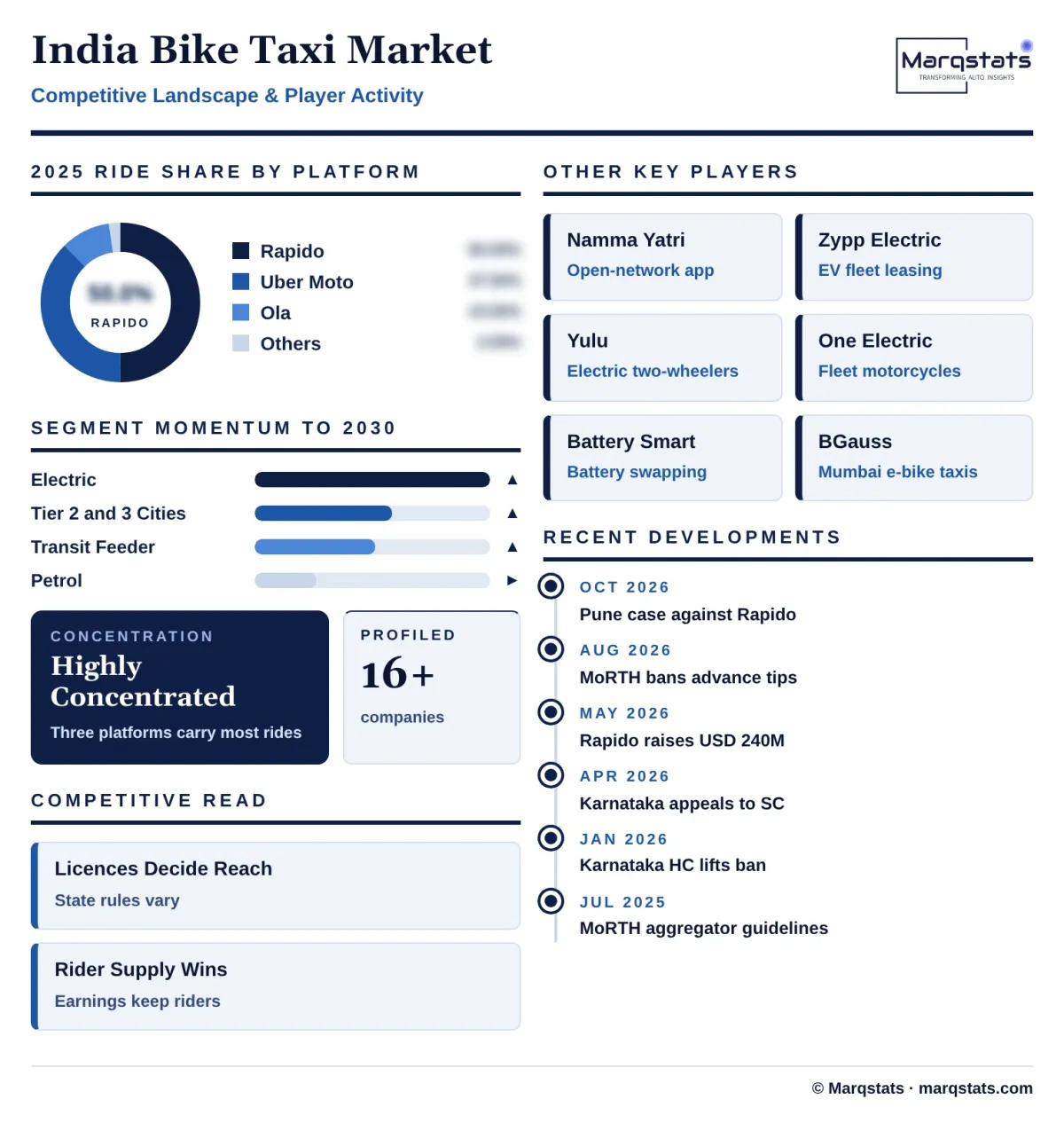
Supply comes mainly from individual riders using their own motorcycles. About half of riders, known as captains, drive part-time alongside other work or studies, and most cite the low barrier to entry: an owned two-wheeler lets them start earning without buying a commercial vehicle. India's commuter motorcycles from Hero MotoCorp, Honda, Bajaj Auto and TVS Motor make up most of the fleet, while electric motorcycles and scooters from operators such as One Electric, Zypp Electric, Yulu, Ather Energy and TVS are growing in cities with battery-swapping networks.
Regulation is decided mostly by states. Road transport is on the Concurrent List of the Constitution, so the Centre sets national guidelines and the states issue permits and enforce them. The Motor Vehicle Aggregator Guidelines, 2025, issued by the Ministry of Road Transport and Highways in July 2025, allow states to let aggregators use privately registered motorcycles for passenger trips and require passenger insurance of at least INR 5 lakh and health and term insurance of at least INR 5 lakh for riders. Delhi allows only electric bike taxis, Maharashtra licenses electric bike taxis under its Bike-Taxi Rules, 2025, and Karnataka's position will be settled by the Supreme Court.
The market grew from INR 1,364.00 crore, or USD 156.78 million, in 2021 to INR 2,438.00 crore in 2022, INR 3,846.50 crore in 2023 and INR 5,408.00 crore, or USD 621.61 million, in 2024, as platforms expanded beyond the metros. Marqstats expects INR 8,972.20 crore, or USD 1,031.29 million, in 2026 and USD 2,624.64 million in 2030.
The bike taxi sector is also a large source of entry-level work. Estimates suggest bike taxis could support around 5 million livelihoods by 2030, and India's gig and platform workforce is expected to reach about 23.5 million workers by 2029-30, with transport driving one of the largest categories. Because many riders work part-time, bike taxi supply rises and falls with local job markets, college calendars and festival seasons, and platforms use incentives and subscription plans to keep enough riders online during peak commuting hours.
Demand is shaped by commuting patterns. Morning and evening office peaks, college timings and late-evening trips from metro stations account for most rides, and more people in smaller cities now use smartphones and UPI payments, making app-based rides easy to book and pay for even for short, low-value trips. Platforms add helmets for passengers, live trip tracking, SOS buttons linked to police control rooms and rider background checks to meet state safety rules.
India Bike Taxi Market Size and Forecast
The India bike taxi market grows from USD 823.14 million in 2025 to USD 2,624.64 million in 2030, a CAGR of 26.10%. In rupees, the market grows from INR 7,161.30 crore to INR 22,834.40 crore. Marqstats expects INR 11,387.00 crore in 2027, INR 14,430.30 crore in 2028 and INR 18,208.80 crore in 2029.
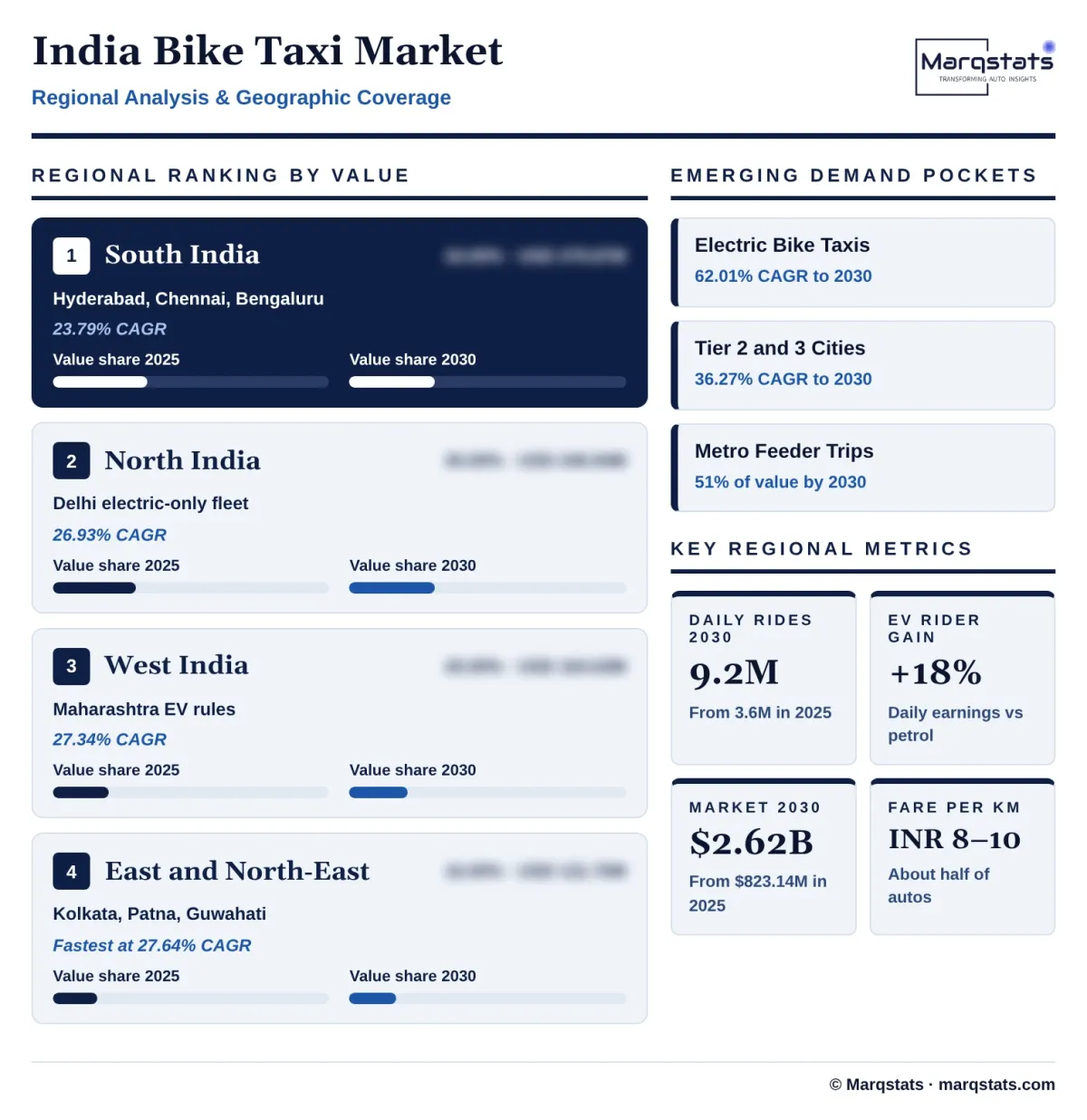
Ride volume drives most of the growth. Completed rides grow from about 1,314 million in 2025 to 1,588 million in 2026, 1,930 million in 2027, 2,335 million in 2028, 2,810 million in 2029 and 3,358 million in 2030, a 20.64% annual rate. Daily rides rise from about 3.60 million to 9.20 million.
Fares rise slowly. Marqstats expects the volume-weighted average fare to rise from INR 54.50 in 2025 to about INR 68.00 in 2030, a 4.53% annual increase, reflecting general inflation, slightly longer trips as metro feeder services grow, and the cost of state welfare levies and insurance requirements.
Riders earn more as fleets go electric. A full-time rider completing about 16 trips a day earns about INR 920 in fares. After platform charges of about 18%, fuel of about INR 185, and maintenance and depreciation, a petrol bike rider keeps about INR 504 a day, or about INR 13,100 over 26 working days. An electric motorcycle rider pays about INR 49 for energy and INR 110 a day for a vehicle or battery lease and keeps about INR 595 a day, or about INR 15,470 a month.
Platforms earn a small part of fare value. Aggregators earned commissions of about 15% to 20% of fares in 2025 and 2026, and Rapido has moved many riders to fixed subscription fees. Rapido reported operating revenue of INR 934 crore in FY25, up from INR 648 crore in FY24, with its net loss narrowing from INR 371 crore to INR 258 crore, and subscriptions reached INR 275 crore of revenue.
Marqstats tracks four indicators to monitor the forecast: state licensing decisions and the Supreme Court ruling on Karnataka, electric fleet mandates and battery-swapping coverage, metro ridership in cities with new lines, and average fares and rider earnings on the main platforms.
The mix of the market shifts over the forecast. Electric two-wheelers rise from 12.00% to 42.00% of value, Tier 2 and Tier 3 cities from 38.00% to 56.00%, and transit feeder trips from 41.00% to 51.00%. Regionally, South India remains the largest market but its share slips from 34.00% to 31.00%, while North India rises to the same 31.00% share as Delhi's electric fleet and Uttar Pradesh cities grow. East and North-East India grow fastest, at 27.64% a year, from a smaller base.
Market Dynamics
Key Drivers
Five forces are expanding app-based bike taxi travel in Indian cities.
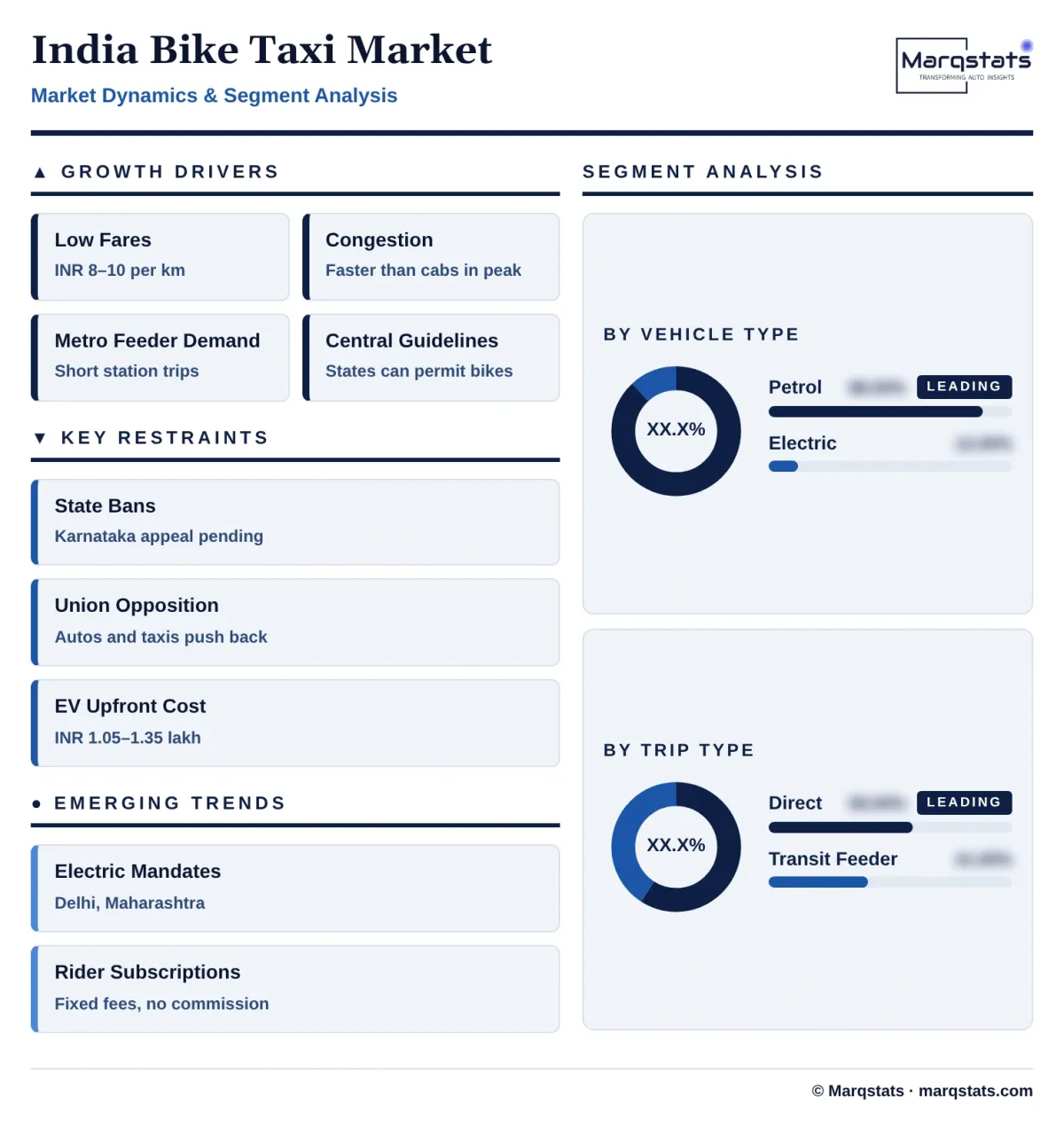
- Low fares. Bike taxis cost about INR 8 to 10 per km, roughly half of an auto-rickshaw and well under a cab, making them the cheapest motorised option for daily commuters, students and blue-collar workers.
- Congestion. Motorcycles move at about 22 to 28 km/h in peak traffic against 12 to 16 km/h for cabs, so bike taxis save time on short trips in crowded cities.
- Metro and rail growth. New metro lines in Delhi, Bengaluru, Mumbai, Pune, Hyderabad and other cities increase demand for short trips to and from stations, especially where feeder buses are weak.
- Easy entry for riders. Riders can use their own motorcycles and start earning quickly, giving platforms a large supply of part-time drivers.
- National support. The Motor Vehicle Aggregator Guidelines, 2025 allow states to let private motorcycles carry passengers through licensed aggregators, giving states a clear way to legalise bike taxis.
Key Restraints
Four constraints slow the growth of bike taxis in India.
- State bans and enforcement. Karnataka has appealed the High Court ruling that lifted its ban, and authorities in Pune filed a police case against Rapido in October 2026 over petrol motorcycles registered for private use, showing that enforcement can halt services quickly.
- Opposition from auto-rickshaw and taxi unions. Unions in several cities have pressed state governments to restrict bike taxis, leading to strikes, crackdowns and policy reversals.
- Cost of electric fleets. Electric motorcycles cost about INR 1.05 lakh to 1.35 lakh without the battery, against INR 72,000 to 85,000 for a petrol commuter bike, so riders need leasing or battery subscription to switch.
- Safety and insurance concerns. State governments cite passenger safety, women's safety and insurance coverage when restricting bike taxis, and compliance requirements raise platform costs.
Key Trends
Four shifts are changing how bike taxi services are run and regulated.
- Electric-only mandates. Delhi allows only electric bike taxis and Maharashtra has told Ola, Uber and Rapido to move their bike taxi fleets to fully electric vehicles by July 2027.
- Subscription pricing. Rapido charges many riders a fixed subscription instead of a commission on each ride, and subscriptions brought in INR 275 crore of its FY25 revenue. Fixed fees give riders predictable costs and let them keep the full fare on each trip.
- Battery swapping and fleet leasing. Operators such as Zypp Electric, Yulu and One Electric lease electric two-wheelers and batteries to riders, lowering the upfront cost of going electric.
- Rider welfare rules. The Code on Social Security, 2020 came into force in November 2025, and Maharashtra proposed a 2% fare contribution to a rider welfare fund in 2026, adding social security costs to the business.
Strategic Implications
- For platforms, compliance is a core capability. Licensing teams that track each state's rules, verify riders, pay welfare levies and keep fleets within permitted vehicle types protect operations from shutdowns.
- For electric two-wheeler makers, bike taxis are a fleet sales channel. Commercial motorcycles with stronger frames, better brakes and swappable batteries suited to 100 to 120 km a day can win large fleet orders.
- For battery-swapping and leasing companies, rider economics create demand. Stations near metro stations and busy corridors, with daily or weekly lease plans, help riders switch to electric vehicles.
- For state governments, regulation can grow jobs and transit use. Clear licensing, insurance and safety rules allow bike taxis to support metro ridership and provide work for millions of riders.
- For new entrants, smaller cities offer room to grow. Tier 2 and Tier 3 cities have less competition and weaker public transport, but need low prices and local rider networks.
- For metro rail and city transit agencies, bike taxis can raise ridership. Dedicated pick-up and drop-off bays at station exits, integrated journey planning and shared payment options make it easier for commuters to reach stations from neighbourhoods that buses do not serve well, while helping control traffic around station entrances.
Market Segmentation
Petrol commuter motorcycles of 100 cc to 125 cc carry 88.00% of 2025 value, USD 724.36 million (INR 6,301.94 crore) and about 1,156 million rides, and grow at 16.01% a year to USD 1,522.29 million by 2030, while their share falls to 58.00%. Riders use their own Hero Splendor, Honda Shine, Bajaj Platina and similar bikes, keeping supply flexible.
Electric motorcycles and scooters carry 12.00% of 2025 value, USD 98.78 million (INR 859.36 crore) and about 158 million rides, and grow at 62.01% a year to USD 1,102.35 million and 42.00% of the market by 2030. Delhi's electric-only rule, Maharashtra's electric fleet deadline, battery swapping and lower running costs drive the shift.
Tier 1 cities, including Delhi NCR, Bengaluru, Hyderabad, Mumbai, Pune, Chennai, Kolkata and Ahmedabad, generate 62.00% of 2025 value, USD 510.35 million, and grow at 17.74% a year to USD 1,154.84 million by 2030, while their share falls to 44.00% as competition intensifies and states tighten registration rules.
Tier 2 and Tier 3 cities such as Jaipur, Lucknow, Patna, Indore, Bhopal, Nagpur, Surat and Coimbatore generate 38.00% of 2025 value, USD 312.79 million, and grow at 36.27% a year to USD 1,469.80 million and 56.00% of the market by 2030, supported by weak bus services and affordable fares.
Standalone trips between homes, offices and colleges account for 59.00% of 2025 value, USD 485.65 million, and grow at 21.50% a year to USD 1,286.08 million by 2030, while their share falls to 49.00%.
Trips to and from metro, rail and bus stations account for 41.00% of 2025 value, USD 337.49 million, and grow at 31.73% a year to USD 1,338.57 million and 51.00% of the market by 2030, as new metro lines open and transit agencies add bike taxi pick-up points.
By Geography
South India
South India is the largest region, with an estimated 34.00% of 2025 value, USD 279.87 million (INR 2,434.84 crore), rising to USD 813.64 million by 2030, a 23.79% CAGR. Hyderabad, Chennai and Bengaluru are among the largest bike taxi cities, although services in Bengaluru were halted from June 2025 until the Karnataka High Court lifted the ban in January 2026, and the state has appealed to the Supreme Court. Tamil Nadu and Telangana platforms operate in a mixed petrol and electric fleet.
North India
North India accounts for an estimated 30.00% of 2025 value, USD 246.94 million, and grows at 26.93% a year to USD 813.64 million by 2030, matching South India at 31.00% of the market. Delhi allows only electric bike taxis under its 2023 aggregator scheme, making the capital the largest electric bike taxi market, while Uttar Pradesh, Rajasthan and Punjab cities such as Lucknow, Jaipur and Chandigarh add Tier 2 demand.
West India
West India accounts for an estimated 20.00% of 2025 value, USD 164.63 million, and grows at 27.34% a year to USD 551.18 million by 2030. Maharashtra's Bike-Taxi Rules, 2025 allow only electric bike taxis, and enforcement against petrol bikes in Mumbai and Pune has slowed growth, while Gujarat and Madhya Pradesh cities such as Ahmedabad, Surat, Indore and Bhopal offer large Tier 2 markets.
East and North-East India
East and North-East India account for an estimated 16.00% of 2025 value, USD 131.70 million, and grow fastest, at 27.64% a year, to USD 446.19 million by 2030. Kolkata permits commercial two-wheelers with yellow registration plates, and Patna, Bhubaneswar, Guwahati and Ranchi are expanding markets with limited public transport.
How Competition Is Evolving
The India bike taxi market is highly concentrated. Marqstats estimates Rapido carries about 50% of rides, Uber Moto about 37.5%, Ola about 10%, and open-network services such as Namma Yatri and regional operators the remaining 2.5%.
Rapido built its business around two-wheelers, with low fares, a presence in more than 400 cities and subscription plans for riders. It raised USD 240 million in May 2026 at a valuation of USD 3 billion, led by Prosus with WestBridge Capital and Accel, after Swiggy sold its roughly 12% stake to Prosus and WestBridge for about INR 2,400 crore in September 2025.
Uber Moto uses Uber's wider app, corporate accounts and pricing tools to win commuters in large cities, while Ola has focused on core cities. Electric fleet operators such as Zypp Electric, Yulu and One Electric supply vehicles and batteries to riders on these platforms.
Competition will be decided by licences, rider supply and cost. Platforms that hold permits in many states, keep riders earning enough to stay, and secure low-cost electric vehicles and battery swapping will gain share.
The business model is changing. Rapido reported FY25 operating revenue of INR 934 crore, with delivery services of INR 340 crore, subscriptions of INR 275 crore and ride commissions of INR 277 crore, showing that rider subscriptions are replacing per-ride commissions as a major source of platform income. Fixed subscription fees give riders more predictable costs and help platforms argue that they act as software providers rather than transport operators, a point that matters in state licensing disputes.
Companies Covered
Companies covered in the report include:
Recent Market Activity
Table of Contents
Coverage & Segmentation
The study covers the India bike taxi market, with 2025 as the base year, 2021 – 2025 as the historical period and 2026 – 2030 as the forecast period. Values are gross merchandise value in US dollars, converted from rupees at INR 87.00 per US dollar, with rupee values also shown. The market is segmented by vehicle type, city tier, trip type and region.
Self-drive two-wheeler rentals, vehicle sharing, parcel and food delivery on two-wheelers, and auto-rickshaw and cab rides are excluded. Vehicle, city tier, trip type and regional splits are Marqstats estimates built on ride volumes, average fares, platform disclosures, state regulations and rider economics.