Market Snapshot
Key Takeaways
Market Overview & Analysis
Report Summary
The UAE intelligent connected vehicle testing market covers the paid services that establish whether an autonomous or connected vehicle may legally operate in the Emirates and whether it continues to meet the conditions of that authorisation. Four activities make up the market: homologation and type approval for vehicles and systems entering the country, test-programme services for autonomous vehicles operating under trial permits, simulation and digital-twin validation, and cybersecurity and data-compliance assessment. Demand is created by regulation and by product launch cadence, not by consumer purchase, which places it among the strategic business-to-business service markets rather than among vehicle markets.
Autonomous vehicle operations in the Emirates are now large enough to sustain a validation industry. Abu Dhabi reported 69 autonomous vehicles in operation across three permitted operators, with WeRide accumulating more than 800,000 kilometres by October 2025 and the AutoGo-K2 programme completing more than 100,000 kilometres during a July to September 2025 testing phase before commercial approval in November 2025. In Dubai, Baidu's Apollo Go secured the emirate's first fully driverless testing permit in January 2026 and operates a 50-vehicle RT6 test fleet, each carrying roughly 40 sensors, against a stated ambition to scale toward 1,000 vehicles. Every one of those kilometres is accumulated under a permit condition that must be evidenced, monitored and periodically re-established.
The market is small in absolute terms and will remain so relative to the vehicle markets it serves, which is characteristic of validation services everywhere. Its significance lies in position rather than size: a provider that certifies vehicles and systems sits upstream of every deployment decision, holds the technical relationship with the regulator, and accumulates operating-domain data that no fleet operator collects across competitors. That position is currently unoccupied by any commercial participant at scale, and the institutions building it are government entities and their strategic partners rather than established testing firms.
Vehicles Under Active Test and Validation Permit
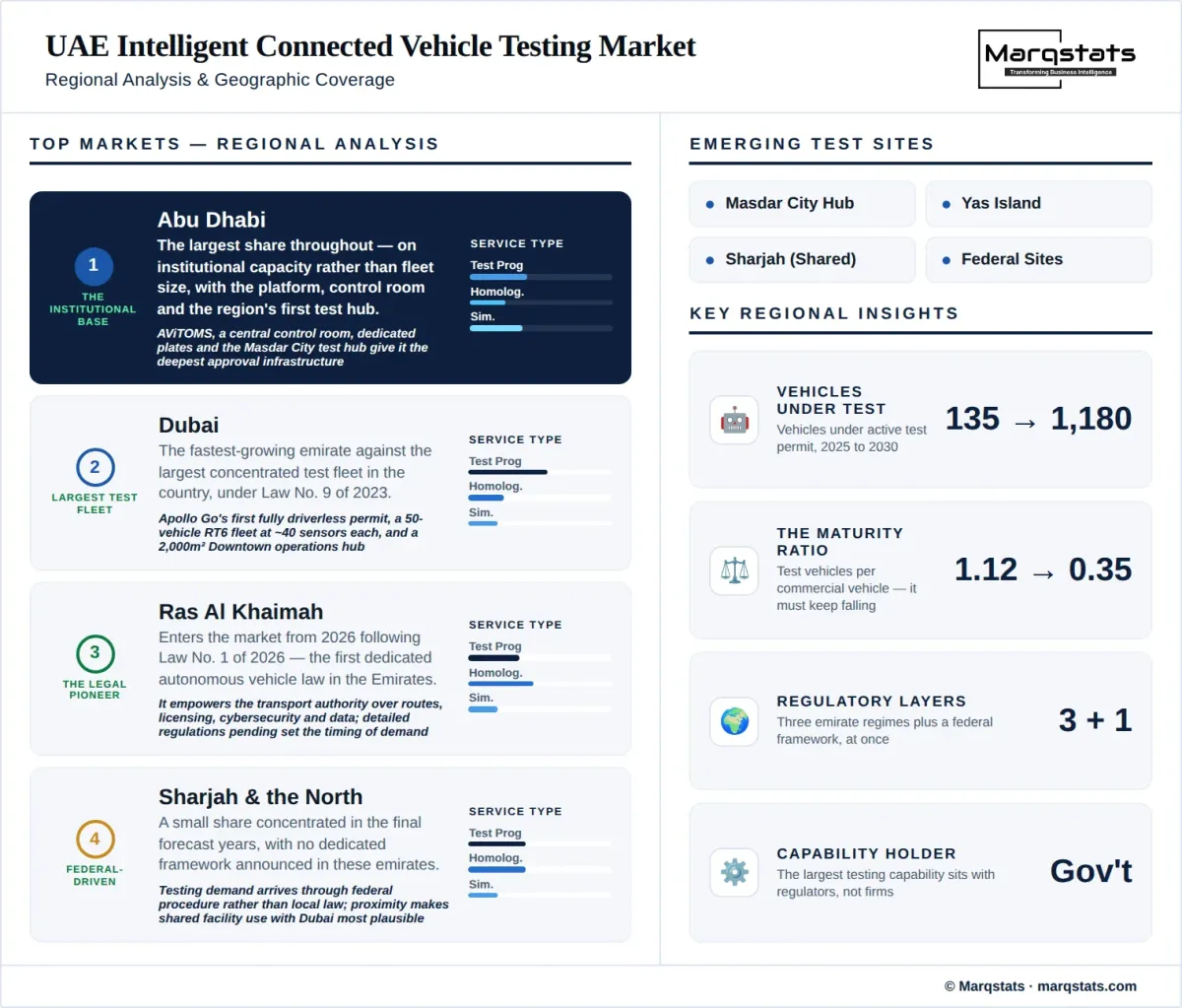
Vehicles under active test and validation permit rise from 135 in 2025 to 1,180 by 2030, a 54.28% compound annual growth rate. The count includes autonomous vehicles operating under trial rather than commercial authorisation, connected vehicle model programmes undergoing local adaptation and type approval, and autonomous logistics, bus and shuttle units in structured evaluation. Vehicles operating under full commercial permits are excluded, since their authorisation has already been established.
The ratio between the test fleet and the commercially operating fleet is the most useful maturity indicator available in this market, and it falls sharply. In 2025 there are roughly 1.12 vehicles under test permit for every vehicle in commercial autonomous service. By 2030 that ratio falls to approximately 0.35. Early-stage markets carry more vehicles in validation than in revenue service because every operator is still establishing its safety case; mature ones carry a small standing validation fleet against a large commercial one. A market in which the ratio stops falling has stalled at the permit stage, which is the specific failure mode to watch.
Validation spend per test vehicle falls from USD 62,000 to USD 51,000 a year, a 3.83% annual decline, which is why service value compounds at 46.76% against 54.28% growth in the test fleet. Two forces work against each other. Requirements deepen — cybersecurity assessment against UNECE guidance, data handling under Federal Data Protection Law No. 45 of 2021, operational design domain characterisation and incident reporting all add scope that did not exist in a conventional type-approval programme. Against that, simulation and digital-twin methods displace a growing share of physical road kilometres, and a permanent test hub spreads facility and instrumentation cost across many programmes rather than loading it onto the first one. The second force is the larger, but only after the hub reaches operation.
The figures are modelled rather than reported. No public revenue series exists for intelligent connected vehicle testing in the Emirates, and no participant discloses segment revenue on this basis. The estimate triangulates active test fleets, the phase structure of the permit regimes, service intensity per programme and announced facility development, and should be read as an addressable service market rather than as audited industry revenue.
Market Dynamics
Key Drivers
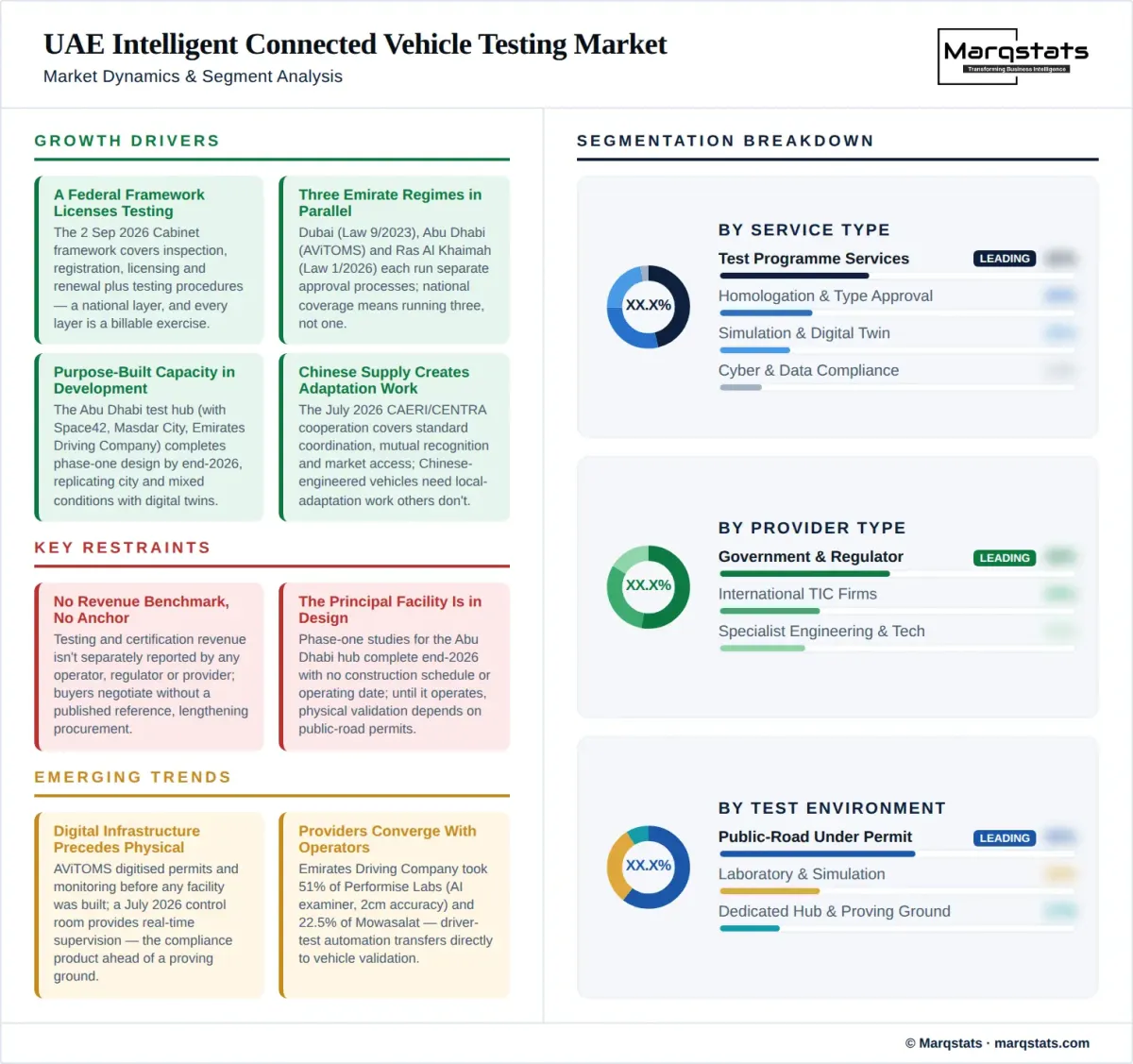
- A federal framework converting testing into a licensed activity. On 2 September 2026 the UAE Cabinet approved rules covering the inspection, registration, licensing and licence renewal of self-driving vehicles, together with procedures for testing new vehicle technologies and the responsibilities of agents, operators and passengers. A national layer sitting above the emirate regimes means a vehicle technology must satisfy federal procedure as well as local permit conditions, and every additional layer of approval is a billable engineering and documentation exercise.
- Three emirate-level legal regimes running in parallel. Dubai regulates autonomous vehicles under Law No. 9 of 2023 administered by the Roads and Transport Authority; Abu Dhabi operates through the Integrated Transport Centre and the AViTOMS platform; Ras Al Khaimah issued Law No. 1 of 2026 on 19 January 2026, giving its transport authority power over routes, speed limits, licensing, cybersecurity protocols, data governance and incident recording. An operator seeking national coverage runs three approval processes, not one.
- Purpose-built physical capacity entering development. The Abu Dhabi autonomous vehicle test hub, announced November 2025 with Space42, Masdar City and Emirates Driving Company, completes phase-one studies and design by the end of 2026 and is designed to replicate city-centre, suburban and mixed-use conditions with sensing networks, digital twins and real-time monitoring. Emirates Driving Company's role covers safety supervisor training and vehicle inspection, attaching a listed operator with existing testing infrastructure to the programme.
- Chinese intelligent connected vehicle supply creating an adaptation workload. The July 2026 cooperation between the China Automotive Engineering Research Institute and CENTRA Mobility covers testing equipment and system development, construction of testing facilities, technical-standard coordination, mutual recognition and market-access support. Vehicles engineered to Chinese standards entering a market that recognises European and Gulf conformity routes require local adaptation work that does not arise for vehicles already homologated to those routes.
- Cybersecurity and data compliance entering the scope of vehicle approval. Abu Dhabi requires autonomous operations to comply with UNECE cybersecurity guidance and Federal Data Protection Law No. 45 of 2021, and the emirate's control room performs continuous real-time monitoring with incident logging. Software and data obligations that persist after deployment convert one-time homologation into recurring validation, which is the structural change that turns a project market into a service market.
Key Restraints
- No revenue benchmark and therefore no pricing anchor. Testing and certification revenue in the Emirates is not separately reported by any operator, regulator or listed provider. Emirates Driving Company reported AED 189 million of revenue in the first quarter of 2026, up 13%, but that figure is dominated by driver training and conventional inspection rather than by autonomous validation. Buyers and providers negotiate without a published reference, which lengthens procurement and suppresses early volume.
- The principal facility is still in design. Phase-one studies for the Abu Dhabi test hub complete at the end of 2026, with no announced construction schedule, capital figure or operating date beyond that milestone. Until the hub operates, physical validation depends on public-road permits and on facilities designed for other purposes, which caps how much of the addressable work can actually be performed in the country.
- Regulatory fragmentation raising cost without raising service value. Three emirate regimes and a federal layer multiply approval effort for a single vehicle programme. The federal government is working toward harmonised standards, and harmonisation would reduce the number of billable approval cycles per programme even as it enlarges the market by making national deployment practical. The direction of that trade-off is not yet settled.
- Validation capability concentrating inside operators rather than in the supply chain. Autonomous developers arrive with their own validation stacks and accumulated global test data — Apollo Go cites more than 240 million logged kilometres worldwide — and prefer to satisfy local requirements using in-house evidence. Independent providers capture the regulatory interface and the local adaptation work, but not the core engineering validation, which limits realised value per vehicle.
Key Trends
- Digital infrastructure preceding physical infrastructure. AViTOMS digitised trial applications, no-objection certificate issuance and live deployment before any test facility was built, and later phases add company registration, incident reporting and vehicle feedback monitoring. A July 2026 central control room provides real-time monitoring, data analysis and emergency response across permitted vehicles. Continuous supervision is becoming the compliance product, ahead of physical proving-ground capacity.
- Identification and traceability formalising as a distinct requirement. Abu Dhabi introduced dedicated blue licence plates on 13 July 2026, marked Test for vehicles in testing and pilot programmes and Auto Drive for those in commercial service, linked to the licensing and operational requirements approved for each. Separating the two populations at the plate level makes the test fleet an administratively distinct category for the first time.
- Testing providers converging with mobility operators. Emirates Driving Company acquired a 51% stake in Performise Labs in February 2026, adding an artificial-intelligence examiner platform delivering automated yard tests with biometric verification and measurement accuracy to two centimetres, and took a 22.5% holding in Mowasalat Holding while repositioning as Emirates Mobility. Automated assessment technology built for driver testing transfers directly to vehicle validation.
- Cross-border standards recognition emerging as a service line. Mutual recognition and market-access support appear explicitly in the CAERI-CENTRA scope, alongside technical-standard coordination and local adaptation. A provider able to convert a Chinese conformity file into a Gulf-acceptable one occupies a position that neither the vehicle manufacturer nor the local regulator wants to hold, and that position is currently contested by very few participants.
Market Segmentation
Test programme services are the largest service type throughout, covering permit application support, safety-case preparation, sensor and system validation, supervised road testing, kilometre accumulation and evidence packaging for phase progression. The segment scales directly with vehicles under test permit and is the activity through which providers build regulator relationships. It is also the most exposed to in-house substitution, since developers arriving with global validation data seek to minimise repeat local work.
Homologation and type approval covers conformity assessment for vehicles and components entering the Emirates, including model-level approvals for connected and new-energy vehicles and the local adaptation of files prepared to other standards. This is the most established of the four service types, with international certification firms already present, and the segment that benefits most directly from mutual-recognition arrangements between Chinese and Gulf conformity regimes.
Simulation and digital-twin services grow fastest across the forecast, driven by the test hub's design commitment to digital-twin capability and by the economics of substituting virtual kilometres for physical ones. Scenario libraries reflecting local road layouts, traffic behaviour, roundabout density and heat conditions are the differentiating asset, since generic scenario sets do not represent the operating design domains that Emirates regulators actually assess.
Cybersecurity and data compliance validation covers assessment against UNECE cybersecurity guidance, software update management, and handling obligations under Federal Data Protection Law No. 45 of 2021. The segment is small in 2025 and expands steadily as continuous supervision requirements accumulate. Its distinguishing feature is recurrence: unlike a mechanical approval, a cybersecurity and data posture must be re-established after material software change.
Public-road testing under permit accounts for the majority of validation activity through the forecast, because it is the only environment in which the Emirates currently authorise autonomous operation and because permit progression is evidenced by real-world kilometres. Its share declines gradually as dedicated facilities and simulation absorb work that does not require public exposure, but it remains the environment in which authorisation is ultimately granted.
Dedicated facility testing is negligible in 2025 and becomes material from 2028, following the Abu Dhabi test hub's transition from design into operation. A controlled environment replicating city-centre, suburban and mixed-use conditions allows repeatable scenario execution and edge-case testing that cannot be scheduled on public roads, and moves work currently performed abroad into the country.
Laboratory and simulation covers component-level testing, hardware-in-the-loop validation, sensor characterisation and scenario execution performed without a vehicle on a road. The environment carries the lowest marginal cost per test and the highest scalability, and its expansion is the principal reason validation spend per test vehicle declines across the forecast.
Autonomous passenger and robotaxi programmes generate the majority of test-vehicle volume, reflecting the concentration of permitted activity in Dubai and Abu Dhabi around passenger mobility. Programme intensity is high because these vehicles operate among the public and progress through structured supervision phases before unmanned authorisation, each phase requiring separate evidence.
Imported connected vehicle model programmes cover type approval, local adaptation and market-access work for connected and new-energy models entering the Emirates, predominantly from Chinese manufacturers. Volume follows model launch cadence rather than fleet size, and a single model programme can generate more certification work than several test vehicles, which is why this segment contributes disproportionately to value relative to its share of the test fleet.
Autonomous logistics, bus and shuttle programmes are the smallest vehicle programme category in 2025 and grow from a low base as freight and public-transport applications follow passenger mobility through the permit pathways. These programmes carry heavier operational validation requirements around vehicle mass, passenger handling and fixed-route operation, which raises service intensity per vehicle above the robotaxi average.
Government and regulator-operated capacity holds the largest share, an unusual structure explained by the sequence in which this market formed: platforms, control rooms and permit systems were built by transport authorities before any commercial testing industry existed. The Integrated Transport Centre, the Roads and Transport Authority and the Ras Al Khaimah Transport Authority each operate approval infrastructure that a commercial provider must work through rather than around.
International certification firms hold established positions in conventional homologation and conformity assessment in the Emirates and are the natural incumbents for imported model programmes. Their share of autonomous validation is smaller, because autonomy assessment depends on operating-domain and regulatory-interface knowledge accumulated locally rather than on globally portable laboratory accreditation.
Specialist engineering and technology providers grow fastest across the forecast, spanning simulation and digital-twin developers, sensing and monitoring integrators, automated assessment platforms and the joint ventures forming around standards recognition. The segment is where new entrants can establish a position without the accreditation base or the regulatory mandate that the other two provider types already hold.
By Geography
Abu Dhabi
Abu Dhabi holds the largest share throughout the forecast on institutional capacity rather than on fleet size. The emirate operates the AViTOMS platform launched in November 2025, a central control room opened in July 2026 providing real-time monitoring and emergency response, dedicated trial and commercial licence plates introduced the same month, and the region's first purpose-built autonomous vehicle test hub in development at Masdar City. The Smart and Autonomous Vehicles Industries cluster, launched at Masdar City in October 2023 with land-based test capacity on Yas Island, supplies the industrial setting around it.
Dubai
Dubai is the fastest-growing emirate market, expanding from a smaller institutional base against the largest concentrated test fleet in the country. Baidu's Apollo Go holds the emirate's first fully driverless testing permit, granted January 2026, operates 50 RT6 test vehicles carrying around 40 sensors each, and has established a 2,000 square metre operations and management hub in Downtown Dubai integrating intelligent road infrastructure with charging and maintenance. Law No. 9 of 2023 provides the legal basis and the Roads and Transport Authority administers permit progression.
Ras Al Khaimah
Ras Al Khaimah enters the market from 2026 following Law No. 1 of 2026, issued 19 January 2026, which established the first dedicated autonomous vehicle legal framework in the country. The law empowers the emirate's transport authority over routes, speed limits, licensing, cybersecurity protocols, data governance and incident recording, and requires automatic transition to safe mode on system failure, real-time connectivity with control centres and transparent incident recording. Detailed licensing regulations remain to be issued, which sets the timing of commercial testing demand.
Sharjah and the Northern Emirates
Sharjah and the remaining northern emirates hold a small share concentrated in the final forecast years. No dedicated autonomous vehicle framework has been announced in these emirates, and testing demand is expected to arrive through federal procedure rather than local legislation. Proximity to Dubai makes shared facility use the most plausible route to participation.
Rest of the United Arab Emirates
The remaining areas hold a negligible share throughout. Testing and validation activity concentrates where regulators, permitted road networks and facility investment coincide, and that combination exists in two emirates with a third establishing its legal basis. Federal harmonisation would change the distribution of demand rather than its location, since the facilities and the technical staff remain where they were built.
How Competition Is Evolving
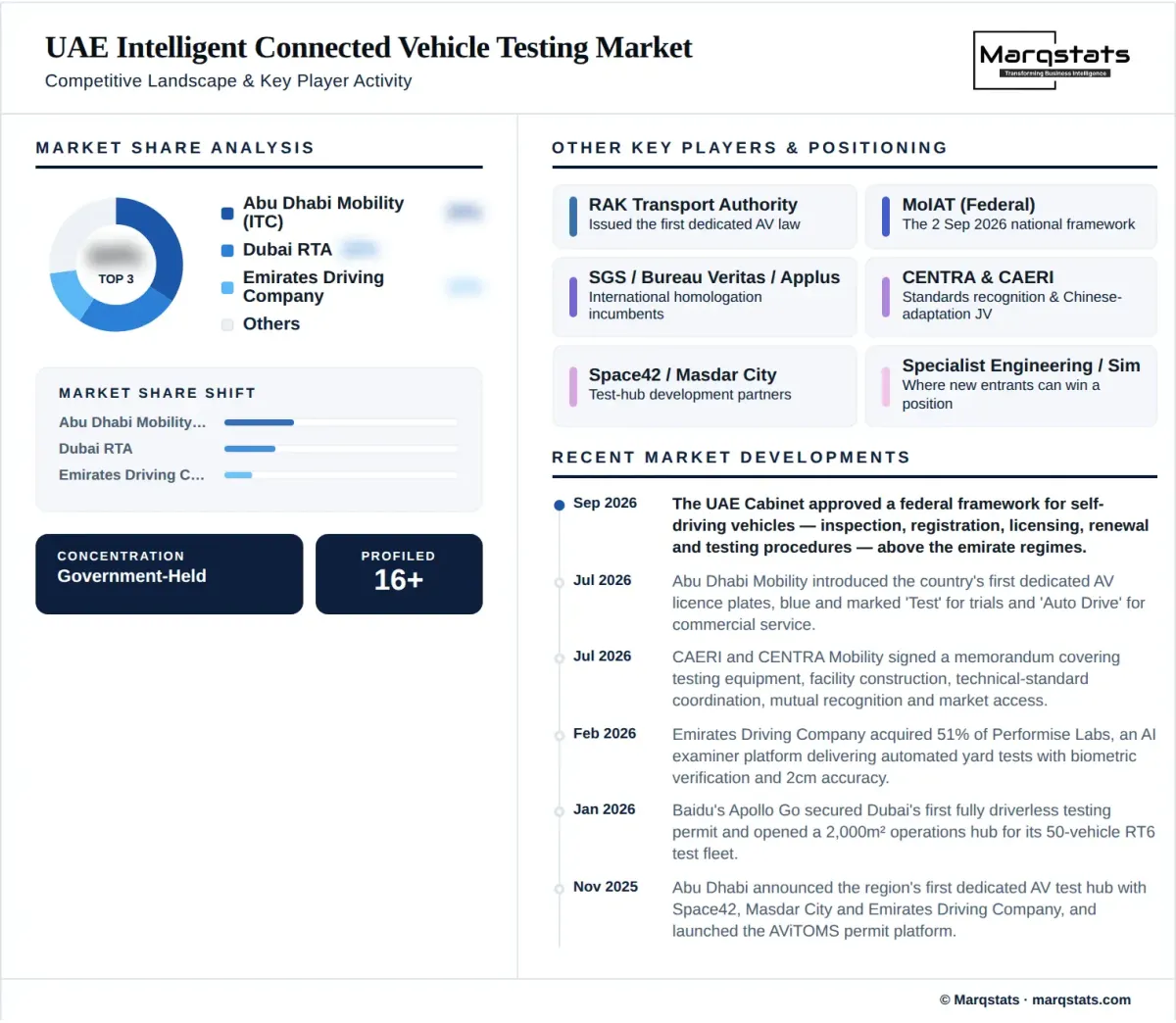
The market is fragmented and structurally unusual, because the largest capability holders are not commercial providers. Transport authorities in Abu Dhabi, Dubai and Ras Al Khaimah own the permit systems, the monitoring platforms and the approval decisions, and the principal physical facility in development is a government programme with strategic partners rather than a private investment. Commercial participants operate around that structure: international certification firms hold conventional homologation work, specialist technology providers supply simulation, sensing and assessment tools, and newly formed ventures pursue standards recognition between jurisdictions.
Competitive position is therefore determined by proximity to the regulator and by inclusion in the institutional programmes, not by accreditation breadth or price. Emirates Driving Company's participation in the Abu Dhabi test hub, covering safety supervisor training and vehicle inspection, is worth more than any laboratory certification an outside entrant could obtain, because it places a commercial operator inside the facility that will define national validation practice. The CENTRA Mobility arrangement with the China Automotive Engineering Research Institute performs the same function on the standards-recognition side, converting a bilateral technical relationship into a market-access service.
Consolidation pressure is low in the near term and the more likely development is vertical extension by adjacent operators. Emirates Driving Company's acquisition of a majority stake in Performise Labs and its holding in Mowasalat demonstrate the pattern: an established testing business acquiring assessment technology and mobility exposure rather than acquiring competitors. Entrants without a regulator relationship should expect to compete for subcontracted scope inside institutional programmes rather than for direct mandates, at least until the Abu Dhabi hub reaches operation and opens third-party facility access.
Companies Covered
The report profiles 16+ companies with full strategy and financials analysis, including:
Recent Market Activity
Table of Contents
Coverage & Segmentation
The study covers the United Arab Emirates with emirate-level detail for Abu Dhabi, Dubai, Ras Al Khaimah, Sharjah and the northern emirates, and the remaining areas. It measures the annual value of testing, validation, homologation and certification services delivered for intelligent connected and autonomous vehicles, in United States dollars, with vehicles under active test and validation permit carried as the secondary unit. The base year is 2025, the historical period covers 2024 to 2025, and the forecast period runs from 2026 to 2030 with an indicative 2031 endpoint. Segmentation covers service type, test environment, vehicle programme and provider type.
Three exclusions define the boundary. Periodic roadworthiness inspection of the in-use vehicle parc is excluded: registration renewal testing at the emirates' inspection centres is a separate, far larger and structurally different market, and sizing this one against total inspection throughput would overstate it by an order of magnitude. Driver training and driver testing are excluded, since they assess people rather than vehicles, which places the majority of Emirates Driving Company's reported revenue outside the market even though the company participates in it. Autonomous fleet operating costs and the vehicles themselves are excluded and belong to the fleet operations and robotaxi markets respectively.