Market Snapshot
Key Takeaways
Market Overview & Analysis
Report Summary
The UAE robotaxi market comprises vehicles operating without a human driver in public or commercial passenger service across the Emirates, together with vehicles engaged in advanced public-road trials under regulator-issued permits. Conventional ride-hailing vehicles with human drivers are excluded regardless of the platform they are booked through. Market size is measured as the operating and permitted robotaxi fleet in vehicles, with annual investment in vehicles entering service reported alongside it as the commercial measure. On this basis the market stood at 120 vehicles and USD 17.40 million of vehicle investment in 2025.
UAE Robotaxi Fleet Size and Vehicle Forecast
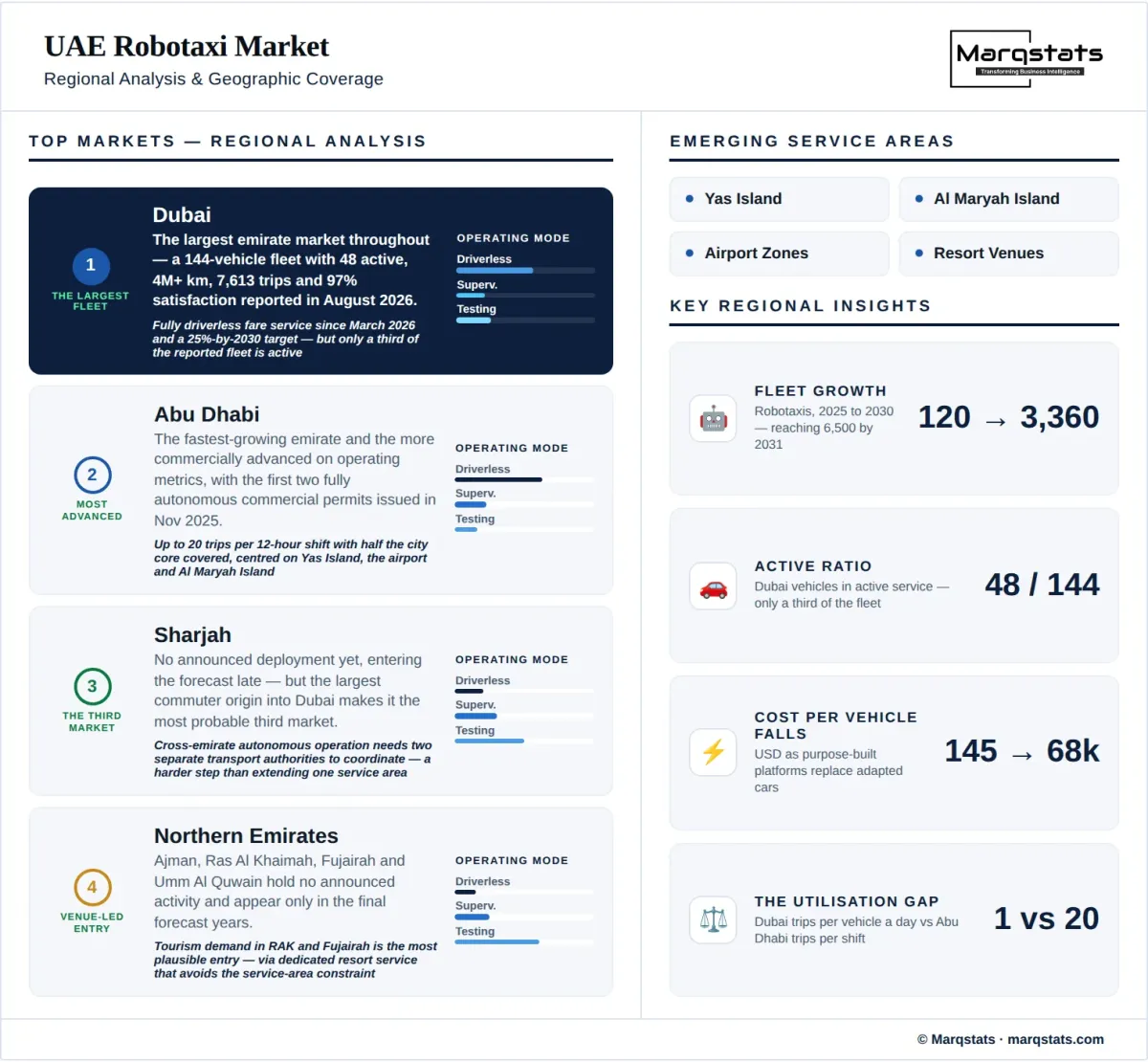
The UAE robotaxi fleet rises from 120 vehicles in 2025 to 3,360 by 2030, a 94.73% compound annual growth rate, reaching 6,500 vehicles by 2031. The 2025 base is anchored on identifiable public fleets — 50 Apollo Go test vehicles in Dubai and a reported 69-vehicle WeRide fleet around the Abu Dhabi commercial launch, plus limited additional units — while the 2026 figure triangulates Dubai's reported 144-vehicle fleet with Abu Dhabi operations and further operator deployments.
Fleet count and vehicle investment diverge by 56 percentage points, 94.73% against 38.63%, because blended cost per robotaxi falls from approximately USD 145,000 to USD 68,000 — a 14.05% annual decline steeper than any comparable vehicle market. Purpose-built sixth-generation robotaxi platforms designed for autonomous service rather than adapted from passenger cars are the principal cause, and the effect is that vehicle investment in 2026 sits marginally below 2025 despite an unchanged number of vehicles entering service. A supplier sizing revenue from the fleet curve alone would overstate it by more than half.
Three boundaries define the market. Conventional ride-hailing vehicles with human drivers are excluded even where they are booked through the same platform and appear in the same application, because the market measures autonomous capability rather than booking channel. Autonomous shuttles, buses and delivery vehicles are excluded, since passenger taxi service is a distinct regulatory category with its own permits. Vehicles in closed-campus or private-estate operation are excluded, because the defining characteristic of a robotaxi is public-road operation under a transport authority permit.
Fleet count is a necessary measure but an incomplete one, and the report carries operating metrics alongside it throughout. Dubai's August 2026 disclosure of 144 vehicles with only 48 in active operation illustrates why: a third of the reported fleet was generating trips. Cumulative distance, trips per day, active-vehicle ratio and service-area coverage are reported wherever regulators publish them, because two fleets of identical size can differ by an order of magnitude in commercial output. Forecasts stated in vehicles should always be read against the utilisation assumption behind them.
Market Dynamics
Key Drivers
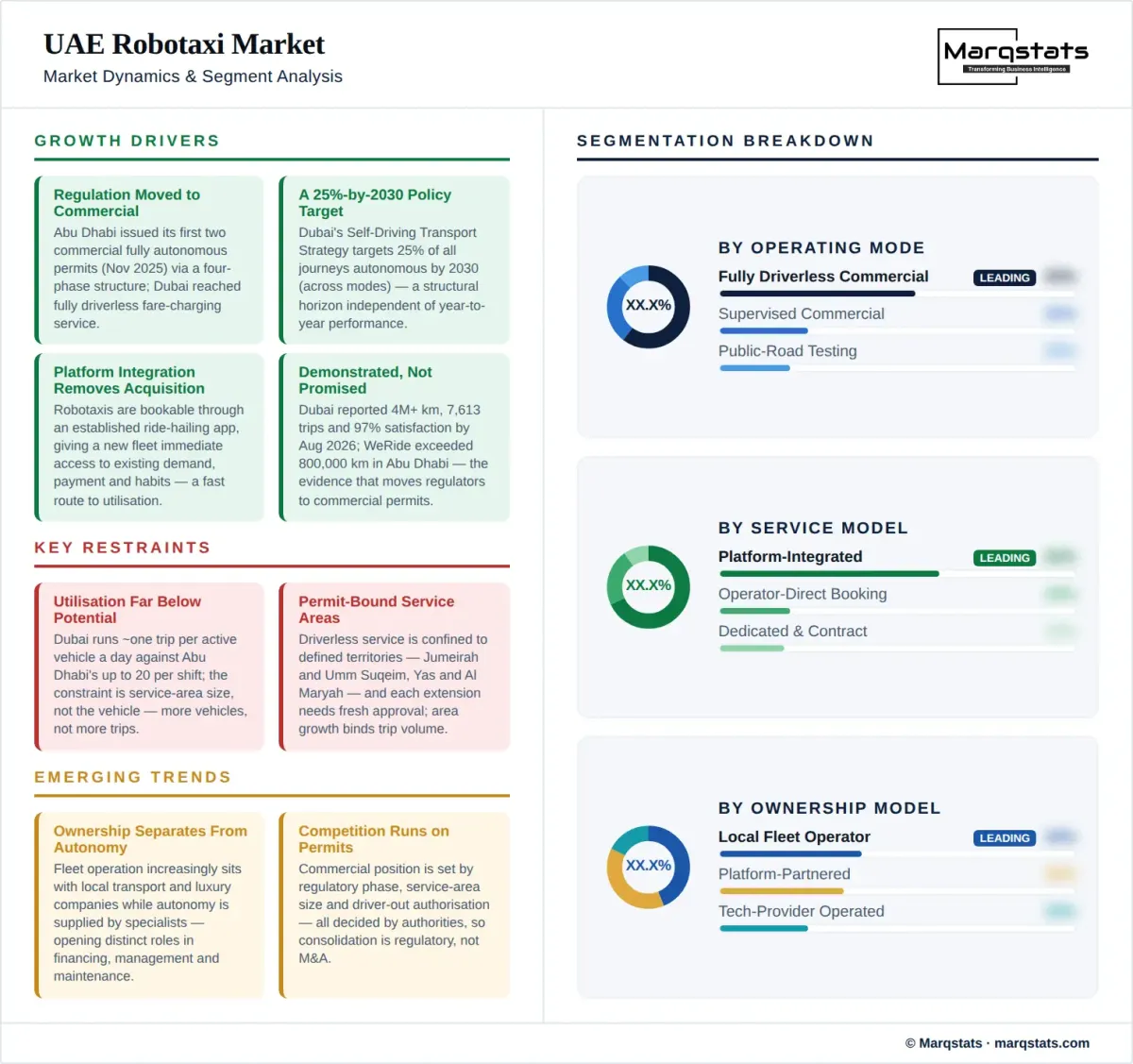
- Regulatory frameworks that moved from pilot to commercial licensing. Abu Dhabi's Integrated Transport Centre issued the first two commercial fully autonomous operating permits in November 2025 following rigorous testing, and manages applications, permits, testing and commercial operations through a four-phase structure under its AViTOMS platform. Dubai's Roads and Transport Authority progressed from supervised pilots to driverless trial permits and then to fully driverless fare-charging operations. Commercial status in this market should be tracked by permit phase rather than by vehicle announcement.
- A stated policy target that anchors long-run demand. Dubai's Self-Driving Transport Strategy targets 25% of all journeys in the emirate as autonomous by 2030, giving operators, investors and infrastructure providers a structural planning horizon that does not depend on year-to-year commercial performance. The target spans multiple transport modes rather than robotaxis alone, so it should be read as a direction of travel rather than as a robotaxi fleet forecast.
- Platform integration that removes the customer acquisition problem. Robotaxis in both emirates are bookable through an established ride-hailing application, with riders requesting standard service matched to a driverless vehicle or selecting a dedicated autonomous option. That gives a new fleet immediate access to existing demand, existing payment infrastructure and existing user habits, which is a materially faster route to utilisation than building a standalone service.
- Demonstrated operating performance rather than promised performance. Dubai reported more than 4 million cumulative kilometres, 7,613 passenger trips and 97% customer satisfaction by August 2026. WeRide vehicles in Abu Dhabi had exceeded 800,000 kilometres by October 2025, running up to 20 trips per 12-hour shift with around half the city core covered. Evidence of sustained public operation is what moves regulators from trial permits to commercial ones, and it is now available in both emirates.
- Multiple operators competing for the same permits. Three Chinese autonomous driving providers hold Dubai trial permits, a UAE national company announced an Abu Dhabi launch with a European vehicle platform and a Chinese autonomy partner, and a further operator holds one of the first Abu Dhabi commercial permits. Plurality at this stage is unusual and it accelerates deployment, because no operator can afford to let a competitor establish service-area coverage first.
Key Restraints
- Utilisation far below what the fleet could deliver. Dubai's reported activity implies roughly one trip per active vehicle per day across 48 active vehicles, against Abu Dhabi operations running up to 20 trips per 12-hour shift. The constraint is service-area size and permitted operating conditions rather than vehicle capability, and until permitted territory expands, adding vehicles raises fleet count without proportionally raising trips.
- Only a fraction of reported fleets is in active service. Of 144 vehicles reported in Dubai in August 2026, 48 were in active operation — about a third. Vehicles held for testing, validation, maintenance or future service-area expansion are counted in fleet disclosures but generate no revenue, which means headline fleet figures systematically overstate commercial capacity at any given moment.
- Permit-bound service areas rather than city-wide operation. Commercial driverless service in Dubai began across Jumeirah and Umm Suqeim, and Abu Dhabi operations centre on Yas Island, the airport and Al Maryah Island. These are defined territories rather than open-city operation, and expansion requires fresh regulatory approval for each extension. Service-area growth, not fleet growth, is the binding constraint on trip volume.
- Fleet economics unproven at scale. No operator has published unit economics for UAE robotaxi service, and the relationship between vehicle cost, utilisation, remote supervision overhead and fare revenue is not publicly established. The 2031 unit forecast is correspondingly sensitive: a smaller high-utilisation fleet could serve the same trip volume as a larger low-utilisation one, and the vehicle count that ultimately proves economic is not yet determinable from published evidence.
Key Trends
- Vehicle ownership separating from autonomous driving technology. Fleet operation is increasingly handled by local transport companies while autonomy is supplied by specialist technology providers — a luxury transport company operates driverless vehicles in Dubai for one provider, and a transport operator partners with an autonomy company and a ride-hailing platform in Abu Dhabi. That separation creates distinct openings in fleet financing, fleet management, charging and maintenance that did not exist when operators owned the whole stack.
- Premium positioning emerging as a distinct segment. A UAE national company announced an Abu Dhabi robotaxi service in December 2025 using a European luxury sedan platform with a Chinese Level 4 autonomy system, launching in 2026. Robotaxi service has until now competed on availability and novelty rather than on vehicle class, and a premium tier changes both the fare structure and the vehicle cost assumption underpinning fleet economics.
- Purpose-built vehicles displacing adapted passenger cars. The steep decline in blended cost per robotaxi across the forecast reflects a shift from retrofitted production vehicles to platforms designed for autonomous service from the outset, with sensor integration, redundancy and interior layout specified for driverless operation. This is the single largest factor in the divergence between fleet growth and vehicle investment growth.
- Emirate-level divergence in rollout model. Dubai and Abu Dhabi are following different paths — different permit structures, different lead operators, different service-area geographies and different sequencing from supervised to driverless operation. The two should be forecast separately rather than aggregated, because a permit decision in one emirate carries no automatic implication for the other.
Market Segmentation
Fully driverless commercial service covers vehicles carrying fare-paying passengers with no safety operator aboard, the configuration in which robotaxi economics are actually realised. Dubai reached this stage across Jumeirah and Umm Suqeim in March 2026 and Abu Dhabi issued its first commercial fully autonomous permits in November 2025. The segment grows from a small share of the 2025 fleet to the clear majority by 2030 as permit phases advance.
Supervised commercial service places a vehicle specialist aboard while passengers are carried and fares are charged, the phase that precedes driverless authorisation in both emirates. It carries the full vehicle and autonomy cost without the labour saving, so its economics rest on regulatory progression rather than on profitability. Abu Dhabi operations continued in this configuration on the ride-hailing platform after commercial permits were issued.
Public-road testing covers permitted vehicles operating without carrying fare-paying passengers, generating the validation distance regulators require before advancing an operator to commercial phases. Vehicles in this mode appear in fleet disclosures but produce no revenue, and the segment's share of total fleet is the clearest leading indicator of near-term commercial capacity.
Platform-integrated service, in which robotaxis are dispatched through an established ride-hailing application alongside human-driven vehicles, is the dominant service model across the forecast and in both emirates. Riders may be matched to a driverless vehicle on a standard request or select a dedicated autonomous option. The model gives operators immediate demand access and gives the platform a differentiated supply pool without vehicle capital.
Operator-direct booking covers robotaxi services dispatched through an autonomous operator's own application rather than a third-party platform, retaining the full fare and the customer relationship. The trade-off is customer acquisition cost against platform commission, and the model is most viable for operators with premium positioning or a captive corporate and hospitality customer base.
Dedicated fleet and contract service covers robotaxis assigned to defined venues, developments or institutional customers rather than open public dispatch — airport transfers, island developments and corporate campuses. Demand is contracted rather than hailed, which makes utilisation predictable and removes the service-area expansion constraint that limits open public operation.
Standard robotaxis, typically adapted from mass-market passenger platforms or purpose-built at volume price points, account for the large majority of the fleet throughout the forecast. Vehicle cost falls fastest in this segment as sixth-generation purpose-built platforms replace retrofitted production cars, and it is where the steep decline in blended per-vehicle cost across the period originates.
Premium robotaxi service, announced for Abu Dhabi in December 2025 using a European luxury sedan with a Chinese Level 4 system, targets a fare tier above standard autonomous service. Vehicle cost per unit runs several times the standard segment, so a small number of vehicles carries a disproportionate share of investment value and the segment's economics depend on fare premium rather than utilisation volume.
Purpose-built platforms are designed for driverless service from the outset, with sensor integration, redundant systems and passenger-focused interiors rather than driver accommodation. They deliver the lowest cost per vehicle at volume and the highest configuration efficiency, and their share rises steadily across the forecast as production scales in the manufacturers' home markets.
Technology-provider operation, in which the autonomy developer also owns and runs the fleet, was the dominant model in the earliest deployments because no local operator had the capability. It gives the provider full control of the operating data that feeds system development, and full exposure to fleet capital and operating cost. Its share declines across the forecast as local operating partners take over fleet functions.
Local fleet operator ownership places vehicles with a UAE transport or luxury transport company that handles depot, maintenance, charging and daily operations while licensing the autonomous driving system. A luxury transport operator performs this role for driverless vehicles in Dubai and a transport company partners on Abu Dhabi commercial permits. The model grows fastest and creates the clearest openings for financing, fleet management and maintenance specialists.
Platform-partnered arrangements place the ride-hailing platform between the technology provider and the fleet operator, with the platform supplying demand and the other parties supplying vehicles and autonomy. This is the structure behind most current UAE deployments and behind the regional commitment to deploy at least 1,200 robotaxis across Abu Dhabi, Dubai and Riyadh as soon as 2027.
By Geography
Dubai
Dubai is the largest emirate market throughout the forecast, reporting a 144-vehicle robotaxi fleet with 48 vehicles in active operation, more than 4 million cumulative kilometres, 7,613 passenger trips and 97% customer satisfaction in August 2026. Fully driverless fare-charging service began in Jumeirah and Umm Suqeim in March 2026, three Chinese autonomy providers hold trial permits, and the emirate's Self-Driving Transport Strategy targets 25% of journeys as autonomous by 2030.
Abu Dhabi
Abu Dhabi is the fastest-growing emirate market and the more commercially advanced on operating metrics, having issued the first two fully autonomous commercial operating permits in November 2025. Operations centre on Yas Island, Abu Dhabi Airport and Al Maryah Island, with vehicles exceeding 800,000 kilometres by October 2025 at up to 20 trips per 12-hour shift and around half the city core covered. A premium robotaxi service was announced for 2026 launch.
Sharjah
Sharjah carries no announced robotaxi deployment and enters the forecast late, but its position as the largest commuter origin into Dubai makes it the most probable third market. Cross-emirate autonomous operation would require coordination between separate transport authorities, which is a materially harder regulatory step than extending a service area within one emirate, and that dependency shapes the timing.
Northern Emirates
The Northern Emirates — Ajman, Ras Al Khaimah, Fujairah and Umm Al Quwain — hold no announced robotaxi activity and appear in the forecast only in its final years. Tourism-driven demand in Ras Al Khaimah and Fujairah provides the most plausible entry case, most likely through dedicated venue or resort service rather than open public dispatch, which avoids the service-area expansion constraint.
Rest of the United Arab Emirates
The remaining areas hold a negligible share throughout. Robotaxi economics depend on dense trip origins and destinations within a defined permitted territory, conditions that exist in the two largest emirates and in specific developed districts elsewhere but not across the wider federation. Any later deployment is most likely at defined venues rather than in general public service.
How Competition Is Evolving
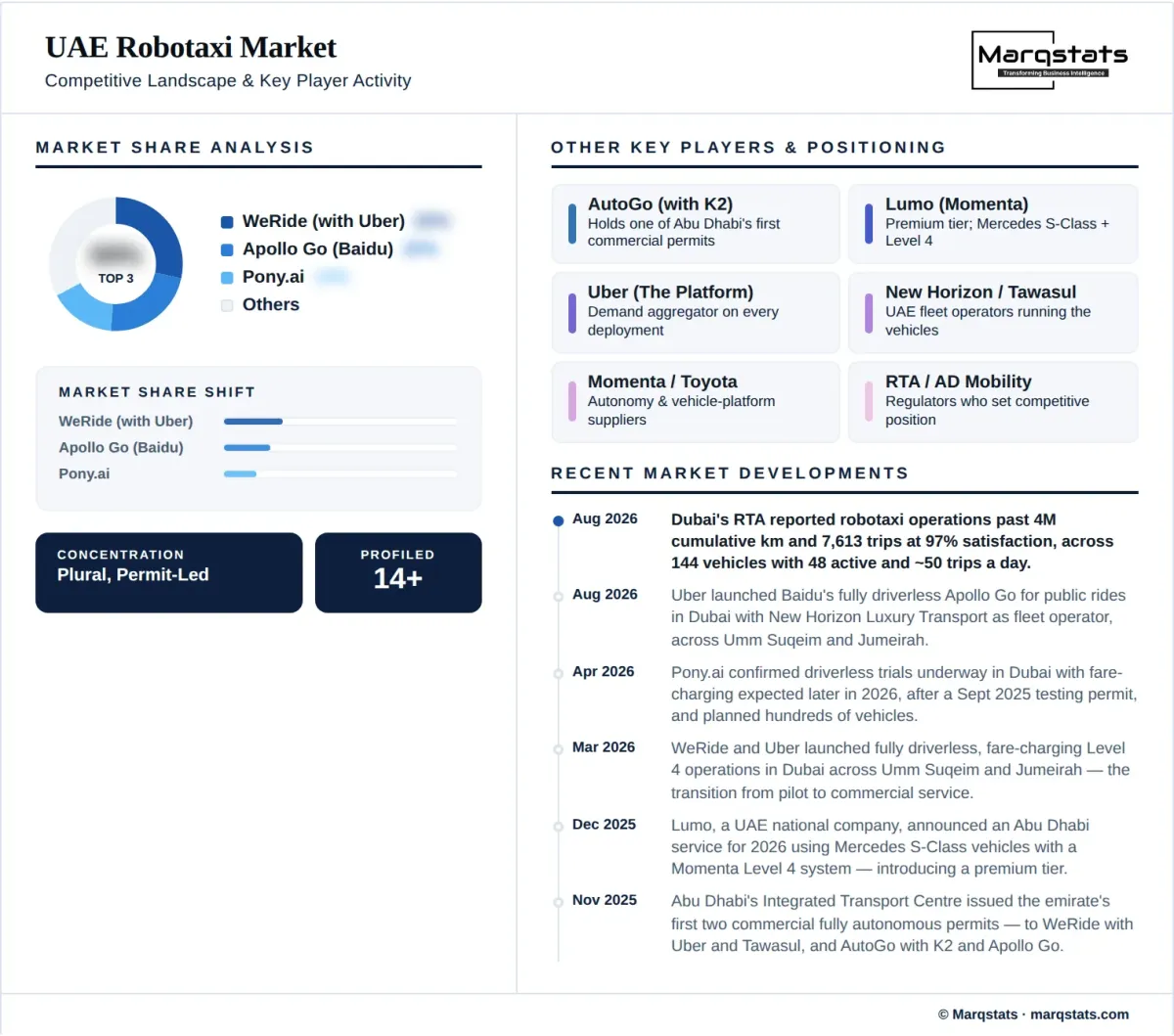
The UAE robotaxi market is moderately fragmented, and it is unusually plural for a market of this age and size. Five operators hold permits or have announced launches across the two leading emirates: WeRide with Uber and a local transport partner, Baidu's Apollo Go with a Dubai fleet operator, Pony.ai under a Dubai testing permit granted in September 2025, AutoGo with K2 under one of the first Abu Dhabi commercial permits, and a UAE national company launching a premium service with a Chinese autonomy partner. No participant approaches dominance, and permits are being awarded to multiple operators in parallel rather than to a single national champion.
The value chain has separated into three distinct roles, and this is the most commercially significant structural feature of the market. Autonomous driving technology is supplied by specialist developers, the great majority of them Chinese. Fleet ownership and daily operation increasingly sit with UAE transport and luxury transport companies. Demand is aggregated by an established ride-hailing platform that appears in effectively every announced deployment in both emirates. A participant must decide which of the three roles to occupy, because vertical integration across all three is no longer how deployments are being structured.
The ride-hailing platform occupies the most defensible position, and it holds it without owning vehicles or autonomy. It appears on both sides of the Dubai and Abu Dhabi markets, across competing technology providers, supplying demand and customer relationship while carrying no fleet capital. That gives it a structural position across the whole market rather than a share of it, and it means competition between autonomy providers is largely competition for supply slots on a single platform rather than for end customers directly.
Competition is running on permit progression rather than on price or product. An operator's commercial position is set by which phase of the regulatory pathway it has reached, how large a service area it is permitted to cover and whether it may operate without a safety operator — all determined by transport authorities rather than by customers. Merger and acquisition activity has been absent, and the more probable consolidation is regulatory: operators that fail to progress through the testing phases will lose service-area ground to those that do, without any transaction taking place.
Companies Covered
The report profiles 14+ companies with full strategy and financials analysis, including:
Recent Market Activity
Table of Contents
Coverage & Segmentation
This report covers robotaxis in public or commercial passenger service and advanced public-road trials across the United Arab Emirates, with 2025 as the base year and 2026 – 2030 as the forecast period. Market size is measured as the operating and permitted robotaxi fleet in vehicles, with annual investment in vehicles entering service reported in US dollars alongside it. Segmentation covers operating mode, service model, vehicle segment and ownership model, with emirate-level analysis for Dubai, Abu Dhabi, Sharjah, the Northern Emirates and the rest of the United Arab Emirates.
Four boundaries define the market perimeter. First, conventional ride-hailing vehicles with human drivers are excluded even where booked through the same application, because the market measures autonomous capability rather than booking channel. Second, autonomous shuttles, buses and delivery vehicles are excluded as distinct regulatory categories with their own permits. Third, closed-campus and private-estate operation is excluded, since public-road operation under a transport authority permit is the defining characteristic. Fourth, the fleet is a stock and vehicle investment is an annual flow: the 2030 investment figure reflects the 1,310 vehicles entering service that year, not the 3,360 then operating.
Dubai and Abu Dhabi are forecast separately and should be read separately. The two emirates operate distinct permit structures, lead operators, service-area geographies and sequencing from supervised to driverless operation, and a regulatory decision in one carries no automatic implication for the other. Aggregating them into a single national rollout assumption is the most likely source of error in any UAE robotaxi forecast, and it obscures the fact that Abu Dhabi reached commercial permitting first while Dubai reached larger reported fleet scale.
Fleet count alone is an incomplete measure and is never presented as sufficient. Dubai's disclosure of 144 vehicles with 48 active demonstrates that roughly a third of a reported fleet may be generating trips at any time, and reported activity implies about one trip per active vehicle per day against up to 20 trips per 12-hour shift in Abu Dhabi. Utilisation, service-area coverage, trips per day and cumulative distance are carried wherever regulators publish them. The 2031 endpoint of 6,500 vehicles is correspondingly sensitive to utilisation: a smaller high-utilisation fleet could serve the same trip volume as a larger low-utilisation one, and confidence is medium rather than high for that reason.