Market Snapshot
Key Takeaways
Market Overview & Analysis
Report Summary
The global automobile rental and leasing market comprises short-term self-drive rental, long-term operating and finance leasing, and car-sharing and subscription models for passenger cars and light commercial vehicles. This study segments the market by service type, vehicle type, and end user, with a 2025 base year, historical coverage from 2021 to 2025, and forecasts to 2030. Market size is stated as total rental and lease revenue in United States dollars, covering airport and off-airport rental, corporate fleet leasing, and consumer subscription products. Vehicle sales into rental and leasing fleets are tracked separately as a supply-side indicator, and are not counted directly in the headline market-size figure, which reflects service revenue rather than the underlying vehicle asset value.
The competitive structure of rental and leasing differs from most automotive services categories in that a small number of global operators, primarily headquartered in the United States and Europe, hold outsized share in nearly every market they enter, supported by shared fleet-purchasing scale, loyalty programmes, and airport concession relationships that create meaningful barriers to entry. Independent and regional operators persist primarily in markets where global operators have chosen not to establish a direct owned presence, competing instead through franchise or licensing relationships with the same global brands. This franchise structure means the same brand name can represent very different underlying business economics from one country to the next, a distinction this report accounts for when building regional revenue estimates rather than treating brand presence as a proxy for owned-operation revenue.
Fleet electrification is advancing at different speeds across rental and leasing: leasing companies serving corporate clients face direct pressure from client sustainability mandates and are electrifying ahead of the broader vehicle parc, while rental operators face a more complex calculation involving charging infrastructure at rental locations, resale value uncertainty for electric vehicles at fleet turnover, and customer familiarity, resulting in slower, still positive electrification momentum across most major rental brands.
The distinction between rental and leasing matters throughout this report because the two businesses face different competitive dynamics even where the same operator serves both. Rental competes primarily on location convenience, price transparency, and loyalty programme depth, with contracts typically running days to weeks. Leasing competes primarily on total-cost-of-ownership transparency, fleet management service quality, and multi-year account relationships, with corporate contracts commonly running three to five years. This report analyses both segments separately throughout the segment and regional sections before combining them into the total market figures presented in the snapshot.
Market Dynamics
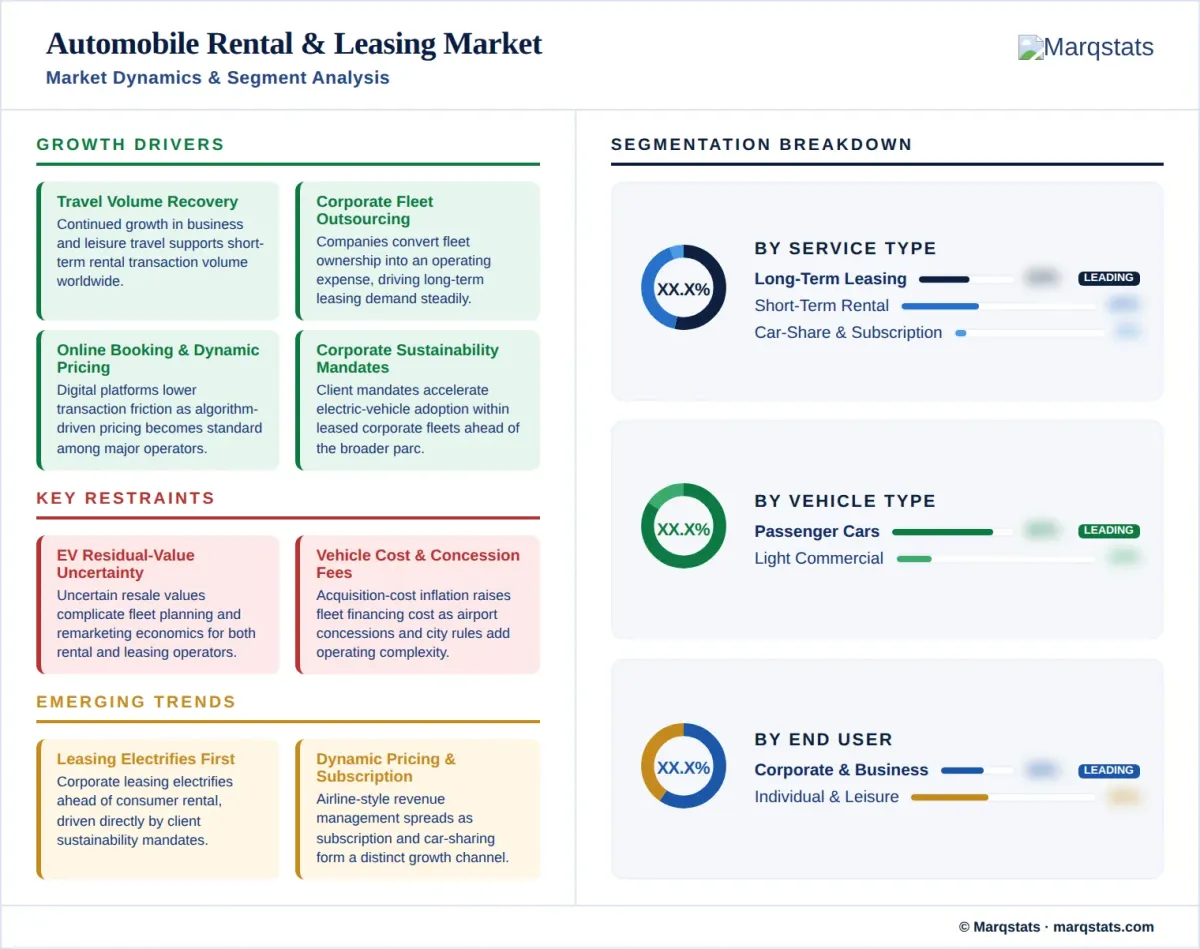
Key Drivers
- Continued recovery and growth in global business and leisure travel volume is supporting rental transaction growth.
- Corporate fleet outsourcing to leasing providers continues to grow as companies seek to convert fleet ownership into an operating expense.
- Online and mobile booking platforms are lowering transaction friction and supporting dynamic, algorithm-driven pricing adoption.
- Corporate sustainability mandates are accelerating electric vehicle adoption within leased corporate fleets ahead of the broader vehicle parc.
- Car-sharing and subscription models are expanding the addressable market to customers who would not otherwise rent or lease.
Key Restraints
- Residual value uncertainty for electric vehicles complicates fleet planning and remarketing economics for both rental and leasing operators.
- Vehicle acquisition cost inflation has raised fleet financing costs, pressuring rental and leasing operator margins.
- Airport concession fees and city-level rental regulations continue to add operating cost and complexity in major travel markets.
Key Trends
- Electrification is advancing faster in corporate leasing than in consumer rental, driven by client sustainability mandates.
- Dynamic, algorithm-driven pricing is becoming standard practice among major operators, narrowing the gap with airline revenue management.
- Car-sharing and subscription products are being positioned as a distinct growth channel alongside, rather than a replacement for, traditional rental and leasing.
- Peer-to-peer rental platforms are capturing a growing share of leisure-segment demand in select urban and tourist markets.
Market Segmentation
Short-term rental, covering daily and weekly self-drive rentals through airport and off-airport locations, generates the highest transaction volume of the three service types, though its average contract value is lower than long-term leasing. Airport rental locations remain the single largest channel by revenue within this segment, reflecting the concentration of both leisure and business travel demand at airport facilities. Off-airport city and neighbourhood locations serve a more price-sensitive, longer-average-duration customer base, including insurance-replacement rentals and local business use.
Long-term leasing, spanning corporate operating leases and consumer finance leases, contributes the largest share of total market value despite lower transaction counts than short-term rental, reflecting multi-year contract terms and higher average vehicle specification among corporate lease fleets. Operating leases, where the leasing company retains residual value risk, represent the larger share of corporate leasing activity relative to finance leases, since operating leases allow corporate clients to convert a capital expenditure into a predictable operating expense while transferring residual-value and disposal risk to the leasing provider.
Car-sharing and subscription models remain the smallest of the three service types by revenue, yet are growing from that small base as an increasingly distinct product category, serving urban customers who use vehicles occasionally enough that traditional ownership or even conventional rental does not fit their usage pattern. Subscription products in particular blur the traditional line between rental and leasing, typically offering month-to-month commitment with rental-like flexibility and leasing-like all-inclusive pricing that bundles insurance, maintenance, and registration into a single payment.
Passenger cars account for the large majority of rental and leasing revenue, spanning economy, mid-size, and luxury vehicle classes, with mid-size vehicles representing the largest single class across both rental and leasing fleets. Luxury and premium vehicle classes command disproportionately higher revenue per unit in both rental and leasing, making this a strategically important, if smaller-volume, class for operators competing on margin rather than pure fleet scale. Sport-utility vehicles have grown from a niche rental category into a mainstream fleet staple over the past decade, mirroring the same consumer shift toward SUVs visible in new-vehicle retail sales more broadly.
Light commercial vehicles, including vans and pickup trucks used for business and trade purposes, represent a smaller, structurally important segment, concentrated heavily in the corporate leasing channel rather than consumer rental. Demand in this category tracks small-business formation and trade-sector employment more closely than the broader travel and tourism indicators that drive passenger-car rental demand.
Individual and leisure customers account for the majority of short-term rental transactions, with demand closely tracking tourism and personal travel volume across every region covered in this study. This end-user category shows the most pronounced seasonality of any segment analysed in this report, with peak-season demand in major leisure destinations running several multiples of off-season volume, requiring rental operators to manage fleet sizing decisions around a demand curve that leasing providers, serving steadier corporate demand, do not face.
Corporate and business end users account for the large majority of leasing revenue and a growing share of rental revenue, as companies increasingly formalise standing rental agreements alongside dedicated fleet leasing contracts for different mobility needs. Large corporate accounts increasingly negotiate combined rental-and-leasing relationships with a single operator group, using guaranteed rental access for occasional travel needs as a complement to a leased core fleet rather than maintaining entirely separate rental and leasing vendor relationships.
By Geography
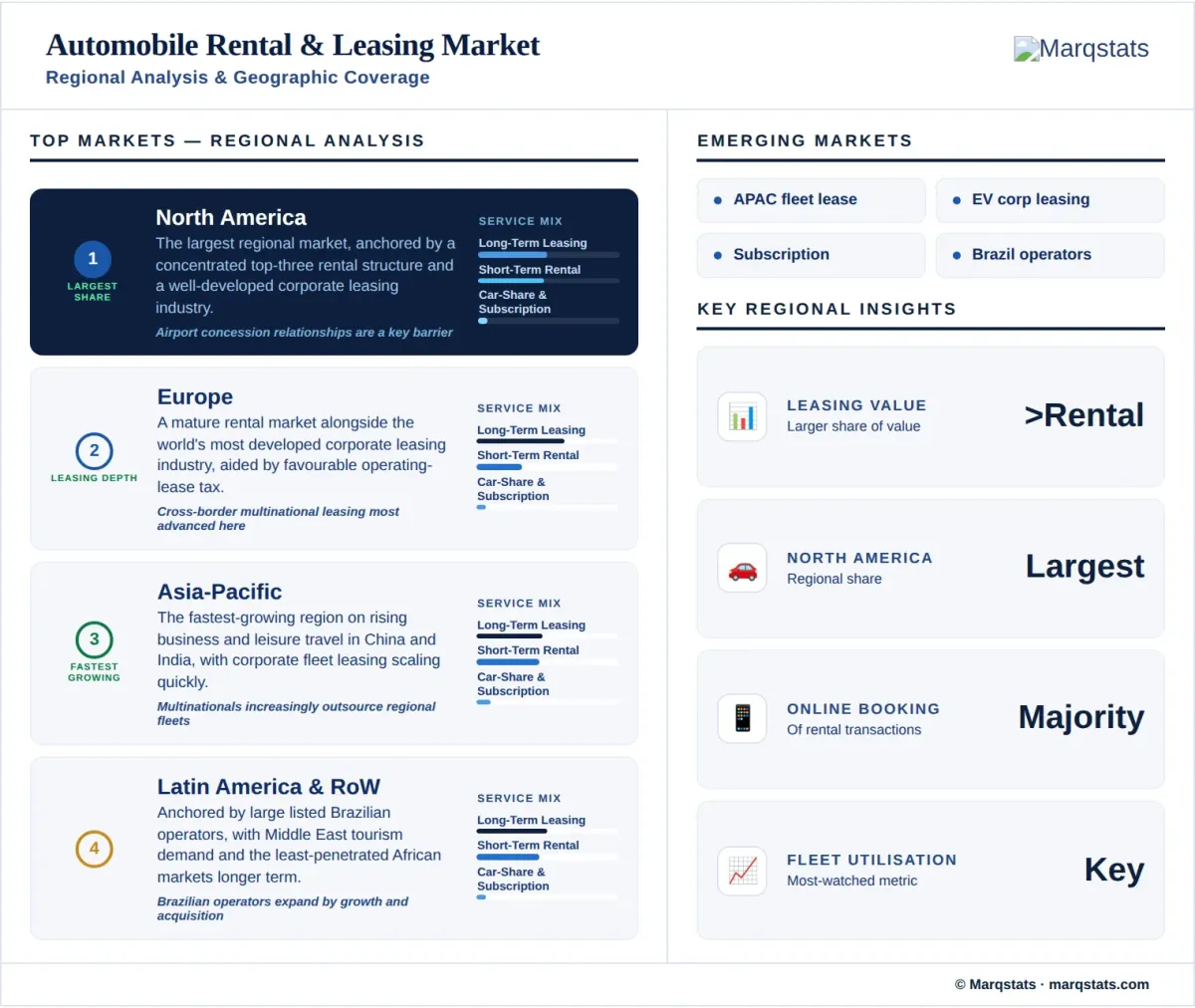
North America
North America holds the largest regional share, anchored by a concentrated top-three operator structure that controls a substantial share of national rental revenue, alongside a well-developed corporate leasing industry serving fleet-intensive sectors including logistics, field services, and sales organisations. Airport concession relationships remain a critical competitive asset in this region, since the largest airports allocate a limited number of on-airport rental counters and shuttle-served facilities, creating a structural advantage for incumbent operators over new entrants.
Europe
Europe combines a mature rental market with the world's most developed corporate leasing industry, supported by favourable tax treatment of operating leases in several major markets and a dense network of leasing providers serving multinational corporate clients across the region. Cross-border corporate leasing programmes, where a single multinational client's fleet across multiple European countries is managed under one master agreement, are more common and more sophisticated in this region than anywhere else, reflecting both the European Union's single market and decades of leasing-industry consolidation.
Asia-Pacific
Asia-Pacific is the fastest-growing region, led by rising business and leisure travel volume in China and India, alongside rapid growth in corporate fleet leasing as multinational companies expand regional operations and increasingly outsource fleet management rather than building owned-fleet capability in each market. China's domestic rental market is shaped by a mix of international operators and large domestic players, while India's market remains more fragmented, with self-drive rental still a comparatively nascent category relative to driver-included car hire.
Latin America and Rest of World
Latin America is anchored by large, publicly listed regional rental and leasing operators headquartered in Brazil, which have expanded across the region through both organic growth and acquisition, while the Middle East shows strong tourism-driven rental demand alongside government and corporate leasing activity tied to large-scale infrastructure and development programmes. African rental markets remain the least penetrated globally on a per-capita basis, representing a longer-term growth opportunity as tourism infrastructure and business travel volume expand.
How Competition Is Evolving
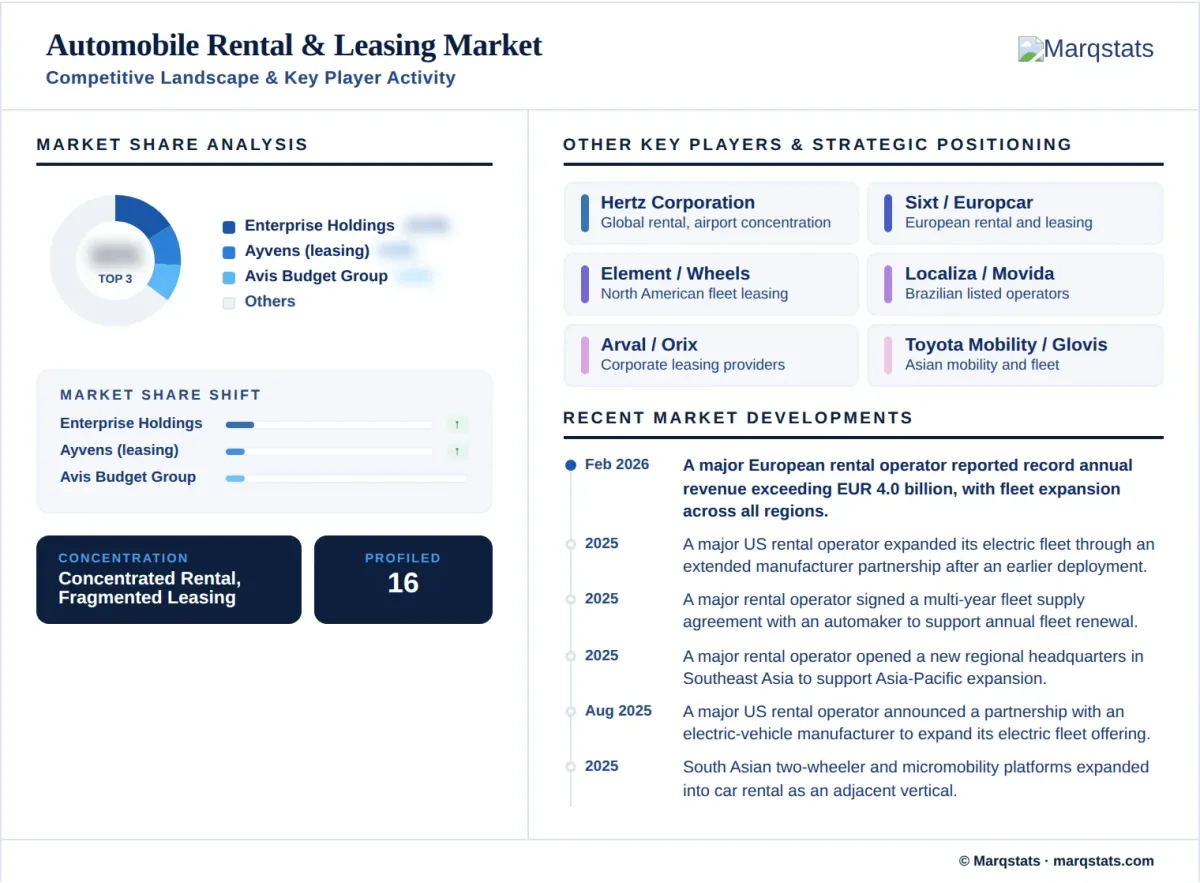
The market is moderately concentrated in rental, where a small number of global operators hold outsized share in most markets they enter, and more fragmented in leasing, where regional and country-specific providers compete alongside global operators for corporate fleet contracts. The largest operators increasingly compete across both rental and leasing simultaneously, using shared fleet-purchasing scale and technology infrastructure to support both business lines rather than operating them as fully separate units. This dual-business strategy gives the largest operators a fleet-purchasing scale advantage that smaller single-business competitors, whether pure-rental or pure-leasing specialists, cannot easily match, since combined purchase volumes translate directly into better vehicle acquisition pricing from manufacturers. Franchise partners, who operate under a global brand but own their local fleet and business, represent a third competitive category distinct from both directly owned operations and independent regional competitors.
Competitive strategy centers on fleet electrification partnerships with vehicle manufacturers, loyalty and corporate account programmes that increase customer retention across both rental and leasing relationships, and technology investment in booking, pricing, and fleet-telematics systems. Consolidation activity has been a recurring feature of the leasing side of the industry specifically, as scale advantages in fleet financing and multinational corporate account service make larger leasing providers structurally advantaged over smaller regional competitors, a dynamic that produced the industry's largest recent leasing merger and continues to shape competitive positioning among the remaining independent regional leasing providers.
Companies Covered
The report profiles 16+ companies with full strategy and financials analysis, including:
Recent Market Activity
Table of Contents
Coverage & Segmentation
This report provides a comprehensive assessment of the global automobile rental and leasing market across a 2025 base year, historical data from 2021 to 2025, and forecasts spanning 2026 to 2030. Market size is stated as total rental and lease revenue in United States dollars. Segmentation covers three dimensions: service type, vehicle type, and end user, alongside regional analysis spanning North America, Europe, Asia-Pacific, and Latin America and rest of world.
The scope includes short-term self-drive rental, long-term operating and finance leasing, car-sharing, and consumer subscription models for passenger cars and light commercial vehicles. The study excludes heavy-truck and off-highway equipment leasing, peer-to-peer rental platforms where Marqstats maintains separate coverage, and ride-hailing and taxi services, which involve a driver rather than self-drive vehicle access and are covered in Marqstats' separate ride-hailing report. Rental and leasing are analysed both individually, since they follow different growth logics and serve different customer bases, and combined into the total market figures presented in this report's summary sections, giving readers visibility into both the individual segment dynamics and the total addressable opportunity. Franchise and directly owned-operation revenue are similarly tracked separately within the competitive analysis section, since the two carry materially different margin profiles for the parent brand. Country-level detail beyond the four-region split covered here is available under customization, alongside deeper cuts by service type, vehicle class, or end-user segment.