Market Snapshot
Middle bar: base-year value × (1 + CAGR), rounded to two decimals. This is a calculated illustration, not a separately researched annual estimate.
The Europe robotaxi market size is estimated at USD 3.20 million in 2025 and is projected to reach USD 1,280.00 million by 2030, growing at a CAGR of 231.45% over 2026 – 2030. The active fleet grows from about 185 vehicles to 18,250, with retrofitted passenger cars making up 78.40% of the 2025 fleet.
Europe's robotaxi market is still at the starting line. Marqstats defines it as fare and service revenue from on-demand passenger rides in SAE Level 4 vehicles operated without a human driver in control, across the EU, the United Kingdom, Norway and Switzerland. In 2025 almost all of this revenue came from funded pilots and user trials in Germany, the United Kingdom, Spain, Croatia and Switzerland, where most vehicles still carried a safety driver. Commercial service began in 2026, when Verne, Pony.ai and Uber launched Europe's first commercial robotaxi service in Zagreb.
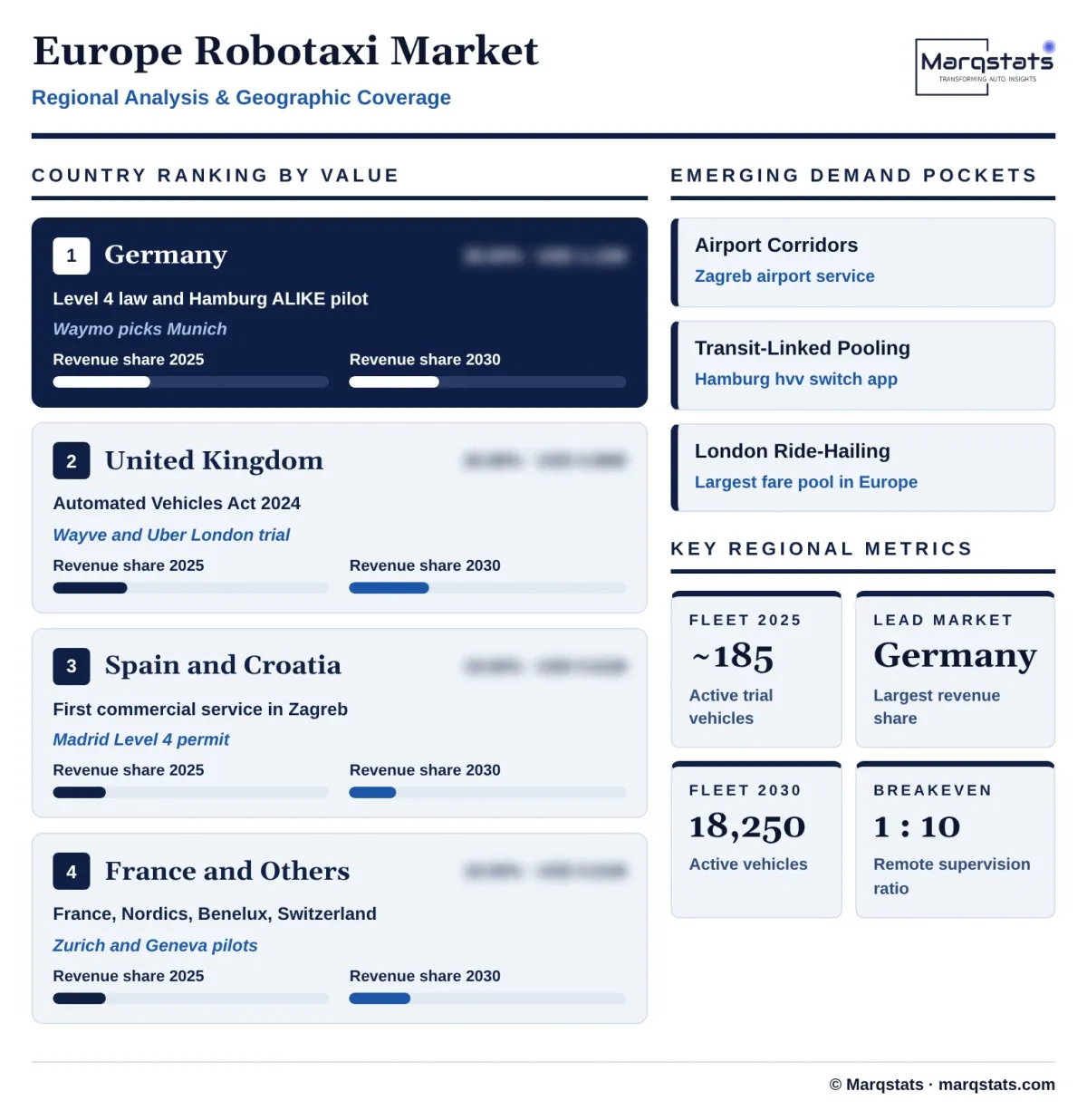
Germany accounts for an estimated 35.00% of 2025 revenue, the United Kingdom for 26.88% and Spain and Croatia together for 19.06%. The study segments the market by vehicle type (retrofitted passenger cars and purpose-built autonomous vehicles) and operating model (platform-partnered fleets, transit-integrated fleets and proprietary fleets), and covers ride revenue only, excluding vehicle sales, sensors and driver-assistance software.
Key Takeaways
Market Overview & Analysis
Report Summary
Marqstats sizes the Europe robotaxi market as fare and service revenue from on-demand passenger transport in SAE Level 4 automated vehicles that do not need a human driver to control them, operated as fleets in the EU, the United Kingdom, Norway and Switzerland. This includes pilots that charge fares or receive service fees, and commercial ride-hailing and ride-pooling services. Vehicle and sensor sales, driver-assistance and Level 3 software for private cars, autonomous trucks and closed-site shuttles are excluded. In 2025 the market generated an estimated USD 3.20 million from about 185 active trial vehicles.
Two types of vehicle compete. Retrofitted production cars, fitted with roof-mounted lidar, radar and cameras and extra computers, are faster to approve because the base car already meets crash safety rules, but the sensor and computer kit adds roughly USD 35,000 to 55,000 to a USD 45,000 to 60,000 car, and the driver seat cannot carry a paying passenger. Purpose-built vehicles without steering wheels or pedals use the whole cabin for passengers and can include ramps for wheelchair users, but they must be approved under the small-series scheme and cost more until volumes rise.
To put the market in context, Europe's taxi and private-hire market is worth about USD 56 billion a year and app-based ride-hailing a similar amount. Robotaxis account for a tiny fraction today. The opportunity lies in the fact that driver pay makes up 45% to 55% of ride-hailing costs in cities such as London, Frankfurt and Paris; once supervision can be shared across many vehicles, robotaxis can undercut human-driven rides.
Europe has moved more slowly than the United States and China. Waymo runs thousands of driverless vehicles across many US cities, and Chinese operators such as Baidu's Apollo Go, Pony.ai and WeRide run large fleets in several Chinese cities. In Europe, most vehicles still carried a safety driver in 2025, because of small-series type-approval limits, national supervision rules and the time needed to validate systems on narrow, historic city streets.
The forecast rests on three conditions. The UK's Automated Vehicles Act secondary legislation takes effect in the second half of 2027 as planned, Germany and Spain expand approved operating areas city by city with remote supervision ratios of one to five to one to ten, and the EU keeps the 1,500-unit small-series limit until 2028, after which volume type-approval becomes available. Under these conditions the fleet reaches 18,250 vehicles in 2030 and revenue USD 1,280.00 million.
Europe Robotaxi Market Size and Forecast
The Europe robotaxi market grows from USD 3.20 million in 2025 to USD 1,280.00 million in 2030, a CAGR of 231.45%. The fleet grows from about 185 vehicles to 18,250, a 150.51% annual rate. Revenue grows faster than the fleet because utilisation rises sharply as vehicles move from closed trials with selected passengers to open commercial service, and because supervision costs fall, allowing more rides per vehicle each day.
Growth comes in steps. Marqstats estimates revenue of about USD 14.80 million in 2026 as Zagreb operates commercially and London and Madrid run fare-charging trials, about USD 62 million in 2027 as UK legislation takes effect and Waymo prepares Munich, about USD 215 million in 2028 as volume type-approval opens, and about USD 580 million in 2029 as tier-one cities reach scale. The fleet passes 4,000 vehicles in 2028 and 9,800 in 2029.
Fares are expected to fall as fleets scale. Early robotaxi rides in Europe are priced at or above human-driven ride-hailing, about EUR 2.50 to 3.80 per kilometre, because of safety drivers and prototype costs. Marqstats expects base-case fares of about EUR 1.80 to 2.00 per passenger-kilometre by 2030, falling toward EUR 1.40 in cities where regulators allow one supervisor to oversee twenty vehicles.
The growth rate looks extreme because the base is very small. Even in 2030, robotaxis earn less than 3% of Europe's taxi and ride-hailing revenue, leaving substantial room to grow after the forecast period.
Market Dynamics
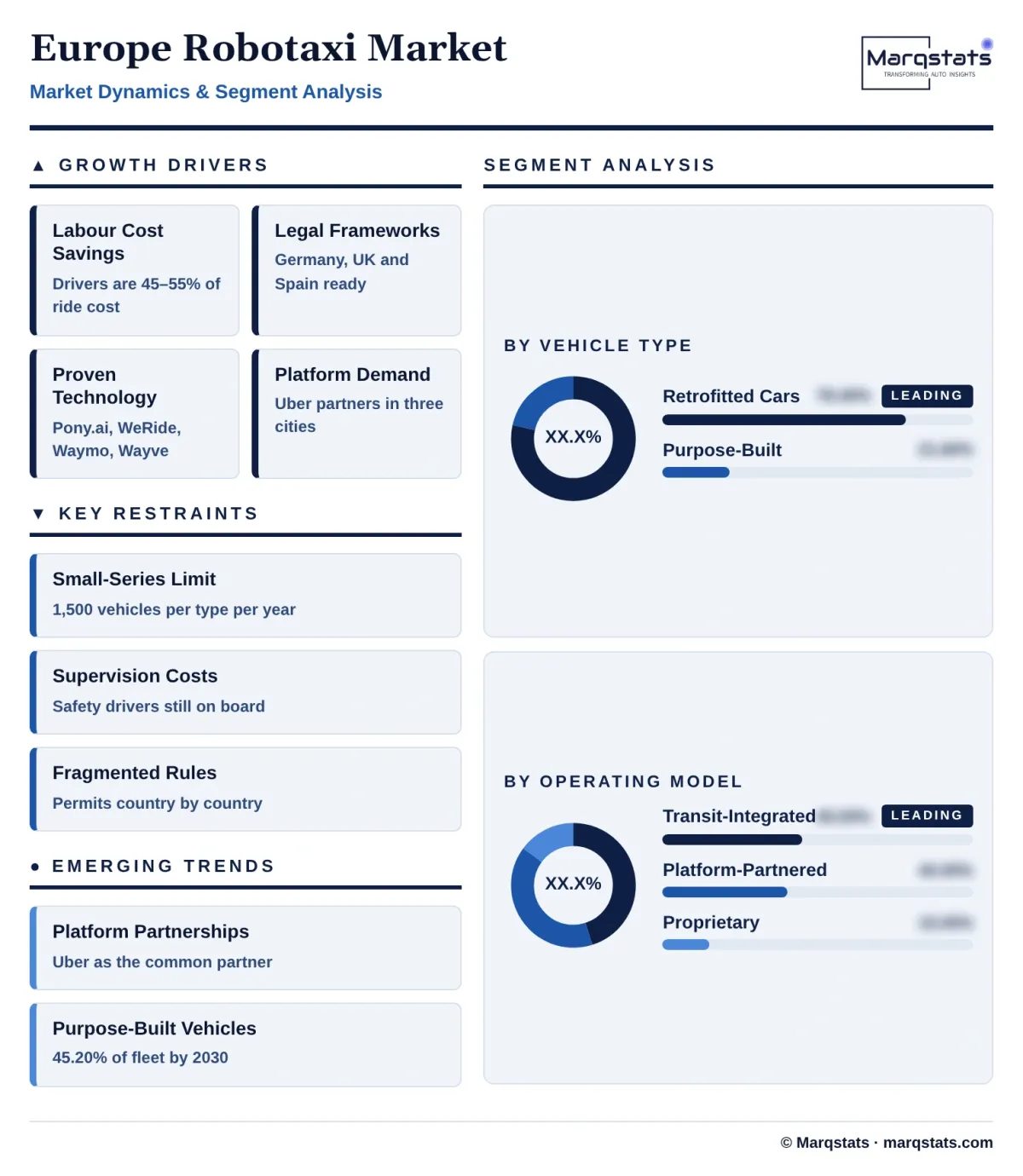
Key Drivers
Five forces are moving European robotaxis from funded pilots to paid services.
- Labour costs make robotaxis attractive. Driver pay and social costs account for 45% to 55% of ride-hailing costs in major European cities, and driver shortages affect taxi and private-hire services. Robotaxis that share remote supervision across many vehicles can run at about EUR 1.04 to 1.44 per vehicle-kilometre, against EUR 1.85 for human-driven ride-hailing.
- Legal frameworks are in place in key markets. Germany's Autonomous Driving Act of 2021 and its 2022 operating regulation allow Level 4 commercial operations in approved areas, the UK's Automated Vehicles Act 2024 creates a full legal framework for self-driving services, and Spain issued its first national Level 4 passenger permit in 2026.
- Proven technology is arriving from abroad. Pony.ai and WeRide bring systems already running at scale in China, Waymo has chosen Munich as its European base, and Wayve brings end-to-end AI software developed in London. Europe can adopt technology already validated over millions of driverless kilometres elsewhere.
- Ride-hailing platforms provide demand. Uber's partnerships in Zagreb, London and Madrid give technology companies immediate access to customers, and Bolt and Free Now are potential partners in other cities. This shortens the path from technical readiness to paying riders.
- Cities and public funding support pilots. Germany funds the Hamburg ALIKE project with EUR 26 million, Croatia's recovery plan allocated EUR 179.5 million to Verne, and transit authorities such as Hamburger Hochbahn see autonomous ride-pooling as a way to extend public transport.
Key Restraints
Four constraints keep European fleets small and costly for now.
- Type-approval limits keep fleets small. EU type-approval for fully automated vehicles is limited to 1,500 vehicles per type per year under the small-series scheme, which restricts purpose-built vehicles and raises costs until a volume route opens.
- Supervision rules raise costs. Germany requires a Technical Supervisor for every Level 4 operation, and early operations in all markets use either safety drivers or one-to-one remote oversight. Until supervisors can oversee many vehicles each, robotaxis cost more to operate than human-driven cars. Supervisors need specialist training and secure, low-latency connections to every vehicle, which adds control-centre and data costs.
- Rules differ across Europe. Each country has its own permits, insurance rules and city licensing, and the UK framework differs from the EU's. Operators must obtain approvals country by country and often city by city, slowing expansion.
- Data and cybersecurity rules add work. UN Regulations 155 and 156 on cybersecurity and software updates and the GDPR's rules on camera data apply to every vehicle, and operators must document every software update that changes driving behaviour. Chinese technology providers face additional scrutiny over data. The EU AI Act adds further obligations for high-risk systems, and operators must show regulators how their driving systems make decisions and handle unusual situations.
Key Trends
Four shifts are shaping who builds, operates and sells European robotaxi rides.
- Platform partnerships are becoming the standard model. Uber's deals with Pony.ai, Wayve and WeRide show that technology companies prefer to supply vehicles and software to established ride-hailing platforms rather than build their own consumer apps in each city.
- Chinese technology companies are entering Europe. Pony.ai in Zagreb and WeRide in Madrid and Switzerland use European partners to bring systems proven in China, while US export controls limit their opportunities in the United States.
- End-to-end AI is challenging map-based systems. Wayve and WeRide use AI models that learn to drive from data and need less detailed mapping, which could make it easier to expand to new European cities with narrow streets and complex traffic. Map-based systems from Waymo and Mobileye rely on detailed maps and explicit safety rules, which regulators find easier to validate.
- Robotaxis are being integrated with public transport. Hamburg's ALIKE project books autonomous rides through the city's hvv switch transit app, and city authorities increasingly see robotaxis as a way to serve areas and times that buses and trains do not, such as outer suburbs, early mornings and late evenings.
Strategic Implications
- For technology developers, partnering is faster than going alone. Supplying vehicles and software to Uber, Bolt or Free Now gives immediate access to riders, while systems must be built to meet European cybersecurity, data protection and remote supervision rules from the start.
- For carmakers, robotaxi-ready platforms are a new business. Manufacturers that offer factory-built vehicles with redundant steering, braking and power systems, and fleet services such as charging, cleaning and sensor calibration, will become key partners for technology companies.
- For cities and transit authorities, integration secures benefits. Linking robotaxis to public transport ticketing and targeting underserved areas helps cities reduce private car use, and gives operators the long-term licences they need.
- For investors, the turning point is remote supervision. The business case depends on regulators allowing one supervisor to oversee ten or more vehicles. Watching how Germany, the UK and Spain set supervision ratios is the best indicator of when European robotaxis will become profitable.
- The main uncertainty is regulation. The base case assumes UK legislation takes effect in 2027 and EU volume approval opens in 2028. Faster harmonisation would raise 2030 revenue, while delays or strict one-to-one supervision would keep robotaxis confined to subsidised pilots.
Market Segmentation
Retrofitted production cars, such as the Ford Mustang Mach-E used by Wayve and Uber in London and the Arcfox Alpha T5 used in Zagreb, make up 78.40% of the 2025 fleet, about 145 vehicles, and USD 2.51 million in revenue. They are easier to approve because the base car already meets crash safety rules. Their share falls to 54.80% by 2030, about 10,000 vehicles and USD 701.44 million, a 208.54% CAGR.
Purpose-built autonomous vehicles, such as the Volkswagen ID. Buzz AD used by MOIA in Hamburg and the HOLON Mover, make up 21.60% of the 2025 fleet, about 40 vehicles, and USD 0.69 million in revenue. They are the fastest-growing vehicle type, rising to 45.20% of the fleet, about 8,250 vehicles, and USD 578.56 million by 2030, a 284.19% CAGR, as volume type-approval opens and their larger, more flexible cabins lower cost per passenger.
Fleets operated with ride-hailing platforms, such as Uber's partnerships with Pony.ai and Verne, Wayve and WeRide, account for an estimated 40.00% of 2025 revenue, USD 1.28 million. They become the largest model, rising to 55.00% and USD 704.00 million by 2030, a 253.24% CAGR, because platforms bring riders immediately.
Fleets integrated with public transport, such as MOIA's ALIKE service with Hamburger Hochbahn, account for an estimated 45.00% of 2025 revenue, USD 1.44 million, the largest share today because publicly funded pilots dominate. Their share falls to 25.00% by 2030, with revenue reaching USD 320.00 million, a 194.68% CAGR.
Fleets operated directly by technology companies through their own apps, such as Waymo's planned service in Munich and London, account for an estimated 15.00% of 2025 revenue, USD 0.48 million, rising to 20.00% and USD 256.00 million by 2030, a 251.07% CAGR.
By Geography
Germany
Germany is the largest market, with an estimated 35.00% of 2025 revenue, USD 1.12 million, rising to USD 415.00 million by 2030. Its 2021 Autonomous Driving Act gives the clearest legal route to Level 4 operation in Europe, Hamburg's ALIKE project, funded with EUR 26 million by the federal transport ministry, runs Volkswagen ID. Buzz AD and HOLON vehicles across a 37-square-kilometre zone with a safety driver on board, and Waymo chose Munich as its European base in 2026, targeting commercial service by late 2027.
United Kingdom
The United Kingdom accounts for an estimated 26.88% of 2025 revenue, USD 0.86 million, rising to USD 365.00 million by 2030. London generates a large share of European ride-hailing revenue, Wayve and Uber began a licensed trial in 2026, and the Automated Vehicles Act 2024 shifts legal responsibility for self-driving vehicles from occupants to the companies that build and operate them. Waymo has also announced plans for a driverless service in London, and UK developers Wayve and Oxa attract much of Europe's autonomous driving investment.
Spain and Croatia
Spain and Croatia account for an estimated 19.06% of 2025 revenue, USD 0.61 million, rising to USD 215.00 million by 2030. Zagreb hosts Europe's first commercial robotaxi service, run by Verne with Pony.ai and Uber, and Spain issued its first national Level 4 passenger permit to WeRide, Uber and AVOMO for Madrid in September 2026.
France
France accounts for an estimated 10.94% of 2025 revenue, USD 0.35 million, rising to USD 145.00 million by 2030. French policy under the Mobility Orientation Law has focused on autonomous public transport shuttles rather than on-demand robotaxis, so consumer robotaxi services are expected to launch later than in Germany and the UK. Paris and Lyon have tested autonomous shuttles on fixed routes, and on-demand services are expected to follow once operators gain approval for remote supervision.
Rest of Europe
The Nordics, Benelux and Switzerland account for an estimated 8.12% of 2025 revenue, USD 0.26 million. They are the fastest-growing region, rising to USD 140.00 million by 2030, a 251.75% CAGR, led by pilots in Zurich and Geneva and planned services in Amsterdam and Oslo. Country shares are a Marqstats allocation based on fleet and pilot data.
How Competition Is Evolving
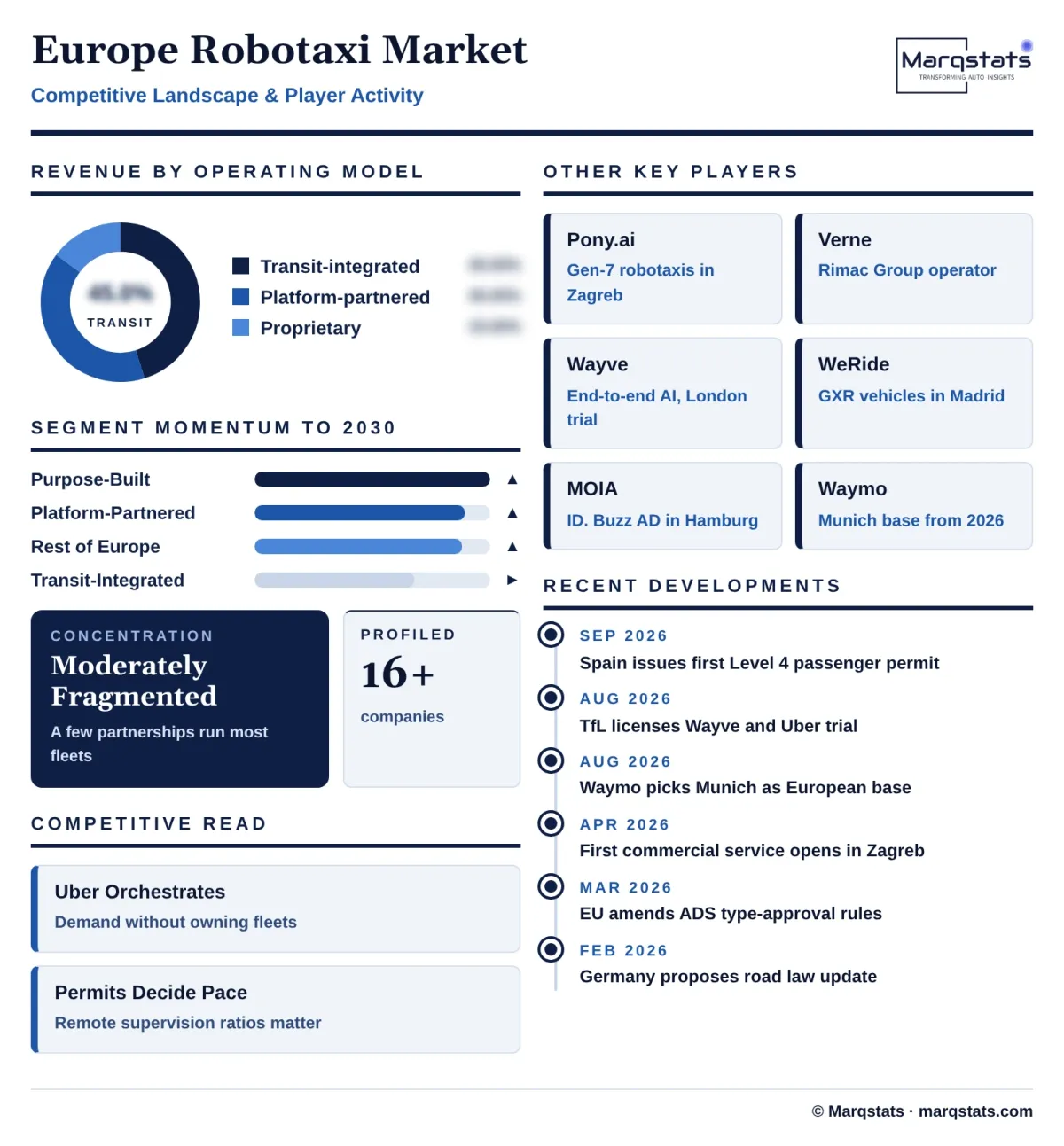
The Europe robotaxi market is concentrated in a few partnerships. Uber is involved in three of the four main European deployments, working with Pony.ai and Verne in Zagreb, Wayve in London and WeRide and AVOMO in Madrid. Volkswagen Group's MOIA operates the leading transit-integrated pilot in Hamburg, and Waymo is preparing its own service in Munich and London.
Three business models compete. Platforms such as Uber provide riders and booking without owning vehicles. Carmaker-transit operators such as Volkswagen Group, through MOIA and its ID. Buzz AD platform with Mobileye software, build and operate their own fleets with city transit authorities. Technology companies such as Waymo, Pony.ai, WeRide and Wayve compete to supply the driving system, with Waymo also operating its own fleets. Each model divides costs and returns differently: platforms earn fees with little capital, fleet owners carry vehicle depreciation and depot costs, and technology companies earn licence fees or operate fleets directly for higher returns.
Vehicle supply is another battleground. Robotaxi operators in Europe use a mix of European, American and Chinese vehicles, including the Volkswagen ID. Buzz AD, Ford Mustang Mach-E, Arcfox Alpha T5 from BAIC and WeRide's purpose-built GXR. Carmakers that can supply factory-built vehicles with redundant steering, braking and power systems, approved for driverless use, will capture a growing share of the value as fleets expand from dozens to thousands of vehicles.
Chinese technology companies have moved quickly. Pony.ai and WeRide use European partners and Uber's network to deploy systems proven in China, with WeRide also operating in Switzerland. European players respond through partnerships, such as Volkswagen with Mobileye, and through UK developers Wayve and Oxa.
Competition will be decided by cost and permits. The companies that first secure permits for remote supervision at high ratios and volume type-approval for purpose-built vehicles will be able to price below human-driven ride-hailing and scale across cities.
Companies Covered
Companies covered in the report include:
Recent Market Activity
Table of Contents
Coverage & Segmentation
The study covers the Europe robotaxi market across the EU, the United Kingdom, Norway and Switzerland, with 2025 as the base year, 2021 – 2025 as the historical period and 2026 – 2030 as the forecast period. Values are in US dollars. The market is defined as fare and service revenue from on-demand passenger transport in SAE Level 4 automated vehicles operated as fleets, including fare-charging pilots and commercial ride-hailing and ride-pooling services. It is segmented by vehicle type and operating model.
Vehicle sales, sensor and computer supply, driver-assistance and Level 3 software for private cars, autonomous trucks and closed-site shuttles are excluded. Fleet counts, revenue estimates, the operating model split and country shares are Marqstats estimates built on public funding records, city pilot reports, operator announcements and regulatory filings.