Market Snapshot
Middle bar: base-year value × (1 + CAGR), rounded to two decimals. This is a calculated illustration, not a separately researched annual estimate.
The Saudi Arabia RoboVan market size is estimated at USD 3.85 million in 2025 and is projected to reach USD 55.48 million by 2030, growing at a CAGR of 70.50% over 2026 – 2030. The active fleet of autonomous delivery pods, robovans and middle-mile vehicles grows from 54 to 1,320, an 89.51% annual rate.
Marqstats defines the Saudi RoboVan market as spending on SAE Level 4 autonomous goods delivery vehicles operating in Saudi Arabia, including vehicle and software purchases and recurring Delivery-as-a-Service fees for vehicles, remote supervision, connectivity and maintenance. It covers sub-ton neighbourhood pods, purpose-built urban robovans and middle-mile autonomous vehicles. Robotaxis, heavy autonomous trucks on highways, drones and warehouse robots are excluded. In riyal terms, the market grows from SAR 14.44 million to SAR 208.05 million at 3.75 riyals per dollar.
Riyadh accounts for an estimated 57.41% of the 2025 fleet, and Delivery-as-a-Service contracts generate 66.23% of 2025 value. Food and quick-commerce delivery is the largest use case in 2025 at 38.96% of value, while courier and postal parcels become the largest by 2030. The study segments the market by vehicle type, use case, business model and region.
Key Takeaways
Market Overview & Analysis
Report Summary
Marqstats sizes the Saudi Arabia RoboVan market as spending on SAE Level 4 autonomous goods delivery vehicles operating on public roads and in private campuses and giga-projects in Saudi Arabia. This includes purchases of vehicles and autonomous driving software, and recurring Delivery-as-a-Service fees covering vehicles, remote control tower supervision, connectivity, insurance and maintenance. Robotaxis, autonomous long-haul trucks, drones, sidewalk robots inside buildings and warehouse automation are excluded. In 2025 the market was worth an estimated USD 3.85 million across 54 active vehicles.
The market covers three vehicle types. Sub-ton neighbourhood pods, such as those operated by Nero, carry 100 to 300 kg at 25 to 45 km/h and suit quick-commerce and food delivery in residential districts. Purpose-built urban robovans, such as the WeRide Robovan W5 with 5.5 cubic metres of space and a 1,000 kg payload, handle multi-stop courier routes in city traffic. Middle-mile autonomous vehicles with 0.5 to 2.5 tonne payloads move goods between sorting centres, airports and neighbourhood depots.
The market is small today but strategically important. Saudi Arabia aims for 25% of goods transport to be autonomous by 2030 under its transport and logistics strategy, and autonomous delivery is one of the first areas where driverless vehicles are earning revenue on public roads. Lessons from delivery pods and robovans on licensing, liability, remote supervision and climate adaptation will shape larger autonomous truck and logistics programmes.
Saudi Arabia has built a regulatory path for these vehicles. The TGA runs a Regulatory Sandbox for Autonomous Vehicles and in September 2025 opened applications for autonomous vehicle business models, including freight delivery. SASO's Technical Regulation for Autonomous Vehicles sets standards for safety, cybersecurity and performance in extreme heat and dust, and became mandatory in April 2026. SDAIA requires driving and mapping data to be processed in the Kingdom, and municipalities are adding delivery bays and charging to new developments.
Demand comes from food delivery and quick-commerce platforms, courier and postal companies, logistics providers and master-planned developments. Jahez and ROSHN launched the Kingdom's first automated food delivery service at ROSHN Business Front in July 2025, Nero received a residential delivery permit in 2026, Saudi Post is preparing autonomous middle-mile trucks, and giga-projects such as NEOM and Red Sea Global plan autonomous logistics from the outset.
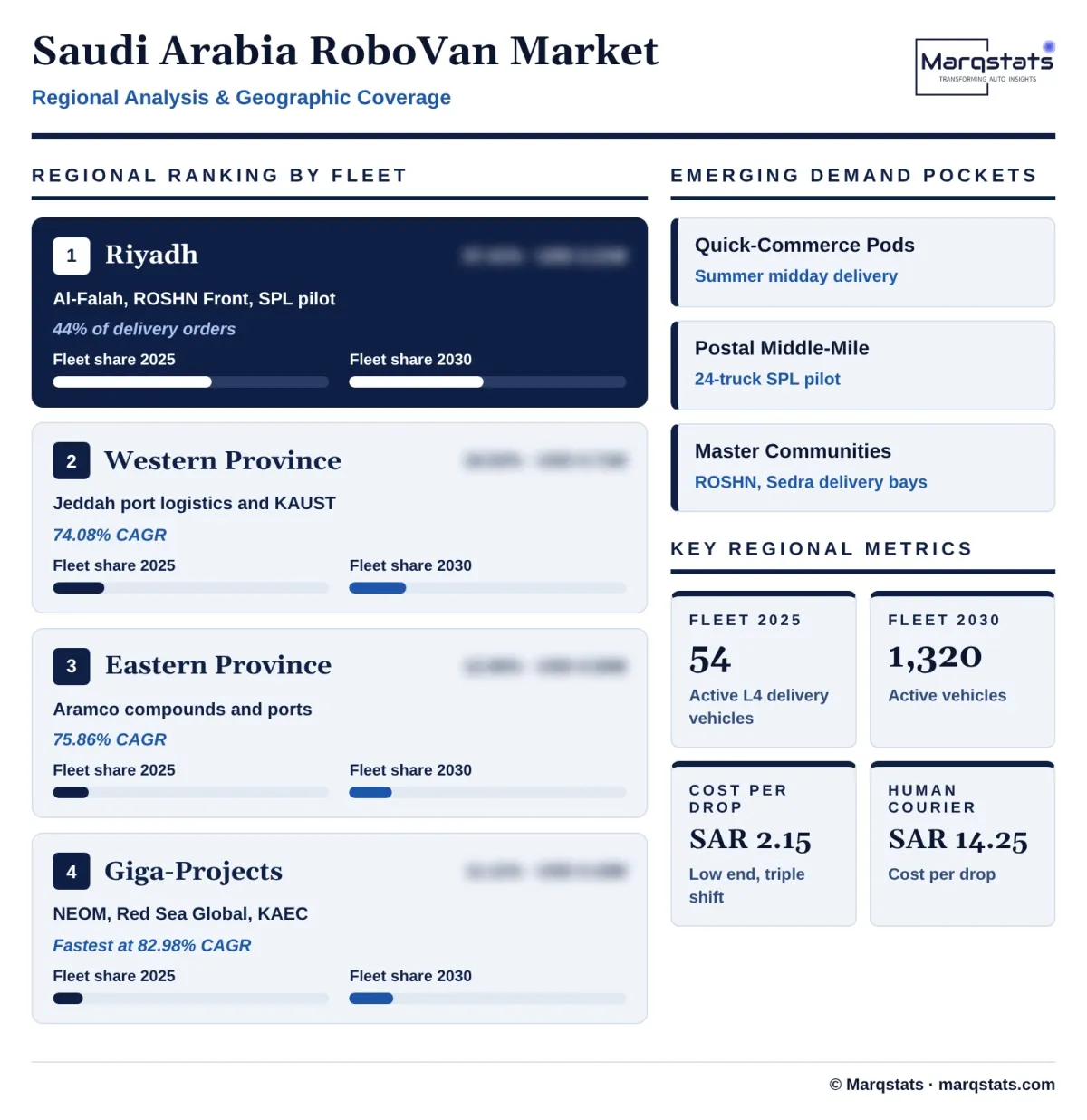
Marqstats expects the fleet to grow from 54 vehicles in 2025 to 102 in 2026, 195 in 2027, 380 in 2028, 710 in 2029 and 1,320 in 2030. Growth depends on the TGA extending permits from pilot districts to more neighbourhoods in Riyadh, Jeddah and the Eastern Province, and on courier platforms adopting multi-shift routing that delivers the largest savings.
Saudi Arabia RoboVan Market Size and Forecast
The Saudi Arabia RoboVan market grows from USD 3.85 million in 2025 to USD 55.48 million in 2030, a CAGR of 70.50%. In riyals, the market grows from SAR 14.44 million to SAR 208.05 million. The active fleet grows from 54 to 1,320 vehicles, an 89.51% annual rate, with 610 new vehicles added in 2030 alone.
The market has grown from a very small base. Value rose from USD 0.32 million in 2021, with four vehicles in closed campus trials, to USD 0.68 million in 2022, USD 1.18 million in 2023 and USD 2.02 million in 2024. Marqstats estimates USD 6.65 million in 2026 as Al-Falah neighbourhood delivery and the Saudi Post pilot begin, USD 11.45 million in 2027, USD 19.80 million in 2028 and USD 33.60 million in 2029.
Service contracts gain share. Delivery-as-a-Service fees, typically USD 1,500 to 2,200 per vehicle per month in 2025 and 2026 plus a fee per drop, account for 66.23% of 2025 value and 75.70% by 2030. Direct purchases, at USD 50,000 to 85,000 per vehicle plus annual software fees of 12% to 15%, remain important for Saudi Post, community developers and giga-projects.
Value per vehicle falls as the fleet grows. Early deployments include high one-off vehicle and setup costs, while later growth comes from monthly service fees spread across more vehicles. Marqstats estimates value per active vehicle falls from about USD 71,300 in 2025 to about USD 42,000 in 2030.
Utilisation patterns differ by use case. Food and quick-commerce pods run many short trips at lunch and dinner peaks, courier robovans work daytime multi-stop routes, and middle-mile vehicles run scheduled overnight transfers between depots. Operators that combine these patterns in the same district, using one vehicle for night-time depot runs and daytime deliveries, achieve the highest number of drops per vehicle and the lowest cost per drop.
The cost case strengthens over time. Vehicles cost about SAR 185,000 each, more than twice a conventional delivery van at about SAR 85,000, but remote supervision at one operator per 15 vehicles cuts labour costs by about 87.5% and electricity costs about 76% less than petrol. Once routes support multi-shift operation, the cost per drop falls by 70% to 85%.
Market Dynamics
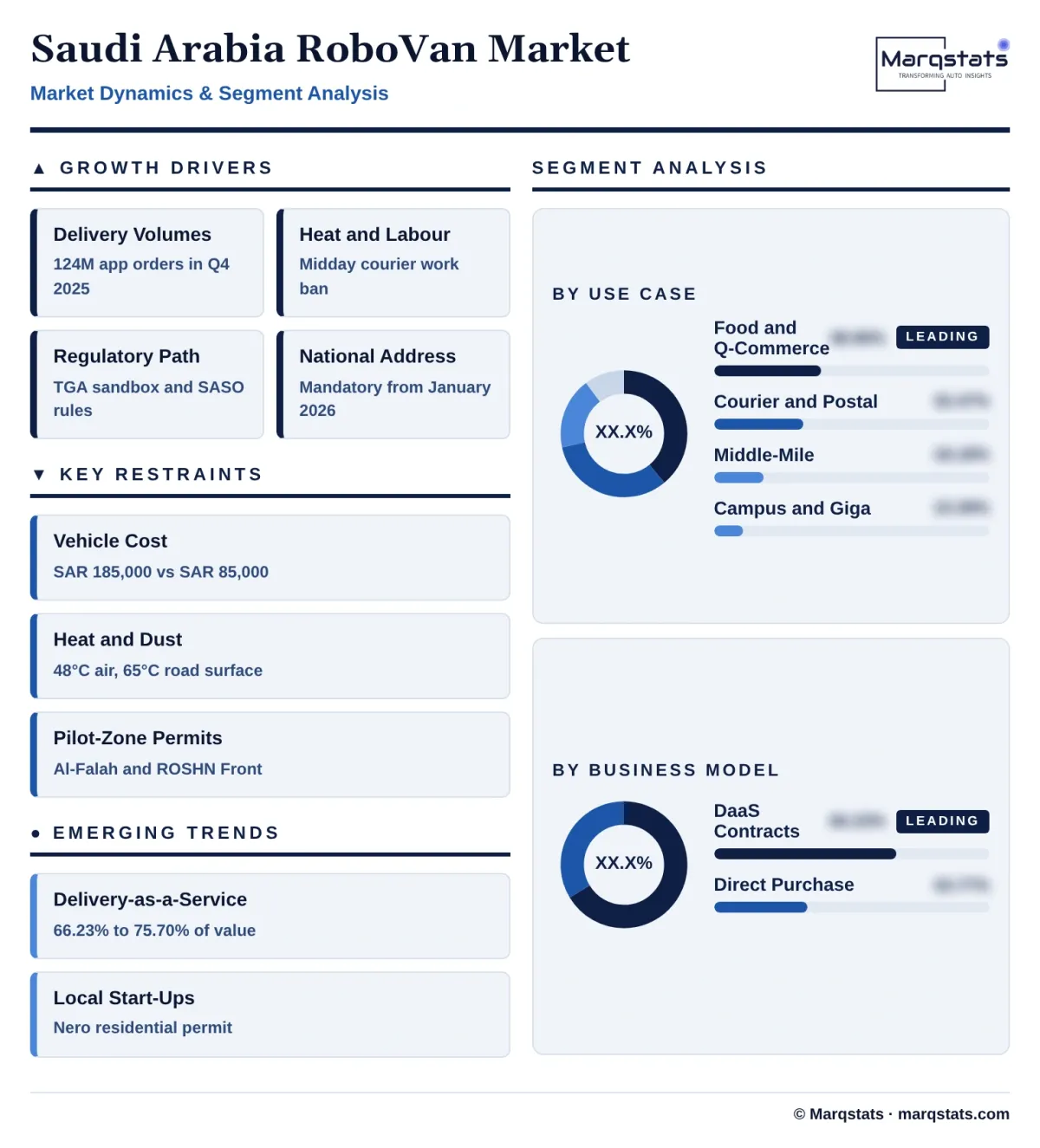
Key Drivers
Five forces are moving Saudi driverless delivery from campuses to public roads.
- Delivery volumes are rising fast. Saudi delivery apps handled 124 million orders in the fourth quarter of 2025, up 60% on the previous year, and postal networks more than 57 million parcels. Riyadh alone generates about 44% of delivery platform orders. These volumes strain courier fleets that depend on human drivers.
- Driver costs and heat limits favour automation. Couriers earn SAR 3,000 to 4,500 a month, but fully burdened costs, including residence permit fees, insurance, recruitment and housing, reach SAR 4,500 to 6,000. The midday outdoor work ban in summer reduces courier productivity, while autonomous vehicles can operate throughout the day and night.
- Regulators have created a clear path. The TGA sandbox, its application window for autonomous business models, SASO's autonomous vehicle regulation and the Traffic Law amendments that assign liability to vehicle owners give operators and investors a framework for commercial service.
- The National Address makes routing easier. Since January 2026, all parcels must use the Saudi National Address, which replaces vague street descriptions with standard digital locations and allows autonomous vehicles to route directly to homes, lockers and gates.
- Master-planned developments are built for automation. ROSHN communities, NEOM, Red Sea Global, KAUST and Aramco compounds offer controlled roads, charging, delivery bays and digital infrastructure that make autonomous delivery easier to deploy than in older city districts.
Key Restraints
Four constraints keep the Saudi autonomous delivery fleet small for now.
- Vehicles cost more than conventional vans. A Level 4 robovan costs about SAR 185,000 against about SAR 85,000 for a conventional van, and software and connectivity add about SAR 900 a month. Without multi-shift use, the savings are modest.
- Extreme heat and dust raise engineering costs. Vehicles must handle air temperatures above 48°C, road surfaces up to 65°C and sand, which require liquid cooling for sensors and computers, sealed sensor housings, automatic lens cleaning and radar backup when cameras are obscured.
- Permits remain limited to pilot zones. Commercial driverless delivery is approved in a few districts such as Al-Falah and ROSHN Front. Expanding permits to more neighbourhoods and cities depends on safety records and regulatory confidence.
- Low-cost couriers remain available. Large numbers of expatriate couriers and motorcycle delivery riders keep human delivery costs relatively low in some areas, reducing the urgency to automate on low-density suburban routes.
Key Trends
Four shifts are shaping how Saudi autonomous delivery fleets are built and sold.
- Delivery-as-a-Service is the preferred model. Courier and quick-commerce platforms prefer monthly fleet contracts that include vehicles, remote supervision, software, insurance and maintenance, rather than buying and managing vehicles themselves.
- Local start-ups are entering. Nero, founded by Saudi entrepreneurs, became the first Saudi company to receive a permit for driverless delivery in public residential neighbourhoods, showing that domestic firms can compete with international technology suppliers.
- Carmakers and distributors are partnering with Chinese technology firms. Abdul Latif Jameel Motors is working with Zelos and Saudi Post on autonomous parcel trucks, and WeRide offers its Robovan W5 alongside its robotaxis, bringing proven Chinese platforms to Saudi roads.
- Vehicles are being adapted to the climate. Operators are adding liquid cooling, IP67 and IP69K sealed sensors, air and water lens cleaning, and 77 to 79 GHz radar to keep vehicles working in heat and dust, along with dual 5G connections on stc and Mobily networks for remote supervision.
Strategic Implications
- For technology suppliers, climate certification and local partners come first. Early SASO certification for heat and dust performance, joint ventures with Saudi partners and local control centres that meet data residency rules will decide who wins permits and contracts.
- For courier and postal operators, hybrid fleets work best. Autonomous vehicles suit dense residential routes, night-time hub transfers and summer midday periods, while human-driven vans handle oversized parcels and low-density or rural routes. Integrating apps with vehicle locker compartments is essential for unattended handovers.
- For quick-commerce and food delivery platforms, pods offer reliable summer service. Neighbourhood pods can keep deliveries running during heat restrictions and peak hours, improving service levels in districts with permits.
- For developers and giga-projects, design for delivery from the start. Dedicated delivery bays, micro-depots, parcel lockers, charging and 5G coverage in new communities lower the cost of autonomous delivery and attract service providers.
- For regulators, a clear expansion timetable matters. Publishing criteria for moving from pilot districts to wider permits, and sharing safety and performance data from Al-Falah and ROSHN Front, would give operators and their customers the confidence to commit to larger fleets.
- For investors, utilisation is the key metric. Operators that secure multi-shift routes and contracts with several shippers in the same districts will reach the lowest cost per drop and the strongest returns.
Market Segmentation
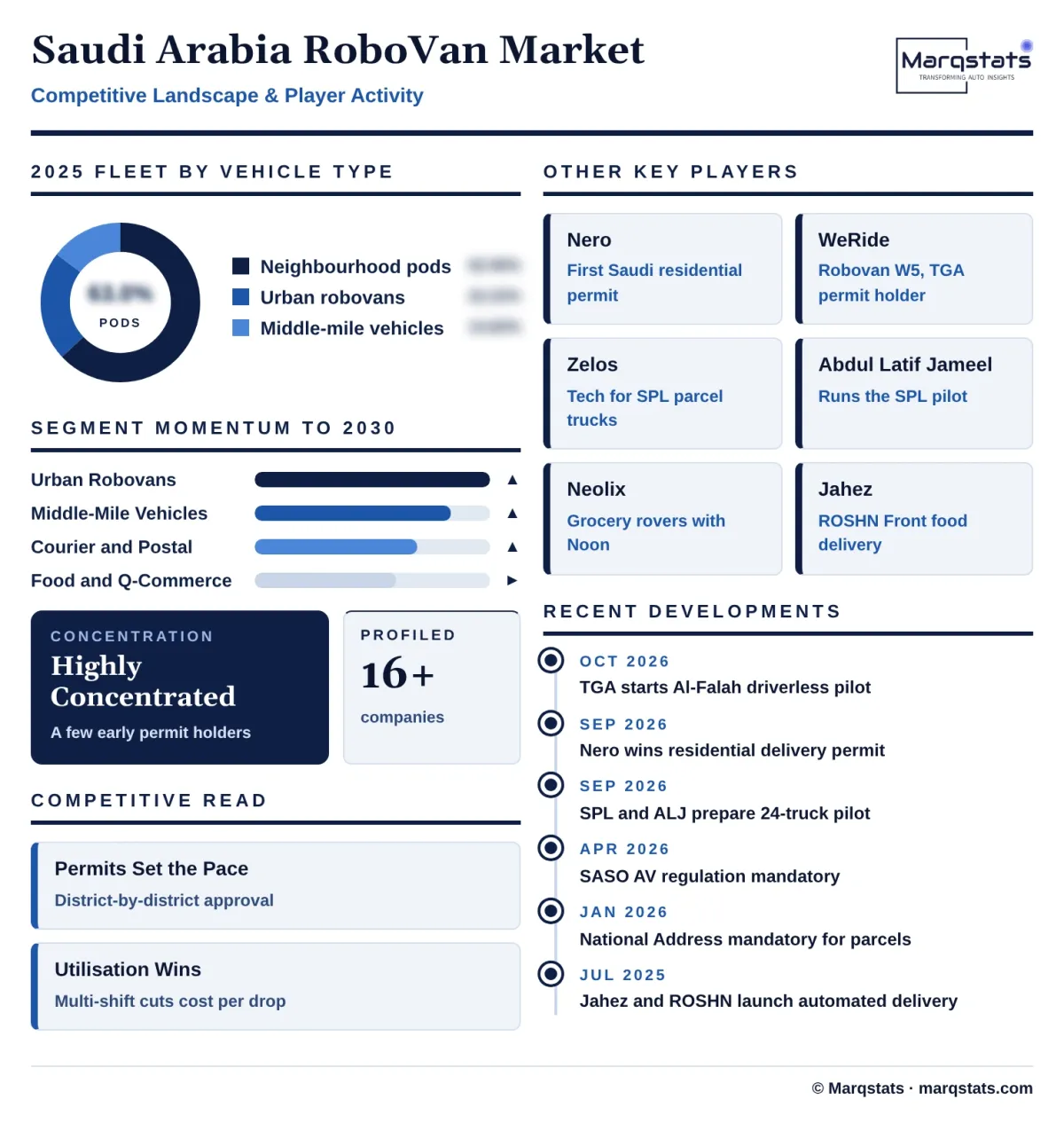
Sub-ton pods carrying 100 to 300 kg at 25 to 45 km/h, such as Nero's vehicles, make up 62.96% of the 2025 fleet, 34 vehicles. The segment grows to 640 vehicles by 2030, a 79.86% annual rate, but its share of the fleet falls to 48.48% as larger vehicles scale. Pods suit food, grocery and quick-commerce deliveries within residential districts and compounds, using lockable compartments opened by a code.
Purpose-built urban robovans with 0.8 to 1.2 tonne payloads and 4 to 6.5 cubic metres of space, such as the WeRide Robovan W5, make up 22.22% of the 2025 fleet, 12 vehicles. They are the fastest-growing vehicle type, reaching 480 vehicles and 36.36% of the fleet by 2030, a 109.13% annual rate, as courier companies automate multi-stop parcel routes in city traffic.
Middle-mile vehicles with 1.5 to 3 tonne payloads operating at 60 to 90 km/h between sorting centres, airports and depots make up 14.82% of the 2025 fleet, 8 vehicles, mainly in industrial and campus trials. The segment reaches 200 vehicles and 15.16% of the fleet by 2030, a 90.37% annual rate, led by the Saudi Post and Abdul Latif Jameel Motors pilot.
Food and quick-commerce delivery from dark stores and restaurant clusters accounts for 38.96% of 2025 value, USD 1.50 million, rising to USD 18.50 million by 2030, a 65.28% CAGR, while its share falls to 33.35%. Jahez, HungerStation and Ninja are among the platforms driving demand.
Courier and postal last-mile parcel delivery accounts for 32.47% of 2025 value, USD 1.25 million, and becomes the largest use case by 2030 at USD 21.00 million and 37.85%, a 75.82% CAGR. Saudi Post, SMSA Express and Naqel benefit from the National Address requirement and rising e-commerce volumes.
Middle-mile transfers between depots, air cargo terminals and distribution stations account for 18.18% of 2025 value, USD 0.70 million, rising to USD 11.50 million and 20.73% by 2030, a 75.03% CAGR. Fixed routes and overnight operation allow high utilisation.
Internal cargo in campuses and giga-projects such as KAUST, Aramco compounds, NEOM and Red Sea Global accounts for 10.39% of 2025 value, USD 0.40 million, rising to USD 4.48 million by 2030, a 62.12% CAGR, while its share falls to 8.07% as public-road delivery scales.
Delivery-as-a-Service and fleet-as-a-service contracts, with monthly fees of USD 1,500 to 2,200 per vehicle plus per-drop charges, account for 66.23% of 2025 value, USD 2.55 million, rising to USD 42.00 million and 75.70% by 2030, a 75.12% CAGR.
Direct purchases of vehicles at USD 50,000 to 85,000 each, with annual software fees of 12% to 15%, account for 33.77% of 2025 value, USD 1.30 million, rising to USD 13.48 million by 2030, a 59.64% CAGR, while the share falls to 24.30%. Saudi Post, community developers and giga-projects prefer this model.
By Geography
Riyadh
Riyadh is the largest market, with an estimated 57.41% of the 2025 fleet, 31 vehicles, and USD 2.21 million of value, rising to 640 vehicles and USD 26.90 million by 2030, a 64.84% CAGR, while its share falls to 48.48%. Riyadh generates about 44% of delivery platform orders and hosts the Al-Falah neighbourhood delivery service, the ROSHN Front pilot and the Saudi Post middle-mile pilot.
Western Province
The Western Province, including Jeddah, Makkah, Madinah and Rabigh, accounts for an estimated 18.52% of the 2025 fleet, 10 vehicles, and USD 0.71 million, rising to 270 vehicles and USD 11.35 million by 2030, a 74.08% CAGR. The region generates about 22% of delivery orders, and deployments focus on port-linked logistics around Jeddah, university campuses and KAUST.
Eastern Province
The Eastern Province, centred on Dammam, Khobar, Dhahran and Jubail, accounts for an estimated 12.96% of the 2025 fleet, 7 vehicles, and USD 0.50 million, rising to 200 vehicles and USD 8.41 million by 2030, a 75.86% CAGR. The region generates about 16% of delivery orders, and Aramco compounds and port corridors provide controlled operating areas.
Giga-Projects and Economic Zones
NEOM, Red Sea Global destinations and King Abdullah Economic City account for an estimated 11.11% of the 2025 fleet, 6 vehicles, and USD 0.43 million, and are the fastest-growing area, reaching 210 vehicles and USD 8.82 million by 2030, an 82.98% CAGR. These developments are designed for zero-emission, automated logistics, with dedicated freight routes and integrated digital infrastructure.
How Competition Is Evolving
The Saudi RoboVan market is concentrated among a few early operators. Nero leads neighbourhood pod delivery in Riyadh, WeRide offers its Robovan W5 alongside its licensed robotaxi operations, and Abdul Latif Jameel Motors with Zelos technology supplies Saudi Post's middle-mile pilot. Neolix has a regional presence through grocery delivery work with Noon.
Platforms and logistics companies are the main customers. Jahez, HungerStation and Ninja in food and quick commerce, Saudi Post, SMSA Express and Naqel in parcels, and DHL and Aramex in logistics will decide which suppliers scale. ROSHN, NEOM and Red Sea Global act as testbeds and buyers.
Chinese technology underpins most deployments. WeRide, Zelos and Neolix supply proven Level 4 platforms, while Saudi partners provide local licensing, operations and customer access. Domestic start-ups such as Nero show that local companies can build their own operations with TGA support.
Supporting services form a further layer of competition. Telecom operators stc and Mobily provide the redundant 5G links required for remote supervision, charging and depot providers supply fleet charging, and insurers are developing cover for owner liability under the Traffic Law amendments of June 2026. Providers that bundle these services into a single Delivery-as-a-Service contract will be easier for platforms to adopt.
Competition will be decided by permits, climate performance and cost per drop. Suppliers that secure the widest permits, prove reliability in heat and dust and deliver the lowest cost per drop through multi-shift operation will win the largest contracts.
Companies Covered
Companies covered in the report include:
Recent Market Activity
Table of Contents
Coverage & Segmentation
The study covers the Saudi Arabia RoboVan market, with 2025 as the base year, 2021 – 2025 as the historical period and 2026 – 2030 as the forecast period. Values are in US dollars, with Saudi riyal values converted at 3.75 riyals per dollar. The market is defined as spending on SAE Level 4 autonomous goods delivery vehicles, including vehicle and software purchases and Delivery-as-a-Service fees. It is segmented by vehicle type, use case, business model and region.
Robotaxis, autonomous long-haul trucks, drones, indoor robots and warehouse automation are excluded. Fleet counts, values, segment and regional splits are Marqstats estimates built on TGA releases, company announcements, delivery order statistics and vehicle and service pricing benchmarks.