Market Snapshot
Middle bar: base-year value × (1 + CAGR), rounded to two decimals. This is a calculated illustration, not a separately researched annual estimate.
The global robotaxi teleoperation market size is estimated at USD 152.10 million in 2025 and is projected to reach USD 782.40 million by 2030, growing at a CAGR of 38.76% over 2026 – 2030. The active commercial fleet of robotaxis and autonomous shuttles grows from about 6,300 to 98,500, a 73.31% annual rate, while remote support spending per vehicle falls from about USD 24,140 to USD 7,940 a year.
Marqstats defines the robotaxi teleoperation market as spending on remote assistance and teleoperation for commercial driverless passenger fleets. It covers remote operations centre staff, teleoperation software platforms, low-latency video streaming and multi-carrier connectivity. Remote assistance, where operators advise the vehicle on what to do while its own system keeps control, is distinguished from direct teleoperation, where an operator drives the vehicle remotely. Vehicles, onboard driving systems, sensors, depot work and fare revenue are excluded.
Managed remote operations centre services account for an estimated 64.30% of 2025 value and software platforms and connectivity for 35.70%. Remote assistance represents 78.40% of spending and direct teleoperation 21.60%. North America accounts for 48.30% of 2025 value and Asia-Pacific for 38.20%. The study segments the market by offering, intervention mode, vehicle type and region.
Key Takeaways
Market Overview & Analysis
Report Summary
Marqstats sizes the robotaxi teleoperation market as spending on remote support for commercial SAE Level 4 robotaxis and autonomous passenger shuttles. It includes the salaries and facilities of remote operations centre staff, teleoperation software licences, low-latency video streaming, multi-carrier cellular bonding and priority network services. Onboard driving systems, sensors, vehicles, depot maintenance, field recovery crews and fare revenue are excluded. In 2025 the market was worth an estimated USD 152.10 million across about 6,300 vehicles.
Two forms of remote support exist. Remote assistance lets an operator view camera images and sensor data and give high-level advice, such as confirming a vehicle may pass a double-parked truck or follow a police officer's signals, while the vehicle's own system keeps full control and can stop at any time. Direct teleoperation lets an operator steer, accelerate and brake from a remote console, which requires very fast and stable connections and carries greater risk.
The market is part of a wider autonomous vehicle remote support industry worth about USD 390 million in 2025 across robotaxis, trucks, port vehicles and delivery robots, and of a robotaxi industry whose fares totalled about USD 1.85 billion. Robotaxis account for the largest share of remote support spending because passenger services face strict permit, safety and incident rules.
Remote support also links to emergency response. When a robotaxi stalls, is involved in a collision or is blocked by police or fire services, remote staff coordinate with first responders, passengers and recovery crews. These event response teams are a fixed cost that operators must maintain in every city, even as routine assistance becomes more automated.
Spending per vehicle is falling. In 2021 remote support cost about USD 33,070 per vehicle a year; by 2025 this had fallen to about USD 24,140, and Marqstats expects about USD 7,940 by 2030. Better onboard software, including vision-language models that understand unusual scenes, reduces the number of requests for help, and each operator can supervise more vehicles. Lower data costs and event-triggered video also cut spending.
Ride-hailing economics explain the opportunity. In conventional ride-hailing, driver pay, benefits and commissions account for 60% to 75% of fares, or about USD 1.20 to 1.60 per vehicle mile. Robotaxis replace the one-driver-per-vehicle model with remote staff who support many vehicles, and remote support spending of about USD 7,940 per vehicle a year in 2030 is a small fraction of a driver's annual cost.
Labour costs differ widely. Marqstats uses a blended burdened cost of about USD 65,000 per full-time operator, reflecting about USD 112,000 in the United States, USD 35,000 in China and USD 18,000 in the Philippines. Keeping one seat staffed around the clock requires about 4.5 full-time staff, so a fleet needing 70 seats employs about 315 people.
Global Robotaxi Teleoperation Market Size and Forecast
The global robotaxi teleoperation market grows from USD 152.10 million in 2025 to USD 782.40 million in 2030, a CAGR of 38.76%. The active fleet grows from about 6,300 to 98,500 vehicles, a 73.31% annual rate. The market grows more than fivefold even though spending per vehicle falls by about two-thirds.
The market grew from USD 24.80 million in 2021, with about 750 commercial vehicles, to USD 41.20 million in 2022, USD 68.50 million in 2023 and USD 102.30 million in 2024. Marqstats estimates USD 225.50 million in 2026 with about 12,525 vehicles, USD 329.80 million in 2027 with 23,000 vehicles, USD 462.10 million in 2028 with 41,500 vehicles and USD 615.40 million in 2029 with 66,000 vehicles.
Annual growth slows from about 48% in 2025 and 2026 to about 27% in 2030 as per-vehicle costs fall faster. Spending per vehicle falls from about USD 18,000 in 2026 to USD 14,340 in 2027, USD 11,140 in 2028, USD 9,320 in 2029 and USD 7,940 in 2030.
Operator ratios are the most important assumption. Marqstats models the global blended ratio of vehicles per on-duty operator rising from about 7 in 2025 to 28 in 2030. At 45 vehicles per operator, the 2030 market would be about USD 657.8 million. If local rules limit ratios to 15 vehicles per operator, spending would reach about USD 1,058.2 million.
Shift coverage multiplies headcount. A remote assistance seat must be staffed 24 hours a day, every day of the year, which requires about 4.5 full-time staff per seat once shifts, weekends, leave and training are included. Marqstats estimates this means Waymo needs roughly 315 remote assistance staff to keep 70 seats filled, and the same multiplier applies across all operators, making seat productivity the key cost lever.
Remote driving remains expensive. Marqstats estimates a US remote driver costs about USD 23.43 an hour including overheads, video data about USD 9.00 an hour at 3.6 GB per hour and USD 2.50 per GB, and software and margin about USD 6.49 an hour, totalling USD 38.92 per vehicle hour. Remote assistance, which streams video only when needed, uses less than 0.25 GB an hour, costing less than USD 0.65 in data.
Market Dynamics
Key Drivers
Five forces are expanding spending on remote support for driverless fleets.
- Shuttle and transit services add steady demand. Autonomous shuttles on fixed routes in cities, campuses and airports also need remote supervision, and transit agencies often require it in their contracts, providing a stable base of demand alongside robotaxis.
- Robotaxi fleets are growing quickly. Waymo expanded from about 3,000 vehicles in early 2026 to about 4,000 across 15 US cities, Pony.ai reported 1,975 vehicles in the first half of 2026, Baidu Apollo Go operates about 2,500, and WeRide runs about 400 robotaxis in Abu Dhabi and Dubai. Every driverless vehicle needs remote support.
- Regulations require remote supervision. California requires driverless operators to maintain a continuous two-way link and remote staff, the California Public Utilities Commission requires passenger safety plans covering remote response, Germany requires a Technical Supervisor for every Level 4 vehicle, and Chinese cities require continuous monitoring centres.
- Services are expanding to new cities. Waymo opened Denver, San Diego, Tampa and Las Vegas in 2026, Zoox began charging fares in Las Vegas, Tesla expanded unsupervised rides in Texas and Florida, and Pony.ai and Uber plan more than 2,000 robotaxis in Europe. Each new city adds operations centre workload and connectivity needs.
- Passenger safety and service quality depend on fast help. When a robotaxi meets an unusual situation, such as roadworks, police directions or a blocked lane, a quick response from a remote assistant keeps passengers moving and avoids traffic disruption.
- Investment in teleoperation platforms is growing. Independent software suppliers such as Ottopia and DriveU.auto, telecom and cloud providers such as Ericsson and AWS, and operators building their own platforms all invest in tools that let one operator handle more vehicles reliably.
Key Restraints
Four constraints shape how remote support for robotaxis can scale.
- Remote driving carries safety risk. US crash data show five low-speed collisions involving Tesla vehicles under remote operator control between 2025 and 2026, including hitting a fence, a construction barricade and a dumpster. Without depth perception or physical feedback, and with variable network delay, remote drivers struggle to judge distances.
- Network coverage is not guaranteed. Cellular congestion at concerts, sports events or protests, and coverage gaps in tunnels and between tall buildings, can interrupt video. Operators need multiple carriers, network slicing and fallback behaviours, which add cost.
- Offshore staffing faces political scrutiny. US lawmakers questioned the use of remote assistance staff in the Philippines in 2026. Rules requiring domestic staff or stricter data localisation could raise labour costs for Western operators by two to three times.
- Workload and fatigue rules are still developing. The US Federal Motor Carrier Safety Administration is considering rules on remote assistant qualifications and working hours, and research by state transport departments has highlighted operator workload. Stricter limits on hours or vehicles per operator would raise staffing needs.
- Data on remote interventions is limited. Regulators do not require operators to report how often remote assistance is used, and most operators treat ratios as confidential, making it harder for regulators, investors and suppliers to benchmark performance.
Key Trends
Four shifts are changing how robotaxi fleets are supervised from afar.
- Operators are moving from remote driving to remote assistance. Waymo says it has never used remote driving on US roads, and most operators now limit direct control to very low-speed repositioning, letting onboard systems keep final control of every manoeuvre.
- Onboard AI is reducing requests for help. Vision-language models running on vehicle computers can interpret unusual scenes such as temporary signs, emergency vehicles and hand signals, reducing the number of times a vehicle needs to ask a human for advice.
- Labour models are tiered and global. Western operators keep event response teams at home and route routine checks to lower-cost centres abroad, while Chinese operators run large centres in cities such as Wuhan and Guangzhou with lower domestic labour costs.
- Platforms are aggregating fleets from several developers. Uber, Lyft and other platforms dispatch robotaxis from Waymo, WeRide, Pony.ai, Avride and others, raising questions about who provides remote support for each vehicle and creating demand for common tools and procedures that work across fleets.
- Network technology is improving. Multi-carrier bonding from DriveU.auto and Ottopia, 5G standalone network slicing and edge computing services such as AWS Wavelength are making remote video more reliable and cheaper.
Strategic Implications
- For robotaxi operators, operator ratios determine profitability. Investing in onboard software and tools that reduce remote requests, and designing remote support around assistance rather than remote driving, lowers cost per vehicle and safety risk.
- For software suppliers, platforms that multiply operator productivity win. Tools that prioritise alerts, summarise scenes and let one operator handle many vehicles across carriers will capture the fastest-growing part of the market.
- For telecom and cloud providers, robotaxis are a premium customer. Priority network slicing, multi-carrier services and edge computing for safety-critical video offer higher-value business than standard vehicle telematics.
- For outsourcing companies, regulated remote support is a new service line. Companies such as Teleperformance and Cognizant can provide trained remote assistance staff, but must meet security, data and qualification rules that are becoming stricter.
- For investors, falling cost per vehicle is the signal to watch. Operators that publish or demonstrate steadily rising vehicles-per-operator ratios are the ones on the path to profitable scale, and suppliers whose tools enable those ratios are best placed for growth.
- For regulators, clear standards would help. Rules defining remote assistant qualifications, working hours, maximum vehicles per operator and incident reporting would give operators certainty and improve public trust.
Market Segmentation
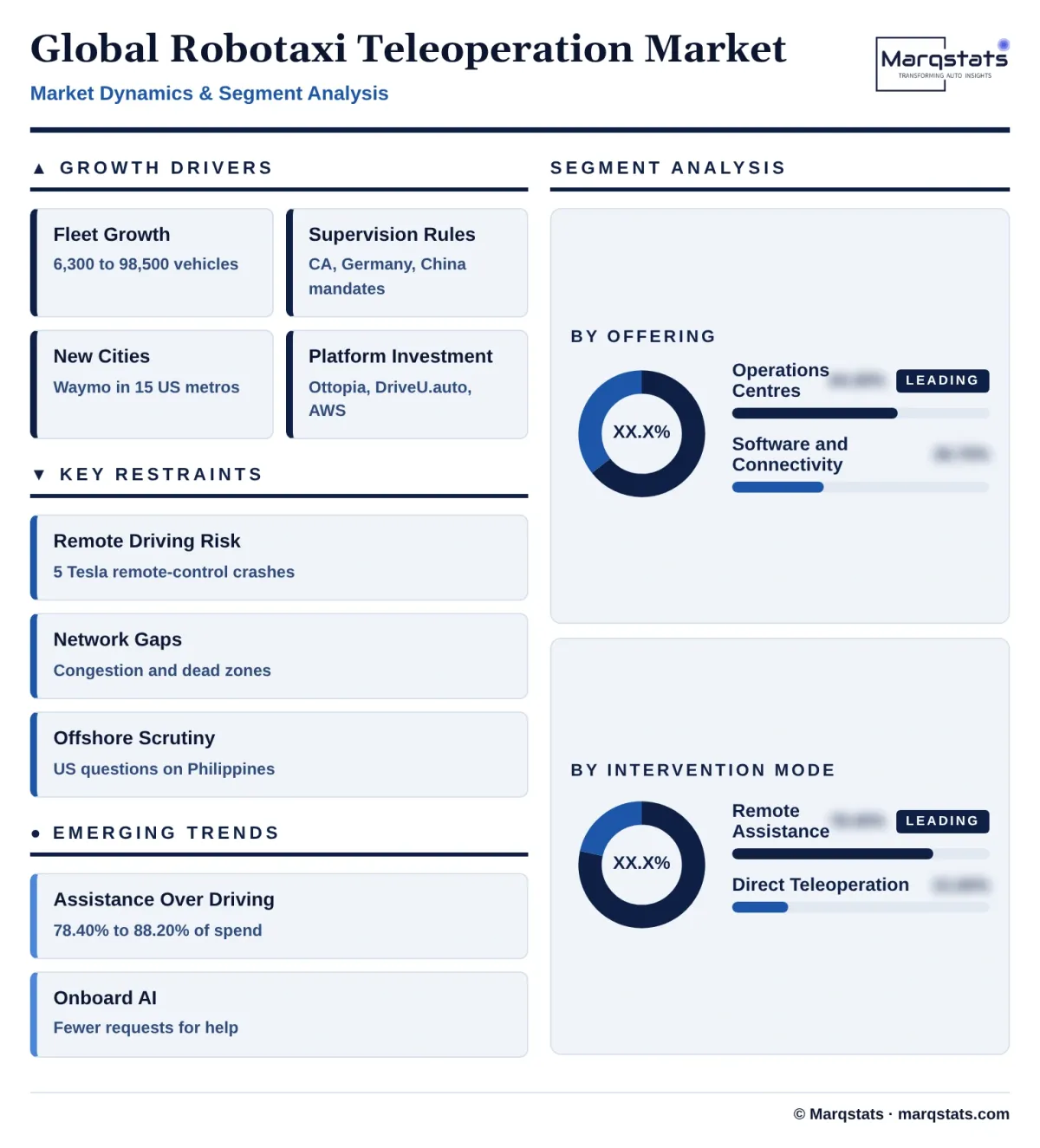
Remote operations centre staff, including recruitment, training, facilities and wages, account for 64.30% of 2025 value, USD 97.80 million, rising to USD 402.94 million by 2030, a 32.73% CAGR, while the share falls to 51.50%. Operators run most centres in-house, with outsourcing companies such as Transdev, Cognizant and Teleperformance providing staff for some services.
Teleoperation software, low-latency video streaming, multi-carrier bonding and priority network services account for 35.70% of 2025 value, USD 54.30 million, and grow faster, at 47.53% a year, to USD 379.46 million and 48.50% of the market by 2030. Ottopia, DriveU.auto, Fernride and AWS are among the suppliers.
Remote assistance, where operators advise the vehicle while its system keeps control, accounts for 78.40% of 2025 spending, USD 119.25 million, rising to USD 690.08 million and 88.20% of the market by 2030, a 42.07% CAGR. It tolerates network delays, uses little data and lets one operator support many vehicles.
Direct teleoperation, where an operator steers and controls the vehicle remotely, accounts for 21.60% of 2025 spending, USD 32.85 million, rising to USD 92.32 million by 2030, a 22.96% CAGR, while its share falls to 11.80%. It is increasingly limited to low-speed repositioning and recovery, and to specialist services such as Vay's remotely driven cars in Las Vegas.
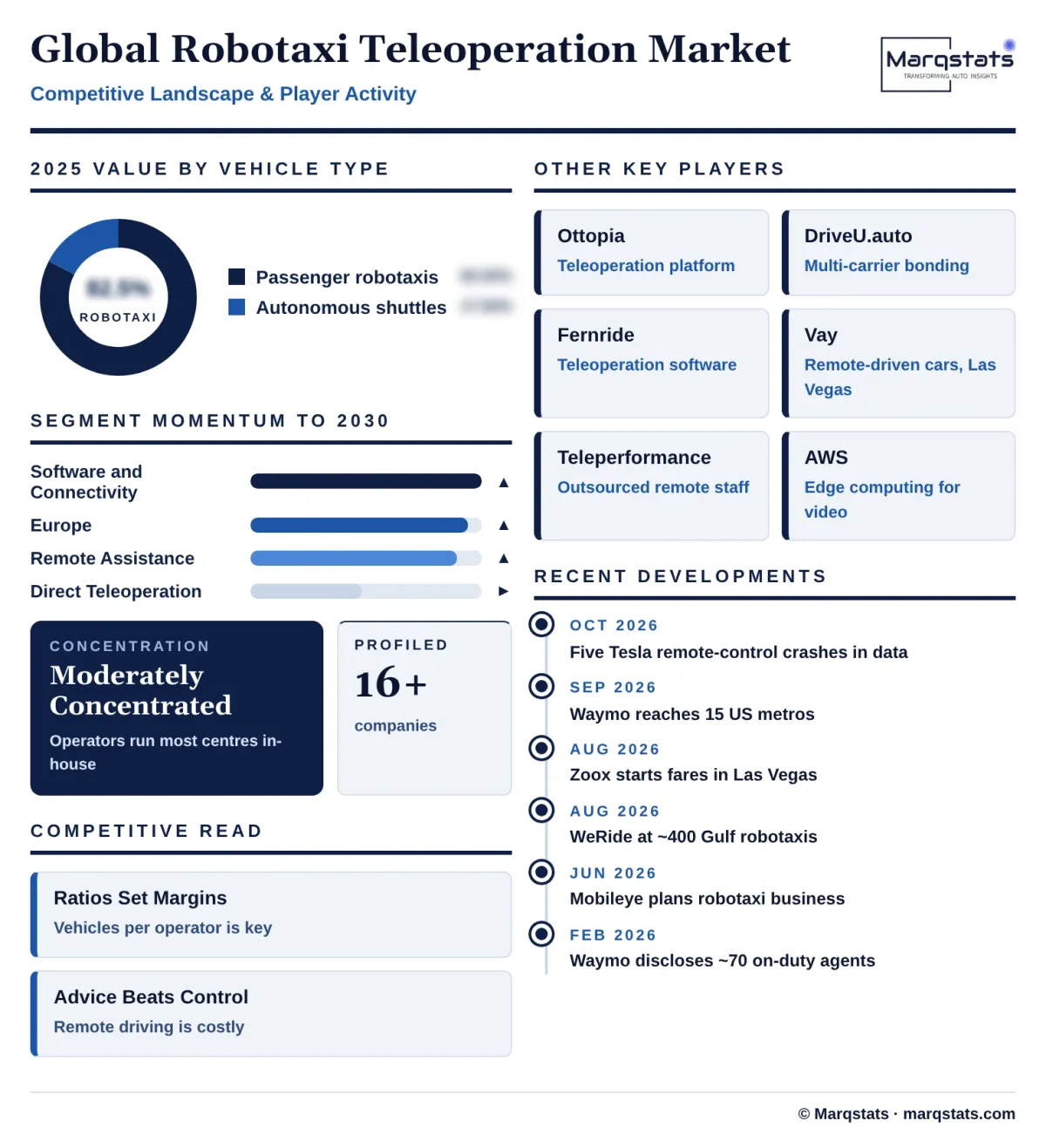
Passenger robotaxis such as Waymo, Baidu Apollo Go, Pony.ai and Zoox account for 82.50% of 2025 value, USD 125.48 million, rising to USD 679.12 million and 86.80% of the market by 2030, a 40.18% CAGR, as fleets expand into new cities.
Fixed-route and on-demand autonomous shuttles from companies such as May Mobility, EasyMile and WeRide account for 17.50% of 2025 value, USD 26.62 million, rising to USD 103.28 million by 2030, a 31.15% CAGR, while the share falls to 13.20%.
By Geography
North America
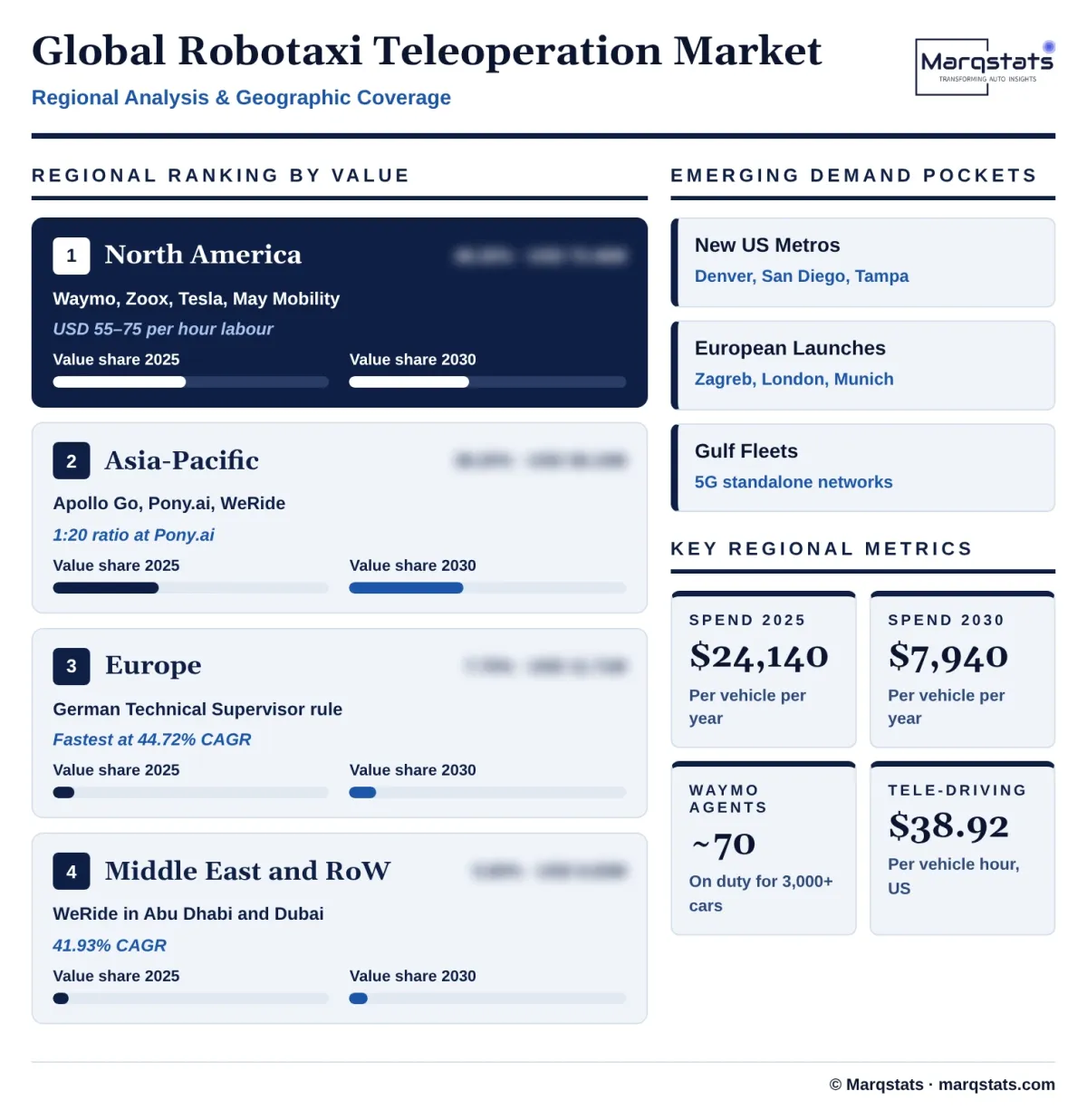
North America is the largest market, with an estimated 48.30% of 2025 value, USD 73.46 million, rising to USD 336.43 million by 2030, a 35.57% CAGR, while its share falls to 43.00%. Waymo operates in 15 US cities with more than 500,000 paid rides a week, and Zoox, Tesla, May Mobility and Avride add demand. Burdened US control room labour costs USD 55 to 75 an hour, encouraging offshore support for routine tasks, which is now under political scrutiny.
Asia-Pacific
Asia-Pacific accounts for an estimated 38.20% of 2025 value, USD 58.10 million, rising to USD 320.78 million and 41.00% of the market by 2030, a 40.74% CAGR. Baidu Apollo Go, Pony.ai and WeRide run large driverless fleets in Wuhan, Guangzhou, Shenzhen and Beijing, Chinese rules require continuous monitoring centres linked to city platforms, and Japan and South Korea are adding Level 4 pilots.
Europe
Europe accounts for an estimated 7.70% of 2025 value, USD 11.71 million, and grows fastest, at 44.72% a year, to USD 74.33 million and 9.50% of the market by 2030. Germany's AFGBV requires an engineering-qualified Technical Supervisor for every Level 4 vehicle, the UK Automated Vehicles Act 2024 creates a licensing route, and services are launching in Zagreb, London, Madrid and Munich.
Middle East and Rest of World
The Middle East and the rest of the world account for an estimated 5.80% of 2025 value, USD 8.83 million, rising to USD 50.86 million and 6.50% of the market by 2030, a 41.93% CAGR. WeRide runs about 400 robotaxis in Abu Dhabi and Dubai under commercial driverless permits, and Saudi Arabia and Qatar are developing services supported by 5G standalone networks.
How Competition Is Evolving
The robotaxi teleoperation market is dominated by in-house operations. Waymo, Baidu Apollo Go, Pony.ai, WeRide, Zoox and Tesla run their own remote operations centres and develop much of their own software, accounting for most spending. Waymo operates four remote assistance centres, and Pony.ai and Baidu run large centres in Chinese cities.
Independent software suppliers serve operators that do not build everything themselves. Ottopia, backed by ComfortDelGro, DriveU.auto and Fernride offer teleoperation platforms, streaming and network bonding, while Teraki and Cognata supply data compression and simulation tools. Telecom and cloud companies such as Ericsson, Qualcomm and AWS provide connectivity and edge computing.
Outsourcing companies are entering the market. Business process outsourcers such as Teleperformance and Cognizant, and transport operators such as Transdev, offer trained remote assistance staff, particularly for routine tasks, under contracts with operators and platforms.
Industry standards are emerging. The Automated Vehicle Safety Consortium has published consensus practices for remote assistance, SAE J3016 defines the role of remote support, and UNECE working groups are developing international rules. Suppliers whose platforms follow these practices will find it easier to win contracts across regions.
Competition will be decided by operator productivity and compliance. Suppliers whose tools let each operator support more vehicles, meet strict security and data rules and integrate with operators' fleet systems will gain share as fleets scale and platforms such as Uber add vehicles from several technology companies.
Companies Covered
Companies covered in the report include:
Recent Market Activity
Table of Contents
Coverage & Segmentation
The study covers the global robotaxi teleoperation market, with 2025 as the base year, 2021 – 2025 as the historical period and 2026 – 2030 as the forecast period. Values are in US dollars. The market is defined as spending on remote operations centre staff, teleoperation software, low-latency streaming and multi-carrier connectivity for commercial Level 4 passenger robotaxis and autonomous shuttles. It is segmented by offering, intervention mode, vehicle type and region.
Vehicles, onboard driving systems and sensors, depot and field staff, consumer in-car services, autonomous trucks, port vehicles and delivery robots are excluded. Fleet sizes, operator ratios, spending per vehicle, segment and regional splits are Marqstats estimates built on operator disclosures, regulatory filings, supplier cost benchmarks and labour cost data.