Market Snapshot
Middle bar: base-year value × (1 + CAGR), rounded to two decimals. This is a calculated illustration, not a separately researched annual estimate.
The Turkey electric scooter market is estimated at 302,549 units in 2025 and is projected to reach 305,772 units by 2030, registering a volume CAGR of 0.21% over 2026–2030. In value terms the market is estimated at USD 558.35 million in 2025 and is projected to reach USD 647.52 million by 2030, a CAGR of 3.01%. The market comprises new registered battery electric mopeds, scooters and motorcycles in Türkiye, sized on the official zero-emission moped and motorcycle registration series that matches the data of the Motorcycle Industry Association (MOTED). Electric mopeds and scooters up to 4 kW hold 99.32% of 2025 units, and electric models took 34.18% of the 885,261-unit Turkish two-wheeler market.
Market size and forecast figures are generated using Marqstats' proprietary estimation framework, updated as of October 2026.
Türkiye has one of the highest electric shares of new two-wheeler registrations outside Asia, and that share rests on a regulatory exemption. Electric vehicles up to 4 kW can be ridden on a car (B-class) licence and need no compulsory traffic insurance, and MOTED expects a regulation from early 2027 to require insurance for these vehicles and for 50 cc petrol mopeds. The market grows 15.68% to 350,000 units in 2026, in line with MOTED's forecast, then falls 30.00% in 2027 before recovering to 305,772 units by 2030.
The forecast is a regulatory call, not a demand call. Value grows faster than volume, at 3.01% a year to USD 647.52 million by 2030, because insured scooters and motorcycles above 4 kW carry higher prices than the mopeds that dominate today. Kuba, Mondial, RKS and Arora sell electric mopeds through national dealer networks, and Yadea and BMW, the largest brand above 4 kW according to Borusan, push higher-power electric models.
Key Takeaways
Market Overview & Analysis
Report Summary
The Turkey electric scooter market covers new battery electric two-wheelers registered for road use in Türkiye, including L1e-class mopeds and scooters up to 4 kW and 45 km/h and L3e-class motorcycles above 4 kW. The market is estimated at 302,549 units in 2025, up 24.68% on 242,656 units in 2024, and reaches 350,000 units in 2026. It falls to 245,000 units in 2027 and recovers to 305,772 units by 2030, a net gain of 3,223 units over the forecast period. Stand-up electric kick scooters, pedal-assist electric bicycles, shared micromobility fleets, used vehicles and petrol motorcycles sit outside the perimeter.
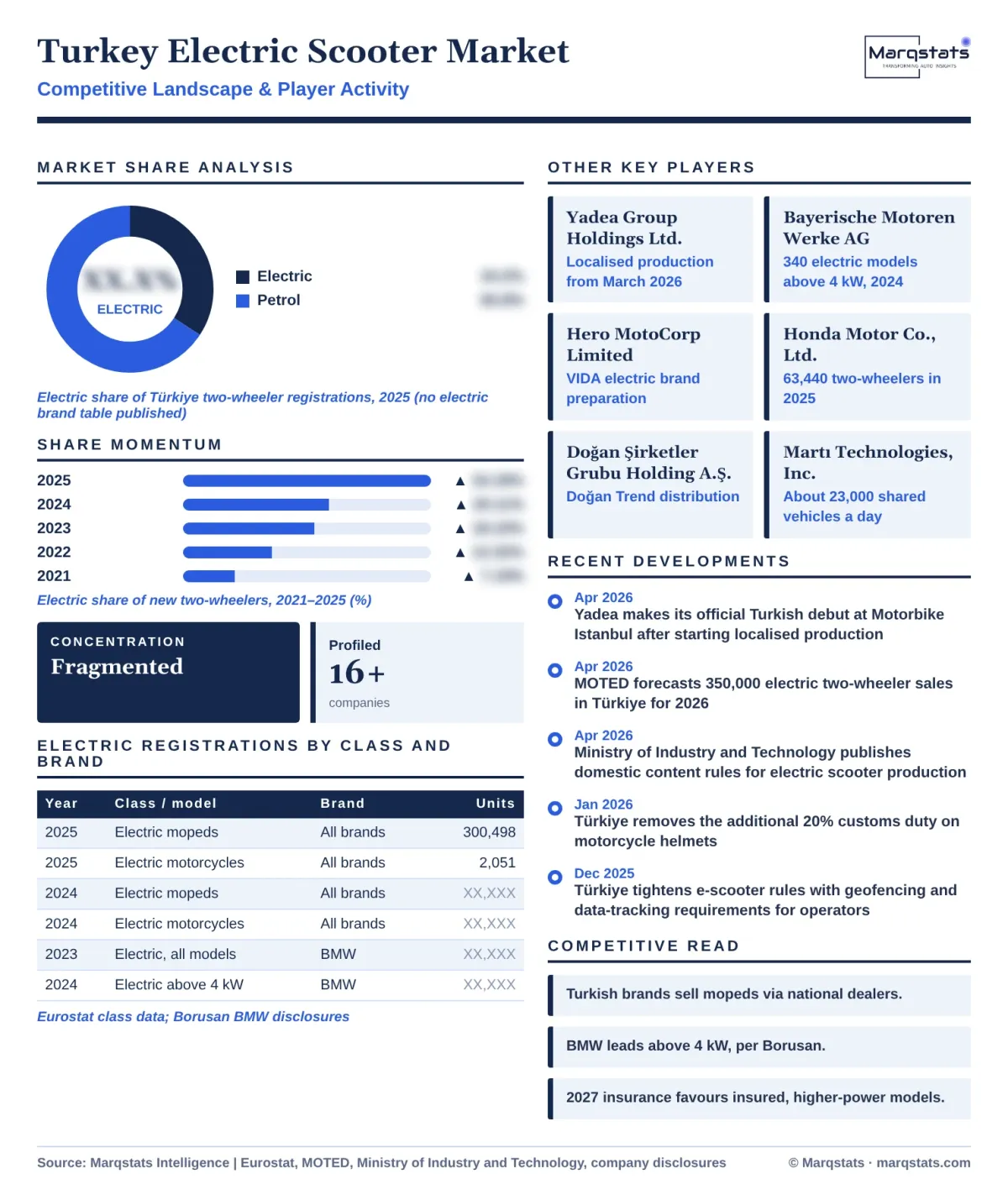
The official series shows one of the fastest electric shifts in any two-wheeler market. Zero-emission moped registrations rose from 18,141 in 2021 to 49,268 in 2022, 170,008 in 2023, 239,814 in 2024 and 300,498 in 2025, while zero-emission motorcycle registrations stayed small at 251, 1,914, 3,294, 2,842 and 2,051. Electric models took 7.19% of new two-wheeler registrations in 2021, 12.32% in 2022, 18.10% in 2023, 20.11% in 2024 and 34.18% in 2025. The series follows Eurostat's moped and motorcycle categories for Türkiye, and its 2025 total of 302,549 matches the figure MOTED published in April 2026.
Türkiye is larger than all of Europe's registered electric two-wheeler markets combined. Marqstats estimates the 17-country European electric motorcycle and scooter market at 65,801 units in 2025, so Türkiye's 302,549 units are 4.60 times that total. The gap reflects product mix as much as adoption: European buyers pay an average of about USD 8,814 for L3e scooters and motorcycles, while Turkish buyers pay about USD 1,845 for low-power mopeds. Among the European markets Marqstats tracks, only Belgium's 61.70% electric share of new mopeds exceeds Türkiye's 54.16%, and no European country comes close in absolute volume.
Electric mopeds grew while the wider market contracted. MOTED data show the total two-wheeler market fell 26% to 885,261 units in 2025 after five years of growth, with 0–50 cc petrol mopeds down 23% to 254,300 units, 50–250 cc motorcycles down 40% to 552,300 units and motorcycles above 250 cc down 32% to 30,380 units. Electric mopeds of 0–4 kW rose 25% over the same period. MOTED general coordinator Remzi Öztürk attributed the 2025 decline to the end of the e-commerce delivery boom, additional customs duties and tighter market surveillance.
The denominator moved sharply over the period. Total new two-wheeler registrations rose from 255,961 in 2021 to 415,544 in 2022, 957,292 in 2023 and a peak of 1,206,587 in 2024, before falling to 885,261 in 2025. Motorcycle-class registrations fell from 637,128 in 2024 to 330,436 in 2025, while moped-class registrations fell less, from 569,459 to 554,825, because electric mopeds replaced petrol mopeds. Electric growth in 2025 therefore came from substitution inside a shrinking market, which makes it more sensitive to a change in running costs than to a change in total demand.
Licence and insurance rules explain the size of the low-power electric segment. Riders with a B-class car licence can use electric vehicles up to 4 kW without a motorcycle licence, and these vehicles and 50 cc petrol mopeds are exempt from compulsory traffic insurance and the motor vehicle tax (MTV). Low-power electric vehicles and petrol mopeds together took 61% of the market in the first seven months of 2025 and 63% of the market according to MOTED's April 2026 statement. The rules let car-licence holders, couriers and young urban riders enter the market at the lowest cost of ownership.
Regulation sets the forecast. MOTED expects a regulation in early 2027 to require compulsory traffic insurance for vehicles up to 50 cc and electric vehicles under 4 kW, and expects the share of this segment to fall from 63% to 20–30%. The forecast applies a 30.00% fall in 2027, when the cost advantage of uninsured mopeds disappears, followed by growth of 7% to 8% a year as buyers move to insured electric scooters and motorcycles. MOTED forecast 350,000 electric sales for 2026 in April 2026, when it also cut its total market forecast to about 700,000 units.
The forecast path follows the regulatory calendar year by year. Volume rises to 350,000 units in 2026, falls to 245,000 in 2027 when the insurance requirement takes effect, and recovers to 262,150 in 2028, 283,122 in 2029 and 305,772 in 2030. Electric motorcycles grow every year, from 2,666 units in 2026 to 7,615 in 2030, because the insurance rule does not change their costs and licensing changes widen their buyer base. If the insurance requirement is delayed beyond 2027, volume stays closer to the 2026 level and the 2030 figure rises.
Brand-level electric data are scarce, and the market is led by Turkish brands. Kuba led the total two-wheeler market with 112,772 units in 2025, followed by Honda with 63,440, Mondial with 54,735 and RKS with 49,461, according to registration compilations published by SBK Motor, and Kuba, Mondial, RKS, Arora and Yuki also sell electric mopeds. No national table of electric registrations by brand or model is published. BMW Motorrad's Turkish distributor Borusan reported 1,472 electric BMW motorcycles and scooters in 2023 and 340 electric BMW models above 4 kW in 2024, which made BMW the largest brand above 4 kW, and the CE 04 scooter accounted for about one-third of BMW Motorrad's Turkish sales in 2023.
The average selling price in the market is approximately USD 1,845 in 2025, rising to USD 2,118 by 2030 as the mix shifts towards insured scooters and motorcycles above 4 kW. Low prices for imported and locally assembled electric mopeds made them the cheapest new motorised transport in Turkish cities during the delivery boom. Local production is expanding: the number of motorcycle manufacturers in Türkiye rose from about 20 to nearly 70 by November 2024, and Arora in Adana and CSN Motor in Şanlıurfa assemble scooters locally. MOTED expects prices to fall as global brands start local production.
Tax policy is the second lever after insurance. Türkiye removed the additional 20% customs duty on motorcycle helmets at the start of 2026, and MOTED has asked for similar relief on other safety equipment. The special consumption tax (ÖTV) system has only two brackets for motorcycles, up to 250 cc and above 250 cc, and MOTED proposes three or four brackets to make mid-size models more attractive. Electric mopeds already benefit from the MTV exemption, so tax changes matter most for higher-power electric scooters and motorcycles.
Market Dynamics
Key Drivers
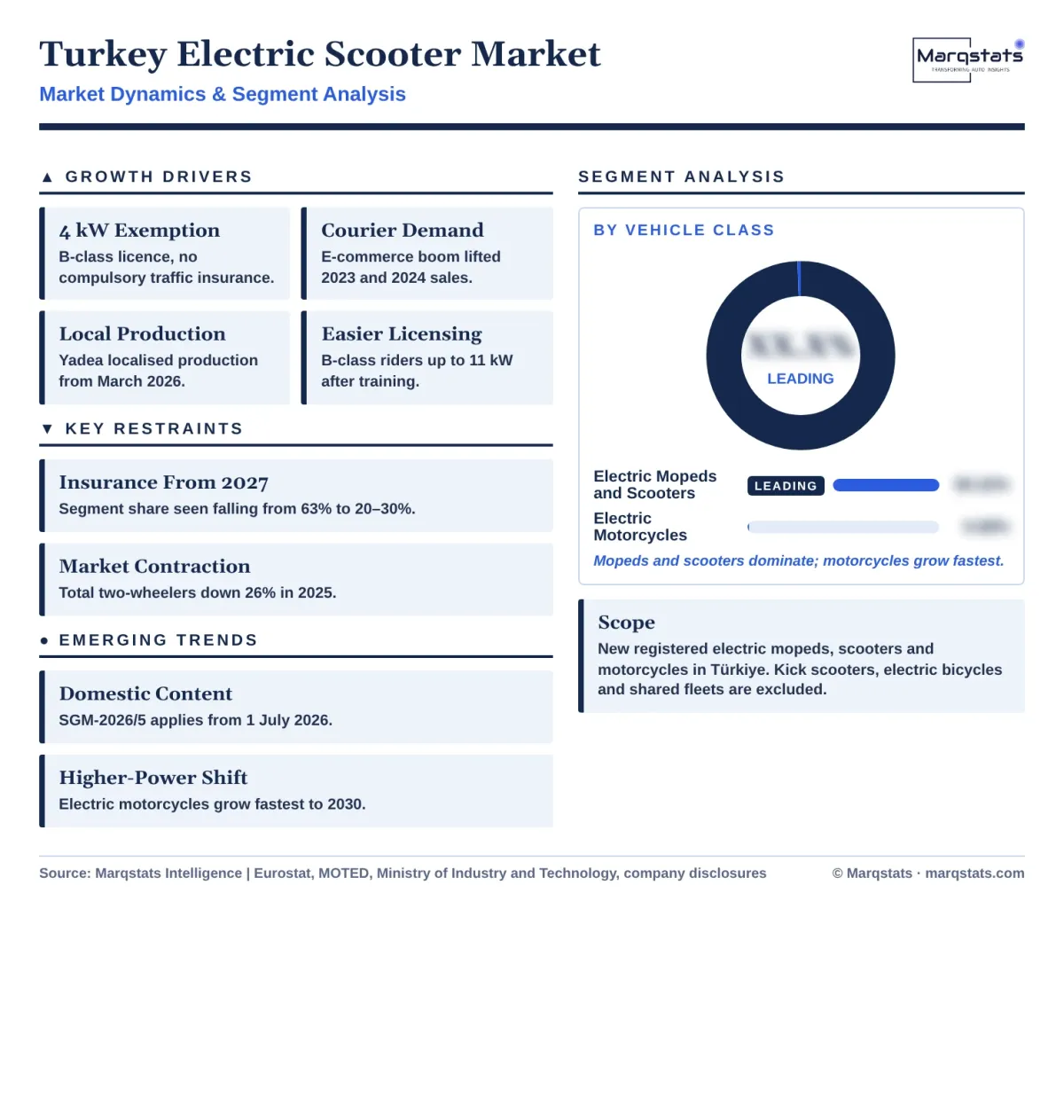
Five conditions drive the Turkey electric scooter market, and the licence and insurance exemption matters most until 2027.
- Licence and insurance exemption for vehicles up to 4 kW. Electric vehicles up to 4 kW can be ridden on a B-class car licence and need no compulsory traffic insurance or MTV, according to MOTED. Electric mopeds reached 54.16% of moped-class registrations in 2025 under these rules.
- Low running costs for couriers and commuters. Delivery riders and urban commuters chose electric mopeds during the e-commerce boom, which helped electric registrations rise from 51,182 in 2022 to 173,302 in 2023. Electric mopeds avoid fuel costs that rose with Turkish inflation. Total registrations of 931,890 in January to September 2024, up 27.3%, show the scale of new rider demand at the peak.
- Local production and new brands. Yadea Group Holdings Ltd. began localised production in Türkiye in March 2026 and made its official debut at Motorbike Istanbul in April 2026 as a self-operated brand building a national sales and service network. The number of motorcycle manufacturers in Türkiye approached 70 in 2024, against about 20 a few years earlier.
- Easier licensing for higher-power models. Licensing changes let B-class licence holders ride models of up to 11 kW after a shorter training course of 6 hours instead of 12, according to Ekonomist in November 2024. The change widens demand above 4 kW, where BMW, Yadea and premium imports compete.
- Urban congestion and high car prices. MOTED attributes the growth of the two-wheeler market to urbanisation, traffic congestion, fuel prices and high car prices, and about 3 million motorcycles were sold in Türkiye in the three years to September 2025. Electric mopeds offer the lowest entry price into motorised transport.
Key Restraints
Four constraints weigh on the market, and the planned insurance requirement is the largest.
- Planned compulsory traffic insurance from 2027. MOTED expects compulsory traffic insurance for electric vehicles under 4 kW and 50 cc mopeds from early 2027, and expects the segment share to fall from 63% to 20–30%. The forecast applies a 30.00% fall in electric volume in 2027.
- Contraction of the two-wheeler market. The total market fell 26% to 885,261 units in 2025 and a further 11% year on year in January to February 2026, and MOTED cut its 2026 total forecast to about 700,000 units. The end of the e-commerce delivery boom removed a large share of new courier demand. Sales in the first seven months of 2025 were just over 526,000 units, down 24.2%, while about 651,000 used motorcycles changed hands, and MOTED expects a long-term annual market of 600,000 to 800,000 new units.
- Customs surcharges and surveillance. MOTED cited additional customs duties and tighter market surveillance as causes of the 2025 decline. Importers of low-cost Chinese mopeds face higher landed costs and stricter conformity checks.
- Small premium segment. Electric motorcycles registered only 2,051 units in 2025, 0.62% of the motorcycle class, and BMW, the largest brand above 4 kW, sold 340 such units in 2024. High prices limit electric models above 4 kW to a small group of buyers.
Key Trends
Four shifts show where the market is moving and which companies gain.
- Global electric brands localise production. Yadea began localised production in March 2026 and entered the Turkish market at Motorbike Istanbul in April 2026, and MOTED expects global brands that produce locally to lower prices. Hero MotoCorp's Turkish operation planned exports to the Balkans and the Middle East and prepared infrastructure for its VIDA electric brand.
- Domestic content rules for electric scooters. The Ministry of Industry and Technology published a communiqué on domestic content in electric scooter production (SGM-2026/5) in April 2026, applying from 1 July 2026 to scooters registered in the U-Net system. Manufacturers must source a battery or chassis locally, plus a motor or two electronic or brake components, and the Turkish Standards Institution (TSE) certifies producers for one year. TSE completes certification within 20 business days of a final application and may inspect production sites, which raises the compliance cost for small assemblers.
- Tighter rules for shared electric scooters. Türkiye tightened e-scooter rules in December 2025 with geofencing and data-tracking requirements for operators, and Martı Technologies, Inc. deployed about 23,000 vehicles a day on average in 2025. Shared operators sit outside the market perimeter and introduce new riders to electric two-wheelers.
- Shift towards insured, higher-power models. Electric motorcycles grow from 2,051 units in 2025 to 7,615 by 2030 and their share rises from 0.68% to 2.49%. The planned insurance requirement removes part of the cost gap between low-power mopeds and higher-power scooters.
Market Segmentation
Electric mopeds and scooters up to 4 kW are the dominant segment, with 300,498 units in 2025 and 99.32% of the market. Volume reaches 347,334 units in 2026, falls to 241,534 in 2027 under the planned insurance rule and recovers to 298,157 by 2030, a CAGR of -0.16%. Kuba, Mondial, RKS, Arora and Yuki sell models in this class to commuters and couriers. The class held its volume in 2025 while 0–50 cc petrol mopeds fell 23% to 254,300 units, so electric models now outsell petrol models in the moped class by about 1.18 to 1.
Electric motorcycles above 4 kW are the fastest-growing segment, rising from 2,051 units in 2025 to 7,615 by 2030 at a 30.00% CAGR and taking 2.49% of the market. BMW's CE 04 and CE 02, Yadea's higher-power models and other premium imports compete with 125 cc petrol scooters. Licensing changes for B-class holders support demand up to 11 kW.
Private commuters account for most registrations and buy low-power electric mopeds as an alternative to cars and public transport in congested cities. Their demand depends on the licence and insurance exemption, so the 2027 rule change affects them most.
Couriers and delivery fleets drove much of the 2023 and 2024 surge, when the e-commerce boom added new riders. MOTED linked part of the 2025 decline to the end of that boom, and fleet buyers now favour insured vehicles with service support. Insurance from 2027 adds a fixed annual cost per vehicle, which fleet operators with many low-power mopeds feel more than private owners with one.
By Geography
Marmara
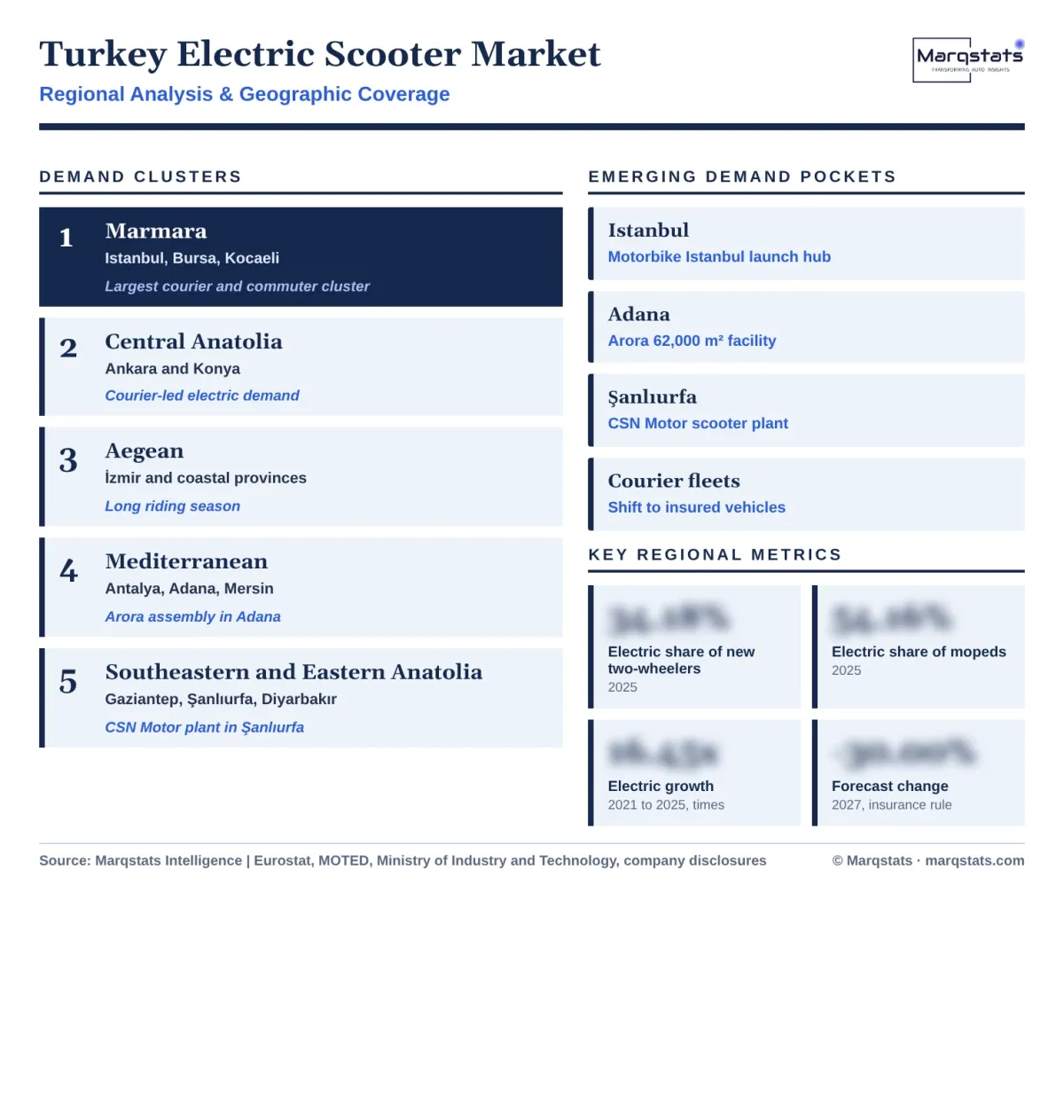
The Marmara region, led by Istanbul, Bursa and Kocaeli, is the largest demand cluster, with the country's largest courier market and the densest dealer networks. Istanbul hosts the Motorbike Istanbul fair, where Yadea made its Turkish debut in April 2026, and shared scooter operators run their largest fleets in the city. Congestion and high parking costs favour two-wheelers over cars.
Central Anatolia
Ankara and Konya form the second cluster, with commuting and delivery demand in the capital. Colder winters shorten the riding season against coastal cities, so electric demand follows the courier market more closely than leisure use.
Aegean
İzmir and surrounding provinces form a large coastal market with a long riding season. Mild weather and tourism support year-round scooter use and rental demand for electric mopeds.
Mediterranean
Antalya, Adana and Mersin combine tourist and local commuter demand, and Arora expands its 62,000 m² production facility in Adana. Local assembly in the region shortens supply chains for dealers in southern Türkiye.
Southeastern and Eastern Anatolia
Gaziantep, Şanlıurfa and Diyarbakır form a lower-income cluster, where low-cost mopeds serve work and family transport. CSN Motor's 22,000 m² plant in the Şanlıurfa Organised Industrial Zone, established in 2023, produces scooters and three-wheelers for the region.
How Competition Is Evolving
The market is fragmented. Turkish brands Kuba, Mondial, RKS, Arora and Yuki sell electric mopeds alongside petrol models, Chinese brands including Yadea Group Holdings Ltd., Niu Technologies and Segway-Ninebot Group Co., Ltd. compete in electric scooters, and Bayerische Motoren Werke AG leads above 4 kW through its distributor Borusan. No national electric registration table by brand is published, so concentration is assessed from the total market and distributor disclosures.
Turkish brands rely on low prices and wide dealer networks. Kuba led the total two-wheeler market with 112,772 units in 2025, RKS registered 49,461 and Mondial 54,735, and nearly 70 manufacturers now assemble motorcycles in Türkiye. Local assembly lets these brands offer electric mopeds at prices close to 50 cc petrol models.
Distributor disclosures show how quickly brand positions changed during the boom. Doğan Trend, part of Doğan Şirketler Grubu Holding A.Ş., sold about 13,000 units by mid-October 2024 against a year-end target of 15,000, and Hero's Turkish operation sold about 30,000 units in the first nine months of 2024, according to Ekonomist. Kuba's volume fell from 175,530 units in 2024 to 112,772 in 2025 and Honda's from 131,384 to 63,440, so the largest brands lost volume as the market contracted, while electric mopeds held up.
International brands compete on technology and service. BMW sold 340 electric models above 4 kW in 2024, Yadea began localised production in March 2026 and builds a national sales and service network, and Hero MotoCorp Limited prepared infrastructure for its VIDA electric brand. Honda Motor Co., Ltd., TVS Motor Company Limited and Yamaha Motor Co., Ltd. hold strong positions in petrol scooters and set the benchmark that electric models must match.
The competitive question to 2030 is who keeps buyers when the insurance exemption ends. Brands with insured, higher-power models and financing gain from the 2027 rule, while importers that depend on the cheapest uninsured mopeds lose their main advantage. Domestic content rules under SGM-2026/5 also favour producers with local battery, chassis or motor supply. Producers that already assemble locally, such as Arora in Adana and CSN Motor in Şanlıurfa, start from a stronger position than importers of complete vehicles.
Companies Covered
Companies covered in the report include:
Recent Market Activity
Table of Contents
Coverage & Segmentation
The Turkey electric scooter market comprises new registered battery electric mopeds, scooters and motorcycles in Türkiye, sized in units and in USD at retail selling prices. The market is segmented by vehicle class into electric mopeds and scooters up to 4 kW and electric motorcycles above 4 kW, and by end use into private commuters and couriers and delivery fleets. Regional analysis covers Marmara, Central Anatolia, the Aegean, the Mediterranean and Southeastern and Eastern Anatolia.
The base year is 2025, the historical period is 2021–2025 and the forecast period is 2026–2030. Historical volumes follow the official zero-emission moped and motorcycle registration series, which matches MOTED's 2025 total; the series is zero-emission rather than strictly battery-only, and its exclusion of three-wheelers was not independently verified. The 2026 figure follows MOTED's forecast, and the 2027–2030 forecast is a Marqstats construction based on the planned insurance rule. No national electric registration table by brand or model is published, so regional analysis is qualitative and brand analysis relies on total-market and distributor data.