Market Snapshot
Middle bar: base-year value × (1 + CAGR), rounded to two decimals. This is a calculated illustration, not a separately researched annual estimate.
The Taiwan electric scooter market is estimated at 49,228 units in 2025 and is projected to reach 59,724 units by 2030, registering a volume CAGR of 3.94% over 2026–2030. In value terms the market is estimated at USD 155.49 million in 2025 and is projected to reach USD 209.88 million by 2030, a CAGR of 6.18%. The market comprises new licensed battery electric scooters and motorcycles registered with the Highway Bureau of the Ministry of Transportation and Communications, across white-plate heavy, green-plate light and small light classes. The above-5.0 kW band holds 73.48% of 2025 units, and Gogoro Inc. took 57.24% of registrations.
Market size and forecast figures are generated using Marqstats' proprietary estimation framework, updated as of October 2026.
Taiwan built a battery-swap network of more than 2,700 GoStation locations and then lost more than two-thirds of its electric scooter sales. New electric licences fell from 168,537 in 2019 to 49,228 in 2025, and the electric share of new scooter licences fell from 18.68% to 6.95% of a 708,392-unit market. Registrations of 31,572 in January to September 2026 put the year on course for 40,802 units, before fleet demand, entry-level models and city subsidies lift volume back to 59,724 by 2030.
The forecast assumes no return to the 2019 peak before 2030. Volume grows from 40,802 units in 2026 to 59,724 units in 2030, which lifts the electric share of new scooter licences to about 8.43% on a flat total market, far below the 35% policy target. Gogoro's recovery to 6.04% of all new scooter licences in June 2026, according to the Commercial Times, is the main sign that volume has stopped falling.
Key Takeaways
Market Overview & Analysis
Report Summary
The Taiwan electric scooter market covers new battery electric two-wheelers licensed for road use in Taiwan, from small light scooters limited to 25 km/h to white-plate heavy scooters with motors above 5 kW. The market is estimated at 49,228 units in 2025, down 37.63% on 78,928 units in 2024, and falls again to 40,802 units in 2026, down 17.12%. It recovers to 59,724 units by 2030, adding 10,496 units over the forecast period. Electric bicycles, pedal-assist bicycles, kick scooters, used vehicles and petrol scooters sit outside the perimeter, and the market is sized on the licence data of the Highway Bureau as reported by the Smart Mobility Association of Taiwan (SMAT) and Gogoro Inc.
Taiwan is a large scooter market with a small electric share. New scooter licences totalled 708,392 in 2025, and electric models took 6.95% of them, against 18.68% in 2019, according to Highway Bureau data reproduced by the National Development Council. The electric share was 9.58% in 2020, 11.62% in 2021, 11.95% in 2022, 9.16% in 2023 and 10.49% in 2024, so 2025 is the weakest year in the series. The total scooter market keeps growing while electric volume shrinks: July 2026 scooter licences rose 8.59% year on year to 70,899, while electric licences fell 28.69% to 3,662, according to the Commercial Times.
Volume fell in two steps, and each step followed a change in the economics of buying an electric scooter. The first fall came in 2020, when licences dropped from 168,537 to 99,204 after national and city purchase subsidies were reduced. The second came in 2025, when licences fell from 78,928 to 49,228 after a 2024 investigation into subsidy claims on imported parts led to the resignation of Gogoro founder Horace Luke in September 2024, and buyers moved to cheaper petrol models. Gogoro registrations fell from 52,513 in 2024 to 28,176 in 2025, while Kwang Yang Motor Co., Ltd. (Kymco) registered 13,195 Ionex scooters, against 17,763 a year earlier.
The brand history explains why the market depends so heavily on one company. Gogoro registered 145,678 scooters in 2019, and Gogoro Network partner brands including Gogoro registered 152,347, which equalled about 90% of that year's 168,537 electric licences. Gogoro's own registrations fell to 64,663 in 2022 and 56,693 in 2023, when Kymco Ionex registered 12,186, Aeon Motor 3,627, China Motor Corporation's eMoving 2,460 and Yamaha 1,270. Kymco grew its Ionex volume to 17,763 in 2024 while Gogoro fell to 52,513, and both brands declined in 2025.
The 2022 model rankings show how far the product mix has moved towards cheaper scooters. In 2022 the Gogoro Viva Mix registered 16,169 units, the SuperSport and S2 series 11,508, the Viva XL and 3 series 11,462, the 2 series 11,394, the Viva 8,323 and the Delight 5,226, while the Aeon Ai-1 registered 4,405, the Kymco i-One 3,807, the PGO Ur1 2,279 and the eMoving EZ1 1,824. By 2024 the low-priced Gogoro Jego led with 20,761 registrations, and by 2026 the EZZY took more than a third of the market. Volume has moved down the price ladder for four years.
Model-level registration data for 2025 show a market split between entry-level and mid-range models. The Gogoro EZZY, launched in June 2025, was the top model with 7,071 registrations, followed by the Kymco Ionex i-One Fly with 6,861, the Gogoro Viva Mix with 4,794, the Viva XL with 4,273 and the Delight with 3,393. The Gogoro Premium registered 1,952, the EZZY500 1,635, the Kymco Ionex S6 Rex 1,592, the Gogoro Viva 1,541 and the Kymco Ionex i-One 1,350. Gogoro reported that the EZZY family, including the EZZY500, sold more than 8,700 units in 2025, which made entry-level models the largest part of its range within six months of launch.
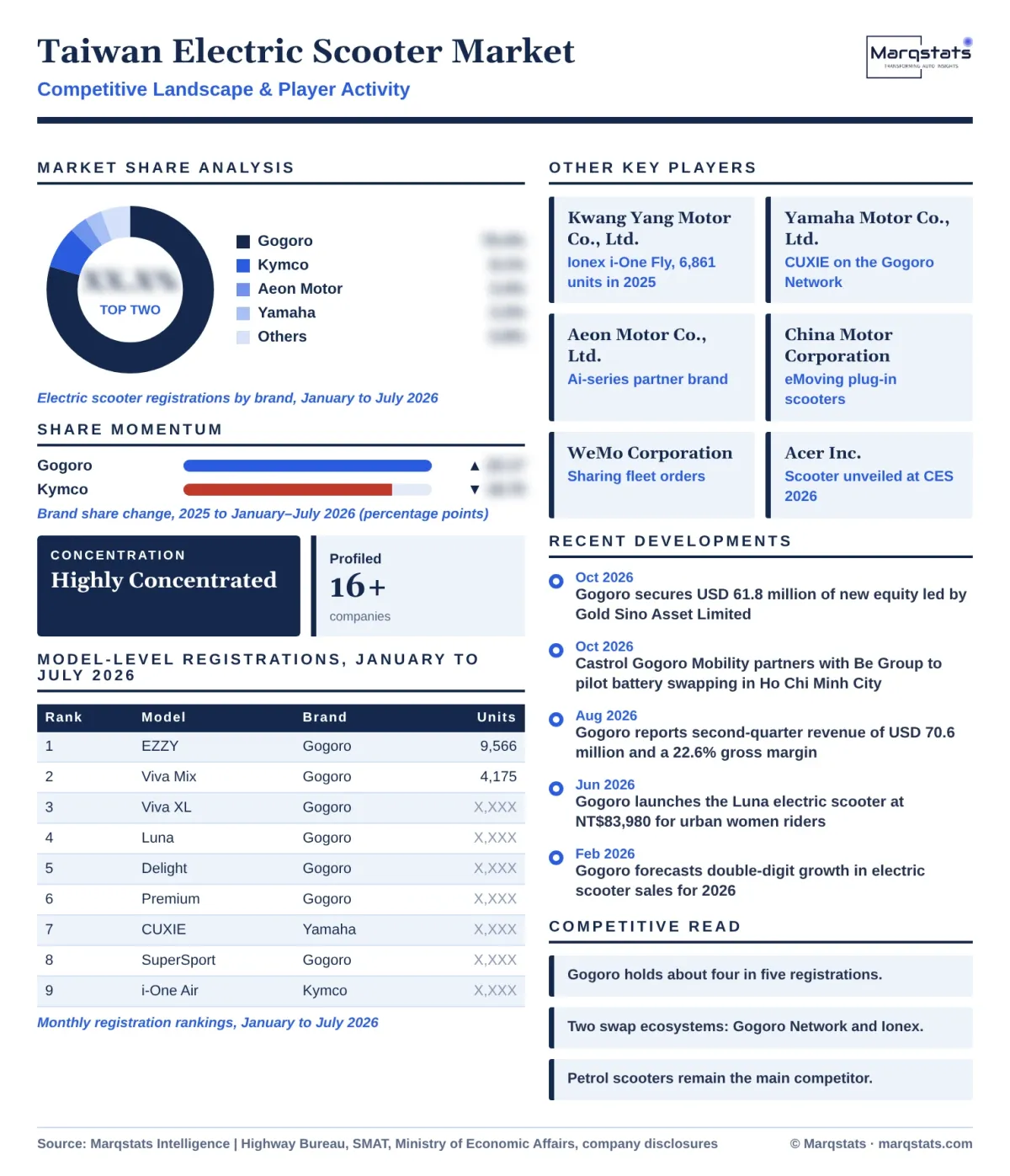
The 2026 registration data show Gogoro consolidating the market. Registrations reached 25,419 in January to July 2026, and Gogoro took 20,184 of them, 79.41%, against 2,059 for Kymco, 858 for Aeon Motor Co., Ltd., 836 for Yamaha, 549 for China Motor Corporation's eMoving, 171 for PGO and 165 for Tai Ling Motor's eReady. The Gogoro EZZY led models with 9,566 registrations, followed by the Viva Mix with 4,175, the Viva XL with 1,195, the Luna with 1,123, the Delight with 1,086 and the Premium with 1,067. The Yamaha CUXIE registered 835, the Gogoro SuperSport 678, the Kymco i-One Air 473 and the Gogoro Pulse 380.
Battery swapping defines the Taiwanese market. Gogoro reported 677,000 battery-swap subscribers at the end of June 2026, up 4% on 648,000 a year earlier, more than 2,700 GoStation locations and more than 900 million cumulative swaps. Yamaha, Aeon Motor, PGO and other partner brands sell scooters that use the Gogoro Network, while Kymco runs its own Ionex swap system. Swap subscriptions turn the scooter into a lower upfront purchase plus a monthly energy fee, and Gogoro promoted plans from NT$119 a month when it launched the Luna in June 2026.
The average selling price in the market is approximately USD 3,159 in 2025, rising to USD 3,514 by 2030 on the Marqstats price model. List prices start well below that level after subsidies: the Gogoro Luna lists at NT$83,980 and falls to NT$34,680 after central and local subsidies. Gogoro reported in August 2026 that the market shifted towards lower-priced entry-level models, which reduced its average selling price and average revenue per user. The value forecast therefore carries more risk than the volume forecast.
Market Dynamics
Key Drivers
Five conditions support the Taiwan electric scooter market, and fleet orders and entry-level products matter most in the near term.
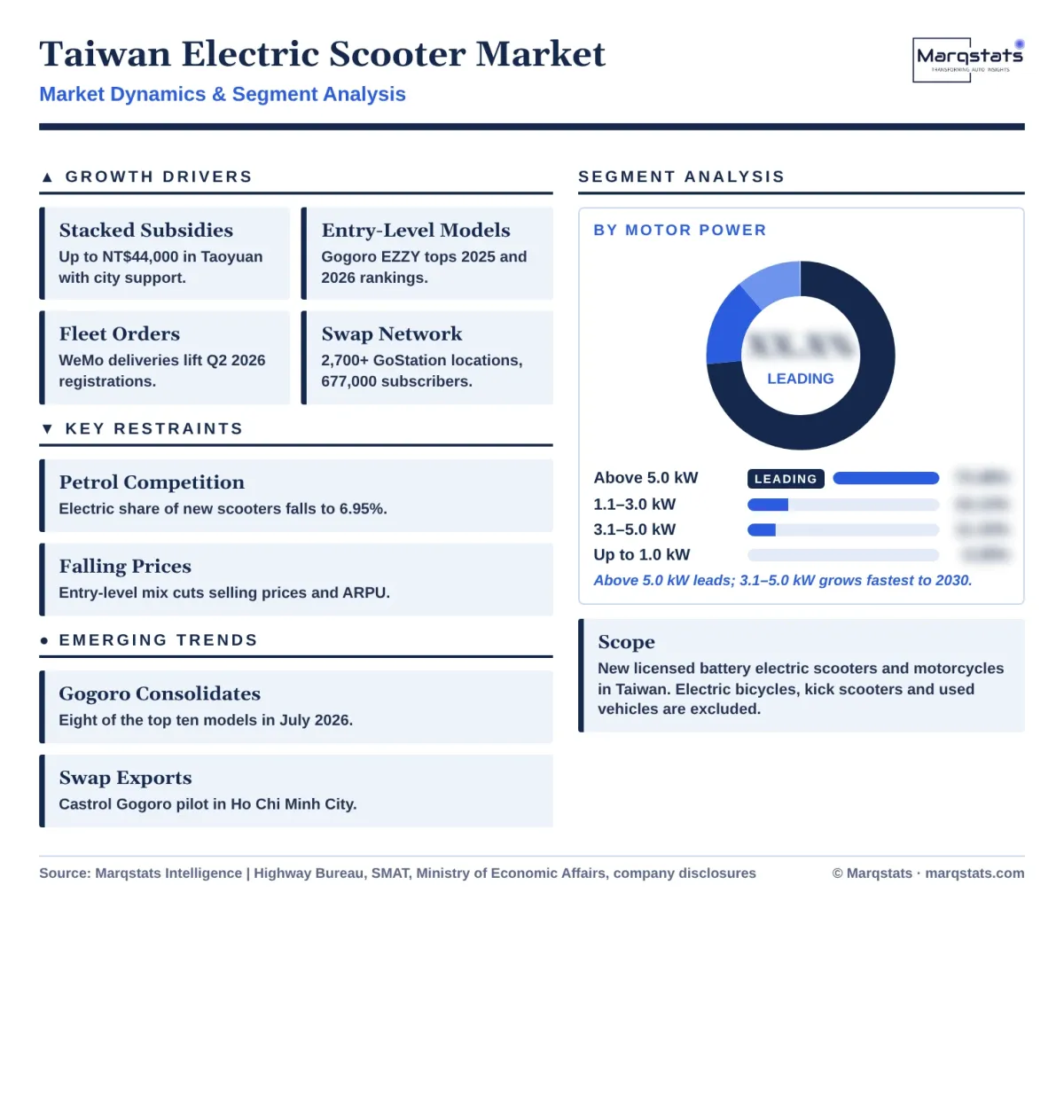
- Stacked central and city subsidies. The Ministry of Economic Affairs offers NT$7,000 for new heavy and light electric scooters and NT$5,100 for small light models, plus NT$3,000 for domestic battery cells and NT$1,000 for scrapping a petrol scooter at least 10 years old, and the Ministry of Environment adds about NT$2,800 for scrappage. Combined central and city support reaches NT$44,000 in Taoyuan and NT$42,300 in Taipei and Taichung, according to Business Today in January 2026.
- Entry-level models from the market leader. Gogoro launched the EZZY in June 2025 to widen its price range, and the model registered 7,071 units in 2025 and 9,566 in January to July 2026. The EZZY500 Toy Story edition passed 1,000 sales in March 2026 and 2,000 by early May 2026, according to Gogoro.
- Fleet and sharing demand. Gogoro attributed its second-quarter 2026 growth to stronger branded scooter sales and deliveries to the WeMo Corporation sharing fleet, and Gogoro-branded registrations rose 50.8% year on year in the quarter. Fleet orders add volume in blocks: Gogoro registered 4,068 units in June 2026 and 3,183 in July after its business orders were delivered.
- The battery-swap network. More than 2,700 GoStation locations and 677,000 subscribers give Taiwan a swap network that removes home charging as a barrier for apartment residents. The network serves Gogoro, Yamaha, Aeon Motor, PGO and other partner brands, so new entrants use existing infrastructure.
- Transport electrification targets. The government set targets in 2022 for electric models to reach 35% of new motorcycle sales by 2030 and 70% by 2035. The 2030 target equals about 247,937 units on the 2025 scooter market, which keeps subsidy programmes in place even after the 2025 fall.
Key Restraints
Four constraints hold the market below its 2019 level, and price competition from petrol scooters is the largest.
- Price competition from petrol scooters. Electric licences fell 28.69% year on year in July 2026 while total scooter licences rose 8.59%, which shows buyers choosing petrol models from Sanyang Motor Co., Ltd., Kymco and Yamaha. The electric share of new scooter licences fell to 6.95% in 2025, its lowest level since at least 2019.
- Damage to consumer trust after the subsidy investigation. The 2024 investigation into subsidy claims on imported parts led to the resignation of Gogoro founder Horace Luke in September 2024 and coincided with a 37.63% fall in electric licences in 2025. Gogoro registrations fell from 52,513 in 2024 to 28,176 in 2025.
- Falling prices and revenue per user. Gogoro reported in August 2026 that demand shifted to lower-priced entry-level models, which reduced average selling prices and average revenue per user, and said it remains cautious given market softness. Its battery-swap revenue fell 0.6% year on year in the second quarter of 2026 to USD 37.4 million.
- Weak financial position of the largest supplier. Gogoro guides 2026 revenue of USD 285 million to USD 305 million and expects its hardware business to reach non-IFRS profitability only in 2028. It raised USD 61.8 million of new equity in October 2026 from Gold Sino Asset Limited and other investors, which leaves Gold Sino with about 45% of the company.
Key Trends
Four shifts show where the market is moving and which companies gain.
- Consolidation around Gogoro. Gogoro's share of registrations rose from 57.24% in 2025 to 79.41% in January to July 2026, and Gogoro models held eight of the top ten places in July 2026. Kymco's share fell from 26.80% to 8.10% over the same period. Smaller partner brands on the Gogoro Network, including Aeon Motor and PGO, also lost share as Gogoro widened its own range into their price points.
- Products for specific rider groups. Gogoro launched the Luna in June 2026 for urban women, with a 6 kW motor, a 22-litre storage box and a 47 kg centre-stand force, and the model registered 1,009 units in its first full month. The Pulse, with a 9 kW motor, and the Pulse Starwalker edition with Starlux Airlines in March 2025 serve the premium tier.
- Swap networks as export products. Gogoro signed a joint venture with Castrol Holdings in February 2025 for battery swapping in Vietnam, and Castrol Gogoro Mobility partnered with Be Group in October 2026 to pilot swapping in Ho Chi Minh City. Taiwanese suppliers use the home market as a reference for Southeast Asian expansion.
- New entrants from technology companies. Acer Inc. unveiled an electric scooter at CES 2026 in January 2026, adding a Taiwanese technology brand to the segment. Technology entrants target connected features and design, where Gogoro set the benchmark.
Market Segmentation
The above-5.0 kW band is the dominant segment and covers white-plate heavy scooters. It accounts for 36,173 units in 2025, 73.48% of the total, and reaches 42,966 units by 2030 at a 3.50% CAGR, taking 71.95% of the market. The Gogoro Viva XL, SuperSport, Delight, Luna and Pulse and the Kymco Ionex S6 Rex sit in this band.
The 3.1–5.0 kW band is the fastest-growing segment. It accounts for 5,465 units in 2025, 11.10% of the total, and reaches 7,048 units by 2030 at a 5.22% CAGR, taking 11.80% of the market. Mid-power green-plate and white-plate models compete here as Gogoro and partner brands add lower-cost variants.
The 1.1–3.0 kW band covers green-plate light scooters for short commutes. It accounts for 7,448 units in 2025, 15.13% of the total, and reaches 9,594 units by 2030 at a 5.19% CAGR, taking 16.06% of the market. The Gogoro EZZY, Viva Mix and Viva and the Kymco Ionex i-One family compete in this band.
The up-to-1.0 kW band is the smallest segment and declines over the forecast period. It accounts for 142 units in 2025, 0.29% of the total, and reaches 116 units by 2030 at a -3.96% CAGR, taking 0.19% of the market. Small light scooters limited to 25 km/h lose volume to electric bicycles, which need no licence plate.
Battery swapping is the dominant energy model, because Gogoro, Yamaha, Aeon Motor, PGO and Kymco Ionex scooters all use swappable batteries. Gogoro reported 677,000 subscribers and more than 2,700 GoStation locations in June 2026, and riders pay a monthly fee instead of buying the battery. Swapping lowers the purchase price and moves part of the cost into a recurring payment.
Plug-in models with fixed or removable batteries charged at home make up a small share of the market. China Motor Corporation's eMoving, Tai Ling Motor's eReady and smaller brands sell plug-in models, mainly in the light and small light classes. Plug-in scooters avoid subscription fees, which appeals to low-mileage riders.
Private commuters account for most registrations, and their demand depends on purchase subsidies and the price gap with petrol scooters. Gogoro's EZZY and Kymco's i-One Fly target first-time electric buyers with list prices that fall sharply after central and city subsidies.
Fleet and sharing operators add volume in blocks, as WeMo Corporation's sharing fleet orders showed in the second quarter of 2026. Gogoro registered 4,068 units in June 2026, when its business orders were delivered, against 3,183 in July. Delivery companies and sharing fleets favour swap models, because swapping removes charging downtime.
By Geography
Northern Taiwan
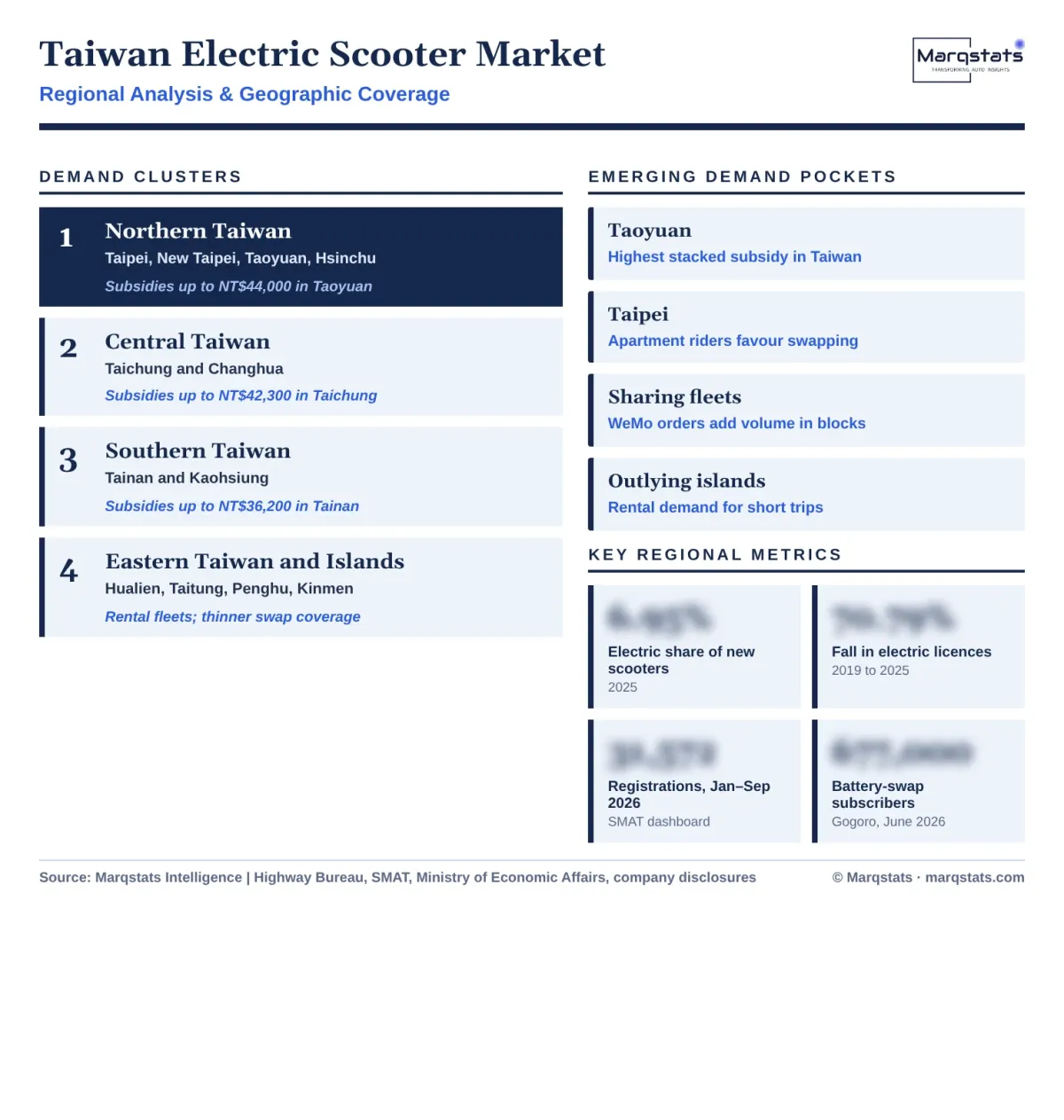
Northern Taiwan, covering Taipei, New Taipei, Taoyuan and Hsinchu, is the largest demand cluster and has the densest GoStation coverage. Combined central and city subsidies reach NT$44,000 in Taoyuan, NT$42,300 in Taipei and NT$39,600 in New Taipei, the highest levels in the country. Apartment living in Taipei and New Taipei makes swapping more practical than home charging, and WeMo Corporation runs its sharing fleet in the region.
Central Taiwan
Central Taiwan, centred on Taichung and Changhua, is the second demand cluster and offers combined subsidies of up to NT$42,300 in Taichung. Dealer networks of Sanyang Motor, Kymco and Yamaha give petrol scooters strong local competition across the region. Electric demand grows as the swap network extends beyond the city centres.
Southern Taiwan
Southern Taiwan, covering Tainan and Kaohsiung, offers combined subsidies of up to NT$36,200 in Tainan and NT$36,000 in Kaohsiung. City subsidies in the south are about NT$8,000 below Taoyuan, which widens the price gap with petrol scooters. Kaohsiung and Tainan are two of the six special municipalities, so electric share gains in the south move national volume.
Eastern Taiwan and Outlying Islands
Hualien, Taitung, Penghu, Kinmen and Matsu form the smallest cluster, with lower population density and fewer swap stations per rider. Island and tourist markets use electric scooters for rental fleets, where short trips suit swappable or plug-in models. Demand in the cluster depends on the spread of GoStation and Ionex stations outside the western corridor.
How Competition Is Evolving
The market is highly concentrated. Gogoro Inc. took 57.24% of registrations in 2025 and 79.41% in January to July 2026, and Kwang Yang Motor Co., Ltd. (Kymco) took 26.80% and 8.10%. Aeon Motor Co., Ltd., Yamaha Motor Co., Ltd., China Motor Corporation, Motive Power Industry Co., Ltd. (PGO) and Tai Ling Motor Co., Ltd. hold most of the remaining volume. Gogoro models held eight of the top ten places in July 2026.
Competition runs on two swap ecosystems. The Gogoro Network serves Gogoro scooters and partner brands including Yamaha, Aeon Motor and PGO, so partner brands share infrastructure and compete on design and price. Kymco runs its own Ionex system, and its share fell sharply in 2026, which shows the difficulty of running a second network against a much larger first one.
Petrol scooter makers are the main competitive threat. Sanyang Motor Co., Ltd., Kymco and Yamaha sell most of Taiwan's 708,392 new scooters, and the total market grew 8.59% year on year in July 2026 while electric licences fell. Electric brands compete against these petrol models on total cost, and subsidies close only part of the gap.
Model breadth is Gogoro's main defence. Its 2026 line-up runs from the EZZY and Viva Mix at the entry level to the Delight, Luna, Viva XL and Premium in the mid-range and the SuperSport and Pulse at the top, and its partners add the Yamaha CUXIE and Aeon Ai-series. Kymco's Ionex range of i-One, i-One Fly, i-One Air and S6 Rex models competes in fewer price points, and smaller brands such as eMoving, PGO and eReady each registered fewer than 600 units in January to July 2026.
Capital and governance shape the next five years. Gogoro raised USD 61.8 million of new equity in October 2026 from Gold Sino Asset Limited, Peng-Lin Investment Limited, Ruen Hua Dyeing & Weaving and Yi Tai Investment, appointed Henry Chiang as chief executive in September 2025 and considered moving its listing from Nasdaq to Taiwan in May 2025. Its second-quarter 2026 gross margin of 22.6% was its highest in more than five years, and its battery-swap business is on course for non-IFRS profitability in 2026.
Companies Covered
Companies covered in the report include:
Recent Market Activity
Table of Contents
Coverage & Segmentation
The Taiwan electric scooter market comprises new licensed battery electric scooters and motorcycles in Taiwan, sized in units and in USD at manufacturer selling prices. The market is segmented by motor power into four bands (up to 1.0 kW, 1.1–3.0 kW, 3.1–5.0 kW and above 5.0 kW), by energy model into battery swapping and plug-in charging, and by end use into private riders and fleets and sharing. Regional analysis covers Northern Taiwan, Central Taiwan, Southern Taiwan and Eastern Taiwan and the outlying islands.
The base year is 2025, the historical period is 2021–2025 and the forecast period is 2026–2030. Historical volumes follow Highway Bureau licence data, and the 2026 estimate extends the January to September 2026 total at the August and September run rate. Electric bicycles, pedal-assist bicycles, kick scooters, used vehicles and petrol scooters are excluded. Brand and model analysis draws on monthly registration rankings and company disclosures. The 2026 figure is a Marqstats construction from partial-year data. The Highway Bureau publishes no regional split of electric licences, so regional analysis is qualitative. Model rankings come from media registration extracts that are reported, not independently verified.