Market Snapshot
Key Takeaways
Market Overview & Analysis
Report Summary
Vietnam's electric two-wheeler market went from a marginal segment to a sixth of national two-wheeler sales in a single year, and the mechanism was not subsidy. It was one manufacturer pricing a swappable-battery scooter below the petrol equivalent, then building the swap network that removed the objection buyers actually had. The 473% growth recorded in 2025 is the largest single-year movement in any vehicle segment covered across this region.
The measure is the retail value of new electric two-wheelers sold in Vietnam, covering licence-exempt electric mopeds, mainstream electric scooters, premium electric motorcycles and delivery-specification electric two-wheelers, across every brand. Vehicle value is counted whether the battery is included in the purchase or rented separately, with the vehicle-only price used where a rental model applies. Battery rental and swap subscription revenue, charging hardware, used retail and electric bicycles below the registration threshold are excluded and are not added to the vehicle figure.
The analysis is written for electric entrants sizing the share available above a dominant incumbent, combustion manufacturers deciding when to convert existing lines rather than build new ones, cell and component suppliers whose addressable content depends on whether the battery is sold or rented, and infrastructure operators weighing swap against charge in a market where the swap network is already the larger asset.
Vietnam Electric Two-Wheeler Market Size and Forecast
The segment is estimated at USD 438.77 million in 2025 and USD 2,128.50 million by 2030, an increase of USD 1,689.73 million. Volume moves from 501,453 to an estimated 2,150,000 units at 33.80%, an increase of 1,648,547 units, while average selling price rises from VND 22.93 million to an estimated VND 25.94 million, or USD 875 to USD 990 at a constant VND 26,200 per USD.
Value compounds 3.34 points ahead of volume at 37.14% against 33.80%, and the mechanism is mix rather than list pricing. Entry models are not getting more expensive: the Evo was priced at VND 19.99 million excluding battery for pre-orders between 15 and 29 January 2026. The premium class is simply growing faster, with the Kinet launched on 20 July 2026 at VND 40 million on rental or VND 49.9 million with two batteries.
The unit series is the electric slice of the all-brand two-wheeler panel built on this cluster, which counts 3,116,510 vehicles in 2025 against the five-member association total of 2,615,057. Every brand in this segment sits outside that association series, so an electric share calculated against the member total would read 19.18% rather than the correct 16.09%, and the error compounds as the segment grows.
The 2026 run rate already validates the forecast shape rather than the forecast validating itself. The leading manufacturer recorded over 135,000 orders and 93,000 deliveries in March 2026 alone and has guided full-year volume to at least 2.5 times 2025, a floor near 1,016,000 units. The all-brand electric segment grew 112.6% year on year through the first four months of 2026, which places 2026 close to double the base year before any 2027 policy measure takes effect.
Why Swapping Is the Competitive Asset Rather Than the Product
The swap network is being assembled through partnerships with state enterprises rather than built as owned infrastructure, which is what makes the cabinet numbers credible on the timeline attached to them. Vietnam Post agreed on 20 May 2026 to host over 16,000 cabinets at more than 13,000 service points with at least 11,000 operational in 2026. EVNHANOI agreed on 19 June 2026 to 7,000 to 10,000 cabinets across 126 communes and wards using 16,000 power substations.
Telecoms and fuel retail carry the remainder: about 6,000 cabinets across 2,500 VNPT sites, up to 6,000 in Bac Ninh with Viettel, and about 3,000 at fuel stations by end-June 2026. The separate charging network runs to 150,000 ports across 34 provinces and cities. A competitor that matches the vehicle cannot match a distribution footprint already built for a different purpose, and that is the durable position in this segment.
Alternative networks are forming rather than conceding. Petrolimex, Xuan Cau Holdings and Selex Motors established Vietnam Green Energy Infrastructure JSC in May 2026 to deploy charging, swapping and renewable services across the Petrolimex fuel-station network. Yadea took the fleet route instead, partnering Grab Vietnam in March 2026 on incentives up to VND 4 million per eligible driver-partner, which buys duty-cycle volume rather than retail footprint.
Capacity Has Run Ahead of the Segment It Serves
Announced electric two-wheeler capacity already exceeds 2 million units per year against a 2025 segment of 501,453 units. Yadea's Bac Ninh plant alone is near 1 million units per year from 1 March 2026, on a first-phase investment above USD 100 million across 232,200 square metres, with 800 to 1,000 staff rising toward 3,000, and a stated intention to double later.
VinFast has passed 1 million cumulative units at Hai Phong and has a further plant under construction at Ha Tinh, with four electric sport motorcycle models planned for 2027. TMT Motors enters from September 2026 with four models on Phylion lithium cells supplied through PSG Energy Vietnam under an August 2026 agreement. Against that, Honda holds 2.75 million units per year of combustion capacity across three plants and has said it will expand its electric lineup.
The practical consequence is that the binding constraint through 2027 is demand, not supply, which inverts the usual sequencing in an emerging vehicle segment. It also means price competition arrives earlier than adoption curves would predict, because three manufacturers with over 2 million units of capacity cannot all fill it from a segment of roughly 1 million units in 2026.
Market Dynamics
Key Drivers
Five forces carry the forecast, and the strongest of them was already recorded in the volume series rather than announced for later.
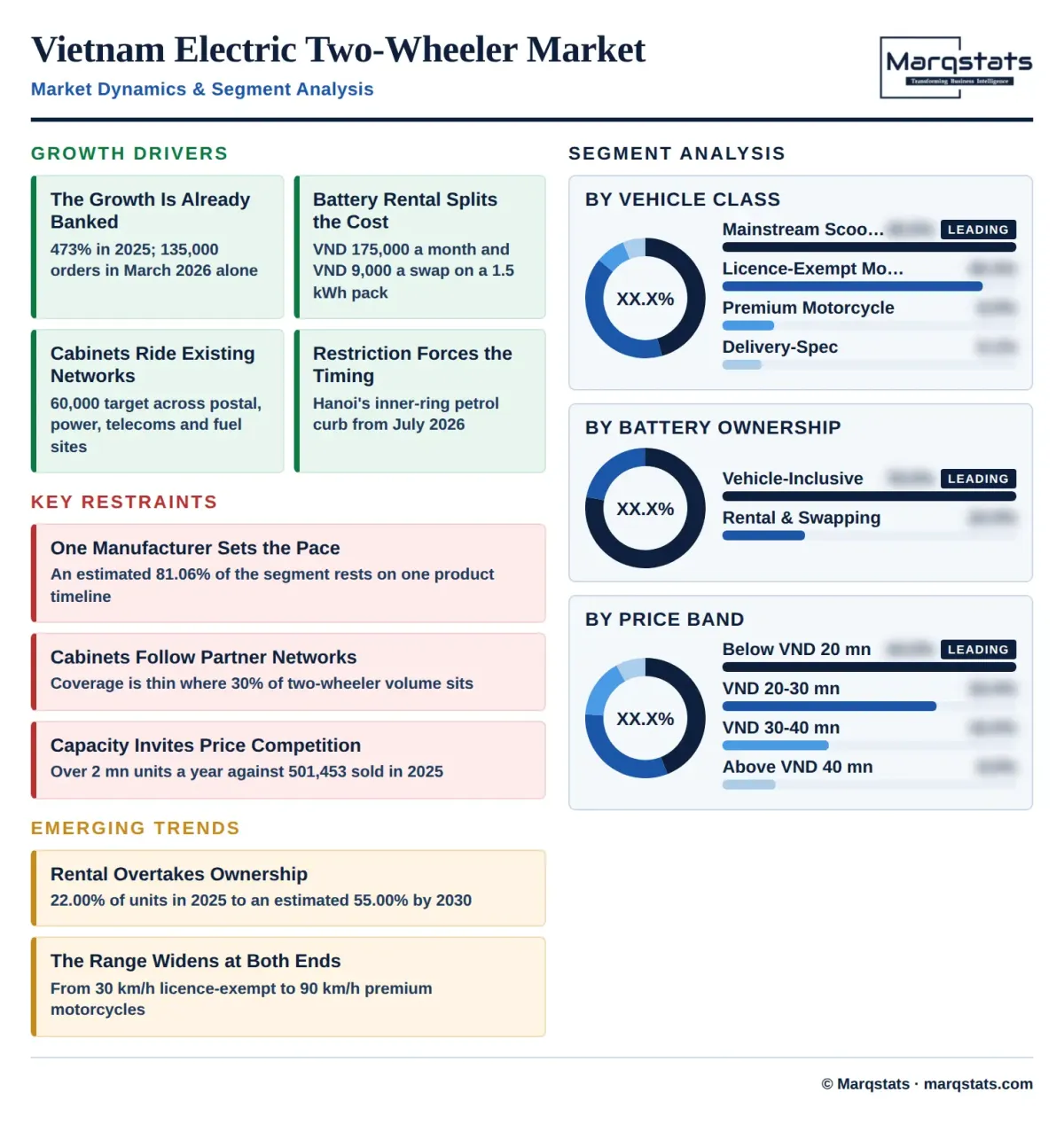
- Deliveries at the leading manufacturer grew 473% in 2025 to 406,453 units, with over 135,000 orders and 93,000 deliveries in March 2026 alone and full-year guidance of at least 2.5 times the 2025 figure.
- Battery-as-a-service separates vehicle cost from energy cost, with a 1.5 kWh lithium iron phosphate pack rented from VND 175,000 per month and swaps at VND 9,000 per battery against an Evo priced at VND 19.99 million excluding battery.
- Swap cabinet deployment moved from 4,500 installed in January 2026 to a 60,000 target across 34 provinces in the second quarter, through partnerships covering over 13,000 postal service points and 16,000 power substations.
- Hanoi's time-based petrol motorcycle restriction inside the inner ring road from July 2026 applies to the densest two-wheeler catchment in the north, converting replacement timing into a compliance decision.
- Trade-in economics were made explicit with an additional 5% discount on electric motorcycles for customers surrendering a petrol vehicle from 10 March 2026, applied across four markets including Vietnam.
Key Restraints
Three constraints hold the segment below the pace its 2025 growth rate would imply, and each is sharpest outside the two largest cities.
- One manufacturer holds an estimated 81.06% of the segment on 406,453 deliveries, so segment growth is materially a function of one company's product and pricing timing rather than of competitive supply.
- Swap cabinet coverage is concentrated in the provinces where the partner networks already operate, so the 60,000-cabinet target across 34 provinces does not distribute evenly against a country where 30.00% of two-wheeler volume sits outside the two main deltas.
- Grid and electricity supply were identified alongside charging infrastructure as the principal obstacles to shifting a fleet of roughly 75 million vehicles, in a June 2026 review of the 2050 transport net-zero target.
- Announced capacity above 2 million units per year against a 2025 segment of 501,453 units makes early price competition likely, compressing the margin available to fund the network build that differentiates the leader.
Key Trends
Four movements reshape the segment inside the forecast window rather than at its end.
- Battery rental and swapping rises from 22.00% of units in 2025 to an estimated 55.00% by 2030 at 60.70%, moving the cell purchase from the consumer to the network operator and changing who the addressable customer is for a cell supplier.
- The product range is widening at both ends, from licence-exempt models at 30 km/h through mainstream 70 km/h scooters to 90 km/h premium motorcycles, with four electric sport models planned for 2027.
- Fleet channels are being contested directly, with driver-partner incentives up to VND 4 million and a fuel-retail joint venture formed in May 2026 to serve commercial duty cycles rather than private buyers.
- Domestic manufacturers lead the fastest-growing vehicle segment in the country, with an estimated 81.06% held by one Vietnamese company and a second domestic entrant arriving in September 2026, inverting the above-95% foreign share that holds in combustion.
Market Segmentation
Scooters up to 70 km/h are the largest class at an estimated 228,175 units and 45.50% of 2025 volume, reaching an estimated 1,140,000 units and 53.02% by 2030 at 37.95%. The class carries the highest-volume models in the market, with one lineup alone above 250,000 units in 2025, and is where the swap network was designed to operate.
Licence-exempt and low-speed models below 50 km/h account for an estimated 202,573 units and 40.40% of 2025 volume, growing to an estimated 534,164 units at 21.40%, the slowest class. Share falls to an estimated 24.84% by 2030 as buyers who entered the segment through a 30 km/h model migrate upward into full-specification scooters with swappable packs.
Models at 90 km/h and above account for an estimated 40,116 units and 8.00% of 2025 volume, reaching an estimated 310,000 units and 14.42% by 2030 at 50.53%, the fastest class on the page. Pricing runs from VND 40 million on battery rental to VND 49.9 million with two packs, against claimed ranges of 145 km and 160 km.
Purpose-built delivery and commercial models account for an estimated 30,589 units and 6.10% of 2025 volume, reaching an estimated 165,836 units and 7.71% by 2030 at 40.22%. The class is bought on total operating cost rather than on purchase price, which is why swap access rather than range determines the specification.
Vehicles sold with the battery included account for an estimated 391,133 units and 78.00% of 2025 volume, growing to an estimated 967,500 units at 19.86% but falling to 45.00% of the segment by 2030. The model remains prevalent wherever swap cabinet density is thin, which is most of the country outside the two main deltas.
Rented and swappable packs account for an estimated 110,320 units and 22.00% of 2025 volume, reaching an estimated 1,182,500 units and 55.00% by 2030 at 60.70%, the fastest-growing dimension on the page. Economics run at VND 175,000 per month rental and VND 9,000 per swap on a 1.5 kWh lithium iron phosphate pack, against a vehicle priced at VND 19.99 million excluding battery.
Entry models below VND 20 million account for an estimated 220,639 units and 44.00% of 2025 volume, reaching an estimated 774,000 units at 28.53% but falling to 36.00% of the segment by 2030. The band is anchored on a VND 19.99 million vehicle-only price that undercuts the petrol scooters it replaces.
The VND 20 million to VND 30 million band accounts for an estimated 160,465 units and 32.00% of 2025 volume, reaching an estimated 731,000 units and 34.00% by 2030 at 35.43%. The band absorbs buyers trading up from licence-exempt models and carries most battery-inclusive variants of the entry range.
The VND 30 million to VND 40 million band accounts for an estimated 80,232 units and 16.00% of 2025 volume, reaching an estimated 425,000 units and 19.77% by 2030 at 39.58%. Pricing here covers mid-premium models at VND 30 million on rental or VND 35.3 million with batteries included.
Models above VND 40 million account for an estimated 40,117 units and 8.00% of 2025 volume, reaching an estimated 220,000 units and 10.23% by 2030 at 40.55%. The band is where the premium motorcycle class sits, from VND 40 million on rental to VND 49.9 million with two packs.
Private commuting accounts for an estimated 340,988 units and 68.00% of 2025 volume, reaching an estimated 1,376,000 units by 2030 at 32.18%, just below the segment rate. Share eases to 64.00% as fleet channels grow faster, though the use case remains the great majority of volume throughout.
Delivery and last-mile logistics account for an estimated 70,203 units and 14.00% of 2025 volume, reaching an estimated 344,000 units and 16.00% by 2030 at 37.42%. Daily distance converts the energy cost difference into a payback measured in months, which is why this use case reaches parity ahead of private buyers.
Ride-hailing accounts for an estimated 45,131 units and 9.00% of 2025 volume, reaching an estimated 258,000 units and 12.00% by 2030 at 41.72%, the fastest use case. Platform incentives up to VND 4 million per eligible driver-partner from March 2026 buy duty-cycle volume directly rather than through retail.
Rural and secondary town buyers account for an estimated 45,131 units and 9.00% of 2025 volume, reaching an estimated 172,000 units at 30.68%, with share easing to 8.00% by 2030. Adoption here is gated by cabinet density rather than by price, since the 60,000-cabinet target follows partner networks concentrated in the deltas.
By Geography
Ho Chi Minh City and the Southeast
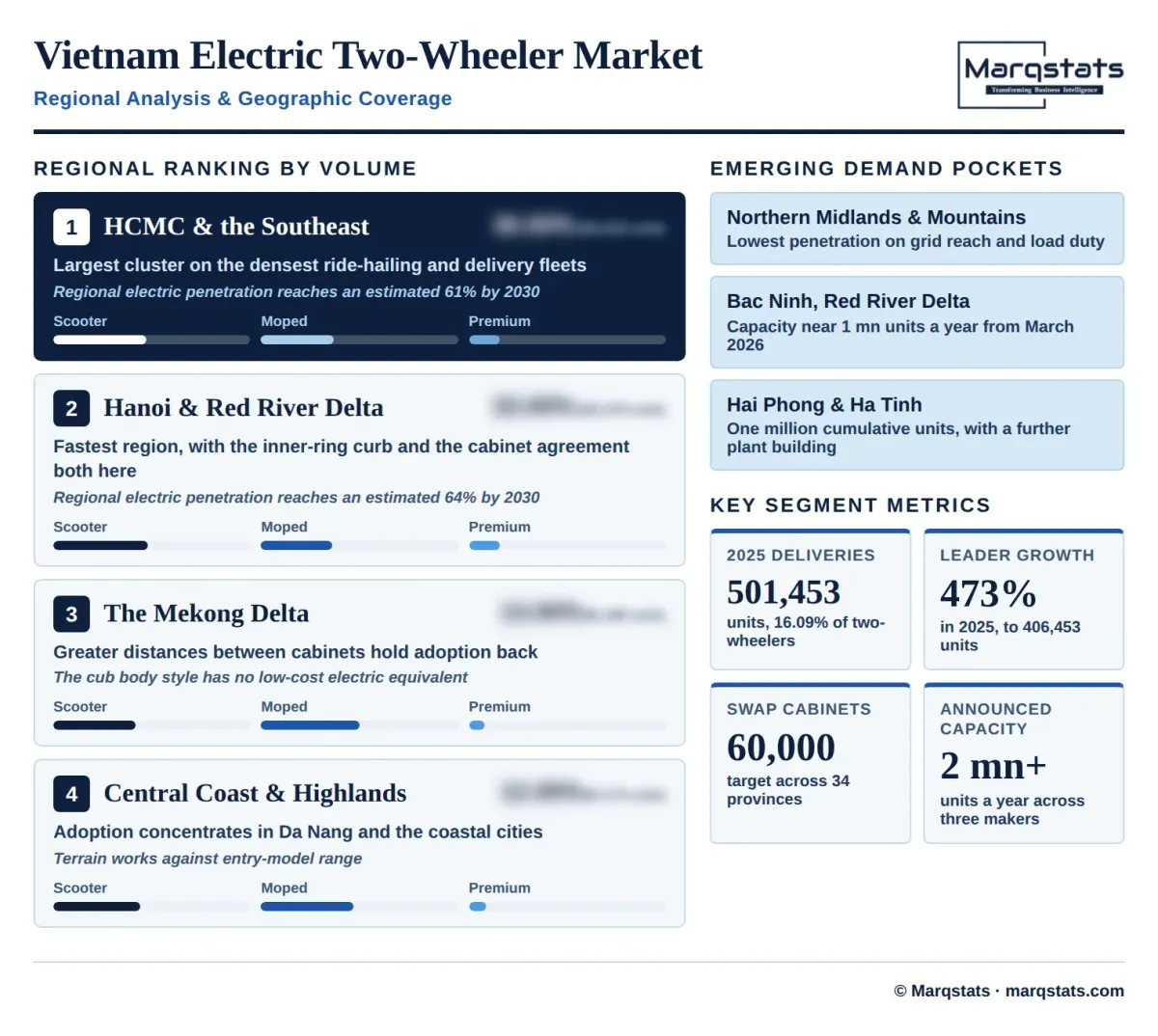
The southern cluster is the largest at an estimated 180,523 units and 36.00% of 2025 segment volume, reaching an estimated 752,500 units by 2030 at 33.04%. It carries the densest ride-hailing and delivery fleets in the country, which is why electric penetration within the region's total two-wheeler sales reaches an estimated 61.00% by 2030.
Hanoi and the Red River Delta
The northern cluster accounts for an estimated 165,479 units and 33.00% of 2025 segment volume, reaching an estimated 731,000 units and 34.00% by 2030 at 34.60%, the fastest region. The inner-ring petrol restriction from July 2026 and a cabinet agreement covering 126 communes and wards across 16,000 power substations both concentrate here, taking regional electric penetration to an estimated 64.00%.
The Mekong Delta
The Mekong Delta accounts for an estimated 65,189 units and 13.00% of 2025 segment volume, reaching an estimated 279,500 units by 2030 at 33.80%. Regional electric penetration reaches an estimated 41.00%, the second lowest, because distances between cabinets are greater and the cub body style prevalent here has no low-cost electric equivalent.
The Central Coast and Central Highlands
The central cluster accounts for an estimated 60,174 units and 12.00% of 2025 segment volume, reaching an estimated 258,000 units by 2030 at 33.80%. Regional electric penetration reaches an estimated 47.00%, with adoption concentrated in Da Nang and the coastal cities rather than across the highlands, where terrain works against entry-model range.
The Northern Midlands and Mountains
The northern uplands account for an estimated 30,088 units and 6.00% of 2025 segment volume, the smallest cluster, reaching an estimated 129,000 units by 2030 at 33.79%. Regional electric penetration reaches an estimated 33.00%, the lowest of the five, constrained by grid reach and by the load-carrying duty that keeps combustion competitive.
How Competition Is Evolving
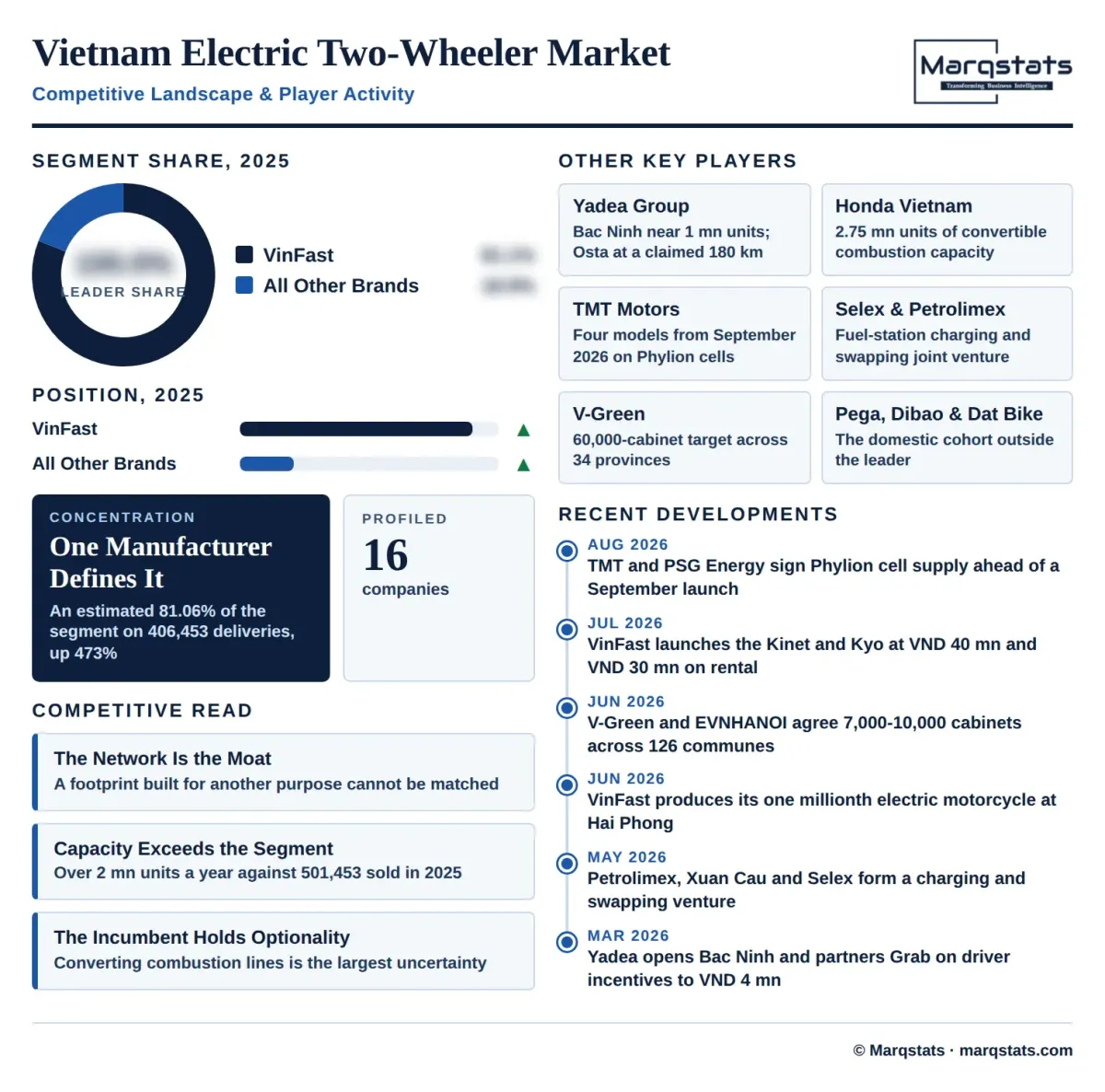
The market is highly concentrated and the concentration is domestic, which inverts the structure of the combustion segment it is replacing. VinFast Trading and Production Joint Stock Company delivered 406,453 electric two-wheelers in Vietnam in 2025, up 473%, for an estimated 81.06% of the segment, with the Evo lineup alone above 250,000 units. It passed 1 million cumulative units at Hai Phong on 12 June 2026, across nearly 15 models and over 30 variants since 2018, supported by more than 600 authorised distributors as of January 2026.
Competition is now being contested on network and channel rather than on vehicle. Yadea Group Holdings Ltd. opened a Bac Ninh plant on 1 March 2026 near 1 million units per year, launched with the Osta at a claimed 180 km range, and went straight to the fleet channel with Grab Vietnam incentives up to VND 4 million per eligible driver-partner. Petrolimex, Xuan Cau Holdings and Selex Motors formed Vietnam Green Energy Infrastructure JSC in May 2026 to build charging and swapping across a fuel-station network, which is the only asset base in the country comparable to the incumbent's partner footprint.
The combustion incumbent has not conceded the segment and holds the largest optionality in it. Honda Vietnam said in June 2026 that it will expand its electric motorcycle lineup and develop charging and battery-swapping infrastructure, having sold nearly 2.3 million motorcycles in fiscal 2026 against 2.75 million units per year of installed capacity across three plants. Converting existing lines rather than building new ones remains the single largest uncertainty in this forecast. TMT Motors Joint Stock Company enters from September 2026 with four models under the TMT E-MOTOR brand on Phylion lithium cells supplied through PSG Energy Vietnam.
Companies Covered
The report profiles 16+ companies with full strategy and financials analysis, including:
Recent Market Activity
Table of Contents
Coverage & Segmentation
The analysis measures the retail value of new electric two-wheelers sold in Vietnam from 2021 to 2030, with 2025 as the base year and 2026 to 2030 as the forecast period, covering vehicle class, battery ownership model, price band and end use, with five regional clusters. Volume is the electric slice of the all-brand two-wheeler series built on this cluster, at 501,453 units against an all-brand 3,116,510 in 2025, because every brand in this segment sits outside the five-member association total of 2,615,057. Battery rental and swap subscription revenue, charging hardware, used retail and electric bicycles below the registration threshold are excluded. Values are expressed in USD at a disclosed constant VND 26,200 per USD.
Coverage spans four vehicle classes, two battery ownership models, four price bands and four end uses across five regional clusters. Vehicle value is counted whether the battery is included or rented, with the vehicle-only price applied where a rental model is offered, so that a single vehicle is never counted at two prices. Average selling price is carried as a derived series at VND 22.93 million in 2025. Sixteen entities are profiled across vehicle manufacturers, swapping network operators and cell supply partners.