Market Snapshot
Middle bar: base-year value × (1 + CAGR), rounded to two decimals. This is a calculated illustration, not a separately researched annual estimate.
The Japan electric scooter market is estimated at 9,000 units in 2025 and is projected to reach 25,302 units by 2030, registering a volume CAGR of 22.97% over 2026–2030. In value terms the market is estimated at USD 47.25 million in 2025 and is projected to reach USD 147.68 million by 2030, a CAGR of 25.60%. The market comprises new battery electric scooters, mopeds and motorcycles sold for road use in Japan, from Class 1 electric mopeds to motorcycles above 5 kW. The 3.1–5.0 kW band holds 35.51% of 2025 units, and electric models took about 2.49% of the 361,990 two-wheelers sold in Japan in 2025.
Market size and forecast figures are generated using Marqstats' proprietary estimation framework, updated as of October 2026.
Japan's electric scooter market is a fleet market that is now turning retail. Japan Post planned to lift its cumulative electric motorcycle fleet from about 23,800 conversions in March 2025 to 30,800 by the end of FY2025, about 7,000 vehicles, equal to roughly 77.78% of the 9,000-unit 2025 market. The end of 50 cc petrol moped sales after the November 2025 emissions rules, Honda's ICON e: at JPY 220,000 and Yamaha's JOG E open the retail moped segment to electric models from 2026.
Honda leads every part of the value chain. It supplies most of Japan Post's electric fleet, sells the EM1 e:, CUV e: and ICON e: at retail, makes the shared Mobile Power Pack e: battery and controls Gachaco, the swap network founded with ENEOS, Yamaha, Suzuki and Kawasaki. Value grows faster than volume, at 25.60% a year to USD 147.68 million by 2030, as higher-power models gain share.
Key Takeaways
Market Overview & Analysis
Report Summary
The Japan electric scooter market covers new battery electric two-wheelers sold for road use in Japan, including Class 1 and Class 2 electric mopeds, electric scooters and electric motorcycles. The market is estimated at 9,000 units in 2025, up 28.57% on 7,000 units in 2024, and grows 27.80% to 11,502 units in 2026. It reaches 25,302 units by 2030, adding 16,302 units over the forecast period. Pedal-assist bicycles, specified small mopeds limited to 0.60 kW and 20 km/h, stand-up kick scooters, used vehicles and petrol motorcycles sit outside the perimeter.
Japan has a mature, shrinking two-wheeler market with a very small electric share. The Japan Automobile Manufacturers Association (JAMA) recorded domestic demand of 362,304 two-wheelers in 2019, 415,892 in 2021, 405,216 in 2023, about 368,000 in 2024 and 361,990 in 2025, combining moped dealer shipments and motorcycle registrations across powertrains. Electric models take about 2.49% of that market, against 15.23% in Vietnam and 34.18% in Türkiye in 2025 on Marqstats estimates. Honda, Yamaha, Suzuki and Kawasaki dominate the petrol market, and all four now offer or plan electric models in Japan.
Micro-mobility sits next to the market and is larger than it in some years. Members of the Japan Electric Mobility Promotion Association (JEMPA) reported 9,200 vehicles in 2023, 14,705 in 2024 and 7,107 in 2025 across mixed categories, including 5,130 specified small mopeds in 2023, 10,855 in 2024 and 6,056 in 2025. Specified small mopeds, limited to 0.60 kW and 20 km/h under the regime in force from 1 July 2023, need no licence for riders aged 16 and over and sit outside the market perimeter. Broader estimates of electric two-wheeler shares in Japan, such as the 7.2% figure cited for 2024 from International Energy Agency data, include some of these low-speed categories.
Fleet buyers created the market. Japan Post converted about 9,300 delivery vehicles to electric two-wheelers in FY2019 to FY2022, about 7,000 in FY2023 and about 7,500 electric two- and three-wheelers in FY2024, reaching about 23,800 cumulative conversions by 31 March 2025, with a target of 30,800 by the end of FY2025. Honda supplied about 20,000 electric postal bikes, its MD e: and BENLY e: models, according to Traffic News. Honda launched the BENLY e: for corporate customers in April 2020 with a 2.8 kW motor and a range of 87 km at 30 km/h.
Japanese makers build electric scale abroad before they build it at home. Honda, Suzuki and Yamaha sold more than 10,735 electric scooters in India in 2026, with Honda holding over 51% of that total, and Honda planned a dedicated electric motorcycle plant in India by 2028 to build at least eight models. Honda Vietnam builds the ICON e: locally, and Honda agreed with LG Energy Solution and Hanoi in May 2026 to roll out 1,000 swap stations in Vietnam. The domestic market benefits from these overseas volumes through lower component costs and shared platforms.
Retail demand starts from a small base. Honda's EM1 e:, launched in August 2023 as its first electric two-wheeler for general sale in Japan, has a 1.7 kW motor, a range of 53 km at 30 km/h and an annual sales plan of 3,000 units, and qualified for a national Clean Energy Vehicle (CEV) grant of JPY 23,000. The CUV e:, launched in June 2025, is a Class 2 commuter with a 6 kW motor, two Mobile Power Pack e: batteries and a 57 km range at 60 km/h. No national registration series separates electric two-wheelers, so model-level sales are not published.
The end of the 50 cc moped reshapes the entry segment. Japan introduced a new-standard moped category in April 2025 that allows motorcycles of up to 125 cc with a maximum output of 4 kW to be ridden on a moped licence, and emissions rules from November 2025 ended most 50 cc petrol scooter sales. Honda's petrol new-standard models, such as the Dio 110 Lite at JPY 239,800 and the Super Cub 110 Lite at JPY 341,000, cost about 40% more than the 50 cc models they replace. Electric Class 1 mopeds such as the ICON e: at JPY 220,000, the Yamaha JOG E at JPY 159,500 body-only and the Yadea POLTA at JPY 217,800 now undercut petrol alternatives on price.
Battery swapping uses one shared standard. Gachaco, formed in April 2022 by ENEOS and Japan's four motorcycle makers, began battery sharing in October 2022 using Honda's Mobile Power Pack e:, and operates 42 stations in Tokyo, 7 in Osaka and 2 in Saitama. Yamaha's JOG E, sold from December 2025 in Tokyo and Osaka, is the first Yamaha two-wheeler built around the Honda battery under an August 2024 supply agreement. Honda made Gachaco a consolidated subsidiary in April 2026, which ties the swap network to the market leader.
The average selling price in the market is approximately USD 5,250 in 2025, rising to USD 5,837 by 2030. The high average reflects fleet vehicles with two batteries, Class 2 scooters such as the CUV e: and premium imports from BMW, Zero Motorcycles and LiveWire. Entry prices are falling fast, so the average selling price in the moped segment will fall even as the overall average rises with higher-power models.
The forecast assumes that the moped rule change and price parity lift retail sales from 2026. Volume grows 27.80% to 11,502 units in 2026 and at 22.97% a year to 25,302 units by 2030, when electric models take about 7% of a two-wheeler market of roughly 360,000 units. Value grows faster, at 25.60% a year, as the above-5.0 kW band rises from 22.64% to 24.82% of units with models such as the WN7 and CUV e:. Faster growth depends on wider swap coverage outside Tokyo and on Yamaha and Suzuki bringing more models to market.
Market Dynamics
Key Drivers
Five conditions drive the Japan electric scooter market, and the end of the 50 cc petrol moped matters most.
- End of the 50 cc petrol moped. Emissions rules from November 2025 ended most 50 cc petrol scooter sales, and the replacement new-standard petrol mopeds cost about 40% more than their predecessors. Electric Class 1 mopeds from Honda, Yamaha and Yadea now sell below petrol equivalents.
- Fleet electrification at Japan Post. Japan Post reached about 23,800 cumulative electric conversions by March 2025 and targeted 30,800 by the end of FY2025. Fleet demand gives Honda steady volume and a reference customer for delivery models.
- National and Tokyo subsidies. Tokyo's FY2026 EV motorcycle subsidy covers the price gap with a comparable petrol model, less the national CEV grant, up to JPY 480,000, with applications from 30 April 2026 to 31 March 2027. Tokyo targets a 100% non-petrol share of new motorcycle sales by 2035, and reached 18% in FY2024.
- Shared battery-swap network. Gachaco's swap stations in Tokyo, Osaka and Saitama serve Honda and Yamaha models on one battery standard, and Yamaha's JOG E is sold body-only with a battery-sharing contract. Shared batteries lower purchase prices and remove home-charging barriers for apartment residents.
- New models from all four Japanese makers. Honda launched the ICON e: in March 2026 and showed the WN7 with a 9.3 kWh battery and 18 kW motor in November 2025, Yamaha filed design registrations for a new production-ready electric scooter in July 2026, and Suzuki displayed the e-Address at the 2025 Japan Mobility Show. Wider ranges give buyers electric choices in every price tier. Honda also showed the Outlier electric concept at the 2025 Japan Mobility Show, which signals a wider premium range after 2026.
Key Restraints
Four constraints keep the electric share low, and short range is the most important.
- Short range and low power in the moped class. The EM1 e: and JOG E offer about 53 km at a constant 30 km/h, and Class 1 mopeds are limited in speed. Riders outside cities and commuters with long trips still prefer petrol scooters.
- Battery safety and recalls. Honda recalled 23,893 Mobile Power Pack e: batteries in a disclosed serial range in April 2026, and announced a replacement motor-part improvement for EM1 e: and BENLY e: variants in September 2026. Recalls on a shared battery standard affect every brand that uses it.
- Limited swap coverage outside Tokyo. Gachaco's stations are concentrated in Tokyo, with only 7 in Osaka and 2 in Saitama, and Yamaha's JOG E was initially sold only in Tokyo and Osaka. Buyers elsewhere depend on home charging of removable batteries. Yamaha plans to add a standard sale with the battery and charger bundled in the second half of 2026, which would remove the dependence on swap coverage for JOG E buyers.
- Shrinking two-wheeler market. Domestic demand fell from 415,892 two-wheelers in 2021 to 361,990 in 2025, and an ageing population reduces the pool of new riders. Electric growth depends on substitution rather than market expansion. New-standard petrol mopeds of up to 125 cc and 4 kW give riders more performance than electric Class 1 mopeds at a moderate price premium, which limits the switch for buyers who value speed and range.
Key Trends
Four shifts show where the market is moving and which companies gain.
- Electric mopeds price below petrol. Honda priced the ICON e: about 10% below its petrol new-standard mopeds, and Yamaha's JOG E sells at JPY 159,500 before battery fees. Price parity in the moped class is the main reason the forecast accelerates after 2026.
- Consolidation of battery infrastructure under Honda. Honda made Gachaco a consolidated subsidiary in April 2026 and agreed with LG Energy Solution and Hanoi in May 2026 to roll out 1,000 battery-swap stations in Vietnam, extending its Japanese swap standard overseas. Japan becomes the reference market for Honda's global battery-swap model.
- Imported models from Asia. Yadea sells the POLTA in Japan at JPY 217,800, and Honda's ICON e: is part of a range Honda also sells in Southeast Asia. Asian supply chains lower the cost of Japanese electric mopeds.
- Subscription and battery-as-a-service trials. Toshiba Corporation and naturenix moved their electric motorcycle battery-subscription trial to a paid pilot in August 2025, and Yamaha sells the JOG E with a Gachaco contract. Separating the battery from the vehicle cuts the upfront price.
- Police and public-sector adoption. Tokyo unveiled a Japan-made electric police motorcycle for the Hakone Ekiden relay in December 2025, and Kyoto Prefecture and Luup introduced GPS-based automatic shutdown zones for shared electric scooters along the Kamo River in June 2026. Public-sector use and regulation build familiarity with electric two-wheelers among urban residents.
Market Segmentation
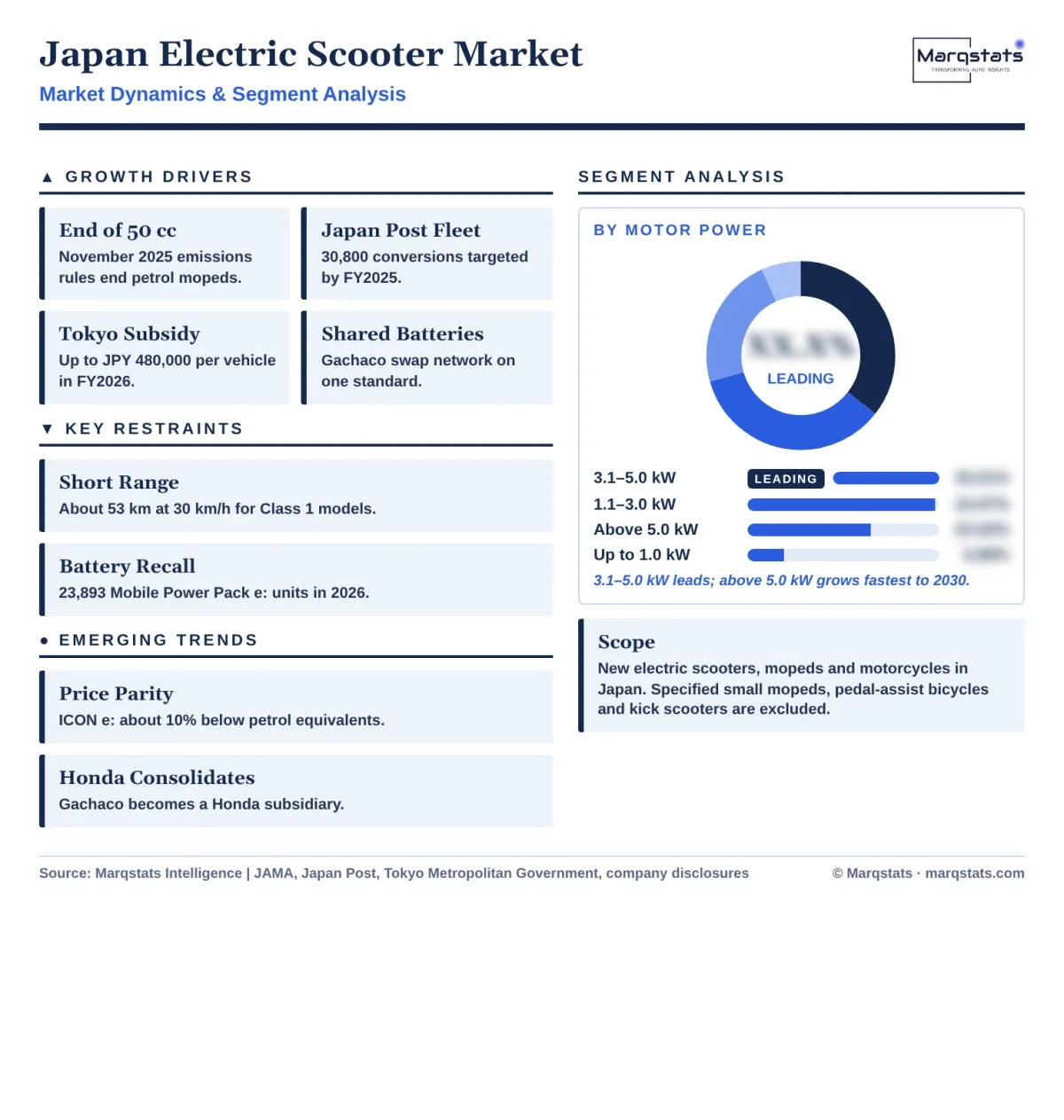
The 3.1–5.0 kW band is the dominant segment and covers delivery and commuter scooters. It accounts for 3,196 units in 2025, 35.51% of the total, and reaches 9,301 units by 2030 at a 23.82% CAGR, taking 36.76% of the market. Fleet delivery models and Class 2 commuter scooters sit in this band.
The 1.1–3.0 kW band covers Class 1 electric mopeds by peak output. It accounts for 3,147 units in 2025, 34.97% of the total, and reaches 8,218 units by 2030 at a 21.16% CAGR, taking 32.48% of the market. The EM1 e:, ICON e: and JOG E, with peak outputs of about 1.7 kW, compete here with new-standard petrol mopeds.
The above-5.0 kW band is the fastest-growing segment. It accounts for 2,038 units in 2025, 22.64% of the total, and reaches 6,281 units by 2030 at a 25.25% CAGR, taking 24.82% of the market. Honda's CUV e: at 6 kW and WN7 at 18 kW, BMW's CE 04 and premium imports sit in this band.
The up-to-1.0 kW band covers low-power mopeds by peak output. It accounts for 619 units in 2025, 6.88% of the total, and reaches 1,502 units by 2030 at a 19.40% CAGR, taking 5.94% of the market. Specified small mopeds limited to 0.60 kW and 20 km/h are excluded from the market and compete with this band.
Fleet and commercial buyers, led by Japan Post, account for most of the market today, with about 7,000 planned conversions in FY2025, roughly 77.78% of 2025 volume. Delivery, police and municipal fleets buy higher-power models with two batteries and service contracts. Japan Post's cumulative conversions rose from about 9,300 in FY2019 to FY2022 to about 23,800 by March 2025, so fleet demand has averaged several thousand vehicles a year.
Private riders are the growth segment from 2026, as 50 cc petrol mopeds disappear and electric Class 1 mopeds undercut new-standard petrol models on price. Tokyo's subsidy of up to JPY 480,000 and the national CEV grant support retail demand.
By Geography
Tokyo Metropolitan Area
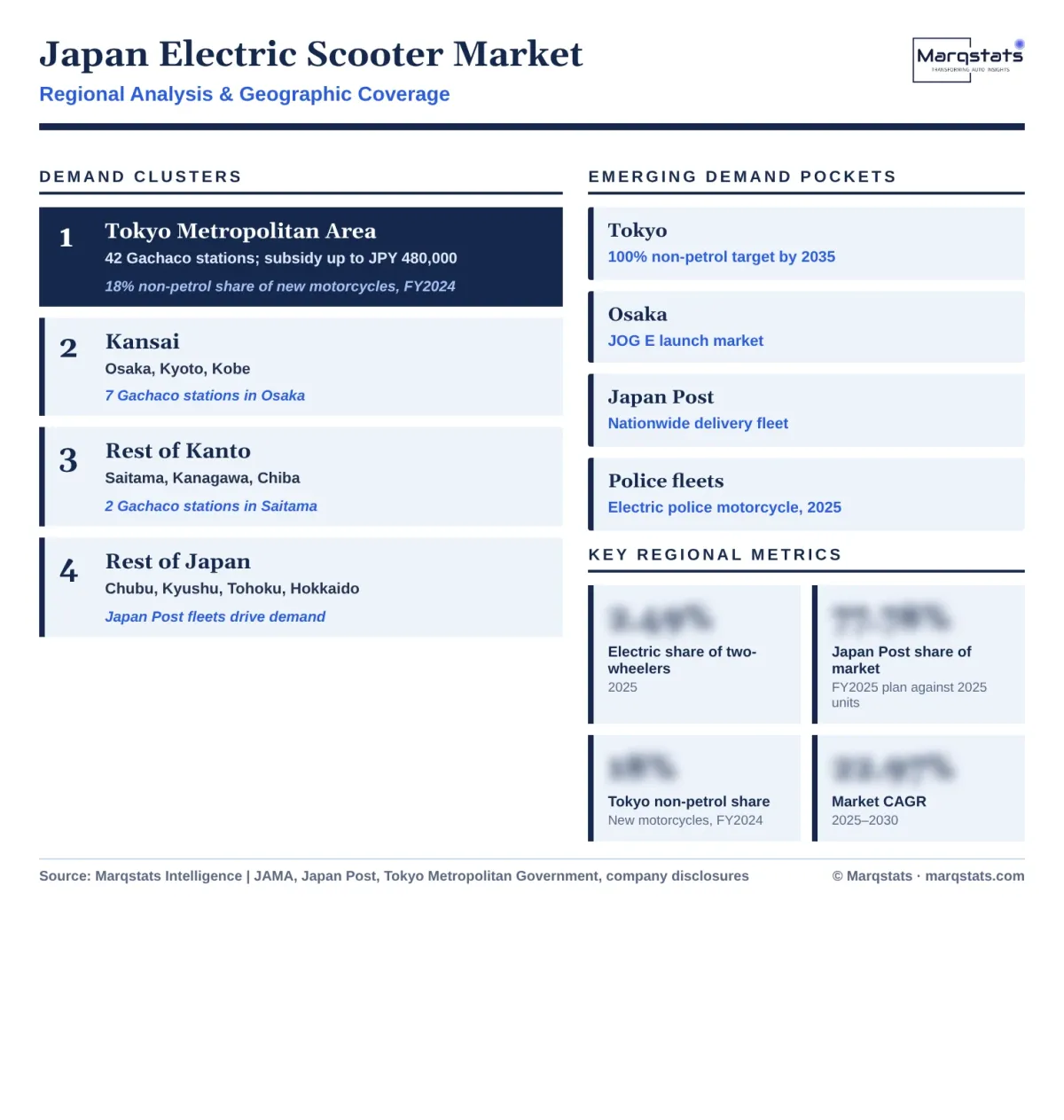
Tokyo is the largest and most advanced cluster, with 42 Gachaco swap stations, the country's most generous subsidy of up to JPY 480,000 and an 18% non-petrol share of new motorcycle sales in FY2024. The metropolitan government targets a 100% non-petrol share by 2035, and Tokyo unveiled a Japan-made electric police motorcycle for the Hakone Ekiden in December 2025.
Kansai
Osaka, Kyoto and Kobe form the second cluster, with 7 Gachaco stations in Osaka and Yamaha's JOG E launch dealers. Dense cities with short commutes suit Class 1 electric mopeds. Kyoto's controls on shared electric scooters along the Kamo River from June 2026 show that cities in the region are tightening rules on unregistered micro-mobility, which separates it more clearly from licensed electric mopeds.
Rest of Kanto
Saitama, Kanagawa and Chiba add commuter demand around Tokyo, and Gachaco operates 2 stations in Saitama. Buyers outside central Tokyo rely more on home charging of removable batteries.
Rest of Japan
Chubu, Kyushu, Tohoku and Hokkaido form a large, lower-density market where Japan Post fleets drive most electric demand. Longer trips and colder winters slow private adoption, and petrol scooters remain dominant. Japan Post's nationwide delivery network means that fleet electric scooters reach every prefecture, even where private buyers have no local electric dealer or swap station.
How Competition Is Evolving
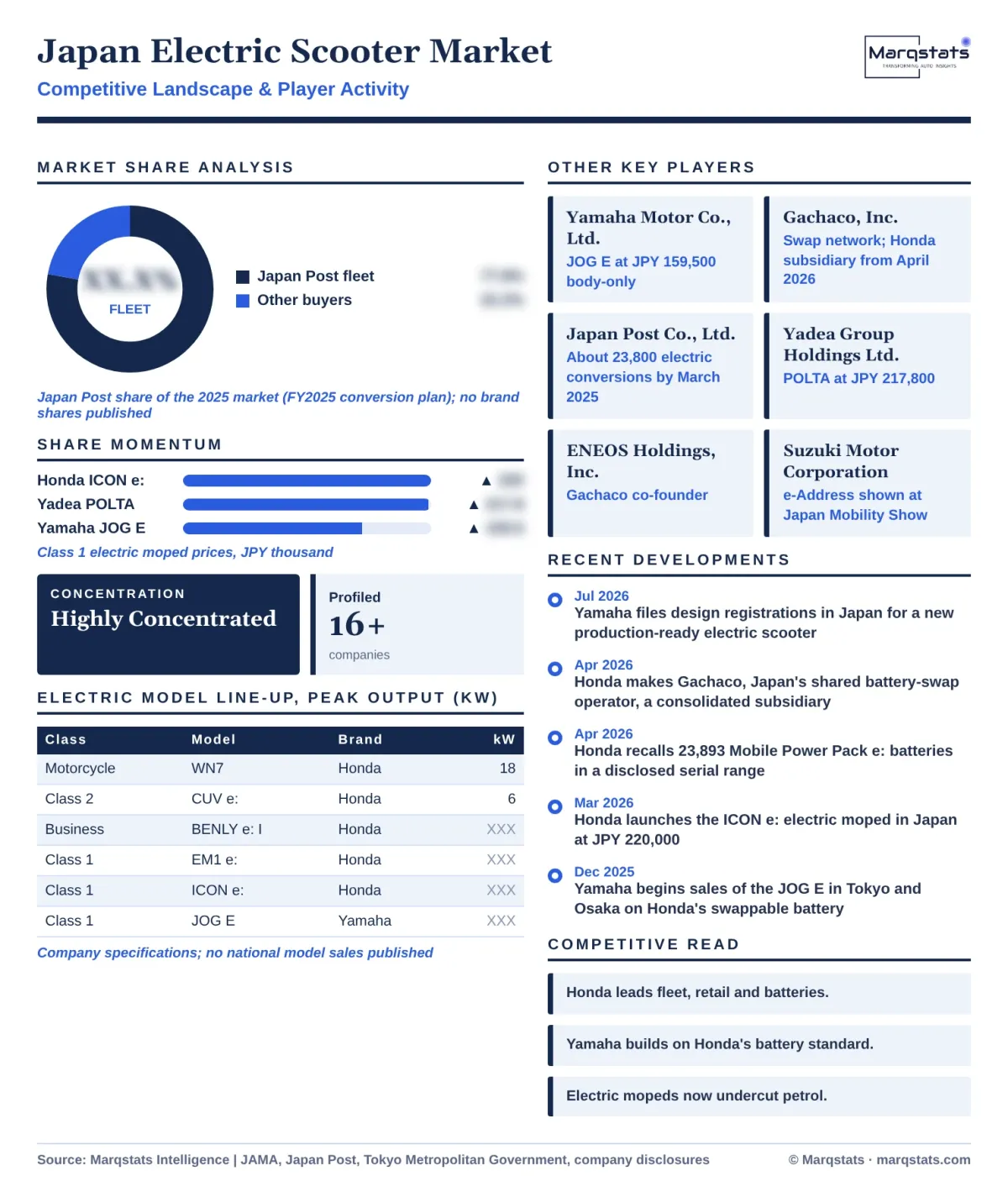
The market is highly concentrated. Honda Motor Co., Ltd. supplies most of Japan Post's electric fleet with about 20,000 MD e: and BENLY e: postal bikes, sells the EM1 e:, CUV e: and ICON e: at retail and owns the Gachaco swap network, while Yamaha Motor Co., Ltd. sells the JOG E on Honda's battery standard. No national electric registration series by brand is published, so market shares are not stated.
Japanese makers cooperate on infrastructure and compete on vehicles. Gachaco, Inc. was formed by ENEOS Holdings, Inc., Honda, Yamaha, Suzuki Motor Corporation and Kawasaki Motors, Ltd., and all four makers adopted the Mobile Power Pack e: as the common swappable battery. Kawasaki has said it will not build new-standard moped models, and Suzuki's e-Address remains a show model in Japan, so Honda and Yamaha lead the retail moped transition.
Product pricing shows the competitive tiers. Yamaha's JOG E at JPY 159,500 body-only, before battery fees, is the lowest-priced of the three main Class 1 models, followed by the Yadea POLTA at JPY 217,800 and Honda's ICON e: at JPY 220,000 including the battery. The CUV e: sits in the Class 2 commuter tier with two batteries, and the WN7 with a 9.3 kWh battery and 18 kW motor sets the premium benchmark. Honda therefore competes in every tier, while rivals hold one or two.
Imports compete at both ends of the market. Yadea Group Holdings Ltd.'s POLTA at JPY 217,800 competes in Class 1 mopeds, while Bayerische Motoren Werke AG, Zero Motorcycles, Inc., LiveWire Group, Inc. and Piaggio & C. S.p.A. with the Vespa Elettrica sell premium electric scooters and motorcycles to enthusiasts. Terra Motors Corporation and Niu Technologies serve smaller niches.
The competitive question to 2030 is whether Honda's integrated model locks in the market. Honda controls the battery standard, the swap network, the largest fleet customer and the widest model range, and other brands must either adopt its battery or build their own charging. Yamaha's July 2026 design filings for a new electric scooter show that the second-largest maker intends to expand its range on the same platform.
Companies Covered
Companies covered in the report include:
Recent Market Activity
Table of Contents
Coverage & Segmentation
The Japan electric scooter market comprises new battery electric scooters, mopeds and motorcycles sold for road use in Japan, sized in units and in USD at retail selling prices. The market is segmented by motor power into four bands (up to 1.0 kW, 1.1–3.0 kW, 3.1–5.0 kW and above 5.0 kW) and by end use into fleet and commercial buyers and private riders. Regional analysis covers the Tokyo metropolitan area, Kansai, the rest of Kanto and the rest of Japan.
The base year is 2025, the historical period is 2021–2025 and the forecast period is 2026–2030. Pedal-assist bicycles, specified small mopeds, stand-up kick scooters, used vehicles and petrol motorcycles are excluded. No national series isolates electric two-wheeler sales, and JAMA totals combine moped shipments and motorcycle registrations across powertrains, so the market size is a Marqstats construction from fleet, company and industry data. Japan Post figures are approximate fleet conversions, not sales, and include some three-wheelers in FY2024, OEM sales plans are not actual sales, and brand shares and regional splits are not available from official data. Company-stated fleet totals are as reported and not independently verified.